
1
Introduction
BACKGROUND AND OBJECTIVES
This report discusses modeling and simulation (M&S) as a foundation technology for many developments that will be central to the Department of the Navy and Department of Defense (DOD) over the next 3 to 4 decades. As discussed in the preface, the report is part of a larger National Research Council study, Technology for the United States Navy and Marine Corps, 2000-2035: Becoming a 21st-Century Force. The study's Panel on Modeling and Simulation was asked to assume a cross-cutting role and, specifically, to address issues of model quality and validity —a matter of growing concern as the Department of the Navy and DOD become increasingly dependent on M&S for activities as diverse as training, acquisition, and operations planning.
Terms of Reference
The terms of reference (TOR) for the overall study made the following request: 1
[T]he review should place emphasis on surveying present and emerging technical opportunities to advance Navy and Marine Corps capabilities. . . . [T]he review should include key military and civilian technologies that can affect Navy and Marine Corps future operations. This technical assessment should evaluate which science and technology research must be maintained in naval
|
1 |
Letter from Admiral J.M. Boorda, USN, Chief of Naval Operations, to Dr. Bruce Alberts, President of the National Academy of Sciences, November 28, 1995. See Appendix A . |
research laboratories as core requirements versus what research commercial industry can be relied upon to develop.
More specifically with respect to M&S, the TOR stated:
The study should review the overall architecture of models and simulation in the DoD (DoN, JCS, and OSD), the ability of models to represent real world situations, and their merits as tools upon which to make technical and force composition decisions.
Defining the Scope of Work
The panel interpreted its charge in light of other developments and judgments about what it could most usefully accomplish consistent with the spirit of the request. The panel concluded that recent documents provide a reasonable architecture-level survey of DOD's M&S, as well as a vision statement. In particular, OSD's Defense Modeling and Simulation Office (DMSO) has developed a substantial Master Plan for M&S, the purpose of which is to establish a common technical framework for DOD's M&S. 2 This involves establishing a common high-level simulation architecture (HLA), conceptual models of the mission space (CMMS), and data standards —items that the panel will discuss later in more detail.
Figure 1.1 , adapted liberally from the Master Plan (DMSO, 1996d), indicates the breadth of DOD's M&S. Figure 1.1 highlights several facts. First, M&S is accomplished at many levels ranging from engineering subsystems up to full-scale wars. This report deals largely with higher level issues shaded in Figure 1.1 . Second, M&S is a key element of work in distinct functional areas—notably training, acquisition, and operations planning. Third, there is M&S for each of the components of military capability, that is, ground forces, naval forces, and aerospace forces. 3 And, as indicated at the left side, there are other dimensions that might have been highlighted: the size and resolution of the M&S, the nature and degree of human participation, and so on.
Given this existing material, the panel chose to focus more narrowly on key issues that have previously gotten insufficient attention. The objectives, then, were as follows:
-
Clarifying why senior levels of the Department of the Navy should care and be concerned about the substantive content and comprehensibility of M&S.
|
2 |
See DMSO (1995a), Kaminski (1996), and other materials—both formal and informal—available from the DMSO or the DMSO's World Wide Web site at http://www.dmso.mil . |
|
3 |
The Master Plan's figure is somewhat different. It shows the three functional areas as training, analysis, and acquisition. It also focuses on the sponsoring component of models rather than the domain they cover. |
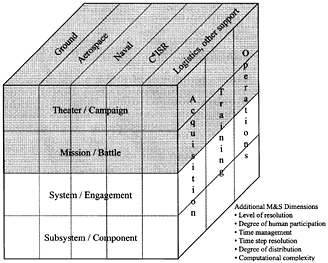
FIGURE 1.1 The scope of DOD's M&S activities. SOURCE: Adapted from Defense Modeling and Simulation Office (1996d), Figure 2-1 .
-
Assessing what the Department of the Navy (and DOD) may need to do in order to benefit fully from the opportunities presented by M& S technology.
-
Clarifying what M&S can and cannot be expected to accomplish in aiding decisions on technical, force-composition, and operations planning issues.
-
Establishing what priorities should be for M&S-related research.
The panel also made no attempt to conduct a full survey of Department of the Navy-relevant M&S, given the enormity of the subject. Much of the report deals with large-scale joint models such as those used in campaign planning, the evaluation of systems and new doctrinal concepts, or joint training, for example, M&S such as the JWARS and JSIMS systems now under development. It has less to say about engineering-or engagement-level models. Examples also tend to focus on naval forces.
REASONS FOR THE DEPARTMENT OF THE NAVY TO BE INTERESTED IN AND CONCERNED ABOUT M&S
Top-level Reasons
With this background of definitions and distinctions, let us next ask why the leadership of the Navy and Marine Corps should be more than routinely interested in M&S. While M&S is already used throughout the Navy Department, this is not a good enough reason to justify special high-level attention. The reasons for interest, however, are several. They relate to
-
Success of next-century naval-force visions (see, e.g., Johnson and Libicki, 1996);
-
The size of the investment in M&S and the potential for saving money and improving effectiveness;
-
Relationship between M&S prowess and Service competitiveness; and
-
Obstacles to success in M&S, including problems of model quality and validity.
M&S as a Critical Factor
The panel's first observation is that the visions painted by the other panels of the larger study, Technology for the United States Navy and Marine Corps, 2000-2035: Becoming a 21st-Century Force, depend on extraordinary advances in M&S in the several domains. As one example, simulation-based acquisition (SBA) can bring about revolutionary changes in ship- and weapon-system development. 4 At the other end of the story, M&S will be an integral part of the command-and-control system that commanders use to develop and test operations plans, and to conduct mission rehearsals before going into battle. It will be an integral part of adaptive planning during campaigns—especially in the longer term when military adversaries become considerably more capable than they are today. If phrases like dominant battlefield knowledge (as distinct from a more static situational awareness) mean anything, they mean that future commanders will be able to project and predict (with an understanding of probabilities) and therefore adapt quickly and decisively. 5
Economic Issues
A second reason for interest is economic. The Department of the Navy (and DOD) is investing large sums to develop aspects of M&S. The proper infrastructure creating interoperability and reusability of model components and data should lead to large dollar savings. However, there is no guarantee that this will occur or that naval forces will be adequately represented. Thus, the Department of the Navy has an interest in active participation and leadership with respect to M&S activities.
M&S and the Department of the Navy Competitiveness
A third reason is another practical one: the Navy's competitiveness in relation to the other Services will depend on the expertise that it develops in M&S.
|
4 |
This was emphasized in a report of the Naval Research Advisory Committee (1994). |
|
5 |
For discussion of troublesome future adversaries, see Defense Science Board (1995). For discussion of information dominance, see, e.g., Johnson and Libicki (1996). |
The latter will be so important to future joint operations that the Services having the best expertise and systems may have the competitive edge for roles and missions (e.g., command and control for a joint task force or theater missile defense), leadership positions generally, and budget share. The converse is also true: if the Department of the Navy is not sufficiently expert—and, even if it is, if it is not sufficiently “connected” to the joint-simulation world—then it should expect to suffer in the competition for budget shares.
Potential Roadblocks
This said, there are many potential roadblocks to success of M&S in the Department of the Navy (and DOD). The advances will not occur naturally, except in domains where the commercial sector is driving progress. For example, one can hardly expect the commercial sector to develop decision-support systems for commanders to use in war, with all the associated complexities, dynamics, competitive and lethal processes, and fog. Nor can one expect productivity enhancing and cost-cutting successes in the commercial world to automatically be assimilated into government organizations: generational changes of technology and reengineering are often painful. They do not happen without top-down insistence and direction, although successful implementation often depends critically on bottom-up innovations and enthusiasms from the winners in the Darwinian struggle for survival.
GETTING STARTED: SOME DEFINITIONS AND DISTINCTIONS
Definitions
Models Versus Simulations
Discussion of M&S is complicated by terminological ambiguity. “Model” and “simulation” are often used interchangeably. In other contexts, they are distinguished, but in several different and confusing ways. Although the DMSO has issued official definitions (DMSO, 1995b), the ambiguities are long-standing and will not go away.
In this report, the panel generally uses “model” to refer to a conceptual representation of some part of the real world, perhaps something expressed in equations, diagrams, or a verbal description. Some models generate descriptions of how the system of interest or aspects thereof change over time; these are called simulation models. If such models are implemented in a computer program or human exercise, we refer to the implementations as simulation programs or, simply, simulations. In day-to-day usage, these are often referred to as models, but the panel reserves the term model for what might more fully be termed “conceptual model.”
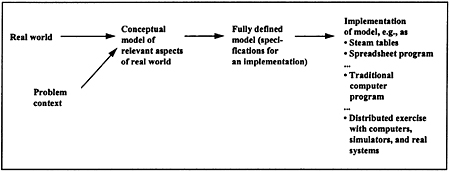
FIGURE 1.2 The real world, model, and implementation.
The phrase modeling and simulation (M&S) blurs “model” and “simulation” and, as commonly used, conveys the sense that M&S consists of computer programs or simulators such as those used to train pilots or for military exercises. However, it is important to remember that not all models are implemented as computer programs ( Figure 1.2 ) and not all models are simulations ( Figure 1.3 ). The first distinction is significant when talking about M&S quality, because the problems may be in the software, the ideas and designs underlying the software, or the absence of any models beyond the computer code itself. The second distinction is important because a sound approach to the problems associated with M&S should include nonsimulation models.
Having made these definitions and distinctions, the panel must now acknowledge that it also uses the term “simulation” to mean something altogether
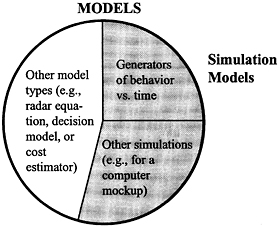
FIGURE 1.3 Types of models.
different. In particular, the panel refers to the important new activity of simulation-based acquisition. In this context, “simulation ” refers to the computerized representation of something like an aircraft or ship being developed in a paperless environment—even though the representation may be purely static. 6
Models Versus Data
Finally, there is the confusion between “model” and “data.” In practice it is often not useful to emphasize the distinction, because modern well-designed M&S puts much of the content in data, providing users flexibility to change assumptions. Thus, results of a simulation are dictated at least as much by input data as by the computer program. 7 Indeed, in some cases, to change “data” is to change the form of algorithms used within the simulation. In this report, the panel treats data as part of an M&S except in a few instances where it discusses data problems per se.
Different Conceptions of Models
The next difficulty is that people have different intuitive conceptions of what models and simulations are supposed to be. At one pole of one spectrum (x-axis in Figure 1.4 ) are those who see models as highly flexible, constantly changing tools for use in analysis (or training). On the other pole of this spectrum are those who see models as a well-defined commodity that one should be able to procure with a warranty and use without much skill or effort.
A different spectrum (y-axis of Figure 1.4 ) separates those who see models as mere tools from those who see them as repositories for knowledge and mechanisms for transmitting knowledge. To the former, large complex models are an abomination because they are so difficult to comprehend and control and because they get in the way of making important points economically. To the latter, large complex models (typically implemented as simulations) embody rich depictions of important phenomena that could not readily be described in other ways: the language of mathematical equations does not go far in describing complex real-world systems transparently, much less describing or communicating their behaviors to new workers or clients.
|
6 |
In other domains, “simulations” refer to such distinct things as forged documents, reenactments of historical events, play-acting of a possible negotiation, and so on. What is consistent across these diverse meanings, however, is that in all cases there is an attempt to reproduce some image, sound, or feel of a real system. By contrast, one never refers to Maxwell's equations as simulating electromagnetic phenomena. Nor is any closed-form equation defining the required characteristics of a system referred to as a simulation. |
|
7 |
That data are typically one of the primary limiting factors is discussed in Hillestad et al. (1996). |
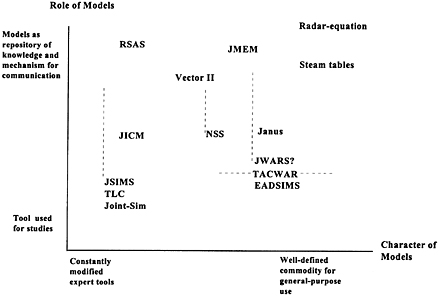
FIGURE 1.4 Different perceived roles for M&S. Dashed lines indicate ambiguity of location.
Both views have much to recommend them: they are not intended as strawmen. But given these differences, is it any wonder that there are strong and sometimes emotional tensions among individuals and groups involved in one way or another with M&S? By and large, analysts resent those who seem to see models as simple commodities (especially when the impression is given that they can be operated by relatively unskilled workers), while managers often find the views of analysts bizarre since it seems obvious to them that in fact M&S is several “systems” that need to be designed, tested, procured, and maintained and that can benefit from standards. On balance, the panel believes that virtue lies in recognizing that models serve as both tools and repositories of knowledge. This leads to conflict. However, to the extent that “big models” become less monolithic and more like environments in which to assemble tools for particular problems, the views can to some extent merge. That would be a healthy development.
Hard Versus Soft Models
Another distinction is that between “hard” and “soft” models, the former represented by, say, the engineering models used in fluid flow or sonar calculations, and the latter represented narrowly by decision models representing the adversary commander's behavior or more broadly by models dealing with individual and social behaviors. Except in Isaac Asimov's science fiction, and even then only in the aggregate over long periods of time, does anyone aspire to the
building of highly predictive social models? In the military domain, we all recognize that commanders' temperaments and life experiences matter, and that some units are much more motivated and capable than others. It is also known that special factors matter, such as deception and surprise, but also including random events such as the accidental detection or nondetection of an approaching attack such as that falling upon Pearl Harbor in December 1941.
Clearly, those involved with the different classes of models (hard versus soft) will have difficulties communicating on what can reasonably be demanded in M&S. Perversely, there has been a chronic tendency for DOD modelers and analysts to avoid representing or considering “soft factors” despite the fact that history tells us they are often dominant. This disjunction between model and reality has long undercut the credibility of most combat models with warriors, historians, and analysts willing to recognize soft factors and uncertainty. 8 It is one reason that higher-level M&S, such as campaign simulations, has seldom been of much interest to senior naval officers.
Although the methodological tensions between physical scientists and social scientists have long been recognized by interdisciplinary workers, it is less well recognized that similar tensions exist within the “hard” domain of engineering. In control theory, for example, many workers focus on near-equilibrium phenomena and on designing systems that are highly robust to large uncertainties in the environment. In this context, nonlinearities are often viewed as just another source of uncertainty. In dynamical systems work, there is a much richer view of nonlinearities and nonequilibrium phenomena, but a tendency to avoid dealing with the large uncertainties that occur in many practical engineering problems. The two viewpoints emphasize different issues and are relevant to different problems. Not surprisingly, the most exciting research directions in both control and dynamical systems involve problems with both large uncertainties and nonlinear, nonequilibrium behavior. 9
Figure 1.4 makes the point—albeit with examples that are strongly open to question—that the various DOD M&S models have been developed with very different notions about what functions they are to serve. This makes generalized discussion of M&S difficult. Consider first models such as the radar equation and steam tables. These represent considerable scientific knowledge, but in a form that many can use readily. So also the joint munitions effectiveness manual (JMEM) records numerous specialized weapon-effect models for broad usage. By contrast, the JSIMS program is focusing on building a “tool kit” that can be used to construct appropriate training exercises. And, while it is assumed that
|
8 |
Interested readers should consult Dupuy (1987), Davis and Blumenthal (1991), and Rowland et al. (1996). |
|
9 |
See Doyle, John, “Theory in Modeling and Simulation,” unpublished, November 1996. Prepared for the panel, but based on material available at http://hot.caltech.edu and Appendix B of this report. |
there will be a repository of suitable objects representing knowledge, the JSIMS program is not really organized to develop that knowledge, except for standard cases. The image conveyed is of software development, which needs databases filled out but has no particular interest in the knowledge per se. This may prove unfair, however, and current work on object models is certainly a connection to model content, so a dashed line indicates that how JSIMS ends up is yet to be determined.
In yet another contrast, mature models such as Vector II have long been seen as a repository of detailed information about forces, equipment, tactics, and terrain. The RAND Strategy Assessment System (RSAS) was also developed with knowledge acquisition strongly in mind. The JWARS program is harder to characterize. The program itself has a distinct “software” flavor, but there has to date been much less emphasis on flexibility than is visible in the JSIMS effort. Again, a dashed line is shown. Just to make another point, a dashed line is attached to TACWAR. While the original developer (the Institute for Defense Analyses) continues to modify TACWAR for particular studies and thus sees it as a tool, albeit a difficult tool to change, some of TACWAR 's users appear to see it more as a fixed, configuration-controlled commodity. Rather generally, complex-model developers with whom panel members are familiar express considerable worry about misuses of their creations, which they hesitate to think of as “products” in the normal sense.
STRUCTURE OF THIS REPORT
With this background, the report proceeds as follows. Chapter 2 surveys the potential of DOD's M&S briefly, painting a very rosy future. Chapter 3 describes reasons for worry, primarily reasons related to model validity and system complexity. It concludes that a good deal of research is needed and that failure to invest adequately in such research could lead to major M&S failures. Chapter 4 elaborates on what the panel means by model quality and validity. Chapter 5 describes an important class of research that should be organized around warfare areas rather than M&S per se. Chapter 6 describes needed improvements in the conceptual, methodological, and technological infrastructure for M&S. Chapter 7 deals with challenges of assimilating and exploiting M&S technology. A collection of appendixes is intended to elaborate on and provide reference for points made in the report.


