
E
Hydroacoustics
This appendix is intended to provide the nonexpert reader with a basic understanding of sound propagation in the ocean.
THE SOFAR CHANNEL
The ocean is a remarkably efficient medium for sound propagation, due largely to the existence of the deep sound or SOFAR (SOund Fixing and Ranging) channel. The channel is characterized by a minimum in the vertical sound speed profile, which occurs at about 1.5 km depth near the equator and gradually rises to shallower depths as one progresses in either direction toward the poles, until the minimum reaches the surface in the Arctic and Antarctic Oceans. Sound speed increases with increasing temperature and increasing pressure (density). The sound speed minimum is a result of higher sound speed at the surface where waters are warm, gradually diminishing with depth as temperature decreases, and then beginning to increase again due to the competing effect of increasing pressure. In northern regions there is little surface heating so sound speed simply decreases with depth due to increasing pressure.
The channel forms a natural waveguide, and sound energy is refracted toward the axis of the channel and away from surface and bottom boundaries. (Figure E.1 shows a sound velocity profile [SVP] and a ray trace.) As a result, sound energy that is coupled into the channel is not attenuated by scattering that would occur if it were to strike the surface or bottom, and the only losses result from geometric spreading of the wavefield and absorption due to conversion to heat arising from viscous and ionic relaxation effects. At low frequencies, absorption losses are small, and geometric spreading accounts for most reduction in signal level.
In shallow waters or at distances from a deep water source comparable to the water depth, the wavefront expands cylindrically, and sound pressure geometric loss is proportional to 1/r. In practice, transmission losses are usually calculated more precisely by a variety of numerical solutions of the scalar wave equation.
As a consequence of the sound channel and the primarily 1/r spreading loss, relatively low-energy signals can be detected at long range. For example, 1 kg TNT explosions at SOFAR axial depths are detected easily at distances of several thousand-kilometer range. Earthquakes and seismic prospecting signals from explosives and airguns can be heard well above the background noise at such ranges.
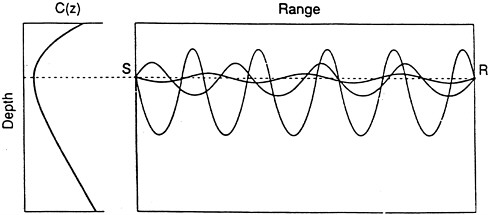
FIGURE E.1 Velocity profile (left) and ray diagram (right) for an idealized SOFAR channel showing ray paths to 700 km distance.
AMBIENT NOISE
There is a persistent level of background noise in the ocean that arises as a result of both manmade and natural processes. At the lowest frequencies (<<10 Hz) the sources of noise include seismicity, ocean turbulence, volcanism, the non-linear interaction of gravity waves (swell), and shallow water gravity waves. In the spectral region between 10 and 100 Hz the noise field is dominated by worldwide ocean shipping and by wind-driven breaking waves. These higher-frequency sources create a more or less continuous red noise spectrum, high at the lowest frequencies and decreasing at 8 to 10 dB per octave up to about 20 Hz, where the spectrum flattens somewhat due to the influence of shipping noise. Rising above this spectral background are distinct noises such as vocalizations by marine animals (whale sounds can be as loud as ships), lightning striking the sea surface (which generates locally sharp sound impulses), and sounds generated by oil and gas prospecting and drilling operations. Hydrocarbon exploration often involves the use of explosive charges or explosive-like signals generated by airgun arrays.
The noise field produces two main monitoring challenges. First, signals from nuclear explosions must be detected against the background noise in which they are embedded. Second, nuclear explosions must be distinguished from noise impulses due to other types of explosions or explosive-like signals.
UNDERWATER EXPLOSIVE SOURCES
Underwater chemical explosions have been studied intensively since World War II, and their characteristics are well understood and accurately modeled. These form a major source of information for monitoring underwater nuclear explosions because of the lack of data from such explosions.
When an explosion occurs at depth, the pressure in the water nearby is so great that the wave velocity becomes a function of pressure and a steep-wavefront, nonlinear shock wave is developed. The shock wave travels radially outward, gradually diminishing in amplitude and entering the linear propagation regime where the wave velocity is constant. For a 1 kt underwater nuclear explosion, the transition from nonlinear to linear propagation occurs at about 10 km.
Hot gases resulting from the explosion are contained by hydrostatic pressure within a bubble, which expands rapidly. As the bubble expands, the pressure inside decreases. The momentum of the
velocity becomes a function of pressure and a steep-wavefront, nonlinear shock wave is developed. The shock wave travels radially outward, gradually diminishing in amplitude and entering the linear propagation regime where the wave velocity is constant. For a 1 kt underwater nuclear explosion, the transition from nonlinear to linear propagation occurs at about 10 km.
Hot gases resulting from the explosion are contained by hydrostatic pressure within a bubble, which expands rapidly. As the bubble expands, the pressure inside decreases. The momentum of the water continues the expansion of the bubble beyond the point at which the internal pressure falls below the external hydrostatic pressure, and the bubble contracts, thereby compressing the gas until its pressure is sufficient to halt the motion of the water, whereupon the cycle repeats, each time with diminished intensity. The oscillating bubble generates a series of pressure pulses, called bubble pulses, which are characteristic of deep underwater explosions. Under ideal conditions it is possible to observe numerous bubble pulse oscillations. Note, however, that long range transmission losses at low frequencies are variable and they can have a major impact on the potential of the bubble pulse as a discriminant. If the explosion is shallow, the bubble vents directly into the atmosphere, and no bubble pulse signature is observed. If the explosion is located above the surface the amount of sound energy coupled into the water is orders of magnitude less than an underwater explosion and again there is no bubble pulse. A 1 kt explosion well coupled to the sound channel (detonated, for example, at 1000 m depth) generates a sound pressure level between 300–310 dB relative to 1 µPa at 1 m (depending upon the depth) and has a bubble pulse period of 0.7 second. A modern airgun array used for seismic exploration can have a sound pressure level of 264–270 dB relative to 1 µPa at 1 m (depending upon volume and pressure of the airgun array) and no discernible bubble pulse.
INTERNATIONAL MONITORING SYSTEM HYDROACOUSTIC SIGNAL LEVELS
A signal-to-noise ratio of about 10 dB is usually required to ensure robust detection. With a source level of 280 dB (1 kiloton [kt] explosion at depth), a background 10 Hz noise field of 80 dB (heavy shipping), and a signal integration time of only a few seconds, this signal will remain 50 dB or more above the background noise at global ranges and can be detected easily and distinguished from other sources. However, there are regions in which it may be blocked by bathymetry or attenuated by scattering that arises, for example, from upward refraction in a shoaling sound channel in Arctic waters and scattering from the sea surface and bottom.
A 1 kt explosion detonated 1 km above the sea surface has a calculated source level at the sound channel axis that is 35 dB less, comparable to the intensity of an airgun array. Its intensity at an IMS hydroacoustic sensor can easily be less than the background noise or comparable in level to earthquakes and airguns.


