
Overview
The role of light in our lives is both pervasive and primordial. Ultraviolet light probably had a role in the very origins of life, and light-driven photosynthesis underlies all but the most primitive of living things today. For humans, sight is the most crucial of the senses for perceiving the world around us. Indeed, the highly evolved vertebrate eye is one of the most exquisite light detectors ever created. Yet light is influencing the way we live today in ways we could never have imagined just a few decades ago. As we move into the next century, light will play an even more critical role—often the central role—in the ways we communicate, in the practice of medicine, in providing for the nation's defense, and in the tools we use to explore the frontiers of science. Optical science and engineering—or, more conveniently, just optics—is the diverse body of technologies, together with their scientific underpinnings, that seek to harness light for these and other tasks. This report addresses a broad range of issues pertinent to this field: its status today, the outlook for tomorrow, and what must be done to ensure its future vitality.
In a broad sense, optics has a long history. Mirrors were already in use thousands of years ago. By the early seventeenth century, lenses were being ground for microscopes and telescopes, and in 1704, Isaac Newton published his classic text Opticks, which set down the fundamental principles of reflection and refraction. Yet optics is also a thoroughly modern field, a young and vital one whose character has been revolutionized by technological advances over the last few decades.
The development of the first laser in 1960 produced a kind of light never before seen on Earth—light with the property of coherence. This coherence permits light to be directed, focused, and propagated in new ways impossible for incoherent light. Laser light has thus made possible
|
OPTICS DEFINED Optics is the field of science and engineering encompassing the physical phenomena and technologies associated with the generation, transmission, manipulation, detection, and utilization of light. |
fiber-optic communications, compact disks, laser surgery of the retina, and laser welding. Other developments in optics have perhaps been less obvious, but their impact can be equally well seen in the commodities and conveniences of our world. Examples include optical lithography systems for making computer chips, high-resolution microscopes, adaptive optics for ground-based astronomy, infrared sensors for a multitude of applications, and highly efficient lighting sources. The sidebar on page 7 suggests some of the ways in which these and other optical technologies affect our everyday lives.
Optics: A Pervasive Enabler
Not surprisingly, then, optics is rapidly becoming an important focus for new businesses in the global economy. In the United States, both large and small businesses are significant players in emerging optics business activity. Optics-related companies number more than 5,000, and their net financial impact amounts to more than $50 billion annually. More significant than this, however, is the role of optics as an enabler. Just as a lens in a pair of glasses enables clear vision, so an investment of a few hundred million dollars in optical-fiber technology has enabled a trillion-dollar worldwide communications revolution. A mere six laser transmitters are used in a transatlantic undersea telephone transmission system that can carry 40 million simultaneous conversations. The cost of the lasers is a tiny fraction of the cost of the system or the revenue it generates, but without them the system would be useless. Indeed, in his report to Congress on July 22, 1997, Federal Reserve chairman Alan Greenspan alluded to this enabling role: "We may be observing ... a number of key technologies, some even mature, finally interacting to create significant new opportunities for value creation. For example, the applications for the laser were modest until the later development of fiber optics engendered a revolution in telecommunications."
As another instance, a compact disk player incorporates hundreds of intricate electronic and mechanical parts, all working together and all absolutely dependent on a single laser costing less than a dollar to illuminate the spinning disk. The following pages contain dozens of additional examples. Often, perhaps even usually, those who developed the enabling optical technologies never imagined their ultimate applications. In this report, the committee has thus sought to address the pivotal question, How does one support and strengthen a field such as optics whose value is primarily enabling?
The remarkable breadth of optics' enabling role is both an indicator of the field's importance and a source of challenges. Virtually every
|
ILLUMINATING OUR DAILY LIVES Optics has a pervasive impact on our daily lives, but that impact is rarely noticed because the products of optical technology are, ironically, often invisible and because we accommodate so swiftly to modern technology. Today we pay as little attention to infrared remote controls, light-emitting diodes, and laser printers as to the mirrors that have been with us since antiquity. Here is a brief story to remind us of some of these pervasive optical technologies.
|
scientific discipline uses optics in some way, so (perhaps unsurprisingly) optics courses in most universities are taught in several science departments, as well as engineering departments and schools of medicine. As a result of such organizational structures as these—in spite of, or perhaps because of, its pervasive importance—optics tends to be an orphan, owned by no one. A second, related question thus emerges: How does one nurture a field that lacks a recognized academic or disciplinary home?
Optics is thus an invaluable means, rarely an end in itself—a field often seamlessly integrated with electronics and materials science (see inset below) and an enabling presence in the university research lab, in our daily lives, and in countless businesses. In the diversity and pervasiveness of optics lies great strength, but these same qualities similarly pose a daunting hurdle to concise assessments and simple prescriptions. The central challenge of this study was to overcome that hurdle in providing a coherent picture of optical science and engineering today and in pointing the way to the field's continuing vitality.
Optics encompasses a broad set of technologies and techniques for exploiting the properties of light, and as suggested earlier, its applications are to be found everywhere. As a consequence, this report cannot hope to be comprehensive. The intent of the committee has been to highlight those areas in which breakthroughs are taking place, in which
|
MATERIALS: AN ENABLER FOR OPTICS Just as optics has enabled scientific advances in diverse disciplines and spawned entire industries, so advances in materials science and engineering have enabled many of the advances in optics described in this report. Many of the devices and systems of modern optics are based largely on classical optical principles that could be fully exploited only after the discovery of new materials and the invention of efficient processes for bringing these new developments to the factory and the marketplace. In the 1870s, Alexander Graham Bell patented the "photo phone," which allowed a conversation to be transmitted through the atmosphere by a beam of light. Practical optical communications, however, awaited the discovery of a materials system capable of guiding light with negligible losses over distances of many kilometers—fiber optics. This practical development was the result of an intimate collaboration between materials and optical scientists. In other instances, new materials enabled the emergence of entirely new branches of optics. Nonlinear optical materials, such as lithium niobate and potassium niobate tantalate, and laser hosts such as yttrium aluminum garnet, were "molecularly engineered" through a synergism between optical physicists and engineers on the one hand and, on the other, solid-state chemists and materials scientists with a deep understanding of how chemical bonding and crystallographic structure determine optical properties. Understanding of the basic principles of crystal growth and phase equilibria, coupled with novel preparation techniques and factory engineering, paced the development and introduction of these new materials. In recent years, both materials science and modern optics have flourished in an atmosphere of interdisciplinary research and engineering, and together they have changed our modern world. |
rapid change is likely in the near future, and to which national needs dictate special attention. The report is organized along the lines of seven major areas of national need: (1) information technology and telecommunications; (2) health care and the life sciences; (3) optical sensing, lighting, and energy; (4) optics in manufacturing; (5) national defense; (6) manufacturing of optical components and systems; and 7) optics research and education.
Trends and Developments
To motivate the report's key recommendations and underscore the dynamic state of optics today, it is useful to look at a few critical applications in which the developments have been most dramatic and the trends point to revolutionary change in the coming years.
Information Technology and Telecommunications
The explosive growth in many areas of optical technology constitutes an optics revolution. In information technology and communications, for example, progress during the past decade has been extraordinary. Around the world, optical fiber is currently being installed at a rate of 1,000 m every second, comparable to the speed of a Mach 2 aircraft. By the year 2005, about 600,000 km of fiber-optic cable will cross the oceans, enough to encircle Earth 15 times. Just 10 years ago, only 10 percent of all transcontinental calls in the United States were carried over fiber-optic cables; today the number is 90 percent.
To suggest the ramifications of this burgeoning capability for high-data-rate communications, a vision was recently proposed for the future of information technology: the "tera era." This vision articulates the need for cost-effective networks of enormously broadened bandwidth. The rapid growth of several key information technologies promises to meet the requirements of this vision: Fiber transport capacity, computer processing power, and magnetic storage density are all advancing by factors of 100 every 10 years. This implies that today's "giga" (109) performance will improve to "tera'' (1012) performance within 15 years. Some of the elements of the tera era vision are summarized on page 10.
Central advances toward the tera era will involve optical technologies. All elements of information transport are likely to require optical fibers and lasers, including 100-gigabit-per-second access networks, 10-gigabit-per-second local area networks, and even 1 gigabit per second to the desktop. Information processing is likely to require advances in both electronics and optics to achieve tera-era rates, and information storage is likely to rely on both volume optical storage and advanced
|
THE "TERA-ERA" VISION FOR INFORMATION TECHNOLOGY IN 10 TO 15 YEARS
The tera era is a 10- to 15-year vision for the needs of the information age, as articulated by Joel Birnbaum of Hewlett-Packard in October 1996. Projections for switching and details for storage have been added. This vision demands hundredfold improvements in many central capabilities. For example, clock speeds for most information processing tasks were measured in hundreds of megahertz in 1997; to achieve the goal of the tera era, they must increase to several gigahertz by 2010. |
magnetic storage. Many capabilities will have to advance a hundredfold to achieve this vision.
With the ubiquity of broadband networks and information services, displays are also increasing in importance. Text, graphics, images, and video are the outputs of the Information Age. Historically, the workhorse of display devices has been the cathode-ray tube (CRT). CRTs are cheap, they are easy to manufacture, and they have benefited from the mass market for televisions. In 1968, however, a new kind of display was invented—the liquid crystal display (LCD). These displays are lightweight, draw little current, and are thus ideal for portable devices such as watches, small televisions, and laptop computer displays. LCDs now command a large and growing share of the display market (see figures on page 11).
Health Care and the Life Sciences
Optics has had a dramatic impact on American health care, changing the practice of medicine and surgery and offering new approaches to both therapy and diagnostics. Some fields, such as ophthalmology,
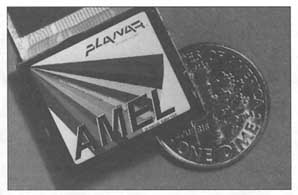
One future market expansion for displays is in flat, light, low-volume visual interfaces for personal digital assistants, Web browsers, augmented and virtual reality engines, and portable and wearable computers. The display shown here is a full-color VGA-sized device that carries nearly the information content of a personal computer monitor. (Courtesy of Planar America.)
have completely integrated lasers into clinical practice. Lasers have also enabled a number of new therapies, ranging from the treatment of kidney stones to the removal of skin lesions. Optics has also enabled the introduction of fiber-optic endoscopes, which allow convenient viewing of the body's interior and have led, in many cases, to the replacement of open surgery by such minimally invasive therapies as arthroscopic knee repairs.
Arguably, the broadest impact of optics in health care is in the fabrication of eyeglass frames, lenses, and contact lenses. In 1994 the market was estimated to be $13.2 billion, extending to 55 percent of the entire U.S. population. More important to the future of health care will be the application of a variety of more complex optical systems and techniques to a broad array of health needs. Lasers are approved by the Food and Drug Administration for refractive surgery to eliminate the need for glasses and are being used with light-activated drugs to treat cancers. Flow cytometry, an optically based diagnostic technique, is a critical tool for monitoring viral loads in AIDS patients and for guiding their therapy. Optical techniques are also under active investigation for noninvasive applications ranging from "needleless" glucose monitoring for the control of diabetes to the early detection of breast cancer.
Optical techniques are providing new tools for biology in the areas of visualization, measurement, analysis, and manipulation. Confocal laser scanning microscopy has presented us with highly detailed three-dimensional pictures of biological structures. Two-photon techniques have not only enhanced the capabilities of fluorescence microscopy but
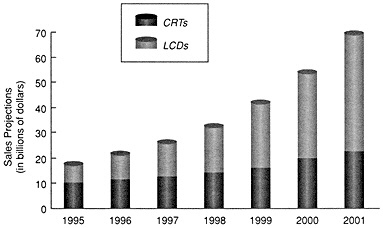
Worldwide market for electronic displays. Over the next several years, LCD sales are expected to grow rapidly.
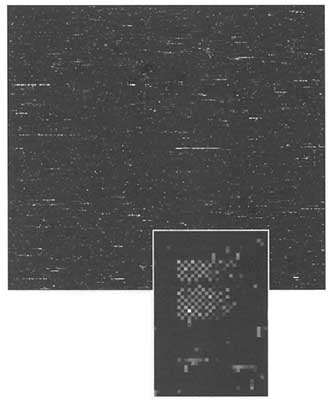
Part of a "DNA chip," showing fluorescently labelled DNA bound to an 8,000-site GeneChip®probe array. (Courtesy of Affymetrix, Inc., Santa Clara, Calif. Copyright © Affymetrix, Inc. All rights reserved. Affymetrix and GeneChip are registered trademarks used by Affymetrix, Inc.)
also opened up new possibilities for performing highly localized photochemistry within cells. Near-field techniques have enhanced resolution to beyond the diffraction limit.
In biotechnology, lasers have become essential parts of all the systems used for DNA sequencing, ranging from commercially available systems to more experimental capillary electrophoresis systems. Other applications of optics to biotechnology range from sophisticated systems using "DNA chips" (at left) to simpler systems using transmission probes.
Finally, laser tweezers are an example of the novel turns optics can take. Normal optical forces are minuscule on the scale of larger organisms, but they can be significant on the scale of macromolecules, organelles, and even whole cells. Laser tweezers thus afford an unprecedented means for manipulations at microscopic scales. They can tow a bacterium through water faster than it can swim, halt a swimming sperm cell in its track, or arrest the transport of an intracellular vesicle.
Optical Sensing, Lighting, and Energy
Advances in lighting sources and light distribution systems are poised to bring about a profound change in the way we use energy for lighting. Currently, lighting accounts for almost one-fifth of the electrical power used in the United States each year. However, recent developments in light sources now offer a dramatic new set of options. Among them are high-efficiency metal halide, sulfur-dimer, and light-emitting diode (LED) sources that can be up to 10 times as efficient as standard incandescent light bulbs.
Innovations in optical sensors have been equally dramatic. With the development of new optical and infrared sensors, it is now possible to greatly augment the normal human visual process and, in some cases, to show details and reveal information never before seen (see figure on page 13). A broad range of newly developed sensors have already taken their places in our daily lives: infrared cameras that provide satellite pictures of clouds and weather patterns for the evening news, infrared night vision scopes for use by law enforcement agencies, infrared sensors in home

Infrared thermal image of a motor and drive assembly, showing the increased heat generated in the bearing as a result of misalignment between the driveshaft and the bearing. This real-time imaging technique is used for testing motors and machinery in industrial plants while in operation and under load. (Courtesy of FLIR Systems, Inc.)
security motion detectors, and supermarket bar-code scanners.
Less apparent in our everyday lives, open-path optical sensors are beginning to have a major impact on real-time measurements of several environmental gases, as well as emissions at industrial plants, and are just beginning to find applications to on-line industrial process control. Sensitive optical-imaging cameras and spectroscopic instruments are being used to monitor green biomass (plant density), as well as the ozone hole, and similar instruments have flown aboard spacecraft to measure the composition and atmospheric makeup of Mars, Jupiter, and several comets. Recent advances in real-time atmospheric turbulence compensation techniques ("rubber mirrors") now allow ground-based telescopes to achieve optical resolutions as good as the orbiting Hubble telescope. For the future, high-resolution, optical-imaging digital cameras are poised to revolutionize and computerize the photographic and printing industries, and improvements in photovoltaic solar cells may permit renewable energy sources to provide as much as 50 percent of the world's energy needs by the middle of the next century.
Optics in Manufacturing
Apart from the more recent acceptance and growth of optics and photonics in information technology, nowhere has optics had a more dramatic economic influence than in manufacturing, particularly since the advent of reliable low-cost lasers and laser-imaging systems. Optical techniques, applied both directly to manufacturing and as process control and diagnostic tools, have become crucial in such diverse industries as semiconductor manufacturing, civil construction, and chemical production. To cite the most obvious example, every semiconductor chip mass produced in the world today is manufactured using optical lithography. Manufacturing the necessary optical processing equipment alone is a $1 billion industry, enabling in turn a $200 billion electronics business. In addition, the semiconductor industry's vitality is a powerful stimulus for research and development: Shrinking feature sizes to 0.1 μm will demand new resist materials, new types of optics, new ultraviolet sources, and improved metrology for mask alignment.
Laser materials processing is another rapidly growing technology and one that promises to significantly reduce manufacturing costs in the automobile and aerospace industries, among others-especially where hostile environments may be present. Laser welding and sintering and
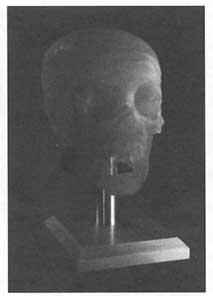
Lasers can be used to make three-dimensional prototypes of mechanical parts under the direct control of computeraided design software. This skull is a demonstration of the complex shapes that can be made. (Courtesy of 3-D Systems, Inc.)
three-dimensional laser modeling hold great promise as new parts of the agile and flexible digital factories of the future. Laser model generation (at left), for example, lends itself to rapid prototyping, which is emerging as a new paradigm for reducing time and cost by eliminating many of the steps between engineering design and manufacturing. Laser repair and customization of high-cost items (e.g., semiconductor displays) are two other important cost-saving manufacturing techniques.
Optics can also be found in a host of chemical-related situations, for example, in the curing of epoxy resins in flat-panel displays or in diagnostic probes for the monitoring and control of on-line chemical processes. Optical sensors for real-time control of chemical processes have been shown to double the productivity of some existing manufacturing facilities. In the future, we may even see the routine industrial use of lasers to promote bond-selective chemical reactions.
As part of real-time process control, optical techniques for alignment and inspection have been shown to reduce variation and shorten the launch time for new product designs. Machine vision, for example, has enormous potential for enhancing automated manufacturing processes, but its use is often limited by the requirement for sophisticated, customized software algorithms. Customization is also frequently required in metrology applications, but the economies inherent in non-contact, real-time process feedback control often warrant the expense for example, in guaranteeing the accurate assembly of complex structures in aircraft manufacturing. Optical inspection of finished or intermediate parts for quality control and statistical process control is especially critical in the electronics industry.
Much less sophisticated applications—but nonetheless highly useful ones—are found in laser guidance systems for the construction industry, where such systems have greatly reduced costs and allowed more rapid and more precise alignments in building, tunneling, and surface grading.
National Defense
Television images of precision laser-guided bombs zeroing in on and obliterating a military headquarters building in Baghdad during

The Pentagon in Washington, D.C., photographed from space in 1967 by the first photoreconnaissance satellite system, Corona. (Courtesy of the National Reconnaissance Office.)
Operation Desert Storm highlighted the central role of optics in modern warfare. Optical technologies play a key enabling role in modern battle plans and have dramatically changed the way wars are fought.
The roles of optics in defense are pervasive and ubiquitous. These range from low-cost components to complex and expensive systems. Among the latter, sophisticated satellite surveillance systems are a keystone of our intelligence gathering (see photograph above). Lower-cost night vision imagers and missile guidance units have recently allowed the United States to "own the night" and to dominate the battlefield. Not surprisingly, lasers also have a place. In applications analogous to the use of radio waves in radar, laser radiation propagating in free space can be used for targeting and range finding. Recent developments have also led to such novel applications as laser gyros for navigation. In the future, laser weapons based on gas or chemical lasers that generate more than 1 MW of power will open the door to directed-energy weapons that may find both terrestrial and space-based applications. Developments in optics also promise a host of less obvious payoffs for defense—many with likely civilian spin-offs as well. For example, Department of Defense investments in new high-leverage optical technologies such as photonics and chemical agent detection will provide a unique military advantage on the battlefield of the future, as well as nondefense payoffs.
Manufacturing of Optical Components and Systems
As the impact of optics has increased in recent years, major changes have been necessary in the way optical components and systems are designed and fabricated. As recently as a decade ago, most optical components were made in small specialty optics shops, with a premium on
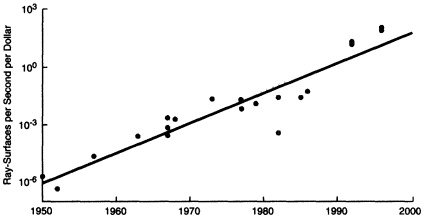
There has been a dramatic revolution in both the speed of ray tracing and the capital cost of the computers required (note the logarithmic scale).
craft work. This work was driven by the needs of the military, government agencies, and scientific research. Today, as military budgets and lot sizes decrease and the use of optics grows in applications as diverse as optical fibers for communication, large space optics, and high-performance short-wavelength aspheric optics for integrated-circuit fabrication, the demand is growing for cheaper, faster, more flexible optics manufacturing with increased capabilities.
In the face of these needs, the manufacture of mass-market optics is now dominated by Asian countries—potentially a cause for concern. On the other hand, developments are enabling U.S. industry to recapture some segments of the optical component fabrication business. One example is the emergence of new classes of numerically controlled optical grinding and polishing machines. Another is a better understanding of the characteristics of optical materials from glasses to polymers to metals, thus permitting broader use of these automated technologies. Advanced optical components cannot be considered commodity items, and even though they represent only a small fraction of the value of the optical systems they enable, their availability is essential for the success of new high-level applications that rely on such systems. To take full advantage of new fabrication methods, flexible manufacturing, assembly, and testing techniques have to be integrated. The U.S. optics industry is currently strongest in the design and manufacture of high-performance specialty products. A key U.S. strength is in optical design, which is being revolutionized by the development of fast and affordable ray-tracing software (see figure above).
In looking to the future, affordable infrared systems for military uses and high-quality components for deep-ultraviolet wavelengths in the semiconductor industry are two of the major challenges within reach of today's optical industry. General aspherics, diffractive and gradient-index optical elements, and conformal optics also offer new optical design and packaging possibilities. In particular, industry support for
deep-ultraviolet aspherics is required for chip making. Fiber devices such as fiber lasers and amplifiers, fiber gratings, and dispersion compensators are also growing rapidly in importance, driven by information technology applications.
Photonic materials are another growth area. Continued advances in photonic networks will depend on continued reductions in the cost of photonic components, increased functionality, and increased levels of integration. Computer-assisted design tools, which are becoming essential for shortening design cycles and increasing functionality, are not available for designing photonic components. Process improvements are also needed to ensure the future practical use of photonic materials such as cadmium telluride, silicon carbide, gallium nitride, and aluminum nitride.
Research and Education
Research continues to yield extraordinary discoveries. Light is now being used to control atoms, with applications in laser cooling and the engineering of quantum states (see figure below). New fluorescent dyes allow the detection of single molecules, with important implications for chemistry, biology, and medicine. New techniques using ultrashort, high-peak-power laser pulses are being made possible by the development of femtosecond optics. Advances in semiconductor lasers are dramatically reducing costs and increasing utility. Research on nonlinear optical materials promises to open up new approaches for future optical devices. High-frequency sources and optical components are enabling microscopy and lithography to move into the extreme ultraviolet
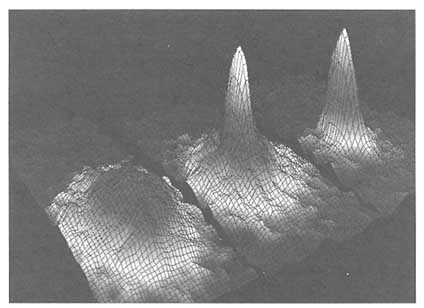
The momentum distribution of atoms during Bose condensation of a lasercooled dilute gas. (Courtesy of M. Matthews, JILA.)
and even the x-ray wavelength regime. These are just a few highlights of the exciting research now under way in optics.
There are only a few formal postgraduate educational programs in optics. In most universities, optics is taught in a wide range of departments—biology, physics, materials science, electrical engineering, computer science, and others—as befits the span of the field's applications. Academic research in optics is no less diverse, and in their diversity, universities have made indispensable contributions to furthering optical technologies. In information technology, for example, academic programs are particularly strong in the basic sciences and the development of device technologies, but weak in the corresponding systems, packaging, and applications areas. Accordingly, universities are relatively ineffective in transferring technologies to U.S. industry and in keeping pace with the needs of newly developing systems.
Key Conclusions and Recommendations
Along with explaining the state of the art in optics and presenting a vision of its future, an important goal of the study that produced this report was to identify actions that could facilitate the field's future technical development and enhance its contributions to society. Each chapter of the report draws conclusions that bear on this goal and offers recommendations aimed at reaching it.
As this report shows, optics is an extraordinarily strong and dynamic field. Its diverse applications are making important contributions to society in areas that range from telecommunications to medicine to energy to national defense. In most cases, the field's vitality is sufficient to keep up the rate of advance without major changes in public policy or other major intervention. In a few important cases, however, action is needed to overcome barriers that might slow the present pace of rapid progress—to ensure consumer access to the dramatically increasing capacity of optical-fiber communications, for example, or to take full advantage of the potential of noninvasive optical methods for medical monitoring and diagnosis. Key recommendations aimed at addressing these concerns are summarized below, along with brief synopses of the arguments that underlie them.
Information Technology and Telecommunications
Optics is now the preferred technology for the transmission of voice, data, and video information over long distances. Already the dominant communications technology throughout the world, fiber-optic systems continue to be deployed at an increasing rate, linking cities and continents

Worldwide undersea network of fiber-optic cable for telecommunications. (Courtesy of P.K. Runge, Tyco Submarine Systems Laboratories.)
(see figure above). As one example, only a thousand voice channels spanned the Atlantic Ocean in 1975; in 1998 10 million are in place or under construction. This technological shift is due primarily to the huge long-distance information capacity made possible by the use of optical fibers and laser transmitters. Data rates exceeding 1 terabit-per-second per fiber have been demonstrated in the laboratory, and systems capable of 20 gigabits per second are being deployed commercially.
As technological advances reduce the cost of optical components, it is becoming cost-effective to use optical fiber communication systems over shorter and shorter distances. Today's long-distance fiber networks extend only as far as the local telephone office, where signals are transferred to metal wires for transmission to and from individual homes and offices. It will eventually be feasible to extend these fiber networks all the way to the end user, dramatically increasing the bandwidth available to individual users for voice, video, and data services.
Demand for high-bandwidth services has grown tremendously over the past few years. The extraordinary growth in use of the Internet, especially the explosive growth of the graphics-intensive World Wide Web, has been the main driving force. Continued rapid expansion of the Web, along with increased demand for audio and video transmissions, will accelerate this growing demand. There are ways to greatly increase transmission capacity while still using the twisted-pair wires that now link homes and offices to the telephone network, but optical connections are much faster than wires will ever be. Just a few years ago, even today's demand for Internet access and other high-bandwidth
services would have seemed extraordinary. Optical fiber to the home will provide for the expected rapid growth in these services. It will also ''future-proof" the network against the bandwidth needs of future services that do not even exist yet but that recent history indicates are sure to emerge.
Fiber also has a number of technical advantages over metal wiring. For example, it is corrosion resistant and immune to electromagnetic interference, and it can eliminate the need for electrical power between the central office and the home, with considerable potential savings in the operation and maintenance of the network. A number of technical challenges remain to be overcome, however, before the ultimate goal of fiber to the home can be achieved. Chief among these is the development of new technologies that reduce the costs of optical components, packages, and systems. Also to be considered is the combined technical-regulatory issue of lifeline power (i.e., enabling communication during emergencies if the customer's premises lose power).
The rapid emergence of broadband telecommunication networks and broadband information services will have an enormously stimulating impact on commerce, industry, and defense worldwide. Congress should challenge industry and the federal regulatory agencies to ensure the rapid development and deployment of a broadband fiber-to-the-home information infrastructure. Only by beginning this task now can the United States position itself to be the world leader in both broadband technology itself and its use in the service of society.
Health Care and the Life Sciences
Developments in optics and especially in lasers have made dramatic contributions to health care. Rigid and flexible viewing scopes allow minimally invasive diagnosis and treatment of numerous sites inside the body, such as the colon, the knee, and the uterus. Accordingly, lasers have become accepted and commonly used tools for a variety of surgical applications in fields ranging from ophthalmology to gynecology (see figure on page 21). In contrast to the progress in therapeutics, however, noninvasive diagnostic methods are less well developed, despite their great potential in the medical laboratory (more accurate blood tests, for example), in the clinic (adjuncts to x-ray mammography), and for home care (noninvasive glucose monitoring). Particularly in the area of monitoring basic body chemistries, the fundamental science is often incomplete; for example, the optical signatures of some human biological processes and substances have yet to be determined. Although the National Institutes of Health (NIH) does have a modest effort in biomedical optical technology, the disease-oriented structure of NIH does not encourage the growth of biomedical optical technology programs.
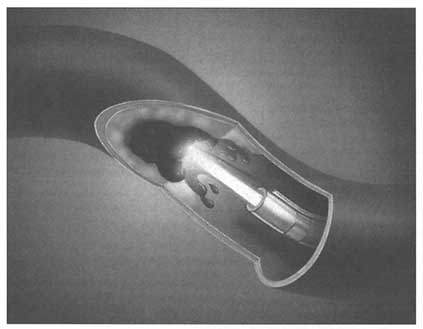
Schematic diagram illustrating laser thrombolysis, the use of a laser to destroy a blood clot. (Courtesy of K. Gregory, Oregon Medical Laser Center.)
To hasten progress in this area, mechanisms should be sought to encourage increased public and private investment in the development of noninvasive optical monitoring of basic body chemistries. A clearer separation between the roles of the public sector (support for basic science and proof-of-principle demonstrations) and those of the private sector (device development) is needed.
Optimal utilization of the fluorescence-based techniques so essential to biology depends on the continual development of new, specific, and inexpensive molecular probes. Scientists, engineers, and technicians with cross-disciplinary training will enhance the transfer of optical science to biology and medicine.
The National Institutes of Health should recognize the importance of optical science in biomedical research aimed at understanding human disease by establishing a study section dedicated to this area. NIH should raise the priority for funding innovative optical technologies for medicine and medical research. An initiative should be launched to identify the optical signatures of human biological processes and substances for application to noninvasive monitoring.
Optical Sensing, Lighting, and Energy
The economic impact of lighting the United States has already been noted. Lighting accounts for about 19 percent ($40 billion) of the total annual electricity use in this country, but higher-efficiency light sources and distribution systems are now available that might dramatically change these numbers. Among the new sources are high-efficiency
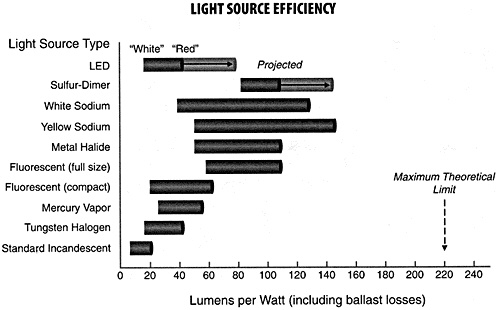
Efficiency of selected types of light sources. The output of several new lighting sources exceeds that of conventional incandescent bulbs three- to tenfold.
metal halide lamps, sunlight-spectrum sulfur-dimer lamps, and white LED sources that can be three to 10 times more efficient than conventional lightbulbs (see figure above). Accordingly, these new light sources have the potential to reduce consumer electricity bills in the United States by tens of billions of dollars each year. For instance, the ongoing replacement of red traffic lights with new red LED lights is expected to save about $175 million annually in the United States within the next few years.
The Department of Energy, the Environmental Protection Agency, the Electric Power Research Institute, and the National Electrical Manufacturers Association should coordinate their efforts to create a single program to enhance the efficiency and efficacy of new lighting sources and delivery systems, with the goal of reducing U.S. consumption of electricity for lighting by a factor of two over the next decade, thus saving about $10 billion to $20 billion per year in energy costs.
National Defense
Optical technologies have played and continue to play an indispensable role in national defense. Post-Cold War Department of Defense (DOD) policy has not substantially reduced the need to develop and acquire optical systems, but it has affected the R&D process. Acquisition reform that actively leverages the use of commercial off-the-shelf technology to reduce procurement and R&D costs is difficult to apply widely to optics because commercial optical products require special adaptation or improvement for DOD use. For example, computer
displays cannot withstand the conditions of vibration, shock, abrasion, and so on that are common on the battlefield. Nonetheless, current DOD policy, which stresses the development of new systems with low risk at low cost, has led to greater reliance on existing or adapted commercial technology and, concomitantly, to less aggressive funding of new optical technology than in the past. The Department of Defense is also seeking to limit its support of manufacturing and other core optical competencies, a position inconsistent with DOD's special operational requirements for systems to be produced at low volume.
The war-proven effectiveness of optics ensures that DOD will continue to require highly capable optical systems for surveillance and for surgical strikes with precision guided munitions, to mention only two conspicuous examples. Downsizing must be done very carefully to ensure that an adequate manufacturing infrastructure is maintained and supported. Similarly, in light of a past climate in which DOD aggressively drove optics development, future efforts must be carefully planned to extract maximum benefit from lower discretionary R&D budgets, expended mainly by the Defense Advanced Research Projects Agency (DARPA). Certain R&D and manufacturing areas deserve special attention and emphasis by the Department of Defense, especially those that offer near-term DOD payoffs, as well as potential commercial economic returns. These areas include the low-cost manufacturing of precision aspheric, diffractive, and conformal optics, discussed below under "Manufacturing of Optical Components and Systems."
Despite the reality of Department of Defense downsizing and acquisition reform, DOD should stress investment in R&D on key optical technologies such as photonics, sensors, and high-power tunable lasers to gain maximum defense competitive advantage. Special attention should also be given to investment in low-cost manufacturing of precision aspheric, diffractive, and conformal optics.
Optics in Manufacturing
Optical techniques are used in a wide variety of manufacturing environments, from photolithography for making semiconductor chips to optical sensors for measuring the temperature of molten steel. These applications fall into two broad classes: (1) the use of light to perform manufacturing, including photolithography, laser materials processing such as welding and machining, and optical methods for rapid prototyping and manufacturing; and (2) the use of optics to control manufacturing, including metrology, machine vision systems, and a wide variety of sensors. Optical lithography is an essential part of the semiconductor, flat-panel, and CRT display industries. In light of this leading role, there is a compelling need for—and great advantage to be gained from—
further advances in ultraprecise optical lithography. Other related fabrication approaches, such as microelectromechanical systems, are rapidly developing as future technologies for control systems, sensors, displays, and other emerging applications. In this broad area, several entities, including DARPA and SEMATECH, not only play key, high-level oversight and coordination roles, but also demonstrate an effective cooperation among government, industry, and academia. A notable example of such cooperation is the Precision Laser Machining Consortium. This government-led consortium has brought together a wide variety of companies, from aerospace to automobiles, to solve their common problems. No single company would have independently devoted the necessary R&D resources to solving these problems, but by coming together, the consortium is making significant progress that is of value to all participants.
Participation in the DARPA-sponsored Precision Laser Machining Consortium should be extended to other optically assisted manufacturing areas by establishing a test facility as a service center.
Manufacturing of Optical Components and Systems
The optical fabrication industry is fractionated, with each company generally being quite specialized. Much of the U.S. high-precision optics supplier base comprises small innovative companies, which can often be flexible and dynamic in their approach to optical system design and fabrication.
In today's fertile and competitive environment, the several professional and trade organizations that represent different portions of the optical industry have, until recently, contended rather than cooperated. (This situation is changing, partly through the formation of the Coalition for Photonics and Optics.) In the face of such specialization—even disunity—industry needs a central voice and source of developments if it is to grow and prosper. Several collaborative programs with significant government participation offer sufficient incentives for modernization of optical design and fabrication.
Active government and industrial participation and support for strong, applicable international standards for optical components are important in cementing the links among the diverse components of the optical industry. Virtually all recent standards have been produced by overseas industry. The failure of U.S. industry and the federal government to support these activities has led to U.S. industry being a follower in adapting to new international opportunities.
The National Institute of Standards and Technology should become a leader in the development of international optics standards by coordinating the efforts of U.S. industry and the domestic and foreign standards-setting communities.
Traditionally, lens systems have been based on the use of spherical refracting surfaces; however, significant design simplifications and improvements in image quality can be obtained by using general aspheric surfaces. Currently, the United States has a significant lead in the low-volume production of high-precision aspheric components. The future of new, efficient imaging systems depends on developing a cost-effective method of producing such surfaces in volume. Other opportunities in manufacturing can be expected from the seamless integration of lens systems and active optical components. These findings lend additional support to the recommendation in Chapter 4 regarding the low-cost manufacturing of aspherics.
Research and Education
As an enabler, optics affects many fields and supports a vast array of applications. However, the funding of such cross-disciplinary areas of research and development is often hindered by the structure and organization of federal agencies. Accordingly, the National Science and Technology Council has been charged to identify promising areas of science and technology that cut across disciplines and would benefit from coordinated initiatives involving multiple agencies.
Optics is an enabling multidisciplinary technology that has a significant and growing impact in many areas of our lives. Multiple agencies should form a working group to support optics as a crosscutting initiative similar to the recent initiative in high-performance computing and communications systems.
Materials advances have been an integral part of the progress in optical devices and systems, from the demonstration of the first laser to the invention and installation of low-loss optical fiber. Progress in materials is a recurring theme in this report, from information technologies to the manufacturing of optics and the demand for sensors to withstand extreme environments. Research on new materials and materials processing methods thus remains critical to advances in optics. However, the development of materials for future applications is especially challenging in the United States, where research funding is rarely consistent with the decade-long time frames required to bring a new material to the level of commercial readiness.
Progress in materials science and engineering is critical to progress in optics. DARPA should therefore coordinate and invest in research on new optical materials and materials processing methods with the goal of maintaining a stream of materials breakthroughs.
In 1995 the National Science Foundation (NSF) announced a new multidisciplinary research initiative in optical science and engineering.
The call for preliminary proposals elicited more than 600 pre-proposals, which were reduced by selection to 70 submitted full proposals, of which only 18 could be funded. These numbers indicate both the extremely competitive nature of funded research and the nationwide interest in optics research. The NSF initiative also incorporated educational aspects that meet many of the needs of optics for interdisciplinary education, with an emphasis on teamwork and systems understanding. The initiative included undergraduate students in the research programs, a key stimulus to student interest in graduate research. Despite its apparent success, however, this NSF initiative was a short-lived venture.
NSF should develop an ongoing, agency-wide, separately funded initiative to support multidisciplinary research and education in optics. Examples of research and education opportunities include fundamental research on atomic, molecular, and quantum optics; femtosecond optics, sources, and applications; solid-state laser sources and applications; and extreme ultraviolet and soft x-ray optics.
Universities should encourage multidisciplinarity in optics education, cutting across departmental boundaries, and should provide research opportunities at all levels, from the bachelor's degree to the doctorate and from basic science to applied technology.
Despite its essential enabling role—or perhaps because of it—optics remains an ill-defined educational program at most institutions. Progress in optics has not obviously suffered from this situation, but a greater commitment to professional education in optics would serve well the continuing expansion in optics research and development. Wider visibility for existing educational programs and more systematic information about them would also greatly benefit the next generation of optical scientists and engineers.
Professional societies should continue to expand their commitment to professional education in optics. Accordingly, they should work to
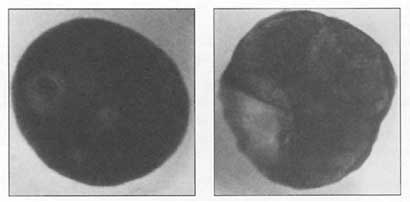
X-ray microscope images of a red blood cell show features of a malaria infection site observed at a resolution not obtainable with an optical microscope. The left image shows a new infection. The right image was taken after 36 hours. (Courtesy of C Magowan and W. Meyer-Ilse, Lawrence Berkeley National Laboratory.)
strengthen optics as a recognized crosscutting area of science and technology through the recently established Coalition for Photonics and Optics. Professional societies should also evaluate optics programs and jointly produce an annual guide to educational programs in optics.
A Vision of the Future
As we peer into the next century, we foresee developments in optics that will change our lives in ways that today we can hardly even contemplate. In almost every major area described in this report, we expect optics to change our world. The future will undoubtedly surprise us, but here is one possible vision:
We imagine the entire world linked together with high-speed fiber-optic communications, as ubiquitous as today's telephone system, made possible by advances in optical materials that enable the mass production of inexpensive, very high-quality optical components and systems. This will result in the growth of very high-speed Internet data and video transmission and other new broadband communications services.
In health care, the development of optical ways to monitor human processes could have an enormous impact on diagnosis and treatment. We dream of a day when people have personal health monitors that can monitor their health cost-effectively and noninvasively by evaluating the optical properties of their blood and tissue. We also foresee a growing impact of optics in many other areas of diagnostic and therapeutic medicine, biomedical research (see photos on page 26), and our quality of life.
Facing a world enveloped in greenhouse gases, we will have to consume energy more wisely. Highly efficient lighting technologies will significantly reduce the energy it takes to illuminate the world. Solar cells will reduce our dependence on fossil fuels by making electricity from the light of the sun.
In industry, optical sensors and infrared imagers will make significant inroads into process control for manufacturing and materials processing. Factories will employ optical sensors extensively in the manufacture of everything from textiles to automobiles, and digital cameras will substitute for film in printing and photography. In the electronics industry, which relies on photolithography to create circuit patterns on chips, producing features smaller than 0.1 µm will require optical steppers that use soft x-ray or extreme ultraviolet light; optical components for these machines will have unprecedented optical figure and atom-level surface smoothness.
The battlefield of the future, of which the Gulf War gave us but a glimpse, will see optics used in virtually every aspect of battle, from
weapons targeting to the detection of chemical and biological warfare agents. This omnipresence will depend critically on the availability of low-cost optical systems, many of them developed for commercial use; unique military needs for performance and reliability, unmet by the commercial marketplace, will continue to require targeted investments in optics research.
The role of optics in research, which already cuts across nearly all fields of science and technology, will be limited only by our imagination. High-power laser systems will make possible the construction of particle accelerators that extend the energy frontier for experiments in particle physics. Lasers will manipulate individual atoms in light traps. Laser interferometer experiments may unravel the mysteries of gravity. Femtosecond visible and x-ray sources will provide new tools for understanding the dynamics of materials.
As the importance of optics grows, colleges and universities will be challenged to meet the educational needs of a growing work force. In time, we expect the field of optics to become a discipline, as computer science has over the past few decades, and to become recognized as such in educational institutions around the world.


