
6
Risk Mitigation
The space shuttle program has developed operational procedures and is about to implement hardware modifications to improve the survivability of the shuttle orbiter and crew in the face of the meteoroid and orbital debris hazard. Additional operational procedures and hardware modifications have the potential to further improve the orbiter’s survivability.
CURRENT APPROACH
Constraining On-Orbit Attitude
Because of the geometry of orbital conjunctions, the shuttle orbiter’s forward-facing (in the direction of the orbiter’s velocity vector) surfaces will be subject to the great majority of collisions with orbital debris. Therefore, the orbiter’s attitude relative to the orbital vector will have a major influence on the effects of impacts of meteoroids and orbital debris. One of the most significant factors in window replacement, for example, is the length of time that windows face in the direction of the velocity vector (Smith, 1995). Figure 6–1 shows how the orbiter’s attitude affects the predicted number of window replacements, and Figure 6–2 shows how the assessed risk of critical penetration (a penetration anywhere on the orbiter that could result in the loss of the orbiter or crew) varies with orbiter orientation. Developers of orbiter attitude time lines take into consideration the possibility of critical damage, damage that would force early termination of a mission, and damage to orbiter windows, and balance the potential for damage against the need to accomplish mission objectives.
Shuttle Flight Rule A2.1.3–32 states that the preferred attitude for orbiter
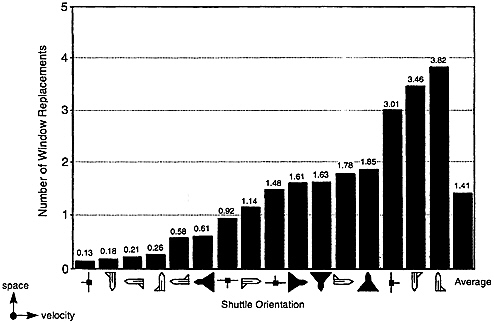
FIGURE 6–1 Window replacements vs. shuttle orientation (BUMPER prediction for 10-day mission, 400 km altitude, 51.6 degree inclination, 1996 environment). The three orientations that place the top of the orbiter in the direction of the velocity vector are most likely to cause window damage because the two overhead windows are exposed, as well as the six forward-facing windows. Source: NASA.
operations is with the payload bay pointing down (toward the Earth) and the nose not pointing forward. Exposure time with the payload bay pointing forward and with the nose pointing forward while the payload bay points up or out of plane is kept to a minimum. If other attitudes are required by payload or orbiter requirements, they will be used. The flight rules are primarily designed to protect the orbiter windows and radiators (for which the hazard is 16 times greater when the payload bay points forward than when it points down) (Reeves, 1997). Although orientations that present the maximum risk of critical penetration are not prohibited, the shuttle program’s maximum allowable critical risk of 1/200 might force mission planners to minimize flight time in those attitudes.
Extravehicular Activity
Operational procedures planned to reduce the risk to astronauts performing EVAs include avoiding EVAs when meteor storms or showers or conjunctions with cataloged debris are predicted. Whenever possible, EVAs are performed in locations that are shaded by the orbiter or (in the future) by elements of the ISS
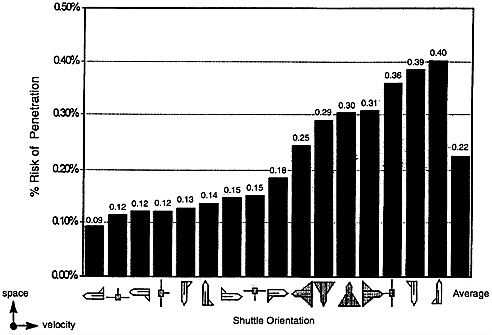
FIGURE 6–2 Critical penetration risk vs. shuttle orientation (BUMPER prediction for 10-day mission, 400 km altitude, 51.6 degree inclination, 1996 environment). Source: NASA.
(Heflin, 1997). NASA considered developing a portable shield to protect astronauts during ISS assembly operations, but that option was determined to be impractical (Simonds and Julian, 1997).
Damage Control and Repair
NASA has developed damage control procedures for the shuttle crew in the event that a pressurized compartment is penetrated. Access to the pressure hull in the orbiter cabin, the Spacelab, and the Spacehab in most cases requires removing racks and storage lockers, which will take significant time and effort. NASA estimates that about 60 percent of the interior of the pressure vessel would be accessible in 30 minutes to two hours, the next 20 percent in two to three hours, and the last 20 percent in more than three hours (Combs, 1997). Given these constraints, NASA has focused on expediting reentry in the event that a pressurized compartment is penetrated.
If the crew detects a penetration of the crew cabin that they believe does not require immediate reentry, they will first attempt to locate the hole. If the hole is accessible, they will attempt to repair it with an epoxy material or sealing tape, which are carried on all flights (Reeves, 1997). The limiting consumable in the event of a leak is the on-board nitrogen gas (N2) supply. The N2 supply was
designed to provide 165 minutes of pressure in the event of a half-inch diameter hole. An emergency reentry could be initiated within 20 minutes if the shuttle is not docked, 90 minutes if it is docked with Mir, and five hours if it is docked with the ISS. The shuttle takes approximately 60 minutes to land after reentry is initiated.
In the case of a penetration of the Spacehab or Spacelab, the crew would first isolate the damaged module and then decide whether to terminate the mission. If the penetration is not too large and if damaging effects of penetration, such as light flashes and pressure pulses, do not delay their response, the large volume of the Spacelab and the Spacehab provides reasonable time for the crew to evacuate the damaged area (Loftus, 1997a).
Hardware Modifications
To date, the only authorized hardware modifications to the orbiter specifically designed to mitigate the risk from meteoroid and orbital debris are modifications to the radiators in the payload bay doors and the insulation inside the leading edge of the wing. The radiator modifications will reduce the risk that the freon coolant loops will be penetrated by meteoroids or orbital debris, which would force the orbiter to return to Earth. As shown in Figure 6–3, strips of aluminum
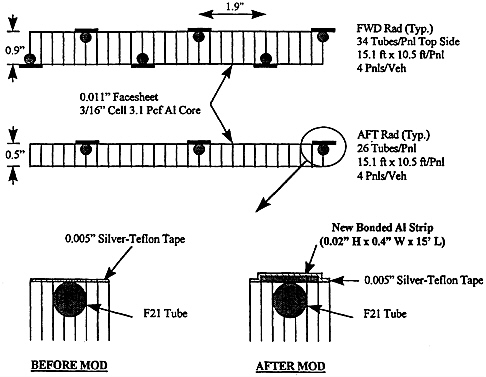
FIGURE 6–3 Modification of radiator tube shielding. Source: NASA.
tape 0.02 inches thick will be added to the length of the coolant loop. In addition, NASA has authorized installation of an isolation valve at the radiator freon inlet and a check valve at the radiator outlet to isolate a leak and limit the loss of freon. The crew will have to close the valves when a caution and warning alarm signals that a change in freon pressure has been detected. An automated system to close the valves is currently under review. The modifications, which will add 30 kg to the orbiter’s mass, are scheduled to be installed on all four orbiters during routine maintenance between February 1998 and February 1999 (Ouellette, 1997).
The modifications to the RCC leading edge of the wing will be made in the region of the wing where the shock wave from the nose of the vehicle and the shock wave from the wing intersect during reentry. Existing insulation inside the wing could not tolerate the heating rates and heating loads from the plasma flow that would result from a penetration of the wing in this area. Several layers of Nextel, a high-temperature ceramic fiber, are being added behind the current insulation. This modification should allow the orbiter to maintain structural integrity during a reentry with a 0.63 cm diameter penetration in the lower side of the RCC. The modification, which will add approximately 77 kg to the orbiter’s mass, will be installed during planned modification periods and inspection cycles (Loftus, 1997b).
ANALYSIS AND FINDINGS
Constraining On-Orbit Attitude
By constraining the on-orbit attitude of the shuttle orbiter, NASA can significantly reduce the risk of significant damage. One issue with the current approach is that it forces mission planners to make trade-offs between (1) protecting the crew cabin windows, (2) reducing the probability that the mission will have to end early, and (3) minimizing the risk of critical damage. During some Mir missions, for example, attitudes chosen to reduce the predicted risk to the radiators have increased the predicted risk of a critical impact. Without a mechanism for making trade-offs, NASA runs the risk of treating minor hazards that are well known (e.g., window pitting) as more important than more serious hazards that have not yet damaged the orbiter.
When ISS operations begin, NASA plans to constrain shuttle attitudes to satisfy ISS power, thermal, and attitude control requirements, rather than to minimize risks from meteoroids and orbital debris (Reeves, 1997). The planned configuration for docking the orbiter to the completed ISS, for example, leaves the orbiter in an orientation that maximizes the predicted risk of critical penetration. Missions to the ISS will also limit mission planners’ ability to modify the launch schedule or orbital altitude to reduce the risk from meteoroids and orbital debris.
Finding. During the ISS era, the orbiter will be unable to use some current operational techniques to improve its survivability in the face of meteoroids and orbital debris.
Damage Control and Repair
NASA has developed procedures to detect, locate, and repair small punctures in the orbiter crew cabin. However, no in-flight procedures have been developed to detect, locate, and repair punctures elsewhere on the vehicle. This capability could be very useful because many of the orbiter’s potential failure modes caused by meteoroid or debris impact may not be critical immediately but could become critical during reentry. If they could be detected and repaired in orbit, the risk of critical failure could be significantly reduced.
On most missions, significant damage from meteoroids and orbital debris could be located without an EVA. Large portions of the orbiter’s critical areas can be surveyed for impact damage with the remote manipulator system (RMS) cameras, if the RMS is on board (80 to 90 percent of planned missions). Figure 6–4 shows how the RMS could be used to survey the orbiter for damage. NASA is also considering stationing free-flying monitor robots at the ISS; these would be able to examine a shuttle docked at the station.
Repairing significant damage from meteoroids or orbital debris outside the pressurized area might also be feasible although it would require at least one EVA. Before the first shuttle flight, NASA developed a spray can foam-in-place ablative material to repair damaged or lost TPS tiles. The hardware was never carried on the orbiter because of NASA’s confidence that the TPS would perform effectively, but it could be used to repair damage from meteoroids or debris on the TPS. Repairs to other orbiter elements might also be possible, although effective repair of the RCC leading edges would be very difficult because the repairs would have to survive exposure to very high temperatures during reentry.
NASA’s guideline that sets the maximum allowable risk of sustaining a critical penetration during a given mission suggests that one or two critical penetrations will occur during the 400 mission life cycle of the orbiter fleet (as of September 1997, 87 shuttle missions have been flown). In deciding how to allocate the finite resources of dollars, crew training time, and on-orbit operations time, NASA must determine whether in-orbit detection and repair of penetrations by meteoroids and debris outside the pressurized compartments are feasible and worthwhile.
Hardware Modifications
The planned modifications to the payload bay door radiators and to the wing leading edge insulation appear to be positive steps that will have minimal negative effects on the overall program. NASA estimates that the modification to the
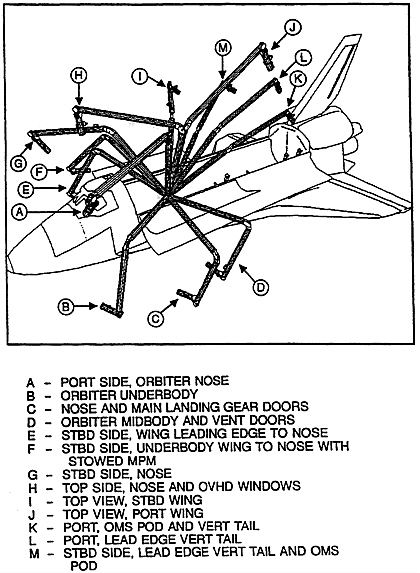
FIGURE 6–4 Use of remote manipulator system to survey orbiter for damage. Source: NASA.
radiator will reduce the worst case risk of early mission termination by approximately a factor of 10. The proposed solution appears to be fairly simple to implement and can be accomplished in a relatively short time. The design modification to prevent melting or overheating of critical structural components inside the leading edge of a wing that has been perforated by a meteoroid or orbital debris should reduce the probability of critical failure and require only a minor increase in vehicle mass.
Finding. NASA plans to modify the orbiter radiators and wing insulation to reduce the risk of early mission termination and critical failure. These modifications appear to be positive steps that will have a minimal negative effect on the program.
In Chapter 3, the committee suggested that NASA should continue to assess the potential of various hardware modifications to improve the survivability of the orbiter in the face of the meteoroid and orbital debris hazard. This assessment could also be used to determine future hardware modifications. Although deciding which areas should be assessed in detail will require further analysis, NASA may wish to consider the following areas:
-
wing locations that contain multiple hydraulic and electrical lines vital for elevon motion and flight control
-
additional modifications inside the leading edges of wings and wing areas
-
payload bay pressurized modules, such as the Spacehab and Spacelab modules
-
pressure vessels in the payload bay, including those on the extended duration module
-
a replacement for the current payload bay liner and multilayer insulation that would provide better protection of the multiple components and pressure vessels in the orbiter mid-body
-
design options to replace existing insulation blankets with materials that provide better protection from meteoroids and orbital debris
-
reinforcement materials on the aft bulkhead of the cabin to provide more robust protection from meteoroids and orbital debris
-
relocation of redundant systems that may be vulnerable to the impact of meteoroids and debris
RECOMMENDATIONS
Recommendation 8. NASA should assess the effect of plans for the ISS era that will render the shuttle unable to use some current operational techniques to protect the vehicle from meteoroids and orbital debris.
Recommendation 9. NASA should reconsider conducting on-orbit surveys of the orbiter exterior to detect impact damage and repair it if necessary.
Recommendation 10. NASA should investigate additional modifications to the orbiter to improve its survivability.
REFERENCES
Combs, N.E. 1997. Personal communication to J.P.Loftus, Assistant Director (Plans), NASA Johnson Space Center. July 7, 1997.
Heflin, M. 1997. Extravehicular activity (EVA) vulnerability mitigation. Briefing presented to the Committee on Space Shuttle Meteoroid/Debris Risk Management, Houston, Texas, June 16, 1997.
Loftus, J.P. 1997a. Letter to the Committee on Space Shuttle Meteoroid/Debris Risk Management from Joseph Loftus, Jr., Assistant Director (Plans), NASA Johnson Space Center. SA-97–178. July 15, 1997.
Loftus, J.P. 1997b. Personal Communication to Committee on Space Shuttle Meteoroid/Debris Risk Management from Joseph Loftus, Jr., Assistant Director (Plans), NASA Johnson Space Center. September 12, 1997.
Ouellette, F. 1997. Orbiter modifications. Briefing to the Committee on Space Shuttle Meteoroid/ Debris Risk Management, Houston, Texas, June 17, 1997.
Reeves, W. 1997. Presentation to the Committee on Space Shuttle Meteoroid/Debris Risk Management, Houston, Texas, June 16, 1997.
Simonds, C.H., and R.L.Julian. 1997. Assessment of portable orbital debris and micrometeorite shield for EVA crew protection at the International Space Station. Houston: Lockheed Martin Space Mission Systems and Services.
Smith, J. 1995. Orbiter window replacement cost reduction. Rockwell Aerospace viewgraph documents of October 26, 1995 provided to the Committee on Space Shuttle Meteoroid/Debris Risk Management.


