
2
Risk to the Orbiter and Crew
The risk to the space shuttle orbiter from meteoroids and orbital debris can be broken down into two elements: the probability that the space shuttle orbiter or crew will be struck (susceptibility), and the probability that an impact will affect the mission (vulnerability). The orbiter’s survivability is best understood as a combination of susceptibility and vulnerability. Figure 2–1 shows a step-by-step process that can be used to determine the orbiter’s survivability in the meteoroid and orbital debris environment.
This chapter first examines the orbiter’s susceptibility to impacts from meteoroids and orbital debris. This is followed by a discussion of the damaging effects of hypervelocity impacts, an overview of the orbiter design, and a preliminary assessment of the potential vulnerability of various elements of the orbiter. The chapter concludes with an assessment of the survivability of shuttle crew members conducting extravehicular activities (EVAs).
ORBITER SUSCEPTIBILITY
The probability that the orbiter will collide with meteoroids or orbital debris can be estimated by multiplying the flux of meteoroids and orbital debris by the relevant exposed surface of the shuttle orbiter and the duration of the exposure. Table 2–1 uses NASA’s meteoroid model and computer-based orbital debris environment model for spacecraft design and observations in low Earth orbit (ORDEM96) to predict the number of collisions with objects of various sizes during a single shuttle mission and during the lifetime of the shuttle fleet. (The accuracy of ORDEM96 predictions is discussed in Chapter 4.)
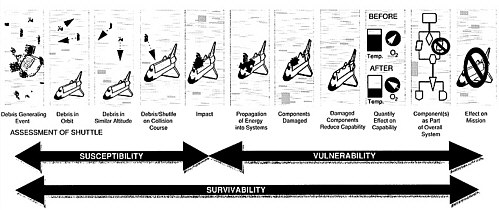
TABLE 2–1 Predicted Number of Impacts on Orbiter (1997 environment, 400 km altitude, 51.6 degree inclination orbit)
|
Diameter of Meteoroid or Debris |
10-day Mission |
400 10-day Missions |
|
>0.04 mm |
700 |
300,000 |
|
>0.1 mm |
100 |
40,000 |
|
>0.5 mm |
1 |
400 |
|
>1 mm |
0.09 |
35 |
|
>2 mm |
0.008 |
3 |
|
>3 mm |
0.002 |
0.8 |
|
>5 mm |
0.0005 |
0.2 |
|
>10 centimeters |
0.000004 |
0.002 |
The flux of meteoroids at shuttle altitudes is comparable to the flux of debris for particles between 0.01 mm and 1 mm in diameter. Above and below this size range, debris are normally more populous than meteoroids. Figure 2–2 compares the modeled flux of meteoroids and debris at the altitude at which the orbiter will visit the International Space Station (ISS).
Once a meteoroid or piece of debris has struck the orbiter, the amount of damage it does depends in large part on the impactor’s composition and velocity, as well as on the composition and thickness of the components that were struck. Meteoroids are typically silica-based, with mass densities on the order of 0.5 grams per cubic centimeter (g/cm3), although meteoroids less than 1 mm in diameter are generally considered to have average densities on the order of 1 to 2 g/cm3. Meteoroids are believed to impact Earth-orbiting objects at average velocities of 19 km/s, although impact velocities can be as high as 70 km/s. Orbital debris can be composed of a variety of materials, such as paint, aluminum, steel, and composites. Steel fragments may have densities of 8 g/cm3, but the densities of paint and composites are more comparable to meteoroids. Aluminum, which is the most common material used in spacecraft, has a density of 2.7 g/cm3. The collision velocities of orbiting objects average about 10 km/s at the shuttle’s altitude and inclinations.
Because of the different characteristics of meteoroids and orbital debris, they will cause different amounts of damage. On average, the impact velocity of meteoroids is twice the impact velocity of debris, but meteoroids are less dense. Meteoroids typically also have lower yield strengths, and the speed of sound in meteoroids is lower than in typical debris. Orbital debris typically causes significantly more damage to a given surface or component than similar-sized meteoroids, primarily because denser objects that are less dispersed by a high-velocity initial impact are better able to punch through spacecraft surfaces and components.
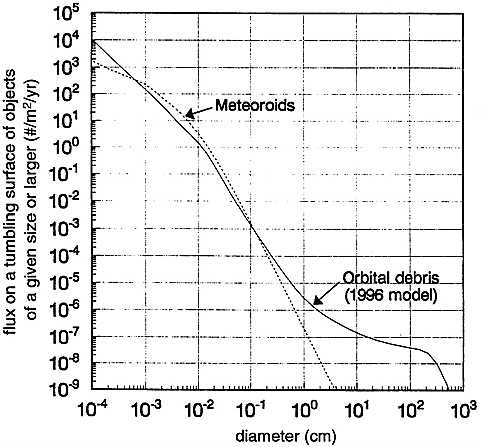
FIGURE 2–2 Comparison of meteoroid and debris flux in ISS orbit. Source: NASA.
An object striking a spacecraft at 10 km/s can cause several types of damage. Impacts can crater or perforate surfaces, create petaled holes and cracks, or cause the back surfaces of walls to spall, sending material from the back of the wall into the spacecraft. If an object penetrates the wall of a spacecraft, its remnants (often fragmented or liquefied) will travel into the spacecraft and be deposited over an area significantly larger than the impact hole. The momentum of the impact can cause impulsive damage, including bending and buckling of structural components and the transmission of a traveling shock wave through the spacecraft’s structure and components (NRC, 1995). Depending on the size of the hole and the amount of energy released into a pressurized area (such as the shuttle crew cabin or a Spacelab module) a variety of phenomena could occur, including a strong acoustic shock wave, an intense flash of light that could temporarily incapacitate crew members, and a decrease in air pressure, which could cause rapid changes in temperature, an internal fog, and the eventual depressurization of the module (NRC, 1997; Serrano et al., 1996).
ORBITER DESIGN
During the 1970s, when the orbiter was being designed and qualified for space flight, the threat from orbital debris was not considered to be significant. The only entry in the orbiter vehicle specifications that referred to impact damage was intended to minimize low energy—up to about 0.008 joules—dings and dents in the external thermal protection tiles. (By comparison, a 1 mm aluminum sphere impacting at 9 km/s has a kinetic energy of about 57 joules.)
The orbiter was designed to operate for 100 missions and was qualified by tests and analyses for 400 missions. The space shuttle orbiter subsystems were designed and located to minimize the likelihood that a single failure would cause or coincide with secondary damage to redundant systems. For example, major electrical buses and their associated wiring are separated to a large extent. Although NASA has analyzed the potential for losses from fire, shortcircuits, explosions of high-energy systems, and mishaps during processing of some critical redundant systems that are not physically separated (Rogers, 1994), the threat from penetrating meteoroids and orbital debris, which could result in much different damage propagation processes, was not considered.
Thermal Protection System
One notable nonredundant orbiter system is the thermal protection system (TPS). The external surface of the orbiter’s primary structure is protected from the heat of ascent and reentry by the TPS. The orbiter’s TPS is a passive, reusable system consisting of various materials applied to the external surface to keep the outer skin within acceptable temperature limits during reentry. For the aluminum materials that are used extensively on the outer skins, this limit is 177°C.
The TPS on the lower surface of the orbiter consists of low-density ceramic materials (designed to survive temperatures up to 1260°C) installed in 15 cm by 15 cm blocks of varying thicknesses (2.5 to 11.5 cm), commonly called “tiles.” The TPS on the orbiter’s upper surfaces consists of several materials: tiles, fabric and batting blankets, and Nomex felt, depending on the anticipated temperature environment. The leading edges of the wing and the nose cap are designed to survive the hottest temperatures (up to 1650°C). These areas are protected by a reinforced carbon-carbon (RCC) material. Although the tiles were not designed to protect against meteoroids and orbital debris, testing has demonstrated that they perform this task four to five times more effectively per unit mass than single walls of aluminum (Christiansen, 1997).
Orbiter Primary Structure
The orbiter primary structure is the other major nonredundant orbiter system. Its major elements are shown in Figure 2–3. The total cross-sectional area exposed to the meteoroid and debris flux is 1,035 square meters (m2).
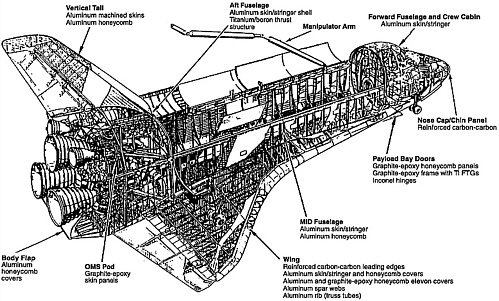
The crew module is a separate pressurized structure suspended by links within the forward fuselage structure. This design provides multiple barriers against penetration by meteoroids or orbital debris from most directions except through the crew module aft bulkhead. The aft bulkhead constitutes the forward boundary of the payload bay and, unlike the rest of the crew module, is not shielded by an outer shell. To support missions to the ISS, however, three of the four orbiters will be outfitted with an external airlock that will provide some shielding of the crew compartment aft bulkhead from impacts by meteoroids or orbital debris. The crew module has 11 windows, each made up of primary alumino-silicate and redundant silica pressure panes. Nine windows have additional outer fused-silica “thermal” panes (Smith, 1995).
The majority of orbiter subsystems that do not need to be in the crew compartment are located along the fore-aft axis, as shown in Figure 2–4. Among the components on this axis are tanks of liquid oxygen, liquid hydrogen, and pressurized gases, as well as hydraulic lines running forward to the nose gear well for lowering, braking, and steering the nose wheel. Most of the components located in the mid-fuselage are located below a payload bay liner, which covers the major frames. When the payload bay doors are open on orbit, the sill longerons and cable trays, which run the full length of both sides, still provide some measure of protection for the pressure vessels and other components below them. Payloads carried in the payload bay can also provide shielding for these areas. TPS tiles and aluminum skin stringer panels provide protection from below.
The payload bay doors are built of graphite-epoxy and are opened for payload operations on orbit. Attached to these doors, and exposed to the meteoroid and orbital debris environment, are the radiators of the active thermal control system. These radiators are constructed of aluminum honeycomb material, with internal lines that carry a freon coolant fluid from the heat exchangers.
The orbiter wing structures are generally devoid of any internal systems hardware, except for the main landing gear wells and the hydraulic and electrical lines that run outboard to the 11 hydraulic actuators along the inside of the rear wing spar. The leading edge of each wing is comprised of 22 panels of RCC material.
The orbital maneuvering system (OMS) pods are installed atop the aft fuselage astride the vertical tail. They contain both the OMS and the aft reaction control systems, as well as their components and propellant tanks. The graphite-epoxy skin panels are covered by a combination of TPS tiles and blankets. The exposed area of the pods is small, so their susceptibility to the impacts of meteoroids and orbital debris is relatively low.
The aft fuselage contains the members of the thrust structure for the space shuttle main engines, the myriad lines and valves of the main propulsion system, the auxiliary power units, and components of several other subsystems. The primary structure of the aft fuselage is comprised of aluminum skin and stringer panels and frames. The vertical tail and OMS pods shield the top portion of the aft fuselage. The massive primary thrust structure and propulsion system feedlines
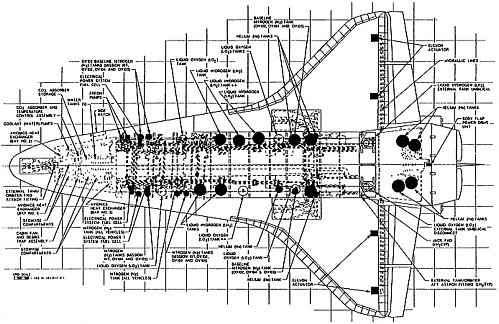
(filled with inert helium on orbit and not needed for reentry) provide some internal shielding for subsystem components. The main engine nozzles and the thermal shields mounted around them to protect equipment in the aft bay from radiant heating and low pressure backflow during space shuttle main engine operations provide additional protection.
The body flap is an aluminum structure with no internal systems. It is shielded from the top by the main rocket nozzles and has thick TPS tiles on its lower surface. The vertical tail is an aluminum structure consisting of the primary fin structural box and the moveable rudder/speed brake panels. These are relatively robust structural components with a small exposed area covered by thick TPS tiles and insulation blankets.
ORBITER VULNERABILITY
The damage caused by a particular impactor depends largely on the location of the impact. Table 2–2 summarizes the damage thresholds for several key components of the orbiter. Calculating the minimum diameter of an impactor that would cause each effect requires making numerous assumptions about impactor composition, shape, and velocity, impact angle, and exact impact location; nevertheless, the table illustrates the range of potential impactors that could damage the orbiter.
The impacts shown in Table 2–2, as well as impacts not included in the table, could cause damage ranging from minor pitting, which would require increased maintenance, to loss of life or loss of the orbiter.
Critical and Near-Critical Damage
There are a number of different mechanisms by which meteoroid and orbital debris could cause critical failure (i.e., involving loss of life or the orbiter). Any
TABLE 2–2 Damage Thresholds for Orbiter Components
|
Effect on the Orbiter |
Minimum Diameter of Debris |
|
Require replacement of window |
0.04 mm |
|
Penetrate a space suit |
0.1 mm |
|
Penetrate radiator tubes |
0.5 mm |
|
Penetrate leading edge of a wing or damage payload bay |
1 mm |
|
Penetrate crew cabin aft bulkhead |
2 mm |
|
Penetrate thermal protection system tiles |
3 to 5 mm |
|
Penetrate crew cabin (average surface) |
5 mm |
|
Collision avoidance possible if object is cataloged |
10 cm |
|
Source: NASA, 1997b |
|
impact that causes structural failure and rapid decompression of the crew module, for example, would be critical. An impact that penetrates the primary structure and explosively ruptures an internal pressure vessel could also be critical. Impacts that penetrate the leading edge of a wing or the lower surfaces of the wing or the fuselage might not be immediately critical—or even detected—but the consequent thermal heating on reentry could have a “blow torch” effect inside the wing that causes loss of flight control or failure of the primary structure resulting in the loss of the vehicle. Major damage to the control surfaces or the hydraulic systems that operate them could result in critical failure during reentry, approach, and landing.
Lesser damage could be survivable but might have a significant impact on the cost and schedule of the shuttle program. For example, an impact on the leading edge of a wing that caused a small hole could result in heating of the wing’s inner structure during reentry that might not cause the wing to fail but would require that a substantial portion of the wing skin, ribs, and spars be replaced. The repair could take 18 to 24 months and could cost as much as $25 million to $40 million (Boeing Space Systems Division, 1997). In addition to the cost, prolonged repairs could have a ripple effect on operations and scheduled modifications of the remaining orbiter fleet, especially if the repairs must be done during ISS assembly.
Mission-Limiting Damage
Impacts of meteoroids and orbital debris could also cause a mission to be terminated early. An impact that penetrates a freon coolant line in the radiators on the payload bay doors, for example, would leave only one operational coolant loop. The remaining loop could perform satisfactorily under reduced power conditions, but, because of the absence of further redundancy in the coolant system, the shuttle flight rules require that the orbiter terminate its mission activities and make the earliest possible return to the primary landing site. A noncatastrophic penetration of a pressurized volume, such as the crew cabin or a Spacelab, would also probably result in early termination of the mission.
Other Damage
Damage from meteoroids and orbital debris impacts could also be costly to repair, even if it is not critical or mission-limiting. Orbiter external surfaces, for example, have experienced impacts from particles on every shuttle mission. Inspections of the windows after each flight have revealed pits that were caused by impacts in orbit. The outer thermal panes of the crew cabin windows have sustained one or more impact pits greater than 0.25 mm in diameter on most flights. Almost 300 pits were reported between 1981 and 1996, and 55 windows were replaced (NASA, 1997b). Windows are replaced based on the design stress conditions and the location and depth of pits.
Close inspections of the radiators and other exposed surfaces also show minor punctures and evidence of spallation. The TPS has been struck by meteoroids and orbital debris, but reentry heating and localized deformations around the damage have made it difficult to differentiate damage from meteoroids and orbital debris from damage suffered during ascent. All surface damage adds to the workload during turnaround operations to prepare the vehicle for the next flight.
EXTRAVEHICULAR ACTIVITY
Astronauts performing tasks outside the orbiter are also at risk from meteoroids and orbital debris. The most vulnerable parts of the EVA mobility unit (EMU) are the soft areas of the space suit, the arms, gloves, and lower torso. (NASA calculates that the harder areas of the space suit contribute less than 10 percent of the overall risk.) The soft areas of the suit are constructed of multiple layers of abrasion and thermal protection material and a single pressure bladder.
The secondary oxygen pack on the EMU is sized to provide astronauts with a 30 minute supply of oxygen in case of a 4 mm puncture in the space suit. Presumably, this would be sufficient time for an injured astronaut to be assisted back to the pressurized crew compartment. NASA estimates that a 2 mm diameter particle could cause a 4 mm hole, and a 0.1 mm particle could cause a minute puncture. The degree of damage from these impacts has not yet been assessed in detail, but NASA now has a trauma physician on staff to examine the issue (Heflin, 1997).
NASA’s calculations of the risk to two astronauts on the end of the orbiter mechanical arm during a six-hour EVA (with no shielding by the structure) are summarized in Table 2–3. The predictions for 180 EVAs are also shown as an example of what the risks might be during the years of ISS operations (Heflin, 1997).
A three-phase study is under way to characterize the vulnerability of the EMU to meteoroids and orbital debris better. The last phase of the study, scheduled to be completed in October 1997, is intended to determine improvements in crew safety that can be realized through practical enhancements to the EMU. A comparable study is in progress for the Russian Orlan EVA suit, which will be used by U.S. astronauts during some cooperative space activities.
TABLE 2–3 Risk during EVA
|
|
6-Hour EVA |
180 EVAs |
|
Probability of no penetration |
99.98% (1/4,800) |
92.7% (1/14) |
|
Probability of no critical penetration (hole >4 mm) |
99.997% (1/31,000) |
98.9% (1/91) |
REFERENCES
Boeing Space Systems Division, 1997. Communication to Donald Emero, member of the Committee on Space Shuttle Meteoroid/Debris Risk Management. August 7, 1997.
Christiansen, E. 1997. Private communication to Paul Shawcross, NRC Study Director, August 29, 1997.
Heflin, M. 1997. Extravehicular Activity (EVA) Vulnerability Mitigation. Briefing presented to the Committee on Space Shuttle Meteoroid/Debris Risk Management, Houston, Texas, June 16, 1997.
National Aeronautics and Space Administration (NASA). 1997a. Space Shuttle Damage Thresholds. Viewgraph distributed to the Committee on Space Shuttle Meteoroid/Debris Risk Management, Houston, Texas, June 17, 1997.
NASA. 1997b. Shuttle Window Damage Database. Houston: NASA Johnson Space Center.
National Research Council (NRC). 1995. Orbital Debris: A Technical Assessment. Committee on Space Debris, Aeronautics and Space Engineering Board. Washington, D.C.: National Academy Press.
NRC. 1997. Protecting the Space Station from Meteoroids and Orbital Debris. Committee on Space Station Meteoroid/Debris Risk Management, Aeronautics and Space Engineering Board. Washington, D.C.: National Academy Press.
Rogers, W.F. 1994. Critical Function Redundant Wire Routing Separation Review. June 21, 1994. Viewgraph documents provided to the Committee on Space Shuttle Meteoroid/Debris Risk Management. Downey, Calif.: Rockwell International.
Serrano, J., D.Liquornik, and W.Schonberg. 1996. Vulnerability of Space Station Freedom Modules: A Study of the Effects of Module Perforation on Crew and Equipment. NASA CR-4716. Huntsville, Ala.: NASA.
Smith, J. 1995. Orbiter window replacement cost reduction. Viewgraph presentation of October 26, 1995 distributed to the Committee on Space Shuttle Meteoroid/Debris Risk Management, Houston, Texas, June 17, 1997. Houston: Rockwell Aerospace Space Systems Division.


