
1
Introduction
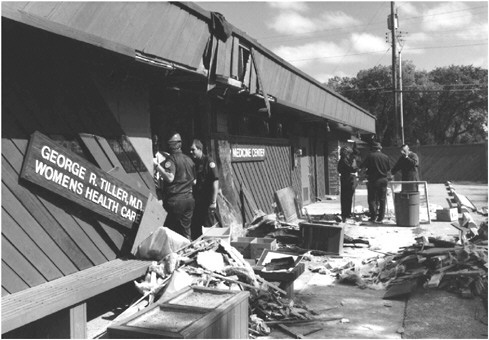
Following several major bombing incidents in the United States in the 1990s, most notably the bombing of the New York World Trade Center in February 1993 and of the Alfred P. Murrah Federal Building in Oklahoma City in April 1995, considerable discussion at the federal level has focused on ways to reduce the threat of illegal bombing attacks. In particular, there has been interest in the possibility of reducing the threat through some combination of introducing additives called detection markers or identification taggants1 into explosive materials to facilitate detection or tracing of the materials (Box 1.1); decreasing the explosive potential of certain chemicals that might otherwise be used to manufacture explosives; and/or imposing licensing or other controls on explosive materials and/or their chemical precursors.
Currently, licensed manufacturers are required to place identifying markings on the packaging for explosives that can assist in tracing them for law enforcement purposes.2 However, there is no requirement that the explosive themselves contain tracer elements—markers or taggants—that could be used to assist preblast or postblast law enforcement.
|
BOX 1.1 Detection Markers and Identification Taggants Detection Markers Detection markers are materials added to explosives that can be sensed before a blast by an instrument designed for that purpose. Markers may be active (continuously emitting a signal such as a chemical vapor or radioactivity) or passive (emitting a signal in response to probing radiation, e.g., a dye molecule that emits visible fluorescent light when probed by ultraviolet light [JASON, 1994]). In countries ratifying the International Civil Aviation Organization's 1991 Convention on the Marking of Plastic Explosives for the Purpose of Detection (ICAO, 1991), plastic and sheet explosives will be marked with one of four volatile chemicals.1 Technologies also exist to detect unmarked explosive materials, including dualenergy x-ray, x-ray computed tomography, thermal neutron activation, vapor/particle detection, and the use of canines (NRC, 1993). Detection marker schemes may improve the specificity and efficiency of these detection technologies or make new methods possible. Identification Taggants Identification taggants are additives designed to survive an explosive blast, to be recoverable at the site of a bombing, and to provide pertinent information, such as last legal purchaser, to aid law enforcement personnel in identifying the perpetrator. Identification taggants can encode information in a variety of ways and can be added at various points in the production and distribution of an explosive material. Macroscopic plastic particles—originally developed by the 3M Corporation—are the most widely known form of identification taggant (Rouhi, 1995). The sequence of colors in the layers that compose the particles is used to encode various |
CHARGE TO THE COMMITTEE
In Title VII of the Antiterrorism and Effective Death Penalty Act of 1996 (Terrorism Prevention Act), Congress mandated (through the Treasury Department) a broad study of issues related to detection, tagging, rendering inert, and licensing of explosives.3 The Committee on Marking, Rendering Inert, and Licensing of Explosive Materials was charged to assess the following:4
-
The viability of adding tracer elements to explosives for the purpose of detection,
-
The viability of adding tracer elements to explosives for the purpose of identification,
|
3 |
In parallel, ATF has its own task force that is also examining many of the same issues. The National Research Council was asked to provide a totally independent assessment. |
|
4 |
See Appendix B for a more detailed description of the statement of task. |
|
items of information. Other approaches to tagging include the use of polymeric microbeads of various sizes and colors, rare-earth elements in a synthetic matrix blended with fluorescent pigments and iron powder, isotopic methods, and immunoassay techniques (Wu, 1996). From 1977 to 1980, a taggant feasibility demonstration program was conducted in the United States for the Treasury Department's Bureau of Alcohol, Tobacco, and Firearms by the Aerospace Corporation. The program evaluated the addition of identification taggants then manufactured by the 3M Corporation to 6.4 million pounds of packaged, cap-sensitive explosives manufactured by four companies. The program evaluated addition of taggants during manufacture, record keeping, and taggant recovery and analysis procedures (Aerospace, 1980b). In 1980, the Swiss government began requiring that all manufactured explosives contain identification taggants to aid in criminal investigations. Some success in resolving bombing cases has been reported (Schärer, 1996). Also, in 1980, the Office of Technology Assessment (OTA) examined the use of identification taggants in commercial explosives (OTA, 1980). While it concluded that taggants could be useful for law enforcement, OTA noted the need for further development and for safety and compatibility evaluation testing.2 However, following the Aerospace Corporation pilot test, all research on taggants for explosives was halted by congressional decision.3
|
-
The feasibility and practicability of rendering inert common chemicals used to manufacture explosive materials, and
-
The feasibility and practicability of imposing controls on certain precursor chemicals used to manufacture explosive materials.
For any materials recommended as candidates for tracer elements or any material, methods, or technologies recommended as candidates for rendering explosive chemicals inert or less explosive, the committee was also asked to consider the associated risk to human life or safety, value for law enforcement, effects on the quality and reliability of the explosives for their intended lawful use, and effects on the environment. The analyses were to include cost drivers, benefits, and the potential drawbacks of various technical alternatives, as well as identification of technical and economic obstacles that exist and further research and development activities that may be needed. The committee was not charged with doing a rigorous cost-benefit analysis.
This report focuses primarily on improvised and commercial chemical explosives
|
BOX 1.2 What Is an Explosive? An explosion is a rapid expansion of matter into a greater volume. An explosive device may be mechanical,1 chemical, or nuclear. This study focuses exclusively on chemical explosives. A chemical explosive is a substance containing a large amount of stored energy that can be released suddenly, thereby converting the substance into rapidly expanding compressed gases (Coursen, 1992). Chemical explosives are combinations of oxidizers and fuels. In some explosives, such as nitroglycerine (NG) and 2,4,6-trinitrotoluene (TNT), the oxidizer and fuel are present in the same molecule; in others, such as ammonium nitrate/fuel oil (ANFO), the oxidizer, ammonium nitrate (AN), and fuel (fuel oil) are mixed together physically. The energy of the explosive is released by a self-sustaining chemical reaction that is usually initiated by heat or by a mechanical deformation of the explosive that produces heat. High and Low Explosives Once initiated, a reaction may proceed through the mass of explosive at a relatively slow (subsonic) rate, called combustion, burning, or deflagration, or at a rate exceeding the velocity of sound in the particular explosive, called detonation. Explosives such as black and smokeless powders, propellants, and pyrotechnics that combust in normal use are called low explosives; those that detonate are called high explosives. However, given suitable conditions, some low explosives may detonate, and some high explosives may combust, even though these conditions may not occur in normal practice (Coursen, 1992). A variety of factors influence whether a high explosive undergoes a transition from combustion or deflagration to detonation. These include intrinsic factors, such as the nature of the chemical reactions taking place inside the explosive, as well as extrinsic factors, such as the quantity of explosive present and the extent to which the explosive is confined inside a container or cavity. |
(Box 1.2), although military plastic and sheet explosives are also discussed owing to their high energy content and concealability. As required by the 1996 Terrorism Prevention Act, black and smokeless powders were specifically excluded from the scope of this study.5
EXPLOSIVES AND THE BOMBING THREAT
Types and Sources of Explosives
Would-be bombers have several options for obtaining main charge explosives. They may be obtained illegally from military sources; purchased legally or
|
Primary and Secondary Explosives The sensitivity of explosives to initiation varies over a wide range. Explosives that are extremely sensitive to initiation are called primary explosives. The primary explosive compounds commonly used in the United States today include lead azide, lead styphnate, and diazodinitrophenol (DDNP). These are generally initiated by heat and are usually handled in small quantities for safety reasons. Secondary explosives are less sensitive in that they require a shock wave for their initiation. They may be "cap-sensitive" (i.e., susceptible to initiation by a "cap" detonator) or non-cap-sensitive (i.e., require a booster for their initiation). Dynamite is an example of a cap-sensitive secondary explosive, while ANFO is a non-cap-sensitive secondary explosive, also called a blasting agent. The reduced sensitivity of secondary explosives means that they can be handled in larger quantities with relative safety. Explosive Train The characteristics of primary and secondary explosives are exploited in the design of the "explosive train." An example of an explosive train is an arrangement consisting of a detonator containing a small quantity of highly sensitive initiator (primary explosive); a booster containing a larger quantity of less sensitive high explosive; and the main charge, which is the least sensitive component making up the bulk of the explosive energy. Details on detonators and boosters are given in Appendix M. |
fraudulently, or stolen, from commercial sources; or improvised by mixing together widely available chemicals, such as ammonium nitrate (AN) fertilizer and fuel oil.
Military Explosives
Military explosives are energetic materials that include explosives, propellants, and pyrotechnics.6 The physical and chemical characteristics of the compounds in these categories differ considerably. Explosives and propellants are capable of undergoing very rapid chemical reactions, evolving large volumes of gases. The difference between explosives and propellants is the speed of the reaction. In high explosives, a supersonic reaction produces in the surrounding
medium a very-high-pressure shock wave that is capable of shattering objects. In propellants, a slower reaction produces lower, sustained pressure that is used, for example, to propel projectiles from cannons and bullets from guns. The chemical reactions involved in pyrotechnics are much slower than those in explosives and propellants. Pyrotechnics generate large amounts of heat but much less gas than do propellants or explosives.
Military Explosives in Common Use
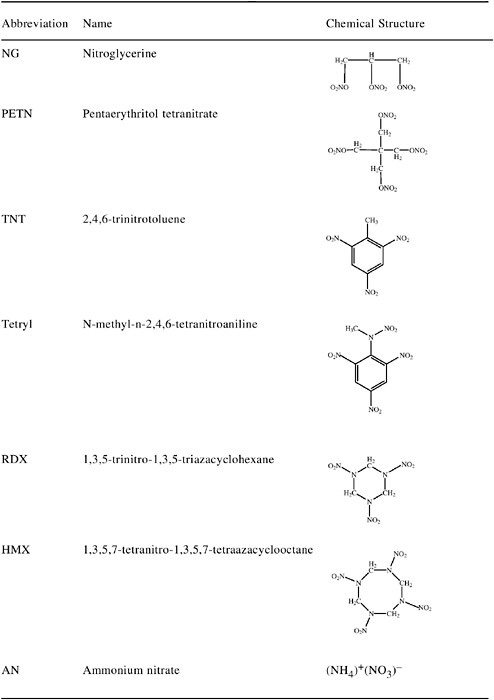
The most common military explosives are pentaerythritol tetranitrate (PETN), 1,3,5,7-tetranitro-1,3,5,7-tetraazacyclooctane (HMX), 1,3,5-trinitro-1,3,5-triazacyclohexane (RDX), n-methyl-n-2,4,6-tetranitroaniline (tetryl), 2,4,6-trinitrotoluene (TNT), nitrocellulose (NC), nitroglycerine (NG), and nitroguanidine (NQ) (some of which are listed in Table 1.1). These compounds are formulated in various combinations and with various binders and plasticizers to make up the bulk of military explosive products. For example, the most widely used plastic explosive, called composition C-4, is composed of 91 percent RDX and 9 percent plasticizers. C-4 is particularly attractive to terrorists because it has great shattering capability, can be handled safely, remains plastic between -57°C and +77°C and so can be molded easily into any shape for concealment, is difficult to detect with existing trace explosive vapor detectors, and is very stable.
The propellants in common use in the military include "single-base" with NC as the main ingredient, "double-base" with NC and NG as the main ingredients, "triple-base" with NC, NG, and NQ as the main ingredients, and "composite'' propellants with, for example, ammonium perchlorate, aluminum, and an organic binder. Stabilizers are added to propellant compositions to prevent catastrophic runaway reactions of inherently unstable nitrate esters (such as NC and NG) during storage. Single-base compositions are used in cannons and small arms; double-base compositions are used in cannons, small arms, mortars, rockets, and jet propulsion units; and triple-base compositions are used in cannon units. Composite propellants are used primarily in rocket assemblies and jet propulsion units.
Pyrotechnics consist of oxidizers and fuels as main ingredients. The common oxidizing agents include nitrates of sodium, potassium, barium, and strontium; the perchlorates of ammonium and potassium; or the peroxides of barium, strontium, and lead. Fuels include finely powdered aluminum, magnesium, metal hydrides, red phosphorus, sulfur, charcoal, boron, silicon, and silicides. The most frequently used fuels are powdered aluminum and magnesium. Pyrotechnics are used in igniters, initiators, fuses and delays, flares and signals, tracers and fumers, colored and white smoke, photoflash compositions, and incendiaries.
Access of Would-Be Bombers to Military Explosives
The illegal use of military plastic explosives such as C-4 poses a special threat because of their high energy content and concealability. However, acquiring these explosives may entail considerable effort and expense. Military magazines have generally high security and are not viewed as a significant source of explosives for would-be bombers.
It is also possible to synthesize military explosives from precursor chemicals, but in general this requires a considerable knowledge of chemistry and several steps of the synthesis. The most likely source of military plastic explosives for illegal use would be black market sources or purchase from foreign producers. Purchase of explosives from these sources requires having the necessary connections with illegal organizations, and might expose a potential bomber to substantial risk of detection. Further, after the ICAO Convention on the Marking of Plastic Explosives for the Purpose of Detection (ICAO, 1991) goes into effect in the near future (see Chapter 2), a bomber would have to find sources of unmarked C-4 to reduce the risk of detection.
Commercial Explosives
Because about 90 percent of commercial explosives used in the United States are for mining operations, this section focuses on the mining industry. About 7 percent of explosives are used in road building, tunneling, blasting trenches for the laying of pipelines, and carrying out other construction tasks. The remaining 3 percent are purchased by tens of thousands of individuals in the United States for smaller jobs, such as foundation work, preparation of trenches for sewers, and removal of large rocks or tree stumps.7Table 1.2 shows the estimated quantities of industrial explosives sold for various purposes in the United States in 1995. The choice of main charge explosive depends on the blasting conditions and the type of job to be done—e.g., shattering rock or heaving a large mass of cover material in a mining operation. Underground coal may be blasted only with certain explosives called "permissibles," or with explosives approved by the Mine Safety and Health Administration.
The sales of commercial explosives in the United States have changed dramatically in the past 40 years. In 1955, essentially 100 percent of the market for high explosives (950 million pounds) consisted of packaged explosives, basically dynamite. In today's 5-billion-pound annual market, only about 3 to 5 percent of the explosives used are in packaged form; the lion's share of the market is bulk
TABLE 1.2 Estimated Quantity of Industrial Explosives Sold in the United States in 1995 (Thousands of Short Tons)
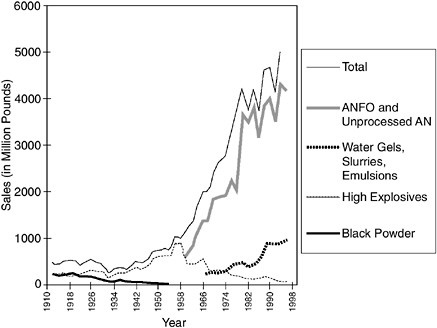
FIGURE 1.1 Sales of commercial explosives in the United States, 1912 to 1995. NOTE: These voluntarily reported data represent a lower bound to actual production figures. Permissible explosives (those approved by the Mine Safety and Health Administration for use in underground coal mining), although high explosives, are not included in this figure, as their production in 1995 was only 8 million pounds. SOURCE: Adapted from Hopler (1997), data in U.S. Geological Survey (1995), and "Apparent Consumption of Industrial Explosives and Blasting Agents in the United States, 1912-1975," published by the U.S. Bureau of Mines, as "Mineral Industry Surveys, Explosives, Annual"; prepared in the Division of Nonmetallic Minerals, April 21, 1976.
(unpackaged)8 ammonium nitrate (AN) and related explosives (Figure 1.1; see also Box 1.3).
The dramatic shift from use of packaged to bulk explosives occurred for several reasons. While chemists had known from the 1860s that AN and a fuel made a good explosive, it was not until the 1950s that AN became available in the form of easily handled spherical particles called prills.9 At about the same time,
|
8 |
The term "bulk" usually refers to material delivered down a hole from a truck with a payload capacity ranging from 5,000 to 50,000 pounds but may also refer to 50-pound bags of explosive material poured into a hole. In packaged explosives, the material is contained in individual cartridges. The choice of packaged or bulk explosives depends on the availability of equipment for handling bulk explosives, which in turn depends on the volume of explosives a mine uses. Small operations usually use cartridges, or if they use ANFO it is poured from bags into a borehole. |
|
9 |
For a more detailed discussion of ammonium nitrate prills, see the section titled "Ammonium Nitrate in Mining and Agriculture" in Chapter 4. |
|
BOX 1.3 ANFO and Improved Related Explosives Generally, ammonium nitrate/fuel oil (ANFO) is the material of choice if blasting conditions are dry. ANFO is cheap, is easily loaded into boreholes, does not require expensive magazine storage, has good "heaving" ability (displaces rock into a neat muckpile), and does not waste energy by shattering the rock immediately around the borehole. However, ANFO lacks water resistance, and its low density limits the explosive power that can be packed into a borehole of a given size. Beginning in the 1960s and continuing through the 1970s and 1980s, research led to the introduction of a new class of AN-based explosives that addressed the deficiencies of ANFO: water gels and emulsions.1 These have excellent water resistance and higher density than ANFO, and like ANFO, lend themselves to bulk loading and delivery. However, they are more expensive. Blends of ANFO and emulsions are used to improve water resistance and increase energy density in the borehole. Commercial ANFO is produced in one of three ways: (1) oiled and bagged at a distributor's facility; (2) oiled by the supplier as the AN prills are being delivered into storage bins at the mine site (the oiled prills are then loaded into high-capacity trucks and carried to the blast site); or (3) delivered as AN prills and stored unoiled in the mine's bins, and then loaded into trucks and oiled as the prills are augered or blown into the borehole. The preferred method depends primarily on the size of the user's operation, going from method 1 to 3 with increasing mine size. |
mining operations began the use of large-diameter boreholes in coal stripping, and dry drilling techniques became common. These developments contributed to the increasing use of ammonium nitrate/fuel oil (ANFO) (Hopler, 1995).
The ability to bulk-load ANFO gives it tremendous economic advantages. A blasting pattern that formerly had to be loaded by a large crew can instead be loaded by only two operators, who can also do it more quickly. Large-capacity ANFO trucks or emulsion trucks with hose reels make the loading operation fast and easy for the operators.
This development has changed the economics of the use of explosives. The high cost of the equipment and the consequent need for high rates of utilization have led to an increase in "shot service," with a supplier taking over the tasks of storing, transporting, and loading explosives that were formerly handled by the user. The cost savings to the user can be substantial. Shot service is also attractive in today's regulatory climate, which can make it difficult or impossible
to find an acceptable site for a magazine for use in a mine, quarry, or construction project.
Improvised Explosives
Bombers can also create bombs from chemical mixtures of oxidizers and fuels. The two most significant bombings in the United States in the 1990s—of New York City's World Trade Center and Oklahoma City's Murrah Federal Building—both involved homemade synthesis or formulation of the explosive materials (synthesized urea nitrate in the former case and AN mixed with a fuel in the latter case).
Information on how to make bombs, including step-by-step recipes, is now widely available in books, on videos, and at many sites on the Internet. A casual Internet search using the keyword "bomb" now yields instructions for making diverse explosives including nitroglycerine, ANFO, dynamite, and even the military explosive RDX. The instructions typically list useful chemicals and sources where they may be purchased or stolen. In many cases, the chemicals can be obtained easily at local lawn and garden stores, hardware stores, or drugstores, or purchased by mail order from chemical supply houses. Furthermore, a chemical process facility is not needed to produce large quantities of improvised explosives; most can be made by someone working at home.
A breakdown of the frequency of use of various bomb filler materials in all improvised explosive devices used in bombings or recovered in the United States in 1995 is given in Figure 1.2. The data show that conventional high explosives, whether stolen from commercial sources or synthesized at home, were used in only about 3 percent of improvised explosive devices.10 The most commonly used fillers were commercial low explosives: black powder, smokeless powder, and Pyrodex® (an improved form of black powder) (36 percent); and pyrotechnics/fireworks (30 percent). The most common containers for these explosive fillers were steel pipes with threaded end caps. Such pipe bombs accounted for 31 percent of all improvised explosive devices in 1995.
Chemical mixtures accounted for 17 percent of the fillers used in improvised explosive devices in 1995. Although specific data on the frequency of use of particular chemicals in this category were not available to the committee, those used most commonly were strong acids or bases mixed, for example, with aluminum
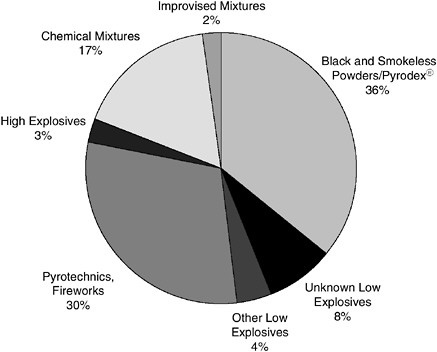
FIGURE 1.2 Bomb filler materials used in improvised explosive devices in the United States in 1995. The total of 5,026 devices includes improvised explosive devices used in bombings or attempted bombings as well as those that were recovered, for instance, in searches of residences. As a result the breakdown presented cannot be compared directly with statistics that include only actual or attempted bombings. SOURCE: Federal Bureau of Investigation (1997), p. 15.
foil.11 These fillers typically react to generate gases that build up pressure and cause brittle rupture of the container. Such devices usually are made and used as a prank.
Improvised mixtures of oxidizers and fuels accounted for only about 2 percent of the fillers used in improvised explosives in 1995. Although specific data were not available to the committee, anecdotal information indicates that the most commonly used oxidizers are potassium nitrate, potassium perchlorate, and potassium chlorate.12 Among the many options for the fuel component are gasoline, motor oil, sugar, or other simple organic compounds, which are largely interchangeable.
Improvised explosives can be synthesized with a wide range of sensitivities.
In the case of bombs using blasting agents such as ANFO, both a detonator and a booster are required to produce a reliable explosion. As pointed out in Appendix M, a booster can be produced with comparative ease and may even be a stick of dynamite. However, despite the public availability of instructions for making detonators of various kinds, the easiest way to obtain detonators is from commercial sources.
Actual and Attempted Bombings in the United States, 1985 to 1995
Two U.S. government agencies gather statistics on domestic bombings: the Department of Justice's Federal Bureau of Investigation (FBI) and the Department of the Treasury's Bureau of Alcohol, Tobacco, and Firearms (ATF).13 Because the two agencies use different methods for gathering information about bombings, the absolute numbers reported for a particular year may differ somewhat, but the trends they indicate are the same. Unless otherwise indicated, the discussion in this section is based on information provided by the FBI.
From 1985 to 1995 (the most recent year for which statistics were available to the committee), actual and attempted bombings14 in the United States increased by nearly a factor of three, from 688 incidents in 1985 to 1,979 incidents in 1995 (Table 1.3; Figure 1.3). However, following a dramatic 64 percent increase from 1990 to 1991, the number of annual bombing incidents reported by the FBI has stayed relatively constant at around 2,000 per year. Total bombing incidents actually declined by 19 percent from 1994 to 1995.
The statistics on the injuries, deaths, and amount of property damage caused by bombings in the United States from 1985 to 1995 (Table 1.4) are dominated by the bombing of the World Trade Center and the Murrah Federal Building. Of the total of 20,528 bombing incidents15 in the United States during that 11-year period, these two major bombings alone were responsible for 39 percent of the deaths, 39 percent of the injuries, and 90 percent of the property damage.16 If these two incidents are set aside, the remaining data indicate that the increase in the total number of bombing incidents from 1985 to 1995 was not matched by commensurate increases in the number of injuries and deaths or the amount of property damage caused by the bombs. For example, excluding the Oklahoma City bombing deaths, 25 people were killed in 1995 as a result of bombings, while 28 people were killed in 1985.
|
13 |
The U.S. Postal Inspection Service has jurisdiction over mail bombs. |
|
14 |
Attempted bombing incidents are those in which a viable explosive device was delivered to a target but was disarmed prior to exploding or failed to explode; neither hoax devices nor devices that are found or recovered as part of an investigation (not associated with a target) are included. |
|
15 |
This total includes both explosive and incendiary bombing incidents. |
|
16 |
In the context of considering effects of the use of explosive devices alone, the impact of these two bombings is understated by these figures, which include deaths, injuries, and property damage resulting from incendiary as well as explosive bombings (see Table 1.4). |
TABLE 1.3 Bombing Incidents Involving Use of Explosive Devices in the United States,1985-1995
TABLE 1.4 Property and Personal Damage Resulting from bombing in the United States, 1985-1995
|
|
Year |
||||||||||
|
|
1985 |
1986 |
1987 |
1988 |
1989 |
1990 |
1991 |
1992 |
1993a |
1994 |
1995b |
|
Property damage ($ millions) |
6.35 |
3.40 |
4.20 |
2.26 |
5.00 |
9.60 |
6.44 |
12.5 |
518 |
7.5 |
105.1 |
|
Persons injured |
144 |
185 |
107 |
145 |
202 |
222 |
230 |
349 |
1,323 |
308 |
744 |
|
Deaths |
28 |
14 |
21 |
20 |
11 |
27 |
29 |
26 |
49 |
31 |
193 |
|
NOTE: Data encompasses incendiary in addition to explosive incidents. a Includes $510 million in property damage done to the World Trade Center on February 26, 1993, 6 people killed, and 1,042 people injured in the same bombing. b Includes $100 million in property damage to the Murrah Federal Building in Oklahoma City on April 19, 1995, 168 people killed, and 518 people injured in the same bombing. SOURCE: Adapted from Federal Bureau of Investigation (1997), p. 6. |
|||||||||||
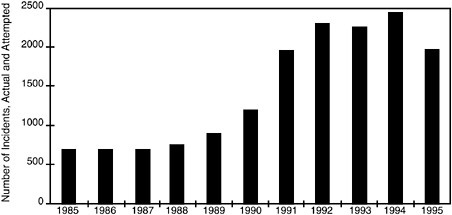
FIGURE 1.3 Total bombings with explosive devices in the United States, 1985 to 1995. Excludes incendiary incidents. SOURCE: Federal Bureau of Investigation (1997), p. 6.
Targets of Bombings in 1995
FBI data for 1995 on the targets of bombings suggest that much of the increase in reported bombing incidents from 1985 to 1995 may be attributable to an increase in vandalism or experimentation in which the bombs were not directed at ''significant" targets (FBI, 1997). In about 43 percent of the cases in 1995, the bombs were directed against mailboxes or other private property (e.g., outbuildings) and caused average losses of less than $100 per incident in property damage. If bombed mailboxes and vending machines, accidental detonations, and open-area detonations are subtracted, 885 of the total of 1,979 bombings (45 percent) were directed at targets with the potential for significant injury, loss of life, or property damage.
Explosive Materials Used in Actual or Attempted Bombings in 1995
Black powder, smokeless powder, and Pyrodex® were the most frequently used fillers in the 1,979 actual or attempted bombings in 1995 in the United States, occurring in 32 percent of these cases.17 Bombs using gunpowders were responsible for 7 deaths, 53 injuries, and an average of $390 per incident in property damage.
Chemical mixtures, defined by the FBI to include mixtures that evolve gases that cause brittle rupture of containers, were the second most commonly used
|
17 |
The percentages given in this section, based on a subset of the data presented in Figure 1.2, are based on testimony to the committee by Gregory Carl, FBI Explosives Group, Materials and Devices Unit, March 3, 1997. |
fillers in 1995 bombing incidents, occurring in 29 percent of the 1,979 actual or attempted bombings. Bombs using chemical mixtures did not cause any deaths in 1995; there were 42 reported injuries and an average of $54 per incident in property damage.
Pyrotechnics or fireworks were used in 16 percent of actual or attempted bombings in 1995. They accounted for 2 deaths, 33 injuries, and an average of $398 per incident in property damage.
High explosives, including commercial materials such as dynamites and ANFO, as well as military explosives such as TNT and composition C-4, were involved in 3 percent of bombing incidents in 1995. ANFO itself was used in only five actual or attempted bombings, although one of those caused the massive death and destruction in Oklahoma City. Not including the Oklahoma City bombing, high explosive bombs as a group caused 9 deaths, 20 injuries, and an average of $2,304 per incident in property damage in 1995. Thus, although high explosives are infrequently used in bombings, the consequences of their use are relatively severe.
Improvised explosive mixtures, including combinations of various chemical oxidizers and fuels, were involved in 1 percent of actual or attempted bombings in 1995, when they caused 1 death, 4 injuries, and an average of $203 per incident in property damage.
In 14 percent of the 1,979 actual or attempted bombing incidents in 1995, the explosive materials were not determined. These unknown materials did not cause any deaths in 1995 but were responsible for 23 injuries and an average of $2,522 per incident in property damage.
Perpetrators of Bombings in 1995
According to the FBI's statistics for bombings in 1995, in 76 percent of the cases in which the bombers could be identified, the perpetrators were juveniles.18 With bombs containing chemical mixtures, juveniles were implicated in fully 92 percent of the cases in which the perpetrator was known. With bombs containing high explosives, juveniles were implicated in 41 percent of the cases in which the perpetrator was known, a level of involvement perhaps suggesting that juveniles find high explosives somewhat more difficult to obtain than other bomb materials.
Otherwise, the most common categories of perpetrators in 1995 were acquaintances, neighbors, and domestic partners, suggesting that personal animus was a significant motive in bombings. No bombings were attributed to international
terrorists in 1995; three were attributed to domestic terrorists. Two bombings were attributed to organized crime, and 32 were judged to be gang-related.
UNDERSTANDING AND ADDRESSING THE BOMBING THREAT
Among the numerous explosive materials for would-be bombers to choose from are military plastic explosives, commercial products such as dynamites, black and smokeless powders, pyrotechnics, and homemade chemical formulations. Common explosive chemicals that can be formulated into powerful bombs can be obtained relatively easily from a wide variety of retail outlets, and videos and written recipes for making bombs are available in bookstores and on the Internet.
Although the occurrence of approximately 2,000 bombings per year in the United States from 1991 onward is a serious concern, the majority of such incidents have involved juveniles who target property such as mailboxes and cause property damage of less than $100 per incident, as indicated by FBI statistics for 1995. Commercial high explosives are currently used in only about 3 percent of bombings, although commercial detonators are probably used more frequently to trigger improvised bombs.
Because of their significance, the bombings of the World Trade Center and the Murrah Federal Building are a special focus of concern in this study. Despite some similarities to one another, however, these two bombings were highly atypical of bombings generally. Both cases involved truck bombs containing thousands of pounds of improvised chemical mixtures—AN with a fuel in Oklahoma City and urea nitrate at the World Trade Center—neither of which is widely used in bombings. Although both cases involved political terrorists, international in one case and domestic in the other, terrorist bombings are extremely rare in the United States.
The problem of illegal bombings is difficult to address from a policy point of view. On the one hand, about 5 billion pounds of commercial high explosives are used each year in the United States for legitimate purposes, and millions of pounds of black and smokeless powders are used for legitimate sporting activities.19 Millions of tons of common explosive chemicals, including fertilizers and racing fuels, are used annually for legitimate purposes unrelated to illegal use of explosives. By comparison, the quantity of these materials used in bombings is negligible. Policy measures that attempt to address the relatively rare use of explosive materials in bombs inevitably must impinge on the much larger legitimate use of these materials in everyday commerce.
APPROACH TO THIS STUDY
In considering how explosives can be controlled by technological or regulatory means, the committee tried to take into account the balance of cost and benefit. In so doing, it identified a range of options for action. Recognizing that the bombing threat is likely to continue but may vary in nature and severity, the committee scaled its recommended options according to the perceived level of threat.20 In considering the level of threat, the committee emphasized not only the severity of bombings (in terms of lives lost and property damage per incident), but also the public's perception of its vulnerability to bombings. However, the committee recognizes that it will be policymakers—not the committee—who will determine what constitutes a specific threat level and which recommended options for control can and will be invoked.
Many stakeholder groups have taken a strong interest in the issues raised by this study. As one example, AN is widely used as a fertilizer and is a principal component of ANFO, the most widely used commercial explosive in the United States (Hopler, 1997). Any new legal or regulatory requirements affecting AN could have a direct impact on a broad range of U.S. industries, particularly the chemical, fertilizer, and mining industries. Questions persist about the efficacy, safety, and cost of using markers, taggants, and inertants, and industry trade associations and private-sector groups have raised a variety of economic and legal questions that must be considered.21 Although this report has a science and technology focus, it also reflects input from a significant number of stakeholder groups (see Appendix E).
The committee believes that, given the wide range of options available to potential bombers, it is not realistic to expect to prevent or deter all illegal bombings. A more realistic goal is to make it more difficult for would-be bombers to operate, and to increase the chances that they will be caught. Various approaches for accomplishing this are discussed in Chapters 2 through 5. The appendixes to this report provide details and supplementary information as appropriate.
|
20 |
The committee is, of course, mindful that responses to an assessment of increased threat cannot for the most part be instantaneous. The committee did not try to describe a threat-response scenario that could be implemented on a real-time basis but instead attempted to provide a range of options to choose from depending on the seriousness of the threat from illegal bombings as judged by policymakers. These options include a series of research efforts that should be undertaken now, so that responses could be quickly implemented should the need arise. But other options would necessarily require time for the normal process of developing any new technical capabilities, programs, or federal regulations and policies that might be considered essential. The committee did not attempt to estimate implementation times for such options. |
|
21 |
For a discussion of associated legal issues, see Appendix G. |


