
8
Historical Background to Current Immigration Issues
Susan B. Carter and Richard Sutch
Immigration has had a long history in the United States. For the most part, however, it was seldom treated dispassionately even when an attempt was made only to ascertain the pertinent facts and their reliability. Books and innumerable articles were written to "prove" that immigration did not contribute to the population growth of this country because immigration depressed the fertility rate of the native population: that immigration, if it continued, would result in race suicide of the Nordic element; that immigration was a threat to "American" institutions, etc. For this reason much of the literature on the subject is almost worthless.
Simon Kuznets and Ernest Rubin (1954:87)
INTRODUCTION
As background for the work of the Panel on Demographic and Economic Impacts of Immigration, we present a broad overview of the scholarly literature on the impacts of immigration on American life in the late nineteenth and early twentieth centuries.
We emphasize at the outset that this is a formidable undertaking. There is an enormous literature on the subject ranging over every conceivable genre. These include nineteenth-century political broadsides, serious and masterfully written histories, the 42 volume report of the first Immigration Commission appointed in 1907, focused cliometric studies appearing in scholarly journals, autobiographies that witness the era of high immigration, two forthcoming economic histories of pre-World War I immigration (Ferrie, 1997; Hatton and Williamson, 1998), obscure statistical compendia, and theoretical analyses some of which are highly abstract and mathematically intricate.
The subject is also emotional and controversial. In the past, as today, immigration policy arouses strong feelings and in some cases these have colored the analysis offered. As Kuznets and Rubin suggested, dispassionate inquiry is hard to find. Many authors express their conclusions with a degree of certitude that is difficult to justify from the evidence they offer. Writers on opposite sides often have failed to take account of the evidence and arguments of their opponents. On
many aspects of the question a modern consensus of scholarly opinion cannot be found.
The economic impact of immigration is a complex issue and one that simple models of supply and demand do not address very well. Indeed, even predictions derived from elaborate general equilibrium models are only as good as the assumed linkages across disparate sectors of the economy. Because of the complexity of the social science, it has become easy for partisans in the debate to ignore scholarly work altogether or to pick and choose studies compatible with their preconceptions from the wide array of findings reported in the literature.
Nevertheless, we believe that it is possible to survey the literature and extract a list of tentative conclusions. These identify rather dramatic differences in the immigrant flows and in immigration's probable impacts between the earlier era of mass immigration and immigration today.
Not everyone will agree with our distillation nor welcome our attempt to cover such an intractable subject with the guise of apparent order. Our "findings" might be better read as provocation for further research. Nevertheless, the process of writing this chapter has convinced us, at least, that this entire area is ripe with important and researchable topics. To encourage debate, we begin by summarizing our findings regarding four interrelated topics.
FINDINGS
The Magnitude and Character of Immigrant Flows
-
Immigrant flows were larger in the past. This is true whether the flows are measured relative to the size of the resident population or to its growth rate.
-
Immigration around the turn of the century was dominated by single males of young working ages. Today's flows include many more women and children.
-
Many of the immigrants during the period of high immigration were sojourner workers who came to the United States to work for a few years and then return to their home country. Today's immigrants are far more likely to be reuniting with family members in this country or to be refugees. Far more than was ever true in the past, today's immigrants come to stay.
-
In the past, immigrant flows were highly responsive to economic conditions in the United States. The numbers swelled when the U.S. economy was booming, wages were rising, and unemployment was low. They ebbed when the economy was depressed. Emigration, the return flow, was highest during American depressions and was reduced during booms. Today the ebbs and flows over time are related to political —not economic—conditions. In particular, some of the largest annual flows in recent years occurred during periods of economic recession in the United States.
-
In the past, America selected people with above-average skills and backgrounds from their countries of origin. Today this pattern still holds for some sending countries, but is less clear for some others.
-
In the past, immigrants took jobs that were concentrated near the middle of the American occupational distribution. There were significant numbers of native-born American workers both below and above the strata occupied by the foreign-born labor force. Today the occupational distribution of immigrants is bimodal, with one group displaying much higher and the other much lower skills than the resident American work force.
Immigration and Economic Growth
Immigration's impact on American economic growth has been the major focus of the scholarship on the previous episode of high immigration. This work suggests that immigration caused the size of the American economy to grow more rapidly than would have been the case in the absence of immigration. The key mechanisms emphasized in the literature are
-
the high labor force participation rate of immigrants;
-
immigration-induced capital flows from abroad, particularly from immigrants' countries of origin;
-
high immigrant saving rates; much of this saving was invested in residential structures and in the capital necessary to operate self-owned businesses;
-
the role of immigration in stimulating inventive activity;
-
the role of immigration in allowing the economy to take advantage of economies of scale; and
-
immigrants' importation of significant stocks of human capital into the United States.
Immigration and the American Income Distribution
Immigration's impact on American income distribution has been much less emphasized in the scholarship on turn-of-the-century immigration. Income inequality appears to have grown over the period of mass immigration, but it is not clear what role immigration played in this development. Key conclusions in the literature are
-
There is no evidence that immigrants permanently lowered the real wage of resident workers overall in the nineteenth and early twentieth centuries.
-
There is no evidence that international immigrants increased the rate of unemployment, took jobs from residents, or crowded resident workers into less attractive jobs.
-
There is no evidence that the early twentieth-century immigrant community placed a disproportionate burden on public charitable agencies or private philanthropies.
-
The turn-of-the-century educational system does not appear to have been
-
an important arena for transferring resources between the foreignand native-born populations.
-
There is some evidence that immigration may have reduced regional differences in income inequality.
On the other hand, there is no consensus regarding the impact of immigration on racial wage differentials. A number of scholars argue that the flow of European-born workers into the rapidly growing industrial cities of the North may have helped to delay the migration of blacks from the South to the North. If it delayed black migration, then immigration from abroad also would have delayed the convergence of black and white incomes.
Immigration and the Character and Quality of American Life
-
There is a broad consensus that immigration did not depress the fertility of the native-born population.
-
The children of nineteenth- and early twentieth-century immigrants appear to have assimilated rather quickly into the mainstream of American life.
THE MAGNITUDE AND CHARACTER OF IMMIGRANT FLOWS
Immigration to the United States has increased steadily in the post-World War II period.1 In 1995, the latest year for which data are available, the number of immigrants admitted into the United States was three times the annual flow between 1951 and 1960 and nearly double that of the 1970s. 2Figure 8-1 displays
|
1 |
''Immigrants" are aliens who have been admitted into the United States for legal, permanent residence. In the post-World War II period, immigrants account for only a small fraction of the total number of aliens who arrive in the United States each year (Bureau of the Census, 1996:Table 7, p.11). In recent years the number of nonimmigrant aliens exceeds the number of immigrants by approximately twentyfold. Note that the data on nonimmigrants count arrivals rather than individuals so a person making multiple visits would be counted once for every visit. The overwhelming majority of these nonimmigrants are tourists, business travelers, and people in transit. Students are another important category of alien nonimmigrants. The number of alien nonimmigrant student arrivals each year is about half as great as the total number of people admitted as immigrants. Over the past ten years the number of temporary workers and trainees has grown very rapidly to become another important category of alien nonimmigrants. In 1995, the latest year for which data are available, the number of temporary workers admitted was almost as great as the number of students. Illegal border crossers, crewmen, and "insular travelers" are a third category of aliens who enter the country. They are not included in any of the totals reported here. |
|
2 |
The number of immigrants admitted in 1993 was 880,000 exclusive of those admitted under the legalization adjustments permitted by the IRCA. The number of immigrants admitted during the years 1951 –1960 was 2.5 million and between 1971 and 1980 it was 4.5 million (Bureau of the Census, 1996: Tables 5 and 6, p.10). |
|
3 |
These are the "official" numbers as published by the U.S. Immigration and Naturalization Service in its annual Statistical Yearbook (1997:Table 1, p. 27). Also see Bureau of the Census (1975/ 1997, series C89; 1996:Tables 5 and 6). |
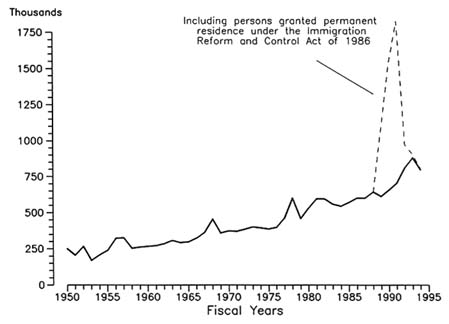
FIGURE 8-1 Immigrants to the United States, 1950–1995.
the number of legal immigrants arriving in the United States annually between 1950 and 1995.3 The spike in the graph for the years 1989 through 1992, shown by the dashed line, includes persons granted permanent residence under the legalization program of the Immigration Reform and Control Act (IRCA) of 1986. Even excluding these "special" immigrants, the figure shows a pronounced upward trend in immigration over the last third of the century. Moreover, if the response to the IRCA can be interpreted as some measure of the "excess supply" of potential immigrants, then the pressure on American borders may have grown much faster than the numbers plotted in Figure 8-1 would suggest.
As a direct consequence of the recent increase in immigration, the fraction of the American population that is foreign born has risen dramatically. Figure 8-2 charts this change for the post-World War II period.4 In the 1950s and 1960s, the small number of immigrants, together with the high fertility of the native population, meant that the fraction of the population that was foreign born actually declined. In 1950 the foreign born comprised 6.9 percent of the population; by 1970 their share had dropped to only 4.8 percent. The increasing numbers of immigrants after 1970 led to a reversal of this downward trend. By 1990 the foreign born had surpassed their 1950 share, accounting for 7.9 percent of the
|
4 |
Bureau of the Census (1975/1997, series A91; 1990:Table 253; 1993:Table 1). |
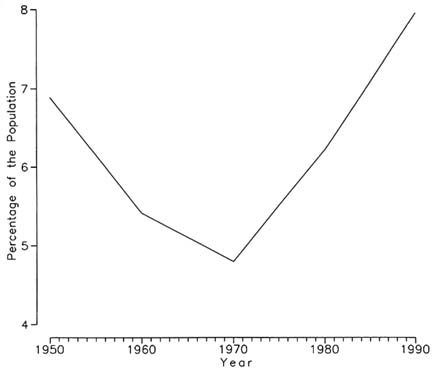
FIGURE 8-2 Foreign born as a percentage of the U.S. population, 1950 –1990.
population. A recent news release by the Census Bureau puts the 1996 share at 9 percent.
Because immigrants tend to be young adults, the recent increase in immigration has had a disproportionate impact on the population in the age range of 20 to 40 years. This is shown in Figure 8-3, which plots the fraction of the foreign-born population by age at three post-World War II census dates.5 In 1950, and even more so in 1970, the foreign born tended to be older than the average American. These people had migrated to the United States in the early decades of the century when they were in their late teens and early twenties. By the post-World War II period, they had aged, but the long period of reduced immigration beginning in the 1920s and lasting through 1970 meant that there were far fewer new recruits at the lower end of the age spectrum. The resumption of heavier immigration in the 1980s and 1990s substantially altered the age structure of the foreign-born population. Because the new immigrants were disproportionately
|
5 |
Bureau of the Census (1975/1997, series A119-A134; 1984:Table 253; 1993:Table 1). |
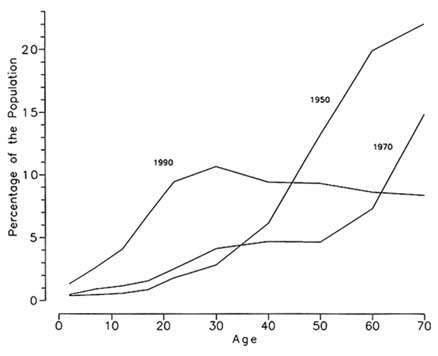
FIGURE 8-3 Foreign born as a percentage of the U.S. population, 1950, 1970, and 1990.
young adults, their arrival increased the foreign-born fraction of the population in the economically active age groups. It is no wonder that the current policy debate over immigration centers on labor market and employment impacts (Borjas, 1995).
Current Flows in Historical Perspective
The level of immigration in the 1980s and 1990s is certainly high in the context of the immediate post-World War II decades—and, indeed, in the experience of almost all of the native-born population of the United States today. Yet it is relatively modest from the perspective of the experience in the period 1880–1914, the era of "mass immigration." Figure 8-4 displays the numbers of immigrants admitted into the United States over the period 1820–1995. This is the same series as the one displayed in Figure 8-1; Figure 8-4 presents this series over
|
6 |
These are the "official statistics" of immigration which are the result of the Passenger Act of March 2, 1819, that required the captain of each vessel arriving from abroad to deliver a manifest of all passengers taken on board in a foreign port, with their sex, age, occupation, country of origin, and whether or not they intended to become inhabitants of the United States. These reports were collected and abstracted for the period 1820–1855 by Bromwell (1856/1969), for the period 1820–1874 by the Secretary of State, for the period 1867–1895 by the Treasury Department's Bureau of Statistics, and since 1892 by the Office or Bureau of Immigration which is now part of the U.S. Immigration and Naturalization Service (1997). The statistics for the period 1820–1910 were compiled by the U.S. Immigration Commission (1911:Volume 1, Table 1, p. 56). The defects of the official series are well known (Bureau of the Census, Historical Statistics of the United States, 1975/1997:97–98, series C89; Jerome, 1926:29–33; Kuznets and Rubin, 1954:55–64; Hutchinson, 1958; Thomas, 1954/1973:42–50; McClelland and Zeckhauser, 1983:32–35; and Schaefer, 1994:55–59). The chief biases are the following: (1) the figures apparently exclude first-class passengers for the early decades, (2) they may include some passengers who died en route, (3) before 1906 they exclude immigrants arriving by land from British North America (Canada) and Mexico, (4) immigrants arriving at Pacific ports before 1849 and at Confederate ports during the Civil War are excluded, and (5) the data measure gross rather than net immigration. Despite these imperfections the official series is thought to measure gross flows reasonably well. |
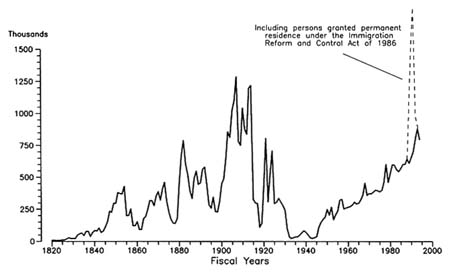
FIGURE 8-4 Immigrants to the United States, 1820–1995.
a longer period of time.6 Although the spike of 1991, reflecting the response to the IRCA, still stands out, the chart reveals that the number of immigrants admitted through normal channels in the recent period is decidedly smaller than the number admitted in the first decade of the twentieth century.
Moreover, the United States was a much smaller country early in the century. To put the current immigration flows into proper perspective, we deflate the numbers of immigrants by the number of people resident in the United States at
|
7 |
The data in Figure 8-5 have been extended back to 1790, and the data before the Civil War have been corrected for the undercounts noted in footnote 6. The figures for 1790–1799 are from Bromwell (1856/1969:13–14) and should be considered as nothing more than educated guesses by contemporaries Blodget (1806/1964) and Seybert (1818). The data for 1800–1849 are estimates made by McClelland and Zeckhauser (1983:Table A-24, p. 113). Those for 1850-1859 are estimates by Schaefer (1994:Table 3.1, p 56). Thereafter the official statistics from the U.S. Immigration and Naturce are used (1997:Table 1, p. 27). The resident population is taken from Bureau of the Census (1975/1997, series A7; 1996:Table 2, p. 8). |
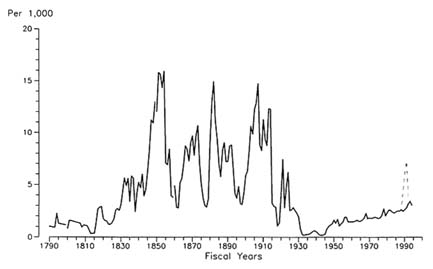
FIGURE 8-5 Immigrants to the United States, 1790–1990 (per thousand of resident population).
the time of the immigrants' arrival and display the result in Figure 8-5.7 Our calculations reveal that, in proportionate terms, the current inflow of immigrants is rather modest. If we look only at the "regular" immigrants—that is, exclusive of those admitted under the IRCA—then the current inflows approximate those in the very slowest years from the period between 1840 and the onset of World War I. Before the imposition of a literary test for admission in 1917 (overriding President Wilson's veto) and the passage of the Emergency Quota Act in May 1921, only the disruptions of World War I pushed the flow of immigrants relative to the native population to levels below the relatively low levels that we experience today.8
Immigration as a Source of Population Change
As a consequence of the large and persistent immigrant flows in the 1845–1914 period, the foreign born came to comprise a rather large fraction of the total population. Figure 8-6 shows that, in the years between 1860 and 1920, the number of resident Americans born abroad ranged between 13 and 15 percent of the total population (Bureau of the Census, 1975/1997, series A91). The foreign-born
|
8 |
Goldin (1994) discusses the legislative and political history of immigration restriction. |
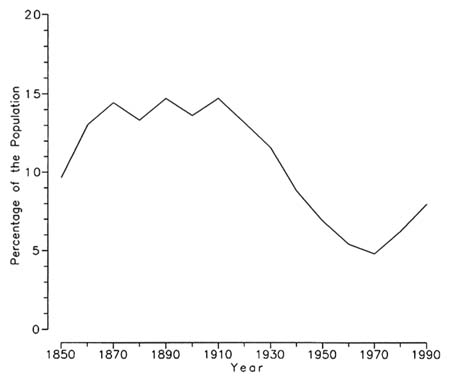
FIGURE 8-6 Foreign born as a percentage of the U.S. population, 1850 –1990.
born fraction of the population in that period was approximately three times the level recorded in 1970 and over one and one-half times as high as it is today.
The historical record thus reveals that the numerical impact of immigration flows were once substantially larger than what we have now and were also larger than the levels we are likely to experience in the foreseeable future. Thus we are tempted to suggest that the economic and demographic consequences of immigration in the 1845–1914 period are likely to have been greater than the impact of immigration flows today.
Yet any comparative analysis should explicitly incorporate at least three ways in which the situation today is different from that of the era of mass immigration. First, the structure of the economy and labor market have changed. Some would say the structure is both more complex and less flexible and that labor markets are more segmented. Second, the government is a much larger entity both in terms of the resources it consumes and the fraction of national income it reallocates through tax and transfer mechanisms. Third, immigration is now regulated. We return to these points later in this chapter.
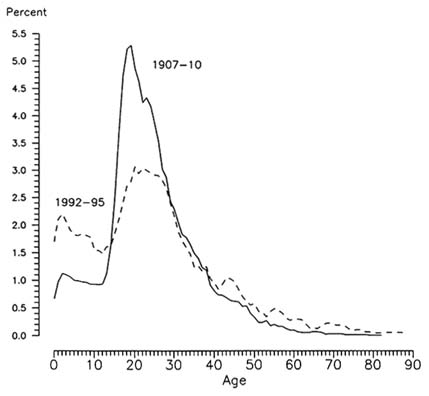
FIGURE 8-7 Age distribution of immigrants to the United States, 1907 –1910 compared with 1992–1995.
Age and Gender of Immigrants
The overwhelming proportion of immigrants are young adults. This is true today and it was so in the early years of the twentieth century as well. Figure 8-7 contrasts the age distribution of immigrants in 1907–1910 with that for immigrants in 1992–1995.9 Clearly, the propensity to immigrate is strongest from
|
9 |
The data for 1909–1910 are based on the Public Use Microdata Sample from the enumerator's manuscripts for the 1910 population census. We use the version of this sample that was prepared in a way that improves their comparability with census samples from other years. This file is known as the Integrated Public Use Microdata Sample or IPUMS (see Ruggles and Sobek, 1995). All immigrants (both males and females) who reported arriving in the United States in 1907 or after were included (n = 7658). This census was taken on April 15, 1910. The sample thus includes all 1907–1909 immigrants and slightly more than one-fourth of the 1910 arrivals. The 1992–1995 data are based on the March Current Population Surveys, or CPS, of the Bureau of Labor Statistics for 1994 and 1995. They include all immigrants who reported a permanent move to the United States during or after 1992. All migrants residing in the United States in 1994 or 1995 who immigrated in 1992–1994 and the first few months of 1995 are included (n = 3841). |
ages 18 to 30 in both periods. One change that is visible is that modern immigrants are more likely to be accompanied with young children than was true in 1907–1910. This finding is understandable in terms of the reduced costs of migration but it also reflects a sharp change in the gender composition of immigrants. In the late nineteenth and early twentieth centuries men were far more likely to come to America than women. This gender imbalance was particularly pronounced among the young adults who constituted the bulk of all immigrants.
Figure 8-8 contrasts the data on gender composition of immigrants by age from the 1907–1910 period with the most recent data available on gender composition. The proportion male was well over 70 percent in the age range 18–40 in 1907–1910. This represents a male-female ratio of more than two to one. For those in their late twenties, the ratio is greater than three to one. The data from the beginning of the century, when the age of independence was younger than today, show a modest imbalance in favor of young women aged 12–16, undoubtedly produced by the earlier maturation of girls than boys. yet the startling
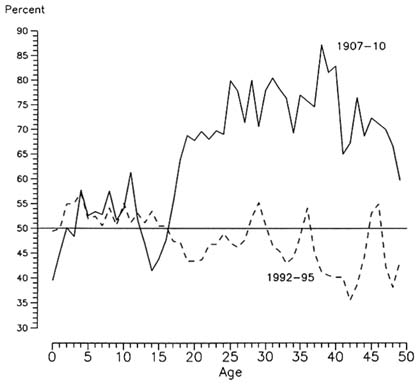
FIGURE 8-8 Proportion of immigrants to the United States who are male, 1907–1910 compared with, 1992–1995.
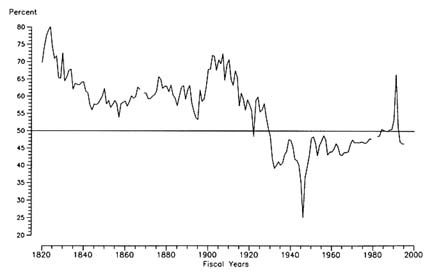
FIGURE 8-9 Proportion of immigrants to the United States who are male, 1810–1990.
finding revealed by Figure 8-8 is the relative gender, equality in immigration in the modern data. Today women actually predominate in the prime migration age cohorts.
The data on the gender of immigrants are available beginning in 1820. 10 The long time series of the proportion male is plotted in Figure 8-9. The predominance of males is clearly a phenomenon of the entire period of uncontrolled immigration but it disappears within a decade following the imposition of limitations in 1921. The spike in 1991 shows the impact of the IRCA, which facilitated the transition to immigrant status of certain illegal alien residents.
The age selectivity of migration and the size of the annual flows affect the age composition of the foreign-born population. Figure 8-10, which displays the fraction of the foreign-born population by age for selected census years beginning in 1870 (Bureau of the Census, 1975/1997, series A119-134), shows that persons resident in the United States at the turn of the century were in the prime working age groups. Although the overall fraction of the foreign-born population in the earlier period was about twice the percentage for 1990 (Figure 8-6), the fraction in the prime working ages was close to three times as great as today. It is no wonder that the first U.S. Immigration Commission (1911) concentrated its attention on the impact of immigration on the labor market and employment.
|
10 |
Census Bureau (1975/1997, series C138-C139); U.S. Immigration and Naturalization Service (1979:Table 10, p. 27; 1990:Table 11, p. 24; 1997:Table 12, p. 54). Official data on gender are not available for 1868, 1980, or 1981. |
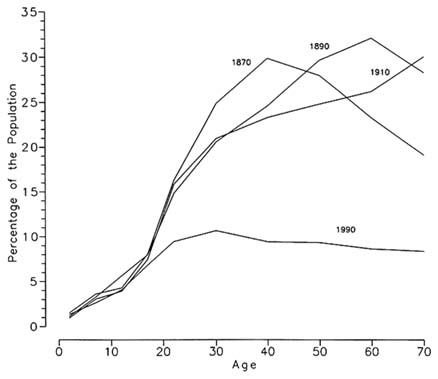
FIGURE 8-10 Foreign born as a percentage of the U.S. population, selected census years.
Return Flows: Sojourners or Permanent Residents?
The literature on the mass migration in the early part of this century emphasizes the role of sojourners who moved to the United States for a temporary period to earn income, accumulate assets, and then returned to their home countries (Baines, 1985, 1991; Wyman, 1993). These temporary migrants in the earlier era bear some similarities with the ''guest workers" in today's Europe or the Braceros of the southwestern United States during the early postwar era.11 Quite possibly, recent illegal immigrants to the United States should be thought of more like these early twentieth-century sojourners than as individuals intending to settle permanently—albeit illegally —in this country (Warren and Kraly, 1985).
|
11 |
The Braceros program was established during World War II to relieve wartime shortages in the agricultural labor markets of Southern California and Texas. These migrant workers were allowed to remain in the United States for up to 18 months. The program was extended after the war and was not ended until 1965 (Feliciano, 1996). |
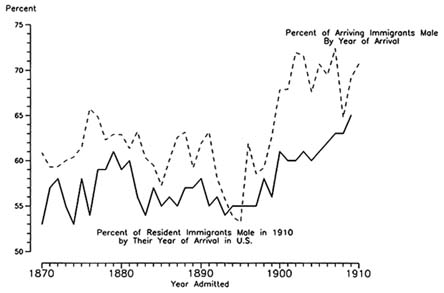
FIGURE 8-11 Proportion of the foreign born in 1910 who were male according to year of arrival compared with proportion of foreign born who were male at various arrival years.
The magnitude of the actual return flows are difficult to measure with precision, yet all of the evidence we have been able to assemble suggests that the return flows were quite large. For example, we think it is interesting to note that, while the age composition of the immigrants had a strong impact on the age distribution of the subsequent foreign-born population, the proportion of males among the foreign-born population recorded at the various censuses from 1880–1910, although greater than 50 percent, was not heavily imbalanced. In Figure 8-11 we make use of the 1910 IPUMS (Ruggles and Sobek, 1995) to calculate the proportion of foreign-born males in 1910 according to their year of arrival in the United States. These numbers are compared with the proportion of immigrants arriving in each year who were male (dashed line).12 The farther the distance back in time from 1910, the smaller the male share among those who arrived in the year and who remained in the United States as compared with the male share among arrivals in that year. Clearly many more male then female immigrants returned to their homelands with just a brief stay in the United States.
Another clue regarding the relative importance of sojourners in the earlier immigrant flows is contained in the time series displayed in Figure 8-9. There,
|
12 |
The immigration data are the same as displayed in Figure 8-9 except that calendar year flows are estimated by averaging the fiscal year data. That is, calendar year 1905 is an average of fiscal year 1905 (which ends June 30, 1905) and fiscal year 1906. |
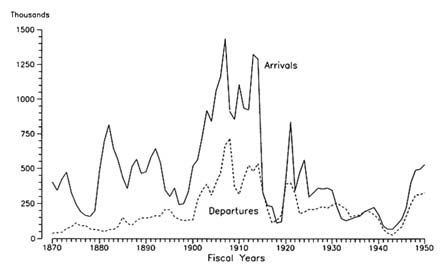
FIGURE 8-12 Alien passenger arrivals and departures 1870–1950.
the predominance of males among new immigrants declines during periods in which the economy was depressed—1857, 1874–1876, 1894–1895, 1920–1921—precisely the same periods when the number of immigrants declined. This cyclical pattern to the male share is consistent with the hypothesis that male immigrants were primarily sojourners whose migration decisions were quite sensitive to economic conditions in the United States.
Certainly it is plausible that a depressed economy would discourage sojourners. But in fact little is known about the phenomenon in the era of mass migration. Before 1908 the official statistics count only arrivals. They do not distinguish between permanent settlers and temporary guest workers, nor is there any comprehensive count of returning immigrants during this period. Kuznets and Rubin (1954: Table B-1, pp. 95–96) have estimated return migration for the period 1870–1908 based on official reports of passenger departures and several assumptions about the mix of American citizens and returning immigrants in the departure data, the mortality of foreign born in the United States, and the mortality of Americans when visiting abroad.13 The Kuznets and Rubin estimates are displayed in Figure 8-12 together with the official departure data from 1908 onward. We have also reproduced the official figures on arrivals in Figure 8-12. This is the same series as the one displayed in Figure 8-4. Figure 8-13 displays what we call the "immigrant return rate." It is the number of departures each year expressed as a percentage of arrivals.
|
13 |
These data from Kuznets and Rubin have been accepted by Hatton and Williamson (1998), who use them for calculating annual estimates of net migration. |
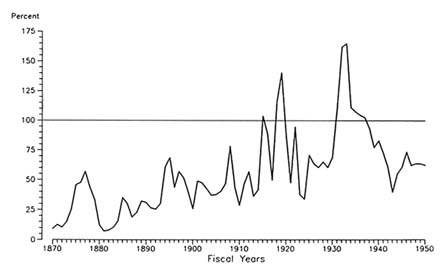
FIGURE 8-13 Immigrant return rate (departures as a percent of arrivals).
Figure 8-13 shows that the return rate rose from less than 10 percent in 1870 and 1881 to over 70 percent just before World War I. This increasing propensity of the United States to attract sojourners makes sense given the declining cost of transatlantic passage due to the continual technological improvement of the steamship following the introduction of scheduled service on the North Atlantic in the 1860s (Baines, 1991:40–42).
Immigration and the American Business Cycle
If we return to Figure 8-4, we find that it reveals another striking difference between the data for the recent and the distant past. In the recent past, immigration flows have increased in almost every year, showing little sensitivity to year-to-year changes in macroeconomic conditions. This is because immigration is today closely regulated and because more wish to migrate than the number of visa slots available. Most successful immigrants have been waiting for admission for several years. Today, year-to-year changes in the number of immigrants reflect policy changes, particularly regarding the admission of refugees and asylees, not changes in demand for admission. In the early period, by contrast, immigration was extremely sensitive to economic conditions in the United States. Between 1891 and 1895, for example, when the unemployment rate almost doubled from 4.5 to 8.5 percent, the number of immigrants fell by more than half, from 560,000 to 259,000. Even more dramatic is the almost 40 percent reduction in the number of immigrants in a single year, from 1.3 million 1907 to 783,00 in 1908 in
response to a sharp jump in the unemployment rate from 3.1 to 7.5 percent between those same years (Bureau of the Census, 1975/1997, series C89; Weir, 1992:341). Jerome (1926:208) concluded that the lag between economic activity and immigration in this period was only one to five months.
The relationship between the American business cycle and the flow of immigrants has been examined extensively (Jerome, 1926; Thomas, 1954/1973; Abramovitz, 1961; Williamson, 1964; Easterlin, 1968). The consensus is that the pull forces of American opportunities dominated the push forces of European poverty, land scarcity, and military conscription (Easterlin, 1968:35–36; Cohn, 1995). Thomas (1954/1973) has developed an elegant model of the "Atlantic economy" as an integrated economic unit with flows of immigrants, goods, and capital moving in a rhythm of self-reinforcing and inversely related long-swing Kuznets cycles.14 This raises the possibility that immigration acted as a "governor" for the economy, slowing down the booms and cushioning the depressions. Early writers on the business cycle such as Mitchell did not believe that immigration was likely to have been a major factor in moderating the cycle (1913:225–228). Jerome on balance thought immigration may have exacerbated depressions, but his conclusion drew a strong rejoinder from Rorty.15 More recent work on the business cycle tends to ignore the role of immigration, perhaps for the obvious reason that the cyclical nature of the immigration flows ended with the Quota Act. However, Thomas (1954/1973) and Hickman (1973) have both suggested that the reduction in immigration was responsible for the decline in demand for housing that preceded and may have contributed to the Great Depression.
It was not just the inflow of immigrants that responded to economic conditions in this country; the outflow of emigrants also responded to the rate of unemployment. Figure 8-13 shows large increases in the rate of departure during the business downturns after 1873, in 1885, after 1893, and in 1908. Throughout the period preceding World War I, the inward and outward movements of immigrants show a negative correlation.16 In 1910 and 1913, when arrivals are up, departures are down. In 1912, when arrivals are down, departures are up. The relationship changes with the onset of the war. Both arrivals and departures are down during the war years and up during the immediate postwar period.
|
14 |
Fishlow (1965:200–203) has expressed doubts about the Thomas model. |
|
15 |
Jerome (1926:120–122) was impressed by the fact that net immigration was positive even during times of depression (he was writing before the Great Depression). Rorty, who as a Director of the National Bureau of Economic Research (NBER) by appointment of the American Statistical Association, had the right to attach a dissenting footnote to Jerome's NBER Occasional Paper, correctly, we think, pointed out that the cause of the growth rate in the population should be irrelevant to population growth's impact on the business cycle. Because immigration flows slowed during business downturns, the cyclical movement of immigration can only have helped reduce the magnitude of the unemployment problem. |
|
16 |
However, a glance at Figure 8-12 reveals that the magnitude of changes in departures is much smaller than that for arrivals. |
Kindleberger (1967), commenting on the European economy in the post-World War II period, has emphasized the potentially important role that sojourners might play in moderating the business cycle. In the upturns an elastic labor supply from abroad might relieve bottlenecks, moderate wage increases, and thereby extend an expansion. In downturns an elastic labor supply can reduce downward pressure on the wage rates earned by the resident population and reduce the drain on public coffers for support of the unemployed. Recently, Hatton and Williamson (1998) have revived the issue of the role of sojourners in moderating the consequences of economic fluctuations in the United States. They compare the actual course of the business cycle of the 1890s with a "no-guest-worker counterfactual" and conclude that the impact of guest workers on moderating the business cycle was "surprisingly small." This assessment is based on their finding that "free migration muted the rise in unemployment during the biggest pre-World War I depression, 1892 to 1896, by only a quarter." Size, of course, is in the eye of the beholder. Some would judge this effect as gratifyingly large. Clearly, an important area for further research would be to improve our understanding of the impact of the sojourner on the American economy at the turn of the century, especially in light of the possibility that illegal migrants might be playing a similar role in the American economy today.
The Question of Immigrant "Quality"
Although it is probably an unfortunate term, the historical literature has given considerable attention to the issue of immigrant "quality." Simply put, the question is whether the United States attracted the more-highly skilled, the more entrepreneurial, and the more adventurous from abroad, or whether it received the "tired, … poor, your huddled masses," the unlucky, the least educated, and the least able?17 Presumably, "high-quality" immigrants would accelerate economic growth, vitalize and enrich the society, and more quickly assimilate into the American "melting pot.'' "Low-quality" immigrants would, it has often been charged, be more likely to become a burden on the economy, exacerbate inequality, and prove to be a disruptive social force.
In 1891 Francis Walker, the first President of the American Economic Association and former Superintendent of the U.S. Census, expressed his opinion on the matter with little generosity:
[N]o one can surely be enough of an optimist to contemplate without dread the fast rising flood of immigration now setting in upon our shores. …[T]he
|
17 |
Recall the poem by Emma Lazarus inscribed at the base of the Statute of Liberty: Give me your tired, your poor, Your huddled masses yearning to breathe free, The wretched refuse of your teeming shore. Send these, the homeless, tempest tossed to me: I lift my lamp beside the golden door. |
immigration of the present time … is tending to bring to us no longer the more alert and enterprising members of their respective communities, but rather the unlucky, the thriftless, the worthless. … There is no reason why every stagnant pool of European population, representing the utterest failures of civilization, the worst defeats in the struggle for existence, the lowest degradation of human nature, should not be completely drained off into the United States. So long as any difference of economic conditions remains in our favor, so long as the least reason appears for the miserable, the broken, the corrupt, the abject, to think that they might be better off here than there, if not in the workshop, then in the workhouse, these Huns, and Poles, and Bohemians, and Russian Jews, and South Italians will continue to come, and to come by millions (Walker, 1891, as quoted in Handlin, 1959:73–74).
Treatment of immigrant "quality" is intimately bound up with the pull versus push debate about the motives underlying immigration. If immigrants were pushed out of their home country by increasing immizeration, lack of jobs, or shortage of land, the presumption is that immigration would tend to select individuals from the lower tail of the skill and resourcefulness distributions of their country of origin. On the other hand, if immigrants were pulled to the United States by the attractiveness of American opportunities, they are more likely to come from the upper tail of the home country distribution. 18
Did Migration Select the Best from Europe?
Whether looked at from the point of view of the attributes of the arrivals or the push versus pull controversy, the consensus among economic historians is that, before World War I, America selected immigrants from the upper tail of the
|
18 |
Historical studies of immigration debate the relative importance of these "push" and "pull" forces. We note that the differential selectivity of push and pull forces is not a certainty. The push view is based on a threshold model in which low incomes in the origin country depress incomes in the lower tail of the income distribution below some intolerable poverty line. This is thought to compel the migration of the most wretched. Those more fortunately situated are thought to want to remain. Those critical of the push view note that the very poor do not have the resources to afford long-distance migration. This emphasis moderates or even reverses the conclusion that push works to select the least able and least skilled. The pull model assumes that those with the highest ability and the most education will have the most to gain by transferring their skills to a country with a higher capital-labor ratio and a stronger growth-induced excess demand for skilled workers. This conclusion is not a certainty, either. Perhaps the highly skilled can earn more at home in a poor country or perhaps their relative income position matters most to them. If so, they would prefer to be a big fish even if they have to live in a small pond. The recent literature on the selectivity of immigration in the modern period makes heavy use of a different model of selectivity developed by Roy (1951). For an application to modern immigration patterns see Borjas (1987, 1994). The Roy model focuses on differences between countries in the variance of their earnings distributions as well as in the mean. Countries with a large variance in earnings tend to select immigrants from the upper tail of the earnings distribution in sending countries; the reverse is true for countries with small earnings variance. |
skill distribution in their countries of origin (Easterlin, 1971; Dunlevy and Gemery, 1983). Mokyr (1983:247–252), for example, has studied the occupations of Irish immigrants before 1850 and concluded that immigration selected from the upper tail of the occupational distribution of Ireland, although the magnitude of the difference between the occupational mix of immigrants and that of the resident population of Ireland was small.19 Authors who emphasize the pull of American opportunities suggest that these forces would select the higher-skilled, better-situated members of European society. Even Thomas (1954/1973: 56–62), one of the relatively few writers who sees a strong role for push factors in motivating immigration, agrees that migrants to the United States tended to come from the upper strata of their own societies.
How Did Immigrants Compare with Native-Born Workers?
Whether these select workers from Europe's perspective appeared as high-skilled and advantaged competitors in the American labor market is more controversial. It could be true that immigrants selected from the upper tail of their home country's distribution of skills and other endowments nevertheless fell below the median of native-born American workers. It has also been asserted that the quality of immigrants fell as mass migration continued. A popular textbook in economic history states that "It is probably true that immigrants after 1880 were less skilled and educated than earlier immigrants."20
Historians have sometimes asserted or assumed that the bulk of immigrants were unskilled.21 Handlin (1951/1973:58, 60) in the classic history of immigration to America, The Uprooted, described immigrants as "peasants," people who lacked training for merchandising and the skills to pursue a craft. This view also appears in some surveys of American history. The textbook by Nash et al. (1986:604), for example, reports that "most immigrants" after the Civil War "had
|
19 |
Others who have reached similar conclusions include Baines (1985:51 –52), Erikson (1972, 1981, 1989, 1990), and Van Vugt (1988a, 1988b). Cohn (1992, 1995) has criticized this work for using biased samples that underestimated the numbers of laborers and farmers in the years before the Civil War. The issue is how to treat the "questionable" passenger lists. These are lists on which every passenger is recorded as a laborer (or farmer) usually by the use of ditto marks down the occupation column. Most researchers have excluded such lists from their samples. Cohn disagrees. When Cohen includes the questionable lists in his sample, he finds more laborers and farmers among immigrants from England and Scotland and more laborers and servants from Ireland than in the occupational distributions of the countries of origin. In the case of Germany, on the other hand, Cohn's work supports the select immigrant hypothesis. |
|
20 |
Walton and Rockoff (1994:402). This exact sentence has passed down to this edition of the textbook from Robertson (1973:387) through Walton and Robertson (1983:444). None of these texts offers a citation or evidence. |
|
21 |
The proposition advanced in this literature is that the immigrants arrived without skills acquired in their home country. This is somewhat different from asserting that immigrants took unskilled jobs in this country regardless of their ability to perform skilled work. |
few skills." Cliometric investigation suggests a quite different story. Available evidence implies that skill differences between native- and foreign-born workers throughout the period of mass immigration were small or nonexistent and that the relative quality of immigrants did not fall over time.
Occupations of Arriving Immigrants
One source of evidence on the relative skills of newly arriving immigrants are the ship manifests giving the occupation of arriving passengers, recorded since the United States began the formal collection of immigration statistics in 1819. These data have been compiled by broad occupational grouping in Historical Statistics of the United States (Bureau of the Census, 1975/1997, series C120–137) and by more detailed occupations for 1819–1855 in Bromwell (1856/1969). Table 8-1 displays the occupational distribution of immigrants who reported an occupation at the time of their arrival into the United States according to broad occupational categories. Figures are presented as decadal averages for the 50-year period 1861–1910. The high proportion of immigrants describing themselves as unskilled laborers in the passenger lists (40–50 percent before 1900) seems to suggest that the skill content of immigration during this period was low. At the same time, farmers and agricultural workers are not particularly evident. They are certainly proportionately less evident in the immigrant flows than in the resident American labor force.
Table 8-2 compares Lebergott's (1964) estimates of the percentage of the resident labor force in the agricultural sector over the 50-year period beginning in 1861 with comparable data on the occupations of arriving immigrants presented
TABLE 8-1 Occupation Upon Arrival to the United States for Immigrants Reporting an Occupation, 1861–1910
|
Decade |
Total |
Agriculture |
Skilled Labor |
Unskilled Labor |
Domestic Service |
Professional |
All other Occupations |
|
1861–1870 |
100.0 |
17.6 |
24.0 |
42.4 |
7.2 |
0.8 |
8.0 |
|
1871–1880 |
100.0 |
18.2 |
23.1 |
41.9 |
7.7 |
1.4 |
7.7 |
|
1881–1890 |
100.0 |
14.0 |
20.4 |
50.2 |
4.9 |
1.1 |
9.4 |
|
1891–1900 |
100.0 |
11.4 |
20.1 |
47.0 |
5.5 |
0.9 |
15.1 |
|
1901–1910 |
100.0 |
24.3 |
20.2 |
34.8 |
5.1 |
1.5 |
14.1 |
|
NOTE: The category "All Other" consists primarily of managers, sales and clerical workers, and self-employed proprietors and merchants. SOURCE: Ernest Rubin. "Immigration and the Economic Growth of theU.S.: 1790–1914." Conference on Income and Wealth. New York: National Bureau of Economic Research, 1957: 8. As reportedin Elizabeth W. Gilboy and Edgar M. Hoover. "Population and Immigration.''In Seymour E. Harris, ed., American Economic History. New York: McGraw-Hill, 1961, table 7: 269. An obvious error inthe Domestic Service column for the last three decades has been corrected. |
|||||||
TABLE 8-2 Agricultural Occupations as a Percentage of All Occupations in U.S. Work Force and the Percentage of Immigrants Reporting an Agricultural Occupation Upon Arrival, 1860–1910
|
Decade |
Agriculture Occupations as a Percentage of United States Work Force |
Percentage of Immigrants Reporting an Agricultural Occupation Upon Arrival |
|
1861–1870 |
52.7 |
17.6 |
|
1871–1880 |
51.8 |
18.2 |
|
1881–1890 |
46.4 |
14.0 |
|
1891–1900 |
41.3 |
11.4 |
|
1901–1910 |
35.2 |
24.3 |
|
NOTE: The figures on agricultural occupations as a percentage of the resident U.S. workforce are averages of data for the two census years that span each decade. That is, the figure for 1861–1870 averages the data for 1860 and 1870. SOURCES: Occupations of the U.S. workforce: Stanley Lebergott. Manpower in Economic Growth: The American Record Since 1800. New York: McGraw-Hill, 1964, table A-1: 510. Occupations of arriving immigrants: Ernest Rubin. "Immigration and the Economic Growth of the U.S.:1790–1914." Conference on Income and Wealth. New York: National Bureau of Economic Research, 1957: 8. As reportedin Elizabeth W. Gilboy and Edgar M. Hoover. "Population and Immigration."In Seymour E. Harris, ed., American Economic History. New York: McGraw-Hill, 1961, TABLE 7: 269]. An obvious error inthe Domestic Service column for the last three decades has been corrected. |
||
from Table 8-1.22 In no decade is the proportion of agricultural workers in the immigrant flow over 25 percent; in no decade is the proportion of agricultural workers in the American labor force less than 35 percent. Because farmer and agricultural occupations are generally classified as unskilled, this evidence implies that a large fraction of the American labor force was also unskilled in the nineteenth century. The high proportion of laborer occupations among the arriving immigrants cannot support the suggestion that new immigrants were less skilled than the average resident worker.
Also, immigrants do not appear to have been particularly deficient in skills as compared with the nonagricultural labor force in the United States. Table 8-3 makes the comparison for the first decade of the twentieth century, the first decade for which the required data are available. Taking the usual definition of skilled workers—craftsmen, foremen, and kindred workers—Table 8-3 reveals a higher proportion of skilled workers among the immigrants, 26.7 percent, than
|
22 |
Because the populations of the primarily European origin countries were more heavily agricultural than the American population and because by most accounts the agricultural labor force in Europe ("peasants") were the least skilled and least educated of European workers, these data provide further support to the conclusion stated above that the immigrants tended to come from the higher strata of European society. |
TABLE 8-3 Occupational Distribution of Nonagricultural Workers in the U.S. Work Force in 1910 and Occupations Reported by Immigrants Upon Their Arrival During the Decade 1900–1910
|
Occupation Classification |
U.S. Work Force |
Immigrants |
|
Skilled |
16.8 |
26.7 |
|
Unskilled |
39.3 |
46.0 |
|
Domestic Service |
14.1 |
6.7 |
|
Professional |
6.8 |
2.0 |
|
All Other |
23.0 |
18.6 |
|
NOTE: For the U.S. labor force the occupational classification for skilled corresponds to "craftsmen, foremen and kindred workers," unskilled are "operative and kindred workers and laborers except farm and mine" domestic service include "private household workers and [other] service workers," and professional include ''professional, technical, and kindred workers." SOURCES: U.S. Workforce: David L. Kaplan and M. Claire Casey. Occupational Trends in the United States, 1900–1950. U.S. Bureau of the Census Working Paper No. 5. Washington: U.S.Government Printing Office, 1958. As reported in United States Bureauof the Census. Historical Statistics of the United States, Colonial Times to 1970,Bicentennial Edition. Two volumes. Washington: U.S. Government PrintingOffice, 1975. Electronic edition edited by Susan B. Carter, ScottS. Gartner, Michael R. Haines, Alan L. Olmstead, Richard Sutch, andGavin Wright. [machine-readable data file]. New York: Cambridge UniversityPress, 1997, Series D182–198. Occupations of arriving immigrants: Ernest Rubin. "Immigration and the Economic Growth of the U.S.:1790–1914." Conference on Income and Wealth. New York: National Bureau of Economic Research, 1957: 8. As reportedin Elizabeth W. Gilboy and Edgar M. Hoover. "Population and Immigration."In Seymour E. Harris, ed., American Economic History. New York: McGraw-Hill, 1961, table 7: 269. An obvious error inDomestic Services has been corrected. |
||
among the resident American labor force, 16.8 percent. Table 8-3 also reveals a relatively lower proportion of domestic servants among arriving immigrants.
Yet as we have noted, at the same time, immigrants were relatively more likely to report "unskilled" occupations than were American workers, which complicates the interpretation of the data. Moreover, and not surprisingly given the young ages of immigrants, professionals were also not well represented among the new arrivals. In an effort to help clarify the picture, we have grouped the skilled, the professional, and "all other" occupations into a single category and contrast the share of these relatively high-status occupations with the share of the unskilled and domestic service occupations. This exercise reveals that 47.3 percent of the nonagricultural immigrants reported relatively high-status occupations while 52.7 percent were unskilled or in domestic service. In this sense, immigrants were (slightly) more likely to be unskilled than skilled. Yet this distribution is nearly exactly the split within the resident American nonagricultural labor force: 46.6 percent in relatively high-status occupations and 53.4 percent in either unskilled or domestic service occupations. We might even say that the newly arriving immigrant nonagricultural work force in this decade was (slightly) more skilled than the resident American labor force.
The data on the occupations of arriving immigrants, shown in Table 8-1,
reveal very little in the way of a trend over time. The high-status occupations accounted for a stable 40 percent of immigrants reporting nonagricultural occupations between 1860 and 1900 and then rose to 47 percent in the final decade before World War I. This evidence contradicts the frequently made claim—put forth without evidence—that the skills of immigrants were falling in this period.
Of course, there is good reason to be cautious about data on immigrant skills. The occupations were self-reported and recorded by ship captains who may have imposed prejudices of their own. Presumably the new arrivals reported the occupation they had followed in the old country, but perhaps young immigrants reported their father's occupation or perhaps some reported their intended occupation in America. In any case, there is strong evidence that many of the new arrivals took jobs other than those they reported on entry. Farming, in particular, was difficult to enter because of the cost of purchasing and equipping a farm and the evident fact that a year's worth of provisions or credit would be required before the first crops came in. Differences in technologies, the quality of the final product, and the organization of trades may have reduced the value of European-acquired skills (Eichengreen and Gemery, 1986). For this reason many researchers have examined, not the occupations immigrants reported on arrival, but the occupations actually taken up by immigrants in their new home.23
Occupations of the Foreign Born in the United States
The federal census provides data on the occupations of the labor force by the nativity of the worker. Hill (1975) categorized these occupations as either "skilled," "semiskilled," or "unskilled,'' using the classification devised by Edwards (1943). The results of this exercise led Hill to conclude that "the native and foreign born were of relatively comparable economic status" during the period of mass immigration (Hill, 1975:59). Although the foreign born were slightly less likely to have been employed in skilled positions and slightly more likely to have been employed in unskilled positions, they were much more likely to have held semiskilled jobs. Their share of the semiskilled jobs is disproportionately large enough to bring them close to occupational parity with the native
|
23 |
Occupations actually taken up by immigrants will not adequately indicate their skills either if immigrants face discrimination in their entry into occupations. A number of scholars have argued that immigrants did in fact face occupation-based discrimination during the era of mass migration (Azuma, 1994; Barth, 1964; Brown and Philips, 1986; Cloud and Galenson, 1987; Daniels, 1962; Hannon, 1982a, 1982b; Higgs, 1978; LaCroix and Fishback, 1989; Liu, 1988; Murayama, 1984; and Saxton, 1971). But see Chiswick (1978a, 1978b, 1991a, 1991b, 1992, 1994) for an analysis that emphasizes the role of human capital in immigrant occupational attainment. The consensus in the literature is that within occupations immigrants were paid roughly equal pay for equal work (Blau, 1980; Ginger, 1954; Higgs, 1971a; McGouldrick and Tannen, 1977). |
born despite their disadvantage at the upper and lower ends of the occupational spectrum.24
WAS IMMIGRATION GOOD FOR GROWTH?
Mass immigration occurred during a period of very rapid economic growth and America's ascendancy to international industrial leadership (Wright, 1990; Abramovitz, 1993). Most of the historians and economic historians who have studied immigration have tried to assess its relationship to these positive economic developments. To do so they relied, explicitly or implicitly, on a model of economic growth and of factor mobility. For those unfamiliar with this literature, it will be helpful to begin with some key definitions and a simple version of the model.
Defining Growth
There is little doubt that immigration caused the American population and the American labor force to grow more rapidly than it would have in its absence.25 Figure 8-14 shows the contribution of net immigration to American population growth. During the period of mass immigration preceding World War I, immigration accounted for somewhere between a third and a half of U.S. population growth.26
More workers meant more output. Population, after all, is fundamental to production, not only because people supply the labor required, but because the consumption of the population is the raison d'& ecirc;tre of the production system. Thus the size of the economy, measured, say, by real gross domestic product (GDP), grew more rapidly than it would have without immigration. This is, we think,
|
24 |
The semiskilled class is largely made up of factory operatives, a class of occupations that is classified as "unskilled" in Table 8-1. |
|
25 |
Because net immigration was positive throughout the entire history of the country before World War I, this would be a tautology except for the possibility that the flow of immigrants somehow might have induced a decline in the natural rate of increase of the native-born population sufficiently large to numerically cancel the inflow. This possibility was actually suggested by Walker (1891, 1896). Although it is true that both the fertility rate and the rate of net population growth from natural increase fell over the nineteenth and first third of the twentieth centuries, most demographic studies of population dynamics lend little or no support to the Walker hypothesis. We summarize this literature in the section of this chapter on population dynamics. |
|
26 |
It is interesting to note that net immigration also accounts for about a third of the growth in the U.S. population today. This is true despite the fact that the numbers of arriving immigrants are smaller and the base population is larger today than it was in the decades immediately preceding World War I. The reason for the relatively large contribution of immigration to American population growth today is that the rate of natural increase is so low. Data on net immigration come from McClelland and Zechhauser (1983) for 1820–1860, Kuznets and Rubin (1954) for 1870–1940, and the Bureau of the Census (1990, 1993) for the recent period. |
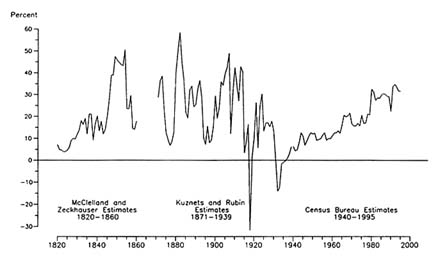
FIGURE 8-14 Net immigration's contribution to national population growth.
what historian Maldwyn Allen Jones had in mind when he wrote in his classic book, American Immigration:
The realization of America's vast economic potential has … been due in significant measure to the efforts of immigrants. They supplied much of the labor and technical skill needed to tap the underdeveloped resources of a virgin continent. This was most obviously true during the colonial period. … But immigrants were just as indispensable in the nineteenth century, when they contributed to the rapid settlement of the West and the transformation of the United States into a leading industrial power (Jones, 1992/1960:309–310).
But this concept of growth, sometimes called "extensive growth," is not what economists usually mean by the phrase "economic growth." Instead, the growth of labor productivity, or the growth of per capita output, or the growth in the standard of living—''intensive growth" —is usually of greater interest. Labor productivity for the economy as a whole is measured by dividing GDP by the number of workers. Thus, if productivity is to grow, GDP must grow faster than the employed labor force. If per capita output is to grow, GDP must grow faster than the population. so the question becomes: Does immigration increase or reduce labor productivity? If workers are paid a wage that reflects their productivity, we can ask the same question as: Does immigration increase or reduce the real wage?27
|
27 |
There are other influences on the real wage than productivity. Of particular importance in this context would be discrimination (presumably against immigrants and in favor of native-born workers) and unionization (presumably weakened by heavy immigration). |
The statistical record is clear: Intensive economic growth did take place during the era of mass immigration. Per capita GDP grew in real terms (Balke and Gordon, 1986), so did labor productivity. Real wages rose (Long, 1960; Rees, 1960). Nonetheless, this evidence is not adequate to rule out a harmful role for immigration. During the late nineteenth century, and, indeed for most of U.S. history, output per worker was growing.28 Thus, the real question is whether immigration retarded or accelerated the rate of intensive growth.
At first glance it would appear that there is no clear consensus among economic historians about the impact of turn-of-the-century immigration on the rate of intensive growth. The most careful of the several reviews of the historical literature, that by Atack and Passell (1994:236–237), concludes that there was a large, positive, and "profound" effect of immigration on the rate of growth measured in per capita terms. On the other hand, Williamson asserts without qualification that
The issue in American historiography, however, has never been whether immigration tended to suppress the rise in the real wage. … Surely, in the absence of mass migrations, the real wage would have risen faster … (Williamson,1982:254).
Hatton and Williamson test this proposition in their recent book, The Age of Mass Migration: An Economic Analysis.29 They conclude that late nineteenth- and early twentieth-century immigration "significantly retarded the growth of real wages and living standards economy-wide" (Hatton and Williamson, 1998:Chap. 8).
It seems to us that there are three factors that underlie the apparent divergence of opinion about the impact of immigration: definitions of the population of interest, composition effects, and model specification.
Defining the Population of Interest
Which is the population for whom the effects of immigration are to be measured? Is it the entire population, including the newly arrived immigrants? Is it the population resident in the United States at the time of the immigrants'
|
28 |
Annual additions to per capita output averaged 1.7 percent per year in the early era of mass immigration between 1901 and 1913 (two business-cycle peaks). (This calculation is based on figures reported in Bureau of the Census (1975/1997, F4). This sustained growth meant that over that 12-year period, average per capita income increased nearly 25 percent. This calculation includes the newly arrived immigrants in the base population. Changes in the standard of living over a lifetime are very sensitive to small changes in the annual rate of growth. For example, with an annual rate of growth of only 1 percent, output increases 63 percent over a 50-year period. With a 2 percent growth rate the improvement is 164 percent, and with a 5 percent growth rate (much slower, by the way, than the rate of growth of per capita output in China today) the standard of living increases 100-fold. |
|
29 |
This book is scheduled to be published in 1998. Hatton and Williamson graciously provided us with a manuscript copy at the time we were writing this chapter. |
arrival? Perhaps it is the native born, or even the native born of native parentage. Are workers alone to be considered, or the workers and their dependents? Just workers and their families, or capitalists and landowners as well? Any of these populations may be a legitimate focus of attention. The appropriate definition depends on the question being asked. One source of confusion in the literature stems from the fact that scholars have not always been explicit about the definition they have chosen.30
Composition Effects
To measure the impact of immigration on the wages of natives and of past immigrants, one needs to partition the population between the resident population and the new immigrants and consider changes in the welfare of the resident population alone. For the most part, however, long-term historical data on wages, income, and wealth are available only for the population as a whole. Scholars are forced to deduce the impact of immigration on the welfare of the resident population (or the native born or the native born of native parents) from data on the entire population.
Such a project is, of course, fraught with hazards. An aggregate time series on wage rates (or living standards) may rise slowly or even fall at the same time that the wages of both the resident population and the newly arrived immigrants are rising rapidly. This would occur if, say, the newly arrived immigrant share of the population were rising rapidly and the wages of the newly arrived immigrants were below those of the resident workers.
Model Specification
To assess the impact of immigration on intensive economic growth, economic historians have implicitly or explicitly relied on a theoretical construct known as the "aggregate production function." This approach asserts that the aggregate output produced by an economy (its gross national product) is determined by the quantities and qualities of its "factors of production": capital, labor, and land. Technological progress plays a role too, either because better machines and tools are used ("embodied" technical change) or because existing machines and tools are organized in better ways ("disembodied'' technical change).
Capital includes machinery and buildings and other structures—all of the
|
30 |
Thus, it becomes clear only after a careful reading that Lebergott (1964:163) is interested in the impact of immigration on the wage rates of the entire population of workers, including the wages of the newly arrived immigrants. Hatton and Williamson (1998:Chap. 8), however, cite Lebergott in support of their contention that immigration slowed the growth rate of wages of natives and of past immigrants in the early decades of this century. |
manufactured physical inputs into the production process that contribute to the level of output. Labor includes number of persons involved in the production process, their hours of work per day, their days of work per year, the intensity of their work effort, and their level of skill. Land includes improvements to land, natural resources, and raw materials. A key feature of this theoretical construct is that it focuses attention on the productivity of factors of production and on the possibility of substitution among capital, labor, and land. Thus, for example, an increase in labor (perhaps from immigration) would be supposed to raise the productivity of capital and thus would create an incentive to invest and further expand the capital stock.
The aggregate production function approach is used to compare the historical record with an explicit counterfactual; a comparison between the historical record and an explicit counterfactual; a comparison of "what was" with "what might have been" had immigration flows been absent or reduced. To assess the impact of immigration on growth, the investigator must specify a general equilibrium model of both the labor and capital markets and of the production and distribution of output.31
The counterfactual method has a long history in cliometric work.32 By now it is clear that the outcome of such an exercise is quite sensitive to the specification of the formal theoretical model that describes the workings of the counterfactual universe. The aggregate production function must be specified mathematically and assigned numerical parameters. Is the production function Cobb-Douglas, or constant elasticity of substitution (CES), or Leontief? Are there economies of scale? Is the growth of the capital stock constrained by the flow of savings or by available investment opportunities? Is the model static or dynamic? The results also depend upon the assumptions built into the model about the distribution of wealth, income, and employment. Are workers paid their marginal product? Are governments redistributive? Do immigrants import or export capital? Do immigrants and native born have different savings propensities? Is the macro economy Keynesian or neoclassical? Because the conclusions reached through counterfactual modeling are so sensitive to the model's structure, the persuasiveness of any such exercise depends crucially upon the plausibility of the model specification.
Given this state of affairs, the most helpful thing we can do is to describe some of the prominent arguments about relevant aspects of the economy that appear in the literature. The reader will note that many of these issues are difficult to resolve with the available data and that the literature itself has given insufficient attention to the data that are available. In the absence of more
|
31 |
For an early and influential example of the counterfactual method that uses a computable general equilibrium model to examine the immigration question with late nineteenth-century data, see Williamson (1974a). Williamson concludes, "An America without immigrants indeed would have grown very differently from how she actually did in the late nineteenth century" (p. 387). |
|
32 |
For a discussion see Fogel (1967). |
empirical work, the conclusion readers reach will depend in large part on their tastes for various theoretical constructs. In the process of constructing our catalog, we reveal our own priors.
Labor Force Participation of Immigrants
Most economic historians noted that early twentieth-century immigration caused the labor force to grow more rapidly than the population (Kuznets, 1952:196–204). Immigrants in that period were disproportionately young males and more likely than their native-born counterparts to be labor force participants. Most economic historians place great weight on the fact that immigrants who arrived in the last era of mass migration were far more likely to participate in the labor force than the average American at the time. This pattern is shown in Table 8-4, which displays the share of the native- and foreign-born populations engaged in the work force for the decennial census years 1870 through 1940. The participation rate for the foreign born is 50 percent or more from 1880 onward, with the rate rising with the rising tide of immigration. The participation rate of the native born is only about two-thirds of this level. Kuznets explained the high labor force participation of immigrants in this way:
Because the immigrants were predominantly males, because by far the preponderant proportion of them (over 80 percent) were over 14 or 15 and in the prime working ages, and because their participation in the labor force tended to be higher than that of the native population even for the same age and sex classes,the share of foreign born among the gainfully occupied was, throughout the period,markedly greater than their share in total population (Kuznets, 1952,1971b).
we have already examined data demonstrating the predominance of males of young working ages in the turn-of-the-century immigrant streams. If these foreign-born workers were as productive as the native born and if their arrival did not depress the capital-labor ratio (that it did not is commonly supposed in the historical literature), then immigration would cause per capita income of the resident population to rise more rapidly than it would have in the absence of immigration (Gallman, 1977:30).33
The first element of the argument—that overall per capita incomes tend to rise because of the immigration-induced increase in the labor force participation rate— is well established. The balance of the argument—that immigration had at least a short-term positive impact on the economic well-being of the resident population— depends on two assumptions that are less well supported by empirical work. One
|
33 |
As already mentioned, in the short run the influx of new labor is likely to depress the capital-labor ratio before it is restored through new investment. If the capital stock is disproportionately owned by native-born residents, as was surely the case in the late nineteenth and early twentieth centuries, then native-born owners of capital will benefit temporarily from higher returns to capital. Indeed, it is this higher return to capital that (in part) is thought to induce an increased volume of investment that ultimately restores the capital-labor ratio to its preimmigration level. |
TABLE 8-4 Labor Force Participation Rate, Native and Foreign-Born, 1870–1940
|
Year |
Native Born |
Foreign Born |
|
1870 |
29.7 |
48.5 |
|
1880 |
32.0 |
52.2 |
|
1890 |
33.1 |
55.1 |
|
1900 |
35.5 |
55.5 |
|
1910 |
37.7 |
57.8 |
|
1920 |
37.8 |
55.7 |
|
1930 |
38.1 |
52.2 |
|
1940 |
39.1 |
50.5 |
|
NOTE: "Labor force participation rate" is defined here as the share of the total population of a given nativity that is engaged in the workforce. SOURCE: Calculations are based on Kuznets (1971b). |
||
point has to do with the nativity differences in worker productivity (or immigrant "quality") discussed above. The consensus is that any differences in the average productivity of the native- and foreign-born work force were small. The second key point—the impact of immigration on capital formation—has been left largely to assumption and speculation. Very little empirical work with historical data has been reported in the literature. There are really two questions. One is, was the growth of capital constrained by saving (at a given interest rate) or was it constrained by the growth of investment opportunities? A second question is to what extent did immigrants either import physical capital or save heavily?
Immigration and the Capital-Labor Ratio
In the short run at least, an influx of immigrants who do not bring capital with them will have the effect of "diluting" the capital stock, that is, reducing the economy-wide capital-labor ratio. If capital and labor are substitutes, this reduction in the capital-labor ratio will raise the rate of return to capital and lower the real wage of workers. The overall impact of this dilution of capital on the initial resident population is predicted by theory to be positive. Capital owners—all of whom are posited to be native born—will gain and workers will lose, but the gains of the capital (and land) owners should exceed the losses of the resident laborers. This is because the labor and capital owned by residents can produce more output after the arrival of the immigrants than before. Immigrants will increase output by more than they will take home in wages.34
|
34 |
Denison (1962:177) suggests that immigrants will take home only 77.3 percent of the increase (labor's share in national income); the rest goes to the resident owners of capital and land. Other scholars estimate an even lower share for labor—closer to 60 percent (Abramovitz, 1993; Taylor and Williamson, 1997). |
In his discussion of the probable magnitudes of the redistribution affected by this mechanism in the modern era, Borjas estimates that immigration effects a loss to native workers of about 1.9 percent of GDP and a gain to native capital owners of approximately 2 percent of GDP. Borjas suggests that this relatively small net surplus, especially compared with the larger wealth transfers from labor to capital, "probably explains why the debate over immigration policy has usually focused on the potentially harmful labor market impacts rather than on the overall increase in native income" (Borjas, 1995:8–9).
When considering the relevance of this redistribution for the period of rapid immigration in the early part of this century, we note first that many of the resident workers were also capital owners.35 Lebergott (1964:512–513) estimates that, as late as 1900, about one-third of the labor force were at the same time owners of land and capital. They were self-employed farm owners and the owners and operators of small retail shops and manufacturing plants. Others were providers of professional and personal services (Carter and Sutch, 1996). Also we note that a substantial fraction of American household heads and workers owned their own homes. Haines and Goodman (1995) put the level at over one-third near the turn of the century. To the degree that the arrival of new immigrants increased the demand for housing, owners of the existing stock of housing would enjoy capital gains.36
Second, a substantial fraction of the turn-of-the-century working-class population owned capital assets indirectly through the agency of insurance companies. Ransom and Sutch (1987:386) estimate that in 1905 there were approximately 9 million tontine insurance policies outstanding at a time when there were only about 18 million households. Tontine policies were, in effect, self-financed pension funds invested in assets and equities whose value rose (or fell) with the return to capital.37
In any case, the widespread ownership of capital by resident workers at the turn of the century meant that any immigration-initiated redistribution of income among individuals was far more muted than the redistribution between labor and capital as factors of production. Although we know of no empirical work on this
|
35 |
This is true today, as well. Many workers own shares of pension and mutual funds that give them a direct and obvious owners' share in the nation's capital stock. |
|
36 |
For evidence on the strong positive impact of immigration on the relative price of housing in New York City during the period 1830 –1860, see Margo (1996). |
|
37 |
A tontine insurance policy combined a term life insurance policy with a saving fund that pooled the contributions of policyholders, invested them, and then divided the principal and accumulated returns at the expiration of the policy among the surviving policyholders. Thus, if the purchaser died prematurely, his or her heirs would receive a death benefit from the insurance portion of the policy. But if the policyholder should live out the term of the contract (typically 25 or 30 years), he or she would receive a share of the savings fund that had been augmented by the contributions of policyholders who had died or defaulted on their premium payments. Tontine insurance was declared illegal and such policies were ultimately phased out after a corruption scandal in the insurance industry. On these issues, see Ransom and Sutch (1987). |
topic, the fact of widespread worker ownership of assets suggests that workers may not have been harmed significantly by immigration even if there was a depressing effect on their real wages in the short run.
Third, to the extent to which the immigrants brought sufficient capital with them, capital dilution and the resulting redistributional effect would not even be present. Available evidence on the relation between capital and labor flows in the early part of this century suggests that immigrants brought some capital with them, although the per capita value of these stocks was generally smaller than the capital-labor ratio in the United States at the time of their arrival (North, 1960; Simon, 1960).
Another point to note in connection with the capital-dilution argument is that, whatever its effects on the returns to capital, asset values, and real wages, the effects are likely to have been transitory. Higher returns to capital should, in a dynamic economy, increase the demand for capital, that is shift the demand for investment outward. If the supply of savings is elastic or if the supply of savings shifted outward as a consequence of immigration, then the capital stock would increase, the capital-labor ratio would rise, real wages would rise, and the return to capital would fall. We return to these possibilities shortly.
Immigration and Physical Capital Formation
Kuznets (1961) has argued that American economic growth was constrained by an inelastic supply of savings. Abramovitz and David (1973, 1996) and David (1977) prefer a model in which expanding opportunities for investment (in turn driven by the flow of technological innovation) play the chief dynamic role, pushing out along a responsive and elastic supply of funds. The debate has not been settled.38 What we know is that the capital stock did grow and grew fast enough to prevent any decline in the capital-labor ratio. Abramovitz and David report that the capital-labor ratio grew 0.6 percent annually between 1800 and 1855, 1.5 percent between 1855 and 1890, and 1.34 percent between 1890 and 1927 (Abramovitz, 1993:Table 1; p. 223). What was the mechanism behind this relative increase in the capital stock? What was the likely role played by immigration?
Suppose, first, that savings is the constraint to capital formation. In this case,
|
38 |
We lean heavily toward the side of the debate that argues that savings was an active constraint on capital formation. First, our view rests on our belief in the historical applicability of the life-cycle model of savings (due to Modigliani, 1966 and 1986), and the implication of that model that the supply of domestic savings is not likely to be interest elastic. Second, we are impressed with the evidence that the flow of capital from abroad in this period was relatively small in magnitude (North, 1960; Simon, 1960; Davis and Gallman, 1973; and Davis and Cull, 1994) and not very interest sensitive (Ransom and Sutch, 1984). Second, we are impressed by a variety of historical studies that seem to us to support Kuznets' version of the mechanism behind capital formation (see Williamson, 1974a, 1974b; David and Scadding, 1974; and Ransom and Sutch, 1988). |
immigration would have to increase the rate of capital formation either by increasing the importation of capital from abroad or by increasing the flow of domestically generated saving. Importation of capital may have been tied to the volume of immigration through two possible mechanisms. There is the possibility that immigrants may have imported substantial amounts of capital with them when they moved. Although little empirical work has been done on this question, it is generally supposed that the amount of immigrant-supplied capital was trivial and, indeed, that any such inward flows were partially offset by an outward flow of "remittances" from immigrants to friends and relatives in the old country.39 Another possibility is that the foreign born were able to attract foreign investment to the American economy by alerting prospective investors in their country of origin of investment opportunities and by acting as principals or intermediaries connecting the foreign investor with an American borrower. A third possibility is that the higher rates of return to capital produced by the capital-dilution effect attracted more capital from abroad.
We know of no systematic study of such induced investment flows from abroad, although Thomas (1954/1973) has incorporated such a mechanism in his model of the Atlantic economy. We note the fact that much of the flow of British investment abroad was directed to economies with a high proportion of English settlers: the United States, Canada, and Australia (Edelstein, 1974; Davis and Gallman, 1973; Davis and Cull, 1994). Because England was the primary source of international capital flows during the late nineteenth and early twentieth centuries, this gave the United States an important advantage (Cairncross, 1953). 40
Another mechanism that linked immigration to capital formation is the behavior of the immigrants themselves who appear to have been unusually heavy savers and investors in the American economy. This possibility was briefly discussed by Ransom and Sutch (1984:49–51) in the context of a life-cycle model of saving. They make two points. First, because the bulk of turn-of-the-century immigrants arrived as young adults, they entered the country at a life-cycle stage when saving is typically heavy. Second, on arrival, most immigrants owned very little in the way of marketable, tangible wealth, particularly so in relation to their earning power in their new home country. Partly this was because the immi-
|
39 |
North (1960:612–617) estimates the average amount of capital per immigrant at $75 in the period 1815–1840 and a varying sum according to nationality (per capita sums of $100 for Germans but only $25 for the Irish) for the period 1840–1860. For comparison, free farm laborers are estimated to have averaged $8.50 to $13.70 per month (including board) over the same period (Lebergott, 1960:462). Thus, the imported capital is less than a year's wages. In the latter part of the nineteenth century, capital imports by immigrants appear to have been smaller still (Simon, 1960:672). |
|
40 |
Argentina and India also received significant flows of capital from England, reflecting the substantial presence of English-born settlers in these two countries. Indeed, a key factor in directing and controlling the foreign investments appears to be community connections with the capital-sending countries. Even today there is a close connection between flows of capital from Asia to the United States and the presence of Asian-American communities in several American cities. |
grants had consumed much of their wealth in financing their passage to the United States; partly this was because they were poor by American standards before they left their country of origin. When they began receiving the new, higher American income stream, they found themselves in an "asset-income disequilibrium"; that is, their stock of assets was too low relative to their permanent income. Under these circumstances they would attempt to restore themselves to equilibrium by saving heavily.
What evidence is there that immigrants were particularly heavy savers? There has not been much research on the question. One bit of evidence consistent with higher saving rates among the foreign born is their differentially high rates of self-employment. These nativity-based differentials were just as evident in the past as they are today (Higgs, 1976; Light, 1984; Light and Bonacich, 1988; Borjas, 1986; Borjas and Bronars, 1989; Aldrich and Waldinger, 1990; Aronson, 1991; Carter and Sutch, 1992). Because entry into self-employment requires physical and human capital acquisition, these data suggest differentially high saving rates among the foreign born. The 1910 Public Use Microdata Sample allows us to give a particularly vivid demonstration of the probable role of financial (and human) capital acquisition on the part of immigrants after their entry into the United States. In Figure 8-15 we show the fraction of the foreign-born self-employed among cohorts of men in their twenties, thirties, forties, and fifties in 1910, arrayed by the number of years they have been living in the United States. The shorter the line, the younger the cohort in 1910. This figure suggests
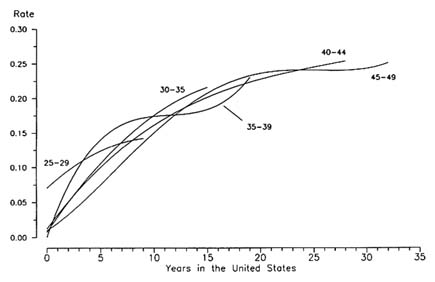
FIGURE 8-15 Self-employment rates for foreign born, five age cohorts defined by age in 1910, male foreign-born nonfarm labor force.
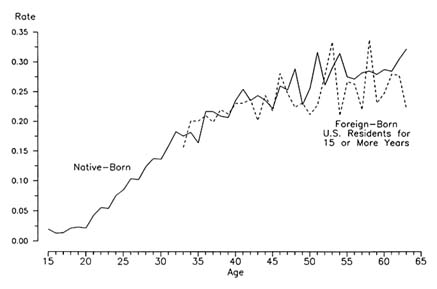
FIGURE 8-16 Self-employment rates by age, native-born and foreing-born male nonfarm labor force, 1910.
that newly arrived immigrants, whatever their age, began their American employment careers as wage workers and then moved into self-employment as their tenure in the United States increased. The similarity of the upward movement for men arriving at different ages suggests heavy saving rates in the years following their arrival into the United States.41
The saving rates of immigrants may have been higher than those of the native born. Figure 8-16 displays self-employment rates by age for both the native- and foreign-born males nonfarm work forces in 1910. We restrict the foreign-born population to those who had been resident in the United States for 15 years or more and were at least 33 years of age. This restriction eliminates the sojourners and also those who arrived in the United States as children. Figure 8-16 shows that the self-employment rates at each age of these two groups are quite similar. Both groups show movement at about the same rate into self-employment between their early thirties and mid-forties. If we imagine that some of the movement of the native (but not the foreign) born at these ages was facilitated by the receipt of an inheritance, then the similarity of their rates of movement into self-employment suggests heavier saving on the part of immigrants.
|
41 |
The upward slope to the self-employment rate line may also reflect possible differences in the self-employment rates of sojourners and those who intended to settle permanently in the United States. The available cross-sectional data do not allow us to assess the relative importance of this selection factor. |
A second piece of evidence of differentially high rates of saving among the foreign born is Haines and Goodman's finding of relatively larger differences in the rates of home ownership between young and older adults for the foreign born in several samples they investigate from the turn of the century (Haines and Goodman, 1995:Table 7.3, pp. 220–221).
There exists an extensive collection of budget studies from the turn of the century that surveyed both foreign- and native-born American workers (Carter et al., 1991). Often a question was included to ask the length of time an immigrant had been in the United States. These surveys, if handled carefully, might be used to estimate the differential savings propensities of immigrants and native-born workers. This work has yet to be done.
Whether the additional "boom in saving" triggered by immigration, hypothesized by Ransom and Sutch, was strong enough by itself to offset the initial capital dilution remains an open question. What is clear is that aggregate American savings rates were very high during this period. Gross saving as a fraction of GDP exceeded 20 percent (Davis and Gallman, 1973; Ransom and Sutch, 1984). What is also clear is that the capital-labor ratio did not fall during this period—it rose! Whether it would have risen even higher had immigration been less strong remains a question for further research.
Kuznets (1958:34) argued that immigration was likely to shift the demand for investment outward, primarily by stimulating the demand for housing, urban infrastructure, and other "population-sensitive capital formation."42 This is undoubtedly true. However, if saving were inelastic in supply and if there had been no immigration-induced shift of the supply of saving, then the increased demand for investment would have simply pushed up the rate of interest rather than increased the capital stock. Yet in fact real interest rates were low and falling during the last half of the nineteenth century, and the rise in real rates during the early decades of the twentieth century was modest (Temin, 1971:70–74; Williamson, 1974a:656). We conclude that immigration actually helped stimulate the increase in the capital stock and in the capital-labor ratio.43
Immigration and Inventive Activity
America became a world leader in many technologies over the late nineteenth and early twentieth centuries (Mokyr, 1990:268; Wright, 1990). Rapid immigration may have contributed to this ascendancy by the simple fact that the
|
42 |
This effect is one of the supposed underlying causes of the strong association between immigration and the "long swings" in economic activity, known as Kuznets' cycles (Thomas, 1954/1973). |
|
43 |
Gallman (1977:30) points out that, insofar as the new capital put in place as a consequence of immigration catered exclusively to immigrant demands for goods and services, the welfare effect on the resident worker need not have been positive, although again capitalists and landowners would have gained. |
foreigners enlarged the size of the economy. A larger economy means that more is being produced at any one time. A greater volume of production meant more opportunities to discover better ways of doing things. Historians of technology have demonstrated the quantitative importance of this ''learning by doing" in stimulating technological advance. Small incremental improvements, repeated many times, appear to have contributed more than well-known breakthroughs to advances in design and to reductions in the costs of production (Rosenberg, 1982, 1981/1995; David, 1975). By promoting extensive economic growth, immigration gave the country's inventors and tinkerers more to do, thereby offering them more opportunities to learn.44
The immigration-induced increase in the size of the economy may have also been good for inventiveness (Kelley, 1972). Adam Smith thought that invention was accelerated by the division of labor which in turn was limited by the size of the market (Smith, 1776:11). Higgs (1971b) found a link between patenting activity and urbanization in the United States during the period 1870–1920. Simon and Sullivan (1989) show a connection between population size and the invention of new agricultural techniques. Because the foreign born enlarge the population, tend to reside in urban areas, and expand the size of the market, we suggest that here too is an indirect impact of immigration on inventive activity.
Immigrants may have played a more direct role in this development as well. Some scattered evidence suggests that immigrants accounted for more than their share of the major inventive breakthroughs in this era. A list of names of the "great" American inventors suggests a disproportionate share of immigrants. Why might this be a systematic aspect of the invention process rather than a coincidence or the result of a flawed sampling procedure? A good answer, we think, is that America was the leading laboratory for invention in the world at the time, with the most advanced industries and one of the highest rates of capital formation. Thus, it would be a magnet for would-be inventors, scientists, and innovators who would benefit from the working conditions, resources, and venture capital not available in their home country.
Immigration and Technological Innovation
Invention will have no impact on economic performance unless the new ideas diffuse, are adapted to existing conditions, and transform the capital stock. Immigration helped to speed the diffusion of new technologies because it enhanced the rate of growth of the population and the GDP of the economy, thereby stimulating a rapid growth in the capital stock. In the process of undertaking the new investment required, the latest and most productive technology was adopted. By providing an incentive for new investment, rapid extensive growth of the
|
44 |
For some empirical evidence connecting manufacturing and patenting activity, see Higgs (1971b), Sokoloff (1988), Sokoloff and Khan (1990), and Khan and Sokoloff (1993). |
economy lowered the average age of capital, bringing more of the advanced techniques into the production process (Nelson, 1964).
Most new technologies are embodied in new designs of capital machinery and factory structures. The new, mass-production techniques introduced in the era of mass immigration required new machines and the redesign of the factory itself. Effective use of refrigeration technology required new railroad cars; use of the electric motor to drive machines required the redesign of factories. So too with continuous flow technology, department store merchandising, and nearly all of the other important innovations of this era. Given the high costs of transatlantic shipping and other barriers to international trade, U.S. firms were heavily dependent on the domestic market. Had the country not welcomed the new immigrants to its shores, aggregate demand would have grown more slowly, there would have been less new investment, and the diffusion of new technologies would have been delayed.45
Immigration and the Exploitation of Economies of Scale
To the extent that there were and are large unexploited economies of scale in various industries (external to the firm), then the extensive growth of the economy by itself would expand per capita output. To the extent to which international trade was limited, growth of the domestic economy would be required for the realization of this opportunity.
Chenery (1960), in a study of the productivity of manufacturing workers across 63 countries, found that, other things being equal, a doubling of a country's size would increase the productivity of its workers by 20 percent. The models of growth most often invoked do not envision such an effect as a possibility, however (Denison, 1962). They begin with the view that the various sources of and contributions to economic growth may be calculated separately and independently and then added up without consideration of economy-wide increasing returns. But if the research begins with a model that includes the possibility of economies of scale, then one is certain to come to the conclusion, independent of the data collected and the historical research undertaken, that no single measurable source of growth is by itself very important (Abramovitz, 1993). Recently Romer (1986b, 1996) has urged a reconsideration of the use of such models for addressing broad-scope, long-run questions such as the one at hand.
As far as we are aware, no one has explicitly tried to examine turn-of-the-century immigration as a possible accelerator of endogenous growth using the "new growth theory" advocated by Romer.46 There is some evidence that has
|
45 |
Rosenberg (1982:249) has also noted the role played by immigrants in accelerating the diffusion of technology from the country of their origin in the United States. |
|
46 |
For several applications of an endogenous approach to growth modeling in an historical context see Johnston (1990), De Long (1995), and Romer (1986b). |
been put forward, however, to lend support to the notion of increasing returns that work at the level of the national economy (Cain and Patterson, 1986). Johnston (1990) has attempted to model these effects by suggesting that the productivity-enhancing effect of scale is proportional to the total stock of capital and he suggests a specific parameterization. Based on his study of increasing returns in the mid-nineteenth century, he suggests that the rate of growth of output might be increased by a factor equal to 5 percent of the increase in the capital stock on account of economies of scale and quite apart from the direct contribution of capital stock growth to economic growth. De Long (1995) suggests that the true factor might be as high as 10 percent.
What would such parameters mean for the impact of immigration? If the flow of new immigrants increased the labor force by 4–8 percent over a decade (compare these numbers with those in Table 8-1) and (eventually) increased the capital stock by the same proportion, then output would be increased by 0.2–0.8 percentage points more than the direct effects of the increase in labor and capital would suggest. This translates to a 5–10 percent increase in productivity. This extra supplement to growth, although proportional to the increase in capital, is not entirely captured in an increase in business profits. Instead the entire economy is made more productive, and both labor and capital share in the "disembodied" increase in efficiency.
So far, empirical modeling with the new growth theory is in its infancy. The profession is far from persuaded that the economies-of-scale effects are or were significant, and the parameterization of such effects is little advanced from educated speculation.47 Yet in the hands of a skillful economic historian the notion of economies of scale can be made to sound plausible and in good theoretical company as well. Consider Abramovitz's account:
In the nineteenth century … capital's share [in national income] rose substantially—by 19 percent during the first half and by another 19 percent during the second half, a 41 percent increase overall. It is this result that creates, as I say, at least a presumption that technology was advancing, not in the neutral fashion that the growth accounts assume, but in a capital-using fashion. A series of powerful forces, each manifestly connected with technological progress, worked in this direction. First, the great expansion in the total size of the domestic market and its increasingly unified character encouraged production on a larger scale and heavier investment in the application of steam power and in more specialized capital equipment. This, indeed, is the message of all the great economists of the nineteenth and early twentieth centuries, in a line stemming from Adam Smith, running through Böhm-Bawerk, Sidgwick, and Taussig, and stretching to Allyn Young. But these men did not see the economies of scale as a source of growth separate from technological progress itself. Rather, they
|
47 |
This state of affairs is surprising in light of the fact that the effects of scale and size on productive efficiency are "one of the oldest and most widely acknowledged sources of economic growth" (Kelley, 1972:36). |
thought of the advances they saw with their own eyes as an emerging technology that was both capital and scale intensive. It was increasingly specialized and round about in its organization; required increasing amounts of capital per worker to employ it; and therefore demanded larger-scale operations in its plants and in the aggregate to make the heavier use of capital economical.
[Second, the] rise of cities, itself a requirement of scale-intensive production, was another capital-intensive development. It required heavy investment in structures for housing, trade, finance, government, and schools and, especially in its early stages, for streets, water supplies, sewage disposal, and urban transport.
[Third, the] westward movement … by attracting immigrants, enlarged the effective aggregate scale of the economy… (Abramovitz,1993:225–226).
Immigration and the Supply of Human Capital
Kuznets made an argument for a positive impact of immigration on the native born that suggests a very large effect coming from the importation of human capital.
Considering the magnitude and duration of [the immigration flow], it is difficult to exaggerate its importance as a factor in the economic growth of the United States. Since immigration brought in a large labor force, the cost of whose rearing and training was borne elsewhere, it clearly represented an enormous capital investment that dwarfed any capital inflows of the more orthodox type(Kuznets, 1952:197).
Neal and Uselding elaborated on this point (Neal and Uselding, 1972; Uselding1971). They begin by noting that most immigrants came to the United States as young adults and entered the labor force, thus producing output, earning wages, and consuming almost immediately on their arrival. Their income can be thought of as the return to the "human capital" they imported when they moved to this country. Yet that human capital—manifest both in its potential for purely physical labor and in the skills and learned abilities of immigrants —was created in another country. The American economy (and a new American) earned the returns from the human capital that had been transferred from—and with out payment to—the economy that spent its resources on raising the individual to young adulthood and endowing him or her with education and other valuable skills. Freed of having to pay for this importation of human capital, the American economy was able to invest the equivalent resources in physical or human capital produced at home. Neal and Uselding calculate the contribution to the U.S. capital stock of these gifts by compounding the flows at a rate of 6 percent. They suggest that immigration might have contributed as much as 9 percent of the capital stock by 1850, 18 percent by 1880, and 42 percent by 1912.48 With this
|
48 |
Gallman (1977) suggests that these figures are too high for two reasons: first, because they are built on wage and work-year data, and, second, because Uselding's (1971) estimates are based on the occupations that immigrants reported on arrival rather than the occupations that they actually pursued in the United States. Gallman believes that some immigrants were forced to pursue occupations beneath their skill level because of discrimination and their lower level of literacy in English. |
larger capital stock—larger than the same immigrants' contribution to the labor force—the national capital-labor ratio was higher than it would have been otherwise. Thus, labor productivity was higher than it would have been without immigration.49
Immigration and the Real Wage
We come to the final argument in our list of possible links between immigration and economic growth. This is the one that is most often used to suggest a negative impact of immigration. Throughout the period of open immigration, contemporary observers, and especially spokesmen for labor, charged that the inflow of immigrants depressed the real wage of labor. The "more the supply of labor the lower must certainly become its price," said Henry Carey a prominent economist of the time in 1873 (cited in Lebergott, 1964:161). His reasoning, as we deconstruct it today, would appear to rest on a static, partial equilibrium model of the supply and demand for all labor, analogous to the familiar supply and demand for a single, homogenous commodity such as wheat. If this analysis is meant to apply to all labor it is—of course—naive. The supply and demand analysis of labor markets makes sense only when applied to the market for a specific type of labor (say bricklayers). The macroeconomic view of the labor market is quite different. An increase in the quantity of labor employed would immediately change the demand for labor. Because the new labor would earn and then spend income, increased employment would increase aggregate demand and thus the demand for labor.50 Whether the immigration-induced increased demand for labor fully offsets the increased supply is an empirical question. It is certainly not a foregone conclusion.
Nonetheless, some distinguished economic historians have suggested without much qualification that the real wages of all Americans were depressed by immigration. They have also pointed to evidence that they claim buttresses this
|
49 |
Gallman (1977) is critical of this argument because he feels it implicitly assumes an extreme version of the Walker effect which Gallman rejects. To Gallman it appears that the saving that Neal and Uselding calculate would only be present if, in the absence of immigration, Americans chose to increase the native birth rate enough to fill the labor force gap left by the absent immigrants. In that case, America would have had to invest in the child rearing and education for this shadow cohort. We suggest that Gallman's line of attack introduces an unnecessary confusion into the analysis. Kuznets' original insight was to see that immigrants not only import labor, they import human capital as well. Thus, America gained a valuable productive resource and the origin countries lost one every time a young adult chose to immigrate. |
|
50 |
The effect of a new immigrant on aggregate demand may appear even before he or she takes a job in this country. The immigrant will have to spend and consume during the transition period between disembarkation and the receipt of the first paycheck. |
view. Lebergott looked at the increase in wages following the restriction of immigration:51
When the immigration flow was cut off in 1914 (first by German submarines,then by legislation) wages rose markedly, as shown in Table 26.3. In the 15 years after 1914, workers' incomes rose as much as they had over the prior half-century. No speedup in entrepreneurial ingenuity or productive energies of workers was occurring at that dramatic rate. Congress, by shutting off the flow of workers from Europe, had helped push up workers' wages.
Average Earnings of Nonfarm Workers (In 1914 Dollars)
|
1860 |
$457 |
|
1914 |
696 |
|
1929 |
898 |
|
Source: Computed from Lebergott (1964:428,524). |
|
There are, of course, many reasons why real wages might have risen during World War I and the Roaring Twenties. Lebergott's evidence is consistent with his thesis, but it is certainly not a rigorous test.52
Hatton and Williamson (1998:Chap. 8) have estimated that the immigration between 1890 and 1913 augmented the labor force in 1910 by 11.8 percent and reduced the real wage in 1913 by between 4.5 and 5.6 percent. Their calculation was made using a Phillips curve model of the aggregate labor market rather than a micro-economic supply and demand model. Nonetheless, their theoretical apparatus dictates their finding of a negative impact of immigration. The Phillips curve is an inverse relationship between the rate of wage inflation and the unemployment rate (Phillips, 1958). Hatton and Williamson argue that by "altering labor supply and unemployment in the short run, immigration should drive down the wage along some long run Phillips curve." We question the applicability of the Phillips curve in this context. During the 1900–1913 period, immigration was negatively correlated with unemployment and positively correlated with wage growth.53
|
51 |
Lebergott (1984:34, who in turn cites Lebergott, 1964:163). |
|
52 |
In looking at the rate of change of real wages before and after the reduction in immigration, Lebergott was echoing an older argument of Douglas (1930), who estimated a very low rate of increase of real wages (0.3 percent annually) in the period of greatest immigration, 1890 and 1914. Douglas's estimates for the period of mass immigration were especially slow compared to the rates of growth of real wages in the period immediately preceding and following this period. Douglas's real wages estimates have been superseded by those of Rees (1961), which show a reasonably rapid growth of wages (1.4 percent) during the era of high immigration. |
|
53 |
The unemployment rate by any measure was relatively low (4.7 to 4.9 percent) for the period 1900–1913 (Lebergott, 1964; Romer, 1986a; Weir, 1992). The earlier decade of the 1890s was a period of industrial depression and high unemployment, but during that decade immigration was greatly reduced. As the depression ended and unemployment rates dropped, immigration flows increased and ran at high levels throughout the booming period between 1900 and 1913. |
Hatton and Williamson get around this seeming contradiction by combining the Phillips relationship with an aggregate demand for labor function derived from a CES production function (no economies of scale). By substitution they are able to eliminate the unemployment rate from their estimating equation. Their formulation reduces the Phillips curve to a positive relationship between the real wage and output per worker. They then use data from the period to estimate a positive relationship between real wages and aggregate labor productivity. They assert that immigration must have had a negative impact on real wages by claiming that immigration would lower productivity. They estimate the magnitude of this presumed negative impact of immigration on productivity by reference to labor's share of output in the long run (0.6, they say). For them, "the long run impact of labor force growth on output is simply the labor share times labor force growth."
Hatton and Williamson's calculation, then, is simply an empirical estimation of the capital-dilution argument discussed above. Because, by assumption, Hatton and Williamson deny any impact of immigration on the capital stock and abstract away from labor market dynamics over the business cycle, they exclude all of the dynamic effects that are hypothesized to generate a positive effect of immigration on real wages and the rate of economic growth. They have not ruled out these positive effects by an examination of the data, the historical record, nor the logic of the arguments.54
At this point it is worth pointing out two facts that are not in dispute. The first is that, whatever the effect of immigration, real wages of labor rose throughout the period between the Civil War and World War I. Figure 8-17 displays data on the real wage in manufacturing (Long, 1960; Rees, 1961). There is no striking slowdown of real wage growth during the period of most rapid immigration between 1900 and 1914. The second point is that the waves of immigrants ebbed and flowed in synchronization with the economy. When immigration rates were high, unemployment was low and real wages rose rapidly; when immigration was less, the economy was depressed. We are not, of course, suggesting that immigration caused an improvement in real wages. Rather, we side with Easterlin (1968:30–33), who interpreted these patterns as evidence that responded to increases in the demand for labor in the United States and that the shifts in demand were larger than the shifts in supply.
There is no evidence that immigration slowed growth or lowered living standards of the resident population. There are good reasons to think that immigration increased the pace of economic growth and the relative welfare of the resident population in the 50 years following the end of the Civil War. Indeed, the impact of immigration on economic growth and on
|
54 |
Hatton and Williamson (1998) also use their computable general equilibrium model to assess the impact of immigration on wages. Their exercise also excludes the possibility of dynamic or short-run effects or the possibility of economies of scale. |
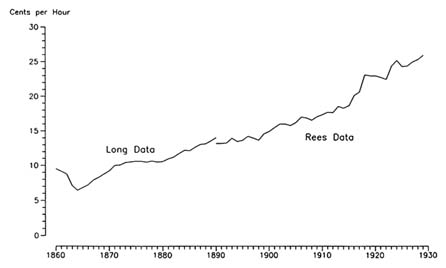
FIGURE 8-17 Real hourly wages in manufacturing, 1899 prices.
the economic welfare of the resident population appears to have been profoundly positive.
IMMIGRATION AND THE AMERICAN INCOME DISTRIBUTION
Potential impacts of immigration on the American income distribution are at the heart of much of the debate over current immigration policy. In the words of Borjas:
The debate over immigration policy is not over whether the entire country is made better off by immigration—it is over how the economic pie is sliced up(Borjas, 1996:77).
The current debate has centered on both the labor market and the public sector as arenas in which resources may be redistributed away from poor Americans and toward the foreign born.
The facts are that income inequality in the United States has risen as immigration flows have surged. A number of scholars have argued that the two developments are linked (see Levy and Murnane, 1992).
In the scholarship on the economic impacts of the earlier mass immigration to the United States the focus is on growth. The potential impacts of immigration on the American income distribution have received much less attention, at least until very recently. Why is this and what do we know?
Trends in Income Inequality During the Earlier Era of Mass Immigration
Williamson and Lindert (1980) developed what has become the standard measure of long-term trends in American income inequality during the earlier era of mass immigration to the United States. It is the ratio of the real wage rates of urban skilled workers to those of urban unskilled workers. The larger the ratio, the greater the gap between rich and poor. We reproduce their series in Figure 8-18.
The inequality measure displayed in Figure 8-18 has a strong, positive correlation with the series on the annual number of immigrants displayed in Figure 8-4. There is a noticeable increase in American income inequality during the 15 years preceding World War I when the inflows of immigrants from abroad reached their highest levels in American history. Inequality abated during World War I, when immigration was curtailed, and then rebounded after the war with the resurgence of immigration. During the 1920s, inequality was roughly stable and then plunged in the 1930s with the onset of the Great Depression and the virtual cessation of immigration.
Correlation does not imply causation, of course. Williamson and Lindert consider immigration as one of a number of possible explanations for the trends in inequality. Ultimately they choose to downplay its role. They write:
While the high tide of immigration of low-skilled workers from southern and eastern Europe may have accelerated labor quantity growth and decelerated
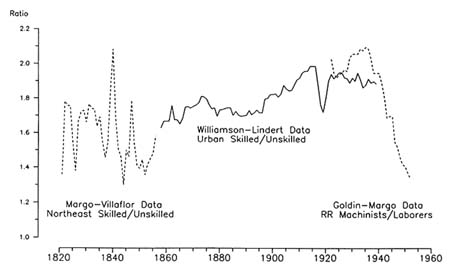
FIGURE 8-18 Williamson-Lindert index of wage inequality ratio of skilled to unskilled wages, urban workers.
labor "quality" growth … these labor supply forces were apparently offset by acceleration in indigenous skills growth. The farmland frontier began to close up sharply in this period, but the model again assigns almost no importance to this change in explaining wage inequality trends. What we know about factor supply growth turns out to play a minor role in explaining the resurgence of wage rate inequality at the start of this century.
The model clearly points to changes in the pattern of technological progress as the explanation of the resurgence. … [T]his acceleration of productivity in the skill-intensive tertiary sector explains why teachers, mechanics,carpenters, and other skilled groups enjoyed rising wage advantages in the first decade of this century (Williamson and Lindert, 1980:236).
In his more recent work with Hatton, Williamson reconsiders this conclusion. Hatton and Williamson establish the plausibility of the view that immigration increased wage inequality not only in the United States, but in all countries experiencing rapid immigration. They do this by asserting that immigrants tended to be unskilled:
Since the migrants tended to be unskilled and increasingly so as the late nineteenth century unfolded (much like the late twentieth century), they served to flood the immigrant country labor markets at the bottom, thus lowering the unskilled wage relative to skilled wages, white collar incomes and rents. Immigration implied rising inequality in rich countries (Hatton and Williamson,1998:Chap. 11).
Hatton and Williamson test their proposition by examining trends in inequality across countries. They find that in countries where immigration flows were large relative to the size of the labor force, inequality rose more rapidly than otherwise;"when countries had to accommodate heavy immigration, inegalitarian trends were strong."
Goldin (1994b:12) also suggests that immigration increased American income inequality in the early years of this century. Citing Coombs's (1926) data on the trend in the real wages of unskilled laborers, she emphasizes their downward movement after 1907 and their rise during World War I.55 She speculates
|
55 |
We have serious reservations about Coombs' data, which are a pastiche of observations drawn from a variety of sources. Coombs used one primary source for the period between 1890 and 1907 and another for the period 1908–1914. The decline in real wages cited by Goldin is largely a matter of a change at the break in sources. There was a sharp recession in 1908 (unemployment jumped from 3.1 to 7.5 percent), and there was an across the board decline in wages as a response. There was also a large decline in gross immigration (from 1.3 to 0.8 million between FY 1907 and 1908) and an increase in departures (Bureau of the Census, 1975/1997, C89, and Weir, 1992:341). Net immigration fell from 767,000 to only 210,000 (Kuznets and Rubin, 1954:95). In fact, 1907 was the peak year for immigration. Moreover, the adjustment to hourly wages for the second segment of Coombs is made by a different procedure than that used for the first segment (David and Solar, 1977:63–64). Data for the 1920s are from yet a third source, the National Industrial Conference Board. Those data were collected by mail questionnaires and left the definition of "unskilled" production workers to the responding firms. The National Industrial Conference Board (NICB) data begin in 1921 but there is also a retrospectively reported prewar wage collected in 1922. It is these retrospectively reported data that are used by Coombs to link the NICB data to the middle segment of the series. It is difficult to know how to compare them with the prewar data.begin in 1921 but there is also a retrospectively reported prewar wage collected in 1922. It is these retrospectively reported data that are used by Coombs to link the NICB data to the middle segment of the series. It is difficult to know how to compare them with the prewar data. |
that the influx of immigrant labor and then the wartime cutoff might have been the cause of this fall and subsequent rise.
We find both the Hatton and Williamson and the Goldin arguments unconvincing. Both simply point to a correlation between immigration and various measures of wage inequality, relying on assertions about immigrants' relative skills to make plausible a cause and effect relationship. Yet it looks to us as though immigrant skills belonged in about the middle of the American skill distribution. If this is correct, then we believe that there is no reason to expect that immigration would increase wage inequality. In our view this issue is currently unresolved and would benefit from further research.
The historical literature has focused on two additional dimensions of wage inequality. These are wage differentials based on race and on geography.
Immigration and Racial Wage Differentials
There is another large literature that focuses on the impact of foreign immigration on the geographic mobility and relative wages of black Americans. For the early period, Thomas (1954/1973) suggested that the mass immigration from Europe in the decades before World War I kept African Americans ''bottled up" in the agricultural South. There is no doubt that their wages in the low-productivity, stagnant, and oppressive South were lower than they would have been in the dynamic and prosperous North in the 50 years between Emancipation and World War I. Their failure to migrate in any significant numbers is one of the mysteries of late nineteenth-century American economic history. There is no shortage of explanations in the literature, but other than Thomas' speculations, no one emphasizes the role of immigration. Ransom and Sutch (1975, 1977) emphasized the institutional structure of the crop-lien, tenant-farming system of post-Civil War agriculture in which blacks were "locked in" by a form of "debt peonage." Wright (1986) discussed the role of the peculiar and controlling labor markets of the South. Margo (1990) stressed the inadequate Southern schooling system that left most blacks ill-prepared to compete for urban jobs. Tolnay and Beck (1995) explored the role of extra-legal coercion. Whether the hypothetical absence of competition from European immigrants in this era would have induced blacks to overcome these oppressive forces and begin their "great migration" before the 1920s is an important and unanswered historical question.
Immigration and Regional Wage Differentials
Regional wage differentials have been a persistent feature of American labor markets, at least since 1840 (Easterlin, 1960; Williamson, 1964; Rosenbloom,
1996). One question is whether immigration acted to exacerbate or to ameliorate these differentials.
Immigrants tend to concentrate geographically in a small number of "magnet" destinations.56 This is true today and it was also true during the earlier wave of mass immigration preceding World War I. There are two principal hypotheses in the literature regarding the forces that create these magnets. One is that these destinations are regions of high opportunity and high wages that attract in-migration of the foreign born and residents alike. Another view is that immigrants are attracted to cities that already have thriving immigrant communities with well-developed ethnic support networks and they flock to them without reference to their relative economic prosperity.
If the first view is correct, then immigration would serve to accelerate economic growth by removing allocative inefficiencies and relieving bottlenecks. It would also tend to reduce wage inequality by expanding the labor supply in highwage markets. The second view, by contrast, suggests that immigrants would soon overcrowd local labor markets and the ethnic neighborhoods that originally attracted them. Their geographic concentration would likely harm the native-born workers in these areas, exacerbate income inequality, slow cultural and linguistic assimilation, and retard the economic advancement of the immigrants themselves.
One recent study that bears on the relative importance of these two hypotheses was conducted by Goldin (1994a), who was interested in the impacts of immigration on intercity differences in wage rates during the turn of the century. In the cross section, Goldin finds a strong positive relationship between the fraction of a city's population that was foreign born and the city's average wage. In other words, cities with a large fraction of immigrants had the highest wages. We are persuaded by Goldin's (1994a:247) conjecture that "immigrants sought out labor markets with high wages." Goldin also finds that the arrival of immigrants caused wage rates to rise more slowly than they might have, had the immigrants not come. More precisely, "in general, a 1-percentage-point increase in the population share that was foreign born depressed wages by about 1 to 1.5 percent" relative to cities with fewer foreign born (Goldin, 1994a:250). In other words, without the influx of immigrants, wages in high-wage cities would have been higher still. Because of their propensity to move to high-wage cities, immigrants helped to equalize intercity wage rate differences by alleviating labor shortages. Had there been no immigration, native-born workers would have moved to fill these positions and the negative wage impact would have still been felt by the native-born residents of boom cities (though the movement toward equalization of wages across regions would have proceeded more slowly). To
|
56 |
For analyses of immigrant settlement patterns in the period prior to World War I, see Lee (1957); Galloway and Vedder (1971, 1972); Galloway et al. (1974); Dunlevy and Gemery (1977a, 1977b, 1978); Dunlevy (1980, 1983); and Dunlevy and Saba (1992). |
blame the immigrants for the adjustment back to equilibrium is simple scapegoatism.57
The key point that emerges from this literature is that regional wage inequality was reduced by immigration. The reason for this is that immigrants tended to locate in high-wage regions.
Income Redistribution Through Social Spending
One source of the modern opposition to immigration stems from a perception that resources may be transferred from the native to the foreign born through government social spending programs. Borjas and Trejo (1991) developed one influential estimate of the possible magnitude of such transfers and their trend over time. They noted that in 1990 immigrants were more likely than the native born to participate in cash-benefit government welfare programs and that the gap between immigrant and native welfare participation has been growing steadily since 1970. Because they believe that immigrants' disproportionately high welfare participation is not offset by disproportionately high income and (presumably) tax payments, Borjas and Trejo conclude that immigrants in modern America do not "pay their way" (summarized in Borjas, 1994:1704–1708).58
Here we examine the evidence on possible redistribution from natives to the foreign born through social spending programs in the early part of this century. Of course, government programs were tiny in this era. In that era, private charities and self-help organizations took the lead in the provision of social insurance, educational services, old-age security, disaster relief, and income redistribution. In this sense, it would be impossible to identify a quantitatively important role for government in income redistribution. For this reason we take a broad view of redistributive schemes and their proportionate impacts on the native and foreign born. We focus on three services that account for the bulk of public expenditures in our own era: poverty relief, old-age relief, and educational services. We also assemble some evidence on immigrants' contributions to the support of these services.
|
57 |
Goldin's estimates were made to help understand the reasons for a political sentiment to restrict immigration. In a sense it was the "scapegoat factor" that she was attempting to measure. |
|
58 |
These conclusions are highly controversial. For example, Borjas and Trejo limit their discussion of social transfers to means-tested entitlement programs such as food stamps, Medicaid, low-income housing assistance, and Head Start. In doing so, they ignore the substantial social redistribution from income earners to retirees through the Social Security system and from single young adults to families through the educational system. Because recent immigrants are disproportionately single, young adults, and labor force participants, they are less likely than the native born to use educational services, especially the more expensive higher education services. They are certainly net contributors to the Social Security system. not pay a disproportionately high share of taxes" (summarized in Borjas, 1994:1705). This statement is probably true if the reference group is the employed only. But because immigrants are so much more likely than the native born to be concentrated in the wage-earning age groups and to be both labor force participants and income tax payers, it is not clear that immigrants pay a disproportionately low share of taxes compared with the population as a whole. The population as a whole forms the denominator in calculations about relative welfare use, thus the population as a whole is the appropriate reference for evaluating the fiscal contributions of immigrants. In their discussion of immigrants' contributions to the governments' income, Borjas and Trejo simply assert that "immigrants do not receive a disproportionately high share of income; they also do not pay a disproportionately high share of taxes" (summarized in Borjas, 1994:1705). This statement is probably true if the reference group is the employed only. But because immigrants are so much more likely than the native born to be concentrated in the wage-earning age groups and to be both labor force participants and income tax payers, it is not clear that immigrants pay a disproportionately low share of taxes compared with the population as a whole. The population as a whole forms the denominator in calculations about relative welfare use, thus the population as a whole is the appropriate reference for evaluating the fiscal contributions of immigrants. |
Poverty Relief in the Gilded Age
Before the New Deal legislation of the 1930s, publicly funded welfare programs were small in scale, limited in geographic scope, and were under local control. Throughout the century preceding the Great Depression, there was stiff public opposition to government-sponsored poor relief (Almy, 1899–1900; Mohl, 1983; Hannon, 1984, 1985; Ziliak, 1996). In the view of many contemporary observers, the root of the problem facing public poverty relief was the massive increase in immigration. "The increase of pauperism amongst us" is due to "the increase of our foreign population," according to a writer quoted by Katz (1986:17). In the view of the publicly funded Philadelphia Board of Guardians of the Poor in 1827:
One of the greatest burdens that falls upon this corporation, is the maintenance of the host of worthless foreigners, disgorged upon our shores (cited in Katz,1986:17).
In 1900, Joseph Lee, a national leader of the movement for urban playgrounds,suggested that
(T)he problems with which American philanthropy has at present to deal have been largely imported along with the greatly increased volume of immigration that has come during the last fifty or sixty years (quoted in Patterson,1981:22).
We know of no scholarship that has systematically explored the relative propensity of the foreign born to seek public charity relief in this era. Some statistical information on this matter, however, was collected by the first Immigration Commission, appointed by Congress in 1907 to make a "full inquiry" into "all aspects" of immigration. The Commission was eager to explore these controversial allegations, especially because it noted that, in earlier times,"
It is recorded that in some cases a considerable part of the immigrants arriving on a ship would be so destitute of means of support that it was necessary to transport them immediately to almshouses, and the earlier poorhouse records show that there were constantly being cared for large numbers of newly arrived foreign-born (U.S. Immigration Commission, 1911:Volume I, p.35).
To uncover the extent of the problem at the turn of the century, the Commission conducted its own investigation of "Immigrants as Charity Seekers." It went to "organized city (i.e., public) charity societies" in 43 different cities and collected evidence on "cases,'' that is, individuals or families requesting assistance at some time during the six-month period, December 1908 through May 1909.
The Commission itself was unable to calculate the relative propensity of the foreign born to seek charity because it did not at the same time survey the population, but instead anticipated the results of the 1910 federal census of population. Nonetheless, the notable absence of recent immigrants from the public charity rolls was striking enough that the Commission concluded that at least this group of immigrants could not have been a burden.
The number of those admitted [into the country] who receive assistance from organized charity in cities is relatively small. In the commission's investigation,which covered the activities of the associated charities in 43 cities,including practically all the larger immigrant centers except New York, it was found that a small percentage of the cases represented immigrants who had been in the United States three years or under, while nearly half of all the foreign-born cases were those who had been in the United States twenty years or more. This investigation was conducted during the winter of 1908–9 before industrial activities had been fully resumed following the financial depression of 1907 –8, and this inquiry showed that the recent immigrants, even in cities in times of relative industrial inactivity, did not seek charitable assistance in any considerable numbers. Undoubtedly conditions would have been otherwise had it not been for the large outward movement of recent immigrants following the depression,but however that may be, it is certain that those who remained were for the most part self-supporting (U.S. Immigration Commission, 1911:Volume I, p. 36).
The charity seeking of all immigrants was more difficult to characterize given the absence of nativity-specific population figures, and thus the Commission avoided any judgment on the issue. Unlike the Commission, we have access to an electronic version of the 1910 population census, and thus we were able to explore the relative charity-seeking propensities of immigrants overall. The results are presented in the scatter diagram displayed in Figure 8–19. In the scatter diagram, each point plotted represents one of the 43 cities included in the Immigration Commission study. Along the horizontal axis we map the proportion of household heads who were foreign born, calculated from the IPUMS from the 1910 Census. Along the vertical axis we show the proportion of charity "cases" who were foreign born. The majority of points fall below the 45-degree line, indicating that in most cities, the foreign born disproportionately eschewed public charity. The unweighted average of the ratio of foreign-born charity seekers to foreign-born household heads across cities is 0.84, whereas the average ratio weighted by city size is 0.92. Because the overwhelming proportion of all immigrants as well as all charity seekers were city dwellers, these results suggest that turn-of-the-century immigrants were not disproportionately heavy users of public welfare agencies.59
|
59 |
Although the ratio of foreign-born charity seekers to foreign-born household heads averages less than one for the sample of cities as a whole, the data in Figure 8–19 show a disproportionately large share of foreign-born charity seekers in cities with large foreign-born population shares. We are tempted to speculate that local government in such cities may have been unusually responsive to the needs of these communities. For the moment, however, this remains an area for further research. |
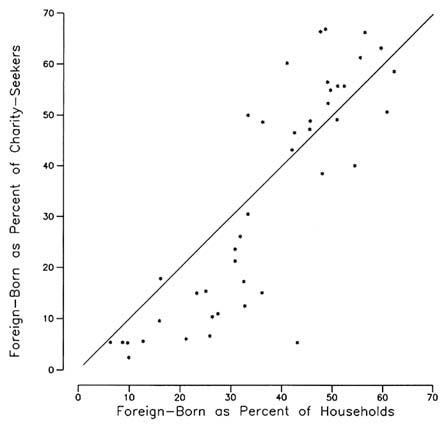
FIGURE 8-19 Foreign born as a percentage of charity seekers and of households, 43 cities, 1909–1910.
One explanation for this pattern is the one the Commission itself suggested: A large fraction of immigrants came as sojourners to this country to work; when work was unavailable, they returned to their native lands. Another reason for the relative absence of immigrants from the rolls of city charities was the importance of immigrants' own efforts to help themselves and one another. These immigrant self-help organizations were noted at the time. A Massachusetts commission commented:
The societies which are organized and maintained by the members of the different nationalities, and which flourish in some form in every community where there are large groups of immigrants, are a factor in helping the immigrant
through the trials of immigration and the difficulties of adjustment to new conditions. The chief reason among all nationalities for the formation of these societies is insurance against sickness and death, but most of them combine with this some other objects. Nearly all of them outline an educational and civic program. They may lack the means to carry this out, yet the statement of these purposes has an influence upon the members (Massachusetts Commission of Immigration, 1914:202, quoted in Handlin, 1959:84).
Thus, private, ethnic charity organized through fraternal societies, labor unions, and churches played an important part in the poverty relief system of the time.
Katz (1986:45) estimates that roughly half of the income of all charitable institutions in New York State in 1900 came from private sources. He calls particular attention to the role of Catholics, a numerically important segment of the new immigrant community at that time.
Catholics gave exceptionally large amounts for relief. Indeed, many of then on public institutions were affiliated with the Catholic church. It is difficult to quantify the proportion of institutional, nonpublic relief provided by Catholic facilities in Buffalo, but it is unlikely that it was less than 50 percent. Given the relative poverty of the Catholic community, these efforts made on behalf of the needy are truly impressive (Katz, 1986:46).
Immigrants also purchased insurance to protect themselves and their families against the many contingencies that might put them at financial risk. For example, Pittsburgh's local of the Brotherhood of Railroad Brakemen earmarked a portion of dues to compensate union members' families in case of a work-related death or disability (Kleinberg, 1989:273). More systematic evidence of immigrants' participation in such "beneficial societies" is contained in Table 8-5 that summarizes data collected by the labor bureaus in key industrial states in the late nineteenth century. The table displays the fraction of surveyed workers belonging to beneficial societies by nativity. Although the numbers vary from survey to survey, overall we find about a fourth of all workmen belonging to such societies, with the membership rates generally a little higher for the foreign than the native born.
These benefit societies and the many labor and ethnic organizations from the period also promoted informal acts of charity. Kleinberg describes some such activities in Pittsburgh
There were spontaneous collections in the mill or at the gates on almost every payday. The workers and their families shared what they had, aware that they, too, might suffer a similar tragedy. The collective culture enshrined generosity and reinforced it through appeals in the labor press "to do the handsome thing" for disabled comrades. It was the trade unionists' duty to do everything in their power to make philanthropic gestures "a grand success financially" (Kleinberg,1989:273).
Although the early twentieth-century immigrant community may have been disproportionately needy, we have found no evidence that it placed a disproportionate burden on public charitable agencies or on private philanthropies.
TABLE 8-5 Membership in Beneficiary Societies by Nativity, Various Surveys of Male Workers, 1884–1894
|
Percent Belonging to Beneficiary Society |
||||
|
Year |
State |
Survey of |
Native-Born |
Foreign-Born |
|
1844 |
Iowa |
Teachers |
16.8% |
35.7% |
|
1884–1887 |
Kansas |
Wage Earners |
26.5 |
25.9 |
|
1888 |
Michigan |
Stone Workers |
5.4 |
10.7 |
|
1889 |
Michigan |
Furniture Workers |
21.9 |
25.5 |
|
1890 |
Michigan |
Detroit Iron Workers |
21.6 |
33.8 |
|
1890 |
Michigan |
Iron Workers outside of Detroit |
21.2 |
26.4 |
|
1890 |
Maine |
Wage Earners |
51.3 |
39.9 |
|
1892 |
Missouri |
Wage Earners |
48.3 |
58.8 |
|
1892 |
California |
Wage Earners |
47.8 |
60.2 |
|
1894 |
Michigan |
Farm Laborers |
14.7 |
14.7 |
|
SOURCES: Susan B. Carter, Roger L. Ransom, Richard Sutch, and HongchengZhao. Codebook and User's Manual: Survey of 3,493 Wage-Earners in California,1892; Reported in the Fifth Biennial Report of the California Bureauof Labor Statistics. Berkeley: Institute of Business and EconomicResearch, 1993; Susan B. Carter, Roger L. Ransom, Richard Sutch,and Hongcheng Zhao. Codebook and User's Manual: Survey of 347 Teachers in Iowa, 1884;Reported in the First Biennial Report of the Iowa Bureau of LaborStatistics. Berkeley: Institute of Business and Economic Research,1993; Susan B. Carter, Roger L. Ransom, Richard Sutch, and HongchengZhao. Codebook and User's Manual: A Survey of 1,165 Workers in Kansas,1884–1887; Reported in the First, Second, and Third Annual Reportsof the Kansas Bureau of Labor and Industrial Statistics. Berkeley:Institute of Business and Economic Research, 1993; Susan B. Carter,Roger L. Ransom, Richard Sutch, and Hongcheng Zhao. Codebook and User's Manual: A Survey of 1,084 Workers in Maine, 1890;Reported in the Fifth Annual Report of the Maine Bureau of IndustrialAnd Labor Statistics. Berkeley: Institute of Business and EconomicResearch, 1993; Susan B. Carter, Roger L. Ransom, Richard Sutch,and Hongcheng Zhao. Codebook and User's Manual: A Survey of 719 Stone Workers in Michigan,1888; Reported in the Sixth Annual Report of the Michigan Bureauof Labor and Industrial Statistics. Berkeley: Institute of Businessand Economic Research, 1993; Susan B. Carter, Roger L. Ransom, RichardSutch, and Hongcheng Zhao. Codebook and User's Manual: A Survey of 5,419 Workers in the FurnitureIndustry of Michigan, 1889; Reported in the Seventh Annual Reportof the Michigan Bureau of Labor and Industrial Statistics. Berkeley:Institute of Business and Economic Research, 1993; Susan B. Carter,Roger L. Ransom, Richard Sutch, and Hongcheng Zhao. Codebook and User's Manual: A Survey of 3,920 Workers in the IronworkingIndustry of Detroit, 1890; Reported in the Eighth Annual Report ofthe Michigan Bureau of Labor and Industrial Statistics. Berkeley:Institute of Business and Economic Research, 1993; Susan B. Carter,Roger L. Ransom, Richard Sutch, and Hongcheng Zhao. Codebook and User's Manual: A Survey of 4,918 Agricultural Implementand Ironworkers in Michigan Outside of Detroit, 1890; Reported inthe Eighth Annual Report of the Michigan Bureau of Labor and IndustrialStatistics. Berkeley: Institute of Business and Economic Research,1993; Susan B. Carter, Roger L. Ransom, Richard Sutch, and HongchengZhao. Codebook and User's Manual: A Survey of 5,600 Farm Laborers in Michigan,1894; Reported in the Twelfth Annual Report of the Michigan Bureauof Labor and Industrial Statistics. Berkeley: Institute of Businessand Economic Research, 1993; Susan B. Carter, Roger L. Ransom, RichardSutch, and Hongcheng Zhao. Codebook and User's Manual: A Survey of 259 Wage-Workers in Missouri,1891; Reported in the Fourteenth Annual Report of the Missouri Bureauof Labor Statistics and Inspection. Berkeley: Institute of Businessand Economic Research, 1993. |
||||
Old-Age Support
During the age of mass immigration about the turn of the century, the only significant public program of old-age support was a federal pension system providing benefits for Union Army veterans of the Civil War.60 By 1907 every male over the age of 62 who had served in the Union Army was eligible to receive a pension. Close to 20 percent of all males over age 60 actually received pensions. In monetary terms these pensions amounted to approximately 30 percent of the average annual nonfarm income of males (Ransom et al., 1996). Because the pension was limited to those who served in the armed forces of the United States during the Civil War, it did not provide support for the bulk of immigrants, most of whom arrived in the United States after that war's end.61 Up to 1935, then, the government-run pension system redistributed income from the foreign born to the native born.62
The first comprehensive public program of old-age support was established by the Social Security Act of 1935 that initiated a pay-as-you-go system in which the elderly are supported by the tax payments of those currently in the labor force.63 Redistribution between the native and foreign born can take place within such a system if the relative proportions of each group in the wage-earning and retirement age groups differ.64
In Figure 8-20 we plot the percentage of the foreign-born population by age at 20-year intervals beginning in 1930, shortly before the Social Security Act was
|
60 |
For descriptions of the establishment and evolution of this system see Oliver (1917), Glasson (1902, 1918), and McMurray (1922). |
|
61 |
For analyses of the politics of this legislation see Quadagno (1988), Skocpol (1992), Orloff (1993), and Ransom et al. (1996). |
|
62 |
Tontine and other private insurance would have redistributed resources from the foreign to the native born if, as seems likely, the foreign born had higher mortality and default rates. |
|
63 |
The original 1935 Act creating old-age "insurance" inaugurated a payroll tax (contributed to equally by the employee and the employer) but deferred all benefits until 1942 and based them on total lifetime earnings. These tax receipts were to be accumulated in a reserve fund; however, no attempt was made to fund the proposed benefits on an actuarial basis, and the benefit formulas had a progressive bias in favor of low-income earners. Amendments made in 1939 moved the system even more explicitly to pay as you go. Benefits would begin in 1940, they would be based on earnings over a set period and would not be tied to lifetime contributions, benefits would be paid by current tax contributions, and the reserve fund would buffer the system against recessions (see Dulles, 1939; Pechman et al., 1968:31–34; and Achenbaum, 1986:18–37). |
|
64 |
Borjas argues against the notion that the Social Security system redistributes resources to the native born by focusing on an age difference between the native and foreign born in their point of entry into the system: "It is important to realize that the median age of immigration is 30, so that many immigrants pay into the Social Security system for a much shorter time span than natives, yet collect roughly the same benefits" (Borjas, 1994:1707–1708). This rate of return consideration is irrelevant. Our pay-as-you-go system transfers resources to the group with proportionately more contributors than recipients. At the present time, the foreign born are the disproportionate contributors. Only if immigration were cut off or reduced considerably would the Social Security system transfer resources from the native to the foreign born in coming decades. |
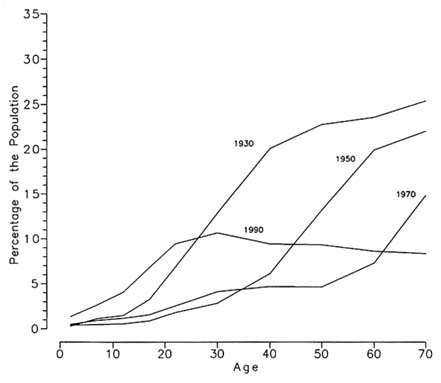
FIGURE 8-20 Percent of the population foreign born by age, 1930–1990.
passed, and ending in 1990, the date of the latest federal census. The figure shows that, in 1930, and increasingly so up to 1970, the foreign-born fraction of the population in the retirement age group was larger than the fraction in the wage-earning age groups. This is because the Quotas Act, the Great Depression, and World War II dramatically reduced the inflow of immigrants beginning in the early 1920s to a level well below that which had prevailed up until that time. The radical reduction in the immigrant flows led to a parallel reduction in the foreign-born fraction of the young adult population. As time passed without any new inflows, the foreign-born population aged, until by 1970 it was comprised overwhelmingly of older persons who had migrated prior to the 1920s.
Under these conditions, the Social Security system effected a substantial transfer of resources from the native to the foreign born. Yet as the age distribution of the foreign born in 1990 reveals, the resumption of immigration in the 1980s reversed the direction of the flow of old-age benefits by raising the relative proportion of foreign born in the working-age groups. Today the Social Security system works to redistribute resources from the foreign born to the native born.
Were the admission of immigrants to increase, the magnitude of the redistribution would be greater still.
Educational Services
In the period of massive immigration near the turn of the century, America had the most extensive and best-funded public education system in the world.65 Financed through the property tax with attendance rates influenced by compulsory schooling and child labor laws, this system educated an increasing fraction of all youths over an increasing fraction of their lives. Did the immigrants pay their share of these public education expenditures? To the best of our knowledge, this question has never been posed in the historical literature. Indeed, the concern of contemporary observers and of historians of the period has been the opposite one. The Immigration Commission, for example, sought to determine "to what extent children of the various races of immigrants are availing themselves of educational facilities and what progress they make in school work" (U.S. Immigration Commission, 1911:Volume 2, p. 5, emphasis added). The native born of this period encouraged school attendance for the children of immigrants. According to Handlin:
Toward mid-(nineteenth) century, an explosive fusion of conversion and reform transformed the mission of the schools in the view of many influential Americans. The schools, they argued, were less important as media for the transmittal of specific bodies of knowledge or skills —Latin, grammar, writing, and the like. They were rather instruments for molding the thoughts and behavior of the next generation and thereby reshaping society (Handlin, 1982:7).
Schools were the primary institution for "Americanizing" the children of immigrants. For many immigrant parents, on the other hand, schools were, "at best,institutions apart. … At worst, the school had been the representative of the state,which imposed on youth a set of values foreign to the parents" (Handlin,1982:6).
Overall, the children of immigrants were less likely than the children of the native born to be in attendance. Although the differences were not very large among elementary school-age children, at older ages and higher (and more expensive) levels of schooling, the children of immigrants were far less likely to be in school. Licht (1992:22), for example, found that 71 percent of 13-year-old sons of native white Americans were in school in Philadelphia in 1900. That rate compared with 60 and 55 percent for sons of the Irish and Russians, respectively. The daughters of immigrants fared even worse. Licht accounts for these ethnic differences in terms of the lower socioeconomic status of foreign-born parents. However, Perlmann, in a study of Providence, Rhode Island, found that large ethnic differences remained even after controlling for background factors. In
|
65 |
For some international comparisons of school enrollment and literacy rates in the late nineteenth century, see O'Rourke and Williamson (1995). |
1880 the son of a Yankee was 5.8 times more likely than the son of an Irishman to begin high school and still 1.8 times more likely after controlling for father's occupation, family property value, number of siblings, and whether or not both parents were present. Of the specific ethnic groups Perlmann studied, only the children of Russian Jews (in 1915) faced better educational prospects than the children of the native born (Perlmann, 1988:204–205).
Yet another reason to doubt that immigrants received positive transfers through the education system was that many immigrants sent their children to private, church-affiliated schools. In 1890, the first year for which national statistics are available, approximately 12 percent of all elementary and secondary school students were enrolled in private schools (Bureau of the Census, 1975/1997, series H418 and H426). Virtually all of these pupils were in Catholic schools which served predominantly immigrant communities.
Finally, as we noted above, immigrants tended to be homeowners at greater rates than the native born. Because the financing of the schools was based on the local property tax, the high foreign-born home ownership rate suggests that immigrants may have contributed a disproportionate share to school finances.66 On the other hand, immigrant families tended to be larger and to have more school-age children than the average native-born household head and homeowner.
In an effort to gauge the direction of the net flow of public education services we examined school attendance and home ownership patterns in large urban areas in the United States, using the 1910 IPUMS. We restricted our search to large urban areas in an effort to control for school costs. Schools in rural areas spent far less per pupil, yet these were far more likely to enroll children of the native born. We counted the number of school children (through age 19) according to the nativity of their fathers.67 We then compared this count with the number of homeowners by nativity. We found a higher ratio of school children to home-owning household heads among the foreign born—4.7 school children per property taxpayer for the foreign born as compared with a ratio of 3.7 for the native born. These calculations suggest that there may have been a net transfer of resources from the native to the foreign born through the public school system. However, the case is far from clear. For example, if 20 percent of these urban children of foreign-born (and none of the children of native-born) fathers attended Catholic schools or if the cost differential between an elementary and a high school education was large enough, then the imputed direction of the redistribution would be from immigrant to native born.
We conclude by noting that, although there is clearly room for further research on this topic, our overview suggests that the education system does not appear to have been an important arena for transferring resources from the native
|
66 |
Alternatively, renters might be thought to pay the school tax indirectly through higher rents. The issue of the incidence of the property tax is not resolved by empirical work in public finance. |
|
67 |
Unfortunately, the federal census, from which the IPUMS sample was drawn, did not collect information on the nature of the institutions in which students were enrolled. |
to the foreign born during this period. It is certainly clear that the native born were not as concerned about the possibility of such transfers in the way they are today.
IMMIGRATION AND THE CHARACTER AND QUALITY OF AMERICAN LIFE
Immigration and Population Growth: The Question of Race Suicide
One concern in the previous era of immigration was that immigrants and their children would overwhelm the native stock in the country's population.
Foreign immigration into this country has … amounted not to are enforcement of our population, but to a replacement of native by foreign stock.… If the foreigners had not come, the native element would long have filled the places the foreigners usurped (Walker, 1899:422–425).
In speaking thus, Francis Amasa Walker, President of the American Economic Association, spoke for many of his contemporaries. There were two fears. If the foreign born had a relatively higher rate of natural increase, then they would dominate in the population sooner or later. Moreover, the presence of foreigners may have somehow discouraged the native born from procreating. The rapid influx of immigrants, in other words, actually depressed the rate of natural increase among the native born.
King and Ruggles (1990) report that fears about the differentially high fertility of the foreign born were expressed as early as 1867. In the words of John Todd, a Congregational minister:
while our foreign population has large families, our own native American families are running out, and, at this rate, must and will entirely run out. The statistics presented to our legislators on this subject are fearful (Todd, 1867, quoted in King and Ruggles, 1990:348).
King and Ruggles explored this first of the so-called Walker effects using data from the Public Use Micro data Sample from the federal census of 1900. Contrary to the beliefs of contemporary observers, their analysis of the data showed no tendency for the "ethnics," as King and Ruggles refer to them, to have higher levels of fertility than those of the native-born population. Although the foreign born themselves had higher levels of fertility than the native born, the children of the foreign born had strikingly lower levels of fertility. Overall, these"ethnics"had lower rates of natural increase than the native born. The explanation offered by King and Ruggles focuses on the geographic distribution of the native and foreign groups. The foreign born and their children tended to live in urban sections of the Northeast where the fertility for all residents were the lowest in the
nation. Whatever were the conditions depressing the fertility in these sections of the country, they affected the immigrants and the native stock to a similar degree.
The weight of scholarship leans heavily against the second of the alleged Walker effects, as well, that is, the purported depressing effect of immigration on the fertility of the native born. Although fertility fell dramatically during the period of high immigration, scholars emphasize the roles of the decline in child mortality and developments such as the spread of universal schooling, urbanization, increased employment opportunities for women, and the introduction of new goods. All of these developments raise the cost of children and thereby reduce parents' demand for them (Easterlin, 1996:111; Thomas, 1961).
The Economic Mobility of Immigrants
Ferrie (1997) has made an extensive study of immigrants who arrived in the 1840s. By matching the names of immigrants on the passenger manifests submitted by ship captains to immigration officials with individuals located in the manuscript censuses of population for 1850 and 1860, Ferrie was able to obtain an estimate of the skills, wealth, and economic mobility of recently arrived immigrants in those two years. He finds that immigrants rapidly accumulated wealth and human capital, exhibited substantial upward occupational mobility, and fared best if they entered with some skills than without. Compared with the rapid assimilation and improvement in status of modern immigrants, however, the pre-Civil War immigrants fared less well.
The upward mobility of immigrants and their children is illustrated by data from the 1910 Census assembled by Hutchinson (1956). He created an index of occupational concentration. Setting the proportion of foreign born in the labor force at the scale of 100, he then calculated the relative proportion of foreign-born workers in each industry. An industry in which the foreign born were underrepresented has an index number below 100, one with a more than proportionate share of foreign-born workers receives an index number greater than 100. The exercise is then repeated for the native-born workers of foreign parentage. A sample of results is displayed in Table 8-6. The foreign born appear to be concentrated in the lower-skilled and lower-status occupations listed at the bottom of the table. By the second generation, however, the prestigious professional occupations of accountant, engineer, and lawyer are at or above parity, and the concentration of immigrants in the low-status occupations has all but disappeared.
CONCLUSIONS
The assigned task for this chapter was to review, synthesize, and assess the scholarly literature on the economic and demographic impacts of the last great mass migration to the United States in the early part of this century. Our objec-
TABLE 8-6 Occupational Concentration Index for the Foreign-Born and Foreign-Stock Work Forces by Occupation, 1910 (''All Occupations" equal 100)
|
Foreign-Born |
Foreign-Stock |
|
|
All Occupations |
100 |
100 |
|
Accountants |
62 |
131 |
|
Engineers |
47 |
104 |
|
Lawyers |
25 |
102 |
|
Physicians and dentists |
45 |
86 |
|
Teachers |
39 |
75 |
|
Domestics |
173 |
87 |
|
Charwomen, porters |
208 |
104 |
|
Janitors |
168 |
102 |
|
Construction laborers |
169 |
84 |
|
Transport laborers |
224 |
58 |
|
SOURCE: Edward P. Hutchinson, Immigrants and Their Children, 1850–1950. New York: John Wiley, 1956, table 39: 204–206. As reproduced in Stanley Lebergott. The Americans: An Economic Record. New York: W.W. Norton, 1984, table 26.4: 344. |
||
tive was to do this in a way that would lend further understanding of the consequences of current migration flows. While we have carried out our assignment as well as we were able, we must conclude that there are no simple lessons that emerge for the current set of policy concerns. This is true for at least four different reasons, which we have noted in more detail in the body of this report.
-
First, the immigrants are different. Another way of saying this is that the level, character, and dynamics of the immigrant flows in the two periods are very different. Largely open borders appear to engender different flows than the highly regulated entry policy we have today.
-
Second, the economy is different. Today, education is a key ingredient in the economic success of individuals. The U.S. economy now operates in a more open world economy than was true at the beginning of the century. For that reason, the size of the U.S. market may be a less important constraint on the ability of U.S. industries to take advantage of economies of scale. Communication and transportation within the United States are faster, easier, and cheaper than before. For that reason, the pace of invention and innovation may be less dependent upon the geographic proximity of interrelated activities.
-
Third, the scale and role of government are different. Today, government plays a much larger role in the provision of services and in redistribution among members of the population than was true at the turn of the century.
-
Fourth, the theoretical approach taken by scholars who analyzed the impacts of the mass migrations in the two decades preceding World War I was
-
different from the approach taken by scholars analyzing the current immigrant flows today. Broadly speaking, the scholarly literature analyzing the earlier flows was couched in terms of the "aggregate production function" and emphasized the long-run consequences of immigration on economic growth, advancing technology, productivity, and changes in factor proportions. The various elements of the economy at the beginning of this century were seen as diverse, complex, and interdependent. The propensity in the current literature is to concentrate only on the first-round impacts of immigration. Judging from the current literature, it must be easy to show that these first-round consequences tend to be harmful to resident workers who come into direct competition with new immigrants. Economic historians writing about the earlier period of high immigration went beyond the first-round effects. Taking a long-run perspective, they identified many aspects of the mass immigration that were beneficial from the point of view of the resident population.
Although there is no simple, single "lesson" from our review of the effects of the earlier immigration for policy makers today, there is one constancy that emerges. It is that, although different, the American economy is probably no less complex and interdependent than it was at the turn of the century. This fact suggests that scholars might profitably take a longer view and shift at least some of their attention away from redistributive issues and toward the impact of immigration on productivity, growth, and economic development. The picture that will emerge is likely to be less worrisome and to offer a wider range of policy options than is widely recognized today.
ACKNOWLEDGMENTS
We would like to thank Ron Lee, James Smith, and Gavin Wright for their detailed comments and suggestions. We also received valuable advice from James Dunlevy, Claudia Goldin, Christopher Hanes, Peter Lindert, and Simone Wegge. The students of the Universidad de San Andres, Buenos Aires, gave us an invaluable international perspective when we presented an early draft of the paper at their seminar in April 1997. Joseph Ferrie and Jeffrey Williamson made available manuscripts of their forthcoming books on the economic history of immigration. Organizations that provided data used in this paper include the Historical Labor Statistics Project at the University of California, the Social History Research Laboratory at the University of Minnesota, and the Inter-university Consortium for Political and Social Research at the University of Michigan. We have also received assistance from Robert Barde, Tiffany Lee, and Chris Meissner. We are grateful to all these individuals and institutions.
REFERENCES
Abramovitz, Moses 1961. "The Nature and Significance of Kuznets Cycles." Economic Development and Cultural Change 9:225–248.
Abramovitz, Moses 1993. "The Search for Sources of Growth: Areas of Ignorance, Old and New." Journal of Economic History 53:217–243.
Abramovitz, Moses, and Paul A. David 1973. "Reinterpreting Economic Growth: Parables and Realities." American Economic Review 63:428–439.
Abramovitz, Moses, and Paul A. David 1996. "Convergence and Deferred Catch-up: Productivity Leadership and the Waning of American Exceptionalism." Pp. 21–62 in The Mosaic of Economic Growth, Ralph Landau, Timothy Taylor, and Gavin Wright, eds. Stanford, Calif.: Stanford University Press.
Achenbaum, W. Andrew 1986. Social Security: Visions and Revisions. New York: Cambridge University Press.
Aldrich, Howard, and Roger Waldinger 1990. "Ethnicity and Entrepreneurship." Annual Review of Sociology 16:111–135.
Almy, Frederic 1899–1900. "The Relation between Private and Public Outdoor Relief-1." The Charities Review (March-February):22–33.
Aronson, Robert L. 1991. Self-Employment: A Labor Market Perspective. Cornell Studies in Industrial and Labor Relations, No. 24. Ithaca, N.Y.: ILR Press.
Atack, Jermy, and Peter Passell 1994. A New Economic View of American History, 2nd ed. New York: W.W. Norton.
Azuma, Eiichiro 1994. "Japanese Immigrant Farmers and California Alien Land Laws: A Study of the Walnut Grove Japanese." California History 73(1):14–29.
Baines, Dudley 1985. Migration in a Mature Economy. Cambridge: Cambridge University Press.
Baines, Dudley 1991. Emigration from Europe, 1815–1930. Houndmills, Basingstoke, Hampshire: Macmillan.
Balke, Nathan S., and Robert J. Gordan 1986. "Historical Data." In The American Business Cycle: Continuity and Change, Robert J. Gordon, ed. Chicago: University of Chicago Press and the National Bureau of Economic Research.
Barth, Bunther 1964. Bitter Strength: A History of the Chinese in the United States, 1850–1870. Cambridge: Harvard University Press.
Blau, Francine D. 1980. "Immigration and Labor Earnings in Early Twentieth Century America." Pp. 21–41 in Research in Population Economic, Julian L. Simon and Julie Da Vanzo, eds. Greenwich, Conn.: JAI Press.
Blodget, Samuel 1806/1964. Economica: A Statistical Manual for the United States of America. City of Washington: Printed for the Author, 1806. Reprint edition, Augustus M. Kelley, New York, 1964.
Borjas, George 1986. "The Self-Employment Experience of Immigrants." Journal of Human Resources 21:(Fall)485–506.
Borjas, George 1987. "Self-Selection and the Earnings of Immigrants." American Economic Review 77(September):531–553.
Borjas, George 1994. "The Economics of Immigration." Journal of Economic Literature 32(4):1667–1717.
Borjas, George J. 1995. "The Economic Benefits from Immigration." Journal of Economic Perspectives 9(2):3–22.
Borjas, George J. 1996. "The New Economics of Immigration: Affluent Americans Gain; Poor Americans Lose." The Atlantic Monthly 278(5):72–80.
Borjas, George, and Stephen G. Bronars 1989. "Consumer Discrimination and Self-Employment." Journal of Political Economy 97:581–605.
Borjas, George, and Stephen J. Trejo 1991. "Immigrant Participation in the Welfare System." Industrial and Labor Relations Review 44(2):195–211.
Bromwell, William J. 1856/1969. History of Immigration to the United States 1819–1855. New York: Redfield, 1856. Reprint edition Augustus M. Kelley, New York, 1969.
Brown, Martin, and Peter Philips 1986. "Competition, Racism, and Hiring Practices Among California Manufacturers, 1860–1882." Industrial and Labor Relations Review 40(1):61–74.
Bureau of the Census 1975/1997. Historical Statistics of the United States, Colonial Times to 1970, Bicentennial Edition. Two volumes. Washington, D.C.: U.S. Government Printing Office, 1975. Electronic edition edited by Susan B. Carter, Scott S. Gartner, Michael R. Haines, Alan L. Olmstead, Richard Sutch, and Gavin Wright (machine-readable data file). New York: Cambridge University Press, 1997.
Bureau of the Census 1990. United States Population Estimates, by Age, Sex, Race, and Hispanic Origin: 1980 to 1988, by Frederick W. Hollmannn. Current Population Reports, Population Estimates and Projections, Series P-25, No. 1045. Washington, D.C.: U.S. Government Printing Office.
Bureau of the Census 1993. United States Bureau of the Census. U.S. Population Estimates, by Age, Sex, Race, and Hispanic Origin: 1980 to 1991, by Frederick W. Hollmannn. Current Population Reports, Population Estimates and Projections, Series P-25, No. 1095. Washington, D.C.: U.S. Government Printing Office.
Bureau of the Census 1996. Statistical Abstract of the United States, 1996 (116th ed.). Washington, D.C.: U.S. Government Printing Office.
Cain, Louis P., and Donald G. Patterson 1986. "Biased Technical Change, Scale, and Factor Substitution in American Industry." Journal of Economic History 46(1):153–164.
Cairncross, A.K. 1953. Home and Foreign Investment 1870–1913. Cambridge: Cambridge University Press.
Carter, Susan B., and Richard Sutch 1992. "Self-Employment in the Age of Big Business: Disguised Unemployment, Hidden Retirement, and the Decline of an American Labor Market Institution." Working Papers on the History of Retirement No. 7. History of Retirement Project, University of California, Berkeley.
Carter, Susan B., and Richard Sutch 1996. "Myth of the Industrial Scrap Heap: A Revisionist View of Turn-of-the-Century American Retirement." Journal of Economic History 56(1):5–38.
Carter, Susan B., Roger L. Ransom, and Richard Sutch 1991. "The Historical Labor Statistics Project at the University of California." Historical Methods 24(2):52–65.
Chenery, Hollis B. 1960. "Patterns of Industrial Growth." American Economic Review 50(4):624–654.
Chiswick, Barry R. 1978a. "The Effects of Americanization on the Earnings of Foreign-Born Men." Journal of Political Economy 86:897–921.
Chiswick, Barry R. 1978b. "A Longitudinal Analysis of the Occupational Mobility of Immigrants." In Proceedings of the Industrial Relations Research Association, Dennis Barbara, ed. Madison, Wisc.: Industrial Relations Research Association.
Chiswick, Barry R. 1991a. "Jewish Immigrant Skill and Occupational Attainment at the Turn of the Century." Explorations in Economic History 28:64–86.
Chiswick, Barry R. 1991b. "Speaking, Reading, and Earnings Among Low-Skilled Immigrants." Journal of Labor Economics April:149–170.
Chiswick, Barry R. 1992. "Jewish Immigrant Wages in America in 1909: An Analysis of the Dillingham Commission Data." Explorations in Economic History 29:274–289.
Chiswick, Barry R. 1994. "The Performance of Immigrants in the United States Labor Market." In Economic Aspects of International Migration, Herbert Giersch, ed. Berlin: Springer-Verlag.
Cloud, Patricia, and David W. Galenson 1987. "Chinese Immigration and Contract Labor in the Late Nineteenth Century." Explorations in Economic History 24:22–42.
Cohn, Raymond L. 1992. "The Occupations of English Immigrants to the U.S., 1836–1853." Journal of Economic History 52(2):377–388.
Cohn, Raymond L. 1995. "Occupational Evidence on the Causes of Immigration to the United States, 1836–1853." Explorations in Economic History 32(3):383–408.
Coombs, Whitney 1926. The Wages of Unskilled Labor in the Manufacturing Industries in the United States, 1890–1924. New York: Columbia University Press.
Daniels, Roger 1962. The Politics of Prejudice: The Anti-Japanese Movement in California and the Struggle for Exclusion Berkeley: University of California Press.
David, Paul A. 1975. Technical Choice, Innovation and Economic Growth. Cambridge: Cambridge University Press.
David, Paul A. 1977. "Invention and Accumulation in America's Economic Growth: A Nineteenth Century Parable." Journal of Monetary Economics 6(Suppl.):179–240.
David, Paul A., and John L. Scadding 1974. "Private Savings: Ultrarationality, Aggregation, and 'Denison's Law'." Journal of Political Economy 82(2, Part I):225–250.
David, Paul A., and Peter Solar 1977. "A Bicentenary Contribution to the History of the Cost of Living in America." Research in Economic History 2:1–80.
Davis, Lance E., and Robert J. Cull 1994. International Capital Markets and American Economic Growth, 1820–1914. Cambridge: Cambridge University Press.
Davis, Lance E., and Robert Gallman 1973. "The Share of Savings and Investment in Gross National Product During the 19th Century in the U.S.A." Pp. 437–466 in Fourth International Conference of Economic History, Bloomington, 1968. Mouton La Haye.
De Long, J. Bradford 1995. "Late Nineteenth-Century Tariffs and American Economic Growth." Paper presented at the meetings of the Economic History Association, Chicago, September.
Denison, Edward F. 1962. The Sources of Economic Growth in the United States and the Alternatives Before Us. Washington, D.C.: Committee for Economic Development.
Douglas, Paul H. 1919. "Is the New Immigration More Unskilled Than the Old?" Journal of the American Statistical Association June:393–403.
Douglas, Paul H. 1930. Real Wages in the United States, 1890–1926. New York: Houghton Mifflin.
Dulles, Eleanor Lansing 1939. "Financing Old-Age Insurance." Annals of the American Academy of Political and Social Science 202:176–183.
Dunlevy, James 1980. "Nineteenth-Century European Immigration to the United States: Intended versus Lifetime Settlement Patterns." Economic Development and Cultural Change 29:77–90.
Dunlevy, James 1983. "Regional Preferences and Immigrant Settlement." Research in Economic History 8:217–251.
Dunlevy, James A., and Henry A. Germery 1977a. "British-Irish Settlement Patterns in the U.S.: The Role of Family and Friends." Scottish Journal of Political Economy 24(3):257–263.
Dunlevy, James A., and Henry A. Germery 1977b. "The Role of Migrant Stock and Lagged Migration in the Settlement Patterns of Nineteenth Century Immigrants." The Review of Economics and Statistics 59:137–144.
Dunlevy, James A., and Henry A. Germery 1978. "Economic Opportunity and the Responses of 'Old' and 'New' Migrants to the United States." Journal of Economic History 38:901–917.
Dunlevy, James, and Henry Gemery 1983. "Economic Opportunity and the Responses of 'Old' and 'New' Migrants to the United States." Journal of Economic History 43:901–917.
Dunlevy, James A., and Richard P. Saba 1992. "The Role of Nationality-Specific Characteristics on the Settlement Patterns of Late Nineteenth Century European Immigrants." Explorations in Economic History 29(2):228–249.
Easterlin, Richard A. 1968. Population, Labor Force, and Long Swings in Economic Growth: The American Experience. New York: National Bureau of Economic Research.
Easterlin, Richard A. 1971. "Influences in European Emigration Before World War I." Pp. 384–395 in The Reinterpretation of American Economic History, Robert Fogel and Stanley Engerman, eds. New York: Harper & Row.
Easterlin, Richard A. 1996. Growth Triumphant: The Twenty-first Century in Historical Perspective Ann Arbor: University of Michigan Press.
Easterlin, Richard A. 1960. "Regional Growth of Income: Long Term Tendencies." Pp. 141–204 in Population Redistribution and Long Term Growth: United States, 1870–1950, Vol. 2. Philadelphia, Pa.
Edelstein, Michael 1974. "The Determinants of U.K. Investment Abroad, 1870–1913: The U.S. Case." Journal of Economic History 34:980–1007.
Edwards, Alba M. 1943. Comparative Occupation Statistics for the United States, 1870 to 1940. In U.S. Department of Commerce, Bureau of the Census, Sixteenth Census of the United States: 1940. Population Washington, D.C.: U.S. Government Printing Office.
Ehrenberg, Ronald G., and Robert S. Smith 1994. Modern Labor Economics: Theory and Public Policy, 5th ed. New York: HarperCollins.
Eichengreen, Barry, and Henry Gemery 1986. "The Earnings of Skilled and Unskilled Immigrants at the End of the Nineteenth Century." Journal of Economic History 46(2):441–454.
Erikson, Charlotte J. 1972. "Who Were the English and Scots Emigrants to the United States in the Late Nineteenth Century?" Pp. 347–381 in Population Studies, D.V. Glass and R. Revelle, eds. New York.
Erikson, Charlotte J. 1981. "Emigration from the British Isles to the U.S.A. in 1831." Population Studies 25:175–197.
Erikson, Charlotte J. 1989. "Emigration from the British Isles to the U.S.A. in 1841: Part I. Emigration from the British Isles." Population Studies 43:347–367.
Erikson, Charlotte J. 1990. "Emigration from the British Isles to the U.S.A. in 1841: Part II. Who Were the English Emigrants?" Population Studies 44:21–40.
Feliciano, Zadia M. 1996. "Mexican Immigrants to the United States: Evidence on Selection and Economic Performance from 1910 to 1990." Paper presented at the Meetings of the Economic History Association Berkeley, Calif., September.
Ferrie, Joseph P. 1997. "Yankeys Now" Immigrants in the Antebellum U.S., 1840–60. New York: Oxford University Press.
Fishlow, Albert 1965. American Railroads and the Transformation of the Ante-Bellum Economy. Cambridge: Harvard University Press.
Fogel, Robert W. 1967. "The Specification Problem in Economic History." Journal of Economic History 27(3):283–308.
Gallman, Robert E. 1977. "Human Capital in the First 80 Years of the Republic: How Much Did America Owe the Rest of the World?" American Economic Review 67(1):27–31.
Galloway, Lowell E., and Richard K. Vedder 1971. "Mobility of Native Americans." Journal of Economic History 31:613–649.
Galloway, Lowell E., and Richard K. Vedder 1972. "Geographic Distribution of British and Irish Emigrants to the United States after 1800." Scottish Journal of Political Economy 19:19–36.
Galloway, Lowell E., Richard K. Vedder, and Vishwa Shukla 1974. "The Distribution of the Immigrant Population in the United States: An Economic Analysis." Explorations in Economic History 11:213–226.
Gilboy, Elizabeth W., and Edgar M. Hoover 1961. "Population and Immigration." In Seymour E. Harris, ed., American Economic History. New York: McGraw-Hill.
Ginger, Ray 1954. "Labor in a Massachusetts Cotton Mill, 1853–60." Business History Review 28(1):67–91.
Glasson, William H. 1902. "The National Pension System as Applied to the Civil War and the War with Spain." Annals of the American Academy of Political and Social Science 19:204–226.
Glasson, William H. 1918. Federal Military Pensions in the United States. London: Oxford University Press.
Goldin, Claudia 1994a. "The Political Economy of Immigration Restriction." In The Regulated Economy: A Historical Approach to Political Economy Claudia Goldin and Gary D. Libecap, eds. Chicago: University of Chicago Press.
Goldin, Claudia 1994b. "Labor Markets in the Twentieth Century." National Bureau of Economic Research: Working Paper Series on Historical Factors in Long Run Growth. Historical Paper No. 58.
Haines, Michael R., and Allen C. Goodman 1995. "A Home of One's Own: Aging and Homeownership in the United States in the Late Nineteenth and Early Twentieth Centuries." Pp. 203–228 in Aging in the Past: Demography, Society, and Old Age, David I. Kertzer and Peter Laslett, eds. Berkeley: University of California Press.
Handlin, Oscar 1951/1973 The Uprooted. New York: Grosset and Dunlap, 1951. Second Enlarged Edition, Little, Brown and Company, Boston, 1973.
Handlin, Oscar, ed. 1959. Immigration as a Factor in American History. Englewood Cliffs, N.J.: Prentice-Hall.
Handlin, Oscar 1982. "Education and the European Immigrant, 1820–1920." Pp. 3–16 in American Education and the European Immigrant 1840–1940, Bernard J. Weiss, ed. Chicago: University of Chicago Press.
Hannon, Joan Underhill 1982a. "Ethnic Discrimination in a 19th-Century Mining District: Michigan Copper Mines, 1888." Explorations in Economic History 19(1):28–50.
Hannon, Joan Underhill 1982b. "City Size and Ethnic Discrimination: Michigan Agricultural Implements and Iron Working Industries, 1890." Journal of Economic History 42(4):825–846.
Hannon, Joan Underhill 1984. "Poverty in the Antebellum Northeast: The View from New York State's Poor Relief Rolls." Journal of Economic History 44(4):1007–1032.
Hannon, Joan Underhill 1985. "Poor Relief Policy in Antebellum New York State: The Rise and Decline of the Poor-house." Explorations in Economic History 22:233–256.
Hatton, Timothy, and Jeffrey G. Williamson 1998. The Age of Mass Migration: An Economic Analysis. New York: Oxford University Press (forthcoming).
Hickman, Bert G. 1973. "What Became of the Building Cycle?" In Nations and Households in Economic Growth: Essays in Honor of Moses Abramovitz, Paul David and Melvin Reder, eds. New York: Academic Press.
Higgs, Robert 1971a. "Race, Skills and Earnings: American Immigrants in 1909." Journal of Economic History (June):420–428.
Higgs, Robert 1971b. "American Inventiveness, 1870–1920." Journal of Political Economy 79(3):661–667.
Higgs, Robert 1976. "Participation of Blacks and Immigrants in the American Merchant Class, 1890–1910: Some Demographic Relations." Explorations in Economic History 13:153–164.
Higgs, Robert 1978. "Landless by Law: the Japanese Immigrants in California Agriculture to 1941." Journal of Economic History 38(1): 205–251.
Hill, Peter J. 1975. "Relative Skill and Income Levels of Native and Foreign-Born Workers in the United States." Explorations in Economic History 12(1):47–60.
Hutchinson, Edward P. 1956. Immigrants and Their Children, 1850–1950. New York: John Wiley.
Hutchinson, Edward P. 1958. "Notes on Immigration Statistics of the United States." Journal of the American Statistical Association 53:963–1025.
Jerome, Harry 1926. Migration and Business Cycles. New York: National Bureau of Economic Research.
Johnston, Louis 1990. "Endogenous Growth and the American Economy." Ph.D. dissertation, University of California, Berkeley.
Jones, Maldwyn Allen 1960/1992. American Immigration. Chicago: University of Chicago Press, 1960; Second Edition, 1992.
Khan, Zorina B., and Kenneth L. Sokoloff 1993. "Schemes of Practical Utility": Entrepreneurship and Innovation among 'Great Inventors' in the United States, 1790–1865." Journal of Economic History 53(2):289–307.
Kamphoefner, Walter D. 1987. The Westfalians: From Germany to Missouri. Princeton, N.J.: Princeton University Press.
Kaplan, David L., and M. Claire Casey 1958. Occupational Trends in the United States, 1900–1950. Bureau of the Census Working Paper No. 5. Washington, D.C.: U.S. Government Printing Office.
Katz, Michael 1986. In the Shadow of the Poorhouse: A Social History of Welfare in America. New York: Basic Books.
Kelley, Allen 1972. "Scale Economies, Inventive Activity, and the Economics of American Population Growth." Explorations in Economic History 10(1):35–52.
Kindleberger, Charles P. 1967. Europe's Postwar Growth: The Role of Labor Supply. Cambridge: Harvard University Press.
King, Miriam, and Steven Ruggles 1990. "American Immigration, Fertility Differentials, and the Ideology of Race Suicide at the Turn of the Century." Journal of Interdisciplinary History 20(3):347–369.
Kleinberg, S.J. 1989. The Shadow of the Mills: Working Class Families in Pittsburgh, 1870–1907. Pittsburgh, Pa.: University of Pittsburgh Press.
Kuznets, Simon 1952. "Long-Term Changes in the National Income of the United States of America Since 1870." In Income and Wealth of the United States: Trends and Structure. International Association for Research in Income and Wealth.
Kuznets, Simon 1958. "Long Swings in the Growth of Population and in Related Economic Variables." Proceedings of the American Philosophical Society 102:31–36.
Kuznets, Simon, assisted by Elizabeth Jenks 1961. Capital in the American Economy: Its Formation and Financing. National Bureau of Economic Research. Princeton, N.J.: Princeton University Press.
Kuznets, Simon 1971a. "The Contribution of Immigration to the Growth of the Labor Force." In The Reinterpretation of American Economic History, Robert William Fogel and Stanley L. Engerman, eds. New York: Harper & Row.
Kuznets, Simon 1971b. "Long-Term Changes in the National Income of the United States of America Since 1870." Pp. 196–204 in Income and Wealth of the United States: Trends and Structure. International Association for Research in Income and Wealth. Reprinted as "The Contribution of Immigration to the Growth of the Labor Force." In The Reinterpretation of American Economic History, Robert William Fogel and Stanley L. Engerman, eds. New York: Harper & Row.
Kuznets, Simon, and Ernest Rubin 1954. Immigration and the Foreign Born. Occasional Paper 46, National Bureau of Economic Research, New York.
LaCroix, Sumner J., and Price Fishback 1989. "Firm-Specific Evidence on Racial Wage Differentials and Workforce Segregation in Hawaii's Sugar Industry." Explorations in Economic History 26(4):403–423.
Lebergott, Stanley 1960. "Wage Trends, 1800–1900." Pp. 449–498 in Trends in the American Economy in the Nineteenth Century, William N. Parker, ed. National Bureau of Economic Research, Studies in Income and Wealth Vol. 24. Princeton, N.J.: Princeton University Press.
Lebergott, Stanley 1964. Manpower in Economic Growth: The American Record Since 1800. New York: McGraw-Hill.
Lebergott, Stanley 1984. The Americans: An Economic Record. New York: W.W. Norton.
Lee, Everett S., Ann Ratner Miller, Carol P. Brainerd, and Richard A. Easterlin 1957. Population Redistribution and Economic Growth, United States, 1870–1950, Vol. I, Methodological Considerations and Reference Tables. Philadelphia, Pa: The American Philosophical Society.
Levy, Frank, and Richard J. Murnane 1992. "U.S. Earnings Levels and Earnings Inequality: A Review of Recent Trends and Proposed Explanations." Journal of Economic Literature 30(3):1333–1381.
Licht, Walter 1992. Getting Work: Philadelphia, 1840–1950. Cambridge: Harvard University Press.
Light, Ivan 1984. ''Immigrant and Ethnic Enterprise in North America." Ethnic and Racial Studies 7:195–216.
Light, Ivan, and Edna Bonacich 1988. Immigrant Entrepreneurship: Koreans in Los Angeles, 1965–1982. Berkeley: University of California Press.
Liu, Kwang-Ching 1988. "Chinese Merchant Guilds: An Historical Inquiry." Pacific Historical Review 57:1–23.
Long, Charlene D. 1958. The Labor Force under Changing Income and Employment. Cambridge, Mass.: National Bureau of Economic Research.
Long, Clarence D. 1960. Wages and Earnings in the United States 1860–1890. National Bureau of Economic Research. Princeton, N.J.: Princeton University Press.
Margo, Robert A. 1990. Race and Schooling in the South, 1880–1950. Chicago: University of Chicago Press.
Margo, Robert A. 1996. "The Rental Price of Housing in New York City, 1830–1860." Journal of Economic History 56(3):605–625.
McClelland, Peter, and Richard Zeckhauser 1983. Demographic Dimensions of the New Republic: American Interregional Migration, Vital Statistics, and Manumissions, 1800–1860. Cambridge: Cambridge University Press.
McGouldrick, Paul F., and Michael B. Tannen 1977. "Did American Manufacturers Discriminate Against Immigrants Before 1914?" Journal of Economic History 37:723–746.
McMurray, Donald L. 1922. "The Political Significance of the Pension Question, 1885–1897." The Mississippi Historical Review 9:19–36.
Mitchell, Wesley Clair 1913. Business Cycles. Berkeley: University of California.
Modigliani, Franco 1966. "The Life Cycle Hypothesis of Saving, the Demand for Wealth and the Supply of Capital." Social Research 33:160–217.
Modigliani, Franco 1986. "Life Cycle, Individual Thrift, and the Wealth of Nations." American Economic Review 76:297–313.
Mohl, Raymond A. 1983. "The Abolition of Public Outdoor Relief, 1870–1900." Pp. 35–50 in Social Welfare or Social Control?, Walter I. Trattner, ed. Knoxville, Tenn. : University of Tennessee Press.
Mokyr, Joel 1983. Why Ireland Starved: A Quantitative and Analytical History of the Irish Economy, 1780–1850. London.
Mokyr, Joel 1990. The Lever of Riches: Technological Creativity and Economic Progress. New York: Oxford University Press.
Murayama, Y. 1984. "Contractors, Collusion, and Competition: Japanese Immigrant Railroad Laborers in the Pacific Northwest, 1898–1911." Explorations in Economic History 21:290–305.
Nash, Gary B., Julie Roy Jeffrey, John R. Howe, Peter J. Frederick, Allen F. Davis, and Allan M. Winkler 1986. The American People: Creating a Nation and a Society. New York: Harper & Row.
Neal, Larry, and Paul Uselding 1972. "Immigration: A Neglected Source of American Economic Growth, 1790 to 1912." Oxford Economic Papers 24:68–88.
Nelson, Richard R. 964. "Aggregate Production Functions and Medium Range Growth Projections." American Economic Review 54:575–606.
North, Douglass C. 1960. "The United States Balance of Payments, 1790–1860." Pp. 573–628 in Trends in the American Economy in the Nineteenth Century, William N. Parker, ed. National Bureau of Economic Research, Studies in Income and Wealth Vol. 24. Princeton, N.J.: Princeton University Press.
Oliver, John William 1917. "History of the Civil War Military Pensions, 1861–1885." Bulletin of the University Wisconsin, Number 844, History Series, Number 1:1–120.
Orloff, Ann Shola 1993. The Politics of Pensions: A Comparative Analysis of Britain, Canada, and the United States, 1880–1940. Madison: University of Wisconsin.
O'Rourke, Kevin H., and Jeffrey G. Williamson 1995. "Around the European Periphery 1870–1913: Globalization, Schooling and Growth." NBER Working Paper 5392. Cambridge, Mass.: National Bureau of Economic Research.
Patterson, James T. 1981. American's Struggle Against Poverty 1900–1980. Cambridge: Harvard University Press.
Pechman, Joseph A., Henry J. Aaron, and Michael K. Taussig 1968. Social Security: Perspectives for Reform. Washington, D.C.: The Brookings Institution.
Perlmann, Joel 1988. Ethnic Differences: Schooling and Social Structure among the Irish, Italians, Jews & Blacks in an American City, 1880–1935. Cambridge: Cambridge University Press.
Phillips, A.W. 1958. "The Relation Between Unemployment and the Rate of Change of Money Wages in the United Kingdom 1861–1957." Economica 25:283–299.
Quadagno, Jill 1988. The Transformation of Old Age Security: Class and Politics in the American Welfare State. Chicago: University of Chicago Press.
Ransom, Roger L., and Richard Sutch 1975. "The 'Lock-In' Mechanism and Overproduction of Cotton in the Post-Bellum South." Agricultural History 49:405–425.
Ransom, Roger L., and Richard Sutch 1977. One Kind of Freedom: The Economic Consequences of Emancipation. New York: Cambridge University Press.
Ransom, Roger L., and Richard Sutch 1984. "Domestic Saving as an Active Constraint on Capital Formation in the American Economy, 1839–1928: A Provisional Theory." Working Papers on the History of Saving No. 1. Institute for Business and Economic Research, University of California, Berkeley.
Ransom, Roger L., and Richard Sutch 1987. "Tontine Insurance and the Armstrong Commission: A Case of Stifled Innovation in the American Life Insurance Industry." Journal of Economic History 47(2):379–390.
Ransom, Roger L., and Richard Sutch 1988. "Capitalists Without Capital: The Burden of Slavery and the Impact of Emancipation." Agricultural History 62:133–160.
Ransom, Roger L., Richard Sutch, and Samuel H. Williamson 1996. "Protecting Soldiers and Republicans: Civil War Pensions, and the Failure of the Social Insurance Movement in the Progressive Era." Working Papers on the History of Retirement. History of Retirement Project, University of California, Berkeley.
Rees, Albert 1960. "New Measures of Wage Earner Compensation in Manufacturing 1914–57." Occasional Paper 75. New York: National Bureau of Economic Research.
Rees, Albert 1961. Real Wages in Manufacturing 1890–1914. Princeton, N.J.: Princeton University Press.
Robertson, Ross M. 1973. History of the American Economy, 3rd ed. New York: Harcourt Brace Jovanovich.
Romer, Christina 1986a. "Spurious Volatility in Historical Unemployment Data." Journal of Political Economy 94(1):1–37.
Romer, Paul M. 1986b. "Increasing Returns and Long-Run Growth." Journal of Political Economy 94(3):1002–1037.
Romer, Paul M. 1996. "Why, Indeed, in America? Theory, History, and the Origins of Modern Economic Growth." American Economic Review 86(2):202–206.
Rosenberg, Nathan 1982. Inside the Black Box: Technology and Economics. New York: Cambridge University Press.
Rosenberg, Nathan 1981/1995. "Why in America?" In Yankee Enterprise, The Rise of the American System of Manufactures, Otto Mayr and Robert C. Post, eds. Washington, D.C.: Smithsonian Institution Press, 1981. Reprinted in Exploring the Black Box, Cambridge University Press, Cambridge.
Rosenbloom, Joshua L. 1996. "Was There a National Labor Market at the End of the Nineteenth Century? New Evidence on Earnings in Manufacturing." Journal of Economic History 56(3):626–656.
Roy, Andrew D. 1951. "Some Thoughts on the Distribution of Earnings." Oxford Economic Papers, New Series 3:135–146.
Rubin, Ernest 1957. "Immigration and the Economic Growth of the U.S.: 1790–1914." Conference on Income and Wealth. New York: National Bureau of Economic Research.
Ruggles, Steven R., and Matthew Sobek 1995. Integrated Public Use Microdata Series: Version 1.0. Minneapolis: Social History Research Laboratory, University of Minnesota.
Sawada, Mitzko 1991. "Culprits and Gentlemen: Meiji Japan's Restrictions on Emigrants to the United States, 1891–1909." Pacific Historical Review 60(3):339–359.
Saxton, Alexander 1971. The Indispensable Enemy: Labor and the Anti-Chinese Movement in California. Berkeley: University of California Press.
Schaefer, Donald 1994. "U.S. Migration, 1850–59." Pp. 53–69 in American Economic Development in Historical Perspective, Thomas Weiss and Donald Schaefer, eds. Stanford, Calif: Stanford University Press.
Seybert, Adam 1818. Statistical Annals: Embracing Views of the Population, Commerce, Navigation, Fisheries, Public Lands, Post-Office Establishment, Revenues, Mint, Military and Naval Establishments, Expenditures, Public Debt Philadelphia, Pa.: Thomas Dobson.
Simon, Mathew 1960. "The United States Balance of Payments, 1861–1900." Pp. 629–711 in Trends in the American Economy in the Nineteenth Century, William N. Parker, ed. National Bureau of Economic Research, Studies in Income and Wealth Vol. 24. Princeton, N.J.: Princeton University Press.
Simon, Julian L., and Richard J. Sullivan 1989. "Population Size, Knowledge Stock, and Other Determinants of Agricultural Publication and Patenting: England, 1541–1850." Explorations in Economic History 21(1):21–44.
Skocpol, Theda 1992. Protecting Soldiers and Mothers: The Political Origins of Social Policy in the United States. Cambridge, Mass.: Belknap Press of Harvard University Press.
Smith, Adam 1776. An Inquiry into the Nature and Causes of the Wealth of Nations. London: W. Strahan and T. Cadell, in the Strand.
Sobek, Matthew 1996. "Work, Status, and Income: Men in the American Occupational Structure since the Late Nineteenth Century." Social Science History 20(2):169–207.
Sokoloff, Kenneth L. 1988. "Inventive Activity in Early Industrial America: Evidence from Patent Records." Journal of Economic History 48(4):813–850.
Sokoloff, Kenneth L., and Zorina B. Khan 1990. "The Democratization of Invention during Early Industrialization: Evidence from the United States, 1790–1846." Journal of Economic History 50(2):363–378.
Taylor, Philip 1960. The Distant Magnet: European Immigration to the U.S.A.. New York: Harper & Row.
Taylor, Alan M., and Jeffrey G. Williamson 1997. "Convergence in the Age of Mass Migration." European Review of Economic History (forthcoming).
Temin, Peter 1971. "General Equilibrium Models in Economic History." Journal of Economic History 31(1):58–75.
Thomas, Brinley 1954/1973. Migration and Economic Growth. Cambridge, England: Cambridge University Press, 1954; second edition, 1973.
Thomas, Brinley 1961. "The Rhythm of Growth in the Atlantic Economy." Pp. 39–48 in Money, Growth, and Methodology: And Other Essays in Economics in Honor of Johan Akerman, Hugo Hegeland, ed. Lund: Gleerup.
Thomas, Brinley 1972. Migration and Urban Development: A Reappraisal of British and American Long Cycles. London: Methuen & Co. Ltd.
Tolnay, Stewart E., and E. M. Beck 1995. A Festival of Violence: An Analysis of Southern Lynchings, 1882–1930. Urbana: University of Illinois Press.
Turner, Frederick Jackson 1920. The Frontier in American History. New York: H. Holt.
U.S. Immigration Commission 1911. Report on Immigrants in Industries, 23 vols., 61st Congress, 2nd session. Washington, D.C.: U.S. Government Printing Office.
U.S. Immigration and Naturalization Service 1979. Statistical Yearbook of the Immigration and Naturalization Service, 1979. Washington, D.C.: U.S. Government Printing Office.
U.S. Immigration and Naturalization Service 1990. Statistical Yearbook of the Immigration and Naturalization Service, 1989. Washington, D.C.: U.S. Government Printing Office.
U.S. Immigration and Naturalization Service 1997. Statistical Yearbook of the Immigration and Naturalization Service, 1995. Washington, D.C.: U.S. Government Printing Office.
Uselding, Paul 1971. "Conjectural Estimates of Gross Human Capital Inflows to the American Economy: 1790–1860." Explorations in Economic History 9(1):49–62.
Van Vugt, William E. 1988a. "Prosperity and Industrial Emigration from Britain during the Early 1850s." Journal of Social History 5:390–405.
Van Vugt, William E. 1988B. "Running from Ruin? The Emigration of British Farmers to the U.S.A. in the Wake of the Repeal of the Corn Laws." Economic History Review 41:411–428.
Walker, Francis Amasa 1891. "Immigration and Degradation." Forum (August):634–644.
Walker, Francis Amasa 1896. "Restriction on Immigration." Atlantic Monthly (June):822–829.
Walker, Francis A. 1899. "Our Domestic Service." In Discussions in Economics and Statistics, Davis R. Dewey, ed. New York.
Walton, Gary M., and Ross M. Robertson 1983. History of the American Economy, 5th ed. New York: Harcourt Brace Jovanovich.
Walton, Gary M., and Hugh Rockoff 1994. History of the American Economy, 7th ed. Fort Worth, Texas: The Dryden Press.
Warren, Robert, and Ellen Percy Kraly 1985. The Elusive Exodus: Emigration from the United States. Washington, D.C.: Population Reference Bureau, Policy Trends and Public Policy Series, No. 8, March 1985.
Weir, David 1992. "A Century of U.S. Unemployment, 1890–1990: Revised Estimates and Evidence for Stabilization." Research in Economic History 14:301–346.
Weiss, Bernard J. 1982. American Education and the European Immigrant 1840–1940. Chicago: University of Chicago Press.
Weiss, Thomas 1990. "Farm Gross Product, Labor Force, and Output per Worker in the United States, 1800 to 1900." Lawrence, Kansas: University of Kansas, Manuscript.
Williamson, Jeffrey G. 1964. American Growth and the Balance of Payments, 1820–1913: A Study of the Long Swing. Chapel Hill, North Carolina: University of North Carolina Press.
Williamson, Jeffrey G. 1974a. "Watersheds and Turning Points: Conjectures on the Long-Term Impact of Civil War Financing." Journal of Economic History 34:636–661.
Williamson, Jeffrey G. 1974b. "Migration to the New World: Long Term Influences and Impact." Explorations in Economic History 11:357–89.
Williamson, Jeffrey G. 1982. "Immigrant-Inequality Trade-Offs in the Promised Land: Income Distribution and Absorptive Capacity Prior to the Quotas." In The Gateway: U.S. Immigration Issues and Policies, Barry R. Chiswick, ed. Washington: American Enterprise Institute.
Williamson, Jeffrey G. 1995. "The Evolution of Global Labor Markets since 1830: Background Evidence and Hypotheses." Explorations in Economic History 32(2):141–196.
Williamson, Jeffrey G., and Peter H. Lindert 1980. American Inequality: A Macroeconomic History. New York: Academic Press.
Whitney, Coombs 1926. The Wages of Unskilled Labor in the Manufacturing Industries in the United States, 1890–1924. New York: Columbia University Press.
Williamson, Jeffrey 1995. "The Evolution of Global Labor Markets since 1830: Background Evidence and Hypotheses." Explorations in Economic History 32(2):141–196.
Wright, Gavin 1986. Old South, New South: Revolutions in the Southern Economy since the Civil War. New York: Basic Books.
Wright, Gavin 1990. "The Origins of American Industrial Success, 1879–1940." American Economic Review 80(4):651–68.
Wyman, Mark 1993. Round-Trip to America: The Immigrants Return to Europe, 1880–1930. Ithaca, NY: Cornell University Press.
Ziliak, Stephen 1996. "The End of Welfare and the Contradiction of Compassion." The Independent Review 11:55–74.


