
6
Paleoclimate Overview
SUMMARY
The task of understanding climate change and predicting future change would be complex enough if only natural forcing mechanisms were involved. It is significantly more daunting because of the introduction of anthropogenic forcing and even more so considering the limitations in available records. Earth history provides a unique opportunity to assess the temporal and spatial characteristics of climate variability prior to any anthropogenic forcing; assess the natural rates of change associated with the evolution of the Earth system to understand how physical and biospheric systems interact across multiple time- and space scales; define the nature of the sensitivity of the Earth' s climate and biosphere to a large number of forcing factors; examine the integrated climatic, chemical, and biological response of the Earth system to a variety of perturbations; and test the predictions of numerical models for conditions significantly different from the present day. In effect, the paleoclimate record provides a series of cases and lessons upon which our understanding of climate change can be constructed and tested.
The paleo perspective has provided some significant surprises concerning climate change, changes in atmospheric chemistry, and the response of natural systems to climate change. The most recent dramatic new discovery is the verification that rapid and massive reorganizations in the ocean-atmosphere system—rapid climate change events—have occurred at frequent intervals throughout at least the last glacial cycle (the past ~100,000 years). The largest of these events are characterized by changes in climate that are close to the order of glacial/interglacial cycles. Perhaps most surprising is the demonstration that these rapid climate change events turn on and off in decades or less and may last centuries to millennia. Furthermore, these events are globally distributed and
found in a variety of paleoenvironments (ocean, atmosphere, and land). Several potential causes for these events have been proposed, but without a more detailed understanding of the relative phasing of these events from region to region, definitive causal mechanisms cannot be constructed.
Of greatest consequence to humans is the fact that subdued versions of these events are documented during our current interglacial (the Holocene, which began ~11,500 years agoa). While subdued relative to earlier events, they are still sufficient to significantly perturb natural systems and still operate at rapid rates (years to decades). Thus, one of the most important tasks for paleoclimatologists is to improve our understanding of Holocene climate, for it is within the Holocene that the boundary conditions for modern natural climate variability can be identified and from which the relative importance of natural versus anthropogenic climate forcing can be assessed.
Patterns in climate variability can be identified on the interannual to millennial scale. This finding is particularly encouraging since one of the end goals of climate change research is predictability. However, deconvolving predictable patterns at the regional scale and determining the temporal baseline from which predictability can be assessed will require more dense spacing of paleodata.
Few instrumental records precede the era of anthropogenic involvement; thus, it is necessary to supplement and hindcast these data with paleoclimate records. The intended meaning of hindcast is to extend instrumental time series back prior to their onset date using proxy records. The assumption is made that a transfer function of some type links the instrumental and proxy records allowing this process. Fortunately, many paleodata series afford detailed views of pertinent climate indicators (e.g., temperature, precipitation, El Niño-Southern Oscillation (ENSO), monsoon). On the other hand, since there are no true analogs in the paleoclimate record for modern or future climate, it is essential to utilize both modern observational and paleoclimate records to solve this complex problem.
New advances in paleoclimate research reaffirm the necessity to view climate change over varying timescales; utilize a variety of globally distributed paleoclimate records that monitor change throughout the Earth system; and focus attention on well-dated, highly resolved multivariate paleoclimate records. These paleodata are essential for understanding global environmental change and its potential impact on humans, assessing human influence on the global environment and for the evaluation of predictive climate models.
The research imperatives for paleoclimate are to:
-
Document how the global climate and the Earth's environment have changed in the past and determine the factors that caused these changes. Explore how this knowledge can be applied to understand future climate and environmental change.
|
a |
Assumed format is calendar years unless specified as 14C years. |
-
Document how the activities of humans have affected the global environment and climate and determine how these effects can be differentiated from natural variability. Describe what constitutes the natural environment prior to human intervention.
-
Explore the question of what the natural limits (e.g., in the frequency of events, trends, extremes) are of the global environment and determine how changes in the boundary conditions (e.g., greenhouse gases, ocean circulation, ice extent) for this natural environment are manifested.
-
Document the important forcing factors (e.g., greenhouse gases, solar variability, ocean circulation, volcanic aerosols) that are and will control climate change on societal timescales (season to century). Determine what the causes were of the rapid climate change events and rapid transitions in climate state.
INTRODUCTION
Since ancient times humans have modified their local and regional environments, but only since the Industrial Revolution has human activity had a significant measured effect at the planetary scale. Human impact on the composition of the global atmosphere is now without question. Human disturbance of biogeochemical cycles may now be approaching a critical level. Over the past few decades concentrations of atmospheric gases (e.g., CO2, CH4, N2O) have been increasing dramatically and have moved into a range unprecedented for the past million years. This increase has produced serious concern regarding the heat balance of the global atmosphere. Greenhouse gases are, however, only part of the human problem. For example, sulfur gases and dusts can reinforce or counteract greenhouse gas effects on local to regional scales. While remarkable efforts are under way to resolve the history and significance of the human influences on climate, pollution, and resource depletion, our understanding of climate change is still hampered by a lack of knowledge of the processes that underlie natural climate variations.
The importance of understanding natural climate variability has been clearly articulated in previous National Research Council (NRC) reports. In a 1975 report prepared by the U.S. Committee for the Global Atmospheric Research Program, documentation is provided for the presence of seasonal to millennial scales of natural climate variability and for regularities in climatic series. In the 1990 report the Committee on Global Change summarized several important contributions to the understanding of natural climate variability made by a variety of major scientific efforts that had emerged since the 1975 report. For example, the CLIMAP (Climate Mapping, Analysis, and Prediction) group produced the first comprehensive reconstructions of the Earth's climate during the last glacial maximum; the COHMAP (Cooperative Holocene Mapping Project) group extended paleoclimatic reconstructions to the post-glacial era and demonstrated the
emergence of the African-Asian monsoon system; and the SPECMAP (Spectral Mapping Project) group verified the strong relationship between the Earth's orbitally induced cycles of insolation and major fluctuations in climate.1 Since the 1990 NRC report several important discoveries have been made that have focused even more attention on the paleoclimate record.
The most dramatic of these new discoveries is the verification that rapid and massive reorganizations in the ocean-atmosphere system —rapid climate change events—have occurred at frequent intervals throughout at least the last glacial cycle (the past ~100,000 years). The largest of these events are characterized by changes in climate that are close to the order of glacial/interglacial cycles. Perhaps most surprising is the demonstration that these events initiate and terminate in decades or less and may last centuries to millennia. Of greatest consequence, however, is the fact that subdued versions of these events are documented during our current interglacial (the Holocene, which began ~11,500 years ago). Thus, these rapid climate change events have immense significance to our understanding of both natural climate variability and modern climate.
While the causes of rapid climate change events and natural climate variability, in general, are still not fully understood, evidence continues to accumulate emphasizing the significance of a variety of climate processes, such as changes in thermohaline circulation of the world's oceans, Earth's orbitally induced (Milankovitch) cycles of insolation, solar variability, greenhouse gases, volcanic activity, and ice sheet dynamics.
CASE STUDIES
This report focuses on five case studies chosen to demonstrate the potential wealth of information available from the paleorecord. The first three are presented in specific time domains (the last glacial cycle to onset of the Holocene; the Holocene; the past 2,000 years of the Holocene). The last two focus on subject areas that draw on a wide range of Earth history—namely, climate-vegetation interactions and warm climates.
The Last Glacial Cycle to the Onset of the Holocene (~11,500 years ago)
Summary of Previous Work
A variety of paleoclimate records demonstrate that the Earth's climate has varied significantly throughout the past 1 million years. This natural climate variability ranges from glacial to interglacial states, in approximately 100,000-year cycles that terminate as ~10,000-year-long interglacials, characterized by relatively ice free and warm conditions. 2
Knowledge of the low-frequency component of the Earth's climate variabil-
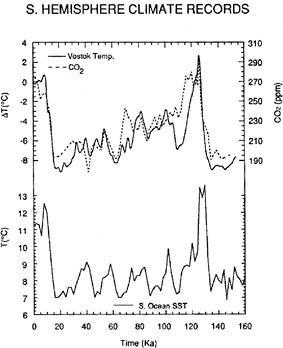
FIGURE 6.1 Comparison of three high-latitude records from the southern hemisphere showing the overall good agreement between CO2 and temperature changes (inferred from δD). Taken from Crowley and North (1990). Data sources: the Vostok δD record (Jouzel et al., 1987) and the CO2 record (Barnola et al., 1987) are plotted according to the revised chronology of Petit et al. (1990).SOURCE: Crowley and North (1990). Courtesy of Oxford University Press.
ity, resulting from changes in the Earth's orbital cycles, pioneered by the CLIMAP project and described by Imbrie et al. (1992, 1993), has been verified and further elucidated by the SPECMAP project. Orbitally induced variations in insolation at the Milankovitch periods (primarily 100,000, 41,000 and 23,000 years) explain much of the change in global ice volume throughout the late Pleistocene and have been identified in a variety of paleoclimate records (e.g., marine and ice cores and loess sequences). CO2 and CH4 figure prominently in climate change over the last glacial/interglacial cycle, as demonstrated by the close association between Vostok (Antarctica) ice core CO2 and temperature (see Figure 6.1).3 This dramatic demonstration of the long-term association between temperature and CO2 has had a profound effect on the implications of anthropogenically induced greenhouse gas warming. However, the fact that CO2 lags temperature at major climate transitions (e.g., the end of the last interglacial) suggests that the system response may be complex.
New Developments
The most dramatic recent contributions to our understanding of paleoclimate during the last glacial cycle have come in the millennial-scale range of climate variability. Unprecedented swings in the Earth's climate have now been recorded in two ice cores from central Greenland, instigating new higher-resolution investigations of land and marine paleoclimate records.
In 1993 the Greenland Ice Sheet Project Two (GISP2) successfully completed drilling to the base of the Greenland ice sheet in central Greenland. In so doing, GISP2, along with its European companion project GRIP (Greenland Ice Core Program), developed the longest high-resolution continuous paleoenvironmental record (>250,000 years) available from the northern hemisphere. Based on the comparison of electrical conductivity and oxygen isotope series between the two cores,4 at least the upper 90 percent displays extremely similar if not absolutely equivalent records.
The central Greenland ice cores provide a framework for other paleoclimate records because of their relatively precise dating. The current best estimate of the age at ~2,800 m is ~110,000 years, based on a combination of multiparameter annual layer counting combined with measurements of the d18O of atmospheric O2 calibrated with the Vostok ice core in Antarctica.5 Error estimates in the dating are quite remarkable, from 2 percent for 0 to 11,640 years ago to 10 percent for over 40,000 years.6 Agreement between the GISP2 and GRIP ice cores (separated by 30 km or ~10 ice thicknesses) over the record period of the past ~110,000 years provides strong support for the climatic origin of even the minor features of these records and implies that investigations of subtle environmental signals can be rigorously pursued. The climatic significance of the deeper part of these ice cores (>110,000 years in age) is a matter of considerable controversy. Without additional records, the evidence for rapid climate change in Greenland during the last interglacial remains equivocal.
The millennial-scale events recorded in the upper 110,000 years of the two central Greenland ice cores are, however, unequivocally climate events. They represent large climate deviations (massive reorganizations of the ocean-atmosphere system) that occur over decades or less and during which ice-age temperatures in central Greenland may have been as much as 20°C colder than today (see Figure 6.2).7 These events have their greatest magnitude during the glacial portion of the record, prior to ~14,500 years ago), when large northern hemisphere ice sheets provided positive climate feedbacks.8
Examination of one of these events, the Younger Dryas (a near return to glacial conditions during the last deglaciation, previously identified in a variety of paleoclimate records), demonstrates the importance of conducting multiparameter high-resolution paleoclimate investigations on well-dated records. During this event lowered temperatures were accompanied by up to twofold and greater changes in snow accumulation, order-of-magnitude changes in the amount
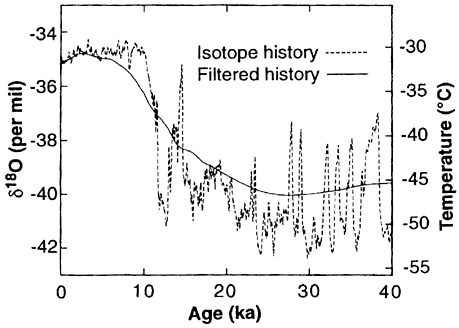
FIGURE 6.2 The central Greenland δ18O history for the most recent 40,000 years. The smooth curve results when this history is filtered to mimic the thermal averaging in the ice sheet. All temperature histories that give this same curve when filtered are indistinguishable to borehole thermometry. The right axis shows the calibrated temperature scale. SOURCE: Cuffey et al. (1995). Courtesy of the American Association for the Advancement of Science.
of wind-blown dust and sea salt in the atmosphere, and large changes in methane concentration, with cold, dry, dusty, conditions correlated with low-methane (see Figure 6.3).9 Annually resolved sampling over early and late stages of the Younger Dryas indicates that this ~1,300-year duration event began and ended in less than 5 to 20 years.10
The identification of rapid climate change event style variations in the GRIP CH4 record11 (see Figure 6.4) prompted considerable interest in the identification of such events in other regions since the source areas for CH4 during the last glaciation may have been in the middle to lower latitudes. In addition, several rapid climate change events recorded in Greenland are in the isotopic temperature record of the Vostok ice core from central East Antarctica, although with apparently smaller amplitude than in Greenland (see Figure 6.5).12
Paleoclimate records from North Atlantic marine sediment cores also contain notable millennial-scale variability,13 although the exact timing of these events is less precisely known than for the Greenland ice cores. Several of the marine cores reveal evidence that the formation of NADW (North Atlantic deep water; warm, saline, nutrient-depleted deep return flow water), and thus the oce-
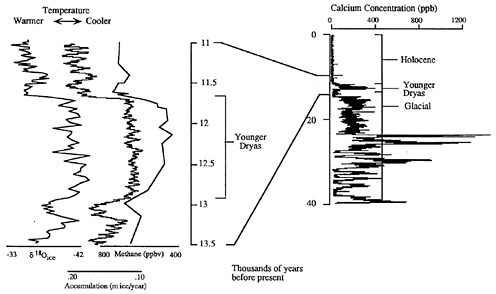
FIGURE 6.3 Composite figure. Above: the Younger Dryas was an abrupt return to near-glacial conditions (about 7°C lower, decreased accumulation rate, decreased methane, increased atmospheric dust) that lasted approximately 1,300 years and punctuated the transition from glacial to interglacial climates. Figure modified from Alley et al. (1993), Grootes et al., (1993), and Brook et al. (1996). Right: This high-resolution calcium record from the GISP2 ice core indicates the relative amount of dust in the atmosphere over Greenland and thus documents other abrupt, frequent, and massive changes in climate that characterize the glacial portion of the ice core record. SOURCE: Adapted from Mayewski et al. (1994, 1997). Courtesy of the American Association for the Advancement of Science.
anic thermohaline circulation, fluctuated dramatically in the past. 14 NADW diminished greatly during the last glaciation and was relatively strong during the interglacials. Recent studies confirm that NADW fluctuates on millennial timescales and correlates with sea surface and atmospheric temperatures.15
Changes in the flux of ice-rafted detritus, d18O of foraminifera shells, and the abundance of climate-sensitive foraminifera indicate that during the last glaciation the North Atlantic was punctuated by iceberg discharge events potentially produced in response to changes in ice sheet dynamics.16 The largest of these (Heinrich events) have a characteristic recurrence in the marine record on the order of 5,000 to 10,000 years. They are also associated with similar events of shorter-timescale variability described above (on the order of 1,000 to 3,000 years long, termed Dansgaard/Oeschger rapid climate change events) that correlate with the stadial/interstadial changes observed in ice core records from central Greenland (see Figure 6.6).17
Evidence for the presence of millennial-scale climate fluctuations has been
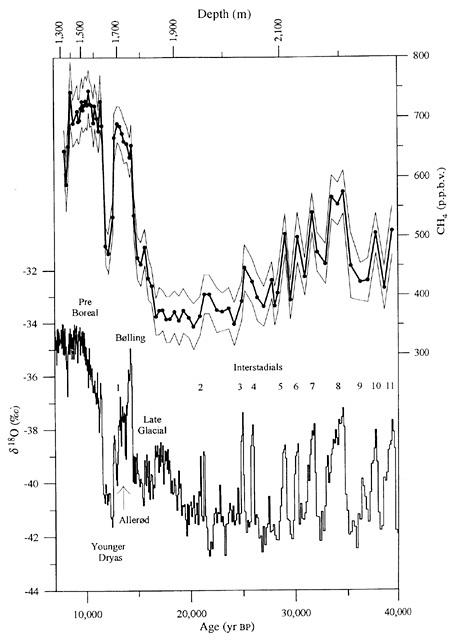
FIGURE 6.4 Top: GRIP ice core values for methane. The thick line runs through the mean concentration (black dots), and the two accompanying thin lines correspond to the experimental uncertainty (2 sigma). Bottom: Mean δ18O record along 2.2-m sections of the core (Dansgaard et al., 1993; Johnsen et al., 1992). The significant climatic events are noted by name or suggested numbering (Dansgaard et al., 1993). The timescale applies to both records. The depth scale applies only to the CH4 curve (top) because of the difference in age between trapped air and ice at a given depth. SOURCE: Chappellaz et al. (1993). Courtesy of Macmillan Magazines Ltd.
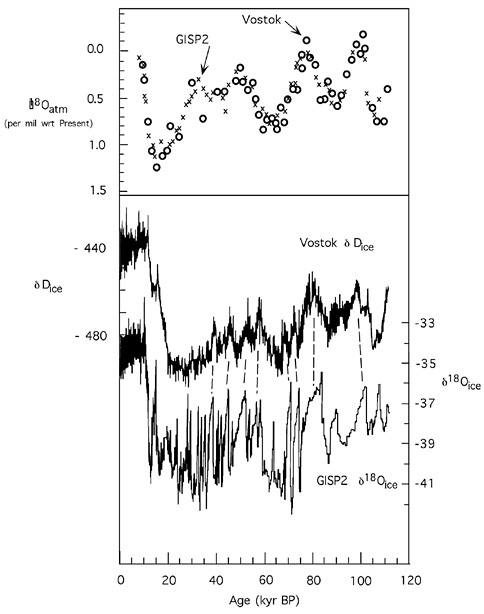
FIGURE 6.5 Greenland (GISP2) and Antarctic (Vostok) climate records covering the last glacial/interglacial cycle. Top: Plot shows the close correlation between GISP2 and Vostok δ18O of O2 in air in these ice cores. Bottom: Curves show close correlation between two proxies for temperature, δDice (Vostok) and δ18O (GISP2) in the ice. SOURCE: Adapted from Bender et al. (1994). Courtesy of Macmillan Magazines Ltd.
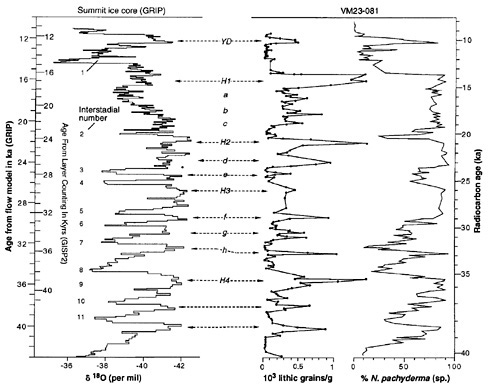
FIGURE 6.6 Comparison of the δ18O record and age model for the GRIP ice core, Summit, Greenland (Dansgaard et al., 1993), with measurements of lithic concentrations and percentages of the planktonic foraminifera Neogloboquardrina pachyderma (left coiling), a proxy for surface water temperatures, in WM23-81 (Bond et al., 1993). That foraminifera today lives in waters <10°C and comprises about 95 percent of the fauna at summer temperatures of less than 5°C. Age model for the marine record is from Bond et al. (1992, 1993). Cycles between the Heinrich events are given letters to aid their description in the text. A good match exists between the lithic concentration cycles and the temperature cycles in the ice core; the match of the lithic cycles to the ocean surface temperatures, however, is much poorer. The GISP2 timescale derived from layer counting to 41,000 years is included for comparison with the GRIP timescale and the 14C timescale. The GISP2 timescale was transferred into the GRIP record at the sharp interstadial boundaries, which are precisely located in both ice core records (Dansgaard et al., 1993; Mayewski et al., 1994), and then ages were interpolated between these boundaries. The progressive difference in ages, reaching about 10 percent at 40,000 calendar years ago, is consistent with the error estimated for ice core dating. SOURCE: Bond and Lotti (1995). Courtesy of the American Association for the Advancement of Science.
extended outside the North Atlantic and polar regions. Marine cores from the Santa Barbara basin reveal highly sensitive perturbations in the ocean circulation patterns of the East Pacific region 18 and ice-rafted debris events in the North Pacific that correlate with the Greenland ice core records. Abrupt changes in atmospheric circulation patterns and precipitation regime also are recorded over eastern Asia in a thick sequence of wind-deposited loess from central China. 19 Records of alpine glacier fluctuations, mountain snowlines, and paleovegetation in the Andes reveal climate fluctuations that are similar in regularity to events in the Greenland ice cores.20
While the exact phasing of rapid climate change events from region to region is still being examined, new advances in age-dating correlation techniques have provided insight into the bipolar phasing of major climate events close to the last glacial maximum. Measurements of the d18O of atmospheric O2 from the Byrd and Vostok ice cores in Antarctica and the GISP2 ice core suggest that the transition from glacial maximum to deglaciation began in Antarctica approximately 3,000 years before the onset of warming in Greenland.21 This view creates a more complex event phasing than that suggested by previous correlations of marine, coral reef, and ice extent records, which suggested that during the last termination nearly synchronous temperature changes affected ice masses from the poles to the equator. 22
New advances in paleoclimate reconstruction also come from the tropics. For example, a 30,000-year-long paleotemperature record from lowland Brazil, based on noble gas concentrations in groundwater23 and an Andean ice core24 suggests a cooling of 5 to 8 degress, contrasted with earlier estimates from marine cores that limit cooling to >3 degrees.25 Implications of this change in temperature to the hydrological cycle and consequently to climate are intriguing.26 These new findings have stimulated examination of other tropical paleoclimate records and renewed investigations into climate forcing that is tied to changes in the tropics.
Causal mechanisms for glacial-age climate fluctuations appear to be complex, and phasing of these events is not understood from region to region. However, evidence for the identification of regularity in the timing of some climate events is building. Studies ranging from the North Atlantic (GISP2) to the subtropics demonstrate 1,450-to 1,800-year periodicities for rapid climate change events.27 In addition, the cumulative effect of multiple climate forcings can now be demonstrated. As an example, ~90 percent of the variance in the GISP2 paleoatmospheric circulation series is related to insolation changes induced by the Earth's orbital cycles, which operate in concert with faster periodic climate forcings such as changes in ice sheet dynamics, thermohaline ocean circulation, and solar variability (see Figure 6.7).28 Additional climate forcing mechanisms are, undoubtedly, also involved, such as changes in CO2, CH4, water vapor, volcanism, biogenic source cloud condensation nuclei, and dusts.
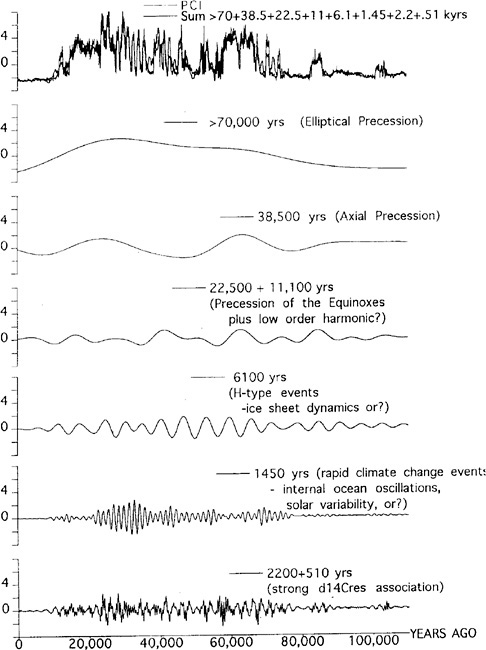
FIGURE 6.7 Top curve: [NRC9] The PCI (Polar Circulation Index) is a time series describing the dynamics (i.e., increase and decrease from mean values) of the well-mixed atmosphere represented by the dominant EOF of the major ions in the GISP2 ice core (Mayewski et al., 1994). The PCI provides a relative measure of the average size and intensity of polar atmospheric circulation. In general terms PCI values increase (e.g., more continental dusts and marine contributions) during colder portions of the record (stadials) and decrease during warmer periods (interstadials and interglacials; Mayewski et al., (1994)). The PCI is contrasted with the sum of the bandpass components (>99 percent significance) estimated from this series. The sum represents about 90 percent of the variance in the original PCI series. Lower curves: Major bandpass components derived from the PCI series, including those with periodicities close to elliptical precession, axial precession, precession of the equinoxes, lower-order harmonics of the preceding, and periodicities potentially related to ice sheet dynamics, internal ocean oscillations (including changes in thermohaline circulation), and solar variability. The 6,100-year bandpass component describes the timing of H (Heinrich events) and the 1,450-year bandpass component of the timing of the rapid climate change events (Dansgaard/Oeschger) events in the GISP2 record. SOURCE: Adapted from Mayewski et al. (1997). Courtesy of the American Geophysical Union.
The Holocene
Summary of Previous Work
One of the most important tasks for paleoclimatologists is improving our understanding of Holocene climate, for it is within the Holocene that the boundary conditions for modern natural climate variability can be identified and from which the relative importance of natural versus anthropogenic climate forcing can be assessed. Understanding modern climate and predicting future climate will require a detailed understanding of Holocene climate forcing and response.
Millennial-scale and finer Holocene climate fluctuations have been identified for more than two decades in a variety of Holocene records. 29 In general, however, Holocene climate variability is significantly more subdued in magnitude than that recorded during the last glaciation, and significantly less attention has been paid to this portion of the paleoclimate record.
New Developments
Environmental response to climate change since the last glacial maximum has been considerable. COHMAP and numerous smaller research efforts have characterized and modeled the effect of changes in land and sea ice extent, sea surface temperature, vegetation, and extent of arid regions during selected periods. Fossil pollen data keyed to the distribution of modern analogs have been used to develop paleovegetation maps for regions such as eastern North America (see Plate 6).30 Pollen and tree ring data have been used to reconstruct the spatial variations of temperature and precipitation over northern North America for the past ~6000 years.31
Several primary conclusions can be drawn from paleovegetation reconstructions. 32 Climate change events of the magnitude captured in these studies result in
dramatic changes in vegetation over regions. Even individual taxa respond sensitively to climate change, and vegetation produced under conditions that lack modern analogs may not be found under modern climate conditions. Some attempts have been made to simulate vegetation patterns that could exist in 2 × CO2 eastern North America, utilizing general circulation models (GCMs) coupled with paleoclimate-vegetation distributions.33
Annually resolved continuous paleoclimate records from the GISP2 ice core demonstrate that Holocene climate is characterized by annual-to millennial-scale variability and that Holocene climate is significantly more complex than glacialage climate.34 Time series for the major ions dissolved in the atmosphere, utilized as tracers for major atmospheric circulation systems, reveal a strong association between expansions of northern hemisphere polar atmospheric circulation systems and a variety of discontinuous paleoclimate records that record worldwide coolings (see Figure 6.4).35 These events have a quasi-periodicity of 2,600 years in phase with previously defined ~2,500- year variations in d14C, suggesting perhaps a solar variability-climate connection.36
Complexities in Holocene climate are noted in a comparison of several environmental parameters recorded in the Summit, Greenland, ice cores. During major Holocene coolings recorded in the GISP2 paleoatmospheric circulation series (see Figure 6.8), the climate response system operated similarly to pre-Holocene cooling events (Figure 6.3). Namely, cooler temperatures (more negative stable isotopes), reduced methane, reduced accumulation rate, and intensification of polar atmospheric circulation (expanded polar circulation index) all vary, in general, together. However, the coherence between these variables weakens as the events get younger and is particularly poor during the periods between events, suggesting increased regionalization of climate from early to late Holocene. This progressive regionalization of climate may be the manifestation of the varying influence of a variety of climate-forcing mechanisms, such as changes in total and season to season insolation, ice sheet and sea ice extent, solar variability, and volcanism.37
Several paleoclimate records document specific periods of climate reorganization. For example, African lake level records, developed in 1990,38 suggest that a major period of ocean-atmosphere reorganization occurred between some 7,000 to 8,000 years ago. A similarly timed reorganization in climate has recently been documented by comparing records from tropical Africa with those from Greenland and Antarctica.39 Other lake level records from Africa plus Dead Sea records suggest that both the tropics and the midlatitudes experienced a series of major changes in hydrological balance.40
Analysis of Arabian Sea sediment records spanning the past 24,000 years reveals that the response of the southwest monsoon over this region to long-term changes in insolation occurred in several distinct events of less than 300-year duration between 14,300 and 7,300 14C years ago.41 Arabian Sea sediment records also document changes in the strength and frequency of the Indian monsoon (see Figure 6.9), confirming earlier reports that the monsoon strengthened in stages
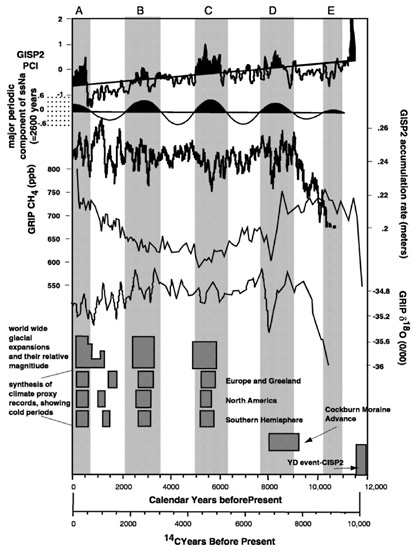
FIGURE 6.8 From top to bottom: GISP2 annually dated Holocene EOF1, a proxy for northern hemisphere polar cell intensity (PCI; described in Figure 6.8) smoothed with a robust spline (equivalent to a 100-year smooth)) with a quasi-2,600-year periodicity (O'Brien et al., 1996); GISP2 accumulation rate (Meese et al., 1994a,b); GRIP methane (Blunier et al., 1995); GRIP δ18O record (Dansgaard et al., 1993); worldwide glacial expansions and their relative magnitude (Denton and Karlen, 1973); synthesis of various climate proxy records from Europe, Greenland, North America, and the southern hemisphere showing cold periods (Harvey, 1980); the Cockburn Stade (Andrews and Ives, 1972; Alley et al., 1997); and the Younger Dryas event (Alley et al., 1993; Mayewski et al., 1993). Letters specify major cold periods with A equal to the Little Ice Age. Courtesy of the American Association for the Advancement of Science, Macmillan Magazines Ltd., the University of Oulu, Geological Society of America, and Academic Press.
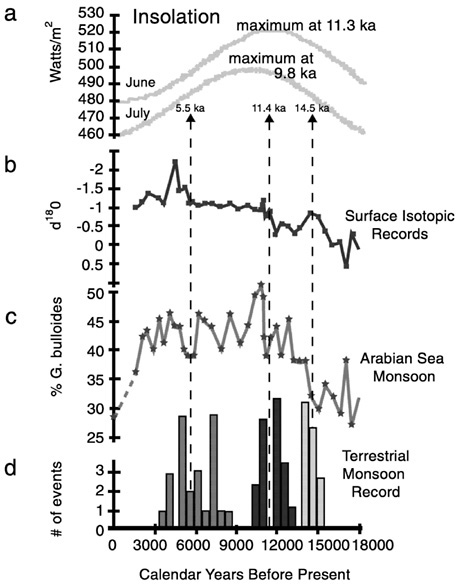
FIGURE 6.9 Summary figure illustrating the hypothesized insolation forcing and the lagged response of post-glacial southwest Indian monsoon intensification: (a) June and July insolation for 40°N, (b) RC27-23 surface isotopic record, (c) RC27-23 G. bulloides abundance (proxy for monsoon strength), and (d) histograms of abrupt monsoon-strength increases and decreases at sites across East Africa and southwestern Asia. Mid-Holocene decreases in monsoon strength appear to have been more time transgressive than the earlier abrupt increases and also more in phase with insolation forcing. The figure shows the timing of the first abrupt increase in monsoon strength (mean, 11,400 years), and the date at which the period of maximum monsoon strength apparently ended at each site (mean 5,500 years). Note that the period of maximum monsoon strength (at 11,000 to 5,000 years) lags peak insolation (at 14,000 to 8,000 years). SOURCE: Adapted from Overpeck et al. (1996). Courtesy of Springer-Verlag.
over the deglaciation.42 The former study also identified a 3,000-year lag between monsoon intensity and insolation that lasted from about 9,500 to 5,500 years ago. By the end of this period, when northern hemisphere glacial boundary conditions had disappeared, monsoon behavior responded more linearly to insolation. Further significant centennial-scale decreases in monsoon intensity occurred prior to ~6,000 years ago, when monsoon strength was enhanced relative to the present. Since abrupt changes in Arabian Sea sediment monsoon records occurred when northern hemisphere summers were significantly warmer than present,43 some researchers have speculated that future greenhouse-warmed summers 44 may offer “surprises” in monsoon behavior.
Major reorganizations in Holocene climate plus finer-scale climate fluctuations such as abrupt shifts in drought and flood frequency may be explained by a combination of climate forcings.45 For the Holocene such forcings may include (1) changes in thermohaline circulation; (2) changes in insolation, notably precession that may generate long-period El Niño-type reorganizations in moisture and temperature and changes in marine and land ice cover; (3) changes in solar output; and (4) changes in the concentrations of volcanic aerosols and dusts.46 A variety of paleorecords are available to test the impact of these forcing mechanisms, including, for example, potential proxies for solar variability derived from d14C series in tree rings and 10Be series from ice cores, CO2 from ice cores, CH4 from ice cores, and volcanic sulfate from ice cores.47
The Late Holocene (~2,000 years ago to present)
Summary of Previous Work
Although the exact timing and geographic distribution of Holocene climate change events are complex, the past 1,000 to 2,000 years offer important opportunities for unraveling the decadal- to centennial-scale and finer climate variability that influences modern climate. There is general agreement that glaciers around the world expanded during at least parts of the thirteenth through the nineteenth centuries, a period called the Little Ice Age (LIA), and that warming occurred for several centuries prior to this period,48 at least in some regions, during what is controversially called the Medieval Warm Period (MWP).
Similarities in decadal- to centennial-scale variability over the past 1,000 years are observed in a variety of paleoclimate records from, for example, China (e.g., temperature, drought, rain frequency, dust events), although differences in the timing of peak cooling differ by region.49 Furthermore, broad similarities exist between the Chinese records and records covering a wide geographic range.
New Developments
Although spatially and temporally incomplete at present, paleoclimate records provide unique environmental reconstructions for the most recent millennia. The
LIA appears to play an important role in understanding modern climate. Based on the GISP2 atmospheric circulation record (see Figure 6.8), the LIA had the most abrupt onset (AD 1400 to 1420) of any of the Holocene rapid climate change events.50 This extends findings from a 1,500-year-long ice core record in the Andes which suggests that entrance into and out of the LIA was abrupt.51
Previous research summarized by Lamb (1995) demonstrates changes in climate such as increased severity of winter storms and sea ice extent, plus accompanying changes in food harvests during the LIA and contrasting milder conditions during the MWP. Recently developed marine sediment records from the Sargasso Sea52 suggest that sea surface temperatures in the Bermuda Rise region were ~1 degree cooler than today ~400 years ago (during the LIA) and ~1,700 years ago, and ~1 degree warmer than today 1,000 years ago (during the MWP). On the basis of this work,53 it is suggested that part of the general climate warming of the past few decades54 could be natural. During the MWP extreme and persistent drought characterized such regions as California and Patagonia,55 implying potential “surprises” during warmer-than-present climates.
Composite time series for El Niño recurrence (see Figure 6.10) suggest that fewer such events occurred during the MWP than during colder intervals prior to and following this time.56 Studies conducted over only the past 500 years, which do not include the LIA/MWP transition, suggest that El Niño recurrence rate is stationary over the long term but that strong El Niño events are nonstationary over centennial scales.57
Analysis of records covering the past 500 years suggests the presence of persistent natural interdecadal and century-scale climate oscillations. A compilation of paleoclimate records representative of the past 400 years of circum-Arctic climate variability indicates that the highest temperatures over this period have occurred since 1840, demonstrating the role of natural climate variability and, as of 1920, the added climate influence of atmospheric trace gases.58 Multidecadal modes and step-function changes in precipitation, temperature, and wind regimes have been identified in a number of regions, ranging from the Intertropical Convergence Zone (ITCZ) to both northern and southern midlatitudes. Recent attempts to match decadal-scale climate change events from region to region do not, however, necessarily reveal synchronous behavior over the past few centuries.59
Although their relative importance is still debated, several mechanisms have been proposed for the natural changes in climate of the past millennium, including changes in solar output, an increase in volcanic aerosols during specific periods, an increase in long-term average atmospheric aerosol loading, variations in thermohaline circulation, and changes in greenhouse gases.60
The paleoclimate record offers the potential to deconvolve the region-to-region climate variability that characterizes the Holocene on millennial to decadal plus finer timescales. Although few such records are available at present, these records offer immense potential (see Box 6.1).
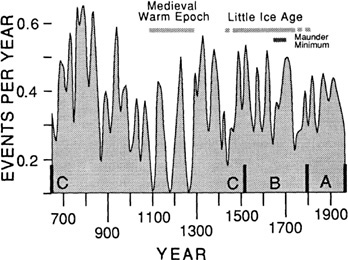
FIGURE 6.10 Composite time series for recurrence of El Niño events since AD 622. Linearly weighted 19-year running mean. Data from Quinn et al. (1987) and Quinn (1992). Segment C (Nile), 622 to 1525; segment B, 1525 to 1800; segment A, 1800 to 1984.SOURCE: Anderson (1992). Courtesy of Cambridge University Press.
Climate-Vegetation Interaction
Summary of Previous Work
Early climate studies of modern tropical deforestation61 have focused attention on the importance of climate-vegetation interactions in governing the surface energy and moisture fluxes and hence the importance of climate-vegetation interactions. More recently,62 it was proposed that boreal forests, in addition to tropical vegetation, have an important climatic effect. A climate model was used to demonstrate that expansion of the boreal forest, associated with greenhouse warming, would enhance this warming through albedo feedback because trees mask the high reflectance of the high-latitude snow cover. In particular, tree cover, even with underlying snow cover, promotes springtime warming. These contributions introduce the potential of climate-vegetation feedbacks to substantially modify the sensitivity of the Earth's climate to a large number of different forcing factors. Earth history enables an assessment of the importance of vegetation-climate feedbacks for a diverse number of forcing factors (carbon dioxide, solar variations, orbital variations, sea level, changes in continental geometry). But most importantly, the combination of knowledge about the nature of the forcing factors, the paleobotanical record of vegetation distribution, and the record of temperatures presents a unique opportunity to critically assess climate-biosphere sensitivity.
|
BOX 6.1 Available Climate Records of the Past Millennium Climate Patterns Temperature and Drought. Tree ring studies offer the greatest potential for developing broad spatial arrays of relatively recent, well-dated proxies for temperature and drought. Filtered tree ring series from, for example, Tasmania clearly reveal interdecadal patterns in temperature (see Figure 6.11).63 In addition, 250- to 300-year reconstructions of spring/summer temperatures are available for western North America and western Europe,64 winter precipitation and annual temperature in western North America, 65 and drought in the conterminous United States.66 ENSO. There are proxy ENSO time series available from a variety of records, including, for example, historical records, tropical corals, tropical ice cores, and polar ice cores. 67 Of particular note are the newly emerging annually resolved coral records that through calibration with the instrumental record provide proxies for zonal winds and precipitation (see Figure 6.12).68 North Atlantic Oscillation (NAO). GISP2/GRIP d18O series have significant correlations with the NAO series.69 Sea Ice. Proxies for sea ice variability are available from Antarctic and Arctic ice cores.70 Climate Forcing CO2. Detailed records of naturally and anthrepogenically induced changes in atmospheric CO2 from an Antarctic ice core (see Figure 6.13) reveal preindustrial carbon dioxide mixing ratios in the range of 275 to 284 ppm, over the time period of the LIA and MWP.71 Sulfate and Nitrate. High-resolution time series for sulfate and nitrate from a south Greenland ice core, covering the past two centuries, demonstrate the difference between natural pre-1900 levels of these two acidic species versus post-1900 values (see Figure 6.14).72 In the preanthropogenic atmosphere over Greenland, nitrate levels were approximately two times the sulfate levels. Increased levels of sulfate during the anthrepogenic era mask volcanic sulfate levels, indicating the large rise over natural background during this period. Volcanic events recorded in Greenland ice core sulfate series correlate with annual changes in atmospheric temperature, providing evidence for sulfate aerosol shielding.73 Solar Variability. d14C series from tree rings and 10Be series from a Greenland ice core provide potential proxies for solar variability.7410Be series vary inversely with sunspot activity, and 10Be production varies inversely with temperature (see Figure 6.15).75 |
New Developments
Recent applications of biome and simple vegetation-climate models coupled with GCMs and applied to the study of Earth history have resulted in a number of
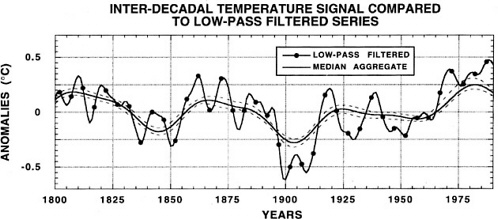
FIGURE 6.11 The median aggregate waveform since AD 1800 with its approximate 95 percent confidence limits compared to the low-pass filtered series developed from Tasmanian tree ring series. The aggregate appears to explain much of the interdecadal warming in the reconstruction since AD 1965. SOURCE: Cook et al. (1996a, b). Courtesy of Springer-Verlag.
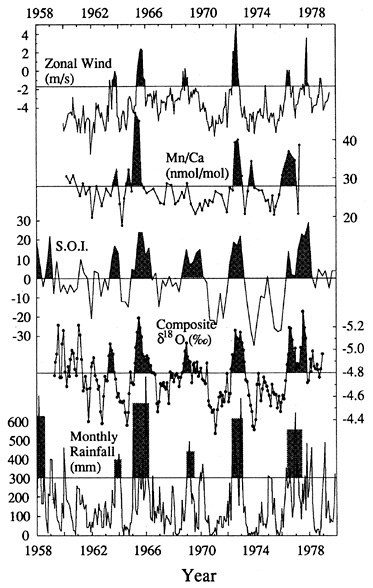
FIGURE 6.12 Instrumental and coral records of environmental conditions at Tarawa Atoll. From top: zonal winds, coral Mn/Ca (Shen et al., 1992), the Southern Oscillation Index (SOI; Wright, 1989); composite coral δ18O (plotted reverse; Cole and Fairbanks, 1990) and monthly rainfall (from Monthly Climatic Data for World and New Zealand Meteorological Service). Shaded periods reflect ENSO warm-phase conditions as noted by Quinn et al. (1978, 1987), which involve the weakening and reversal of the trade winds and dramatically increased rainfall at this site. SOURCE: Cole et al. (1992). Courtesy of Cambridge University Press.
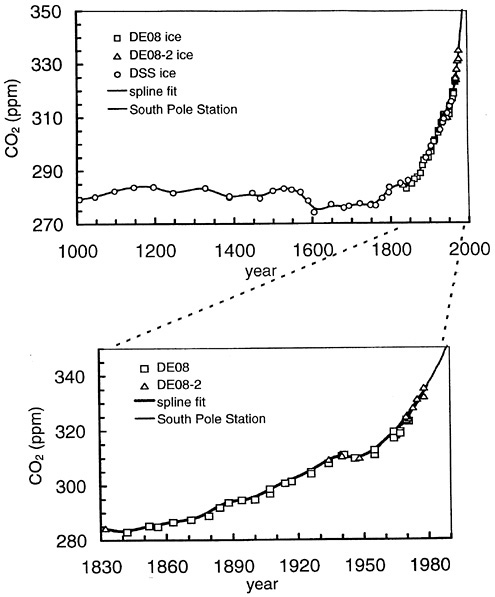
FIGURE 6.13 Top: CO2 mixing ratios from the DEO8, DEO8-2, and DSS ice cores, Law Dome, East Antarctica, and modern South Pole atmospheric record (Keeling, 1991). Bottom: CO2 mixing ratios since early last century from DEO8 and DEO8-2 Law Dome ice cores and the South Pole record (Keeling, 1991). The thick line is a smoothing spline fit to the DEO8 and DEO8-2 data. The degree of smoothing has been set such that an attenuation of 50 percent occurs for CO2 variations of 20 years' duration. Such smoothing was found to best attenuate the shorter-frequency variations that, because of the averaging effect of the air enclosure process, are unlikely to be real atmospheric features and are assumed to be measurement errors. SOURCE: Etheridge et al. (1996). Courtesy of the American Geophysical Union.
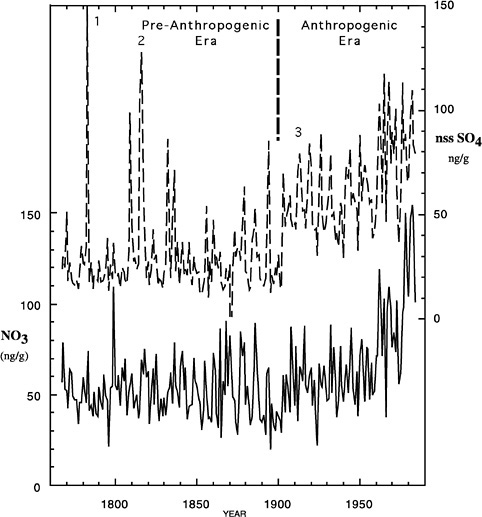
FIGURE 6.14 Time series of the nonseasalt sulfate (nss; dashed line) and nitrate (solid line) concentrations at ice core site 20D, southern Greenland. Data have been smoothed (using a gaussian function) to periods of one to two years from the original five to eight samples per year to remove seasonal signals. Examples of volcanic events recorded in nss sulfate spikes are (1) Laki (1783), (2) Tambora (1815), and (3) Katmai (1912). SOURCE: Adapted from Mayewski et al. (1990). Courtesy of Macmillan Magazines Ltd.
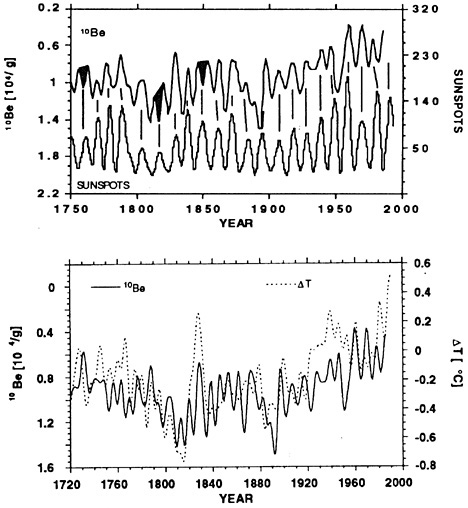
FIGURE 6.15 Top: 10Be measurements derived from the Dye 3 ice core vary inversely with sunspot activity. Bottom: Observed inverse relationship of 10Be production and temperature. SOURCE: Beer et al. (1994). Courtesy of Cambridge University Press.
remarkable conclusions. Foley et al. (1994) have shown that mid-Holocene warming associated with changes in the Earth's orbit was enhanced, particularly in springtime, by an associated poleward expansion of the boreal forests. Gallimore and Kutzbach (1996) have suggested that the onset of the last glaciation was accentuated by the observed equatorward retreat of the boreal forests associated with the cooling. Deriving sufficient climate model sensitivity from changes in the Earth's orbit to produce the observed glacial-interglacial cycles has been a long-standing problem. Evidently, climate-vegetation feedbacks are a
likely candidate to solve this problem, at least partially. In a similar vein, Dutton and Barron (1996, 1997) have suggested that the development of widespread grasses in the Miocene and the retreat of the boreal forests observed to be associated with the development of widespread ice caps could have substantially enhanced the Late Cenozoic cooling. They suggest that both biological innovation (development of a new widespread flora) and climate-vegetation feedbacks (e.g., climate-boreal forest-albedo relationship) may play an important role in governing climate.
More than 20 parameterizations for the land surface are now included in the World Climate Research Programme's Project for Intercomparison of Land Surface Parameterization Schemes.76 Intercomparison of these parameterizations provides a strong foundation for understanding the role of vegetation in governing moisture and energy fluxes. With this foundation we can expect a much greater understanding of the importance of vegetation character and distribution in governing climate.
A primary objective for future research must be to include dynamic vegetation, which evolves with climate change and allows explicit incorporation of climate-vegetation feedbacks. A number of different vegetation models are available now or are under development. Biome models, in which vegetation functional form and species distribution are governed by key climatic variables, provide the foundation for other models.77 The life-form model (EVE—Equilibrium Vegetation Ecology model)78 provides an alternative, in which the net phenology and physical attributes of the vegetation community are determined for each climate model grid point based on the climatic relationships of 110 life forms. Again, pathfinder studies guide research on the application of these models to Earth history. A prescribed change in climate to assess vegetation change has been applied using the Prentice biome model.79 A “dynamic” Holdridge-type vegetation scheme80 has been used to assess climate-vegetation change for a transient doubled carbon dioxide experiment. Again, each of these pioneering studies lacks a capability to verify the results based on climates very different from the present day. In contrast, Earth history presents a considerable record of vegetation character and distribution. Extensive published summaries of the vegetation distribution and history for the Last Glacial Maximum have been provided.81 Global Tertiary (past 65 million years) vegetation distribution maps and recent updates are available.82 Extensive references are given for the Eocene climate,83 and both phytogeographic maps and extensive references for the mid-Cretaceous are available.84
However, actual applications of climate-vegetation models for past climates have been limited. The ability of three different biome models to predict present-day vegetation distribution85 has been assessed using the GENESIS86 GCM; these biome models were then applied to the simulation of the Younger Dryas and the Eocene. In these cases the vegetation was not coupled to the GCM but rather was calculated “off-line” after the GCM produced a climate simulation.
Hence, these models predict a change in vegetation that can be compared to observations but do not include vegetation-climate interaction. EVE was utilized to perform a dynamically coupled experiment to incorporate the role of a changing vegetation in assessing climate sensitivity. 87 Results for the Late Cretaceous suggest that vegetation-climate feedbacks could be a contributing explanation of Cretaceous polar warmth.
The application of ecological models, coupled with climate models, is obviously in its infancy. However, efforts to date have several implications. First, climate-vegetation interaction has the potential to substantially alter the sensitivity of climate models. Second, an intercomparison of several different landatmosphere interaction parameterizations and the spectrum of ecological models is essential. Third, vegetation characteristics and distributions from Earth history have considerable potential as a means of assessing the importance of climate-vegetation feedbacks and in validating coupled climate-vegetation simulations. These data are a unique opportunity to investigate a critical aspect of global change.
Climate-vegetation interactions extend beyond the effects associated with the expansion and contraction of specific biomes due to warming or cooling. For example, carbon dioxide concentrations are evidently correlated with stomatal parameters (frequency and size) on the leaves of land plants.88 It has also been suggested that C4 plants are adapted to conditions of water and CO2 stress and that their widespread expansion 5 million to 7 million years ago was related to lower carbon dioxide levels.89 These vegetation responses are related specifically to the nature of the climate forcing and introduce the potential of utilizing the floral record with proxies of past atmospheric carbon dioxide levels to examine plant responses.
Warm Climates
Summary of Previous Work
Earth history is characterized by time periods in which the climate was significantly cooler and significantly warmer than the present day. Much of the past 150 million years has been substantially warmer than the present day, although a long-term climatic cooling has dominated over the past 60 million years. The extreme warm climates of the past provide an unique set of case studies of global change. They challenge our ability to describe, model, and understand how various elements of the Earth's climate operate and interact. These time periods also provide a critical test of the models used to predict the global climate response to increases in atmospheric greenhouse gases. Although a wide variety of climatic forcing factors have operated over Earth history, variations in atmospheric carbon dioxide concentrations are now linked to the record of climate change on almost every timescale, from abrupt events, to glacial to interglacial
cycles, to the Cenozoic global cooling trend, to the major glaciations, and to the climate of the Archean (early Earth). Substantial evidence is available that links many of the extreme warm periods of the past 100 million years to higher carbon dioxide levels.90 The most recent occurrences of these climatic extremes tend to be the best documented, with sufficient information to provide major challenges to climate models.
There is abundant evidence for global warmth during the mid-Cretaceous (about 100 millions years ago). There is no convincing evidence for permanent polar ice during this time. Arctic Ocean cores recover abundant phytoplankton,91 suggesting at least a seasonally ice-free Arctic. More importantly, more than 400 species of land plants have been recorded from land well within the Arctic Circle.92 Vegetation analysis93 indicates mean annual temperatures from the North Slope of Alaska to be 10 to 13 degrees. Cretaceous deep-water temperatures, derived from the oxygen isotopic composition of benthic foraminifera, are as warm as 15 to 17 degrees. Evidence from the Cretaceous tropics is more problematic, but evidently temperatures were similar to or somewhat warmer than the present day. Equator-to-pole surface temperature gradients were therefore substantially lower than at present, and the Cretaceous Earth was substantially warmer, perhaps at all latitudes. Continental geometries were substantially different from the present day, and carbon dioxide levels were two to eight times present-day values.94
The Eocene (approximately 40 million to 50 million years ago) was also substantially warmer than at present. Oxygen isotopic measurements suggest that the high-latitude oceans were quite warm (perhaps as much as 10 degees warmer than at present at 60 degees N), but the tropics were as much as 5 degrees cooler.95 The interpretation of polar warmth is supported by abundant floral and faunal data.96 The remains of ectotherms, like alligators, above the Arctic Circle have been used to suggest frostless winters in coastal regions above 70 degrees N. In addition, floral data from the Eocene continental interior, such as the presence of palms at the latitude of present-day Chicago, indicate very mild winters even in continental interiors. 97The nature of the Eocene climate is also deduced from measurements of the size of aeolian dust transported through the atmosphere and deposited in the deep sea. Eocene grain sizes are substantially smaller, on a global basis, than earlier records or modern records. The Eocene record is also one of a substantially smaller equator-to-pole gradient, but in this case the poles are substantially warmer and the tropics cooler. This suggests a very different climate mode from the warm Cretaceous. Temperature gradients similar to the Eocene pattern are characteristic of much of the Cenozoic preceding the development of permanent ice caps on Antarctica. According to one report,98 Eocene carbon dioxide levels may have been moderately higher than at present.
The Cretaceous and Cenozoic warm climates present a substantial challenge to climate models used to predict future climate change. They are the basis for exploring a number of different forcing factors and for determining the sensitivity
of the climate system to these factors. Each provides an interesting and valuable opportunity to validate climate models and to assess the nature of climate change and climate sensitivity. If major discrepancies exist between model predictions and the geological record, this analysis will focus attention on areas of needed research.
New Developments
Past warm climates have become a focal point for climate model study. Two results from these studies are particularly interesting. First, modern atmospheric GCMs appear to be incapable of achieving the equator-to-pole temperature gradients for the Eocene or the Cretaceous, although with higher carbon dioxide concentrations they can achieve reasonable globally averaged surface temperatures. Second, the record suggests that the mid- to upper range of Intergovernmental Panel on Climate Change (IPCC) estimates of climate sensitivity to increases in carbon dioxide better fits the geological data.
The first challenge introduced by the record of past warm climates is the reduced equator-to-pole surface temperature gradients. A universal response of atmospheric GCMs to increases in carbon dioxide concentrations is a small increase in tropical temperatures and a greater sensitivity at higher latitudes. To achieve the polar warmth of the Cretaceous (e.g., by increasing atmospheric carbon dioxide levels and incorporating Cretaceous continental geometries), GCMs produce an overheated tropics. 99 The nature of the problem is even greater for the Eocene, as tropical temperatures are lower compared to the present day while high-latitude regions are considerably warmer.100 If the sea surface temperature data are correctly interpreted, the solution must lie in a redistribution of energy. The choices are limited. Either the ocean-atmosphere system is capable of more efficient transport of energy poleward, cloud amounts and character change systematically with latitude in warmer climates, or the energy input to the Earth system is dramatically different. The latter point appears to be excluded based on celestial mechanics. A cloud hypothesis can be made to work but is difficult to justify. The more efficient energy transport idea also can be made to work but presents an enigma.
If the mechanisms of poleward heat transport are examined, there are few opportunities to promote increases in the efficiency of transport during conditions like that of the Eocene. With cooler tropics and warmer poles, both atmospheric sensible and latent heat transport should decline. The aeolian record described above, in fact, is evidence for a weaker atmospheric circulation. If the atmospheric circulation is weaker, the wind-driven ocean surface circulation should be weaker. The only apparent opportunity to increase poleward heat transport is through the deep thermohaline circulation of the ocean. The role of ocean heat transport changes in explaining climate change has become a topic of considerable interest.101 One possibility is a reversal of the thermohaline circula-
tion and the production of warm highly saline deep water in the evaporative subtropics as the dominant bottom water source in times of warm polar temperatures. The implications of such a reversal in circulation on the characteristics of the ocean are considerable. A number of studies102suggest that modest increases in ocean heat transport—on the order of one or two times the amount of heat transported by North Atlantic deep water—would be sufficient to explain much of the paleoclimatic data.
The conclusions from such studies are of considerable interest. These studies introduce the possibility that the role of the ocean under climatic conditions very different from the present day may be very different from the modern ocean. GCMs without coupled oceans may be unable to simulate climatic sensitivity or the distribution of temperatures over the surface to the Earth. Furthermore, the challenge is to incorporate an adequate thermohaline circulation into coupled ocean GCMs. What is clear is that modern atmospheric GCMs are incapable of reproducing the temperature gradients of much of the warm climate periods of the past 100 million years.
The geological record also can be utilized to calibrate model sensitivity to increases in carbon dioxide concentrations in the atmosphere. 103 For example, one study uses global, mean annual, equator-to-pole temperature gradients, ranges in atmospheric carbon dioxide, and assumptions about the nature of other forcing factors to suggest that the midrange of the IPCC estimates (1.5 to 4.5 degees) for a doubling of carbon dioxide is appropriate for much of the Earth' s history.104 It was further noted that the uncertainties in some of these factors probably mean that the paleoestimates of climate sensitivity to increases in atmospheric carbon dioxide have about the same error range as the IPCC estimates.105 In more detailed studies using GCM results106 the actual distribution of surface temperatures was the basis for comparing model simulation results for differing levels of carbon dioxide. The GCM that was used yielded a 2.75 degrees warming for a doubling of atmospheric carbon dioxide. With this model the upper level of carbon dioxide estimates from the Cretaceous based on a variety of geochemical estimates107 was required to achieve Cretaceous warmth. This implies that either unknown forcing factors were operating during the period or that the middle to upper range of IPCC estimates of climate sensitivity is required to explain past climates.
Caution must be applied in using the Earth's history to assess climate sensitivity. There are simply too many potential errors, in the interpretations of the observations, in knowledge of the forcing factors involved, and in the veracity and capability of the climate models used. It is critical to focus on better proxy information at all timescales. However, it is interesting to note that in the more than 100 simulations of past climates with GCMs we are yet to see a simulation that did not underestimate the record from past climates, unless specific assumptions were made in order to achieve past climatic conditions. This statement applies to both past cold and past warm extremes. This aspect of paleoclimate
simulations has been the basis for suggesting that past climates imply a climate sensitivity that is within or exceeds IPCC estimates.
A focus on past extremes in climate obviously presents a challenge to the climate models used to assess future climates. The record of past warm climates appears to be impossible to assess adequately without taking into account the potential role of the ocean in global change. Furthermore, these time periods are suggestive of a very different role for the oceans during warm climates. In fact, it may be inadequate to have a coupled ocean-atmosphere model if the ocean model does not have a credible thermohaline circulation. Importantly, this is just one example of a potential inadequacy of current climate models as illustrated by paleoclimate investigations. Other factors and model systems also may be important, such as incorporation of dynamic vegetation. Past climates also present an opportunity to assess the nature of climate sensitivity. This type of application is imperfect but appears to suggest that past climates will be very difficult to simulate if climate sensitivity to carbon dioxide increases is in the lower range of IPCC estimates.
KEY SCIENTIFIC QUESTIONS AND ISSUES
The key scientific questions facing paleoclimate researchers have been articulated in a series of international projects, including PAGES (Past Global Changes) of the International Geosphere-Biosphere Programme, CLIVAR (Climate Variability) of the World Climate Research Program, and GLOCHANT (Global Changes in the Antarctic) of the Scientific Committee on Antarctic Research. Through the integration of ice, ocean, and terrestrial paleorecords, these international efforts seek to develop a basis for understanding the characteristics of natural global environmental change, notably climate change. These paleodata are essential for assessing human influence on the global environment and for evaluating predictive climate models.
Several questions and issues have evolved as foci for the paleocommunity. These consensus views have been expressed in several documents108 which form the basis for the specific scientific questions that follow.b
Focus on the Past 2,000 Years
Paleoclimate records demonstrate that Holocene climate has been by comparison with glacial climates both warm and relatively stable. Furthermore, it is within the confines of Holocene climate that modern civilization has emerged and prospered, which is suggestive of some relatively benign climate influence.
|
b |
Following internationally accepted PAGES guidelines, these issues are divided into two streams—the past 2,000 years and the past 250,000 years. |
While correct in the context of glacial/interglacial cycles, annually resolved ice core records from central Greenland demonstrate increased complexity in climate through the Holocene—as, for example, cold climate feedbacks produced by the presence of ice sheets dissipated during the early Holocene. Moreover, detailed examination of these and other paleoclimate records suggests that subdued versions of glacial-age rapid climate change events regularly punctuated the Holocene and that major atmospheric phenomena such as ENSO and monsoons varied markedly in frequency and magnitude throughout the Holocene. In fact, closer examination of Holocene climate records reveals more variability than that typically observed in the instrumental records covering the past century. Paleoclimate reconstructions, while not generally as accurate as the instrumental record, can uncover information from times and regions not covered by the instrumental record, thus supplementing it.
The past 2,000 years of Holocene climate offer examples of climates both warmer than modern (the MWP) and colder (LIA). While these climate events do not serve as strict analogs for future warmer or colder climates because they predate the industrial era, they do offer important “climate opportunities.” Furthermore, despite the fact that instrumental records are most commonly less than a century in length, abundant and relatively untapped records in the form of historical journals and natural archives (e.g., tree rings, ice cores, corals) are relatively abundant for this period. Embedded in these records is evidence of both climate response (e.g., changes in temperature, precipitation, circulation strength) and climate forcing (e.g., solar variability, biogenic emissions, volcanism).
The most recent major climate event of the 0Holocene—the Little Ice Age—was a period of regionally lowered temperatures, increased atmospheric circulation intensity, and significant decadal-scale variability. While Holocene climatic shifts larger than those of the LIA are recorded in several proxy records, the LIA appears to have started more abruptly (within several decades) than other Holocene climate change events. The significance of this climatic “surprise” is not fully understood.
Despite general agreement that temperatures characteristic of the LIA have not characterized the twentieth century, there is considerable debate over the timing and geographic extent of this event and little discussion of the other climate parameters (e.g., precipitation, atmospheric circulation intensity) that characterized it. While climate forcings such as solar variability and volcanism explain some degree of LIA climate, more complex multiple forcings and nonlinear responses to these forcings must be investigated. Therefore, while the LIA is the most recent example of a naturally forced cooler climate, our knowledge of this event is not sufficient to understand its significance or explain its causes. Less is known about the MWP. Understanding of modern climate is, therefore, hampered not only by questions concerning the influence of humanly induced forcing through emissions of radiatively important trace gases and aerosols but as
fundamentally through a lack of understanding of the natural climate variability that underpins modern climate.
While significant progress has been made in the short-term prediction of important atmospheric phenomena such as ENSO, relatively little is understood about potential changes in the frequency and magnitude of this and other important climate systems (e.g., monsoons, North Atlantic hurricanes) on decadal and greater scales, despite evidence that such events did vary in frequency and magnitude over such periods as the LIA.
Holocene climate and environmental response have been sufficient to create significant stresses for emerging civilizations. Human impact on the chemistry of the atmosphere and on the land-ocean environment and climate has also been extremely significant. However, the complex interplay of human activity and environmental and climatic change still holds many unanswered questions (see Box 6.2).
Focus on the Past 250,000 Years
The interglacial climate we currently enjoy is known from paleoclimate records that cover the past 1 million years to be relatively rare. These records also demonstrate that interglacial climates appear coincident with the relatively rapid dissipation (several hundred to thousands of years) of glacial-age ice sheets and end more gradually as ice sheets re-encroach. Pioneering studies link the cadence of these glacial/interglacial cycles to insolation changes produced by changes in the Earth's orbit (Milankovitch cycles), yet not all details of event phasing or event frequency can be explained by these theoretically calculated insolation changes.
Ice core records from Antarctica have demonstrated the close linkage between temperature and the greenhouse gases CO2 and CH4. However, issues of phasing, particularly for CO2, remain less well understood. Furthermore, despite their importance in climate forcing, changes in the concentration of greenhouse gases cannot fully explain documented changes in temperature.
Rapid climate change events recently developed from the central Greenland ice cores and since found in marine and terrestrial sediments punctuate the slower pattern of ice sheet growth and decay. From the highly resolved and well-dated Greenland ice cores comes evidence that many of these rapid climate change events occur in relatively predictable cycles of ~6,000 years (Heinrich events, first revealed from marine sediments as massive discharges of icebergs) or as massive atmosphere-ocean reorganizations that occur with ~1,500-year frequency (Dansgaard/Oeschger cycles).
Although globally distributed and dramatic in magnitude and timing, important characteristics of the rapid climate change events are still not clearly understood. These events were documented through the investigation of well-dated continuous records; to understand the phasing of these events from region to
|
BOX 6.2 Key Scientific Questions: Stream One—The Past 2,000 Years
|
region more such records will be required. Phasing information will be crucial in determining the cause of these events.
Changes in thermohaline circulation of the ocean are believed to play a major role in the production of rapid climate change events, but the causes of such changes are not well understood. Multiple nonlinear forcings that invoke internal ocean oscillations, changes in ocean-continent boundary conditions, solar variability, changes in the concentration of greenhouse gases and biogenic
|
BOX 6.3 Key Scientific Questions: Stream Two—The Past 250,000 Years
|
emissions, changes in the hydrological cycle, volcanism, and ice sheet dynamics superimposed on insolation cycles must be investigated through both more well-resolved and well-dated paleoclimate records and modeling efforts to understand rapid climate change events.
Glacial/interglacial cycles and rapid climate change events provide dramatic examples of the dynamic range of natural climate variability. As such these climate events offer excellent opportunities for examining global to regional-scale changes in atmospheric circulation patterns (e.g., ENSO, Asian-Australian monsoon, ITCZ, jet streams) (see Box 6.3).
LESSONS LEARNED
The task of understanding climate change and predicting future climate change is particularly complex. However, the paleoclimate record provides a series of lessons upon which our understanding can be constructed and tested. An understanding of climate change and an understanding of the consequences of this change are possible if the lessons learned from the paleoclimate record are considered.
The first lesson is that, while there are no true analogs for modern or future climate in the paleorecord, the modern instrumental record is too short and too
undersampled to understand and predict the full range of climate change. There are, in fact, parts of the Earth (e.g., Antarctica, high-altitude sites) for which no multidecadal instrumental series are available. Yet these sites are often ideal for the recovery of paleodata (e.g., ice cores, lacustrine sediments, tree rings). The most robust paleodata are those that can be calibrated with instrumental records. A classic example is the perfect fit between modern atmospheric CO2 and the CO2trapped in ice cores.109 While paleodata may come from a variety of mediums and reveal a wide range of proxies to direct environmental indicators, such data are all we have short of a time machine. Unfortunately, the paleorecord is also severely undersampled in time and space.
The second lesson is that only from the perspective of paleoclimate records can patterns, trends, thresholds, and ranges of natural climate variability (both unforced and naturally forced) be assessed. Recognition of potential “surprises” in natural climate variability, such as rapid climate change events, ENSO, and drought recurrence, require long backward glances to assure proper perspective. As a corollary to this it is clear that the paleoclimate record is essential as a basis for quantifying signal to noise ratios in shorter observational records. It will not be possible to assess interannual- to decadal-scale signal to noise in expensive satellite-based measurements until well into the twenty-first century, at which time too much will have been invested to make a mistake. It will be impossible to assess decadal- to centennial-scale variability without data collections that extend well into the twenty-second century.
The third lesson is that regular patterns of climate variability can be identified on the decadal-to-millennial scales. This finding is particularly encouraging since one of the end goals of climate change research is predictability. It is also apparent that there are significant temporal and spatial differences in climate variability. Deconvolving predictable patterns at the regional scale and determining the temporal baseline from which predictably can be assessed will require a considerably more dense spacing of paleodata.
The fourth lesson is that it is not possible to utilize modern instrumental records, which characteristically cover a century or less, to understand natural climate variability because these data series are too short and record mixed responses to natural and anthropogenic forcing of climate. However, natural climate variability is a major component of modern and future climate. Only paleodata covering periods prior to the past century can be considered to reflect natural responses to natural forcing. The paleorecord provides a unique testbed for assessing relative differences in the significance of natural climate forcings (e.g., solar variability, greenhouse gases, sulfate aerosols) over time and space. Only the paleoview provides the recognition and understanding that climate change is the cumulative effect of causal mechanisms that operate over short to long timescales. Furthermore, it is not likely that absolutely unambiguous determinations of the natural background state for atmospheric chemistry can be determined without examining paleodata.
The fifth lesson is that the value of high-resolution (subannual to annual), annually resolved, continuous, and multivariate paleodata provide the best opportunity for step function advances. A new standard for this type of record has been set by the Greenland ice cores, but too few such datasets exist. These records provide a new framework for examining shorter, less well resolved, discontinuous paleodata. Not all paleorecords allow annually resolved dating. Some depend on other dating techniques that include, for example, modeling, 14C dating, and stratigraphic markers. Extensive efforts will be required to remove limitations in these techniques. For example, 14C reservoir effects in oceans and lakes are not well understood. The value of less well resolved, even discontinuous, records should not, however, be underestimated as a tool for exploration and as a stimulus for new ideas. A classic example comes from a 1987 examination of beetle remains in Britain, which demonstrated the potential for rapid onset and decay of the Younger Dryas event.110
The sixth lesson is that, while spatially dense networks of paleodata are preferable in some cases, single sites can provide significant results if the records are well dated, continuous, of high resolution, and multivariate. Such records may prove to be of immense value because they are close to major environmental transitions or because they allow measurement of variables that reflect local- to regional- to global-scale change depending on the measurements.
The seventh lesson is that paleodata provide a wide range of case studies for assessing human, animal, and plant responses to a variety of environmental changes, such as shifts in atmospheric circulation, temperature, and moisture availability.
RESEARCH IMPERATIVES
During the past decade paleoclimate research has made dramatic advances that built on a strong background of previous research. New records have emerged that reveal rapid changes in climate that operate on scales and at magnitudes that are of crucial relevance to human society. The paleoclimate record has revealed the complexity of both climate response and climate forcing and variations of both in time and space. While complex, the identification of recurring patterns in some climate records offers promise for future understanding and prediction. Furthermore, considerable advances have been made in our understanding of environmental response to climate. Paleoclimate studies literally stand on a threshold of understanding that will continue to expand if fueled by future research. The research imperatives are as follows:
-
Document how the global climate and the Earth's environment have changed in the past and determine the factors that caused these changes. Explore how this knowledge can be applied to understand future climate and environmental change.
-
Document how the activities of humans have affected the global environment and climate and determine how these effects can be differentiated from natural variability. Describe what constitutes the natural environment prior to human intervention.
-
Explore the question of what the natural limits are of the global environment and determine how changes in the boundary conditions for this natural environment are manifested.
-
Document the important forcing factors that are and will control climate change on societal timescales (season to century). Determine what the causes were of the rapid climate change events and rapid transitions in climate state.
Paleoclimate records come from a variety of archives (e.g., tree rings, ice cores, marine and lake sediments, corals, historical documents) and are available at a variety of resolutions and age ranges. Paleoclimate records also provide different types of information ranging from proxy to direct. Furthermore, they contain evidence of both environmental response to change and the potential causes of change. A broad range of types of records will be required to understand climate change. No one type of record will suffice, since no single record type can provide the temporal, spatial, proxy, and direct measurements required to develop the global array required to understand past changes in climate.
Our most detailed view of climate comes from the past few decades of instrumented observations. To take the fullest advantage of paleoclimate records, calibration between paleoclimate and instrumented records is essential. Landmark examples already exist, notably the calibration between CO2 measurements in ice cores and CO2 observations in the atmosphere. Preliminary comparisons between coral, tree ring, and ice core paleoclimate series and instrumental series of, for example, ENSO and the NAO are extremely encouraging.
Paleoclimate studies calibrated to instrumental series offer the “missing years” prior to the introduction of Earth-observing satellites and instrumented observations. These missing years cannot be produced by any other known methodology. Furthermore, through the hindsight offered by paleoclimate records, observing programs will be able to more accurately assess natural climate variability, patterns, trends, and signal to noise. Finally, paleoclimate records offer the climate modeling community a bold opportunity for testing climate response and forcing on a variety of timescales and resolutions heretofore untouched.
Nine guiding principles for future research are as follows:
-
Development of a global array of highly resolved, continuous, precisely dated, multivariate paleoclimate records that sample the atmosphere, ocean, cryosphere, and land. For the identification of environmental change over the past two millennia, annual to decadal resolution will be required, and for longer timescales decadal- to centennial-scale resolu-
-
tion will be needed. Continuously sampled and precisely dated records are essential. Tree ring and more recently ice core studies have set a standard of annually resolved dating that should be adhered to wherever possible. Multiproxy paleorecords should be developed wherever possible to maximize interpretations. The primary purpose of this global array should be to specify change over critical regions and during critical periods. For example, a major focus should include investigation of the frequency and extent of rapid climate change events (millennial to ENSO range) and identification of the controls on such events.
-
Long paleodata series (centennial- to millennial-scale) should be complemented by spatial arrays of shorter records (decades) to enhance record interpretations and allow differentiation of local versus regional and wider environmental signals.
-
Integration and detailed calibration of paleodata and observational series will be essential. This approach will allow hindcasting of the relatively short timescale observational series. With coupled instrumental/paleodata series, it will be possible to specify the frequency and magnitude of variability for major atmospheric circulation systems (e.g., ENSO, NAO, North Pacific Oscillation) and extreme events (e.g., droughts, floods).
-
Paleoclimate and observational series should be coupled with process studies to specify controls on climate behavior. Ground-based and remote observing systems afford a unique tool for studying processes. Such studies should be closely integrated with existing observational sites and regions from which valuable paleodata series may be collected. Future ground-based stations and satellite observations should be planned with paleodata in mind.
-
A clear demonstration of the “natural state of environmental variability” is needed as a baseline for assessing the influence of anthropogenic forcing on climate change. This will require the collection and interpretation of a broad array of paleodata series that capture variability in the physical, chemical, and biological boundary conditions down to regional and in some cases locally specific areas over several timescales.
-
Time-dependent modeling of climate behavior is required that is explicitly designed to test paleoclimate event histories, address boundary conditions present during periods of purely natural climate forcing and boundary conditions for the modern climate era where complex interactions of an anthropogenically forced climate are superimposed on a system of naturally varying climate.
-
Improved dating techniques are required for paleodata. While annually resolved records are available from tree rings and some ice cores, most paleoseries are dated by models, spot relative and absolute dating, and spot marker horizons. Great advances have been made in 14C dating of small-volume materials and the identification of unique events such as globally distributed volcanic events, but more work is needed.
-
More unique tracers are needed to reconstruct ocean and air mass trajectories. Unique chemical signatures have proven to be valuable tracers for atmospheric circulation systems, but more work is needed.
-
Free and open exchange of paleodata and other data (e.g., instrumental, satellite, ground-based) is essential if continued progress is to be made in global environmental change.
Over the past few decades science has demonstrated the impact of human activity on the environment and has realized the importance of natural variability in climate. As a consequence of both natural forces and human activities, climate change and environmental change are now known to be inevitable. What is not known are the rates, frequency, and magnitude of these changes and the exact controls on them.
As inextricably as our understanding of the Earth is dependent on viewing it as a complex system from space, thus assuring a view of the whole system, so too is it inextricably true that this understanding must include the evolution over years to millennia of the Earth system as a major goal. Paleoclimate records offer the temporal perspective of years to millennia. Within the paleoclimate record are the answers to principal scientific questions. Does climate evolve or is it chaotic? Is climate predictable and at what resolutions?
Many major advances in our understanding of climate would not have come without paleoclimate research. Although paleoclimate reconstructions are not absolute truth, when based on high-quality records they are the best information available for understanding past climate changes. Paleoclimate reconstructions provide fertile ground for modeling, and those involving multiple records that have broad geographic coverage and multiple-proxy capability should be encouraged as input to models. The results of these model experiments undertaken in an iterative mode and incorporated into paleoclimate reconstructions hold great promise for increasing our understanding of climate change.
Based on paleoclimate research we now realize the following:
-
The Earth's orbital cycles of insolation provide the cadence for glacial/ interglacial cycles.
-
Greenhouse gas concentrations and biogenic emissions are closely linked to temperature.
-
Rapid climate change events that operate at magnitudes and rates significant to humans have operated throughout at least the past glacial/interglacial cycle.
-
Human influences on the chemistry of the atmosphere (e.g., trace gases, aerosols, trace metals) exceed rates and magnitudes measured over the past few million years.
-
Climate change is produced by single forcings (e.g., volcanism) nd multiple forcings that can act nonlinearly to produce climate “surprises. ”
NOTES
1. CLIMAP Project Members (1976, 1981), COHMAP Members (1988), Hays et al. (1976), Imbrie et al. (1984, 1989).
2. E.g., Hays et al. (1969), Imbrie et al. (1973).
3. Jouzel et al. (1987), Barnola et al. (1987).
4. Taylor et al. (1993), Grootes et al. (1993).
5. Annual layer counting, Alley et al. (1993), Meese et al. (1994a); ice core, Bender et al. (1994).
6. Alley et al. (1993), Meese et al. (1994a, b), Sowers et al. (1993).
7. Cuffey et al. (1995).
8. E.g., Birchfield and Weertman (1983), LeTreut and Ghil (1983), Budd and Smith (1987).
9. Snow accumulation, Alley et al. (1993); magnitude changes, Mayewski et al. (1993); methane, Brook et al. (1996).
10. Alley et al. (1993), Mayewski et al. (1993), Taylor et al. (1993).
11. Chappellaz et al. (1993).
12. Bender et al. (1994).
13. E.g., Heinrich, (1988), Broecker et al. (1992), Bond et al. (1992), Andrews and Tedesco (1992), Lehman and Keigwin (1992).
14. E.g., Ruddiman and McIntyre (1981), Boyle and Keigwin (1987).
15. Oppo and Lehman (1995).
16. Discharge events, Heinrich (1988); ice sheet dynamics, MacAyeal (1993).
17. Bond et al. (1993), Mayewski et al. (1994), Cortijo et al. (1995), Bond and Lotti (1995).
18. Kennett and Ingram (1995), Behl and Kennett (1996), and Kotlainen and Shackleton (1995).
19. Porter and An (1995).
20. Lowell et al. (1995).
21. Sowers and Bender (1995).
22. Broecker and Denton (1989).
23. Stute et al. (1995).
24. Thompson et al. (1995).
25. CLIMAP Project Members (1981).
26. Broecker (1996).
27. Cortijo et al.(1995), Sirocko et al. (1996), Mayewski et al. (1997).
28. Mayewski et al. (1997).
29. E.g., Denton and Karlen (1973), Harvey (1980).
30. E.g., Overpeck et al. (1992).
31. Diaz et al. (1989).
32. Delcourt and Delcourt (1987), Huntley and Webb (1988), Davis (1990), Prentice et al. (1991), Overpeck (1993).
33. Overpeck et al. (1991).
34. E.g., Meese et al. (1994b), O'Brien et al. (1996).
35. Circulation systems, Mayewski et al. (1994, 1997); paleoclimate records, Denton and Karlen, (1973), Harvey (1980), Alley et al. (1997); coolings, O'Brien et al. (1996).
36. E.g., Denton and Karlen (1973), Stuiver and Braziunas (1989), 'Brien et al. (1995).
37. O'Brien et al. (1996).
38. Street-Perrott and Perrott (1990).
39. Stager and Mayewski (1997).
40. African lake levels, e.g., Gasse and Van Campo (1994), Stager et al. 1997), Lamb et al. (1995); Dead Sea levels, Klein (1986), Frumkin et al. (1991).
41. Sirocko et al. (1993).
42. Indian monsoon, Overpeck et al. (1996); earlier reports, Kutzbach (1987), lemens et al. (1991).
43. COHMAP members (1988), Overpeck et al. (1996).
44. Houghton et al. (1992).
45. E.g., Street-Perrott and Perrott (1990), Hodell et al. (1991, 1995), Ely et al. (1993), Knox (1993).
46. (1) E.g., Broecker (1987), Broecker et al. (1992); (2) insolation, Thomson (1995); moisture and temperature, McIntyre and Molfino, (1996); (3) e.g., Denton and Karlen (1973), Damon et al. (1989), Damon and Jirikowic (1992), Stuiver and Braziunas (1993).
47. Solar variability, Stuiver and Braziunas (1993); 10Be series from ice cores, Finkel and Nishiizumi (1997); CO2 from ice cores, e.g., Barnola et al. (1987), Wahlen et al. (1991), Etheridge et al. (1996); CH4 from ice cores, Chappellaz et al. (1993), Blunier et al. (1995), Brook et al. (1996); volcanic sulfate from ice cores, Zielinski et al. (1994, 1996).
48. Grove (1988).
49. Zhang and Crowley (1989).
50. O'Brien et al. (1996).
51. Thompson and Mosley-Thompson (1987).
52.Keigwin (1996).
53. Ibid.
54. Houghton et al. (1992).
55. Stine (1994).
56. Anderson (1992).
57. Enfield and Cid (1991).
58. Regions, Ebbesmeyer et al. (1991); ITCZ, e.g., Mann et al. (1995), Linsley et al. (1994), Cole et al. (1993), Dunbar et al. (1994); midlatitudes, e.g., Boninsegna (1992).
59. E.g., Bradley and Jones (1993), Mosley-Thompson et al. (1993), Hughes and Diaz (1994).
60. Solar output, e.g., Eddy (1976, 1977), Jirikowic and Damon (1994), Lean et al. (1995); aerosols, e.g., Stothers (1984), Bradley (1988), Scuderi (1990); aerosol loading, Porter (1981, 1986); thermohaline circulation, Weyl (1968), Watts (1985).
61. E.g., Dickinson and Henderson-Sellers (1988), Henderson-Sellers and Gornitz (1984).
62. Bonan et al. (1992).
63. E.g., Cook et al. (1996a).
64. Briffa et al. (1992).
65. Fritts (1991).
66. Meko et al. (1993), Cook et al. (1996b).
67. Historical records, Quinn et al. (1978, 1987), Quinn (1992); tropical corals, Cole et al. (1992); tropical ice cores, Thompson et al. (1992); polar ice cores, Legrand and Feniet-Saigne (1991).
68. Cole et al. (1992).
69. Barlow et al. (1993), White et al. (1997).
70. Antarctic, Welch et al. (1993); Arctic, Grumet et al. (1998).
71. Etheridge et al. (1996).
72. Mayewski et al. (1990).
73. Lyons et al. (1990).
74. Tree rings, Stuiver and Braziunas (1993); Greenland ice core, Beer et al. (1994).
75. Beer et al. (1994).
76. Henderson-Sellers et al. (1995a, 1995b).
77. Holdridge (1947), Prentice et al. (1992).
78. Bergengren (1994), Bergengren et al. (1997).
79. Prentice et al. (1993).
80. Henderson-Sellers and McGuffie (1995).
81. Huntley and Webb (1988).
82. Vegetation maps, Wolfe (1985); updates, Berhensmeyer and Potts (1992).
83. Wing and Greenwood (1993).
84. Spicer and Corfield (1992), Spicer et al. (1993).
85. Mangan (1996).
86. Pollard and Thompson (1995a, 1995b).
87. DeConto et al. (1997).
88. E.g., Woodward (1987), Kurschner (1996), Kurschner et al. (1996).
89. Cerling et al. (1993).
90. E.g., Berner et al. (1983), Berner (1991), Freeman and Hayes (1992), Cerling (1991).
91. Clark (1977).
92. Smiley (1967).
93. Spicer and Parrish (1990), Spicer and Corfield (1992).
94. Berner (1991), Freeman and Hayes (1992), Cerling (1991).
95. Shackleton and Boersma (1981), Keigwin and Corliss (1986), Zachos et al. (1994).
96. E.g., Estes and Hutchinson (1980), McKenna (1980), Wolfe (1980).
97. Wing and Greenwood (1993).
98. Berner (1991).
99. Barron et al. (1995).
100. Shackleton and Boersma (1981), Sloan and Barron (1990).
101. Spelman and Manabe (1984), Covey and Thompson (1989), Rind and Chandler (1991), Barron and Peterson (1990, 1991), Barron t al. (1995).
102. Rind and Chandler (1991), Barron et al. (1995).
103. E.g., Hansen and Lacis (1990), Lorius et al. (1990), Hoffert and Covey (1992), Crowley (1993).
104. Hoffert and Covey (1992).
105. Crowley (1993).
106. Barron et al. (1995).
107. Berner (1991), Freeman and Hayes (1992), Cerling (1991).
108. PANASH (1995), CLIVAR (1994).
109. Etheridge et al. (1996).
110. Atkinson et al. (1987).
REFERENCES AND BIBLIOGRAPHY
Alley, R.B., D. Meese, C.A. Shuman,A.J. Gow, K. Taylor, M. Ram, E.D. Waddington, and P.A. Mayewski. 1993. Abrupt increase in Greenland snow accumulation at the end of the Younger Dryas event. Nature 362:527-529.
Alley, R.B., P.A. Mayewski, T. Sowers,M. Stuiver, K.C. Taylor, and P.U. Clark. 1997. Holocene climatic instability: A large event 8000-8400 years ago. Geology ( Boulder) 25(6):483-486.
Anderson, R.Y. 1992.Long-term changes in the frequency of occurrence of events. Pp. 193-200 inEl Niño: Historical and Paleoclimatic Aspects of the El Niño-Southern Oscillation, H.F. Diaz and V. Markgraf, eds. Cambridge University Press, Cambridge, U.K.
Andrews, J.T., and J.D. Ives. 1972. Late and post-glacial events (<10,000 BP) in eastern Canadian Arctic with particular reference to the Cockburn moraines and the break-up of the Laurentide ice sheet . In Climate Changes During the Last 10,000 Years, Vasari ed. University of Oulu, Finland.
Andrews, J.T., and K. Tedesco. 1992. Detrital carbonate-rich sediments, northwestern Labrador Sea: Implications for ice sheet dynamics and ice-berg rafting (Heinrich) events in the North Atlantic. Geology 20:1087-1090.
Anandakrishnan, S., R.B. Alley, and E.D. Waddington. 1993.Sensitivity of ice-divide position in Greenland to climate change . Geophysical Research Letters 21(6):441-444.
Atkinson, T.C., K.R. Briffa, and G.R. Coope. 1987.Seasonal temperatures in Britain during the past 22,000 years reconstructed using beetle remains. Nature 325:587-592.
Bard, E., M. Arnold, R.G. Fairbanks, and A. Zindler. 1990.Calibration of the 14C timescale over the past 30,000 years using mass spectrometric U-Th ages from Barbados corals. Nature 345:405-410.
Barlow, L.K., J.W.C. White, R.G. Barry, J.C. Rogers, and P.M. Grootes. 1993.The North Atlantic Oscillation signature in deuterium and deuterium excess signals in the Greenland Ice Sheet Project 2 ice core, 1840-1970 Geophysical Research Letters 20(24):2901-2904.
Barnola, J.M., D. Raynaud, Y.S. Korotkevich, and C. Lorius. 1987.Vostok ice core provides 160,000 year record of atmospheric CO2. Nature 329:408-414.
Barron, E.J., and W.H. Peterson. 1990.Mid-Cretaceous ocean circulation: Results from model sensitivity studies. Paleoceanography 5:319-337.
Barron, E.J., and W.H. Peterson. 1991.The Cenozoic ocean circulation based on ocean circulation model results Palaeogeography, Palaeoclimatology, Palaeoecology 83:1-28.
Barron, E.J., P.J. Fawcett, W.H. Peterson, D. Pollard, and S.L. Thompson. 1995.A “simulation” of mid-Cretaceous climate. Paleoceanography 10:953-962.
Beer, J., S.T. Baumgartner, B. Dittrich-Hannen, P. Hauenstein, C. Kubik, C. Lukasczyk, C.W. Mende, R. Stellmmacher, and M. Suter. 1994.Solar variability traced by cosmogenic isotopes. Pp. 291-300 in The Sun as a Variable Star: Solar Irradiance Variations, J.M. Pap, ed.Cambridge University Press, Cambridge, U.K.
Behl, R.J., and J.P. Kennett. 1996.Brief interstadial events in the Santa Barbara basin, NE Pacific, during the past 60 kyr. Nature 379:243-246.
Behrensmeyer, A., and R. Potts. 1992.Late Cenozoic terrestrial ecosystems. Pp. 419-541 inTerrestrial Ecosystems Through Time, A. Behrensmeyer et al., eds.University of Chicago Press, Chicago.
Bender, M., T. Sowers, M.L. Dickson, J. Orchardo, P. Grootes, P. Mayewski, and D. Meese. 1994.Climate correlations between Greenland and Antarctica during the past 100,000 years. Nature 372:663-666.
Berger, A., and M.F. Loutre. 1991.Insolation values for climate of the last 10 million years. Quaternary Science Reviews 10:297-317.
Bergengren, J.C. 1994.Modeling the Effects of Vegetation Change on Climate Sensitivity. EOS (AGU fall meeting abstracts volume), p. 120.
Bergengren, J.C., S.L Thompson, and D. Pollard. 1997.Modeling the effects of vegetation change on climate sensitivity: Coupled GENESIS-EVE experiments with 1x and 2x CO2. Global Planetary Change. Submitted.
Berner, R.A. 1991.A model for atmospheric CO2 over Phanerozoic time. American Journal of Science 291:339-376.
Berner, R.A., A.C. Lasaga, and R.M. Garrels. 1983.The carbonate-silicate geochemical cycle and its effect on atmospheric carbon dioxide over the last 100 million years. American Journal of Science 283:641-683.
Birchfield, G.E., and J. Weertman. 1983.Topography, albedo-temperature feedback, and climate sensitivity. Science 219:284-285.
Bloom, A.L. 1971.Glacial-eustatic and isostatic controls on sea level since the last glaciation. Pp. 355-380 in Late Cenozoic Glacial Ages, K. Turekian, ed.Yale University Press, New Haven, Conn.
Blunier, T., J.A. Chappellaz, J. Schwander, J.B. Stauffer, and D. Raynaud. 1995.Variations in atmospheric methane concentration during the Holocene epoch. Nature 374:46-49.
Bonan, G.B., D. Pollard, and S.L. Thompson. 1992.Effects of boreal forest vegetation on global climate. Nature 359:716-718.
Bond, G., and R. Lotti. 1995.Iceberg discharge into the North Atlantic during the last glacial period. Science 267:1005-1010.
Bond, G., H. Heinrich, W. Broecker, L. Labeyrie, J. McManus, J. Andrews,S. Huon, R. Jantschik, S. Clasen, C. Simet, K. Tedesco, M. Klas, G. Bonani, and S. Ivy. 1992.Evidence for massive discharges of icebergs into the North Atlantic Ocean during the last glacial period. Nature 360:245-250.
Bond, G., W.S. Broecker, S.J. Johnsen, J. McManus, L.D. Labeyrie, J. Jouzel, and G. Bonani. 1993.Correlations between climate records from North Atlantic sediments and Greenland ice. Nature 365:143-147.
Boninsegna, J.A. 1992.South American dendroclimatological records. Pp. 446-462 in Climate Since AD 1500, R.S. Bradley and P.D. Jones, eds.Routledge, London.
Boyle, E.A., and L.D. Keigwin. 1987.North Atlantic thermohaline circulation during the past 20,000 years linked to high latitude surface temperature. Nature 330:35-40.
Bradley, R.S. 1988.The explosive volcanic eruption signal in northern hemisphere continental temperature records. Climate Change 12:221-243.
Bradley, R.S., and P.D. Jones. 1993.“Little Ice Age” summer temperature variations: Their nature and relevance to recent global warming trends. The Holocene 3:367-376.
Briffa, K.R., P.D. Jones, T.S. Batholin, D. Eckstein, F.H. Schweingruber, W. Karlen, P. Zetterberg, and M. Eronen. 1992.Fennoscandian summers from AD 500: Temperature changes on short and long timescales. Climate Dynamics 7:111-119.
Broecker, W.S. 1986.Oxygen isotope constraints on surface ocean temperatures. Quaternary Research 26:121-134.
Broecker, W.S. 1987.Unpleasant surprises in the greenhouse. Nature328:123-126.
Broecker, W. 1996.Glacial climate in the tropics.Science272:1902-1904.
Broecker, W.S., andG.H. Denton. 1989.The role of the ocean-atmosphere reorganizations in glacial cycles Science269:210-215.
Broecker, W.,G. Bond,M. Klas,E. Clark, andJ. Manus. 1992.Origin of the North Atlantic's Heinrich events.Climate Dynamics6:265-273.
Brook, E.J.,T. Sowers, andJ. Orchado. 1996.Rapid variations in atmospheric methane concentration during the past 110,000 years.Science273:1087-1091.
Buckland, P.C.,T. Amorosi,L.K. Barlow,A.J. Dugmore,P.A. Mayewski,T.H. McGovern,A.E.J. Ogilvie,J.P. Sadler, andP. Skidmore. 1996.Bioarchaeological evidence and climatological evidence for the fate of Norse farmers in medieval Greenland.Antiquity70(267):88-96.
Budd, W.F., andI.N. Smith. 1987.Conditions for growth and retreat of the Laurentide ice sheet.Geography Physics Quarterly41:279-290.
Cerling, T.E. 1991.Carbon dioxide in the atmosphere: Evidence from Cenozoic and Mesozoic paleosols.American Journal of Science291:77-400.
Cerling, T.E.,Y. Wang, andJ. Quade. 1993.Expansion of C4 ecosystems as an indicator of global ecological change in the late Miocene.Nature361:344-345.
Chappellaz, J.,T. Blunier,D. Ratnaud,J.M. Barnola,J. Schwander, andB. Stauffer. 1993.Synchronous changes in atmospheric CH4 and Greenland climate between 40 and 8 kyr B.P.Nature366:443-445.
Clark, D.L. 1977.Climatic factors of the Late Mesozoic and Cenozoic Arctic Ocean.In Polar Oceans,M.J. Dunbar, ed.Arctic Institute of North America, Calgary, Canada.
Clemens, S.,W. Prell,D. Murray,G. Shimmield, andG. Weedon. 1991.Forcing mechanisms of the Indian Ocean monsoon.Nature353:720-725.
CLIMAP Project Members. 1976.The surface of the ice-age Earth.Science191:1131-1137.
CLIMAP Project Members. 1981.Seasonal Reconstruction of the Earth's Surface at the Last Glacial Maximum.Map and Chart Series 36.Geological Society of America Bulletin, Boulder, Colo.
CLIVAR. 1994.The PAGES/CLIVAR Intersection: Providing the Paleoclimate Perspective Needed to Understand Climate Variability and Predictability.IGBP/WCRP, Paris, France.
COHMAP Members. 1988.Climatic changes over the last 18,000 years: Observations and model simulations.Science241:1043-1052.
Cole, J.E., andR.G. Fairbanks. 1990.The Southern Oscillation recorded in the oxygen isotopes of corals from Tarawa Atoll.Paleoceanography5:669-683.
Cole, J.E.,G.T. Shen,R.G. Fairbanks, andB. Moore. 1992.Coral monitors of El Niño/Southern Oscillation dynamics across the equatorial Pacific.Pp. 349-375 inEl Niño: Historical and Paleoclimatic Aspects of the Southern Oscillation, H.F. Diaz andV. Markgraf, eds.Cambridge University Press, Cambridge, U.K.
Cole, J.E.,R.G. Fairbanks, andG.T. Shen. 1993.The spectrum of recent variability in the Southern Oscillation: Results from the Tarawa Atoll coral.Science260:1790-1793.
Cook, E.R.,B.M. Buckley, andR.D. D'Arrigo. 1996a.Inter-decadal climate oscillations in the Tasmanian sector of the southern hemisphere: Evidence from tree rings over the past three millennia.Pp. 141-160 inClimate Variations and Forcing Mechanisms of the Last 2000 Years, P.D. Jones, et al., eds.NATO ASI Series vol. 141.Springer-Verlag, Berlin.
Cook, E.R.,D.M. Meko,D.W. Stahle,M.K. Cleaveland. 1996b.Tree ring reconstructions if past drought across the conterminous United States Tests of a regression method and calibration/verification results.In Proceedings of the International Conference on Tree Rings, Environment and Humanity: Relationships and Processes.Radiocarbon, Tucson, AZ.
Cortijo, D.G.,P. Yiou,L.D. Labeyrie, andM. Cremer. 1995.Sedimentary record of climatic variability in the North Atlantic Ocean during the last glacial cycle.Paleoceanography10(5):911-926.
Covey, C., andS.L. Thompson. 1989.Testing the effects of ocean heat transport on climate.Global and Planetary Change1(4):331-341.
Crowley, T.J. 1993.Geological assessment of the greenhouse effect.Bulletin of the American Meteorological Society74(12):2363-2373.
Crowley, T.J., andG.R. North. 1990.Paleoclimatology.Oxford University Press, New York.
Cuffey, K.M.,G.D. Clow,R.B. Alley,M. Stuiver,E.D. Waddington, andR.W. Saltus. 1995.Large Arctic-temperature change at the Wisconsin-Holocene transition Science270:455-458.
Damon, P.E.,S. Cheng, andT. Linick. 1989. Fine and hyperfine structure in the spectrum of secular variations of atmospheric 14C.Radiocarbon31 (3):704-718.
Damon, P.E., andJ.L. Jirikowic. 1992. The sun as a low-frequency harmonic oscillator.Radiocarbon34(2):199-205.
Dansgaard, W.S.,S.J. Johnsen,H.B. Clausen, andC.C. Langway, Jr. 1971.Climatic records revealed in the Camp Century ice core.Pp. 37-56 inThe Late Cenozoic Glacial Ages,K. Turekian, ed.Yale University Press, New Haven, Conn.
Dansgaard, W.,S. Johnsen,H. Clausen,D. Dahl-Jensen,N. Gundestrup,C. Hammer,C. Hvidbeg,J. Steffensen,A. Sveinbjornsdottir,J. Jouzel, andG. Bond. 1993.Evidence for a general instability of the past climate from a 250 kyr ice core record.Nature364:218-220.
Davis, M.B. 1990.Research questions posed by the paleoecological record of global change.Pp. 385-395 inGlobal Changes of the Past,R.S. Bradley, ed.385-395, UCAR/Office for Interdisciplinary Earth Studies, Boulder, Colo.
DeConto, R.,S. Thompson, andJ.C. Bergengren, 1997.The role of terrestrial ecosystems in maintaining late Cretaceous warmth, low meridinonal thermal gradients and warm continental interiors Paper presented at the meeting of the American Geophysical Union, San Francisco.
Delcourt, P.A., andH.R. Delcourt. 1987.Long-Term Forest Dynamics of the Temperate Zone.Springer, New York.
Denton, G.H., andW. Karlen. 1973.Holocene climatic variations—their pattern and possible cause.Quaternary Research3:155-205.
Diaz, H.F.,J.T. Andrews, andS.K. Short. 1989.Climate variations in northern North America (6000 BP to present) reconstructed from pollen and tree-ring data.Arctic and Alpine Research21:45-59.
Dickinson, R.E., andA. Henderson-Sellers. 1988.Modeling tropical deforestation: A study of GCM land-surface parameterizations Quarterly Journal Research Meteorological Society,114:439-462.
Domack, E.W.,T.A. Mashiotta, andM.I. Venkatesen. 1992.Preservation of primary productivity signal in Antarctic fjord sediments: Andvord Bay, Antarctica.Antarctic Journal of the United States27:66-67.
Dunbar, R.B.,G.M. Wellington,M. Colgan, andP.W. Glynn. 1994.Eastern Pacific climate variability since AD 1600: Stable isotopes in Galapagos corals.Paleoceanography9:291-315.
Dutton, J.F., andE.J. Barron. 1996.GENESIS sensitivity to changes in past vegetation.Paleoclimates1:325-354.
Dutton, J.F., andE.J. Barron. 1997.Miocene to present vegetation changes: A possible piece of the Cenozoic cooling puzzle.Geology25(1):39-41.
Ebbesmeyer, C.C.,D.R. Cayan,D.R. McLain,R.H. Nichols,D.H. Peterson, andK.T. Redmond. 1991.1976 step in the Pacific climate: Forty environmental changes between 1968-1975 and 1977-1984.Pp. 115-126 inProceedings of the Seventh Annual Pacific Climate (PACLIM) Workshop, J.L. Betancourt andV.I. Tharp, eds.California Department of Water Resources, Interagency Ecological Studies Program Technical Report 26.
Eddy, J.A. 1976.The Maunder minimum.Science192:1189-1202.
Eddy, J.A. 1977.Climate and the changing sun.Climate Change1:173-190.
Ely, L.L.,Y. Enzel,R. Baker, andD.R. Cayan. 1993.A 5000-year record of extreme floods and climate change in the southwestern United States.Science262:410-412.
Emiliani, C. 1968.Paleotemperature analysis of Caribbean cores P6304-8 and P6304-9 and a generalized temperature curve for the past 425,000 years. Journal of Geology74:109-126.
Enfield, D.B., andL.S. Cid. 1991.Low-frequency changes in El Niño-Southern Oscillation.Journal of Climate4:1137-1146.
Estes, R., andJ.H. Hutchison. 1980.Eocene lower vertebrates from Ellesmere Island, Canadian Arctic Archipelago Palaeogeography, Palaeoclimate, Palaeoecology30:325-347.
Etheridge, D.M.,L.P. Steele,R.L. Langenfelds,R.J. Francey,J.M. Barnola, andV.I. Morgan. 1996.Natural and anthropogenic changes in atmospheric CO2 over the last 1000 years from air in Antarctic ice and firn.Journal of Geophysical Research101:4115-4128.
Finkel, R., andK. Nishiizumi. 1997.Beryllium 10 concentrations in the Greenland Ice Sheet Project 2 ice core from 3-40 ka.Journal of Geophysical Research102/C12:26,699-26,706.
Foley, J.A.,J.E. Kutzbach,M.T. Coe, andS. Levis. 1994.Feedbacks between climate and boreal forests during the Holocene epoch.Nature371:52-54.
Freeman, K.H., andJ.M. Hayes. 1992.Fractionation of carbon isotopes by phytoplankton and estimates of ancient CO2 levels.Global Biogeochemical Cycles6:185-198.
Fritts, H.C. 1991.Reconstructing Large-Scale Climatic Patterns from Tree Ring Data. University of Arizona Press, Tucson.
Frumkin, A.,M. Magaritz,I. Carmi, andI. Zak. 1991.The Holocene climatic record of the salt caves of Mount Sedom, Israel The Holocene1(3):191-200.
Gallimore, R.G., andJ.E. Kutzbach. 1996.Role of orbitally induced changes in tundra area in the onset of glaciation.Nature381:503-505.
Gasse, F., andE. Van Campo. 1994.Abrupt post-glacial climate events in West Asia and North Africa monsoon domains.Earth and Planetary Science Letters126:435-436.
GRIP Members. 1993.Climate instability during the last interglacial period recorded in the GRIP ice core.Nature364:203-207.
Grootes, P.M.,M. Stuiver,J.W.C. White,S. Johnsen, andJ. Jouzel. 1993.Comparison of oxygen isotope records from the GISP2 and GRIP Greenland ice cores.Nature336:552-554.
Grove, J.M. 1988.The Little Ice Age.Methuen and Co., London.
Grumet, N.,S. Grumet,P.C. Wake,G.A. Zielinski,D. Fisher,R. Kroener, andJ.D. Jacobs. 1998.Increased climate variability during the last 1000 years as recorded in the Penny ice cap sea ice record.Geophysical Research Letters25(3):357-360.
Hansen, J.E., andA.A. Lacis. 1990.Sun and dust versus greenhouse gases: An assessment of their relative roles in global climate change.Nature346:713-719.
Harvey, L.D.D. 1980.Solar variability as a contributing factor to Holocene climatic change Progress in Physical Geography4:487-530.
Hays, J.D.,T. Saito,N.D. Opdyke, andL.H. Burckle. 1969.Pliocene-Pleistocene sediments of the equatorial Pacific, their paleomagnetic biostratigraphic and climatic record.Bulletin Geological Society of America80:1481-1514.
Hays, J.D.,J. Imbrie, andN.J. Shackleton. 1976.Variation in the earth's orbit: Pacemaker of the ice ages.Science194:1121-1132.
Heinrich, H. 1988.Origin and consequences of cyclic ice rafting in the northeast Atlantic Ocean during the past 130,000 years.Quaternary Research29:142-152.
Henderson-Sellers, A., andV. Gornitz. 1984.Possible climatic impacts of land cover transformation, with particular emphasis on tropical deforestation.Climatic Change6:231-258.
Henderson-Sellers, A., andK. McGuffie. 1995. Global climate models and “dynamic” vegetation changes.Global Change Biology1:63-75.
Henderson-Sellers, A.,K. McGuffie, andC. Gross. 1995a.Sensitivity of global climate model simulations to increased stomatal resistance and CO2 increases.Journal of Climate8(7):1738-1756.
Henderson-Sellers, A.,A.J. Pitman,P.K. Love,P. Irannejad, andT.H. Chen. 1995b.The Project for Intercomparison of Land Surface Parameterization Schemes (PILPS): Phases 2 and 3.Bulletin of the American Meteorological Society76(4):489-503.
Hodell, D.A.,J.H. Curtis,G.A. Jones,A. Higuera-Gundy,M. Brenner,M.W. Binford, andK.T. Dorsey. 1991.Reconstruction of Caribbean climate change over the past 10,500 years Nature352:790-793.
Hodell, D.A.,J.H. Curtis, andM. Brenner. 1995.Possible role of climate in the collapse of classic Maya civilization Nature375:391-394.
Hoffert, M.I., andC. Covey. 1992.Deriving global climate sensitivity from palaeoclimate reconstructions Nature360:573-576.
Holdridge, L.R. 1947.Determination of world plant formations from simple climatic data Science105:367-368.
Houghton, J.T.,B.A. Callander, andS.K. Varney. 1992.Climate Change 1992: The Supplementary Report to the IPCC Scientific Assessment.Cambridge University Press, Cambridge, U.K.
Hughes, M.K., andH.F. Diaz. 1994.Was there a “Medieval Warm Period” and if so, where and when?Climate Change30:1-33.
Huntley, B., andT. Webb III. 1988.Vegetation History. Kluwer, Dordrecht. IPCC Assessment, 1996.
Imbrie, J.,J. van Donk, andN.G. Kipp. 1973.Paleoclimate investigation of a late Pleistocene Caribbean deep-sea core: Comparison of isotopic and faunal methods.Quaternary Research3:10-38.
Imbrie, J.,J.D. Hays,D.G. Martinson,A. McIntyre,A.C. Mix,J.J. Morley,N.G. Pisias,W.L. Prell, andN.J. Shackleton. 1984.The orbital theory of Pleistocene climate: Support from a revised chronology of the marine 18O record.Pp. 269-305 inMilankovitch and Climate,A. Berger et al., eds.D. Reidel, Dordrecht, The Netherlands.
Imbrie, J.,A. McIntyre, andA. Mix. 1989.Oceanic response to orbital forcing in the late Quaternary: Observational and experimental strategies.Pp. 121-164 inClimate and Geosciences,A. Berger et al., eds.Kluwer, Dordrecht, The Netherlands.
Imbrie, J., et al. 1992.On the structure and origin of major glaciation cycles. 1. Linear responses to Milankovitch forcing.Paleoceanography7(6):701-738.
Imbrie, J., et al. 1993. On the structure and origin of major glaciation cycles. 2. The 100,000 year cycle.Paleoceanography8(6):699-735.
Jirikowic, J.L., andP.E. Damon. 1994.The Medieval solar activity maximum.Climate Change26:309-316.
Johnsen, S.,H. Clausen,W. Dansgaard,K. Fuhrer,N. Gundestrup,C. Hammer,P. Iversen,J. Jouzel,B. Stauffer, andJ. Steffensen. 1992.Irregular glacial interstadials recorded in a new Greenland ice core Nature359:311-313.
Jouzel, J.,C. Lorius,J.R. Petit,C. Genthon,N.I. Barkov,V.M. Kotlyakov, andV.M. Petrov. 1987. Vostok ice core: A continuous isotope temperature record over the last climatic cycle (160,000 years).Nature329:403-418.
Keeling, C.D. 1991. Atmospheric CO2—modern record, South Pole.Pp. 24-27 inTrends'91: A Compendium of Data on Global Change,T.A. Boden et al., eds.Report ORNL/CDIAC-46, Carbon Dioxide Information and Analysis Center,Oak Ridge National Laboratory, Oak Ridge, Tenn.
Keigwin, L.D. 1996.The Little Ice Age and Medieval Warm Period in the Sargasso Sea.Science274:1504-1508.
Keigwin, L.D., andB.H. Corliss. 1986.Stable isotopes in Late Middle Eocene to Oligocene foraminifera.Geological Society of America Bulletin97:335-345.
Kennett, J.P., andB.L. Ingram. 1995.A 20,000 year record of ocean circulation and climate change from the Santa Barbara basin.Nature377:510-513.
Klein, C. 1986.Fluctuations of the level of the Dead Sea and climatic fluctuations in Israel during historical times. Ph.D. thesis, Hebrew University, Jerusalem.
Knox, J.C. 1993.Large increases in flood magnitude in response to modest changes in climate.Nature361:430-432.
Kotilainen, A.T., andN.J. Shackleton. 1995.Rapid climate variability in the North Pacific Ocean during the past 95,000 years.Nature377:323-326.
Kurschner, W.M. 1996.Leaf Stomata as Biosensors of Palaeoatmospheric CO2 Levels.LPP Foundation, Utrecht, The Netherlands.
Kurschner, W.M.,J. van der Burgh,H. Visscher, andD.L. Dilcher. 1996.Oak leaves as biosensor of Late Neogene and Early Pleistocene paleoatmospheric CO2 concentrations.Marine Micropaleontology27:299-312.
Kukla, G. 1970.Correlations betwen loesses and deep-sea sediments.Geologiska Föreningen Stockholm Förhadlingar92:148-180.
Kutzbach, J.E. 1987.The changing pulse of the monsoon.Pp. 247-268 inMonsoon,J.S. Fein andP.L. Stephens, eds.John Wiley & Sons, New York.
Lamb, H.H. 1995.Climate History and the Modern World,Second Edition.Routledge, London.
Lamb, H.F.,F. Gasse,A. Benkaddour,N. El Hamouti,S. van der Kaars,W.T. Perkins,N.J. Pearce, andC.N. Roberts. 1995.Relation between century-scale Holocene arid intervals in tropical and temperate zones.Nature373:134-137.
Lean, J.,J. Beer, andR. Bradley. 1995.Reconstruction of solar irradience since 1610: Implications for climate change.Geophysical Research Letters22:3195-3198.
Legrand, M., andC. Feniet-Saigne. 1991.Methanesulfonic acid in south polar snow layers: A record of strong El Niño?Geophysical Research Letters18:187-190.
Lehman, S.J., andL.D. Keigwin. 1992.Sudden changes in North Atlantic circulation during the last deglaciation Nature356:757-762.
LeTreut, H., andM. Ghil. 1983.Orbital forcing, climatic interactions, and glaciation cycles.Journal of Geophysical Research88:5167-5190.
Leventer, A.,E.W. Domack,S. Ishman,S. Brachfield,C.E. McClennen, andP. Manley. 1996.200-300 year productivity cycles in the Antarctic Penisula region: Understanding linkages among the sun, atmosphere, oceans, sea ice and biota.Geological Society of America Bulletin108(12):1626-1644.
Linsley, B.K.,R.B. Dunbar,G.M. Wellington, andD.A. Mucciarone. 1994.A coral-based reconstruction of Intertropical Convergence Zone variability over Central America since 1701.Journal of Geophysical Research99:9977-9994.
Lorius, C.,J. Jouzel,D. Raynaud,J. Hansen, andH. Le Treut. 1990.The ice-core record: Climate sensitivity and future greenhouse warming Nature347:139-145.
Lowell, T.,C. Heusser,B. Andersen,P. Moreno,A. Hauser,L. Heusser,C. Schluchter,D. Marchant, andG. Denton. 1995.Interhemispheric correlation of late Pleistocene glacial events.Science269:1541-1549.
Lyle, M.,F. Prahl, andM. Sparrow. 1992.Upwelling and productivity changes inferred from a temperature record in the central equatorial Pacific Ocean.Nature355:812-815.
Lyons, W.B.,P.A. Mayewski,M.J. Spencer,M.S. Twickler, andT.E. Graedel. 1990.A Northern Hemispheric volcanic chemistry (1869-1984) record and climatic implications using a south Greenland ice core.Annals of Glaciology14:176-182.
MacAyeal, D.R. 1993.A low-order model of the Heinrich event cycle.Paleoceanography8:767-773.
Mangan, J.M. 1996.Global vegetation patterns, past and present, as predicted by the GENESIS climate model. Ph.D. dissertation, Pennsylvania State University.
Mangan, J.M., andE.J. Barron. 1996.Global vegetation patterns, past and present, as predicted by the GENESIS Climate Model.Palaeogeography, Palaeoclimate, Palaeoecology, in revision.
Mann, M.,J. Park, andR.S. Bradley. 1995.Global interdecadal and century scale climate oscillations during the past five centuries.Nature378:266-270.
Mayewski, P.A.,W.B. Lyons,M.J. Spencer,M.S. Twickler,C.F. Buck, andS. Whitlow. 1990.An ice core record of atmospheric response to anthropogenic sulphate and nitrate.Nature346 (6284):554-556.
Mayewski, P.A.,L.D. Meeker,S. Whitlow,M.S. Twickler,M.C. Morrison,R.B. Alley,P. Bloomfield, andK. Taylor. 1993.The atmosphere during the Younger Dryas.Science261:195-197.
Mayewski, P.A.,L.D. Meeker,S. Whitlow,M.S. Twickler,M.C. Morrison,P.M. Grootes,G.C. Bond,R.B. Alley,D.A. Meese,A.J. Gow,K.C. Taylor,M. Ram, andM. Wumkes. 1994.Changes in atmospheric circulation and ocean ice cover over the North Atlantic during the last 41,000 years.Science263:1747-1751.
Mayewski, P.A.,M.S. Twickler,S.I. Whitlow,L.D. Meeker,Q. Yang,J. Thomas,K. Kreutz,P. Grootes,D. Morse,E. Steig, andE.D. Waddington. 1996.Climate change during the last deglaciation in Antarctica.Science272:1636-1638.
Mayewski, P.A.,L.D. Meeker,M.S. Twickler,S.I. Whitlow,Q. Yang, andM. Prentice. 1997.Major features and forcing of high latitude northern hemisphere atmospheric circulation over the last 110,000 years.Journal of Geophysical Research102:345-366.
McIntyre, A., andB. Molfino. 1996.Forcing of Atlantic equatorial and subpolar millennial cycles by precession.Science274:1867-1870.
McKenna, M.C. 1980.Eocene paleolatitude, climate and mammals of Ellesmere Island.Palaeogeography, Palaeoclimotology, Palaeoecology,30:349-362.
Meko, D.M.,E.R. Cook,D.W. Stahle,C.W. Stockton, andM.K. Hughes. 1993.Spatial patterns of tree-growth anomalies in the United States and southeastern Canada.Journal of Climate6:1773-1786.
Meese, D.,R.B. Alley,J. Fiacco,M.S. Germani,A.J. Gow,P.M. Grootes,M. Illing,P.A. Mayewski,M.C. Morrison,M. Ram,K.C. Taylor,Q. Yang, andG.A. Zienlinski. 1994a.Preliminary depthagescale of the GISP2 ice core.Special CRREL Report 94-1,U.S. Army Corps of Engineers, Cold Regions Research and Engineering Laboratory, Hanover, NH.
Meese, D.A.,R.B. Alley,A.J. Gow,P. Grootes,P.A. Mayewski,M. Ram,K.C. Taylor,E.D. Waddington, andG. Zielinski. 1994b.The accumulation record from the GISP2 core as an indicator of climate change throughout the Holocene.Science266:1680-1682.
Mesolella, K.J.,R.K. Matthews,W.S. Broecker, andD.L. Thurber. 1969.The astronomic theory of climatic change: Barbados data.Journal of Geology77:250-274.
Mosley-Thompson, E.,L.G. Thompson,P.M. Grootes andN. Gundestrup. 1990.Little Ice Age (Neoglacial) paleoenvironmental conditions at Siple Station, Antarctica.Annals of Glaciology14:199-204.
Mosley-Thompson, E.,L.G. Thompson,J. Dai,M. Davis, andP.N. Lin. 1993.Climate of the last 500 years: High-resolution ice core records.Quaternary Science Reviews12:419-430.
National Research Council. 1975.Understanding Climate Change: A Program for Action.National Academy Press, Washington, D.C.
National Research Council. 1990.Research Strategies for the U.S. Global Change Research Program.National Academy Press, Washington, D.C.
O'Brien, S.R.,P.A. Mayewski,L.D. Meeker,D.A. Meese,M.S. Twickler, andS.I. Whitlow. 1996.Complexity of Holocene climate as reconstructed from a Greenland ice core.Science270:1962-1964.
Oppo, D.W., andS.J. Lehman. 1995.Suborbital timescale variability of North Atlantic deep water during the past 200,000 years.Paleoceanography10(5):901-910.
Overpeck, J.T. 1993.The role and response of continental vegetation in the global climate system.Pp. 221-237 inGlobal Changes in the Perspective of the Past,J.A. Eddy andH. Oeschger, eds.John Wiley & Sons, New York.
Overpeck, J.T.,P.J. Bartlein, andT. Webb III. 1991.Potential magnitude of future vegetation change in eastern North America: Comparisons with the past.Science254:692-695.
Overpeck, J.T.,R.S. Webb, andT. Webb III. 1992.Mapping eastern North American vegetation change over the past 18,000 years: No analogs and the future.Geology20:1071-1074.
Overpeck, J.,D. Anderson,S. Trumbore, andW. Prell. 1996.The southwest Indian monsoon over the last 18,000 years.Climate Dynamics12:213-225.
Overpeck, J.,K. Hughen,D. Hardy,R. Bradley,R. Case,M. Douglas,B. Finney,K. Gajewshi,G. Jacoby,A. Jennings,S. Lamoreux,A. Lasca,G. MacDonald,J. Moore,M. Retelle,S. Smith,A. Wolfe, andG. Zielinshi. 1997.Arctic temperature change over the last four centuries.Science278:1251-1256.
PANASH Project. 1995.Paleoclimates of the Northern and Southern Hemispheres, The PANASH Project, The Pole-Equator-Pole Transects. PAGES Series95-1, Paris, France.
Petit, J.R.,L. Mounier,J. Jouzel,Y.S. Korotkevich,V.I. Kotylakov, andC. Lorius. 1990.Paleoclimatological and chronological implications of the Vostok core dust record.Nature343:56-58.
Pollard, D., andS.L. Thompson. 1995a.Use of a land-surface-transfer scheme (LSX) in a global climate model: The response to doubling stomatal resistance.Global and Planetary Change10:129-161.
Pollard, D., andS.L. Thompson. 1995b.User's Guide to the GENESIS Global Climate Model, Version. 2.0. NCAR Technical Note. NCAR, Boulder, Colo.
Porter, S.C. 1981.Recent glacier variations and volcanic eruptions.Nature291:139-142.
Porter, S.C. 1986.Pattern and forcing of northern hemisphere glacier variations during the last millennium.Quaternary Research26:27-48.
Porter, S.C., andZ. An. 1995.Correlation between climate events in the North Atlantic and China during the last glaciation.Nature375:305-308.
Prentice, I.C.,P.J. Bartlein, andT. Webb III. 1991.Vegetation and climate change in eastern North America since the last glacial maximum.Ecology72:2038-2056.
Prentice, I.C.,W. Cramer,S.P. Harrison,R. Leemans,R.A. Monserud, andA.M. Solomon. 1992.A global biome model based on plant physiology and dominance, soil properties and climate.Journal of Biogeography19:117-134.
Prentice, I.C.,M.T. Sykes, andW. Cramer. 1993.A simulation model for the transient effects of climate change on forest landscapes.Ecological Modelling65:51-70.
Quinn, W.H. 1992.A study of Southern Oscillation-related climatic activity for AD 622-1990 incorporating Nile River flood data.Pp. 119-149 inEl Niño: Historical and Paleoclimatic Aspects of the Southern Oscillation, H.F. Diaz andV. Markgraf, eds.Cambridge University Press, Cambridge, U.K.
Quinn, W.H.,D.O. Zopf,K.S. Short, andK.T.W. Yang. 1978.Historical trends and statistics of the Southern Oscillation and Indonesian droughts.Fisheries Bulletin76:663-678.
Quinn, W.H.,V.T. Neal, andS.E. Antunez de Mayolo. 1987.El Niño occurrences over the past four and a half centuries.Journal of Geophysical Research 92:14,449-14,461.
Rind, D., andM. Chandler. 1991.Increased ocean heat transports and warmer climate.Journal of Geophysical Research96:7437-7461.
Ruddiman, W.F., andA. McIntyre. 1981.The North Atlantic Ocean during the last glaciation.Paleogeography, Paleoclimatology, and Paleoecology 35:145-214.
Sancetta, C.J.,J. Imbrie, andN.G. Kipp. 1973.Climatic record of the past 130,000 years in North Atlantic deep-sea core V23-82: Correlation with the terrestrial record.Quaternary Research3:110-116.
Scuderi, L.A. 1990.Tree-ring evidence for climatically effective volcanic eruptions.Quaternary Research34:67-85.
Shackleton, N.J., andA. Boersma. 1981.The climate of the Eocene Ocean.Geological Society of London Journal138:153-157.
Shackleton, N.J., andN.D. Opdyke. 1973.Oxygen isotope and paleomagnetic stratigraphy of equatorial Pacific core V28-238: Oxygen isotope temperatures and ice volumes on a 105 and 106 year scale.Quaternary Research3:39-55.
Shen, G.T.,L.J. Linn,T.M. Campbell,J.E. Cole, andR.G. Fairbanks. 1992.A chemical indicator of trade wind reversal in corals from the western tropical Pacific.Journal of Geophysical Research. C, Oceans97(8):12,689-12,697.
Sirocko, F.,M. Sarnthein,H. Erienkeuser,H. Lange,M. Arnold, andJ.C. Duplessy. 1993.Century-scale events in monsoonal climate over the past 24,000 years Nature364:322-324.
Sirocko, F.,D. Garbe-Schonberg,A. McIntyre, andB. Molfino. 1996.Teleconnections between the subtropical monsoons and high latitude climates during the last deglaciation.Science272:526-529.
Sloan, L.C., andE.J. Barron. 1990.“Equable” climates during Earth history.Geology18:489-492.
Sowers, T., andM. Bender. 1995.Climate records covering the last deglaciation.Science269:210-125.
Sowers, T.,M. Bender,L. Labeyrie,D. Martinson,J. Jouzel,D. Raynaud,J.J. Pichon, andY.S. Korotkevich. 1993.A 135,000-year Vostok-SPECMAP common temporal framework.Paleoceanography8(6):737-766.
Smiley, C.J. 1967.Paleoclimatic interpretations of some Mesozoic floral sequences.AAPG Bulletin51:849-863.
Spelman, M.J., andS. Manabe. 1984.Influence of oceanic heat transport upon the sensitivity of a model climate.Journal of Geophysical Research89:571-586.
Spicer, R.A., andR.M. Corfield. 1992.A review of terrestrial and marine climates in the cretaceous with implications for modelling the ‘Greenhouse Earth.'Geology Magazine129(2):169-180.
Spicer, R.A., andJ.T. Parrish. 1990.Late Cretaceous-Early Tertiary palaeoclimates of northern high latitudes: A quantitative view.Journal of the Geological Society147:329-341.
Spicer, R.A., P. McA. Rees, and J.L. Chapman. 1993. Cretaceous phytogeography and climate signals.Transactions of the Royal Society of London341:277-286.
Stager, J.C., andP.A. Mayewski. 1997.Abruptly early to mid-Holocene climate transition registered at the equator and the poles.Science276(5320):1834-1836.
Stager, J.C.,B. Cumming, andL.D. Meeker. 1997.A high resolution, 11,400 year diatom record from Lake Victoria, East Africa.Quaternary Research47:81-89.
Stine, S. 1994.Extreme and persistent drought in California and Patagonia during Medieval time.Nature369:546-549.
Stothers, R.B. 1984.The great Tambora eruption in 1815 and its aftermath.Science224:1191-1198.
Street-Perrott, F.A., andA. Perrott. 1990.Abrupt climate fluctuations in the tropics: The influence of Atlantic Ocean circulation.Nature343:607-612.
Stuiver, M., andT.F. Braziunas. 1993.Sun, ocean, climate and atmospheric 14CO2: An evaluation of causal and spectral relationships.The Holocene3(4):289-305.
Stute, M.,M. Forster,H. Frischkorn,A. Serejo,J.F. Clark,P. Schlosser,W.S. Broecker, andG. Bonani. 1995.Cooling of tropical Brazil (5°C) during the last glacial maximum.Science269:379-383.
Taylor, K.C.,C.U. Hammer,R.B. Alley,H.B. Clausen,D. Dahl-Jensen,A.J. Gow,N.S. Gundestrup,J. Kipfstuhl,J.C. Moore, andE.D. Waddington. 1993.Electrical conductivity measurements from the GISP2 and GRIP Greenland ice cores.Nature366:549-552.
Thompson, L.G., andE. Mosley-Thompson. 1987.Evidence of abrupt climate change during the last 1500 years recorded in ice cores from the tropical Quelccaya ice cap, Peru.Pp. 99-110 in Abrupt Climate Change,W.H. Berger and L.D. Labeyrie, eds.D. Reidel, Dordrecht, The Netherlands.
Thompson, L.G.,E. Mosley-Thompson,W. Dansgaard, andP.M. Grootes. 1986.The Little Ice Age as recorded in the tropical Quelccayaice cap.Science234:361-364.
Thompson, L.G.,E. Mosley-Thompson, andP.A. Thomson. 1992.Reconstructing interannual climate variability from tropical and sub-tropical ice core records.Pp. 295-322 in El Niño: Historical and Paleoclimatic Aspects of the Southern Oscillation, H.F. Diaz andV. Markgraf, eds.Cambridge University Press, Cambridge, U.K.
Thompson, L.G.,E. Mosley-Thompson,M.E. Davis,P.N. Lin,K.A. Henderson,J. Cole-Dai,J.F. Bolzan, andK.B. Liu. 1995.Late glacial stage and Holocene tropical ice core records from Huscaran, Peru. Science269:46-50.
Thomson, D.J. 1995.The seasons, global temperature and precession.Science268:59-68.
Van der Hammen, T.,T.A. Wijmstra, andW.H. Zagwijn. 1971.The floral record of the Late Cenozoic of Europe.Pp. 391-424 in The Late Cenozoic Glacial Ages,K. Turekian, ed.Yale University Press, New Haven, Conn.
Veeh, H.H., andJ. Chappell. 1970.Astronomical theory of climate change: Support from New Guinea.Science167:862-865.
Wahlen, M.,D. Allen,B. Deck, andA. Herchenroder. 1991.Initial measurements of CO2 concentrations (1530-1940 AD) in air occluded in the GISP2 ice core from central Greenland.Geophysical Research Letters18:1457-1460.
Watts, R.G. 1985.Global climate variations due to fluctuations in the rate of deepwater formation. Journal of Geophysical Research90:8067-8070.
Webb, R.S., andR.A. Goldberg. 1990.Modern analogy reconstructions of changes in vegetation patterns for eastern North America since 18,000 yr. B.P.Geological Society of America22(7):84.
Weiss, H.,M.A. Courty,W. Wetterstrom,L. Senior,R. Meadow,F. Guichard, andA. Curnow. 1993.The genesis and collapse of third millennium north mesopotamian civilization Science261:995-1004.
Welch, K.A.,P.A. Mayewski, andS.I. Whitlow. 1993.Methanesulfonic acid in coastal Antarctic snow related to sea-ice extent.Geophysical Research Letters20(6):443-446.
Weyl, P.K. 1968.The role of the oceans in climate change: A theory of the ice ages Meteorological Monographs8:37-62.
White, J.W.C.,L.K. Barlow,D. Fisher,P. Grootes,J. Jouzel,S.J. Johnsen,M. Stuiver, andH. Clausen. 1997.The climate signal in stable isotopes of snow from Summit, Greenland: Results of comparisons with modern climate observations.Journal of Geophysical Research102(C12):26425-26439.
Wing, S.L., andD.R. Greenwood. 1993.Fossils and fossil climate: The case for equable continental interiors in the Eocene.Transactions of the Royal Society( London) 341:243-252.
Wolfe, J.A. 1980.Tertiary climates and floristic relationships at high latitudes in the Northern Hemisphere.Palaeogeography, Palaeoclimate, Palaeoecology30:313-323.
Wolfe, J.A. 1985.Distribution of major vegetational types during the Tertiary.Pp. 357-375 inThe Carbon Cycle and Atmospheric CO2 Natural Variations: Archean to Present,E.T. Sundquist and W.S. Broeker, eds.Geophysical Monographsvol. 32.American Geophysical Union, Washington, DC.
Woodward, F.I. 1987. Stomatal numbers are sensitive to increases in CO2 concentration from preindustrial levels.Nature327:617-618.
Wright, P.B. 1989.Homogenized long-period southern oscillation indices.International Journal of Climatology9:33-54.
Zachos, J.C.,L.D. Stott, andK.C. Lohmann. 1994.Evolution of Early Cenozoic marine temperatures.Paleoceanography9:353-387.
Zhang, J., andT.J. Crowley. 1989.Historical climate records in China and reconstruction of past climates Journal of Climate2:833-849.
Zielinski, G.A.,P.A. Mayewski,L.D. Meeker,S.I. Whitlow,M.S. Twickler,M.C. Morrison,D. Meese,R. Alley, andA.J. Gow. 1994.Record of volcanism since 7000 BC from the GISP2 Greenland ice core and implications for the volcano-climate system.Science264:948-952.
Zielinski, G.A.,P.A. Mayewski,L.D. Meeker,S.I. Whitlow, andM.S. Twickler. 1996.A 110,000 year record of explosive volcanism from the GISP2 (Greenland) ice core.Quaternary Research45:109-118.


