
Use the Standards to Bring Science to Everyone
Bringing exemplary science teaching into our schools nationwide is a challenge. It involves designing high-quality curricula, selecting appropriate instructional materials (textbooks, software, kits, lab equipment, and so on), preparing teachers to use the new materials, developing ways to assess student achievement, and building community support for the program. To make this transition, schools and school districts need the right tools. Fortunately, such tools exist.
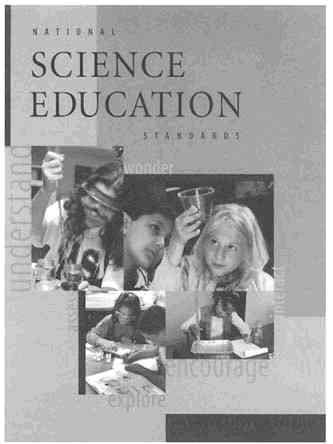
In 1996, the National Research Council of the National Academy of Sciences published the National Science Education Standards. Conceived and written through a collaborative process involving more than 18,000 people (teachers, school administrators, parents, curriculum developers, college faculty, administrators, scientists, engineers, and government officials), the Standards represent a broad consensus about the type of science education that must be in place for all students to succeed.
The Standards are not "national" in the sense that they have the approval of or derive authority from the federal government. Rather, they are "national" because they were developed by a broad, representative group. They are a model or guidelines for state and local education agencies who have the authority and responsibility for science education. Parents and educators who use the Standards to make changes in science education programs can be assured that they represent the best efforts this country can offer its citizens.
What Are Science Education Standards?
Educational standards for science, whether they are written at the local, state, or national level, are a detailed, descriptive vision of what it takes to produce a scientifically educated citizen. The overall goal of the
Standards, therefore, is to enable all students to achieve scientific literacy-the knowledge and understanding of scientific concepts and processes required for personal decision making, participation in civic and cultural affairs, and economic productivity.
Although the Standards address many areas of the science program, the one that is probably the most familiar is the content—and for good reason. The content is the heart of the science program, what teachers teach and students learn.
The content standards outline what students need to know, understand, and be able to do at the completion of grades 4, 8, and 12. The following example illustrates statements from one earth science standard at each of these levels.
|
Example of Statements from the Earth Science Standards at Three Grade Levels |
|
|
Grade Level |
What Students Should Understand |
|
K-4 |
The sun provides the light and heat necessary to maintain the temperature of the earth. |
|
5-8 |
The sun is the major source of energy for phenomena on the earth's surface, such as growth of plants, winds, ocean currents, and the water cycle. Seasons result from variations in the amount of the sun's energy hitting the surface, due to the tilt of the earth's rotation on its axis and the length of the day. |
|
9-12 |
Heating of earth's surface and atmosphere by the sun drives convection within the atmosphere and oceans, producing winds and ocean currents. |
|
(National Science Education Standards, National Academy Press, 1996) |
|
A coherent, supportive educational system is necessary for all students to learn the content outlined in the Standards. This system includes six important areas: teaching, professional development of teachers, assessment, the content to be learned, the K-12 science program, and the larger educational system. Standards for these areas are vital components of the National Science Education Standards.
How Can the National Science Education Standards Improve the Quality of Science Education?
Think of the Standards as criteria that community members and educators can use to judge the quality of the educational system—the content that students should learn; the quality of the curriculum, including the textbooks and other resources used; the professional development of teachers; the teaching and assessment strategies used; and the support provided for teachers. Working to achieve the Standards can improve the quality of science education by bringing consistency and coherence to local and state systems.
How can the Standards increase consistency and coherence? They show how all parts of the program should relate to one another. For example, the development of concepts in the biological and physical sciences, starting in kindergarten and ending in high school, needs to show an orderly progression that teaches appropriate concepts at each grade while building a strong foundation in science.
When the science program lacks this coherence, there are gaps in the subject matter, material is repeated unnecessarily, and content is presented in inappropriate ways at the wrong age. Such a program wastes the school's—and the students'—time and resources and can result in lower student achievement.
One useful way to view the Standards is as a building code for science education. Just as building codes ensure that our houses and office buildings are safe and meet the needs of their occupants, so do science education standards serve as safeguards to protect our children's educational well-being in an increasingly scientific and technological world.
However, just as building codes do not inhibit the creativity of architects and builders, the criteria for a high-quality educational program presented in the Standards do not constrain the creativity of states
|
Six Areas of the National Science Education Standards TEACHING Describe effective science teaching. PROFESSIONAL DEVELOPMENT Describe the learning experiences teachers need to teach science effectively. ASSESSMENT Outline effective assessment of students and opportunity to learn. CONTENT Describe what students should know and be able to do in levels K-4, 5-8, and 9-12. PROGRAM Provide criteria for designing or assessing the science education program in a school or district. SYSTEM Provide criteria for judging how the larger education system—at the community, state, national levels—supports good science education. |
and local districts. Although the Standards specify the important content that students should learn to become scientifically literate, they do not specify how it is arranged in the units and courses that make up each district's curriculum. The curriculum is left to the decisions and creativity of teachers, administrators, and community members in each district.
Teachers, administrators, and parents must share a strong commitment to providing students with a foundation of scientific skills and knowledge crucial for success in modern society. The Standards are designed to be adapted by states and local districts to serve their own commitment to excellence.
|
An Example of Poor Coherence Some current testing practices clearly illustrate the pitfalls of poor consistency and coherence in education. If the tests used by the school district or state are not consistent with the curriculum materials the teachers are using, the tests will not measure what was taught. When parents receive the test scores, they will be concerned about their children's poor performance. They will not understand that the reason for the gap is not that the student has not learned but that the student has not been tested on the knowledge that he or she has learned in class. Furthermore, teachers and students will not have useful information to help improve the learning process, and money will have been wasted. Attention to the Standards can help provide coherence among curriculum, teaching, and testing, thus preventing these problems. |


