
Take the First Steps Toward Science Education Reform
What can you do to move your school district toward the goal of exemplary science instruction? Begin by taking some small (but critical) steps toward the long-term goal.
Become informed. Find out what your son or daughter and other children in your community are doing in science class. Talk to them about the program and see whether they are learning what they need to know. Then talk to their teachers to get more detailed information. Take the time to visit your child's class to see for yourself what is going on there.
Bring science to your home and neighborhood. Show your own and other children that you, too, are interested in science. For example, you might take a group to local science museums, parks, or nature centers. Try incorporating science into your everyday life by buying a outdoor thermometer and asking your children and their friends to check the temperature each morning, setting up a bird feeder in your yard and keeping track of which birds visit and why, or planting a garden together and discovering which plants grow best in sun or shade, which need the most water, and which thrive in your yard.
Take your commitment to better science education to the next level. Learn about the philosophy and elements of inquiry-based science instruction by reading the National Science Education Standards and related publications. Call your school, district office, state department of education, nearby university, or state science teachers association to find out what activities related to science education reform are taking place in your community. Find out if there are state standards or frameworks that call for an improved science program.
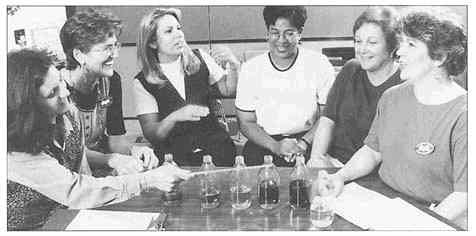
Seek out like-minded adults in the community. Identify other parents, scientists, and business leaders who are interested in implementing change and create an informal committee. Start with your school's local parent-teacher association. Form a study group to become better acquainted with the Standards and to compare them with your school's philosophy and program. Then meet periodically to discuss your goals and plans.
Involve like-minded teachers. Look for interested teachers in your school or nearby schools known for their excellence. Solicit their help in determining how to bring the new science program to your community. Most teachers will welcome your involvement, and they will be able to recommend exemplary curriculum programs. Support and reinforce the teachers that are using an inquiry approach in their classrooms; it probably is requiring an extra effort on their part.
Discuss your ideas with your school's principal. As a group, meet with your school's principal to share your ideas. Reach consensus about what direction the group should take. Then arrange to meet with the principal, school administrator, teacher on special assignment, or science coordinator who has responsibility for the district science program. The support of these administrators helps gain the support of higher level administrators, such as the assistant superintendent for instruction and the superintendent of the school district.
Talk to scientists and engineers. Scientists from local industries and universities as well as physicians in the community can help you convince the community and school administrators of the need to reform the school science education program. You might try inviting scientists to a meeting to discuss their role in the reform effort. If scientists also happen to have children in the school system, they will become even stronger advocates.
|
You will find the following publications to be quite helpful. Mailing and web addresses where available are provided in the ''Resources" Section. See page 25. The National Science Education Standards (National Academy Press, 1996) and a brochure summarizing the key ideas in the Standards are good places to start your study of science education. The brochure outlines succinctly what you need to know about the Standards. Science for All Children: A Guide to Improving Elementary School Science in Your School District (National Academy Press, 1997) helps round out the vision of effective science teaching and learning through a series of "case studies" that fill the last third of the book. By reading about how other people have succeeded in reforming science education, you can get a good idea about how long it might take you in your community and how to overcome the obstacles you may face. Elementary School Science for the'90s (Association for Supervision and Curriculum Development, 1990) provides guidelines for changing your science program and includes vignettes on effective teaching and learning. Active Assessment for Active Science, by George Hein and Sabra Price (Heinemann, 1994) describes how to move from traditional to alternative assessments. Redesigning the Curriculum, edited by R. W Bybee and J.D. McInerney (Kendall-Hunt, 1995) is a collection of essays about the Standards and their role in science education. Local Leadership for Science Education Reform, by Ronald D. Anderson and Harold Pratt (Kendall-Hunt, 1995) outlines the steps needed to improve the quality of a district science program. The May/June 1997 issue of Our Children, the National PTA Magazine, is a special issue on parental involvement with school reform. You might find the PTA's suggestions particularly relevant. Dragonfly, from the National Science Teachers Association and Miami University, is a new science magazine for children ages 8-13. Individual subscriptions include the "Dragonfly Home Companion" for parents. Get Involved (American Association for the Advancement of Science, 1996) summarizes a one-year study of parent involvement in science education. |
Take your ideas to the school board. Once you can reach this group and the superintendent, you will be close to putting your ideas into practice. In most communities, if the school board believes that improving the science program is a priority, you will achieve your goals much more quickly than if it does not.
Try Other Approaches, Too
The journey to better science in your schools does not always go smoothly. For example, the principal or some of the teachers in your school may not see a pressing need for change. In that case, you may need to involve more community members to participate in discussions of relevant issues, such as how children learn, why science education is important, and what different parts of the community can do to help.
Promoting new ideas in the media can be a good idea. Invite a reporter from a local newspaper or TV station to cover a meeting where you will be talking about or demonstrating the new, hands-on science kits your group is considering recommending for your school. Through such publicity, more interested people may come forward.
As you work to reform science education in your community, do not be surprised if you encounter roadblocks along the way. Finding time for professional development, funding for new curriculum materials, and ways to handle competing pressures from other disciplines are just a few of the common obstacles. But the effort is worth it. Our children's future is in your hands.


