
2
Scope and Patterns of Work by Children and Adolescents
How many young people in the United States work? Who are they? Where do they work? According to the Bureau of Labor Statistics, 34.5 percent of 16-and 17-year-olds—more than 2.6 million youths—were employed at any given time during 1996 (Bureau of Labor Statistics, 1997). 1 Because young people's jobs are often temporary, and teens move in and out of work, the proportion of teens employed at all during the year is most likely to be greater than the proportion employed at any given time. In 1996, more than 44 percent of 16-and 17-year-olds had worked at some point during the previous year.2 Likewise, the proportion of teens who work for at least some of their high school years is greater than those who work in any given year. While some periods of work occur during the summer, surveys of youth suggest that about 80 percent of teens work at some time during the school year in their junior or senior
years in high school (Bachman and Schulenberg, 1992; Light, 1995; Steinberg and Cauffman, 1995).
Whether young people are employed or not may be less important than where they work and how much time they devote to work. Retail trades and services employ the vast majority of working 15-to 17-year-olds (51 percent and 26 percent, respectively). Agriculture—one of the three most dangerous industries in the country—is the next largest employer of this age group, employing 8 percent of them. Young people spend a significant amount of time each week working. In 1995, working 15-to 17-year-olds averaged about 18 hours of work in weeks that they worked (data from 1995 Current Population Survey).
Both cross-sectional and longitudinal data paint a general picture of the employment of adolescents in the United States. But that picture lacks many details. This chapter examines the information about the number of children and adolescents who work, who they are, where they work, and how much they work. The strengths and weaknesses of the data sources that provide this information and reasons for differences among the data sources are discussed.
DATA ON WORK
Statistics from the U.S. Department of Labor
Official estimates of employment (and unemployment) in the United States are derived from the Current Population Survey (CPS), which is conducted by the Bureau of the Census for the Bureau of Labor Statistics (BLS). The CPS is a monthly survey of about 50,000 households, scientifically selected to be representative of the civilian, noninstitutionalized population of the United States.3 Households are in the sample for 4 months, retired for 8 months, and then return for 4 more months. The first and fifth interviews are face-to-face interviews; the other interviews may be conducted by telephone. Labor-force information that includes employment status and hours worked during the previous week is collected in the Basic Monthly Survey for each household member aged 15 or older. In addition, an
extended survey each March, the Annual Demographic Survey or "March Supplement," collects other information about work experience during the previous calendar year, including earnings, number of weeks worked, average hours worked per week, occupation and industry classifications, and demographic information. The CPS Base Monthly Surveys for 1993 to 1996 indicate that about one-third of 16-and 17-year-olds are employed at any given time during the year. Data from the decennial census, which also collects information on employment, found similar results: About one-third of U.S. 16-and 17-year-olds were employed in the spring of 1990.
In 1996, for the first time, young women were more likely to be employed than young men: 35.7 percent for 16-and 17-year-old females; 33.3 percent for 16-and 17-year-old males. As with adults, there was a marked contrast in employment by race: Only 18.8 percent of young African Americans were employed, compared with 38.6 percent of white youths (Bureau of Labor Statistics, 1997). Likelihood of employment increased with age, ranging from 17.5 percent for 15-year-olds to 51.9 percent for 17-year-olds.4
There are advantages to relying on official statistics because they are regularly collected over a long period of time on a representative sample of the population. For information about children and adolescents' work experience, however, using the Current Population Survey has drawbacks. The Department of Labor's definition of the labor force automatically excludes people under the age of 16. The CPS data exclude those under the age of 15—youngsters who, under child labor laws, are allowed to work as news carriers, on family farms, in other family businesses, and in certain other jobs.
Even though data are collected on 15-year-olds, those data are not used in official BLS estimates, nor are they included in published tables. Furthermore, in all but the most detailed published tables, 5 data for 16-and 17-year-olds are aggregated with those for older age
|
4 |
This finding is based on committee analysis of data from the 1995 CPS March Supplement. |
|
5 |
It is possible to purchase CPS Monthly Survey data tapes to analyze the data on 15-, 16-, and 17-year-olds. The U.S. General Accounting Office (1991) did such an analysis of 1988 data and found that 28 percent of 15-year olds and 51 percent of 16-and 17-year-olds were employed at some time during 1988. In addition, data from the CPS Monthly Survey and the CPS March Supplement are available on the World Wide Web for analysis (http://ferret.bls.census.gov). |
groups; thus, BLS publications cannot be used to track work experience of minors, for whom the legal restrictions on child labor have been imposed. Furthermore, 19-year-olds and many 18-year-olds have finished high school, so their employment patterns can be expected to differ from those of adolescents still in high school. Aggregating the data for 16-to 19-year-olds obscures these differences. The official figures also exclude individuals who work fewer than 15 hours per week without pay in family-operated enterprises, a group that is likely to include many children and adolescents.
The CPS collects information on all the members of each household from one responding adult, so information about hours of work by adolescents does not come from adolescents themselves. It is possible that adults and adolescents would give different answers, not only for the number of hours worked by the adolescent, but also for whether the adolescent worked or not. In fact, Freeman and Medoff (1982) found that parents systematically reported that their children worked fewer weeks per year than the children reported. Obtaining information from the CPS on subpopulations of adolescents is also problematic. Pallas (1995) notes that the number of minorities enrolled in grades 10 to 12 in the sample in any given year is not large; therefore, statistical estimates about them are subject to large sampling errors. Disabled youngsters are not identified in the CPS, so no estimates are available for them.
National Longitudinal and Other Surveys
A number of national longitudinal surveys, such as the National Longitudinal Survey of Youth, the National Educational Longitudinal Survey, and the National Longitudinal Study of Adolescent Health, collect information on young people, including their employment experience (see Table 2-1 and Appendix B for details about these surveys). Unlike the CPS, which provides a snapshot of youngsters' employment at a particular time, longitudinal surveys allow researchers to study the complex patterns of young people's employment over time. Youngsters may start to work in informal jobs (e.g., mowing lawns, babysitting) or in family businesses and family farms at fairly young ages. As they move through their teens, they are likely to move from job to job, working different numbers of hours at different times.
Surveys suggest that most youth are employed at some time dur-
ing their high-school years and that many of them work during the school year. These surveys find a higher percentage of young people working than reported in the CPS. For example, one-third of 10th-grade and two-thirds of 12th-grade participants in the 1987 National Assessment of Economic Education Survey reported that they were employed at some time during the school year (Lillydahl, 1990). Surveys of parents of 16-to 18-year-olds in the nationally representative National Survey of Families and Households (conducted between March 1987 and May 1988) found that 70 percent of the teenagers had worked during the past month (Manning, 1990).
Surveys of representative samples of young people themselves, such as Monitoring the Future and the National Longitudinal Survey of Youth, give estimates that about 80 percent were employed at some point during the school year in their high-school years (Bachman and Schulenberg, 1992; Light, 1995; Steinberg and Cauffman, 1995). Such employment may begin early. Data from the National Longitudinal Study of Adolescent Health found that 30.6 percent of 12-year-olds worked during the school year, as did 36.9 percent of 13-year-olds, 35.4 percent of 14-year-olds, and 44.2 percent of 15-year-olds (Kruse, 1997). Table 2-2 shows the hours of work by 7th through 12th graders in this survey.
Early involvement in work may be associated with a greater amount of time spent working in later teen years. Schoenhals et al. (1997) found that students who worked more than 5 hours per week at a formal job during the school year as 8th graders had the highest labor-market participation rates of any group by 10th grade. They were more likely to be employed in 10th grade than those who had less or no work experience in 8th grade and, on average, they worked more than 20 hours per week when they were in 10th grade.
Differences Among Findings
A number of factors may account for the discrepancies between data from CPS and data from survey results, and among surveys themselves. The employment questions sometimes refer to different periods of time (e.g., during the current school year, during the last month, during the last calendar year) and sometimes to employment at a single date (e.g., when the survey is administered). The longer the period of time under consideration, the higher will be the proportion of employed youngsters identified among those surveyed. In
TABLE 2-1 National Surveys Containing Data on Youth Employment in the United States
|
Survey Name |
Respondent |
Ages |
Sex |
Definition of work |
|
National Survey of Families and Households (NSFH), 1987–1988 |
Parent |
12–18 |
Yes |
Amount earned in last month |
|
National Educational Longitudinal Survey (NELS) 1988 |
Child |
14 in 1988 (8th grade); follow-up in 10th and 12th grades |
Yes |
Work for pay |
|
National Longitudinal Study of Adolescent Health (Add Health) 1994–95 |
Child and Parent |
7th–12th graders |
Yes |
Work for pay in last 4 weeks |
|
Panel Survey of Income Dynamics (PSID) |
16+ |
16+ |
Yes |
Weeks worked |
|
Monitoring the Future |
Child |
12th graders; 8th and 10th graders added in 1991 |
Yes |
Work during year |
|
National Longitudinal Survey of Youth (NLYS), 1979 |
Child |
14–21 in 1979; annual follow-up |
Yes |
Work for pay, in own business, or more than 15 hours without pay in family business |
|
Monthly Current Population Survey (CPS) |
Adult |
16+ |
Yes |
Work for pay, in its own business or more than 15 hours without pay in family business in week of survey |
|
Employment Paid/Unpaid |
Employment Full/Part-Time |
Employment School/Vacation |
Occupation/Industry |
|
Paid |
Hours worked in past week |
Determined by date of interview |
No/No |
|
Paid |
Hours worked in present or most recent job |
School vs. summer |
Yes/No |
|
Amount earned per week |
Hours per week |
Nonsummer vs. summer |
No/No |
|
Paid |
Hours worked |
|
|
|
Paid and unpaid |
Hours worked per week |
|
|
|
Paid; unpaid only if more than 15 hours per week in family business |
Hours worked per week |
Start and stop dates of employment |
Yes/No |
|
Paid; unpaid only if more than 15 hours per week in family business |
Hours worked per week |
May be determined by month of survey |
Yes/Yes |
Table 2-2 Hours Worked per Week by Grade (in percent)
|
|
Grade 7 |
Grade 8 |
||
|
Hours Worked per Week |
School Year |
Summer |
School Year |
Summer |
|
0 |
58.82 |
46.62 |
53.93 |
40.70 |
|
1 to 4 |
22.22 |
16.88 |
21.55 |
14.60 |
|
5 to 9 |
10.91 |
13.80 |
13.59 |
13.58 |
|
10 to 14 |
3.49 |
6.67 |
4.59 |
7.17 |
|
15 to 19 |
0.80 |
2.82 |
1.20 |
2.99 |
|
20 to 24 |
1.61 |
3.98 |
2.03 |
5.64 |
|
25 to 29 |
0.40 |
0.88 |
0.53 |
2.59 |
|
30 to 39 |
0.22 |
3.66 |
0.88 |
5.68 |
|
40 or more |
0.37 |
2.90 |
0.75 |
5.57 |
|
Missing data |
1.15 |
1.80 |
0.96 |
1.49 |
|
SOURCE: Special tabulation for the committee. Data collected by the National Longitudinal Study of Adolescent Health, J. Richard Udry, principal investigator, |
||||
some studies, students must be working a minimum number of hours per week to be considered employed. Some studies include only paid work, and others also include unpaid work. Some studies include informal work, such as babysitting or lawn-mowing, but others do not. Because of these varying definitions, estimates of employment vary considerably across surveys (Kablaoui and Pautler, 1991). Determining the extent of labor by children and adolescents at the state or metropolitan-area level is even more problematic, making geographical comparisons within and among states difficult (National Institute for Occupational Safety and Health, 1997). The CPS publishes state-specific data only for the age group of 16-to 19-year-olds.
Results are influenced by whether the respondent is the child, the parent, or another household member. As noted above, parents systematically understate their children's labor force attachments, particularly for children who are still in school. The nature of the sample may also have an effect. Samples drawn from school populations miss teenagers who have dropped out of school. About 9 percent of all 16-and 17-year-olds are not in school (based on 1990 census data), so studies done in schools miss a group of young people
|
Grade 9 |
Grade 10 |
Grade 11 |
Grade 12 |
||||
|
School Year |
Summer |
School Year |
Summer |
School Year |
Summer |
School Year |
Summer |
|
52.72 |
40.71 |
44.35 |
32.33 |
35.78 |
24.05 |
26.42 |
18.53 |
|
16.15 |
9.41 |
10.59 |
5.44 |
5.87 |
2.56 |
4.52 |
1.61 |
|
11.60 |
9.21 |
9.48 |
7.33 |
7.21 |
3.89 |
5.02 |
3.17 |
|
6.96 |
7.58 |
7.46 |
5.19 |
8.68 |
4.04 |
6.98 |
1.74 |
|
2.87 |
3.56 |
6.62 |
3.94 |
9.88 |
4.05 |
10.29 |
2.44 |
|
4.06 |
7.42 |
9.34 |
8.71 |
14.17 |
7.99 |
15.39 |
8.53 |
|
0.94 |
2.40 |
3.62 |
4.96 |
5.78 |
5.46 |
8.63 |
6.63 |
|
1.84 |
7.65 |
4.82 |
13.32 |
8.25 |
19.08 |
14.25 |
18.78 |
|
1.92 |
10.37 |
2.41 |
16.12 |
3.50 |
26.88 |
7.37 |
36.41 |
|
0.93 |
1.70 |
1.30 |
2.68 |
0.88 |
2.00 |
1.11 |
2.16 |
|
funded by the National Institute of Child Health and Human Development, National Institutes of Health, and 17 other federal agencies. |
|||||||
whose background characteristics and employment experience may be quite different from those of their counterparts who remain in school.
INTENSITY OF WORK
Not surprisingly, both the percentage of youngsters employed and the hours of employment apparently increase with age. In 1988, according to an analysis of CPS data, 28 percent of all 15-year-olds and 51 percent of all 16-and 17-year-olds held jobs; 15-year-olds with jobs worked an average of 17 hours a week and 19 weeks a year; working 16-and 17-year-olds averaged 21 hours a week and 23 weeks a year at work (U.S. General Accounting Office, 1991). Because these annual data do not differentiate between the school year and summer vacation, the analysis could not estimate the amount of time youngsters worked during the school year. An analysis of 1995 data files from the CPS found that 15-year-olds with jobs worked an average of 11 hours per week during the school year and 19 hours per week during the summer. For 17-year-olds with jobs, the numbers were an average of 18 hours per week during
the school year and 26 hours per week during the summer.6Figure 2-1 shows employment in the summer versus the school year, by age group, and Figure 2-2 shows the number of hours worked for summer months versus the school year, by age group.
Surveys and studies other than the CPS provide more information on the amount of time young people spend working. Data from the National Longitudinal Survey of Youth show that 3 percent of all sophomores, 10 percent of all juniors, and 19 percent of all seniors worked more than 20 hours per week in the week the survey was conducted (Ruhm, 1997). The recent National Longitudinal Study of Adolescent Health found that 17.9 percent of all high-school students worked more than 20 hours per week during school (Resnick et al., 1997). Tables 2-3 and 2-4 summarize the findings of various studies on how much adolescents work.
An additional factor that may lead to different estimates of work in different studies is erroneous recall, which can complicate data on the number of hours worked, particularly if the respondents are estimating their average hours worked during some previous period. How best to estimate actual work hours is a matter of debate. Studies using detailed time diaries find lower hours of work than surveys that ask people the average number of hours worked in a previous period (Robinson and Godbey, 1997). Unfortunately, the time-diary data available on work by children and adolescents lump together data for ages 12 to 17, making them impossible to compare with other survey data.
Several potentially important aspects of work intensity are not well accounted for in most studies, such as the number of hours per day, the timing of those hours, and the variability of the work schedule. For example, working two 8-hour days over the weekend may be qualitatively different than working four 4-hour days after school. How late a youngster works on school nights may be as important as how many hours he or she works in a week. Working many hours for a short period of time (such as the Christmas holidays) may have
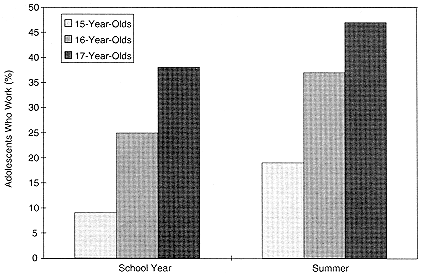
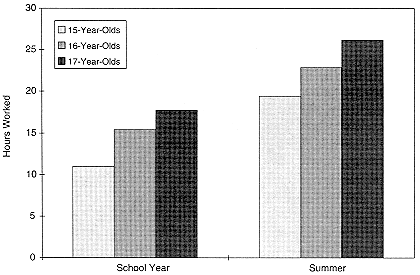
TABLE 2-3 Studies of Employment and Hours of Work During School Year
|
Study |
Survey Name |
Ages |
|
Bachman and Schulenberg (1992) |
Monitoring the Future |
High-school seniors; 8th and 10th graders added in 1991 |
|
Light (1995) |
National Longitudinal Survey of Youth (NLYS), 1979 |
11th–12th graders |
|
Resnick et al. (1997) |
National Longitudinal Study of Adolescent Health (''Add Health") 1994–1995 |
9th–12th graders |
|
Schoenhals et al. (1997) |
National Educational Longitudinal Survey (NELS) 1988 |
10th graders |
|
Sweet (no date) |
National Survey of Families and Households (NSFH) 1992–1994 follow-up |
9th–12th graders |
|
Special tabulations prepared by Jo Jones, Carolina Population Center, for National 1994–1995 Research Council, 1998 |
National Longitudinal Study of Adolescent Health ("Add Health") |
7th–12th graders |
(table continued from previous page)
|
Findings |
|
|
How Many Work |
Amount of Work |
|
74.9% of males for pay 6.3% of males unpaid 72.7% of females for pay 6.7% of females unpaid |
53.5% of working males 20hrs/wk 46.5% of working males > 20 hrs/wk 61.6% of working females 20 hrs/wk 38.4% of working females > 20 hrs/wk |
|
80% of males 73% of females |
Males averaged 12.8 hrs/wk Females averaged 11.1 hrs/wk |
|
|
17.9% worked 20 hrs/wk or more during the school year |
|
43.3% of males 37.7% of females |
Males averaged 17.5 hrs/wk Females averaged 15.0 hrs/wk |
|
37% of males for pay 45% of females for pay |
20% of males < 10 hrs/wk 17% of males ≥10 hrs/wk 27% of females < 10 hrs/wk 18% of females ≥ 10 hrs/wk |
|
40% of 7th graders 45% of 8th graders |
2.6% of 7th graders work 20 or more hrs/wk 4.2% of 8th graders work 20 or more hrs/wk |
TABLE 2-4 Findings on the Extent to Which Work and School are Combined
|
In-School Work |
Selected Findings |
|
Percent of weeks worked |
50% (75%) of white males work in grade 10 (12), 15% (57%) for more than half the year; less for minorities and females. |
|
Cumulative work experience while in school |
48% work in high school, 63% in college; 24% average at least 20 hours per week. |
|
Whether employed at time of last observed exit from school |
48% of white males hold jobs, work 60% of last year of school, on average; college students work more than others. |
|
Whether employed week prior to 1979 interview |
25% of 14-year-olds work, 51% of 17-year-olds; males work more than females, whites more than blacks or Hispanics. |
|
Whether employed interview week, grades 10–12; hours/week and weeks/academic year |
28% of sophomores, 43% of juniors, 50% of seniors work; seniors work 19 hours per week, 52% of academic year, on average. |
|
Whether employed at time of 1979 interview |
58% of whites work, 41% of Hispanics, 35% of blacks; all average about 25 hours per week. |
|
Whether working FT or PT or unemployed while in school |
29% of whites work FT, 33% PT, 7% unemployed; less FT, PT work for blacks, more unemployment. |
|
Whether working FT or PT or unemployed while in school |
46% work FT, 11% PT, 9% unemployed; (blacks and whites combined). |
|
Whether employed week prior to interview |
51% work; average about 16 hours a week in 1978–79. |
different effects than working many hours for many months. Few surveys collect adequate details about these facets of work. The manner in which data are collected in the CPS also makes it difficult to distinguish work during the school year from work during summer months.
WHERE YOUNG PEOPLE WORK
As shown in Figure 2-3, more than one-half of 15-to 17-year-olds are employed in the retail sector (e.g., restaurants, grocery stores, other retail stores) and more than one-quarter work in the service sector (e.g., recreation, health, education). Agriculture is the next largest employer of this age group, employing 8 percent of them. Restaurants employ more young people (28 percent) than any other industry. These patterns vary somewhat by age, with more than
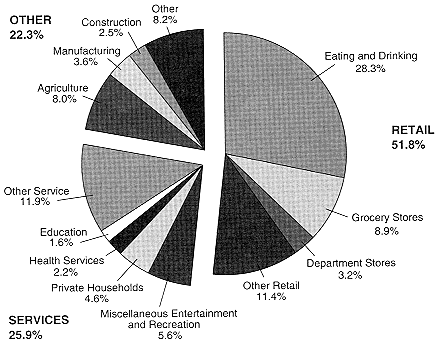
FIGURE 2-3 Working adolescents aged 15 to 17, by industry (in percent). Source: Data from 1996 Current Population Survey March Supplement.
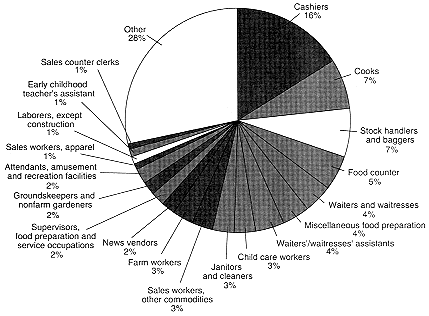
FIGURE 2-4 Working 15-to 17-Year-Olds, byoccupation (in percent). Source: Data from 1996 Current Population Survey March Supplement.
twice the percentage of employed 15-year-olds working in agriculture than 16-and 17-year-olds (based on data from 1995 CPS March Supplement) 7.
The types of jobs that adolescents hold are varied. As shown in Figure 2-4, the most common job held by 15-to 17-year-olds, is cashier (16 percent), followed by cook (7 percent), stock handler (7 percent), food-counter worker (5 percent), waiter (4 percent), waiters' assistant (4 percent), and food-preparation worker (4 percent). However, the job titles youngsters have may not reflect the actual nature of the tasks they perform (Massachusetts Department of Public Health, 1997). For example, youngsters hired as cashiers may also clean and perform other tasks that are not associated with
operating a cash register. This phenomenon makes it difficult to estimate the kinds of hazardous exposures adolescents may experience on the job. Furthermore, inappropriate job titles could obscure the fact that adolescents are performing tasks prohibited by child labor laws.
Adolescents' type of employment appears to vary by family income, with youngsters from low-income families working in more hazardous jobs. An analysis by the U.S. General Accounting Office (1991) found that 20 percent of 15-to 17-year-olds from low-income families worked in hazardous industries, such as agriculture, mining, manufacturing, construction, and wholesale trade, compared with 14 percent of those from high-income families.8
Determining the extent of illegal employment among children and adolescents is difficult. By analyzing CPS data available on the number of hours worked and the occupations and using a number of assumptions, Kruse (1997) estimated that nearly 3 percent of working 15-to 17-year-olds were employed in violation of child labor laws: One-third of those were working more hours per week than allowed by law, and two-thirds were working in prohibited hazardous occupations. More than 12 percent of 15-year-olds in the National Longitudinal Study of Adolescent Health were found to be working more than the legally allowed 18 hours per week during the school year (Kruse, 1997).
Children employed in "sweatshops" and other illegal activities are likely to be underrepresented in survey data. Sweatshops are defined as businesses that regularly violate safety-and-health, wage-and-hour, or child-labor laws and are believed to be concentrated in the apparel, restaurant, and meat-processing industries. Although no good data exist on their number or the extent to which children and adolescents are employed in them, Kruse (1997) extrapolated from child labor violations found in New York City apparel firms (U.S. General Accounting Office, 1989), to estimate that about 13,000 minors a year might be employed in sweatshops.
Young people's employment in criminal activities, such as prostitution or drug dealing, has been documented only among children and adolescents who have run away from home, been thrown out of
their homes, or been arrested. There were an estimated 1.5 million runaway children in 1988 (Children's Defense Fund, 1988). About 26 percent of runaways seen in a medical outpatient clinic reported that they had traded sex for drugs at some time (Yates et al., 1988). A study of homeless adolescents in Northern California found that those who chose to remain on the street and use no services reported high levels of involvement in illegal activities: 88 percent panhandled, 62 percent stole, 50 percent sold drugs, and 42 percent engaged in prostitution (Stanford Center for the Study of Families, Children, and Youth, 1991).
The Drug Use Forecasting Program of the U.S. Department of Justice collects information on drug use and other illegal activity from individuals who have recently been arrested.9 In 1996, 19 percent of young arrestees reported that their primary source of income was from legal full-or part-time work; the primary source of income from drug dealing was reported by 5.8 percent, from other illegal activity by 3.2 percent, and from prostitution by 0.1 percent (Golub, 1997).
WORK-RELATED ISSUES FOR SPECIAL POPULATIONS
Minority and Poor Youth
Minority adolescents have consistently been found to be less likely to be employed than white adolescents. In 1995, 18.8 percent of young African Americans had jobs, compared with 38.6 percent of young whites (data from 1995 CPS March Supplement). Ahituv et al. (1997), using data from the National Longitudinal Survey of Youth, found that African Americans also had their first jobs at later ages than whites. By the age of 15, 22.2 percent of whites, 23.1 percent of Hispanics, and only 16.4 percent of African Americans had held their first job. By age 17, 82.8 percent of whites, 79.1 percent of Hispanics, and 69.5 percent of African Americans had job experience. However, the detailed analysis found that the racial and ethnic distinctions resulted largely from group differences in family socioeconomic characteristics. Adolescents from poorer families living in economically disadvantaged locales were less likely to have
paid jobs while attending high school. For minority youngsters with jobs, their number of hours worked are similar to those for whites (Ruhm, 1997; Steel, 1991). Similarly, for poor youngsters, their hours worked are similar to those worked by more affluent youngsters (data from National Longitudinal Survey of Adolescent Health).
Race, ethnicity, and socioeconomic status also appear to affect the types of jobs young people get. Although retail establishments provide the greatest number of first jobs for all youth, a greater percentage of minority than white youngsters are employed in services, such as janitorial work (Ahituv et al., 1997). And low-income youth, when employed, are more likely than more affluent youth to work in hazardous industries, such as agriculture, manufacturing, and construction (U.S. General Accounting Office, 1991).
Children and Adolescents with Disabilities
About 12 percent of those between the ages of 15 and 21 are considered disabled, as defined by the Americans with Disabilities Act (Public Law 101-336), which includes those whose actions or activities are limited because of physical, mental, or other health conditions (McNeil, 1997). About 10.5 percent of school-age children have disabilities as defined by the Individuals with Disabilities Education Act (U.S. Department of Education, 1996). These are children with impairments caused by physical, mental, or other health conditions requiring the provision of special education and related services. Slightly more than half (51.2 percent) of disabled school-age children have specific learning disabilities, 21.8 percent have speech or language impairments, 10.9 percent are mentally retarded, and 8.7 percent have serious emotion disturbances; the remaining 7.5 percent suffer have disorders or conditions, such as autism, deafness, blindness, hearing impairments, multiple disabilities, orthopedic impairments, other health impairments, traumatic brain injuries, or visual impairments (U.S. Department of Education, 1996).
Work-force participation is lower for disabled people of all ages, adolescents and adults, than for the general population; disabled women have particularly low rates of employment. The rate of employment for all disabled individuals over the age of 15 is about 67 percent for men and 21 percent for women (compared with 71 percent for men and 57 percent for women aged 16 and over in the
general population). The rates are much lower for those with severe disabilities or combinations of chronic illness and physical or cognitive impairments (White, 1997). Among adults with severe disabilities, only 26 percent are employed (McNeil, 1997). Using data from the National Longitudinal Transition Study of Special Education Students for young people 3–5 years after leaving high school, Wagner et al. (1992) found that 57 percent of disabled individuals were employed and only 27 percent were enrolled in post-secondary education. Few disabled adolescents under the age of 15 are employed (White, 1997).
Not only do adolescents with disabilities lack work experience, but they also receive little preparation for work or careers. White and colleagues (White and Shear, 1992; White et al., 1990) have been studying a large sample of youngsters with chronic illnesses and physical disabilities. To measure their attitudes toward and knowledge of work, the subjects took a Career Maturity Inventory, which has been normed at each age group with adolescents who have no disabilities. The adolescents with chronic illnesses and physical disabilities scored high on involvement: They did not see themselves as hopeless in terms of work, and they saw their disabilities as less problematic than potential employers see them. But the subjects scored much lower on orientation: They knew little about work-places and what would be expected of them. Career maturity was found to be highly associated with parental perception of readiness for work. Often parents or other caregivers postponed a disabled child's entry into the workplace, and in some cases they did not think a first job was needed until age 25. Socioeconomic status played no role in this phenomenon. Interestingly, the degree of disability was not associated with career maturity.
These factors can have important consequences for development and successful transition into adult roles. Benz et al. (1997) found that having two or more job experiences during high school was highly predictive of a disabled individual's being competitively employed after high school. Work may play a central role in acculturating young people with disabilities. In making the transition from school to work, social context—how the parent or employer sees the disabled young person—may be as important as the young person's functional status (White, 1997).
Immigrant Youth
Very little data on work among immigrants, in general, and immigrant youth, in particular, have been collected. Furthermore, there are problems with the data that do exist. For example, the census makes no distinctions between legal and illegal immigrants or between legal immigrants who have the right to work in the United States and those who are here legally but who are not allowed to work (as is the case, for example, with the spouse or child of a visiting professor). This makes it difficult to interpret the existing data (Jasso, 1997). For immigrants younger than 18 who are granted permanent residency in the United States, the vast majority are coded as students by the Immigration and Naturalization Service. In 1994, for example, only about 11 percent of 17-year-old male immigrants and 8 percent of 17-year-old female immigrants reported an occupational title (Jasso, 1997). A committee analysis of 1990 census data indicated that 16-and 17-year-olds who had at least one immigrant parent were less likely to be employed than were their counterparts whose parents were born in the United States. These data shed no light on the reasons for this difference. It is possible that adolescents with at least one immigrant parent are less likely to report employment, even if they are working. It is also possible that immigrant parents encourage their children to concentrate on school achievement rather than work. A New Immigrant Pilot Study currently under way is designed to test the feasibility of alternative methods of locating immigrants and maximizing their participation in surveys, and to test ways of tracking this highly mobile population.
CONCLUSIONS
The vast majority of adolescents in the United States have their first work experience prior to finishing high school. The combination of federal data sources and national and local survey research provide a fair amount of information about teenagers who have jobs, where they work, and how much they work. However, little information is available on the quality of the work in which young people engage. Information is lacking about the extent to which those under the age of 15 work, although it seems clear that many youngsters begin working for pay at a young age. There is also very little information on subpopulations of young people, such as disabled, minority, and poor youth.


