
Page 199
4
Upper-Atmosphere and Near-Earth Space Research Entering the
Twenty-First Century1
Summary
This Disciplinary Assessment identifies those research essentials with the strongest societal and environmental impacts that derive from the scientific disciplines covered by the National Research Council's (NRC's) Committee on Solar-Terrestrial Research (CSTR) and Committee on Solar and Space Physics (CSSP). These committees are concerned with the areas of solar and heliospheric physics, magnetospheric physics, ionospheric physics, middle- and upper-atmospheric physics, and cosmic-ray physics.
1 Report of the Committee on Solar-Terrestrial Research and the Committee on Solar and Space Physics. Committee on Solar-Terrestrial Research: M.A. Geller (Chair), State University of New York, Stony Brook; G.P. Brasseur, National Center for Atmospheric Research; J.V. Evans, COMSAT Laboratories; P.A. Evenson, Bartol Research Institute, University of Delaware: J.F. Fennell, The Aerospace Corporation; J.T. Gosling, Los Alamos National Laboratory; S.R. Habbal, Harvard-Smithsonian Center for Astrophysics; M. Hagan, National Center for Atmospheric Research; M.K. Hudson, Dartmouth College; G. Hurford; California Institute of Technology; M.C. Kelley, Cornell University; J.U. Kozyra, University of Michigan; N.F. Ness, Bartol Research Institute, University of Delaware; A.D. Richmond, National Center for Atmospheric Research: T.F. Tascione, Sterling Software; and R.K. Ulrich, University of California, Los Angeles. Committee on Solar and Space Physics: J.G. Luhmann (Chair), University of California, Berkeley; S.K. Antiochos, Naval Research Laboratory; T.I. Gombosi, University of Michigan, Ann Arbor; R.A. Greenwald, Applied Physics Laboratory; R.P. Lin; University of California, Berkeley; M.A. Shea. Air Force Phillips Laboratory: H.E. Spence. Boston University; K.T. Strong, Lockheed Palo Alto Research Center; and M.F. Thomsen, Los Alamos National Laboratory.
Page 200
Major Scientific Goals and Challenges
When societal and environmental impacts are considered, the dominant scientific and technical goals in upper-atmosphere and near-Earth space can be identified as the following:
• to understand the physical, chemical, and dynamical processes that determine the interactions between the stratosphere, climate, and the biosphere;
• to develop the infrastructure that will permit operational forecasting of "space weather";
• to understand the relationships between changes in the middle and upper atmosphere and the Earth's surface and lower-atmospheric climate; and
• to study solar variability and its influence on the middle and upper atmosphere.
Key Components of the Scientific Strategy
The components of the strategy to address the major scientific issues in upper-atmosphere and near-Earth space science are developed on the basis of four national goals:
1. To study atmospheric processes using observations, laboratory research, theory, and modeling.
2. To have the necessary observations, understanding, modeling capability, and transfer to operations to permit skillful forecasts of "space weather."
3. To document middle- and upper-atmospheric change and produce models that consistently simulate these changes along with those of the lower-atmosphere-surface system.
4. To document changes in solar output, determine how these affect lower-atmosphere and surface climate, and compare these with the climate record.
Scientific Requirements for the Coming Decade(S)
Role of the Stratosphere in Climate, Weather Prediction, and Tropospheric Chemistry
The stratosphere plays two roles in the climate system. The first involves the impact of stratospheric trace gases and aerosols, including those of anthropogenic origin, on radiative fluxes through the tropopause. The second role of the stratosphere in the climate system is through the dynamic coupling between the troposphere and the stratosphere. Considerations of the stratospheric role in various aspects of climate and weather include the following:
Page 201
• modeling and observational studies of how the stratosphere determines various aspects of climate,
• determinations of how the stratosphere should be correctly represented in numerical forecast models,
• analysis to determine if present and anticipated stratospheric data are sufficient for climate and weather forecasting purposes, and
• analysis to determine how stratospheric change will affect tropospheric chemistry.
Space Weather
In order to "nowcast" and ultimately forecast key aspects of the near-Earth space environment with the goal of mitigating the negative effects of space weather on human life and technology, progress must be made on the following fronts:
• achieving a basic understanding of the relevant physical phenomena and processes so that physical models of the near-Earth system can be developed;
• putting in place the infrastructure to convert research models into operational models;
• obtaining the necessary data to assimilate into and test numerical models of space weather;
• improving on existing statistical models that specify "space climate"; and
• producing nowcasting and numerical forecasting capabilities and using them to develop mitigation strategies.
Global Change in the Middle-Upper Atmosphere
It is critical to understand the effects of natural variability and anthropogenic effects on the ozone layer, the influences of the stratosphere on tropospheric climate, and the impact of upper-atmospheric changes on space-based systems and telecommunications. Scientific requirements in this area include
• analysis of historical data from systems operating from the 1940s to the 1960s;
• monitoring sensitive parameters in the middle and upper atmosphere;
• monitoring inputs to the middle and upper atmosphere from space above and the lower atmosphere below;
• understanding atmospheric phenomena that are now poorly understood, such as "sprites"; and
• developing models that correctly treat disparate and interacting processes important for coupling the middle and upper atmosphere with regions above and below.
Page 202
Long-Term Solar Variability and Global Change
The Sun undergoes a variety of small changes in its radiant and corpuscular energy output. Long-term, well-calibrated measurements of the outputs and understanding solar variations and the atmospheric response to them are the focus of studies in this area. Scientific requirement for this topic include
• measurement of the solar energy output continuously over at least one full solar cycle,
• investigations of the Earth's temperature and middle- and upper-atmo-sphere chemical responses to changes in the Sun's energy output, and
• studies comparing solar variations to those of similar stars.
Expected Benefits and Contributions to the National Well-Being
A successful program of research on the upper atmosphere and near-Earth space, with implications for the long-term stability of the ozone layer, will provide insight into issues of the biological effects of increased ultraviolet radiation and the effects of changes in the middle and upper atmosphere on spacecraft operating practices and radio communication.
Upper-Atmosphere and Near-Earth Space Research Tasks
Recommended Stratospheric Research
• Deploy manned and unmanned aircraft to make high-precision, high-data-rate measurements.
• Use stratospheric satellite measurements from the Earth Observing System (EOS) to make comprehensive upper-air chemistry measurements.
• Develop three-dimensional, stratospheric models to assess the response of stratospheric ozone to various atmospheric emission scenarios.
• Improve characterization and modeling of volcanic aerosols in the stratosphere for studies of stratospheric heterogeneous chemistry and radiation transfer.
• Improve microphysical models for characterizing stratospheric aerosols to improve atmospheric models.
• Improve currently crude treatments of heterogeneous chemistry in atmospheric models as a fundamental requirement for making atmospheric chemistry models more realistic.
Page 203
• Develop three-dimensional stratospheric models including heterogeneous chemistry and microphysics to make these models more realistic.
• Improve characterization of stratosphere-troposphere exchange to correctly treat the exchange of chemical constituents near the tropopause.
• Test effects of including a more realistic stratosphere in numerical predictions to determine how this will affect forecast skill.
• Develop better understanding of upper-troposphere and lower-stratosphere water vapor measurements for the improvement of models.
• Develop a basic understanding of the physical phenomena and processes to provide the basic knowledge required for space weather models.
• Develop better statistical space climate models to provide useful forecasts of space climate.
• Develop nowcasting and numerical forecasting capability to provide more skillful space weather forecasts.
• Evaluate mitigation strategies to ensure the best use of state-of-the-art space weather forecasts.
• Analyze historical data to extend the data record for identifying changes in the middle and upper atmosphere.
• Monitor sensitive parameters in the middle and upper atmosphere to identify parameters that show unexpected variability.
• Model inputs to the middle and upper atmosphere to identify the drivers for middle- and upper-atmosphere change.
• Pursue research on poorly understood processes to determine the significance of global change.
• Understand and model chemical and physical interacting processes to permit the development of comprehensive general circulation models.
• Distinguish between natural and anthropogenic effects to determine their relative importance in middle- and upper-atmosphere global change.
• Investigate the consequences of middle- and upper-atmosphere changes on biotic systems, tropospheric chemistry, and climate.
• Measure the solar energy output continuously over at least a full solar cycle to establish the range of variation of solar radiant and corpuscular energy.
• Establish the Earth's temperature sensitivity to variations in the solar
Page 204
output to separate anthropogenically produced changes in temperature from solar-induced changes.
• Determine the atmospheric effects of changes in solar x-ray and ultraviolet emissions to determine the response of middle- and upper-atmosphere chemistry and ionization to such changes.
• Determine the Sun's interior dynamics to develop a model of the solar dynamo.
• Explore the variability of solar-type stars to develop statistical estimates of the likelihood of solar variations.
Introduction
This Disciplinary Assessment identifies those research priorities with the strongest societal impacts that derive from the scientific disciplines covered by the NRC's Committee on Solar-Terrestrial Research and Committee on Solar and Space Physics. These committees cover the scientific areas of solar and helio-spheric physics, magnetospheric physics, ionospheric physics, middle- and up-per-atmospheric physics, and cosmic-ray physics. A brief description of the coupled Sun-Earth system that is the subject of these research areas is given below. The four research priorities identified are then discussed.
The Sun
The most obvious solar output reaching the Earth is the steady 5,700 K black-body photon emission from the Sun's visible photosphere. Other, more subtle solar-terrestrial connections that originate from different regions of the Sun and through other forms of energy emissions also exist. Above the photo-sphere, the temperature of the solar atmosphere first falls slowly in the chromo-sphere and then rises rapidly up to 106 K in the solar corona at a few thousand kilometers above the photosphere. The solar corona is heated from below by mechanisms that are still not well understood. In regions where the solar magnetic field cannot constrain it, the hot ionized gas expands outward to form the solar wind and reaches supersonic speeds at a distance of a few solar radii.
Interplanetary Space
Interplanetary space is permeated by the dilute, yet hot and fast-flowing, solar wind plasma (see Figure II.4.1). Owing to the high electrical conductivity of the plasma, remnants of the solar magnetic field are "frozen" into the solar wind flow. Rooted at one end in the Sun, the interplanetary magnetic field (IMF) is twisted into an Archimedean spiral by the combined effects of solar rotation and the outward solar wind flow. Energetic particles produced in solar outbursts and in interplanetary space are guided by the IMF.
Page 205
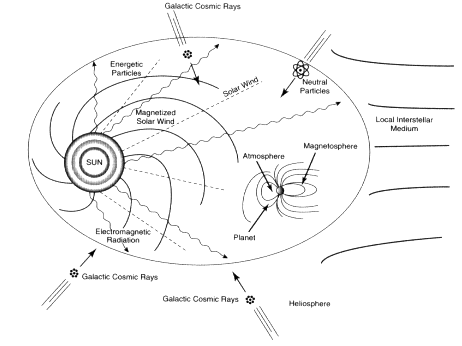
Figure II.4.1
Solar connections.
The Magnetosphere
The geomagnetic field presents an obstacle to the solar wind. Its interaction with the solar wind produces a large cavity in the flow, called the magnetosphere (see Figure II.4.1), that surrounds the Earth. This cavity is compressed on the sunward side by the ram pressure of the solar wind, but it is elongated on the night side into a very long magnetic "tail." While shielding the Earth from the incident solar wind, the geomagnetic field also acts as a magnetic bottle that traps and holds plasma that leaks in from the solar wind and escapes from the Earth's ionosphere. These plasmas are heated, accelerated, and transported within the magnetosphere by a variety of processes that are only partially understood.
Of particular concern in this Disciplinary Assessment are dramatic changes to the Earth' s magnetosphere occurring as a result of propagating structures in the solar wind. A southward turning of the interplanetary magnetic field increases the transfer of energy from the solar wind into the magnetosphere, resulting in increases in the trapped (Van Allen) radiation, auroras, changes in the surface magnetic field, and heating of the upper atmosphere that creates high-speed winds and composition changes.
Page 206
The Ionosphere-Upper Atmosphere
Earth's upper atmosphere extends out to several hundreds of kilometers and is partially ionized by extreme ultraviolet radiation from the Sun, creating what is known as the ionosphere. Cosmic-ray and solar energetic particle bombardment and magnetospheric particle precipitation augment solar-produced ionization, especially at auroral latitudes. Daily changes in solar ionizing radiation and heating drive large-scale motions in the upper atmosphere and ionosphere. Electrodynamic coupling between the ionosphere and magnetosphere allows magnetospheric currents and fields to influence ionospheric structure. Collisional, frictional, and chemical changes in the neutral atmosphere also force changes in ionospheric structure and dynamics.
The Middle Atmosphere
The atmosphere is divided into a number of layers associated with obvious changes in temperature structure. This structure (see Figure II.4.2) is determined primarily by the absorption of solar radiation. The atmosphere is mostly transparent to the bulk of solar radiation, which is in visible wavelengths (400 to 700 nm). This leads to most of the solar radiation being absorbed at the Earth's surface. Sensible and latent heat transport from the Earth's surface is responsible for heating the lower atmosphere, and this accounts for the fall-off of temperature with increasing altitude in the troposphere. Ultraviolet (UV) solar radiation (wavelengths less than 242 nm) dissociates molecular oxygen and leads to stratospheric ozone formation. Ozone, in turn, absorbs ultraviolet radiation at slightly longer wavelengths (less than about 300 nm). These processes account for the temperature increasing with height throughout the stratosphere. Above this, the temperature decreases with height in the mesosphere until extreme-ultraviolet (EUV) radiation (wavelengths less than 180 nm) dissociates and ionizes the atmospheric gases, leading again to a temperature increase with altitude in the thermosphere.
Ozone losses occur as a consequence of chemical reactions in which catalytic reactions with hydrogen, nitrogen, and halogen oxides are crucial. Any process that increases the concentration of such reactive species will lead to stratospheric ozone decreases. For instance, industrial chlorofluorocarbon (CFC) emissions have increased the concentrations of reactive chlorine in the stratosphere and led to observable ozone losses that are of societal concern.
Atmospheric waves, on various spatial and temporal scales, are forced mainly in the troposphere. As these waves propagate upward and grow in amplitude, they become very important and comprise a major component of the circulation at higher altitudes. These waves affect the dynamics of the middle atmosphere, which in turn gives rise to transports of many minor atmospheric constituents, including ozone. Since ozone absorbs solar UV radiation but is affected by
Page 207
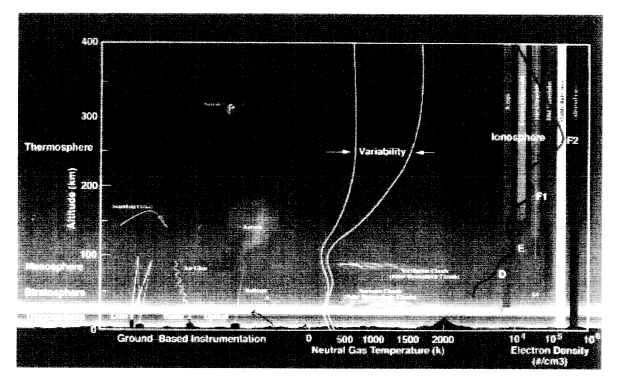
Figure II.4.2
Schematic illustration of the atmospheric thermal structure and electron (ion) content. Various processes
of interest are depicted, showing the altitude range over which they are observed. These include nacreous and
noctilucent clouds, the aurora, and the attenuation of selected solar wavelength ranges that produce the
ionospheric layer and excite and dissociate atmospheric species. Source: J.H. Yee and associates, Applied
Physics Laboratory, Johns Hopkins University.
Page 208
chemical and transport processes, middle-atmospheric behavior is determined by rather complex radiation-chemistry-dynamics interactions.
Cosmic Rays
In addition to the neutral gas, plasma, and field environments described above, the Earth is immersed in an extremely tenuous rain of highly energetic charged particles called cosmic rays. Such particles are produced both in our galaxy and in other galaxies. Processes occurring at the Sun and in interplanetary space also occasionally accelerate particles to cosmic-ray energies. The Earth's magnetic field acts as a barrier to this cosmic-ray bombardment, but the shielding effect is imperfect, especially in the magnetically open polar regions and at high altitudes. Owing to their great energy, cosmic rays can be especially dangerous to man and machine throughout space.
Research Priorities
A recent report (NRC, 1995b) of the CSSP-CSTR identified research priorities for overall scientific progress in these areas. Here, we identify imperatives for research, selected from the broader priorities in the earlier report (NRC, 1995b), that specifically address the national goals of
• protecting life and property,
• maintaining environmental quality,
• enhancing fundamental understanding, and
• enhancing economic vitality.
The topics selected with these criteria are, in priority order,
1. stratospheric processes important for climate and the biosphere,
2. space weather,
3. middle- and upper-atmospheric global change, and
4. solar influences.
This prioritization reflects not only national priorities but also other considerations such as timeliness of the research and relevance to other areas of atmospheric research.
Research into the topic ''stratospheric processes important for climate and the biosphere'' is vital to our understanding of the Earth's atmosphere. Anthropogenically produced substances have been shown to be altering the stratospheric ozone layer; studies in this area are important for maintaining environmental quality. Regulations have been promulgated internationally that ban the future
Page 209
use of chlorofluorocarbons, and decisions concerning future supersonic transport aircraft may hinge on predictions of their effects on stratospheric ozone. Thus, research in this area has important considerations for national economic vitality. Finally, given the fact that stratospheric ozone affects the biosphere's exposure to harmful UV radiation, which can have consequences for human health, and that changes in ozone can affect the Earth's climate, research into this area clearly can have an effect on life and property. Hence, studies of stratospheric processes are relevant to all four of the criteria enumerated above.
"Space weather" encompasses all of the effects associated with the variable release of energy from the Sun in the form of x-rays, energetically charged particles, and streams of plasma with embedded magnetic fields. Through a complex sequence of events, the plasma streams interact with the Earth's magnetosphere giving rise to auroral events, the Van Allen radiation belts, and other geophysical phenomena grouped under the heading "magnetic storms." Such events have caused failures in power transmission grids at high latitudes and the loss of control over communication satellites. Outbursts of x-rays (from flares) or protons pose threats to humans in space. Even the occupants of high-flying aircraft on polar routes are exposed to much higher levels of radiation at certain times.
The space weather imperative is particularly strong because of its timeliness. The reliance on space systems in the civilian sector for meteorological weather forecasting, navigation, and communications is increasing at a rapid rate. This enormous investment of resources is at considerable risk until a coordinated approach to space weather forecasting and improved models of radiation hazards are developed. As a consequence of space research conducted during the past several decades, our understanding of the linkages between the Earth and the Sun has reached a level at which the development of numerical models can now be attempted and efforts undertaken toward using them for prediction. Our inability to relate this topic to "maintaining environmental quality" is the reason this topic has been given second priority, but its importance for manned space flight and for prediction of near-Earth space conditions that affect military communications adds strategic elements that have not been fully explored in this report.
The "middle and upper atmosphere" is the region of our atmosphere extending roughly from 10 km altitude out to several hundred kilometers. This region is subject to long-term changes due to both man-made and solar variability effects. Man-made changes in the ozone layer and in the concentrations of other trace gases are expected to cause major changes in the temperature structure within these regions, which will be most noticeable at high altitudes. These changes will influence the atmospheric circulation, including possible effects on tropospheric climate, and may influence space operations and radio-wave communications. Although much remains to be learned about this region, models are being constructed that include many of the important effects related to dynamics, chemistry, and energetics. This topic was judged to relate less strongly to the stated societal imperatives than those listed previously, so that it was given third priority.
Page 210
Fourth on our priority list is the topic "solar influences." The Sun, of course, warms our planet and sustains life thereon. Recently discovered small variations in solar irradiance over the sunspot cycle are now suspected to have played a role in past climate fluctuations. Moreover, most space weather events are initiated by changes at the Sun. The understanding of processes at work in our star is perhaps least developed among the topics discussed here. However, with the exception of improved forecasting of some space weather events, it is not clear how studies of the Sun can be translated into short-term, societally relevant impacts, such as enhancing economic vitality and maintaining environmental quality, yet its possibly critical role in driving climate change makes this a subject of considerable concern over the long term.
It is important to note that although we have assigned priorities and selected topics on the basis of our best judgment, it would, in our opinion, be foolhardy to forsake other areas covered in the recent NRC science strategy report (NRC, 1995b). The progress of science has demonstrated repeatedly the wisdom of performing basic research on a broad front, since our ability to judge those areas in which great payoffs are to be found is imperfect, at best. Two examples of this are discussed briefly below to illustrate the point.
The demonstration by Marconi in 1901 that radio waves could traverse the Atlantic Ocean caused Kennelly and Heaviside independently to suggest that a conducting region high in the Earth's atmosphere was responsible for reflecting the waves. A small group in Cambridge, England, under Sir Edward Appleton first measured the height of reflection (of a medium-wavelength British Broadcasting Corporation transmitter's signals) in 1924. Their work was followed by that of another small group at the U.S. Naval Research Laboratory under Breit and Tuve, who developed a pulse-sounding technique for exploring reflection heights as a function of frequency at vertical incidence (i.e., overhead). These results paved the way for widespread use of ionosondes, which proved critical for optimizing high-frequency communications (on which the armed forces depended) during World War II. The pulse-height technique, moreover, is often considered the genesis of pulse radar, which also proved to be of critical importance to the Allies during the war. The origin of this ionospheric work was pure scientific curiosity, with little awareness of its ultimate importance.
Another area of research in which fundamentally important results were obtained despite the absence of high initial priority can be found in both the discovery and the explanation of the Antarctic ozone hole. Although the subject of ozone depletion was already receiving a lot of attention in the middle 1980s and satellite data were being used to look for stratospheric ozone depletions, it was a small group of British researchers, who had been making ground-based observations of total ozone at Halley Bay in Antarctica since the 1950s, that first noticed the precipitous decrease in springtime stratospheric ozone there. They had, moreover, suggested that its cause might be found in industrial chlorofluorocarbons released into the atmosphere. Also, during the 1980s, much research was
Page 211
being performed in stratospheric chemistry, but the great emphasis was on gas-phase chemistry. Fortunately, a few groups had been investigating heterogeneous chemistry (primarily with respect to chemical reactions in tropospheric clouds), and in only a few years it was established that the Antarctic ozone hole was caused by chemical reactions occurring on the surfaces of the aerosols in polar stratospheric clouds. This discovery was made possible by a large, directed research effort involving ground-based and aircraft measurements aimed specifically at finding the reason for the very large ozone decreases observed in the Antarctic. Thus, remarkable progress was built on foundations made by a few small research groups, which shows the value of modestly funded research of no great national priority followed by a very high priority research effort.
With these lessons in mind, this report attempts to highlight a few areas in which we feel that directed research will pay large dividends as we enter the twenty-first century. It is equally important, however, to maintain broadly based research in the other areas of upper-atmosphere and near-Earth space discussed in the earlier NRC report (NRC, 1995b) so that the groundwork can continue to be laid for future knowledge and understanding and for the rare—sometimes important—surprises that can occur.
Stratospheric Processes Important for Climate and the Biosphere
Natural and anthropogenic variations of the stratosphere can affect the climate and the biosphere in several ways. Firstly, stratospheric ozone (03) is the major absorber of UV-B radiation (280 to 320 nm wavelength) in the Earth's atmosphere. Since UV-B is known to damage DNA and thus harm biological systems, any processes, whether natural or anthropogenic, that cause decreases in stratospheric ozone and therefore increases in UV-B are of great concern.
Changes in the stratosphere also affect the climate in complex ways through radiative and dynamical interactions with the troposphere. On the one hand, ozone decreases result in less absorption of solar UV in the atmosphere, thereby allowing more solar radiation to heat the surface. On the other hand, reduced stratospheric ozone leads to a cooler stratosphere that, in turn, radiates less infrared energy downward into the troposphere, resulting in tropospheric cooling. The climate can be changed as a consequence of alterations in these incoming and outgoing radiative fluxes. It is also possible that ozone changes in the stratosphere lead to changes in the stratospheric distributions of wind and temperature and thus affect the dynamical interactions between the troposphere and stratosphere. There is likewise a possibility that reduced concentrations of ozone in the stratosphere could enhance photochemical activity in the troposphere and hence alter the oxidizing capacity of the atmosphere.
Clear evidence now exists that the stratosphere has changed as a result of anthropogenically induced changes in atmospheric composition (WMO, 1995).
Page 212
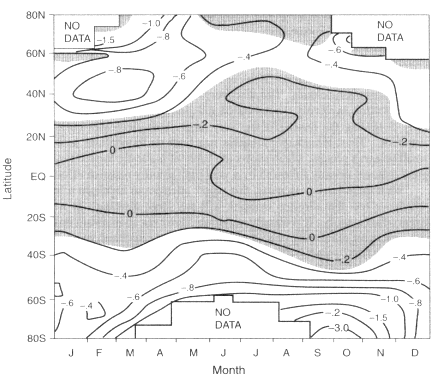
Figure II.4.3
Total ozone trends (percent per year) as observed by the Total Ozone Mapping
Spectrometer.
Ground-based, aircraft, and satellite observations have clearly shown that the Antarctic ozone hole is caused by increased chlorine and bromine radical concentrations in the lower stratosphere and that these are a result of the anthropogenic emission of huge amounts of halogen-containing compounds in combination with the unique meteorological conditions of the Antarctic lower stratosphere. Similar enhancements in chlorine and bromine radicals are also observed in the Arctic winter lower stratosphere for periods of time, and smaller ozone decreases are seen in this region and at lower Northern Hemispheric latitudes (due to the different meteorological conditions there), but there is no detailed understanding of the reasons for these decreases in ozone at this time. Finally, substantial ozone losses (see Figure II.4.3) have been observed at midlatitudes, particularly in the Northern Hemisphere, exposing large populations to increased levels of UV-B radiation.
Thus, the stratosphere is known to be changing in response to human activities, and stratospheric changes of these types can affect the climate and biosphere (including human health). This situation has led the international community to
Page 213
adopt a number of regulations on anthropogenic trace gas emissions that can affect ozone, with the goal of returning ozone to its natural level in several decades.
Some other outstanding questions in this area include the following:
• How does the increase in concentration of stratospheric aerosol affect climate by changing the radiation balance of the troposphere and altering stratospheric chemistry?
• What is the atmospheric impact of possible future fleets of stratospheric aircraft?
Below, the four specific areas in which research on stratospheric effects is critical (stratospheric ozone, volcanic effects, atmospheric effects of aircraft, and the stratosphere's role in climate and weather prediction) are described, including a brief scientific background, important questions to be answered, and current and future research. Finally, the research imperatives for the twenty-first century that arise from these topics, their contributions to solving societal problems, the programs required, and measures of success are discussed.
Stratospheric Ozone
Atmospheric penetration of UV-B radiation is determined primarily by the amount of absorbing ozone in the stratosphere, even though aerosols, tropospheric clouds, and tropospheric ozone also play an important role. UV-B radiation is damaging to living cellular tissue. Thus, the observed decrease in ozone (Figure II.4.3) implies an increase in the biosphere's exposure to this harmful radiation. For example, Figure II.4.4 shows the estimated daily dose of effective UV radiation for generalized DNA as a function of latitude and season for the average ozone distribution in 1979-1989, along with the trend in daily effective UV dose predicted by ozone trends for this period. Note that although the maximum downward ozone trend at middle northern latitudes occurs in February-March, the maximum absolute increases in UV radiation are seen later in the year due to the annual march in the solar zenith angle. Only with the deployment of the latest generation of research instrumentation has the predicted relationship between ozone and UV-B radiation been verified (see Figure II.4.5). Previous operational networks were not capable of making the necessary measurements.
Ozone in the lower stratosphere acts as a greenhouse gas. As mentioned earlier, it plays two distinct roles—as an absorber of solar radiation and as an emitter of infrared radiation. Because of these roles, the effect of ozone changes on tropospheric climate depends on the altitude at which the ozone changes occur. Models show that the surface climate is most sensitive to ozone changes in the vicinity of the tropopause, where the temperature is the lowest (see Figure II.4.6).
Page 214
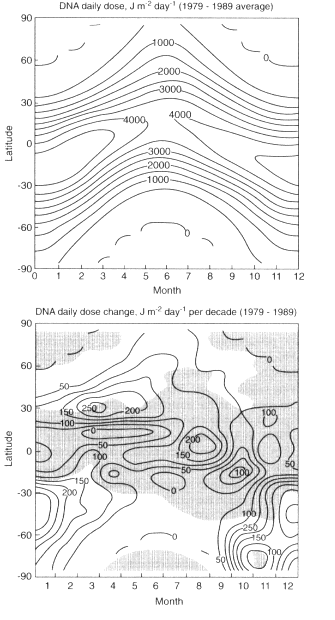
Figure II.4.4
Estimated daily dose of effective UV radiation for generalized
DNA: seasonal and latitudinal distribution (1979-1989).
Page 215
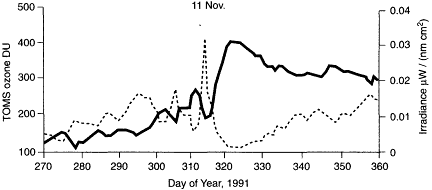
Figure II.4.5
Irradiance at 300 nm (dotted line, right axis) and SBUV ozone (heavy line,
left axis) during spring season at the South Pole.
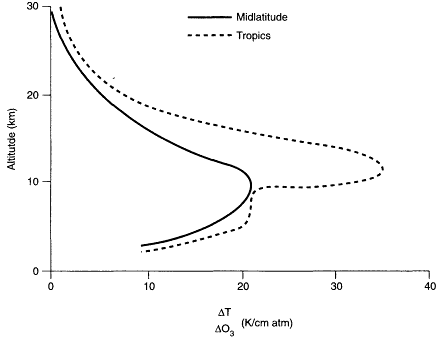
Figure II.4.6
Computed change in surface temperature (per unit local O3 change) as a function
of altitude at which O3 is perturbed. The surface temperature sensitivity curve is
shown for midlatitude (solid line) and tropical (dashed line) atmosphere conditions.
Source: Wang and Sze, 1980.
Page 216
These considerations, together with the now well-established fact that the Antarctic ozone hole is caused by anthropogenic emissions of halocarbons, have had profound implications on international policy. The London (1990) and Copenhagen (1992) amendments to the Montreal Protocol and the U.S. Clean Air Act Amendments have accelerated the phaseout of many halocarbons. These actions appear to be having their desired effect since very recent measurements have shown that the rate of increase of the chlorinated fluorocarbons and halons is slowing, while CFC substitutes are beginning to accumulate in the atmosphere (WMO, 1995). These results, documented through a worldwide measurement network, verify that emission controls are beginning to have a beneficial effect on atmospheric halogen levels. Nevertheless, according to models, ozone depletion will likely worsen for at least another decade (WMO, 1995). Decision makers continue to turn to the world's scientific community for advice. How well can we forecast the future of the ozone layer? Responding to this will require research that answers the following critical science questions:
• What processes are causing the observed ozone depletion at midlatitudes in the Northern Hemisphere, which is greater than predicted by current models?
• What will the global ozone losses and surface UV increases be in the next 20 years, during which atmospheric halogen levels are expected to peak?
• What ozone losses and surface UV increases could appear in the Arctic (and the Antarctic) during the same period?
• What is the quantitative relationship among global, lower-stratospheric ozone depletion; radiative forcing of the Earth's atmosphere system; and climate change?
• What are the global impacts of the Antarctic ozone hole (which is expected to continue well into the next century)?
• How well do we understand the role of methyl bromide in ozone depletion?
• When will the ozone layer begin to be rehabilitated?
Currently, there is much research activity in these general areas, and proposals for future programs have been developed. In Europe and the United States, extensive aircraft campaigns to better understand stratospheric processes take place on a regular basis, especially in the Arctic and Antarctic lower stratosphere. These typically involve both high-flying stratospheric aircraft that make in situ measurements and lower-flying aircraft that make remote sensing measurements. Many ground-based measurements are also being made of the stratosphere, both to better understand processes and to establish trends in temperature and composition at a number of locations. A surface UV network has been deployed, but as discussed above, it has proved incapable of making the measurements required for the detection of surface UV trends because of inadequate instrumentation and calibration. Although research instrumentation is capable of making such mea-
Page 217
surements (Figure II.4.5), little use has been made of this in an operational environment. Photochemical models for stratospheric ozone exist, but they do not correctly predict the observed levels of ozone at upper-stratospheric altitudes or observed ozone decreases in the lower stratosphere. Interactive three-dimensional radiative-dynamics-chemistry models for stratospheric ozone are in their infancy, but much has been learned from simplified versions of these models. Both field measurements and laboratory work are going on to understand anthropogenic chemicals that may pose threats to stratospheric ozone, such as methyl bromide and the CFC substitutes whose atmospheric concentrations are increasing rapidly. Lastly, the Upper Atmosphere Research Satellite (UARS) has provided very valuable observations of chemical compounds never observed globally before, as well as solar flux, energetic particles, and winds, thus enabling a global picture of the workings of the stratosphere that was not available earlier.
Future programs that are needed to make progress in this area include the deployment and utilization of unmanned aircraft, stratospheric satellite observations, stratospheric modeling, and monitoring of surface UV radiation. These programs are described in more detail below.
Aircraft observations have shown their great value in unraveling the physics and chemistry of polar ozone. The ability to deploy these aircraft in specific regions and to make high-precision and high-data-rate measurements of many atmospheric parameters has led to great advances in understanding. Unfortunately, these aircraft are limited to the lower stratosphere, and it is difficult and expensive to deploy them in remote regions. Unmanned aircraft are being developed that will carry significant payloads to higher altitudes, will be less expensive to operate, and will not be subject to the safety limitations imposed on piloted aircraft. It is very important that development of these aircraft continue and that they be used extensively to better understand stratospheric chemistry.
UARS, and the earlier NIMBUS-7 satellites, have shown the impact that satellite observations can have on stratospheric research. There were, however, significant gaps in UARS observations that lacked hydroxy radical (OH) observations and had limited comprehensive chemistry measurements in polar winter. The next opportunity for comprehensive stratospheric satellite measurements will be provided by the EOS, which is scheduled to be deployed in 2002. The atmosphere will have changed a great deal by then, so EOS measurements should show different chemical characteristics. It is crucial that these comprehensive stratospheric measurements be carried out as planned.
Comprehensive three-dimensional models of the stratosphere are just being developed. Very little use has been made of three-dimensional models for assessments of stratospheric ozone. Continued development in this area is needed to make assessments for the future as well as to check that the atmosphere responds to current chemical usage regulations as expected.
Improved UV monitoring instrumentation must be deployed to verify that our understanding of the effects that control UV flux to the surface is correct and
Page 218
to verify calculation methods used for locations where measurements are not being made. This UV flux is crucial for biological investigations.
Volcanic Effects
Discovery of the Antarctic ozone hole in the austral spring spurred intense effort to learn the reason for this unanticipated decrease in total ozone column. Models were developed suggesting that heterogeneous chemical reactions were responsible for converting relatively chemically inactive chlorine species (usually referred to as reservoir species) into reactive chlorine species (radicals) that catalyze ozone loss. These model predictions were later substantiated through observations. The reactions that destroy ozone take place in the lower stratosphere where temperatures are low enough for polar stratospheric clouds (consisting of nitric acid and water) to occur and provide the surfaces on which chemical reactions take place. This knowledge has spurred an increased interest in heterogeneous chemistry.
In the 1980s, there were suggestions that stratospheric ozone decreases occurred following the eruptions of Mt. Agung in 1962 and E1 Chicon in 1983. It was then proposed that heterogeneous reactions might be occurring on the surfaces of volcanic aerosols that form in the stratosphere after a large eruption such as that of Mt. Pinatubo (in 1991). Comparisons of stratospheric aerosol levels following the eruption of Mt. Pinatubo with those prior to the eruption are available from satellite observations. Later aircraft campaigns did, in fact, confirm the existence of ozone-destroying chemical reactions in the lower stratosphere resulting from heterogeneous reactions occurring on aerosols from Mt. Pinatubo. In addition, it had long been known that after large volcanic eruptions, the enhanced stratospheric aerosol amounts increase both the backscattering of solar radiation and the absorption of solar radiation. Thus, a temperature decrease at the surface and a temperature increase at the height of the volcanic aerosol are expected. both are, in fact, observed, although great care must be taken to extract the relatively small signal from natural variability.
The current state of our knowledge is that the increased stratospheric aerosol loading resulting from large volcanic eruptions causes perturbations both in the radiation balance of the atmosphere and in stratospheric chemistry. As a result, the following questions must be addressed to further our understanding:
• How has the evolution of aerosol concentrations in the stratosphere over the past decades affected the evolution of stratospheric ozone?
• Are the effects of major volcanic eruptions on tropospheric and stratospheric temperatures, which have been inferred from observations, consistent with modeling predictions?
• Can we observe differences in the distribution of species within chemical
Page 219
families [e.g., oxides of nitrogen (NOx)] in the stratosphere due to major volcanic eruptions?
• Can models explain the stratospheric chemical differences that occur in the presence of ''background'' and volcanic aerosols?
• What are the net chemical-radiative-dynamical effects on the atmosphere of large volcanic eruptions?
Several massive volcanic eruptions have affected the stratosphere in recent decades. In particular, the eruption of Mt. Pinatubo occurred at a time when many observational systems were deployed to observe the stratosphere. Micro-physical models have been developed and merged with atmospheric transport models in an attempt to understand the evolution of the volcanically induced stratospheric aerosol. There has been rapid development in understanding the heterogeneous chemical reactions that occur on volcanic aerosols. Some observations have indicated that the chemical partitioning predicted to occur in the presence of stratospheric aerosol particles does, in fact, occur. Some general circulation models have been run to examine the climatic effects expected from volcanic eruptions. Future projects include improved characterization of stratospheric aerosols, improved microphysical models, and improved treatment of heterogeneous chemistry.
There is a paucity of information on the composition, surface characteristics, and so forth, of stratospheric aerosols. Yet, these characteristics are crucial in considerations of heterogeneous chemistry and radiative transfer. In recent years, several microphysical models have been developed for characterizing stratospheric aerosols. More has to be done, and these models should be combined with dynamical and heterogeneous chemistry models for more realistic characterization of the atmosphere and improved predictive capability. Laboratory and field measurements have shown that heterogeneous chemistry is very important in the stratosphere. Yet, the treatment of this chemistry in models remains very crude. More realistic treatment of heterogeneous chemistry in atmospheric models is needed and should be coupled to detailed microphysical models.
Solar Effects
The abundances of ozone and other chemical species in the stratosphere are affected by photodissociation processes and hence by the level of solar ultraviolet radiation penetrating the atmosphere. Since the intensity of solar radiation at short wavelengths varies with solar activity, the concentrations of stratospheric gases (including ozone) are expected to vary with a period of approximately 11 years. Ozone and other chemical compounds are also expected to respond to changes in solar radiation on a time scale of 27 days, corresponding to the apparent rotation period of the Sun. Although these natural perturbations in the chemi-
Page 220
cal composition of the middle atmosphere are generally smaller than some of the recent anthropogenic effects, they are nevertheless significant and are discussed more extensively later.
Quasi-Biennial Oscillation Effects
Atmospheric waves (gravity waves and equatorial planetary waves such as Kelvin and mixed Rossby-gravity waves) interact with the mean flow in the equatorial lower stratosphere to produce an oscillation in the mean zonal winds such that they reverse from eastward to westward with an average period of approximately 28 months. This is known as the quasi-biennial oscillation (QBO). Although the wind oscillation is confined to the lower stratosphere, it appears to modulate global stratospheric circulation, and hence the meridional transport of ozone and polar winter temperatures. This effect modulates the severity of the Antarctic ozone hole, and global ozone concentrations in general, according to the phase of the QBO.
There have also been suggestions that the QBO significantly influences the troposphere, including the number of Atlantic hurricanes. It is uncertain how this influence arises, but a suggestion has been made that the QBO influences upper-tropospheric wind shear in the tropics, which in turn affects the nature of deep convection that occurs during hurricane formation. More research is needed to understand the QBO and its influence on global circulation.
Atmospheric Effects of Aircraft
Much of the impetus for modern stratospheric ozone research has its roots in the supersonic transport research of the 1970s. At the time, the concern was that such aircraft would emit large amounts of water vapor and nitrogen oxides into the stratosphere where they could initiate catalytic ozone destruction. Since then, the airline industry has grown considerably, and this expansion has included great growth in long-distance routes in the Pacific region. At this time, plans are under way for a new generation of supersonic civilian transports. This planning involves assessing the effects of proposed aircraft operations on the stratosphere, with particular emphasis on stratospheric ozone.
The nature of this research puts great emphasis on atmospheric photochemical modeling, since no alternative method for predicting the effects of supersonic transport exists at present. This places particular stress on current modeling abilities. For instance, two-dimensional models have been used extensively to simulate the effects of halogens on stratospheric ozone. This has some justification since the halogen-containing gases are long-lived and should therefore mix extensively within the troposphere before entering the stratosphere. On the other hand, aircraft exhaust products are deposited along the flight path, and since many of the products have short lifetimes, they do not become well mixed. Thus,
Page 221
analysis of the effects of aircraft on the atmosphere entails treating what is inherently a three-dimensional process.
In addition, aircraft exhaust products are deposited in the lower stratosphere, near the tropopause, which is a very difficult region to model correctly because, in this region, the very complex tropospheric chemistry merges with stratospheric chemistry. Further, the exchange of mass between the stratosphere and the troposphere, known as stratosphere-troposphere exchange (STE), is not well understood. In addition, heterogeneous chemical reactions that occur on ambient and aircraft-produced aerosols are a concern. To make modeling efforts relevant to this problem, many reaction rates must be measured in the laboratory under conditions encountered in the stratosphere, and atmospheric measurements must be carried out to test our understanding and the correctness of the models.
The decision on whether or not to build a fleet of high-altitude aircraft, and how to operate them, depends to a large extent on the confidence that the scientific community has in correctly predicting their atmospheric effects. To provide meaningful input in this area, the following critical questions must be answered:
• What will the effect of a large fleet of supersonic aircraft be on atmospheric composition and structure?
• What are the limits imposed by using two-dimensional models to simulate the impact of aircraft on a three-dimensional atmosphere?
• How do we represent stratosphere-troposphere exchange processes properly in chemical transport models?
• What differences would there be in the atmospheric effects of supersonic aircraft under volcanically enhanced stratospheric aerosol conditions and background conditions?
• What will the atmospheric effects of aircraft be in the polar regions?
• What will the effects of aircraft be under different chlorine loading conditions?
During the past several years, extensive programs have been put in place to assess the atmospheric consequences of the present aircraft fleet, as well as to predict the effects of future fleets of subsonic and supersonic aircraft. Experimental facilities have been built to measure the exhaust products of present aircraft and proposed aircraft engines. Laboratory investigations are proceeding to measure the rates of chemical reactions that transform the aircraft exhaust products and influence atmospheric composition. Models are being developed to predict the transformations that take place between the time the aircraft exhaust leaves the tail pipe and the time it mixes with atmospheric gases. Models have been built to predict the changes in atmospheric composition resulting from the deployment of present and future aircraft fleets. At present, these models are mostly two dimensional, but a few three-dimensional models are starting to appear. To make substantive progress, more realistic three-dimensional models are
Page 222
needed, as well as better characterization of STE processes, particularly along flight paths. These models require better treatment of aerosol physics and heterogeneous chemistry. The nature of stratosphere-troposphere exchange is not sufficiently well understood to be incorporated satisfactorily in model treatments at this time. Observational campaigns, together with modeling efforts, will be necessary to gain the required understanding of these processes.
The Role of the Stratosphere in Climate and Weather Prediction
The stratosphere plays at least two roles in the climate system. The first is the impact of stratospheric trace gases and aerosols on the net radiative balance of the surface-troposphere system. Ozone and aerosols reduce the downward radiative flux at the tropopause by absorbing and reflecting solar radiation. On the other hand, ozone, carbon dioxide (CO2), and several other trace gases increase the downward radiative flux by emitting longwave radiation. The second role of the stratosphere in the climate system is through the dynamic coupling of the troposphere and stratosphere. Stratospheric circulation influences the vertical propagation of tropospheric waves, but the feedback of this process on tropospheric circulation is not well understood.
It is essential that the stratosphere be considered in any effort to understand certain aspects of climate. For instance, CFCs are greenhouse gases, so their increasing concentrations lead to climatic warming. CFCs also lead to stratospheric ozone depletion and are probably responsible for the observed decreases in ozone in the lower stratosphere. Since lower-stratospheric ozone is itself a greenhouse gas, the combined effects of CFCs on radiative transfer and ozone depletion lead to less greenhouse warming when their effects on stratospheric ozone are considered. When comparing trends in lower-stratospheric temperatures with model predictions, it is also important to consider both the CO2 greenhouse and the ozone depletion effects.
The following are critical questions for characterizing the role of the stratosphere in weather and climate:
• How do processes in the stratosphere affect the prediction of future climate states?
• How can improved representation of the stratosphere be included in numerical forecast models?
• Are the present and anticipated data sources for the stratosphere (e.g., for water vapor and winds) sufficient for climate and weather forecasting purposes?
• Do current models correctly model troposphere-stratosphere interactions?
• How do different models of the troposphere-stratosphere system compare with one another?
Several active areas of research are currently being pursued. Radiation
Page 223
chemistry climate models exist that can be used to address some questions involving troposphere-stratosphere interactions, but most are relatively crude (either one or two dimensional). Some modeling work has also been done on dynamical-radiative interactions, at times with conflicting results. For instance, one general circulation model predicts that doubled CO2 concentrations will lead to a warmer lower stratosphere in winter, whereas others do not. This question is of great importance in understanding the prospects for the occurrence of an Arctic ozone hole in the future. A few research papers have appeared indicating that better inclusion of the stratosphere in numerical forecasting models leads to greater forecasting skill, but there have been no large-scale operational tests of this type.
To make further progress, the effects of inclusion of a realistic stratosphere in numerical weather prediction models have to be better understood. In addition, models must be tested both against each other and against observations. Better observations of water vapor in the upper troposphere and lower stratosphere are also needed. Both radiative and chemical models require such data.
Key Initiatives
In the following, some key initiatives for the next 15 years are discussed that will enable progress to be made in the research issues identified earlier. These initiatives are organized by scientific area. It should be noted that although they have been listed in specific scientific areas, many of them will also be useful in other areas. In all cases, a strategy that combines observations, laboratory studies, and modeling is needed.
Stratospheric Ozone
• Deployment and Utilization of Unmanned Aircraft: Aircraft observations have shown their great value in unraveling the physics and chemistry of polar ozone. The ability to deploy research aircraft in specific regions and to make high-precision and high-data-rate measurements of many atmospheric parameters has led to great advances in understanding. Unfortunately, these manned aircraft have ceiling limits that are low in the stratosphere, and they are difficult and expensive to deploy in remote regions. Unmanned aircraft are being developed that will carry significant payloads to higher altitudes, will be less expensive to operate, and will not be subject to the safety limitations imposed on piloted aircraft. It is very important that unmanned aircraft have a defined role in the study of stratospheric chemistry. Support for other unique platforms such as the National Aeronautics and Space Administration's (NASA's) ER-2 and the National Science Foundation's (NSF's) WB-57 is also important because these research aircraft have the capability to carry large scientific payloads at high altitudes.
Page 224
• Stratospheric Satellite Observations: Satellite observations, such as those from UARS, have made a substantial impact on stratospheric research. However, measurements have been limited by the lack of OH observations and the fact that comprehensive chemistry measurements are available for only one Southern Hemisphere winter. The next opportunity for comprehensive stratospheric satellite measurements will be on the EOS mission.
• Stratospheric Modeling: Comprehensive three-dimensional models are just being developed. Very little use has been made of three-dimensional models for assessments of stratospheric ozone. Continued development in this area is needed to make assessments for the future as well as to check that the atmospheric response to current regulations has been as expected.
• Monitoring Surface UV Radiation: Improved ultraviolet monitoring instrumentation is required to verify that our understanding of the effects that control UV flux to the surface are correct, as well as to verify the calculation methods that will be used for locations where measurements are not being made. It is this UV flux that is crucial for biological investigations.
Volcanic Effects
• Improved Characterization of Stratospheric Aerosols: There is a paucity of information on the composition, surface characteristics, et cetera, of stratospheric aerosols. Yet these characteristics are crucial in considerations of heterogeneous chemistry and radiative transfer.
• Improved Microphysical Models: In recent years, several microphysical models have been developed for characterizing stratospheric aerosols. More needs to be done, and these models should be combined with dynamical and heterogeneous models for more realistic characterization of the atmosphere and improved predictive capability.
• Improved Treatment of Heterogeneous Chemistry: Heterogeneous stratospheric chemistry has been shown to be very important by laboratory and field measurements as well as in models. yet, the treatment of heterogeneous chemistry in models remains very crude compared to laboratory understanding. More realistic treatments of heterogeneous chemistry in atmospheric models are needed. Also, these treatments should be coupled to microphysical models.
Atmospheric Effects of Aircraft
• More Realistic Three-Dimensional Models: More realistic three-dimensional models of aircraft effects on the atmosphere have to be produced. These models require better treatment of aerosol physics and heterogeneous chemistry, as well as stratosphere-troposphere exchange.
• Better Information on the Exchange of Material Through the Tropopause: The decrease of temperature with height and slight stability typical of the tropo-
Page 225
sphere is reversed in the stratosphere. Although stratospheric temperature increases with height, the resulting stability of the stratosphere does not bar the exchange of materials such as radioactive particles or ozone-depleting chemicals between the two.
• Better Characterization of Stratosphere-Troposphere Exchange: The nature of stratosphere-troposphere exchange is not sufficiently well understood to check against model treatments. Observational campaigns together with modeling efforts will be necessary to gain the required understanding of these processes.
Climate and Weather Prediction
• Weather Prediction: The effects of inclusion of a realistic stratosphere in numerical weather prediction models must be better understood. Versions of numerical weather prediction models should be developed that include the stratosphere in a realistic fashion. Retrospective and real-time weather prediction testing are required to see how inclusion of the stratosphere affects the forecasting skill of these models.
• Testing of Models: General circulation models that include the troposphere and stratosphere have to be better tested against observations. Also, models must be carefully intercompared so that the reasons for their different behavior are understood.
• Water Vapor: Better observations of water vapor in the upper troposphere and lower stratosphere are needed. Both radiative and chemical models require such information.
Measures of Success
A successful program will provide a much-improved quantitative understanding of the fundamental chemical, dynamical, and radiative processes that influence the physical and chemical behavior of the middle atmosphere. It will reduce some key uncertainties affecting the behavior of ozone and other chemical constituents in the middle atmosphere, and specifically in the lower stratosphere, where large ozone depletions have been observed. A successful program should also provide the information needed to determine whether it is possible to take measures that would enhance the long-term stability of the ozone layer and the climate of the Earth.
Space Weather
Earth does not exist in an unchanging and benign vacuum. Rather, it is embedded in the dynamic solar wind that fills interplanetary space with a continuous supersonic flow of plasma from the Sun. The interaction of the solar
Page 226
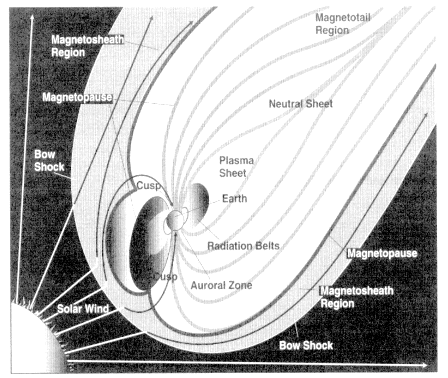
Figure II.4.7
Sun-Earth connections.
wind with the Earth's magnetic field (see Figure II.4.7) yields a dynamic structure called the magnetosphere. Spatial and temporal variations in the solar wind outflow, in response to spatial and temporal changes of the Sun's magnetic field, have a profound effect on the magnetosphere. The complex, time-dependent variations of particles and electric and magnetic fields in the solar wind, the magnetosphere, and the ionosphere produced by solar variability are known collectively as "space weather." The domain of space weather is distinct from that traditionally associated with better-known lower-atmospheric weather (tropospheric meteorology). It encompasses those regions noted in the introduction to this Disciplinary Assessment that are most sensitive to transient phenomena originating on the Sun. They are physically linked to one another in various ways; this coupling makes space weather intrinsically an interdisciplinary topic.
As with lower-atmospheric weather, research on space weather has two main thrusts: (1) a basic research focus to explore and understand the physical processes linking the fundamental elements of the solar-terrestrial system, and (2) an
Page 227
applied research focus to develop useful physical models capable of predicting the changes associated with space weather. Relevant to the latter point, various aspects of space weather can have deleterious effects on both ground- and space-based technological assets, as well as on humans operating in space or at high altitudes. As our reliance on space systems continues to grow, so too does our vulnerability to space weather. The first crude, unmanned satellite was launched about 40 years ago. At present, more than 200 sophisticated satellites are operating at geosynchronous orbit alone, and there is a routine manned presence in low Earth orbit. In the decades ahead, we anticipate many hundreds of technologically advanced satellites operating in space and a nearly continuous manned presence.
The effects of space weather on satellite performance and human health are well documented. Some of these effects are listed in Box II.4.1 for two disturbed periods in 1989. Both naturally occurring space radiation and electrical discharges on spacecraft induced by the space environment can damage and/or destroy critical spacecraft components. Ionization by a single energetic heavy ion can randomly change the state of electronic logic circuits and thus place a spacecraft in jeopardy. Changes in ionospheric structure can adversely affect critical civilian and federal navigation and communications systems. Astronauts on board the shuttle or space stations and even people on board aircraft in polar routes can be at risk in a radiation environment that changes in response to solar-terrestrial interactions. Space weather variations also have negative effects at the surface of the Earth. Reliance on large-scale power grids has led to a broad vulnerability to transient electrical currents induced by time-varying magnetic fields in near-Earth space. These vulnerabilities will likely increase as technology advances, as our presence in space intensifies, and as we become dependent on ever more sophisticated systems for communications, navigation, and other critical functions.
Our understanding of space weather, our ability to specify its present state, and our ability to predict changes in this state are at a primitive level, perhaps analogous to that of tropospheric meteorology in the early 1950s. The purpose of the space weather research program is to convert our present fragmentary understanding into a coherent body of knowledge, so that reliable numerical models of the space environment and the changes associated with space weather can be developed. Just as the extension of meteorological capabilities to stratospheric altitudes has been essential for the full exploitation of commercial aviation, so will the application of the meteorological paradigm to space weather be essential for the full exploitation of space technology. It is critical to recognize that both long-term (years) and short-term (minutes) variations are important in this endeavor. These aspects are described below in the context of solar variability and the corresponding changes that occur in the solar wind and in the Earth's magnetosphere, ionosphere, and upper atmosphere.
Page 228
|
Box II.4.1 Some Consequences of Space Weather Disturbances in 1989 |
|
March 13-14, 1989 |
|
• Massive power outage darkened most of Quebec Province for up to nine hours. At the same time, power losses occurred on power distribution lines in central and southern Sweden. |
|
• GOES-7 lost imagery and had a communications outage. |
|
• Seven commercial satellites required 177 manual operator interventions to maintain operational attitude orientation. This is more than are normally required during a year of regular operations. |
|
• Numerous LORAN navigation problems. Difficulty in using high-frequency radio communications to alert user to the problem. |
|
• California Highway Patrol messages were overpowering local transmissions in Minnesota. |
|
• Large voltage swings in undersea cables. |
|
September-October, 1989 |
|
• Data from radiation sensors aboard the Concorde indicated that passengers and crew received a radiation dose the equivalent of a chest X-ray. |
|
• Shuttle ATLANTIS astronauts reported eye "flashes" produced by energetic protons penetrating the optic nerves. |
|
• Computations indicate that an unshielded astronaut on the Moon would have received "lethal" radiation. |
Scientific Background
Space Climate
To understand the dynamical behavior of the coupled solar-terrestrial system and its potentially deleterious effects, it is imperative to understand first its gross time-averaged conditions and the extreme, long-time-base departures from the mean ("space climate"). In the introduction to this Disciplinary Assessment, some aspects of the climatology of the four coupled regions (Sun, interplanetary space, magnetosphere, ionosphere-upper atmosphere) that comprise the solar-terrestrial system were outlined. Space climate models are especially important at present, given that our ability to provide accurate and specific space weather forecasts is rather limited at the present time. Indeed, knowledge of the space climate rather than space weather is used principally by engineers who design and build systems to withstand the equivalent of a hundred-year flood or storm. This manufacturing philosophy may lead to inefficiency and costly overdesign. Ultimately, production of a reliable space weather forecast capability may give designers the confidence to build "smart" systems that take advantage of ad-
Page 229
vanced knowledge of inclement conditions. In the meantime, improving the validity of space climate models is an important first step toward the goal of understanding and mitigating the effects of the space environment.
The Space Weather System
The Sun is a variable star. Driven by dynamics in the solar interior, the solar magnetic field is continually evolving. This evolution produces the well-known ˜11-year cycle of solar activity. The solar magnetic field causes the Sun's outer atmosphere, the solar corona, to be highly structured. Even when the Sun is relatively quiet, the solar wind near Earth is highly variable since the solar rotation (with a period near 27 days) produces a progression of different coronal regions facing the Earth. Solar wind flow speeds near Earth vary from approximately 300 to 850 km/s, densities range from approximately 1 to 50 cm-3, and magnetic field strengths vary from approximately 1 to 30 nT; average values are approximately 400 km/s, 8 cm-3, 10 eV (electron volts), and 5 nT. Large deviations of the magnetic field from the standard Archimedean spiral direction are common. These temporal variations in solar wind are usually organized into alternating streams of high- and low-speed flows, with the density and field strength generally being strongest on the leading edges of the high-speed streams as a result of compression that occurs in interplanetary space. When the magnetic field within a compression region on the leading edge of a high-speed stream is directed southward, the solar wind is particularly effective in stimulating geomagnetic activity.
The most dramatic forms of solar activity are solar flares and coronal mass ejections (CMEs) (see Figure II.4.8). Flares are distinguished by enhanced electromagnetic radiation over a broad range of frequencies on time scales ranging from seconds to hours. Often particles are accelerated to high energies during the flare process. CMEs are events in which large amounts of solar material are suddenly injected into the solar wind. They originate in closed magnetic field regions in the solar corona that have not previously participated in the solar wind expansion. Although they are distinct phenomena, flares and CMEs both seem to result from the release of stored energy from unstable magnetic configurations in the solar atmosphere. In particular, flares are usually observed on closed field lines statically bound in the solar atmosphere, whereas CMEs are characterized by mass motions on field lines being opened to interplanetary space. CMEs exhibit a wide range of outward speeds. The faster CMEs usually produce major shock wave disturbances in the solar wind. The strong interplanetary magnetic fields produced by such disturbances are particularly effective in stimulating geomagnetic activity when they contain fields with southward components on their arrival at Earth.
Intense and long-lasting energetic particle events, usually called solar energetic particle (SEP) events, are often observed in interplanetary space in associa-
Page 230
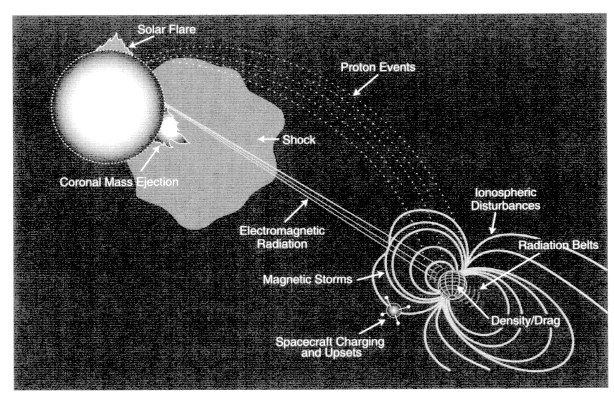
Figure II.4.8
Solar flares and coronal mass ejections.
Page 231
tion with shock disturbances driven by fast CMEs. The temporal profiles of these particle enhancements differ from event to event, depending on the position of the Earth relative to the propagation direction of the interplanetary disturbances. Typically, however, major energetic particle events in interplanetary space begin shortly after fast CMEs lift off from the Sun and continue until well after shocks driven by the CMEs pass the Earth several days later. Although some of the energetic particles observed in major SEP events often are accelerated near flare sites at the Sun, most of the energetic particles in major events appear to be the result of a shock acceleration process that occurs in the outer solar corona and in interplanetary space.
The various manifestations of solar variability in interplanetary space produce both magnetospheric and ionospheric responses, as illustrated in Figure II.4.8. The magnetospheric regions of particular relevance to space weather are shown in Figure II.4.9 and include the magnetopause, the outer boundary of the magnetospheric cavity; the tail plasma sheet, a region of warm plasma extending across the midplane of the geomagnetic tail on the night side of Earth; the near-Earth plasma sheet, the sunward extension of the tail plasma sheet into the region surrounding the inner magnetosphere, out to the dayside magnetopause; the plasmasphere, a region of dense, cold plasma relatively near the Earth populated primarily by particles that escape from the ionosphere; the radiation belts, consisting of magnetically trapped ions and electrons of very high energies (˜106 eV); and the ring current, a region of quasi-trapped, high-temperature plasma that carries a current large enough to be detectable at the surface of the Earth. Each of these regions is connected along geomagnetic field lines to low altitudes. For example, the ovals where auroral emission occurs are low-altitude projection(s) of the plasma sheet at high geomagnetic latitudes. Field lines in regions near the geomagnetic poles are interconnected to the interplanetary magnetic field and are said to be magnetically ''open.''
When the interplanetary magnetic field at Earth contains a southward component, energy transfer from the solar wind to the magnetosphere increases and the magnetosphere becomes stressed. When the magnetosphere relaxes from this stressed state, strong plasma heating and particle acceleration occur in the near-Earth plasma sheet, enhanced particle precipitation into the upper atmosphere occurs at high latitudes with a concurrent brightening and motion of auroral forms, and electric current is diverted from the magnetotail down to the nightside ionosphere. This global release of energy is known as a magnetospheric substorm. Because the magnetic field embedded in the solar wind often contains a south-ward-directed component even when the solar wind is not disturbed, magnetospheric substorms occur at a typical rate of one to a few per day.
As noted above, particularly strong geomagnetic responses are triggered by the strong southward-directed fields often contained within compression regions on the leading edges of high-speed streams and by interplanetary shock disturbances driven by fast coronal mass ejections. Geomagnetic activity stimulated in
Page 232
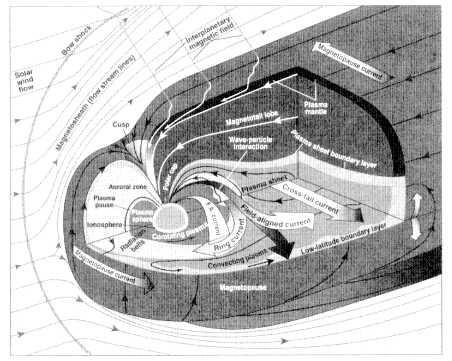
Figure II.4.9
Magnetospheric regions of particular relevance to space weather.
Note: F-A = field-aligned.
this way often persists for several days at a time; such intervals are known as geomagnetic storms. The electric and magnetic field perturbations associated with large geomagnetic storms can extend to the Earth's surface, driving strong ground currents. New, transient radiation belts may also be formed in the largest such events.
Because solar and interplanetary events vary in frequency and intensity with the solar activity cycle, so too does geomagnetic activity. The most severe geomagnetic storms usually are associated with interplanetary disturbances driven by fast CMEs and thus are most common near the maximum of solar activity. Geomagnetic storms associated with high-speed stream compression regions are generally less severe, but tend to recur at the 27-day rotation period of the Sun, particularly on the declining phase of the solar activity cycle. Moreover, for unknown reasons, recurrent storms are much more effective in accelerating electrons to million-electron-volt energies in the outer reaches of the radiation belts. Hence, it is during the approach to solar activity minimum that the fluxes of these electrons with million-electron-volt energies are particularly
Page 233
elevated within the magnetosphere, and these flux enhancements tend to recur at 27-day intervals.
The ionosphere-upper atmosphere system also responds to changes in the external space environment at all local times and latitudes. The upper reaches of Earth's atmosphere lie at the low-altitude extension of the magnetosphere and include both neutral and charged constituents. The charged component is called the ionosphere and is collocated with the upper neutral atmosphere (Figure II.4.2). The ionosphere responds to and affects both the magnetosphere and the neutral atmosphere and thus plays a crucial role in coupling the two.
The physical properties of the ionosphere and upper neutral atmosphere are affected dynamically by changes in both solar radiation and magnetospheric electrodynamics. Solar ultraviolet radiation ionizes the neutral atmosphere, creating the ionospheric structure noted in Figure II.4.2. The ionosphere extends from altitudes of about 90 to 500 km, with local peaks in electron density near 100 and 250 km. Electrical currents, electric fields, and particle precipitation are all imposed onto the ionosphere from their magnetospheric source regions in the polar magnetic cusp and boundary layers, the geomagnetic tail, and the inner magnetosphere. Time variations in magnetospheric convection, especially during magnetospheric substorms and storms, couple electrodynamically with ionospheric motions via magnetically field-aligned currents in the auroral zone. Horizontal ionospheric currents act to couple auroral latitudes to lower latitudes. During large geomagnetic disturbances, activity at relatively high magnetic latitudes can thus affect the nature of the near-equatorial ionosphere. These effects include enhanced or decreased ionization, enhanced or reduced winds, composition changes, heating, gravity wave generation, plasma irregularities and instabilities, and enhanced atmospheric density. These may affect communications, electric power distribution, navigation, space system operations, satellite drag, geomagnetic surveys, and radiation dose.
The ionosphere-upper atmosphere also responds to rapid changes in solar ionizing radiation and energetic particle precipitation that accompany transient solar events. These events, including solar flares and CMEs, produce significant changes in electron density at lower altitudes (80 to 90 km), which in turn inhibit or block high-frequency radio communication at all daytime latitudes.
From a practical standpoint, much of what is relevant to the human condition in space weather involves the Earth's ionosphere. This blanket of ionized matter, or plasma, around the Earth is more dense than that around any other planet, and one must approach the surface of the Sun to find a comparable plasma environment. In our ever-increasing dependence on communications involving satellites that lie far above the ionosphere, this medium must be traversed by electromagnetic waves, which carry our messages and even information about where we are located. In addition to buffeting from above by the solar atmosphere, the ionosphere is subjected to enormous winds borne aloft by tidal and atmospheric gravity waves generated in the dense atmosphere of the Earth. Just as waves
Page 234
breaking on the Earth's ocean shores create turbulence and severe rip currents, these upward-propagating disturbances create ionospheric space weather that matches the severity of solar-induced effects.
Space Weather Effects
To understand and assess the effects of the space environment on systems, it is necessary to know both the environment and the way in which technological systems interact with it. The following material provides several examples of the types of interactions that occur; the different classes of effects are outlined below. Such a list is not exhaustive; indeed, it continues to grow as new and more sophisticated technologies are put to use in human endeavors.
The principal space weather hazard to humans in space and at high altitudes is exposure to ionizing radiation. The exposure gained in high-altitude aircraft is lower in a spacecraft because of the shielding effect of the atmosphere above the aircraft. The primary regions of concern for aircraft are the high magnetic latitudes, where energetic cosmic rays and solar particle events are not shielded by Earth's magnetic field. Manned space flight programs are also very concerned about the exposure of astronauts to radiation. For missions that leave low Earth orbit, the ability to traverse quickly known concentrations of radiation, such as the Earth's radiation belts, and to predict the occurrence of energetic solar particle events is of extreme importance.
Varying levels of solar UV during the solar cycle change the altitudinal profile of the ionosphere, thereby changing ground-to-ground transmission paths for radio communications that use the ionosphere as a reflection medium, and limit the maximum usable frequency (MUF) for such systems. In addition, magnetospheric storms create enhanced and localized ionization levels in the ionosphere, while the variations in the electric fields in the atmosphere-ionosphere electric circuit lead to instabilities that structure the ionospheric ionization. This structured ionization can cause time-variable disruptions in ground-to-satellite and ground-to-ground transmission paths.
High-frequency (HF) radio communications continue to be used by the Department of Defense, shortwave broadcasting authorities, mariners, and others. The ionosphere, which supports such communications, is subject to disturbances during which there can be degraded capability and even a total communications blackout. Sudden ionospheric disturbances caused by intense solar flares are short-lived (minutes to an hour) interruptions caused by increased absorption in the lowermost (D-) region of the Earth's ionosphere. Longer-lived disruptions occur as a result of heating of the upper atmosphere at auroral latitudes. Composition changes carried by enhanced winds depress levels of ionospheric density (in the F-layer) at midlatitudes, resulting in poorer HF communications. This effect can last up to several days in severe magnetic storms.
Both modern and traditional navigation technologies can be affected by
Page 235
space weather. For example, variations in the strength and location of ionospheric currents and the currents that couple the ionosphere and magnetosphere cause significant errors in navigation by magnetic compass systems. The variability of the ionospheric electron density, discussed above, causes phase shifts and time delays in global positioning system (GPS) signals, which can lead to ephemeris and position errors for the user and decreased reliability and accuracy of GPS products.
Electric power systems can be affected by currents induced in the Earth by enhanced ionospheric currents during magnetospheric storms and substorms. These effects are large enough to damage parts of power networks (e.g., transformers) and disrupt power distribution systems.
Space weather can similarly affect the function of modem telecommunication systems. For example, magnetospheric storms and substorms drive ionospheric currents that can in turn induce significant voltages in long transmission lines (e.g., transoceanic cables) and potentially result in loss or limitation of function. To protect against this possibility, electrical design limits must be set very high with cost impacts on the systems.
Satellites experience several different types of space environment effects. Some are climatological—for example, the degradation of electronics, solar cells, and materials that results from long-term radiation exposure or the erosion of materials via oxygen bombardment when traversing the oxygen-rich upper atmosphere. Similarly, polymerization and embrittlement of some materials by UV exposure or the single-event effects induced in electronics by galactic cosmic rays (see Figure II.4.10A) can be considered climatological effects.
Other satellite effects occur during transient space weather events. For example, satellite charging (both surface and deep dielectric charging) occurs when a satellite is rapidly immersed in a hot plasma or the energetic electron radiation is significantly enhanced above average levels for extended periods. If the charging level exceeds the dielectric strength of a component, an electrostatic discharge can occur and result in operational anomalies (see Figure II.4.10B) or even system failures (see Figure II.4.10C). Enhanced solar cell radiation damage can be caused by energetic solar particles. Accelerated decay of satellite orbits is caused by increased atmospheric density at satellite altitudes as a result of atmospheric heating via sporadic solar x-ray and UV input or dumping of magnetospheric energy into the ionosphere-atmosphere system (see Figure II.4.10D).
Geomagnetic surveys from aircraft and on the Earth's surface are an important tool used by commercial companies in their searches for natural resources. The variation in strength and position of the ionospheric and magnetosphere-ionosphere coupling currents can create significant errors in such surveys. For example, they can create strong signatures in the survey data that are related not to subsurface features but to transient ionospheric currents operating at the time of the survey.
Ionospheric disturbances driven from below produce very severe effects in
Page 236
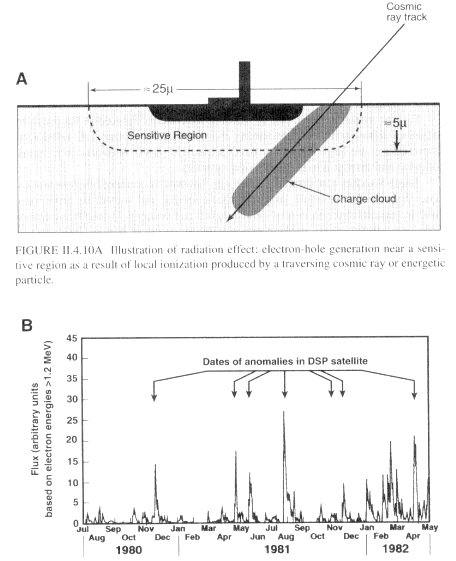
Figure II.4.10A
Illustration of radiation effect; electron-hole generation near a sensitive region as a
result of local ionization produced by a traversing cosmic ray or energetic particle.
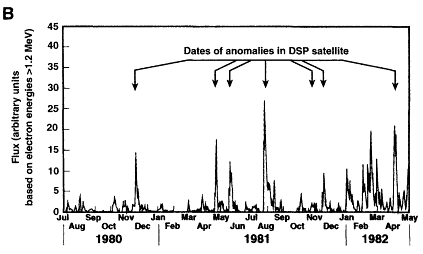
Figure II.4.10B
Plot of the energetic electron flux in geosynchronous orbit, showing the
correlation between flux enhancements and satellite anomalies.
Source: V.A. Joselyn and E.C. Whipple, Vampola, private communication, 1990.
two latitudinal bands that straddle the equator. These disturbances, which are called Appleton anomalies after their discoverer, were first photographed during the Apollo mission. Created by a fountain effect due to the geometry of the Earth's magnetic field, the anomaly zone often becomes extremely disturbed
Page 237
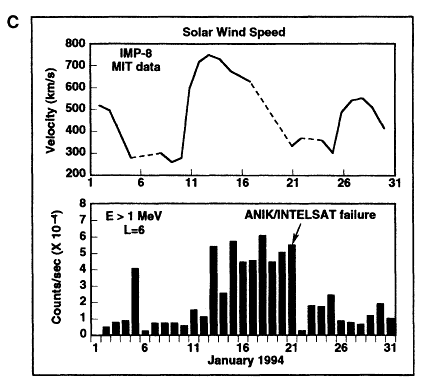
Figure II.4.10C
Average solar wind speeds.
after sunset when severe convective storms disrupt the entire low-altitude zone. Since most of the world's people live in this region, such severe space weather must be understood and predicted for commercial and military purposes.
Critical Science Questions
The capabilities of our current space weather and climate prediction services are quite rudimentary compared to societal, commercial, and governmental needs. Because our basic understanding of fundamental physical processes is not well developed, integrated physical models do not currently exist at operational facilities, and many of the data required to drive these models are not available. Thus, the space weather science plan must address some basic questions that must be answered before adequate space weather support can be delivered.
As described above, major solar events have a profound effect on space weather in the vicinity of the Earth. In addition, there are effects driven by the quasi-stationary solar wind. Because the disturbances evolve as they propagate
Page 238
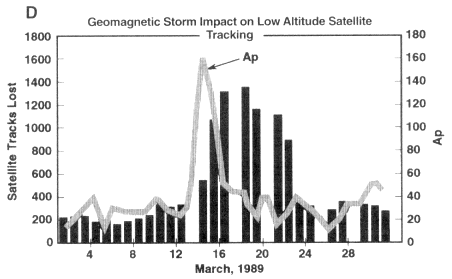
Figure II.4.10D
Geomagnetic storm impact on low-altitude satellite tracking (Ap is the geomagnetic
index). Source: Chen et al., 1993. Reprinted with permission of the American
Geophysical Union.
from the Sun to the Earth and the evolved structure affects near-Earth space, it is necessary to understand the physical processes that control this evolution.
• What are the fundamental causes of CMEs and flares, and what controls their properties (size, energy release, etc.)?
• Can we predict when CMEs and flares will occur, and are there specific precursor events that can facilitate prediction of the occurrence and effects of a given CME or flare?
• What determines the solar activity cycle and its amplitude?
• How can we predict the orientation and magnitude of the magnetic field and the plasma flow speed associated with transient solar events and their arrival time at Earth?
• How is the solar wind accelerated in coronal holes? Can we predict the size of the coronal hole and the speed of the flow?
• What factors control the characteristics of solar energetic particle events, and can we predict them on the basis of solar observations and numerical models?
• What is the most crucial factor in determining the overall effect of a CME on the space weather system: speed, mass, energy content or magnetic field?
In addition to understanding the causes and properties of space weather, a crucial element in progress toward quantitative and accurate space environment
Page 239
predictions is a comprehensive physical understanding of the global magnetospheric response to external variations and internal reconfigurations. The spatial and temporal evolution of the magnetospheric space environment is driven by and responds to variations in the solar wind and interplanetary magnetic field as described above. Consequently, the element that is crucial for progress toward quantitative space environment predictions of sufficient accuracy and specificity is a comprehensive physical understanding of the internal magnetospheric response to external variations. The dynamism of the magnetospheric space environment is governed by physical transfer mechanisms operative largely within the magnetospheric boundary layers, which separate interplanetary and magnetospheric regimes. Presently, the major physical processes at these interfaces are fairly well known; however, a comprehensive and quantitative measure of the relative role of each transfer process is not well specified, as a function of either space or time.
Magnetospheric space weather depends not only on the physics of the driver (solar wind) and of the mass, momentum, and energy filter (boundary layer processes), but also on the complex internal magnetospheric response to the external, filtered stimuli. These internal reconfigurations may be tightly coupled or may have a nonlinear response to the driver input. Regardless of the form of the response, most space weather effects are strongly connected with the most dynamic elements of geomagnetic storms and substorms. As such, there are specific scientific questions relevant to storms and substorms that require more complete answers than presently known. Each of these questions requires a quantification and sophistication beyond those presently available in order to improve space environment predictions. Questions include the following:
• What in detail are the coupled processes by which mass, momentum, and energy are transferred from the interplanetary medium to the magnetospheric system?
• What physical processes or boundary conditions differentiate geomagnetic storms from substorms?
• What determines the location of, and what process triggers, substorm onset?
• What are the mechanisms responsible for kilo-electron-volt particle energization (both in the ring current and in the auroral zone) as well as particle loss?
• What processes are responsible for million-electron-volt outer-zone electron modulation?
• What processes are responsible for the formation of new inner-zone radiation belts on the scale of particle drift times?
When discussing the electrodynamic response of the magnetosphere to external forces, it is imperative to recognize the importance of the coupled iono-
Page 240
sphere and, to a lesser extent, the neutral atmosphere (inasmuch as it is coupled to the ionosphere by collisions between ions, neutral atoms, and molecules). First, we need improved global models of the bulk macroscopic properties of the atmosphere and ionosphere. We must also make progress in understanding their dynamic responses to the space weather effects discussed above. Unlike the magnetospheric environment, the ionospheric-atmospheric environment is responsive to solar variations both directly (e.g., photoionization) and indirectly (e.g., auroral joule heating). Both aspects are important and have several associated outstanding scientific questions, the former dependent primarily on photons and the latter on charged particles and fields.
Predicting ionospheric space weather and its effects both in space and on the ground requires, in part, accurate descriptions of electric fields and currents present in the ionosphere (at both auroral and subauroral latitudes). As noted above, the magnetosphere and ionosphere are tightly coupled electrodynamically and must be treated as a system. The critical issues of the magnitude and location of time-dependent ionospheric currents and electric fields thereby rely on the physics operative both locally and globally. At present, our understanding of the individual components is maturing; however, much work is needed to achieve the synthesis required to move to the next stage of physical understanding. Specific outstanding questions follow:
• Can we develop a predictive understanding of the connection between magnetosphere-ionosphere coupling processes and the production of ionospheric irregularities and scintillation (particularly for ionospheric disturbances associated with auroral bombardment ionization)?
• What physical processes determine the electrodynamic structure of the ionosphere during geomagnetic storms, magnetospheric substorms, and quiescent convection? How are high-latitude, ionospheric variations transferred to low latitudes? Are the processes predictable? Do data exist to evaluate them?
• How does the flux of solar ionizing radiation vary in time? Are direct measurements or proxy data available to provide accurate answers?
• What is the role of the ionosphere-upper atmosphere in magnetosphere-ionosphere coupling?
• What are the factors that control the day-to-day variability of severe low-altitude ionospheric disturbances?
• What is the role of atmospheric gravity waves in seeding severe ionospheric weather in the equatorial and anomaly zones, and can these waves be predicted?
• Progress is needed in numerical space; existing space weather models must be implemented so that deficiencies can be identified and rectified.
Another agent of ionospheric-atmospheric space weather effects, whose role is poorly quantified, is the very energetic charged particles that interact with
Page 241
ionosphere and upper atmosphere. Some ionospheric disturbances are thought to be initiated by the deposition of relativistic electrons and solar protons to low altitudes that enhance ionization and cause plasma instabilities. These instabilities lead to complicated ionospheric structure that can affect communications. Some of these energetic particles may even contribute to modifying mesospheric ozone indirectly through chemical and transport influences.
History and Current Research Activities
Over the past nearly 35 years of basic research, the solar-terrestrial and space physics communities have developed a broad empirical and theoretical understanding of solar-terrestrial relationships and the space environment through a balanced program of spaceflight experimentation, data analysis, and theory. This advance has been motivated largely by the intrinsic scientific merit of these studies. In the past decade or so, increased emphasis has been placed on applying this basic knowledge to societal concerns about the space environment both in the private sector and in several national agencies [e.g., Department of Commerce (DOC), National Oceanic and Atmospheric Administration (NOAA), Department of Defense (DOD), U.S. Air Force, Department of the Interior (DOI), U.S. Geological Survey, NASA, NSF, Department of Energy (DOE)]. As a result, the first numerical models are now being developed to specify, nowcast, and forecast the space environment. In response to this need, a National Space Weather Program (NSWP) is being formed through the coordinated efforts of many government agencies.
To see how the NSWP might evolve, it is instructive to compare first the field of space physics (specifically, space weather) with the development of atmospheric physics (in particular, dynamic meteorology). Since their inception, numerical weather prediction models have shown a steady improvement in both their accuracy and their specificity of tropospheric weather over the last 35 years. One standard figure of merit is the so-called S1 score (a measure of the 36-hour prediction of the geopotential height at 500 mbar), which when converted to a percentage accuracy has improved from approximately 28 percent predictive in 1956 to approximately 94 percent predictive in the early 1990s. This achievement was accomplished by a rigorous effort wherein each element supported and motivated the others: basic research, model development, model testing, application, data gathering, and assimilation. Throughout this effort, a strong customer base was established and continued to grow as forecast and specification capabilities improved.
The interagency NSWP is now at the same crossroads that confronted the meteorology community in the early 1950s. However, in at least one respect, speedier success might be anticipated because computational resources today are orders-of-magnitude more powerful and sophisticated than they were in the 1950s.
Page 242
In addition, a broad customer base that recognizes the importance of space weather to its operations or products has been established over the past 30 years.
For significant improvement to be made in numerical space weather predictions, we must make progress on the same type of issues that confronted dynamic meteorologists 40 years ago. It is important to implement existing space weather models quickly so that deficiencies can be identified rapidly and remedied. Concurrently, a vigorous research program should continue to explore the basic physics of the comprehensive space environment, and new advances should be included in improved operational numerical models through the NSWP. Another necessary element for progress is the identification of critical input parameters and data needed for models and the development of experimental programs to provide these data. To summarize, the following efforts must be implemented that are supportive of a well-balanced space weather initiative (many of which are already ongoing):
• Establish new experimental spacecraft missions to provide the inputs needed to improve prediction capabilities, for example:
1. We cannot currently observe Earth-directed CMEs.
2. We cannot currently measure coronal magnetic fields.
3 We cannot currently measure near-Sun solar wind properties.
• Embark on comprehensive observing programs to elucidate the flow of mass, momentum, and energy from Sun to Earth.
• Establish a window on the polar ionosphere using remote sensing capabilities.
• Exploit existing data bases; update and improve existing empirical and statistical models to serve as climatological models.
• Develop improved physical models of components of the comprehensive system through focused research campaigns.
• Promote experimental, theoretical, and analytical research programs that are supportive of space weather needs.
Key Initiatives
A space weather program should achieve the following: (1) increase humankind's understanding of space weather processes and problems to a level high enough to implement numerical space weather prediction codes; (2) continually improve the capability to specify, nowcast, and forecast key aspects of the space environment; and (3) through a combination of items 1 and 2, mitigate the negative effects of space weather on human life and technology. To achieve these goals, progress must be made in five areas:
Page 243
1. Develop and disseminate a better basic understanding of the relevant physical phenomena and processes.
2. Generate statistical models, based on comprehensive measurements, that specify the average space environment properties and the range of anticipated values (space climate).
3. Produce nowcasting capabilities that permit the instantaneous state of the magnetosphere to be described on the basis of specific near-real-time observations.
4. Build numerical forecasting capabilities that provide accurate predictions of space weather properties with enough advance warning to allow mitigating actions.
5. Evaluate mitigation strategies based on a synthesis of scientific understanding, engineering considerations, and operational guidelines.
Several specific initiatives must be pursued to accomplish these tasks:
• We must establish and foster communications between scientists and those affected by space weather, including industry, government agencies, and the public. A start in this direction is the NSWP currently being developed as a cooperative program of NSF, DOC, DOD, NASA, and other agencies (OFCM, 1995, 1997).
• We must identify and make the key measurements needed both for progress in the fundamental understanding of space weather processes and for use in monitoring and forecasting space weather conditions. A number of existing and planned satellite programs can contribute to this initiative (e.g., the International Solar-Terrestrial Program satellites and geosynchronous satellites operated by DOD and NOAA). Additionally, key measurements are required to image coronal mass ejections as they leave the Sun, and a secure, reliable source of real-time, continuous, upstream solar wind data must be established and maintained.
• Support must continue for the development of numerical models of the solar-terrestrial relationship chain, as well as their integration into full-scale predictive tools. NSF's Geospace Environment Modeling (GEM); Coupling, Energetics, Dynamics of Atmospheric Regions (CEDAR); and SUNRISE programs are directly targeted toward this effort (NSF, 1986, 1988, 1990).
• Models must be tested, evaluated, and verified continuously against space weather measurements.
• User-specific and user-friendly space environment products must be developed, including environmental specification models; educational tools for both the public and engineering users; and expert system design tools.
• Physical models must be translated into operational nowcasting and forecasting codes as soon as possible.
Page 244
Qualitative measures of the success of this initiative fall into two basic categories, scientific and societal:
1. Scientific: The general measure of scientific success is assessment of the degree to which our basic understanding of the solar-terrestrial connection and the space environment has improved. Specifically, have we developed more accurate numerical models, predictions, and specifications of
• near-Earth interplanetary conditions,
• storm onset timing and magnitude,
• substorm onset time and location,
• magnetospheric particle flux profiles, and
• spacecraft orbit alterations due to upper-atmospheric changes?
2. Societal: The general measure of societal success is assessment of the degree to which increased basic understanding of the solar-terrestrial connection and the space environment is used to modify and improve applications that are of benefit to society at large, specifically:
• Have science-based applications or products been developed that are used to provide accurate determinations of the space environment?
• Are potential users optimally reaping the benefits of increased knowledge in this field (e.g., designs of environment-tolerant systems, optimizing of resource management, reducing asset risk)?
Over the past ten years, new technologies such as personal computers, lasers, and the telecommunications revolution have profoundly changed the day-to-day nature of all our lives in ways we could foresee only dimly at first. Presently, our lives are being reshaped by the emerging technologies of computer networking, cellular communications, and the GPS, to name a few. Increasingly, these new technologies will contain key space-based elements. Thus, success in achieving a better understanding of both space climate and space weather will have broad and profound effects. The mechanisms by which such benefits will accrue may not always be obvious, but given the routine reliance on space-based systems, they will be profound. Failure to address space weather issues will lead to equally profound but deleterious effects.
Direct economic benefits will accrue from the use of improved tools for spacecraft design, which generate more cost- and performance-effective space-based assets. Economic benefits will result from improved reliability of satellite, communications, navigation, and power systems. Management of space-based assets will be enhanced through improved environmental and orbital predictions, both for critical short-term operations and for long-term reliability. The radiation safety of Earth-orbiting astronauts and high-altitude aircraft crew and passengers
Page 245
will be enhanced. Furthermore, in the longer term, an increased understanding of the space weather environment will be needed as we approach the establishment of lunar colonies and the manned exploration of Mars.
Finally, the program outlined here will result in an increased and broader intellectual understanding of our environment, an environment whose boundaries have expanded and continue to expand upward from the ground, through the lower atmosphere early in this century, to the upper atmosphere, and into the near-Earth space environment. This program will provide a driving motivation to unify the diverse fields of solar physics, space physics, magnetospheric physics, and atmospheric physics using the tangible test of prediction as a metric to judge the success of our understanding.
Middle-Upper Atmosphere Global Change
The lower, middle, and upper atmospheres form a single, highly coupled physical system. In attempting to understand global changes in the atmosphere resulting from natural and anthropogenic influences, one should consider the changes in all of these regions, because if we cannot explain the changes occurring in all regions of the atmosphere, our understanding is incomplete. The middle and upper atmosphere undergo climatological changes that are often larger than those in the troposphere. Some of these changes are the result of natural variability in the UV and EUV radiation from the Sun; others are thought to be induced by anthropogenic effects. It is critical to understand the nature of these changes because of the importance of the ozone layer for terrestrial life, because of subtle influences of the stratosphere on tropospheric climate, and because of the impact of the upper atmosphere on space-based technological systems and radio telecommunications.
Scientific Background
Climatological change has already occurred in the middle and upper atmosphere. Some direct and indirect measurements of mesospheric temperatures have suggested a cooling on the order of 2-4 K per decade (Figure II.4.11) over the past 10 or 20 years, considerably greater than predicted by current models that consider the enhanced radiative cooling due to increased atmospheric carbon dioxide. The stratosphere has also cooled measurably owing to increased carbon dioxide and decreased ozone. Noctilucent clouds were virtually unknown before 1885 but are commonly observed today, and their frequency of occurrence is apparently increasing from decade to decade (Figure II.4.12). The cause appears to be partly the decreased mesopause temperature, but more importantly, the increased mesospheric water vapor concentration that is expected from observed increases in the atmospheric methane burden. Observations suggest that the density of exospheric hydrogen may also have increased substantially over the
Page 246
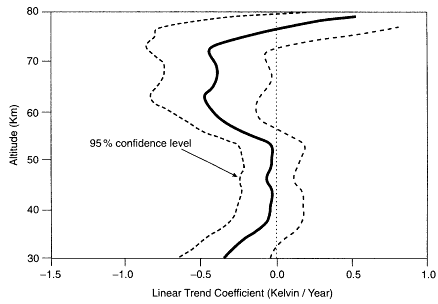
Figure II.4.11
Linear trend of the lidar temperature during summer months (data from 1979 to 1990).
past 20 years, even more than would be predicted by models based on the effects of increased methane. A quasi-biennial oscillation in the atmospheric semidiurnal tide has only existed since after about 1905.
One of the most dramatic changes resulting from human activities has been the growth of the springtime Antarctic ozone hole. This and other aspects of stratospheric ozone have been discussed earlier. Stratospheric radiative cooling by greenhouse gases can be expected to exacerbate the Antarctic ozone hole, and possibly lead to an Arctic ozone hole, by increasing the occurrence of polar stratospheric clouds that help catalyze ozone destruction.
The sensitivity of the middle and upper atmosphere to global change results in part from the relatively large changes that may occur in forcings from above and below. Far-ultraviolet radiation from the Sun, which is absorbed in the middle and upper atmosphere, is much more variable than visible solar radiation that reaches the ground. The upper atmosphere responds strongly to cyclic changes in solar ultraviolet and x-radiation. Weaker changes in upper-strato-spheric temperatures and ozone concentrations are also related to the solar cycle. The upper atmosphere is influenced by auroral energy inputs that undergo large long-term, as well as short-term, variations. Infrequently, large fluxes of highly energetic particles penetrate into the mesosphere and stratosphere at mid- to high latitudes, producing changes in atmospheric photochemistry and ionization. The
Page 247
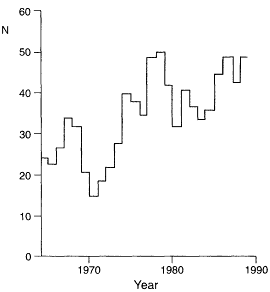
Figure II.4.12
Number of nights per year N on which noctilucent clouds
were reported from northwest Europe for 1964-1988. Source:
Gadsden, 1990. Reprinted with permission of Elsevier Science Ltd.,
Oxford, England.
global electric circuit and the electric potential difference between the ionosphere and the ground can be directly affected by changes in global lightning activity, which may be very sensitive to surface temperatures. The concentrations of a number of anthropogenic gases that are important for physical and chemical processes in the middle and upper atmosphere have been increasing rapidly in recent years, especially methane, halocarbons, carbon dioxide, and nitrous oxide.
Besides being subjected to relatively large variability in external forcing, the middle- and upper-atmospheric regions respond very sensitively to a number of these forcing influences. The sensitivity of stratospheric ozone concentration to the presence of chlorine compounds, to stratospheric temperature changes, and to the presence of aerosols is one example. Another example is the greater cooling of the middle and upper atmosphere than heating of the troposphere, due to increased concentrations of carbon dioxide. Figure II.4.13 shows calculated changes in upper-atmospheric temperature and density for a doubling of CO2 (solid lines), as well as for a halving of methane (CH4) (dashed lines), the latter being possibly representative of a glacial maximum. The occurrence of clouds in the polar mesosphere is highly sensitive both to the temperature and to the increasing amount of water vapor associated with methane.
There are major gaps in our understanding of the interacting physical and
Page 248
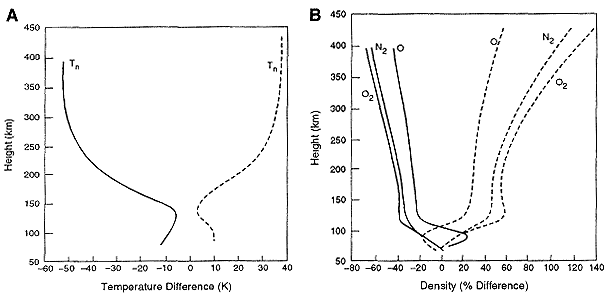
Figure II.4.13
Calculated changes from the base case to (A) atmospheric temperature Tn and (B)
densities of atomic oxygen (O), molecular oxygen (O2), and molecular nitrogen (N2),
when atmospheric carbon dioxide and methane are doubled (solid lines) or halved (dashed lines).
Source: Roble and Dickinson, 1989. Reprinted with permission of the American Geophysical Union.
Page 249
chemical processes occurring in the middle and upper atmosphere; as a result, there are grave deficiencies in our ability to predict the nature, magnitude, and consequences of changes that may result from altered external forcings. For example, depending on the nature of the physical parameterizations used in three-dimensional models of the middle atmosphere, one can find either heating or cooling of the winter polar stratopause and summer polar mesopause in conjunction with doubled atmospheric CO2. Unexplained electrical phenomena, such as optical flashes in the stratosphere and mesosphere (''jets'' and "sprites") and strong electric fields in the ionosphere above the areas of electrical storms show how incomplete our knowledge is of electrical processes in the middle and upper atmosphere and of the way these may couple to lower-atmospheric electrical phenomena. Electrical discharges, the presumed source of optical flashes, may be an important and previously unappreciated means of moving charges between the troposphere and middle atmosphere, and may impact middle-atmospheric chemistry.
Large uncertainties exist in other areas of middle- and upper-atmospheric science. The microphysics involved in the formation of polar mesospheric clouds, such as the roles of meteoric dust and cluster ions, is not well known. The structures of turbulence and of mesoscale motions, and their effective roles in heat balance and in the transport of minor species in the mesosphere and lower thermosphere, remain poorly understood. The generation of gravity waves by orographic, convective, and baroclinic sources has not been quantified on a global basis, even though such waves are now known to play a critical role in middle-atmospheric circulation and the production of turbulence as the waves grow and break. The causes of variability in atmospheric tides and planetary waves are not fully understood, even though these global-scale waves can be the dominant form of dynamical variation in the mesosphere and thermosphere. Thermal balance in the upper atmosphere is strongly affected by nonlocal thermodynamic-equilibrium radiative processes that have been difficult to quantify in models.
Critical Science Questions
What physical processes determine the state of the middle and upper atmosphere? How are atmospheric regions coupled to those above and below? How do middle-atmosphere electrodynamics, heterogeneous chemistry, polar mesospheric cloud chemistry, wave-mean flow interactions, and turbulence affect the state of the mesosphere and its response to inputs from space and the lower atmosphere? How can these effects be incorporated into global models of the coupled system to predict short- and long-term variability?
What changes have already occurred in the state of the middle and upper atmosphere? What are the current and expected future trends? Is it possible to separate the responses of the middle atmosphere to natural, as opposed to anthro-
Page 250
pogenic, forcing by looking at characteristic time scales for the variability (i.e., the 11-year solar activity cycle)?
How are climatological changes in the state of the middle and upper atmosphere related to variability in the forcing of this region from above and below due to solar variability; the diffusion of trace gases; changing patterns of tides, gravity waves, and planetary waves propagating upward from the lower atmosphere; and electrodynamic coupling to higher altitudes?
How do short- and long-term changes in the state of the middle atmosphere impact lower altitudes (i.e., weather prediction, penetration of harmful UV radiation to the Earth's surface) and affect the near-Earth space environment and, through it, U.S. space assets (i.e., satellite lifetimes, space station reboost activities, aerospace plane operations) as well as other relevant technologies?
Key Initiatives
A combination of theoretical and observational initiatives are needed to address the critical questions posed above.
• Analyze Historical Data: Many long-term records exist that relate to the state of the middle and upper atmosphere, and analyses of these records have already determined certain climatological changes, such as the solar-cycle variations of the upper atmosphere and the growth of the ozone hole. The existence and magnitude of other possible changes (e.g., changes in the mean temperature and wind structure of the middle and upper atmosphere) are less certain. Careful analysis of historical data that are related either directly or indirectly to these possible changes is required to explore and determine their magnitudes. This knowledge is needed to test simulation models that might be used to predict future states. The analysis of historical data is often fraught with problems of changing data quality, calibrations, and measurement locations, as well as problems of data gaps, uncertain data locations, and data that are not in machine-readable form. In addition, some data types give only indirect information about the state of the middle atmosphere. For example, surface pressure records have been analyzed for tides from which inferences about the QBO could be drawn. The interpretation of these indirect data requires a good understanding of the interacting processes in the middle and upper atmosphere and the ability to accurately model these processes. Some examples of long-term data bases that might be useful in this analysis are
1. ionosonde observations since the 1940s of the charged particles in the ionosphere;
2. topside sounder observations from Alouette 1 and 2, and ISIS 1 and 2, that give historical information on the ionosphere above ˜500 km altitude;
Page 251
3. a variety of observations of the charged and neutral components in the thermosphere and above since about 1962 including satellite drag;
4 incoherent scatter data since the mid-1960s on a regular basis; and
5. magnetic variation data since the nineteenth century that contain information about the variability of atmospheric tides.
Figure II.4.14 gives a history of the number of ionosonde stations since they came into regular use in the 1940s. Figure II.4.15 is a time line from 1965 through 1989 (more than two solar cycles), indicating the satellites in low Earth orbit and the altitude range addressed by their instruments.
• Monitor Sensitive Parameters of the Middle and Upper Atmosphere: Clearly, long-term monitoring of middle- and upper-atmospheric parameters that may be sensitive to change, using well-calibrated techniques and ensuring the continuity of observations, will greatly simplify future studies of long-term trends. Because of the complex nature of spatial and temporal variations, it will be important to make long-term observations at many geographical locations. This can be accomplished most effectively by a combination of spaceborne observations, with the advantage of global coverage, and ground-based sensors needed for maintaining well-calibrated measurements over a long period of time. Medium-frequency (MF), mesosphere-stratosphere-troposphere (MST), incoherent scatter (IS), and meteor radars are particularly useful in observing the middle atmosphere and examining its coupling to higher-altitude regions. Because of the importance of the polar region, measurements in the Arctic are key components for studies in the polar middle and upper atmosphere. Lidars provide important information on the distribution of temperature and trace species. Improvements in sensor technology have enabled instruments to probe previously inaccessible spectral regions to obtain information on important chemically and radiatively active species in the middle atmosphere both from space and from the ground, opening up this region of the atmosphere to detailed study. Some of the parameters of greatest interest are temperature; winds; aerosols; concentrations of important constituents such as ozone, water vapor, hydrogen, nitric oxide, halogens, and the hydroxyl radical; heights and densities of ionospheric layers; and ionospheric electrical potential. One of the requirements for research is thus to establish and/or maintain long-term measurement programs for middle- and up-per-atmospheric parameters that may be sensitive to change. We need to closely monitor the occurrence and latitudinal extent of polar mesospheric clouds as a marker of global change.
• Monitor Inputs to the Middle and Upper Atmosphere: To understand the causes of any climatological changes in the middle and upper atmosphere, we must know how the forcing has changed. Thus, it is critical to establish and/or maintain long-term programs to make stable, accurate measurements of parameters that influence the middle and upper atmosphere, including solar ultraviolet
Page 252
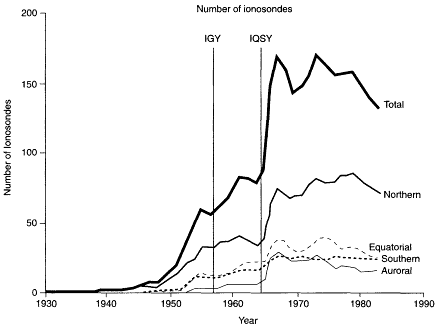
Figure II.4.14
Number of ionosondes operational since 1930. Note: AUR = number at auroral
latitudes; EQU = number at equatorial latitudes; IGY = International Geophysical Year
1957-1958. Source: Bilitza, 1991. Reprinted with permission of the Society of
Geomagnetism and Earth, Planetary, and Space Sciences.
and x-ray fluxes, cosmic rays, auroral particles and fields, tropospheric trace gases, global thunderstorm activity, and injections of volcanic material. Some, but not all, of these inputs will be monitored in the Mission to Planet Earth satellite program.
• Understand Uncertain Processes: Knowing the trends of atmospheric parameters and of changing inputs will not be enough. A number of processes are occurring within these atmospheric regions that we cannot yet predict with any reasonable degree of confidence. We do not understand whether and how they may be significant to mechanisms of global change. We must aggressively pursue research on these poorly understood processes to determine the roles they may play. Areas in which understanding is particularly deficient include middle-atmospheric electrodynamics, heterogeneous chemistry, polar mesospheric clouds, wave-mean-flow interactions, and turbulence.
• Understand and Model Interacting Processes: Even though the nature of many atmospheric processes is reasonably well understood (e.g., basic dynamics, chemistry, radiation, and ionospheric electrodynamics), the manner in which
Page 253
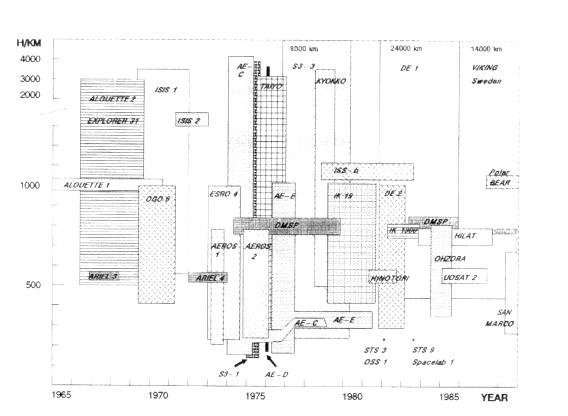
Figure II.4.15
Altitude-time chart of satellites measuring in situ in the ionosphere and thermosphere. Note:
Alouette 1,2, ISIS 1,2, IKl9, and ISS-b carried topside sounders measuring the electron density
down to the F peak; ISIS topside ionograms were recorded up to 1989. Source: Bilitza, 1991.
Reprinted with permission of the Society of Geomagnetism and Earth, Planetary, and Space
Sciences.
Page 254
these processes interact in their response to changing forcing influences is extremely complex and not well understood. Thus, there must be a broad-based program of research with the goal of understanding the middle and upper atmosphere as an integrated physicochemical system, including the interactions with regions above and below. A critical part of this research program must be the development of general circulation models of the middle and upper atmosphere that incorporate all of the important physical and chemical processes, with the aim of continually reducing the need for ad hoc parameterizations so that valid predictive capabilities can be attained.
• Distinguish Between Natural and Anthropogenic Effects: One of the most important goals of research on global change in the middle and upper atmosphere is to determine the relative importance of natural and anthropogenic sources of the change, since it is only the latter that may be altered through policy decisions. The clearest distinction between natural and anthropogenic effects would come from detailed knowledge of the variability in all of the various forcing elements, together with an accurate, comprehensive modeling capability. However, even before this ideal situation is achieved, progress can be made by carefully analyzing the temporal and spatial characteristics of the different forcing functions and comparing these with the temporal and spatial characteristics of the atmospheric response. For example, solar radiation influences have a strong 11-year cyclical component that often helps identify these influences in the atmospheric response. Similarly, observed changes in the middle and upper atmosphere that are found to be most marked in recent decades may be associated with the rapid increase in certain anthropogenic gases. However, distinguishing the source of different effects merely by comparison of temporal trends will never be completely convincing, so that the development of detailed knowledge and comprehensive simulation models remain essential.
• Understand the Consequences of Middle- and Upper-Atmosphere Global Change: The uncertainties associated with global change in the middle and upper atmosphere concern not only the nature and magnitude of the changes that might be expected, but also the possible consequences of these changes on biological systems, on tropospheric chemistry and climate, and on space-based technological systems. Research is required to determine the relative importance of these consequences.
Contributions to the Solution of Societal Problems
Changes in the state of the middle and upper atmosphere may have a variety of impacts. Reductions in ozone concentrations can increase the intensity of solar ultraviolet radiation that reaches the troposphere and the ground. In addition to having biological effects, the increased UV radiation will alter tropospheric chemistry, including the atmospheric oxidizing capacity and hence the lifetimes of
Page 255
species such as methane. Altered middle-atmospheric structure can affect the propagation conditions of global-scale planetary and tidal waves, which in turn are likely to influence atmospheric circulation. The lifetimes, and thus atmospheric concentrations, of some long-lived greenhouse gases such as nitrous oxide and CFCs may be affected by changes in stratospheric circulation and solar UV intensity, the latter due both to solar irradiance variations and to altered absorption by ozone. Upper-atmospheric cooling will lead to reduced drag on spacecraft and space debris, increasing the lifetimes of both at a given altitude and thus affecting space operations and planning. The altitudes of the ionospheric layers might decrease, causing changes in high-frequency radiowave propagation conditions. Increased hydrogen densities in the exosphere may further affect ionospheric densities, as well as possibly increasing satellite drag and affecting the rate of loss of protons from Earth's radiation belts. Understanding the sources, nature, and magnitudes of these impacts will be necessary to plan mitigation strategies.
The ability to predict anthropogenic sources of possibly harmful influences on the state of the Earth's atmosphere at a stage early enough to allow intervention is a powerful tool for protecting the environment and preserving the quality of life. The middle atmosphere is a particularly sensitive indicator of perturbations to trace gases originating in the lower atmosphere that diffuse upward and disturb the sensitive balance in this region.
Measures of Success
An aggressive and successful research program will enable us to do the following:
• Identify changes in the state of the middle and upper atmosphere that have already occurred through careful analysis of well-calibrated historically available and targeted observations of atmospheric parameters and external inputs to the region.
• Achieve increased accuracy in predictive physical models by improving our knowledge, and thus accuracy, in representing physical phenomena that are poorly understood at present. Targeted areas include the effects of sprites and jets on the global electrical circuit and middle-atmospheric chemistry, the formation of aerosols in the stratosphere and mesosphere, the rates of important heterogeneous chemical reactions, and the role of wave-mean-flow interactions in the atmospheric circulation.
• Establish the nature of the relationship between changes in the middle and upper atmosphere and changes in the troposphere, the role of the global electrical circuit in climate, and the response of the middle and upper atmosphere to changed inputs.
Page 256
Solar Influences
The Sun modifies the Earth's environment in ways that are both obvious and subtle. That the Sun's radiant energy is essential to life on Earth is obvious. The major component of this energy is steady and is taken to be a baseline constant for the average environmental conditions. However, the Sun undergoes a variety of small changes in its output, and the identification and measurement of the causes and effects of these variations are the focus for the study of solar influences. We note that the topics of shorter-term variations such as coronal mass ejections and solar flares are included in the discussion of space weather. The study of solar influences does not have a long history because solar variations are small and their potential impacts on the low Earth atmosphere are easily masked by the larger intrinsic variations of the weather system. Within the past few decades it has become possible to monitor solar variability through space-based observations, and most recently, large-scale observations of the Earth's upper and middle atmosphere have provided evidence of a terrestrial atmospheric response to the solar output. In building on this new data base, several activities that are poised for significant progress:
• Measure the solar energy output with space-based monitors continuously over at least a full solar cycle. Adequate accuracy in the measurement can be achieved only by simultaneous operation of two instruments in space. The changes in the Sun's irradiance are so small that they can be detected only as a variation of a single instrument. The transference of the absolute scale from an aging space-based instrument to its replacement requires that both be operating in space simultaneously. At present, no adequate time series of the full solar cycle is available because previous monitors of solar output ceased operation before their replacements could be placed in orbit so no calibration intercomparison was possible.
• Investigate the Earth's temperature sensitivity to variations in the solar energy output. Knowledge of this dependence is essential to separate global warming effects due to greenhouse gases from temperature changes caused by solar output variations.
• Determine the response of the Earth's middle- and upper-atmosphere chemistry and state of ionization to variations in the Sun's UV and x-ray emissions. Production of ozone and other gases, as well as the Earth' s global electric circuit, depends in part on the Sun's hard x-radiation, which is produced in the complex outer solar atmosphere.
• Measure the Sun's interior dynamics, and develop a model of the solar dynamo that both agrees with the Sun's observed internal dynamical state and reproduces the pattern of solar magnetic activity. Helioseismology now provides knowledge of the Sun's interior dynamics, that is inconsistent with the assumptions required by previous models of the solar dynamo.
Page 257
• Study possible long-term changes in solar behavior through the observation of solar-type stars. The Sun has undergone periods of decreased activity typified by the Maunder Minimum. Observations of solar-type stars can provide a statistical estimate of the future likelihood of such behavior through the large number of realizations available at any given time.
Solar Energy Output over a Solar Cycle
The total solar irradiance is the energy flux crossing a surface at the average distance between the Sun and the Earth. Since this parameter is the average rate at which radiative energy is provided to the atmosphere, it is fundamental to the Earth's environment. This energy flow was long assumed invariant; indeed, it was called the "solar constant" until recently. However, the possibility that the solar constant was actually variable remained a logical one that, in principle, could have a profound effect on the Earth's climate. Attempts to measure variations of the total solar irradiance from the ground were made by Abbott during the early part of this century but were thwarted by the variabilities of the Earth's atmospheric transparency.
Space-based monitoring of the Sun's total energy output, which began in 1978, established that the total solar irradiance undergoes changes on time scales of days to years. As the Sun rotates, both bright features (faculae) and dark features (sunspots) are carried across the visible face of the solar surface. These produce measurable changes of up to 0.5 percent in the solar irradiance that can be reproduced approximately based on the positions and strengths of the visible features. The changes associated with the solar rotation include at least two parts: deficits in energy output due to sunspots, typically of 0.3 percent, and enhancements in energy output due to faculae, typically by 0.08 percent. There may be other components that are widely distributed over the solar surface and do not show rotational modulation. When averaged over longer temporal periods that are a fraction of a solar cycle, the total irradiance shows a trend wherein it is greatest by 0.1 percent at the height of the solar cycle. Evidently, the widely distributed surface brightness enhancement (e.g., plages and faculae) is able to overcome the obvious darkening of the sunspots.
Figure II.4.16 shows a summary of the total solar irradiance measurements. The data in this figure are compiled from all available instruments. Only the sequence from the Earth Radiation Budget Experiment (ERBE) sensor on the NIMBUS-7 environmental research satellite is continuous, and it was not designed to provide calibrated long-term stability in its total solar irradiance measurement. The Active Cavity Radiometer Irradiance Monitor (ACRIM I and ACRIM II) instruments were designed for high precision and stability, but do not provide a continuous data set because UARS was launched after the reentry of the Solar Maximum Mission (SMM) spacecraft due to the pointing problems of the SMM spacecraft between late 1980 and spring 1984.
Page 258
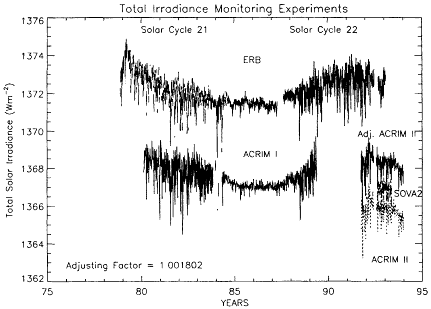
Figure II.4.16
Summary of current irradiance observations. ERB instrument on NIMBUS 7 is the
only one present continuously. Solid line for ACRIM II has been adjusted by the
factor indicated; the need for this adjustment emphasizes the importance of having
overlapping space-based observations.
Instruments that monitor the total solar irradiance have great precision and stability but are difficult to calibrate on an absolute scale. In addition, these instruments often undergo an initial period of variation because of processes such as spacecraft outgassing and detector degradation due to solar radiation. Consequently, irradiance values observed with different instruments cannot be combined directly to maintain a long-term high-precision data base. In Figure II.4.16, only the upper curve from the ERBE radiometer on NIMBUS-7 spans the full period of a solar cycle. The other more precise and better-calibrated instruments have had to use the ERBE results to carry the time sequences across gaps in 1980, 1984, and 1989-1991. Parts of the ACRIM I curve and ACRIM II results shown in this figure have been multiplied by normalization factors based on ERBE results. The overall range of variation for the total solar irradiance from minimum to maximum solar activity has thus far not been determined with complete reliability.
To firmly establish the range of variation of the total solar irradiance, it is imperative that space-based monitors be deployed with adequate regularity to ensure overlap in their periods of observation. Cross-comparison is the only way
Page 259
to determine the longer-term variations reliably. Satisfying this imperative may require the development of small and easily deployed spacecraft that carry a basic solar irradiance monitor. The space station may also provide a platform for such monitors, although contamination of the space environment during shuttle visits could introduce accelerated periods of detector degradation that would reduce the effectiveness of this approach.
Separating Solar and Anthropogenic Effects
The question of global warming has been a major public issue during the past decade as measurements of greenhouse gas concentrations have shown a systematic increase capable of eliciting an important temperature response. As described in the previous section, the total solar irradiance also varies. The role of these variations in influencing the global temperature has not received as much attention as greenhouse gases for at least two reasons:
1. the climate system displays such a large natural variability that it can easily mask the effects of solar forcing, and
2. the amplitude of variation of the total solar irradiance is not known on the appropriate time scales.
Over longer periods, where increasing greenhouse gas concentrations should have a greater effect, there are no measurements of total solar irradiance. Over shorter periods, the rate of change in the climate forcing function during either the rising or the falling phase of the solar cycle is comparable to the rate of change in the forcing function due to changes in the greenhouse gas concentration.
The relative contributions of solar and anthropogenic effects to climate forcing are illustrated in Figure II.4.17, which shows estimates of combined effects of solar and anthropogenic variations. The quantities plotted here have all been estimated from very crude models. A similar figure based on sound data and theory would represent success in understanding the roles of solar and anthropogenic effects in the global climate. In evaluating the possible role of the Sun as a climate forcing function from historical records, we are limited by the lack of direct measurements of key quantities. The most extensive record is in the form of sunspot numbers. Figure II.4.18 shows a reconstruction of this parameter from the early 1600s to the present. It is noteworthy that even though the dominant variation is on an 11-year time scale, long-term trends are also evident. Possible correlation of solar activity with sea surface temperature anomalies on decadal time scales has been indicated, as shown in Figure II.4.19.
To compare the theoretical effects of solar and anthropogenic climate forcing to observed effects, we need to translate climate forcing into a temperature change. This parameter is referred to as the climate sensitivity coefficient, and
Page 260
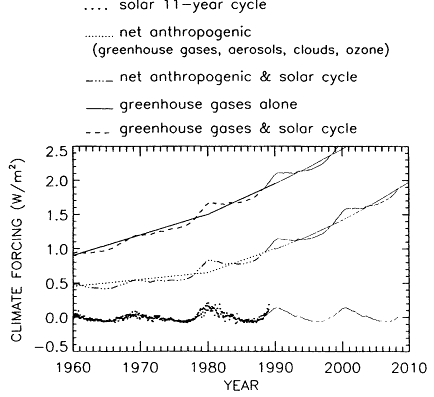
Figure II.4.17
Estimated climate forcings during the three recent decades of the twentieth century
owing to measured changes in greenhouse gases (solid line); net anthropogenic
forcing from greenhouse gases, aerosols, clouds, and ozone changes (dotted line);
and solar irradiance variations associated with the 11-year solar activity cycle alone
(lowest line). Combined greenhouse plus solar (dashed line) and net anthropogenic
plus solar (dash-dot line) forcings are also shown. In each case, the thin lines are
projections. The solar forcing is from the empirical model of Foukal and Lean (1990),
which accounts for irradiance changes during the 11-year cycle caused by dark
sunspots and bright faculae, but does not include additional variability sources acting
on longer time scales. Zero point of solar forcing is the 1978-1989 mean. Source:
Hansen and Lacis, 1990; Hansen et al., 1993b. Reprinted with permission of Macmillan
Magazines Limited.
current general circulation models (GCMs) give a number in the range of 1 K/(W m2). Although a single number like this is easiest to quote, it is unlikely to represent the true situation where the time scale of change and the wavelength of the changing radiation are certain to modify the temperature response. Similar uncertainties affect the modeling of climate response to greenhouse gas concen-
Page 261
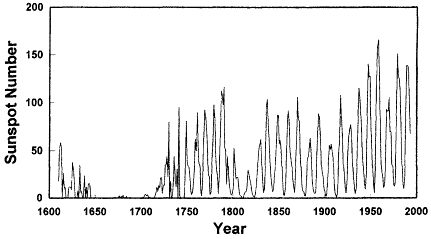
Figure II.4.18
Reconstruction of historical record of sunspot number including times of near
absence of sunspots during the seventeenth century. Source: Hoyt et al., 1994.
Reprinted with permission of Springer-Verlag New York.
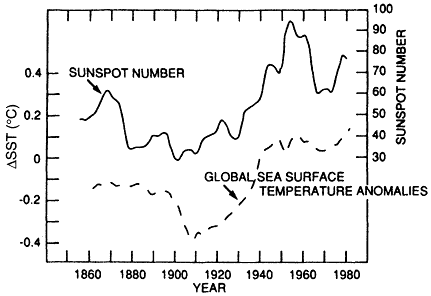
Figure II.4.19
The 11-year running mean of the sunspot number and global average sea surface
temperature anomalies. In a one-dimensional model of the thermal structure of the
ocean, consisting of a 100 m mixed layer coupled to a deep ocean and including a
thermohaline circulation, a change of 0.6 percent in total solar irradiance is needed to
reproduce the observed variation of 0.4°C in sea surface temperature anomalies.
Source: Reid, 1991. Reprinted with permission of the American Geophysical Union.
Page 262
trations since each gas component interacts with the radiation flow through the Earth's atmosphere in a unique manner.
Our current knowledge of the sensitivity of climate to both solar and anthropogenic effects is limited by the difficulty in isolating the effect of a small-amplitude total irradiance variation from the intrinsic short-term variability of the weather system. Any atmospheric response to forcing function variations will become evident only after the weather (or natural climate) variability has been averaged out. Moreover a large amount of the energy in the climate system is stored in the Earth's oceans, and this will tend to smooth out the effects of small changes. Many of the records of long temporal duration refer to a limited geographical region and thus are especially vulnerable to local effects. The fact that the effects, if present, have to be extracted from a highly variable background has made it difficult to detect a signal identifiable with solar influences. However, longer-term effects may, in fact, be present in the system at a significant level.
Another critical problem in understanding the effects of solar variability comes from the greater variability in the Sun's ultraviolet (UV) output than of visible radiation. This problem is magnified because in those parts of the Earth' s atmosphere where UV radiation is absorbed, its effects are dominant. The solar UV output is strongly dependent on the phase of the solar cycle and is often strongly modulated by solar rotation. These separate natural time scales for solar variations can be used as a tool for the identification of terrestrial responses although neither time scale is ideally suited for study. The shorter periods are well suited to solar observations but easily masked by terrestrial variability. The longer periods have less reliable records for solar output and terrestrial response, but the amplitude of response should be largest. In addition, solar UV variability is not well described by a single parameter since it is affected by the details of active region size, strength, and position on the solar disk, as well as by the strength of the widely distributed magnetic network. Thus, a multivariate analysis is required in principle even though the existing single-variate analyses have produced only tentative correlations.
Progress toward the goal of separately measuring climate sensitivity and its response to both solar and anthropogenic forcing variations can be made by fully utilizing the opportunity provided by UARS data, which measure simultaneously the solar inputs and the atmospheric response. This UARS opportunity is of limited duration and has sampled only the declining phase of the solar cycle. The largest and strongest sunspots typically appear during the rising phase of the sunspot cycle, and the effect of sunspots on UV and EUV fluxes has not been monitored and studied in detail yet. An extended UARS mission or future space-based observations could provide the missing observations during the rising phase of the next sunspot cycle.
Progress in the study of longer-term variability requires a separate approach. Current space-based measurements provide high-quality data that address shorter time-scale variations but cannot help with the study of longer time-scale prob-
Page 263
lems. Historical reconstructions of the atmospheric and ocean thermodynamic state, atmospheric composition, and details of the solar output are required to disentangle the interrelationships on longer time scales. These reconstructions will build on the base provided by the verification from UARS and future spacecraft observations. Although such reconstructions based on proxy models are critical to the analysis of historical data, they will require verification by future direct observations and cannot be used as replacements for such observations.
Solar Influences on the Earth's Upper and Middle Atmosphere
The concentration of chemical constituents in the atmosphere is affected by photodissociation and photoionization processes, and hence by the solar flux that penetrates the Earth's atmosphere. Since the shortest wavelengths, which are most affected by solar variability, are absorbed in the highest layers of the atmosphere, the chemical response of the atmosphere is expected to be greatest at high altitudes (i.e., in the thermosphere and mesosphere). However, species such as ozone in the stratosphere, which is produced from the photolysis of molecular oxygen, are also sensitive to changes in extraterrestrial solar flux.
Solar activity has a direct impact on the Earth's ionosphere. Substantial increases in solar EUV radiation and x-rays, associated with enhanced solar activity, lead to substantial increases in the concentrations of ions and electrons in the D-, E-, and F-regions of the ionosphere. In the stratosphere, the largest ionization source results from the penetration of galactic cosmic rays, which is modulated by the solar cycle; hence, the stratospheric ionization rate is reduced during periods of high solar activity.
The abundance of neutral species is also affected by solar activity in the middle and upper atmosphere. For example, the concentration of nitric oxide, a constituent produced by ionic and photolytic processes in the thermosphere, is significantly enhanced in this region of the atmosphere during high solar activity. In the mesosphere, significant variations associated with solar variability affect the concentration of water vapor, a molecule that is photolyzed by shortwave ultraviolet radiation. Finally, in the case of ozone, the response is significant and results from the combination of several processes. In the stratosphere and the thermosphere, the ozone concentration increases with solar activity as a result of enhanced photolysis of molecular oxygen. In the mesosphere, the ozone response is dominated by the enhanced ozone loss caused by hydroxyl (OH) and hydroperoxyl (HO2) radicals produced by a more vigorous photolysis of water vapor during high solar activity. The resulting change in the vertically integrated ozone concentration (column abundance) over a solar cycle is not greater than 1 or 2 percent.
As middle-atmosphere heating results primarily from the absorption of solar ultraviolet radiation by ozone, the temperatures of the stratosphere and mesosphere are also affected by solar activity. Amplitudes of the temperature varia-
Page 264
tion on the 11-year time scale have been inferred from ground-based lidar and from satellite observations. Temperature amplitudes derived from atmospheric models are not in agreement with values deduced from observations. A major scientific question that remains unsolved is the potential dynamical response of the atmosphere to the 11-year solar cycle. Although substantial changes in dynamical patterns within a period of 11 years have been reported in the stratosphere and even in the troposphere on the basis of statistical analyses, no mechanism has yet been identified to explain these variations, which cannot be reproduced by atmospheric models.
Although evidence for the response of chemical compounds such as ozone to the 11-year solar cycle is provided by long-term observations, definitive quantitative response has not yet been established experimentally, because of insufficient precision in the data and the limited lifetime of the instrumentation. The observational evidence is much better established for the ozone and temperature response on the 27-day time scale, where analyses of satellite observations and model calculations are in fairly good agreement.
The direct measurements of the solar UV and x-ray irradiance provided by current satellites allow study of the current atmospheric composition, but comparable observations are not available for other time periods and may not be available in the near future. Consequently, it is important to be able to model and reproduce these irradiances based on observations of other solar parameters. These quantities are mapped on a regular basis so their positions on the solar disk can be used in the models. Other integrated measurements (e.g., the 10.7 cm flux), which indicate the strength of various integrated UV, EUV, and x-ray fluxes, are needed for middle- and upper-atmospheric chemistry studies but cannot provide definitive measurements with the necessary precision.
The need for detailed knowledge of the distribution and strength of the activity comes from the fact that solar ultraviolet radiation is produced in regions on the solar surface where magnetic fields are concentrated. Often these have sunspot groups at their center, but sometimes the area of higher-than-average magnetic field is a remnant of previous sunspots. An individual sunspot typically is identifiable for a period of up to 30 to 60 days. However, there are regions of enhanced activity that can persist for one to two years. It is common for the solar surface to be covered very unevenly by sunspots so that one hemisphere will emit a high level of ultraviolet radiation while the other hemisphere is very quiet. This configuration produces a strong rotational modulation to the solar UV flux.
The data bases of adequate direct measurements for both the total solar irradiance and the solar UV irradiance are limited to the last 10 to 20 years. Prior to this, the state of the solar output had to be deduced from proxy information. The most readily available proxy is the one shown in Figure II.4.18—the sunspot number. This index is based on the visible distribution of sunspot area and position and does not take into account the more widely distributed magnetic field, which is typically associated with sunspot groups. Other regions of en-
Page 265
hanced fields are sometimes found unassociated with sunspots and indeed can be at higher latitudes than sunspots. They are also present during times of sunspot minimum. To fully evaluate the state of the Sun, more than one proxy parameter is required. Current models of the solar UV irradiance include components due to the quiet Sun, sunspots, active regions, and a fourth widely distributed component that comes from linear boundary regions between large convection cells.
Physical Basis of the Solar Activity Cycle
Fundamental to the question of solar influences on the Earth's environment is the occurrence on the Sun of an 11-year cycle of magnetically driven activity in the form of sunspots, solar atmosphere temperature changes, and unstable eruptions. Because of terrestrial responses to solar activity, the functioning of the solar cycle can impact society. The occurrence of periods of low solar activity, such as those shown in Figure II.4.18, indicates that the solar cycle must involve some complex nonlinear processes that affect solar irradiance with or without magnetic activity. If the periods of low activity coincide with periods of low total solar irradiance, then entry of the Sun into a new quiet period could produce global cooling. Indeed, the previous low period of the Maunder Minimum coincided with a time of unusually low temperatures in Europe, sometimes referred to as the Little Ice Age. Figure II.4.20 illustrates this relationship. Without a fundamental understanding of the solar cycle, neither the probability of such future behavior nor the occurrence of possible precursors can be recognized. Should there be a change in the apparent behavior of the solar cycle at some time in the future, we would want to know if this signaled the onset of a Maunder Minimum period or some less significant statistical variation.
The most prominent indicators of solar activity are sunspots. Within these spots the temperature is much lower than that of the surrounding atmosphere, and the emergent flux of visible radiation is substantially reduced. Evidently the convective motions that bring energy from the Sun's interior to the surface elsewhere are suppressed in the spots, and the reduced spot temperature results from the absence of an efficient process to replace the radiation emitted into space. Sunspots typically occur in pairs of opposing polarity. Each spot pair in the Sun's Northern Hemisphere has one east-west orientation and those in the Sun's Southern Hemisphere have the opposite orientation. This configuration is naturally interpreted in terms of a source toroidal magnetic field, with each sunspot pair being an arch that breaks the solar surface. The direction of the field within each torus is opposite in the Sun's Northern and Southern Hemispheres. In addition, there is a weak background solar polar field. The directions of the two toroidal fields and the weak polar field all reverse every 11 years. In addition, the Sun rotates differentially, with an inertial period of 24 days at its equator and 35 days in the polar regions.
Although the above sequence of observed changes through the solar cycle has
Page 266
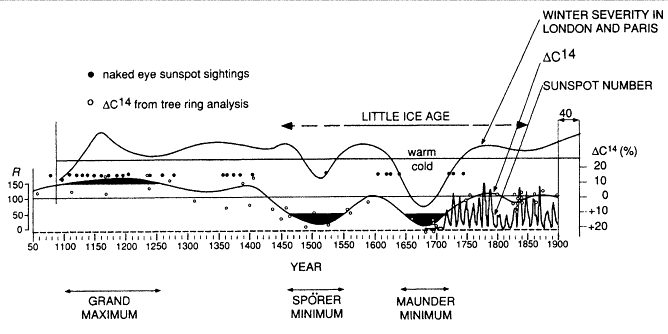
Figure II.4.20
Relationship between severity of winter in Paris and London (top curve) and long-term solar activity variations (bottom
curve). Shaded portions of curve denote times of Spörer and Maunder Minima in sunspot activity. Dark circles indicate
sunspot observations by the naked eye. Details of solar activity variation since 1700 are indicated in the bottom curve
by sunspot number data. Winter severity index has been shifted 40 years to the right to allow for cosmic-ray-produced
14C assimilation into tree rings. Source: Daddy, 1976. Reprinted with permission of the American Association for the
Advancement of Science.
Page 267
been known for many years, there is as yet no successful theory of the process. The principal components of the solar activity cycle must come from the interaction of convection and rotation. The pattern of differential rotation should be derived from fundamental hydrodynamic theory but usually is just postulated as part of the input to a model. More importantly, the pattern of internal rotation has only recently become known, at least in a preliminary fashion. This was a critical free parameter, and it was expected that the Sun rotated more rapidly below the surface than at the surface. Such a pattern made it possible to reproduce the solar cycle, but that pattern is now known to be incorrect. Speculation about the driving region for the solar cycle has shifted from the zone just below the solar surface to the interface between the convection zone and the radiative deep interior at a distance of about 70 percent of the way from the Sun's center toward the solar surface. These theoretical ideas are at a very primitive stage of development and have not even been able to reproduce such essential aspects of solar activity as the 11-year period, the direction of sunspot migration, or sunspot size.
Reproduction of the most basic features of the solar cycle must be the first objective of any modeling effort, but this is only a step toward a more urgent goal: understanding the mechanisms or indicators of changes in the Sun's overall level of activity as measured by the strength of the solar cycle. Two historical changes in the cycle strength—the absence of activity during the Maunder Minimum (and similar earlier minima) and the growth of the cycle strength during the past century—are even further from being understood than the cycle itself but have potentially substantial climatic implications. Because these changes have a very long time scale, high-quality data from the most recent space-based era provide little guidance. Hints in the historical record from the late Maunder Minimum period indicate that there were changes in the Sun's rotation pattern or radius associated with the low level of output. Perhaps most intriguing in guessing the nature of the activity cycle during this low period was the chaotic nature of the first few cycles as the Sun recovered. The 11-year period did not manifest itself until nearly 50 years after the first moderate number of spots were seen. There also seems to be a gradual shortening of the cycle length to 9.5-10 years instead of the nominal 11.
The new tool of helioseismology represents the best hope of making fundamental progress in understanding the processes that govern the solar cycle. With this tool, it has become possible for the first time to measure velocities below the solar surface. Both the largest-scale motions involving flows over the entire convective envelope and the smaller-scale flows associated with active regions are accessible with this tool. By making such measurements over a full solar cycle, it should be possible to obtain clues as to the origin and nature of the solar dynamo. Two major experiments in helioseismology have recently begun with the deployment of GONG (Global Oscillation Network Group) instruments at six sites around the surface of the Earth and with the launch of three helioseismology experiments on the SOHO (Solar and Heliospheric Observatory) spacecraft. The
Page 268
GONG instruments already are beginning to return data of high quality and maps of internal rotation.
In addition to providing a tool for understanding solar interior dynamics, helioseismology may be able to assist with long-range projections of space weather. Active regions and magnetism ultimately depend on the dynamics of the deep solar interior. The oscillation frequencies and their shifts are dependent on the interior velocity field and on the interior structure, including possible strong magnetic field effects. Thus, helioseismology data have the recently demonstrated capability to detect magnetized regions before they appear at the solar surface. On at least one occasion, precursor changes in the solar acoustic spectrum were measured prior to the arrival of a sunspot group on the solar surface. Similar changes are not seen in control regions where sunspots did not appear. This sequence is shown in Figure II.4.21. This type of observation may provide a means of long-range solar activity forecasting. Additionally, there may be relationships between the Sun's acoustic spectrum and the coronal magnetic configuration. This area is completely unexplored at present. Both the GONG and the SOHO experiments have planned durations of two years with possible extensions to longer periods.
Long-Term Changes in Solar Behavior: Solar-Type Stars
The study of solar variability through observations of the Sun is limited in two ways: there is no easy way to extend the time base beyond the current era, and there is no way to change parameters such as the rotation rate that govern solar dynamics. The study of Sunlike stars can ease these problems by sampling a range of states not exhibited by the Sun because of the natural range in stellar rotation rates. We pay two prices for these benefits: the properties of the stars are not fully and accurately known, and there is no way to obtain spatially resolved information about the distribution of activity over the stellar surface (although Doppler imaging can provide some information of this type). Estimates of stellar age are most difficult to obtain and represent the greatest uncertainty in this technique, with rotation rate being adopted as the best available indicator. Stellar observations consist of two parts: (1) a regular measurement of the strength of the ionized calcium emission (at the H and K wavelengths) and (2) a regular measurement of broadband stellar brightness. The longitudinal asymmetry in the distribution of active regions is found for stars as well as for the Sun, so that it is routinely possible to measure the rotation rate for stars from the pattern repeat rate in brightening of the ionized calcium features. More stars have been followed by using calcium emission features than broadband photometry. The set with extensive enough data in both ionized calcium and broadband contains just 10 stars. By adding the Sun to this set, there are 11 stars.
An important question that can be addressed with this stellar sample is whether the amplitudes of the solar chromospheric and total irradiance variation
Page 269
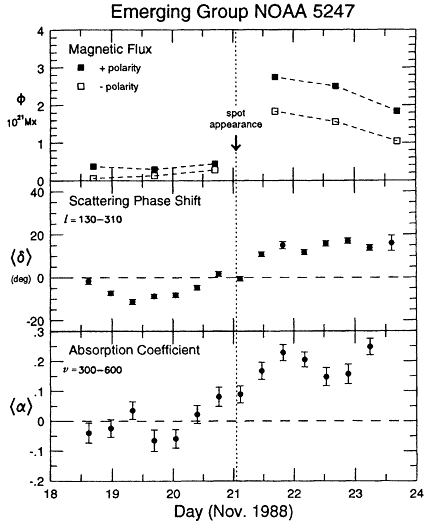
Figure II.4.21
Time evolution of magnetic flux and p-mode scattering for the emerging sunspot
group NOAA 5247. Top panel shows magnetic flux as measured from KPNO
magnetograms versus time. Middle and bottom panels show l- and v-averaged
values of scattering phase shifts
d and absorption coefficient a, respectively. Time
of appearance of the spot is indicated by vertical dashed line. Negative phase shifts
in middle panel indicate a signature of p-mode scattering prior to emergence of the
sunspot group. Positive phase shifts observed in the emerged spot are consistent
with previous measurements of phase shifts in other (mature) sunspots.
Page 270
are typical for stars of its type. Figure II.4.22 illustrates the relationship between the amplitude of variation in these two quantities. This figure shows that
• the Sun is near the low range of variability in its ionized calcium index, and
• the correlation between brightness variation and variation in the ionized calcium index is somewhat atypical for the Sun in the sense that the broadband variation is less than the ionized calcium index variation for the Sun. Interpreted literally, this implies that the Sun could in fact have had a much higher level of change in its energy output than has been observed recently.
Data of the type plotted in Figure II.4.22 can be obtained only through long-term studies. At present, the number of stars for which an adequate set of observations has been obtained is very small and does not permit any statistically significant conclusions. One difficulty in the use of stellar data is the estimation of stellar age. A larger sample of stars would permit better determination of the age through statistical use of the rotation rate, spectroscopic characteristics, and stellar motion indicators.
Key Initiatives
Solar influences on the Earth's environment are subtle and require careful measurement to be detected reliably. Nonetheless, as its ultimate energy source, the solar input is fundamental to the Earth's atmosphere and climate system, and understanding solar influences on the Earth's environment requires that we do the following, which has been discussed earlier in more detail.
• Measure the solar energy output with space-based monitors continuously over at least a full solar cycle.
• Investigate the sensitivity of the Earth's temperature to variations in the solar energy output.
• Determine the response of the Earth's middle- and upper-atmosphere chemistry and state of ionization to variations in the Sun's UV and x-ray emissions.
• Measure the Sun's interior dynamics, and develop a model of the solar dynamo that both agrees with the Sun's observed internal dynamical state and reproduces the pattern of solar magnetic activity.
• Study possible long-term changes in solar behavior through the observation of solar-type stars.
Page 271
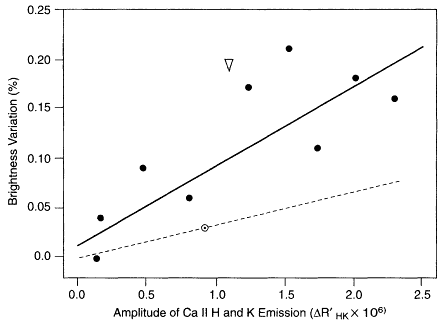
Figure II.4.22
Possible relationship between the total brightness variability of
the Sun and solar-typestars as measured by
DR'HK, which depends on
chromospheric emission of Ca II H and Kspectroscopic lines.
Chromospheric emission is sensitive to magnetic activity, whereas
the totalbrightness variation includes sunspot blocking,
chromospheric brightening, and other less wellunderstood effects.
Quantities shown are root-mean-square variations; peak-to-peak
variationsare roughly three times larger. Position of the Sun as
indicated by  is taken from SSMmeasurements and the solar
DR'HK.
Dashed line defines the solar brightnesschromospheric activity
change ratio based on yearly averaged data of SSM and NSOfrom 1980
to 1988. Inverted triangle (
is taken from SSMmeasurements and the solar
DR'HK.
Dashed line defines the solar brightnesschromospheric activity
change ratio based on yearly averaged data of SSM and NSOfrom 1980
to 1988. Inverted triangle ( ) is longer-term upper bound of
thesolar total irradiance variation from 1967 to 1984 taken from
rocket and balloon measurements;corresponding value of DR'HK is
estimated from combined solar measurements of MWO (1967-1978)and
NSO (1976-1984). Solid line is linear regression using all data
except the upper limit for the Sun.Most noteworthy in this figure
is the fact that the variability of solar total output seems to be
less than that for other solar-type stars with similar
chromospheric activity. Source: Soon et al., 1994.Reprinted with
permission of Springer-Verlag New York.
) is longer-term upper bound of
thesolar total irradiance variation from 1967 to 1984 taken from
rocket and balloon measurements;corresponding value of DR'HK is
estimated from combined solar measurements of MWO (1967-1978)and
NSO (1976-1984). Solid line is linear regression using all data
except the upper limit for the Sun.Most noteworthy in this figure
is the fact that the variability of solar total output seems to be
less than that for other solar-type stars with similar
chromospheric activity. Source: Soon et al., 1994.Reprinted with
permission of Springer-Verlag New York.
Contributions to the Solution of Societal Problems
The program of research described above will lead to greater understanding of the nature of solar variability, and will improve our ability to predict future states of the Sun. Understanding of the way in which solar variability affects the Earth and its climate will be enhanced, and we will have more confidence in our ability to distinguish anthropogenic effects from effects caused by solar influences.


