
Page 272
5
Climate and Climate Change Research Entering the Twenty-First
Century1
Summary
Climate is variable on time scales of seasons to centuries and over longer time intervals. Both climate variability and climate change can have significant societal impact. Climate influences agricultural yields, water availability and quality, transportation systems, ecosystems, and human health. Climate variability and change are a product of external factors such as the Sun, complex interactions within the Earth system, and anthropogenic effects. The mission of climate research is to understand the physical, chemical, and ecological bases of climate in order to characterize and predict the nature of climate variability from seasonal and interannual to decadal and longer time scales, and to assess the role of human activities in affecting climate and of climate in influencing human activities and environmental resources.
A central goal of climate research is prediction. The objectives are to understand the mechanisms of natural climate variability on time scales of seasons to centuries and to assess their predictability, to predict the future response of the
l Report of the Climate Research Committee: E.J. Barron (Chair), Pennsylvania State University; D. Battisti, University of Washington; R.E. Davis, Scripps Institution of Oceanography; R.E. Dickinson, University of Arizona; T.R. Karl, National Climatic Data Center; J.T. Kiehl, National Center for Atmospheric Research; D.G. Martinson, Lamont-Doherty Earth Observatory of Columbia University; C.L. Parkinson, NASA Goddard Space Flight Center; S.W. Running, University of Montana; E.S. Sarachik, University of Washington; S. Sorooshian, University of Arizona; K.E. Taylor, Lawrence Livermore National Laboratory; P.J. Webster, University of Colorado.
Page 273
climate system to human activities, and to develop improved capabilities for applying and evaluating these predictions.
The climate research of the past few decades drives the requirements for future research by focusing our attention on the remaining uncertainties and on the importance of climatic research for society:
• Climate variability, such as El Niño, can be characterized by significant economic and human dislocations. Modeling studies over the past two decades suggest that aspects of this climate variability may be predictable. In cases where El Niño/Southern Oscillation (ENSO) events were predicted in advance, immediate practical benefits were realized through human response and adaptation.
• Analyses of historical records have revealed a number of interesting cases of longer-period fluctuations for North America and other parts of the world, while model studies have demonstrated that ocean-atmosphere and land-bio-sphere-atmosphere interactions are plausible mechanisms to explain decade-to-century variability. Historical and paleoclimatic data, as well as coupled models, indicate the potential for significant climate variability on long time scales. Such changes can be expected to occur in the future, irrespective of human impacts on climate. Current observational capabilities and practice are inadequate to characterize many of the changes in global and regional climate. An enhancement of current observational capability and improved knowledge of the coupled Earth system will therefore likely increase our understanding of climate variability on all time scales and lead to a greater realization of practical benefits.
• The effort to predict the climate response to increases in greenhouse gases has both demonstrated the importance of this problem to society and focused attention on many of the most important limitations of current climate models. Increased concentrations of greenhouse gases and changes in land use and land cover are directly and indirectly tied to human activities. Current model projections based on increases in greenhouse gases and aerosols and on land cover change indicate the potential for large, and rapid, climate change relative to the historical and paleoclimatic records, with concomitantly large influences on human activities and ecosystems. Although remarkable progress in developing these climate models has occurred over the past two decades, current climate models are characterized by a great number of uncertainties. Improved predictive capability is likely to have a positive impact on economic vitality and national security because of its potential to minimize risk and maximize benefit associated with the impacts of any climate change.
A comprehensive analysis of the remaining scientific questions and uncertainties and of the societal drivers for climate research leads us to four major imperatives for the twenty-first century. Each imperative is associated with a series of basic requirements:
Page 274
1. We must work to enhance current observational capabilities and to build a permanent climate observing system.
• Where feasible, adopt consistent data collection and management rules to ensure the utility of operational and research system measurements for climate research.
• Develop and adopt interagency plans to ensure the protection of critical long-term observations, to limit gaps in continuity due to small budget changes in single agencies, and to recognize the value of these observations in a balanced, integrated research program.
• Provide strong U.S. support and participation in the development of a global climate observing system (GCOS).
• Ensure full and open international exchange of data and information.
• Maintain major research observation systems, such as the Tropical Ocean Global Atmosphere (TOGA) Tropical Atmosphere Ocean (TAO) array, that have demonstrated clear predictive value.
• Focus on key opportunities for reducing major uncertainties in climate models, including improved observations of water vapor.
• Ensure full interagency commitment to both the in situ and the satellite observations necessary to address the major uncertainties in our understanding of the climate system, including a commitment to long-term Earth observations of critical variables such as the major climatic forcing factors.
2. We must extend the instrumented climate record through the development of integrated historical and proxy data sets.
• Widely sample the alpine glaciers and ice caps before this important repository of information on natural variability is lost.
• Continue efforts to collect and analyze data from around the world from tree rings, lake sediments, corals, and ice cores, and actively pursue high-resolution records from ocean sediments.
• Focus research efforts on the development and validation of proxy indicators.
3. We must continue and expand diagnostic efforts and process study research to elucidate key climate variability and change processes.
• Enhance cross-disciplinary communication and collaboration.
• Develop clearly articulated linkages between strategies for observation, analysis, model development, and application of predictions to evaluating consequences of climate change.
• Implement focused research initiatives on processes and in regions that are identified as important in understanding variability in the climate system.
• Implement and analyze new observations necessary for understanding the
Page 275
processes that couple the components of the Earth system and improve our understanding of climate variability on decade-to-century time scales.
• Develop focused process studies with the objective of addressing key uncertainties associated with boundary layer processes and vertical convection; improved linkages coupling the atmosphere, oceans, and land surface; and more explicit representation of land surface processes, including vegetation and soil characteristics.
• Support the development and implementation of a comprehensive research program to study and advance seasonal-to-interannual prediction. Such a program is currently the objectives of GOALS (Global Ocean-Atmosphere-Land System) of the World Climate Research Programme (WCRP).
• Support the development and implementation of a comprehensive research program to study the mechanisms of decadal-to-century variability and its implications for longer time-scale predictability. Currently, the planning for this element is incorporated in the Dec-Cen (study of climate variability on decadal-to-century time scales) and anthropogenic climate change components of the WCRP.
4. We must construct and evaluate models that are increasingly comprehensive, incorporating all major components of the climate system.
• Improve opportunities and enhance efforts at model observation and model-model comparisons that pay particular attention to simulating observed changes associated with solar irradiance, aerosol loadings, and greenhouse gas concentrations.
• Develop mechanisms that promote formal interaction between physical scientists and social scientists, by working on common problems to improve the applications and assessments of climate change impacts.
• Enhance the computational infrastructure and focused efforts to develop climate system models that include explicit representation of the atmosphere, ocean, biosphere, and cryosphere.
• Focus on key opportunities for reducing major uncertainties in climate models, including greater understanding of climate-water vapor feedbacks and improved representation of atmospheric chemistry and indirect chemistry-climate interactions.
• Focus effort on improving the credibility and usefulness of climate model predictions at spatial scales relevant to analysis of the responses of ecosystems, socioeconomic systems, and human health to climate change predictions.
• Develop and construct high-resolution, regional climate models along with empirical methods for producing estimates of climate change characteristics of immediate relevance to humans.
These four imperatives offer a general framework, while the specific objectives and requirements for each characterize more specific opportunities to promote
Page 276
significant advancement in climate and climate change research. To some, the list of requirements outlined above may appear overly ambitious and without priority. However, a comprehensive climate research program that serves societal needs is clearly within our grasp. In many cases, the programs required to achieve these objectives are in place. In other cases, changes in requirements can be implemented with minimum budgetary impact. In still other cases, objectives can be fulfilled by increased collaboration and closer interagency planning and linkages. However, even some of the more logical, minimal-impact issues appear to be problematic. For example, in terms of the requirement for continuity and quality as part of the climate observing system, current policies verge on becoming a national and international embarrassment. Addressing these issues must be a priority. Finally, with careful planning to achieve greater efficiencies, the full spectrum of climate objectives should be realizable. Although each of the listed requirements has substantial merit, we recognize that improvements and augmentations of the U.S. climate research programs must still be paced, based on budgetary and other considerations. Consequently, the requirements described above are placed in a prioritized framework in the remainder of this Disciplinary Assessment. This prioritized framework is based on a relatively simple perspective. Improvements that have minimal budgetary impact but substantial merit should be implemented without hesitation. Requirements with significant programmatic or budgetary implications should have identifiable levels of priority or clear trade-offs with current efforts.
Introduction
Three general categories of climate variability and change have been adopted by the World Climate Research Programme: seasonal-to-interannual climate variability, decadal-to-centennial climate variability, and changes in global climate induced by the aggregate of human activities that change both the concentrations of greenhouse gases and aerosols in the atmosphere and the pattern of vegetative land cover. Humans, as individuals and societies, and ecosystems are affected by and respond to each of these three categories of variability and change.
Useful predictive skill for seasonal-to-interannual climate variability has been demonstrated. Moreover, early indications of human influence on global climate warming are emerging from the background of natural climate variability. The possibility that human activities have the potential to modify natural climate variability and long-term climate trends on a global scale is a research issue of high priority. Results of such research will have very high utility for informing the public and decision makers of appropriate response strategies.
Climate is defined as the long-term statistics that describe the coupled atmosphere-ocean-land weather system, averaged over an appropriate time period. For example, the averaged daily mean, minimum, and maximum temperatures recorded for a given month at a specified place are some important manifesta-
Page 277
tions of climate. Likewise, the daily average hours of sunlight, cloud cover, rainfall, ground water saturation, snowpack, and runoff observed for a given month at a specified locality are other important climate characteristics.
Climate variability refers to fluctuations in climate statistics with reference to a very long time average. Thus, the average summer temperature over a region may differ from year to year (interannual variability) or may manifest a fluctuation that spans a number of years (decadal variability). Natural climate variability has been observed on a range of time scales from months to seasons to centuries and more.
A climate trend refers to a long-term secular change in average climate statistics or a change in their statistical variation about the average. A climate trend may be forced by a cause external to the climate system, such as a change in the solar radiative output, or by human-induced changes in the atmospheric composition of trace gases and aerosols or the structure of vegetative land cover. A climate trend may also be forced by an internal change in the climate system, which could result, for example, from a change in ocean circulation patterns.
A climate quantity is predictable when a significant fraction of its variations can be consistently explained by a physical theory or mathematical model. Meaningful predictive skill is usually based on correlation between the predicted time series and the verifying time series of the quantity. Since climate statistics are strongly correlated with boundary quantities (e.g., sea surface temperatures), the boundary quantities may be considered climate quantities.
Seasonal-to-interannual variability, such as the phases of ENSO, is associated with widely distributed weather anomalies and sometimes severe conditions. These anomalies may persist for many months and can result in significant economic and human dislocations from Australia through tropical and semitropical South America to parts of Africa. Historical records and paleoclimatic data sources indicate the occurrence of significant climate variability on time scales of decades to centuries. Climate variability on these time scales has produced marked shifts in human well-being recorded in history over the past several centuries and can be expected to result in significant economic and human dislocations in the future. Current climate model projections based on anthropogenic increases in greenhouse gases and land cover changes indicate the potential for large, and rapid, climate change relative to the historical and paleoclimatic records, with concomitantly large influences on human activities and ecosystems.
Climate change can lead to significant changes in energy use, air pollution, crop yields, water quality and availability, the frequency and intensity of severe weather events, and the occurrence and spread of infectious diseases. Improved knowledge of the climate system offers the potential to enhance our predictive capability, which could support societal efforts to adjust to, forestall, or even eliminate some of the negative impacts of projected climate change. An enhanced capability to predict future climate will have a positive impact on economic vitality and national security.
Page 278
Progress in understanding the physical, chemical, and ecological bases of climate during the past few decades is clearly a result of a wide variety of research efforts. A clear set of scientific objectives and requirements can be formulated for the coming years. Nonetheless, significant progress in achieving the mission of characterizing and predicting seasonal-to-century time-scale variability in climate, including the role of human activities in forcing this variability, is likely to take a decade or more. Some aspects of the problem will continue to be intractable for considerably longer periods.
The remainder of this Disciplinary Assessment articulates a mission and identifies the principal issues and related scientific questions that challenge the climate research community entering the twenty-first century. Seven scientific and programmatic objectives intended to guide this community over the next decade are presented.
Mission Statement
Human endeavors have come to depend on familiar global and regional environments. In fact, much of the fabric of our society is tied directly to climate through agriculture, water resources, and energy utilization. We have long recognized that climate is variable on time scales of seasons to centuries, and even longer intervals, and that this variability can have significant societal impact. El Niño events, the 1930s drought in the United States, the Sahel droughts, and variations in the monsoons over the most populous areas of the globe provide examples of the importance of natural climate variability for human activities and well-being. The nature of global and regional climates is also subject to change because of human activities, most notably in response to the observed changes in atmospheric composition (e.g., greenhouse gases and aerosols) and land use, characteristic of the last century. The potential impact of these changes is great and spans such diverse issues as agricultural yield, water resource availability, transportation systems, water quality, energy production and utilization, frequency and magnitude of extreme weather events, natural ecosystem viability, and even the nature of infectious diseases and their spread by agents that are influenced by climate.
The magnitude and timing of human-induced climate change remain active research topics. Large gaps in our knowledge of interannual and decade-to-century natural variability hinder our ability to provide credible predictive skill or to distinguish the role of human activities from natural variability. Narrowing these uncertainties and applying our understanding define the mission of climate and climate change research and education for the twenty-first century.
The mission of climate research is to understand the physical, chemical, and ecological bases of climate in order to characterize and predict the nature of climate variability from seasonal and interannual to decadal
Page 279
and longer time scales, and to assess the role of human activities in affecting climate and of climate in influencing human activities and environmental resources.
The scientific uncertainties, coupled with the potential significance of climate variability and climate change, indicate the importance of developing a scientific strategy for monitoring changes to the climate system, addressing key scientific uncertainties, enhancing our understanding of the impact of human activities, assessing societal vulnerability to climate change, and minimizing risk and maximizing benefits to society. Our primary goal is to enhance our capacity to predict climate variability and climate change, which implies understanding the impact of human activities in influencing climate.
Perspectives for the Twenty-First Century
To determine the imperatives for research in the coming decades, one must note the results of the past few decades of research, including both the explicit advances in knowledge and the increased potential to address the remaining critical uncertainties, and must recognize the importance of climatic research for society.
Insights of the Twentieth Century
A broad interest in climate variability and climate change was awakened in the early 1970s and during the 1980s due to a large number of weather-related disasters in widely scattered parts of the world and to accumulating evidence that human activities are altering the concentrations of radiatively important trace gases in the atmosphere. This awakening resulted in a large dedicated effort, through both the WCRP and national efforts, such as the U.S. National Climate Program and the U.S. Global Change Research Program (USGCRP), to enhance and analyze observations, conduct process studies, and improve climate models. The principal goal has been to develop credible methods to predict climate variability and change. The insights gained from these efforts are diverse and numerous. The three sections that follow illustrate the state of the science.
Seasonal-to-Interannual Variability and the El Niño/Southern Oscillation
ENSO is a major global-scale signal of seasonal-to-interannual climate variability. ENSO consists of both warm and cold phases, with the warm El Niño phase attracting most public attention. The El Niño phenomenon is an anomalous warming of surface ocean waters in the central to eastern equatorial Pacific Ocean accompanied by large-scale anomalies in rainfall (Figure II.5.1). El Niño occurs irregularly with a typical time period of three to six years. It has been known throughout the twentieth century, mostly through its detrimental effects
Page 280
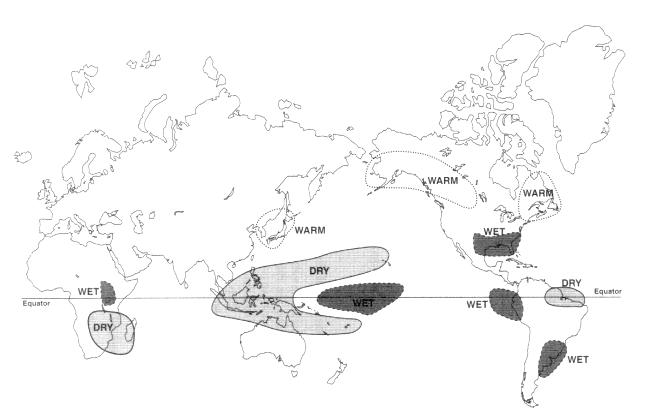
FigureII.5.1
Schematic of large-scale climate anomalies associated with the warm phase of the Southern Oscillation during Northern
Hemisphere winter. Based on Ropelewski and Halpert (1986, 1987) and Halpert and Ropelewski (1992). Source: NRC,
1994a.
Page 281
on the fisheries, agriculture, and water resources of countries bordering the tropical Pacific, but only in the past 20 years has major progress been made in understanding the mechanisms that create ENSO and observing its occurrence and wide-ranging impacts.
The 1982-1983 warming, the largest of the twentieth century, was neither predicted in advance nor recognized until nearly at its peak. The enormous worldwide damage directly attributable to this warming (floods in Peru, collapse of the Peruvian anchoveta fishery, devastating drought, and forest fires in Australia and Borneo) gave impetus to an emphasis on observing the tropical Pacific in real time and on predicting the phases and intensity of ENSO.
As a result, the international TOGA program of the WCRP was developed. The accomplishments of TOGA, including major contributions by U.S. scientists, are many (NRC, 1996c):
1. The TOGA observing system, consisting of 65 TAO moorings, expendable bathythermographs (XBTs), drifting buoys, tide gauges, upper-air integrated sounding systems, and volunteer observing ships (Figure II.5.2)—all telemetering to the global telecommunication system (GTS) in real time—allows an unprecedented look at the state of the atmosphere, sea surface and subsurface tropical Pacific in real time (McPhaden et al., 1998).
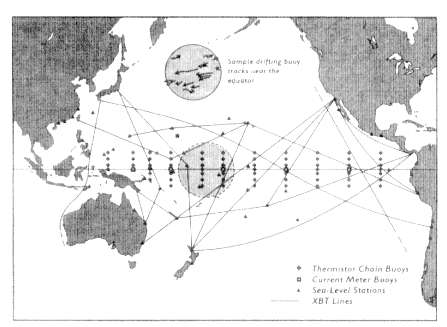
Figure II.5.2
The TOGA observing system (TAO). SOURCE: NRC, 1996c.
Page 282
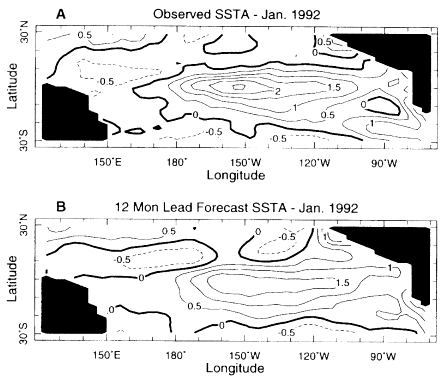
Figure II.5.3
(A) Observed Sea Surface Temperature Anomalies (SSTA) In Tropical Pacific And (B)
Prediction Made 12 Months In Advance By Cane And Zebiak (1987). Reprinted With
Permission Of The Royal Meteorological Society.
2. A set of theories about ENSO has been developed and the mechanisms that may be responsible for its irregularity have been identified (Battisti and Sarachik, 1995; Neelin et al., 1998).
3. Connections between warming in the equatorial Pacific and climate phenomena in other parts of the world have been demonstrated, and the dynamical mechanisms responsible for these connections are beginning to be understood (Lau and Nath, 1994; Trenberth et al., 1998).
4. Coupled atmosphere-ocean models have been developed that are capable of simulating the major features of ENSO in the tropical Pacific (Zebiak and Cane, 1987; Delecluse et al., 1998).
5. Significant skill beyond persistence has been demonstrated in predicting sea surface temperature anomalies (SSTA) in the eastern to central tropical Pacific as much as a year in advance (Figure II.5.3) (Latif et al., 1994, 1998).
6. Prediction systems, consisting of coupled atmosphere-ocean models, data
Page 283
assimilation and initialization techniques, and validation methods, are under development (Kleeman et al., 1995; Rosati et al., 1997).
7. Regular and systematic prediction of aspects of ENSO have been implemented (Ji et al., 1996).
8. Short-range climate variability predictions are beginning to be applied for the social and economic benefit of countries influenced by ENSO (Moura, 1994).
The development of predictive skill a year or more in advance is a monumental achievement that has vast implications both for science and for the applications of these predictions for the benefit of humankind. Consequently, we are in a position to consolidate our experience into ongoing prediction efforts and to expand our horizons and more fully explore global seasonal-to-interannual variability, its predictability, and the applications of this predictability.
Decade-to-Century Variability
Widely scattered instrumental records that extend back more than a century and more extensive observations of the past few decades provide a reasonably strong sense of interannual variability. The study of tree rings, ice cores, corals, and lake sediments demonstrates that climate variability on decade-to-century time scales has also occurred over the past millennia; such variability will certainly continue into the future. Our documentation and understanding of these longer-period variations is much weaker than for interannual variability. However, over the past two decades, research on natural climate variability on time scales of decades to centuries has grown because the complexities and uncertainties associated with both detecting and projecting the nature of future climate change have been recognized. Efforts to document and understand natural climate variability on time scales of decades to centuries provide important insights for climate research in the twenty-first century:
1. Analyses of historical records illustrate a number of interesting cases of longer period fluctuations for North America including (a) significant increases in temperature and decreases in precipitation in the 1930s; (b) decreases in tropical storm intensity for the East Coast in the 1960s and 1970s; (c) increases in interannual variability, mean winter temperatures, and total precipitation in 1975-1985; and (d) changes in lake levels over the last several decades (Figure II.5.4).
2. Ocean time series, although limited in availability, demonstrate significant decadal and longer time-scale variability, such as an abrupt change in the ocean surface state during 1976-1977 in the North Pacific, fluctuations in the sea ice limit of the Northern Hemisphere, and the Great Salinity Anomaly in the North Atlantic.
3. Careful study of historical records has also identified false jumps or
Page 284
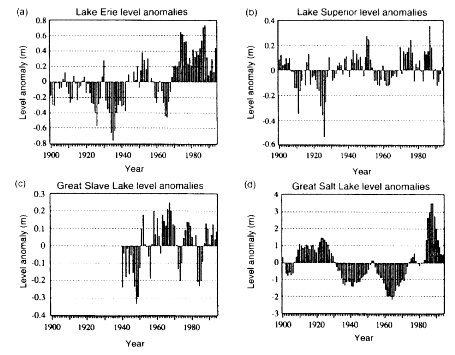
Figure II 5.4
Lake-level anomalies for selected North American lakes. Source: Nicholls et al., 1995.
discontinuities in climate time series due to changes in observation practice, such as the relocation of observation sites or changes in instruments (Figure II.5.5).
4. Concerted efforts have resulted in long records of natural variability (e.g., 200,000-year records from ice cores and a greater than 1,000-year record from tree rings). The analysis of ice cores demonstrates century and multicentury variability and also provides remarkable evidence for abrupt (as short as 1 to 10 years) climate changes of regional to global significance (Figure II.5.6). A tree ring study for the midlatitude Asian continent suggests that the last half of the twentieth century is the warmest period of the past millennium for this region. Advances in the study of climate proxies indicate substantial potential to assess climate variability prior to the historical record.
5. Model studies have demonstrated that ocean-atmosphere interaction is one plausible mechanism for decade-to-century variability. The idea that the asymmetry in coupling between ocean and atmosphere, which is associated with heat and moisture fluxes, would create modes of variability has now been seen in simple model experiments. There are strong feedbacks associated with surface heat flux and temperature changes. They are, however, complicated (e.g., the
Page 285
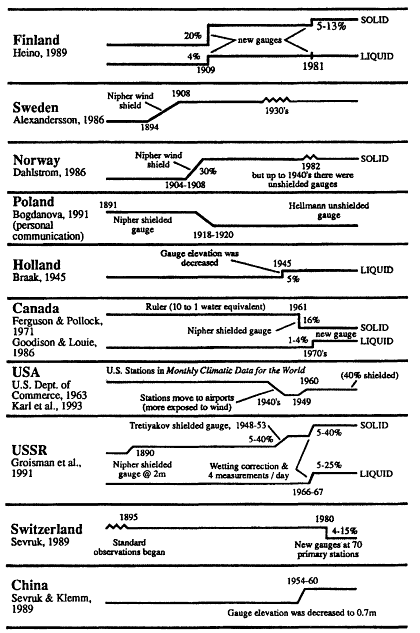
Figure II.5.5
Selected set of time-dependent precipitation measurement biases that have
affected various countries. Source: From Karl et al., 1993.
Page 286
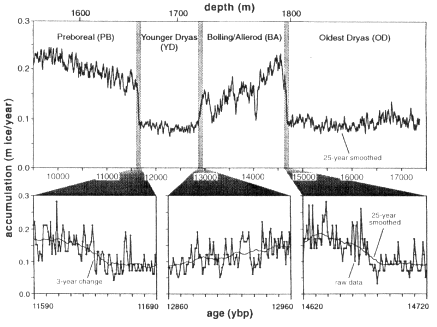
Figure II.5.6
Snow accumulation in central Greenland, showing abrupt changes. Source: Alley
et al., 1993. Reprinted with permission of Macmillan Magazines Limited.
freshwater flux due to precipitation is a significant influence on the ocean circulation, whereas changes in ocean salinity have little direct impact on the atmosphere).
6. Long simulations of coupled ocean-atmosphere and ocean general circulation models show evidence of centennial variability associated with the thermohaline circulation, as well as evidence for shorter (multidecadal) time-scale variations. These studies, coupled with both observations and other model experiments, identify the North Atlantic and its associated deepwater formation as a focal point of decade-to-century variability.
7. Climate model studies suggest that the feedbacks between land surface characteristics and the atmosphere may also be significant factors in decadal-scale variability (e.g., prolonged Sahel drought).
8. Direct observations of aerosol properties and radiative forcing from the Mt. Pinatubo volcanic eruption have offered a unique opportunity to increase our understanding of the climate system (Figure II.5.7). The global radiative forcing from Mt. Pinatubo of -4 W m2 is equal but opposite to that due to the doubling of carbon dioxide. Climate model studies have been successful in predicting the correct magnitude of the response to this forcing, thus lending credibility to the
Page 287
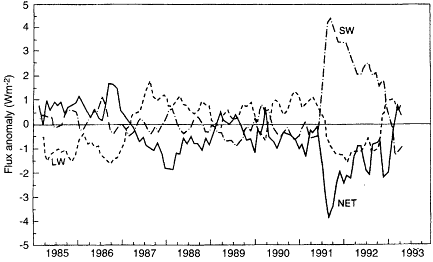
Figure II.5.7
Time series of smoothed wide field of view Earth Radiation Budget Experiment
long-wave (LW), short-wave (SW), and net (LW-SW) irradiance anomalies between
40°N and 40°S relative to the five-year (1985-1989) monthly mean. The deviation
starting in mid-1991 is mainly due to the Mt. Pinatubo eruption—the net anomaly
in August (about -4 W m-2)
is almost three times higher than the standard deviation
computed between 1985 and 1989. Source: After Minnis et al, 1993; updated by
Minnis, 1994.
models' predictive capability. In Figure II.5.8, the eruption is indicated by the vertical dashed line. The stratospheric temperatures [Figure II.5.8(a)] are from satellite observations and show the 30 mbar zonal mean temperature at 10°S; they were supplied by M. Gelman, National Oceanic and Atmospheric Administration; model results represent the 10-70 mbar layer at 8 to 16°S. The zero is the mean for 1978 to 1992. The tropospheric temperatures [Figure II.5.8(b)] are from satellite observations, and model results are essentially global. The zero is given by the mean for the 12 months preceding the eruption. The surface temperatures [Figure II.5.8(c)] are derived from meteorological stations; observations and model results are essentially global. The zero is given by the mean for the 12 months preceding the eruption. Note that the model results use a simple prediction of the way the optical thickness of the initial volcanic cloud varied with time, rather than detailed observations of the evolution of the cloud.
9. Observations and models suggest substantial low-frequency variability in the period and amplitude of ENSO, which implies a decadal modulation of the predictability of aspects of ENSO. In particular, the first half of the 1990s exhibited a large-scale warming in the eastern Pacific (within ±30° of the equa-
Page 288
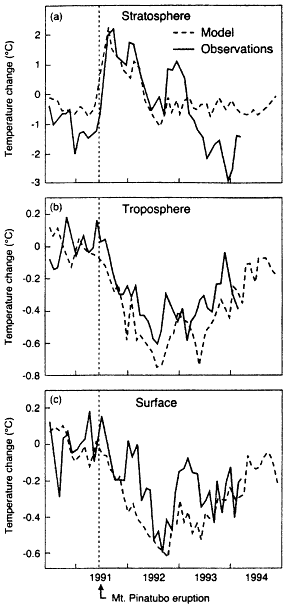
Figure II.5.8
Observed and modeled (from the GISS general circulation model)
monthly mean temperature changes over the period of the Mt.
Pinatubo eruption. The eruption is indicated by the vertical
dashed line. Updated from Hansen et al., (1993a). Source: M.
Gelman, National Oceanic and Atmospheric Administration.
Page 289
tor) that coincided with a degradation of the skill of prediction of sea surface temperatures in the tropics. The nature of these decadal modulations is unknown.
10. Observations and models have clarified part of the complexity of natural variability. Isolation of the mechanisms is challenging because of the uncertainty in characterizing the magnitude of many forcing factors and the variety of potential causes. Uncertainties include variability within individual components of the Earth system, variability associated with the coupling of system components with different response times, and forced variability (e.g., solar variation and volcanic eruptions).
An understanding of natural variability is essential to the wise use of resources, human health, agricultural productivity, and economic security. Research in the twentieth century has elucidated much of the complexity of natural variability and has begun to document its scope. These results demonstrate the importance of additional research to reduce the uncertainties associated with detecting and projecting future climate change.
Assessing the Human Role in Climate
Greenhouse gases absorb and reemit the infrared radiation emitted by atmospheric gases, clouds, and the Earth's surface. Atmospheric concentrations of greenhouse gases, including carbon dioxide (CO2), methane (CH4), nitrous oxide (N2O), and halocarbons, have increased significantly above preindustrial levels. [Water vapor is also an important greenhouse gas, which is discussed below (Raval and Ramanathan, 1989; Chahine, 1992; Stephens, 1990).] This increase is clearly due to anthropogenic activities. Because of their infrared absorption, increased concentrations of these gases promote global warming. The debate is not over whether these gases promote global warming but, rather, over the more difficult problem of the timing, magnitude, and regional patterns of the climate change, including regional changes of climate extremes such as tropical and extratropical storms, severe local storms, hail, floods, droughts, and heat waves. The prediction of future climate change is problematic because of a number of significant uncertainties (IPCC, 1996) including (1) the natural variability of climate (NRC, 1995c); (2) the difficulty in predicting future greenhouse gas and aerosol concentrations (NRC, 1993, 1996a); (3) the potential for unpredicted (e.g., volcanic eruptions) or unrecognized factors (e.g., unknown human influences and unrecognized climate feedbacks); and (4) a lack of understanding of the total, coupled climate system. Because of these uncertainties, future greenhouse warming is usually described in terms of a range of increase in globally averaged temperature for specific scenarios of greenhouse gas emissions (e.g., 1.5 to 4.5°C temperature increase for a doubling of CO2 concentration). Although the past few decades of research have yielded substantial progress in projecting future human-induced climate change, there is much to be learned
Page 290
about the regional or local characteristics of global climate change (Giorgi and Mearns, 1991).
Efforts to understand the forcing and response of the climate system and the role of human activities in effecting climate change provide a number of important insights:
1. Intercomparison of the magnitude of cloud feedback in a number of global climate models (Figure II.5.9) indicates nearly a fourfold range of uncertainty, with some models predicting strong positive cloud feedback and others a weak negative feedback to the climate system. This range of uncertainty in cloud feedback contributes to the range of uncertainty in climate model prediction. Calibrated five-year Earth Radiation Budget Experiment (ERBE) observations have documented that clouds have a net global radiative cooling effect on the Earth-atmosphere system. Regional cloud forcing data have contributed significantly to diagnosing deficiencies in global climate model treatment of cloud radiative interactions. This regional cloud forcing has a significant impact on the magnitude and direction of ocean heat transport (Gleckler et al., 1995; Hack, 1998). The net effect of changing atmospheric concentrations of greenhouse gases on these other factors is an outstanding scientific issue.
2. Water vapor behavior and feedback analysis have been advanced on theoretical, observational, modeling, and methodological grounds, spurred by the understanding that water vapor in today's atmosphere is its most radiatively important greenhouse gas. Observational uncertainty in relative humidity, particularly in upper levels of the atmosphere, contributes substantially to the uncertainty in predicted climate changes at the surface and as a function of altitude.
3. Improved representation of the land surface in climate models—from early parameterizations of specified albedo, emissivity, and simple ''bucket'' hydrology to fully coupled biosphere-atmosphere transfer schemes with multiple soil layers—has served to demonstrate that changes in the land surface with land use change, and through vegetation-climate feedbacks, can be significant because of their impact on energy, moisture, and greenhouse gas fluxes.
4. Experimentation with ocean general circulation models and coupled ocean-atmosphere models demonstrates the potential for "surprises" in future global change. For example, model studies have demonstrated the possibility of more than one stable mode for the ocean circulation associated with changes in the hydrologic balance in the North Atlantic. The importance of incorporating explicit ocean heat transport and oceanic processes, such as resolution of the thermohaline circulation and accurate representation of surface moisture and energy fluxes, is clearly evident from these studies.
5. Incorporation of the radiative effects of specific trace gases and their distribution in the atmosphere improves climate simulations substantially. Further, research during the last decade has demonstrated the importance of interactions between atmospheric chemistry and climate and the need for improved
Page 291
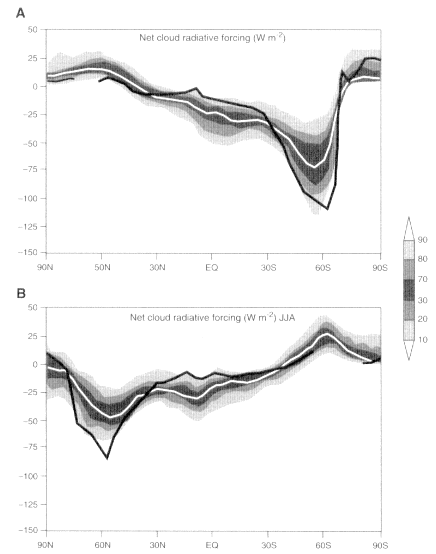
Figure II.5.9
Zonally averaged net cloud-radiative forcing (W m-2)
as observed (black line) and
as simulated by Atmospheric Model Intercomparison Project (AMIP) models for
December-February (top) and June-August (bottom). Mean of model results is
given by white line; the 10, 20, 30, 70, 80, and 90 percentiles are given by shading
surrounding the model mean. Observational estimates are from ERBE data for
1985-1988. Climate simulations completed by participants in AMIP were carried out
with sea surface temperatures prescribed for 1979 through 1988. Note that most
models overestimate the cooling effect of clouds in the tropics and underestimate
the cooling effect of clouds in the summer midlatitudes. Source: Harrison et al.,
1990. Reprinted with permission of the American Geophysical Union.
Page 292
representations of atmospheric chemical interactions within climate models. In this regard, models have shown the importance of temperature-dependent reaction rates in determining ozone concentrations, which in turn affect temperatures. Chemical interactions are also important in determining the distribution and concentration of sulfate aerosols and the hydroxyl radical (OH).
6. Various ice- and snow-related feedbacks, based largely on the high albedos of ice and snow and their insulating qualities, make the sea ice, ice sheet, and snow cover particularly important to the climate system. Incorporation of simple parameterizations of sea ice and simple relationships between snow cover and albedo have yielded marked effects on the polar simulations of general circulation models (GCMs), confirming the expected importance of sea ice and snow cover to the model results. Such results further identify the need for more complete parameterizations of sea ice, including ice dynamics as well as thermodynamics, plus more complete snow cover parameterizations and incorporation of dynamic ice caps.
7. The focus on transient climate model simulations, extending from 100 years in the past to 100 years into the future, including time-varying forcing, provides much stronger tests of model capability. For example, comparison of atmospheric GCMs with the time evolution of temperature identify important limitations of these models. As another example, ocean tracer data in conjunction with the transient integration of climate system models can be used to evaluate the mechanisms by which carbon, mass, and heat enter the ocean interior. Transient integrations also provide more reliable estimates of the effect of increasing greenhouse gases on the climate system.
8. Anthropogenic aerosols can affect climate directly by scattering sunlight and indirectly by serving as condensation nuclei for cloud drops, thereby potentially altering cloud radiative properties and lifetimes. Increases in aerosols tend to cool climate at least locally and contribute to historically observed changes in climate; they may be a factor in explaining some of the differences between observations and model predictions of the warming due to increases in carbon dioxide (Figures II.5.10-II.5.12). However, characterization of the distribution and nature of aerosols in the atmosphere is currently inadequate.
9. The evidence from improved weather forecasting suggests that the use of finer-scale models and empirical techniques that allow models to incorporate regional features, such as improved topography, vegetation, and soil characteristics, has the potential to improve climate model predictions (Giorgi and Avissar, 1997).
10. In addition to the improved recognition and documentation of the scope of natural variability, comparison of paleoclimatic data and model experiments suggests a range of climate sensitivity in geologic history to a variety of climatic forcing factors, including carbon dioxide, which is very similar to the range given by the Intergovernmental Panel on Climate Change (IPCC) assessment.
11. The linkage of climate models with models designed to assess the im-
Page 293
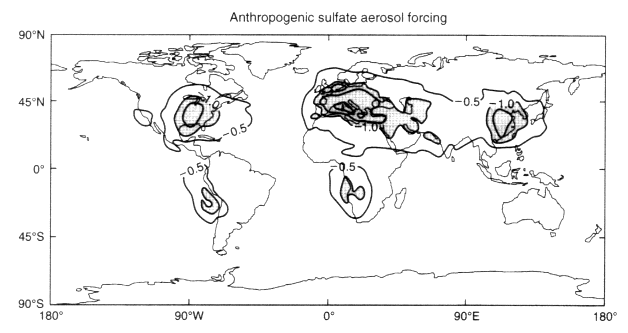
Figure II.5.10
Annual mean direct radiative forcing (W m-2) resulting from anthropogenic sulfate aerosols. Source: Shine et al.,
1995.
Page 294
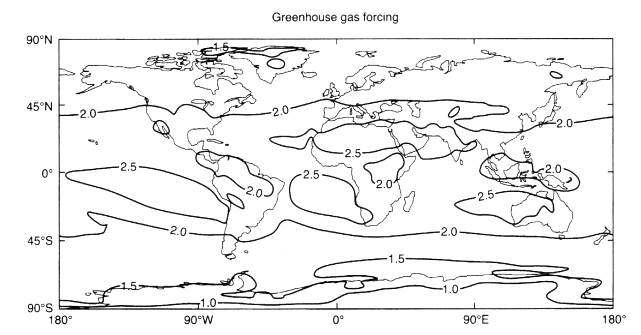
Figure II.5.11
Annual mean instantaneous greenhouse forcing (W m-2) from CO2, CH4, N2O, CFC-11, and CFC-12 from
preindustrial to present. Note: CFC = chlorofluorocarbon; CH4 = methane; CO2 = carbon dioxide; N2O = nitrous
oxide. Source: Shine et al., 1995.
Page 295
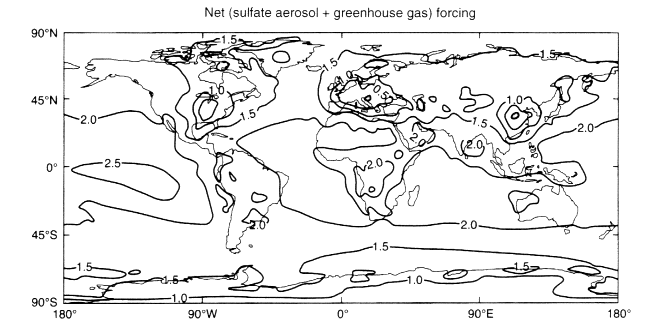
Figure II.5.12
Annual mean instantaneous radiative forcing (W m-2) since pre-industrial times due to changes in both
greenhouse gases and sulfate aerosols. Source: Shine et al., 1995.
Page 296
pact of global change on agriculture, water resources, ecosystems, health, and the economy, and quantification of the positive and negative effects of climate change, have been substantially improved and show promise in the development of integrated assessments.
Progress over the past decade in projecting future human-induced climate change is clear. However, many critical climate questions remain. The answers to these questions cannot be achieved without (1) a long-term commitment of resources; (2) a comprehensive, integrated program of observations, process studies, and modeling; and (3) a dedicated effort at improving prediction.
The Scientific Questions
The scientific uncertainties, coupled with the potential significance of climate variability and climate change, demand a careful, focused scientific strategy. The foundation of this strategy must be based on addressing key scientific questions:
• What is the nature of global and regional climate variability on seasonal-to-decadal and longer time scales? What are the spatial and temporal characteristics of this variability? What are the extremes in variability? What are the climate phenomena that acutely affect societies on a regional scale, and what are the probability distributions of these phenomena?
• To what extent are these variations predictable? For which parameters, locations, and times of the year are prediction skills highest? What data and model characteristics enhance predictive capabilities?
• What data are needed to evaluate these predictions?
• What is the climate history of the Earth and what caused it?
• What are the human-induced and natural forcing changes in the global climate system? How well do they explain the observed climate record?
• What is the response of the climate system, including its variability and extremes, to projected changes in greenhouse gases, water in all its phases, aerosols, and other human forcing? For example, how does the addition of radiatively important gases affect the intensity and frequency of ENSO cycle fluctuations? How does this manifest itself throughout the world?
• To what extent can climate change be simulated at a scale appropriate to assess its impact on human activities?
• What are the expected impacts of climate change on the rest of the global system, especially elements of immediate relevance to humans (e.g., growing seasons, agricultural yields, spread of diseases)? What information is needed to maximize the benefit to society of future predictions of climate variability and climate change?
Page 297
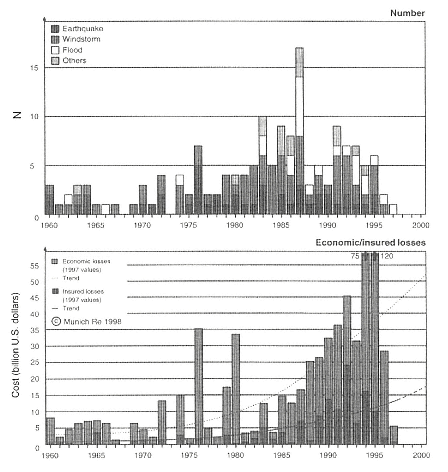
Figure II.5.13
Number and cost of great natural catastrophes. Economic losses have been
adjusted for inflation. Source: From G. Berz, 1998.
Key Drivers for Research in the Twenty-First Century
The observations and the insights derived from the twentieth century can be used to describe the impetus for climate and climate change research entering the twenty-first century. The impetus centers around increased recognition of (1) the evidence for climate variability and the potential for change, (2) the economic and societal impact of this variability and change (Figure II.5.13), (3) the opportunities for progress in enhancing our predictive capabilities, and (4) the po-
Page 298
tential for immediate practical benefits as a result of increased predictive skill. The primary drivers are the following:
• Seasonal to interannual variability (e.g., the phases of the ENSO cycle) is associated with widely distributed weather anomalies and sometimes severe conditions, which are characterized by significant economic and human dislocations.
Tropical Pacific sea surface temperature (SST) changes on interannual time scales associated with ENSO events produce both local, or nearby, and remote effects. Local effects are robust and determined mostly by the association of rainfall with warm water. When the SST increases in the eastern and central Pacific, the area of heavy rainfall expands eastward to lie over the warmest water, leaving the western end of the tropical Pacific drier and the central and eastern end wetter. The local effects of a warm phase of ENSO include excess rainfall and storminess over central Pacific islands, increased rainfall over the normally semiarid plains of coastal Peru and Ecuador, drought in Northeast Brazil, excess rain in southern Brazil and Uruguay, drought over the Indian peninsula during the summer monsoon, and drought in Australia and Indonesia. The remote effects are well documented, but the mechanisms are less well understood. Remote effects of a warm phase of ENSO frequently include anomalous warmth in Newfoundland and in the northwestern sector of North America, dry conditions in the southeastern part of the African subcontinent (including South Africa and Zimbabwe), and a weaker Asian monsoon. The economic effect of the 1982-1983 warming has been estimated to be of the order of $13 billion (1983 dollars).
• Modeling efforts over the past two decades to couple the atmosphere, ocean, and land system indicate that aspects of the coupled system, especially SSTs and rainfall, may be predictable.
Starting with the first forecast of Cane and Zebiak (1987) of the 1986-1987 warm phase of ENSO one year in advance, prediction systems have been demonstrating increases in forecast skill over the existing record. A typical prediction system involves a coupled atmosphere-ocean model, data for initialization provided by the TOGA observing system and other sources, a data assimilation and initialization method (including quality control of data over the period of record), and an evaluation procedure to compare forecasts with actual results. Recent advances in all of these areas have indicated that forecast skill can be useful as much as a year in advance but that the skill varies decadaly in ways that are not presently understood. Also, the limits of predictability are not understood. Current skill levels for process-based physical models are comparable to those achievable by the best statistical regression-based models, so it should be anticipated that further increases in skill will result from an increased process-level understanding of the coupled ocean-atmosphere system and incorporation of this understanding into physical models.
• In cases where ENSO events were predicted in advance, immediate practical benefits were realized through human response and adaptation.
Page 299
Peru, Brazil, and Australia routinely make use of predictions of SST in the tropical Pacific (e.g., Peru regularly passes laws regulating agricultural policy). As a result of the forecast of warm rainy conditions in 1986-1987, rice was favored over cotton, and the agricultural output, normally adversely impacted by warm phases of ENSO, remained normal. Northeast Brazil, which is usually semiarid and marginal for agriculture, has learned to use these forecasts for agricultural planning and now, despite severe droughts, is able to maintain its agricultural output near normal and therefore avoid the traditional plague of human migration, endemic to Brazilian history. Of course, such successes are also limited by the skill of predictions. Care must be exercised in extrapolating from a few successes. Long time series are required to establish the level of skill of a prediction system, especially since ENSO is only a part of the explanation of interannual variability. For example, precipitation in Northeast Brazil is highly correlated to tropical Atlantic variables such as sea surface temperature. ENSO appears to explain only 20 to 25 percent of the variation in rainfall in northeastern Brazil.
• Historical and paleoclimate data sources, and coupled atmosphere-ocean model experiments, indicate the potential for significant climate variability over long periods of time. Irrespective of human impacts, future climate can be expected to vary significantly, with the expectation that human and economic dislocations will also be significant.
Paleoclimatic records from a variety of sources reveal a rich history of climate variability on time scales of decades to millennia. Coupled model experiments contribute to our understanding of the mechanisms that are responsible for these longer time-scale variations. Given the causes, from forced changes (e.g., volcanic eruptions) to internal variability associated with coupling the different components of the Earth system, there is every reason to believe that such variability will continue into the future. Paleoclimatic records indicate that the magnitude of regional and global variability can exceed observed interannual variations that are known to result in significant human and economic dislocations.
• Improved knowledge of the coupled Earth system will increase understanding of natural variability on all time scales and lead to a greater realization of the practical benefits of enhanced predictive capability.
Isolation of the mechanisms that produce decade-to-century variability is challenging. One major mechanism is the nonlinear coupling of system components that have different time constants or whose coupling is not symmetric (i.e., the coupling of temperature and salinity between the atmosphere and ocean). The coupled modeling of the components of the Earth system is in its infancy. Improved knowledge of this coupling is, therefore, likely to enhance our understanding of at least one of the major mechanisms associated with decade-to-century variability. In this area, increased predictive capability is possible, whereas some of the forced elements of natural variability (e.g., volcanic eruptions) may remain unpredictable.
Page 300
• Increased concentrations of carbon dioxide, methane, nitrogen oxides, chlorofluorocarbons (CFCs) and aerosols, and changes in land use and land cover, are directly and indirectly tied to human activities.
The observed concentration of atmospheric carbon dioxide is 30 percent higher than preindustrial levels as measured directly and in ice cores. The major anthropogenic sources (fossil fuel consumption and deforestation) are significantly larger than anthropogenic sinks. Carbon isotope studies demonstrate that this increase is due to fossil carbon and biomass reduction. Methane concentrations are more than 100 percent higher than preindustrial levels. Anthropogenic sources, such as agriculture, energy production, and energy use, and knowledge of potential sinks are consistent with these measured increases. Nitrous oxide concentrations are about 10 percent above preindustrial levels. Again significant anthropogenic sources have been identified (nylon production and agriculture). Preindustrial concentrations of halocarbons are zero because there are no natural sources. Emissions of sulfur dioxide (SO2) have increased dramatically over the past 50 years; anthropogenic emissions began to exceed the global natural source of SO2 around 1940. This large increase in atmospheric SO2 has led to a substantial increase in sulfate aerosols.
• Current model projections based on the increases in greenhouse gases and aerosols, as well as land cover changes, indicate the potential for large and rapid climate change relative to the historical and paleoclimatic records, with concomitantly large influences on human activities and ecosystems.
The radiative effects of greenhouse gases are well known. Because of their infrared absorption, increased concentrations of these gases should act to warm the air. Current climate models provide the most comprehensive projections of the magnitude and timing of climate change associated with increases in greenhouse gases and aerosols. The range of model experiments and their assessment by the IPCC suggest that global mean surface temperature will increase by about 0.9 to 3.5°C by the end of the twenty-first century. The best estimates for a climate in equilibrium with a doubling of CO2 is 2.5°C with a range of 1.5-4.5°C. These projected warmings are large compared to the historical and most recent paleoclimatic records and would produce the warmest global climate of the past 200,000 years. For comparison, the temperature change associated with the last ice age is of a magnitude similar to some greenhouse climate projections (the last ice age had a globally averaged temperature approximately 3-5°C cooler than present day), but the changes from glacial to interglacial periods occurred over thousands of years rather than a century. Use of these results to examine potential human impacts indicates some significant changes in crop yields, the availability of energy and water resources, natural ecosystems, and other factors such as the potential distribution of infectious disease vectors.
• Remarkable progress in developing climate models has occurred over the past two decades, but current climate models are characterized by a large number of remaining uncertainties.
Page 301
The differences between climate models of a decade ago and current versions are considerable, especially in spatial resolution, treatment of oceans, hydrologic cycle, land surface processes and vegetation-atmosphere interactions, and clouds. However, most coupled atmosphere-ocean models still exhibit significant drift, indicating continuing problems with the component models and their coupling. Sensitivity studies have indicated that the response of climate models to a given forcing can vary significantly due to differences in the way these processes are parameterized. In many cases, model improvements have actually revealed uncertainty because we have come to recognize the importance of a specific interaction (e.g., vegetation-climate), yet our understanding of the processes involved is insufficient to define the magnitude of the effects. To improve the predictive capability of these models, refinements in key model processes are required.
• Improved knowledge of the fully coupled climate system can lead to enhanced predictive capability and the possibility of minimizing risk and maximizing benefit associated with the impacts of projected climate change. An enhanced ability to predict future climate is likely to have a positive impact on economic vitality and national security.
Advances in ENSO prediction, improvements in weather forecasts associated with incorporation of specific system components (e.g., soil moisture), and improvements in climate models over the past two decades strongly suggest that enhanced predictive capability will occur as a result of increased knowledge of the coupled Earth system. Just as interannual-to-seasonal forecasts have considerable economic value, increased predictive capability on longer time scales is likely to have a positive impact on economic vitality and economic security.
• The development of international, national, and regional policies will be enhanced by an increased ability to separate natural variability from human-induced climate change.
Uncertainties associated with model predictions of future climate change and an inability to separate clearly the human-induced climate signal from natural variability hinder developing and sustaining optimal policies. Three elements limit our ability to address these uncertainties: (1) the lack of a comprehensive climate observing system, (2) inadequate knowledge of the scope and character of natural variability, and (3) limitations of current climate models.
• Current observational capabilities and practices are inadequate to provide the long-term, continuous, quality observations required to characterize changes in global and regional climate.
Much has been learned from existing observation systems for operational weather forecasting. However, in many cases the operation of these observation systems does not fulfill the climate mission. There are several reasons: the basic observational infrastructure has deteriorated (NRC, 1992, 1994d); standard procedures for collecting side-by-side overlapping measurements are rarely applied
Page 302
when measurement techniques change significantly; inclusion of information about the nature of the observations, station relocations, algorithms, and quality control are inadequate; and observations of some variables have been discontinued. Special attention must be given to the long-term homogeneity of existing climate records. Few cases can be identified in which there is truly a long-term consistent data set for any major climate or hydrologic variable. In addition, in several cases the observation of specific variables should be enhanced in order to address ocean-atmosphere coupling, atmospheric water vapor-climate feedback relationships, and the role of clouds in climate change.
Objectives and Requirements for Climate Research
The results of twentieth century research yield a set of important remaining scientific questions. The economic and societal importance of climate provides the impetus for developing a comprehensive program for climate research. The scientific questions lead to a set of research objectives. In most cases, these research objectives address multiple scientific questions. For each objective, we can articulate a list of requirements based on experience from past successes and failures, from the remaining uncertainties and areas of scientific debate, and from reasoned assessment of the opportunities to promote significant advancement in climate and climate change research.
Objective 1
Stop the deterioration and improve current observational capability as a first step in building a comprehensive climate observing system. Include climate requirements as a priority in operational systems.
Long-term consistent observations of the key variables that describe the state of the atmosphere, land, and ocean are the foundation for understanding climate. These data are the source of information on the nature and extent of climate variability and are the basis of determining whether climate is changing. Modern observations are the primary means of evaluating climate models.
However, current observational systems are far from adequate in addressing the questions being posed by scientists and policy makers concerning climate change. Virtually all of the data available have been collected for the purpose of weather prediction. Yet these data are being utilized as the key source for examining many critical long-term climate variables. A brief examination of a few of the data sets illustrates the nature of the problem. In situ measurements are the primary sources of land near-surface temperatures and are made available through the World Meteorological Organization's (WMO's) World Weather Watch. The data are not without problems. WMO Resolution 40 seeks to limit the distribution of country-originated research. Extensive areas of tropical land are charac-
Page 303
terized by poor quality or missing data. Even in the United States we lack a reference temperature network, and no network is dedicated to monitoring decadal homogeneous temperature changes. The United States has had a history of problems related to preserving the homogeneity of maximum and minimum temperature readings. At cooperative observing sites, changes in instrumentation without adequate overlap introduced a serious discontinuity in measurements (Quayle et al., 1991). Automated surface observing network sites located at airports are influenced by urban heat islands and have had (not corrected) daytime overheating problems. There are a number of problems in assessing decadal changes in quantities such as temperature extremes, including station locations without suitable overlaps, urban heat islands and jet exhaust, changes in local conditions, and new instruments not calibrated with previous equipment. Complex adjustments are required to resolve global and regional changes in ocean temperatures measured largely from ships of opportunity. A worldwide network of radiosondes and the microwave sounding unit instrument aboard National Oceanic and Atmospheric Administration (NOAA) polar orbiters are the key to documenting changes in the vertical structure of the atmosphere. WMO and GCOS have developed a network of 140 rawinsonde stations for climate detection. Already, 27 of the 140 stations are not reporting. The former USSR recently reduced its sampling rates. Canada has closed some high-latitude sites. NOAA is considering a reduction of 14-20 sites (NAOS, 1996). Satellite data are also susceptible to problems. Given NOAA policy to launch polar orbiters with minimum overlap, overlap problems tend to occur. The result is a concern (Hurrell and Trenberth, 1998) about the ability of scientists to remove large intersatellite biases from the record of tropospheric temperatures. These examples focus on a single fundamental variable—temperature—but they serve to illustrate the flaws and problems that arise when the answers to climate questions are dependent on an observational system designed for very different purposes.
The climate community has relied on data from observing systems that were not designed to monitor climate. Current priorities of these observing systems do not take into account a variety of climate requirements. Despite these difficulties, the data have been used to document and understand much of what we know today about natural and anthropogenic climate variability and change. Current trends toward reduced data quality, reduced quantity of critical elements, and inadequate information about the manner in which observations are made and processed, jeopardize our ability to document and understand climate variations.
The primary challenge is to develop a permanent climate observing system for monitoring the state of the atmosphere, ocean, land, and hydrologic cycle. The most effective means to accomplish this task will require incremental improvements in the existing observing system. This challenge is multifaceted. First, the major systems developed for operational weather forecasting rarely have the continuity and consistency required for climate research. In many
Page 304
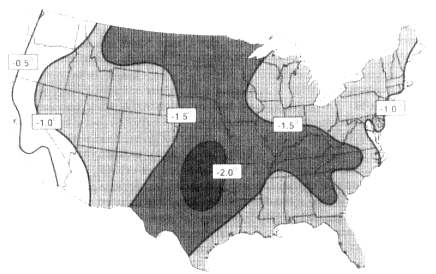
Figure 11.5.14
Effect of change in average March temperature (°C) resulting from changing
the time of observations from 5:00 p.m. to 7:00 a.m. for cooperative climate
stations in the United States, the data from which are used detect decade-to-
century scale climate change. Source: From Karl et al., 1986.
instances, simple rules of data management (Figure II.5.14) and observation—such as accurate, timely, and regular reporting on the techniques and algorithms used to collect and process data; knowing the differences in observing biases between new and old observing methods prior to eliminating the old observing method; and more effective use of existing data bases—would make a critical difference to climate research.
The collection of U.S. climate-related observations is also inherently a combination of multiagency federal, state, and local efforts. Key elements of the current observational system are vulnerable to relatively small budget cuts in individual agencies or programs, without appropriate recognition of their value to the broader objectives of global change research. These include rural observation sites with long periods of record, portions of the upper-atmosphere sounding network, and portions of the coastal buoy network. The development of a credible climate observing system must be a priority. This requires an integrated observational strategy that is less dependent on individual agency missions or budgets. Such an integrated strategy must include identification of key elements of the current observational system and formulation of an interagency observational plan.
Satellites now collect vast amounts of potentially relevant data about the current atmosphere, hydrosphere, cryosphere, biosphere, and land surface pro-
Page 305
cesses. To ensure a long enough data series for decade-to-century time-scale studies, such observations must continue. Satellite measurements must address and minimize the biases associated with drifting orbits that alias the diurnal cycle. New satellites and sensors must overlap the measurements of existing satellites prior to the decommissioning or decay of the latter in order to eliminate inhomogeneities in the climate record (Figure II.5.15). Similarly, the introduction of new instruments on satellites poses tremendous challenges in the development of a homogeneous climate record. Differences in measurements between new and existing instruments must also be resolved prior to discontinuing existing measurements.
Research-based observational systems (e.g., the TOGA observing system, specifically the TAO array) have a difficult and uncertain transition to operational systems, even when the value of observations has clearly been demonstrated. Data collected by the TOGA observing system are valuable to the world's
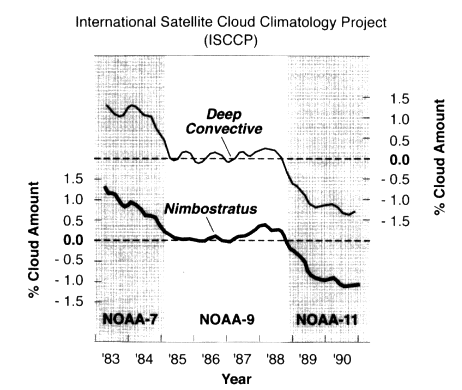
Figure II.5.15
Monthly anomalies (50°N to 50°S) in mean cloud amount depicting the biases and drift in
measurement associated with different satellite systems even after records were reprocessed
for consistent calibration. Source: Klein and Hartmann, 1993. Reprinted with permission of
the American Geophysical Union.
Page 306
operational weather prediction agencies. The array provides surface winds over vast reaches of the Pacific where no other instruments exist. It is essential that the flow of data and information derived from the TOGA observing system be maintained. In the transition to operational systems, research arrays should be evaluated in the context of operational needs to determine whether these systems should be expanded or downsized to maximize operational utilization and efficient use of resources.
Climate issues are inherently global, and a credible, useful observation system must be an international endeavor. In pursuit of this goal, the WMO is working toward defining a set of observations that meet the specific needs of climate system monitoring, climate change detection, and research to improve our understanding of climate variability and change. The WMO effort is designed to create an internationally recognized global climate observing system. Given the importance of internationally agreed upon standards and procedures and the historical role of WMO in organizing weather observations, U.S. participation in the GCOS effort is of considerable importance to climate research.
Current trends toward limited access to international data and information must be overcome (NRC, 1995a). Data and information that quickly lose their market value for operational real-time weather forecasting are still critical for achieving climate research goals and should be made freely available within a short time after their use in operational forecasting. Full and open exchange of data is an important element of the challenge to a climate observing system.
We must take full advantage of existing observing systems by ensuring that operational observations can be utilized for climate research. Long-term, consistent observations of climatologic variables and climate forcing factors are essential for achieving the mission described in this Disciplinary Assessment.
The following requirements are essential to achieve this objective:
1. Where feasible, adopt consistent data collection and management rules to ensure the utility of operational and research system measurements for climate research.
2. Develop and adopt interagency plans to ensure the protection of critical long-term observations, to limit gaps in data continuity due to small budget changes in single agencies, and to recognize the value of these observations in a balanced, integrated research program designed to address climate variability and change issues.
3. Maintain major research observation systems, such as the TOGA TAO array, that have demonstrated clear predictive value.
4. Provide strong U.S. support and participation in the development of a GCOS.
5. Ensure full and open international exchange of data and information.
Page 307
Objective 2
In addition to current observations, enhance the observation and monitoring of key variables, including atmospheric water vapor, ocean temperature, salinity (circulation), surface winds, soil moisture, precipitation (including cloud water and aerosols), snow cover, sea ice thickness, ice sheet topography, and the major forcings of the global climate system (solar output, aerosols, and changes in the land surface).
In developing a comprehensive climate observation strategy, it is important to distinguish between two scientific purposes that observations serve:
1. Observations Aimed at Elucidating Key Processes Governing the Nature, Timing, Rate, and Geographical Distribution of Climate Variability: Observation efforts that serve this purpose have to be comprehensive in scope to include all relevant variables that control the process under investigation.
2. Observations Aimed at Detecting Climate Variability and Change: Generally, observations that serve this purpose must be carefully selected to maximize the signal of climate change from the noise of the climate system and to ensure that the observed variables are measured with relatively high precision over an extended period of time with very low tolerance for discontinuities in the record.
Observing strategies serving each of these purposes should be individually developed, with an awareness of whatever opportunities for synergism among instruments and platforms become apparent.
Testing climate models requires comparison with long-term observations that are sufficiently comprehensive, and cover enough of the globe, to distinguish among different physical mechanisms. Increased study, through process experiments and monitoring, of water vapor distribution and transport; the transport of heat, salinity, and momentum within the oceans; and the fluxes of energy at the ocean-atmosphere and land-atmosphere surfaces addresses major limitations in current understanding of the coupling between the ocean and the atmosphere. In each case, these elements have been identified as major areas of uncertainty in the analysis of climate model sensitivity and the understanding of processes that govern natural variability.
We must collect a global climate data base of key variables and forcings sufficient to allow a statistical classification of natural variability and the identification of its predictable modes. These observations are also required both to determine how anthropogenic changes to the environment are altering or influencing natural climate variability and its predictable modes and to improve model predictions.
Page 308
In addition, it is extremely difficult to detect human-induced climate change or to understand and predict natural variability without an adequate assessment of all the primary forcing factors, including solar output, aerosols, greenhouse gases, and changes in the land surface. Determination of the degree to which solar output and/or greenhouse gases are a significant factor in governing the nature of the climate record can be addressed only by improved observations and concerted effort to compare the record with the various forcing factors. At the same time, enhancements to the suite of climate observations must be limited enough that they can be maintained economically.
Practical technologies exist for most of the needed observations. Many are planned as part of major observing systems [e.g., the National Aeronautics and Space Administration (NASA) Earth Observing System (EOS)] or major international research programs [e.g., the Global Energy and Water Cycle Experiment (GEWEX), Climate Variability and Prediction Program (CLIVAR), GOALS-Dec-Cen, and the World Ocean Circulation Experiment (WOCE)]. The challenge will be to form the best total, composite, observational system from this diverse set of efforts and to ensure the continuity and geographic coverage of the data in the face of budgetary constraints and pressure to support activities that promise faster results. Concerted debate and planning for a GCOS are required.
The continuity of climate-related observations is subject to yearly reshaping and descoping resulting from a process of almost continuous budget scrutiny and pressure; thus, continuity is not at all certain. A long-term commitment is particularly uncertain in NASA EOS and other research, rather than operational, agency missions. GEWEX and GOALS are also highly susceptible to budget pressures. Both were developed to address critical elements associated with limitations in understanding moisture and energy fluxes, and to evaluate and enhance our ability to develop seasonal-to-interannual prediction. However, the excitement and dedication of the scientists involved in these major efforts correspond to a period of considerable budgetary uncertainty.
In some areas, technological developments are required to make the needed climate observations practical outside the research mode. The development of a climate observing system, by taking full advantage of current observations and adding the key variables required to describe the climate system (e.g., water vapor) and its forcing factors (e.g., aerosols and solar output), will be a substantial advance (NRC, 1993, 1996a). If observations of the key variables and the major climate forcing factors are not part of a continuous, high-quality observing system, success will be very difficult or impossible. NASA EOS promises to provide new observations of water vapor, precipitation (clouds, aerosols), and solar forcing. Many of these measurements must be ''calibrated'' against in situ observations, and the in situ instrumentation is inadequate (mechanical rain gauges suffer from aerodynamic biases, and systems to characterize the composition and optical properties of aerosols and clouds are too cumbersome for routine use). In other cases, satellite technologies are immature, and technological im-
Page 309
provements are needed before long-term global observations become practical (e.g., ocean salinity, soil moisture, sea ice thickness).
These developments involve both mission agencies such as NASA and NOAA and research support agencies such as the National Science Foundation (NSF). Given the role and involvement of so many agencies with different purposes and responsibilities, the continuity of observations, calibration of new with in situ systems, and maintenance of the breadth of observations can be at risk. Full interagency commitment is needed to maintain a cost-effective and balanced observing system.
The following requirements are essential to achieve this objective:
1. Implement and analyze new observations necessary for understanding the processes that couple the components of the Earth system, and improve our understanding of climate variability on decade-to-century time scales.
2. Enhance current operational facilities, with continued implementation of supportive process studies and commitment to long-term Earth observations.
3. Ensure full interagency commitment to both the in situ and the satellite observations necessary to address the major uncertainties in our understanding of the climate system, including a commitment to long-term Earth observations of critical variables such as the major climatic forcing factors.
Objective 3
Utilize historical and paleoclimatic observations to describe the nature of global and regional climate variability.
Modern observations provide a wealth of climate information. However, the period of data collection is insufficient to examine climate variability on longer, decade-to-century time scales. Innumerable studies over the past several decades have demonstrated that data from tree rings, lake sediments, corals, and ice cores provide invaluable records on these scales, and recent work has demonstrated that ocean sediment records from high-deposition-rate areas can also supply quality records of long-term climate variability using existing technology. The continued collection and analysis of these paleoclimatic data are crucial, both for understanding the past history of the Earth's climate and for providing information needed to determine the ability of general circulation models to simulate large-scale climate change. To achieve as broad a representation of natural variability as possible, a substantial global data base has to be developed for each data type and for a variety of physical variables. Furthermore, it must be recognized that in some cases, this data collection must be completed in a timely fashion or the records will no longer be available. In particular, as alpine glaciers and ice caps retreat, a portion of the records they hold is permanently lost unless previously saved by ice core drilling.
Page 310
Observations from the paleoclimate records require interpretation and synthesis. They are not direct observations of state variables; rather, they provide proxies from which climatic interpretations are derived. Considerable effort must be devoted to improving current techniques of interpreting tree rings, lake sediments, ice cores, and coral records, as well as developing new proxy indicators.
Recorded historical events also provide an important source for reconstructing the climate record of the past few thousand years. These data provide a valuable means to cross-validate physical paleoclimatic data such as tree rings, lake sediments, and coral records.
The following requirements are essential to achieve this objective:
1. Widely sample the alpine glaciers and ice caps before this important repository of information on natural variability is lost.
2. Continue efforts to collect and analyze data from around the world from tree rings, lake sediments, corals, and ice cores, and actively pursue high-resolution records from ocean sediments.
3. Focus research efforts on the development and validation of proxy indicators.
Objective 4
Understand the major processes that govern climate variability through analysis of the observed record, correlation with natural and human forcing factors, focused process studies, and construction and analysis of coupled models of the climate system.
The enhanced climate observing program (Objective 2) and the proposed efforts to analyze and synthesize the historical and paleoclimatic record are crucial for identifying the mechanisms that govern climate variability and determining how this variability is related to natural and human forcing factors. When there are strong indications that the observed variability depends crucially on processes that are poorly understood, focused research programs (including field and theoretical studies) should be developed to enhance knowledge of these processes. Present examples include the processes that control the transfer of momentum, heat, and moisture within the atmospheric boundary layer (including low-level clouds and radiation). In the ocean, a portion of the climate variability must be sensitive to the mechanisms that control the exchange of carbon and nutrients between the surface and the permanent thermocline; these mechanisms are also poorly understood. Priorities should be on process studies that reduce the uncertainty in important feedbacks in the climate system (e.g., sea ice and cloud feedbacks) and will lead to improvements in the aggregate parameterization of key small-scale (unresolved) processes (e.g., transfer of water, energy, and car-
Page 311
bon between the atmosphere and the land biosphere). The process study research of the last decade has successfully focused on critical regions. For example, TOGA field and modeling campaigns centered on a region of high seasonal-to-interannual climate variability for which a global-scale signal was identified. Regions of strong signal are logical research priorities if we are to fulfill the objective of identifying the mechanisms that govern climate variability.
There will be instances when variability in the climate system is implied solely from the analysis of climate system models and fundamentally involves processes that are poorly resolved. For example, recent work indicates that the simulated climate variability can be extremely sensitive to details of the parameterizations in models, and these sensitivities are accentuated when component models are coupled to create climate system models. In such instances, considerable efforts should be made to improve the parameterizations of unresolved processes.
The development of coupled climate models is integral to understanding the processes that govern climate variability. For example, model studies have demonstrated that ocean-atmosphere interaction is a plausible mechanism for decade-to-century variability. Coupled models also played a major role in enhancing our knowledge of ENSO and in demonstrating predictive skill. In addition, the development of coupled models focuses attention on the physical processes operative at the interfaces of the atmosphere, ocean, biosphere, and cryosphere. Knowledge of the energy and mass fluxes at these interfaces has been repeatedly identified as a major area of uncertainty. For these reasons, the development of coupled climate system models is a priority in climate research. The development of these computationally intensive models requires a strong computational infrastructure and focused effort. The development of models that include explicit representation of atmosphere, ocean, biosphere, and cryosphere systems requires considerable cross-disciplinary communication and collaboration.
The following requirements are essential to achieve this objective:
1. Enhance the climate observing system capability, with dedicated monitoring programs, as previously described.
2. Implement focused research initiatives on processes and in regions that are identified as important to understanding variability in the climate system.
3. Enhance the computational infrastructure and the focused efforts to develop climate system models that include explicit representation of atmosphere, ocean, biosphere, and cryosphere.
4. Enhance cross-disciplinary communication and collaboration.
Objective 5
Increase the skill of climate predictions.
Page 312
Two paradigms for seasonal-to-interannual climate variability prediction are currently in use. The first paradigm employs empirical-statistical methodologies for seasonal and annual forecasts. A second paradigm focuses on the prediction of SST variations in the tropical Pacific and rainfall associated with these variations. This second case involves initializing the upper ocean with in situ measurements taken from the TOGA observing system, assimilating these observations into an ocean model to obtain the initial ocean conditions for the prediction, and then coupling the ocean to an initialized atmosphere and allowing the coupled system to evolve to a later prediction time. Since rainfall is so highly coupled to SST variations, the system effectively gives a prediction of rainfall. These predictions are then used by nations bordering the tropical Pacific for applications in various economic sectors.
The skill of climate prediction can be increased in a number of different ways. Where skill has already been demonstrated, the problem is to increase it by improvements in data quality and quantity; improvements in the coupled models; improvements in data assimilation procedures; and continuous evaluations of the prediction system by making regular and systematic predictions with constant comparisons to verifying data.
Where predictability has not been demonstrated, indications of predictability must first be sought (e.g., by observed correlations of climatic parameters with SST) and then demonstrated in a model simulation mode. The proper initializing data and the correct assimilation procedures can then be examined in a model context. If predictability is indicated in this mode, the system is initialized and evaluated with whatever real data exist. The process is cumbersome and requires a significant amount of computer resources in the early stages and the establishment of in situ observations in the later stages. The demonstration of useful predictability then leads to the next step: the establishment of an observing system and the implementation of a regular and systematic forecast cycle in order to exploit the skill of prediction.
The prediction effort requires a preponderance of research in the early stages and becomes more and more "operational" as prediction systems are built and regularized. Prediction for the tropical Pacific has passed through its earliest research stages and now is nearing a transition to a more stable and permanent status. Crucial to this transition is the maintenance of the TOGA observing system until its density and quality of measurements can be thoroughly assessed by observing system evaluation experiments and tested against the skill of prediction and the expansion of effort to larger regions.
The strategy for research must initially (1) exploit the predictability of the ENSO cycle to the fullest extent and then (2) focus on seeking and developing predictive skill associated with the global coupled system, including other time scales not directly related to ENSO.
Expansion of this skill of prediction on seasonal-to-interannual time scales to larger regions of the globe is the major emphasis of the newly established GOALS
Page 313
research program, a core program of the WCRP as part of CLIVAR. It seeks to increase the skill of prediction in the tropical Pacific in a research mode and then expand predictability to larger regions of the globe in a phased manner. The first phase begins with the tropics, based on the simplifying features of the interactions of heat sources in the tropics that determine most features of the tropical circulation. Established correlations of ENSO with monsoons form the guideposts for this initial expansion. Tantalizing hints of correlation of ENSO with climatic conditions on the West Coast, northwest corner, and southeastern part of the United States are already leading to experimental predictions of rainfall over the North American continent. Land-ocean-atmosphere coupling will play an increasing role as research is expanded beyond the tropics.
Expansions of the skill of prediction to time scales beyond a year are conjectural but are based on the slow time scales of the ocean relative to the atmosphere: if the ocean can be initialized, the coupled dynamics of the atmosphere-ocean system may control the way water reaches the surface enough to retain some imprint of the initial conditions against the inevitable noise superimposed on the system by the atmosphere. Proving predictability under these circumstances requires a greater understanding of slow motions in the ocean, in particular how the interior communicates with the surface of the ocean and then the atmosphere: This forms the research content of the Dec-Cen program, the other component of CLIVAR.
Characterization of the level of predictability of the seasonal-to-interannual time-scale variability in the climate system beyond current tropical Pacific SSTs will be a significant sign of success. This achievement may lead to regular (operational) seasonal-to-interannual prediction with a level of skill that can be utilized internationally. It depends on the development of facilities for integrated assessment, on the objectives of research, and on disseminating forecast information (including uncertainties) and working with nations in terms of how to use it. Fulfillment of these objectives will be a major contribution to addressing societal needs.
A well-defined record of decade-to-century variability derived from historical and paleoclimatic records and the identification, through exploration with coupled climate models and analysis of observations, of the fields and geographical distributions where decade-to-century variations may have predictability, will be a significant advance in our understanding of climate variability.
The following requirements are essential to achieve this objective:
1. Maintain major research observation systems that have clear value for improved climate prediction. A key example is the TOGA observing system.
2. Support the development and implementation of a comprehensive research program to study and advance seasonal-to-interannual prediction. Such a program is currently the objective of the WCRP's GOALS.
3. Support the development and implementation of a comprehensive re-
Page 314
search program to study the mechanisms for decadal-to-centennial variability and the implications for longer time-scale predictability. Currently, planning for this element is incorporated in the Dec-Cen and anthropogenic climate change components of the WCRP.
Objective 6
Continue to improve the analysis and predictive skill of the degree to which humans are affecting climate, including changes in variability and the probability of extreme events.
Analysis of how humans can potentially affect climate and its variability is carried out with a hierarchy of global climate models and observational data sets. Studies with these models indicate that the nature of global and regional climate is in danger of changing due to human activities, most notably in response to increases in greenhouse gases, aerosols, and changes in land use. However, the nature and timing of this change are uncertain. The prediction of future climate change is problematic, in part, because of an inadequate understanding of climate variability, the difficulty of predicting future greenhouse gas and aerosol concentrations, and a limited understanding of the behavior of the coupled climate system. Current climate predictions based on projected increases in greenhouse gases and aerosols indicate the potential for large and rapid climate change relative to the historical record. Improved knowledge of the fully coupled climate system can lead to an enhanced predictive capability that could support societal efforts to adjust to, forestall, or even eliminate some of the negative impacts of projected climate change. This enhanced ability to predict future climate will have a positive impact on economic vitality and national security.
The research of the last decade has clearly identified a number of key factors that require a reduction in uncertainty if progress is to be made in climate prediction:
First, the current observational system does not measure all of the key global factors that force climate change. For example, despite years of debate about the role of solar variations in explaining observed climate fluctuations, we lack a long-term, consistent, calibrated measure of solar input to the Earth system. Similarly, measures of global aerosol concentrations and character are inadequate to assess its role in climate. Without an enhanced climate observing system, such debates are likely to continue without satisfactory resolution.
Second, substantial debate concerning the nature of climate sensitivity to increases in carbon dioxide stems from uncertainties in the measurement of water vapor in the upper troposphere and in the nature of climate-water vapor feedbacks. The nature of this debate demands improved measurement of water vapor.
Page 315
Third, much of the uncertainty involves ocean-atmosphere coupling, land-vegetation-atmosphere coupling, sea ice modeling, and cloud-climate interactions. Process studies that combine the use of fine-scale regional models, field programs, and diagnostic analysis to bridge the spatial and temporal gaps between observations and typical scales of climate models offer great promise of improving model parameterizations. Diagnostic analysis of paleoclimate and historical data sets can also increase understanding of processes involved in climate change. These studies carded out for a number of large-scale conditions will lead to generalized parameterizations for a range of physical processes (e.g., clouds, sea ice). Reduced uncertainty in modeling surface energy budgets through improved cloud parameterizations will increase the reliability of coupled atmosphere-ocean-land modeling. Furthermore, increased resolution of ocean models will enhance understanding of the coupled system. Systematic analysis of these various climate components should reduce climate drift of the coupled system.
Fourth, experience with weather forecasting models suggests that increased spatial resolution results in improved prediction. In addition, the aspects of climate and climate change prediction of greatest relevance to humans and to ecosystems are those that impact water, water resources, weather hazards, agricultural yields, and human health. Most GCM simulations are at spatial scales that are too coarse for credible climate impact analysis. Increased spatial resolution must be matched with better physical representations.
Fifth, model-data comparison is critical to diagnose and improve climate model predictions. In many cases, the suite of satellite and in situ data sets has been underutilized in efforts to validate climate models. Further, observations from the industrial period represent too short a time span for satisfactory model validation. Greater confidence in model predictions will be gained through efforts to reproduce industrial, preindustrial, and paleoclimatic data sets.
In addition, WCRP efforts to compare climate models based on standard sets of climate simulations through the AMIP (Atmospheric Model Intercomparison Project) process has resulted in increased scrutiny of model parameterizations. The success of this effort has resulted in paleoclimatic intercomparison projects, land surface parameterization comparisons, and intercomparison of limited-area mesoscale models. Continued effort to intercompare models and their parameterization will continue to provide substantial benefit.
Finally, increased coordination of climatic research has the potential to yield significant efficiencies. For decades, we have developed observational strategies, promoted and completed process studies and field campaigns, developed a host of atmospheric and oceanic models, and produced impact analyses of climate change based on model output. As yet, however, the path from a proposed new observational strategy or field campaign through to the development of improved model parameterizations or improved application is often not articulated clearly. The cost, in human and financial resources, of major observational
Page 316
systems and field campaigns is sufficient justification for developing clearly articulated strategies for climate research.
The development of more physically based parameterizations for clouds (including their interaction with radiation), coupled atmosphere-ocean models that do not rely on flux corrections to simulate current and historical climates, and multiple examples of coupled Earth system models that adequately represent the major components of the Earth system will be evidence of significant progress in efforts to project future changes in the climate system, including its response to human activities. The efforts to develop a more comprehensive observing system and to construct more comprehensive climate system models should lead to demonstrated progress in reducing uncertainties in the prediction of human-induced climate change.
The following requirements are essential to achieve this objective:
1. Develop an enhanced climate observing system capability, with dedicated monitoring programs, as described previously.
2. Focus on key opportunities for reducing major uncertainties in climate models, including improved observations of water vapor and greater understanding of climate-water vapor feedbacks and improved representation of atmospheric chemistry and indirect chemistry-climate interactions.
3. Develop focused process studies with the objective of addressing key uncertainties associated with boundary layer processes and vertical convection; improved linkages coupling the atmosphere, oceans, and land surface; and more explicit representation of land surface processes, including vegetation and soil characteristics.
4. Improve the opportunities to develop coupled models, and enhance efforts at model-observation and model-model comparisons that give particular attention to simulating the observed changes due to changes in solar irradiance, aerosol loadings, and greenhouse gas concentrations.
5. Focus effort on improving the credibility and usefulness of climate model predictions at spatial scales relevant to analysis of the responses of ecosystems, socioeconomic systems, and human health to climate change predictions.
6. Improve the reconstruction, simulation, diagnostic studies, and analysis of data sets from the industrial, preindustrial, and paleoclimatic periods in order to increase confidence in model predictions.
7. Develop clearly articulated linkages between strategies for observation, analysis, model development, and application of predictions to evaluating consequences of climate change.
Objective 7
Enhance the linkages between climate model predictions and aspects of the Earth system of immediate relevance to humans (e.g., extreme
Page 317
|
Box II.5.1 Necessities for the Twenty-First Century |
|
Three clear issues emerge from the discussion of insights gained from research over the past few decades and the scientific and societal drivers of climate and climate change research. These necessities are a follows: |
|
1. Document and understand the mechanisms of natural variability on time scales of seasons to centuries, and assess the predictability of natural variability. |
|
2. Develop prediction, application, and evaluation capability when useful Skill is demonstrated. |
|
3. Project the response of the climate system to human activities. |
weather events, growing seasons, agricultural yields, and spread of diseases), for the purposes of helping society, realize maximum benefit from whatever skill is demonstrated.
Climate variations can have substantial economic impacts, as demonstrated on interannual time scales by the effects of ENSO variation on countries bordering the tropical Pacific. Yet current predictions of climate change generally are not accurate enough or at an appropriate spatial resolution to help provide detailed estimates of future impacts on natural ecosystems, agricultural yields, energy use, emergence and transmission of infectious diseases, and other human activities.
Given the magnitude of natural variability on longer time scales and the potentially large impact of human activities on climate, a particularly important objective is to provide reliable regional climate predictions with better characterization of probabilities of extreme events.
The nature of the responses of human societies to change depends on human behavior, demographics, vulnerability, and a host of other factors. It is therefore evident that a comprehensive assessment of the impacts of predicted climate changes will require close cooperative studies by social and physical scientists. Such assessment could be used in the formulation of policies that maximize benefits to society. These issues are summarized in Box II.5.1.
The following requirements are essential to achieve these necessities:
1. Develop and construct high-resolution, regional climate models along with empirical methods for producing estimates of climate change characteristics of immediate relevance to humans.
Page 318
2. Develop mechanisms that promote formal interaction between physical scientists and social scientists, by working on common problems to improve the applications and assessments of climate change impacts.
Priorities for Climate Research
Climate research objectives and their associated requirements can be summarized as four major priorities:
1 Build a permanent climate observing system.
2. Extend the instrumented climate record through the development of integrated historical and proxy data sets.
3. Continue and expand diagnostic efforts and process study research to elucidate key climate variability and change processes.
4. Construct and evaluate models that are increasingly comprehensive, incorporating all major components of the climate system.
These four priorities offer a general framework, whereas the objectives and requirements described previously characterize more specific opportunities to promote significant advancement in climate and climate change research. To some, the list of requirements outlined in the previous section may appear overly ambitious and without priority. However, a comprehensive climate research program that serves societal needs is clearly within our grasp. In many cases, programs required to achieve the objectives outlined in this report are in place. In other cases, changes in requirements can be implemented with minimum budgetary impact. In still other cases, objectives can be fulfilled by increased collaboration and closer interagency planning and linkages. However, even some of the more logical, minimal-impact issues appear to be problematic. For example, in terms of the requirement for continuity and quality as part of the climate observing system, current policies verge on becoming a national and international embarrassment. Addressing these issues must be a priority. Finally, with careful planning to achieve greater efficiencies, the full spectrum of climate objectives should be realizable. There are two primary areas in which greater efficiency has the potential to allow an expanded, and more successful research agenda. The first involves convergence of satellite systems in order to credibly and carefully address both research and mission needs. The second area involves greater coordination of major field and process study campaigns in order to serve multiple scientific objectives. Although each of the listed requirements has substantial merit, we recognize that improvements and augmentations of U.S. climate research programs must still be paced, based on budgetary and other considerations. Consequently, the list of requirements described in the previous section is repeated below but within a prioritized framework. This prioritized framework is based on a relatively
Page 319
simple perspective. Improvements that have minimal budgetary impact but substantial merit should be implemented without hesitation. Requirements with significant programmatic or budgetary implications should have identifiable levels of priority or clear trade-offs with current efforts.
Build a Permanent Climate Observing System
Requirements with Minimal Budgetary Impact
• Where feasible, adopt consistent data collection and management rules to ensure the utility of operational and research system measurements for climate research.
• Develop and adopt interagency plans to ensure the protection of critical long-term observations, to limit gaps in continuity due to small budget changes in single agencies and to recognize the value of these observations in a balanced, integrated research program.
• Provide strong U.S. support and participation in the development of a global climate observing system.
• Ensure full and open international exchange of data and information.
Requirements with Significant Budgetary or Programmatic Impact
• Maintain major research observation systems, such as the TOGA TAO array, that have demonstrated clear predictive value.
• Focus on key opportunities for reducing major uncertainties in climate models, including improved observations of water vapor.
• Ensure full interagency commitment to both the in situ and the satellite observations necessary to address the major uncertainties in our understanding of the climate system, including a commitment to long-term Earth observations of critical variables such as the major climatic forcing factors.
The TOGA TAO array is already in existence and has demonstrated value for both research and operational forecasts; thus, its maintenance is a top priority for building a permanent observing system. At issue is moving the costs from research budgets to operational budgets. Operational studies, through four-dimensional assimilation studies, should provide some guidance as to the importance of the current characteristics of station density and distribution, enabling an assessment of minimum costs to operational agencies.
Current plans for the National Polar-orbiting Operational Environmental Satellite System (NPOESS), with NASA contributions of advanced sounder instruments, offer the potential to satisfy both operational and research needs for improved observations of water vapor. These plans support this requirement under
Page 320
current budgets that save dollars through NOAA-Department of Defense-NASA collaboration.
Critical remaining issues are (1) to ensure sufficient overlap of instruments in space to develop a long-term record and (2) to provide credible measurement of all major climate forcing factors. The addition of commitments for global aerosol measurement and solar energy input to the Earth system should be priorities.
Extend the Instrumented Climate Record Through Development of Integrated Historical and Proxy Data Sets
Requirements with Minimal Budgetary Impact
• Widely sample the alpine glaciers and ice caps before this important repository of information on natural variability is lost.
• Continue efforts to collect and analyze data from around the world from tree rings, lake sediments, corals, and ice cores, and actively pursue high-resolution records from ocean sediments.
• Focus research efforts on development and validation of proxy indicators.
Continue and Expand Diagnostic Efforts and Process Study Research to Elucidate Key Climate Variability and Change Processes
Requirements with Minimal Budgetary Impact
• Enhance cross-disciplinary communication and collaboration.
• Develop clearly articulated linkages between strategies for observation, analysis, model development, and application of predictions to evaluating consequences of climate change.
Requirements with Significant Budgetary or Programmatic Impact
• Implement focused research initiatives on processes and in regions that are identified as important for understanding variability in the climate system.
• Implement and analyze new observations necessary to understand the processes that couple the components of the Earth system, and improve our understanding of climate variability on decade-to-century time scales.
• Develop focused process studies with the objective of addressing key uncertainties associated with boundary layer processes and vertical convection; improved linkages coupling the atmosphere, oceans, and land surface; and more explicit representation of land surface processes, including vegetation and soil characteristics.
• Support the development and implementation of a comprehensive research program to study and advance seasonal-to-interannual prediction. Such a program is currently the objective of WCRP's GOALS.
Page 321
• Support the development and implementation of a comprehensive research program to study the mechanisms of decadal-to-century variability and its implications for longer time scale predictability. Currently, the planning for this element is incorporated in the Dec-Cen and anthropogenic climate change components of the WCRP.
The climate community has already begun to focus attention on critical regions, through the follow-on to TOGA (GOALS), which expands the focus from the tropical Pacific to the tropics worldwide; the Dec-Cen portion of CLIVAR, which focuses on important regions for longer-term variability such as the North Atlantic; and GEWEX, which focuses on energy and moisture fluxes, particularly at the land-atmosphere interface. Each of these major programs has well-defined justifications and scientific plans and defined major areas of focused study. Completion of the objectives of these three major WCRP programs and focused study of processes at high latitudes are the top priority for continued process study research that can satisfy many aspects of the research requirements listed above. Research funds should be available following the termination of TOGA efforts for continued support of GOALS. Both GEWEX and Dec-Cen are entrained in U.S. budgets and those of other countries. However, at present, these programs lack sufficient resources to complete their objectives in a timely fashion. This type of problem has plagued programs of the WCRP in the past (NRC, 1992). Three solutions are offered. First, we should continue every effort to provide community-based planning and debate that carefully develops priorities and advises on implementation in an efficient manner. Second, every effort should be applied to develop greater coordination of major field and process study campaigns across WCRP and U.S. efforts in order to serve multiple scientific objectives. This may well provide some of the added resources to enable completion of climate research objectives. Third, we must recognize that these efforts are strong candidates for added support.
Construct and Evaluate Models That Are Increasingly Comprehensive, Incorporating All Major Components of the Climate System
Requirements with Minimal Budgetary Impact
• Improve opportunities and enhance efforts at model observation and model-model comparisons that give particular attention to simulating observed changes associated with solar irradiance, aerosol loadings, and greenhouse gas concentrations.
• Develop mechanisms that promote formal interaction between physical scientists and social scientists, by working on common problems to improve the applications and assessments of climate change impacts.
Page 322
Requirements with Significant Budgetary or Programmatic Impact
• Enhance the computational infrastructure and the focused efforts to develop climate system models that include explicit representation of atmosphere, ocean, biosphere, and cryosphere.
• Focus on key opportunities for reducing major uncertainties in climate models, including greater understanding of climate-water vapor feedbacks and improved representation of atmospheric chemistry and indirect chemistry-climate interactions.
• Focus effort on improving the credibility and usefulness of climate model predictions at spatial scales relevant to analysis of the responses of ecosystems, socioeconomic systems, and human health to climate change predictions.
• Develop and construct high-resolution, regional climate models along with empirical methods for producing estimates of climate change characteristics of immediate relevance to humans.
The observation and process study research described above are key to reducing major uncertainties in climate models and improving the representation of the atmosphere, ocean, biosphere, and cryosphere interfaces. If these efforts move forward, the major requirement will be (1) to have dedicated computational and human resources for the development of coupled system models, and (2) to develop clearly articulated linkages between strategies for observation, analysis, model development, and application of predictions to evaluating consequences of climate change. Increased computational capability with its associated human resources is critical and costly, but is a priority for additional climate research funding. The second priority, which is complementary to improved coupled system models, is the development of higher-resolution models suitable for producing estimates of climate change of relevance to humans. Increased computational capability, associated with high levels of research effort, is the first step toward fulfilling this requirement.
Cross-Cutting Requirements
Education
Education must be an important facet of the perspective and activities in climate and climate change research entering the twenty-first century. Three elements are of particular importance. First, the general level of public understanding on issues of climate and climate change is disheartening and clearly limits perceptions of the importance of climate research and the development and acceptance of national and international policy. Outreach, contributions to the popular press, and speaking to the general public must be encouraged and rewarded as mechanisms to increase public knowledge of climate and climate
Page 323
change. Second, the long-term health of research programs and their applications depends on a strong background in math and science, beginning with K-12 education, and a strong interest in atmospheric, oceanic, and related sciences. We must inject the importance and excitement of our disciplines into both K-12 and undergraduate educational programs in order to develop and attract the most capable climate researchers. The climate research community should take an active role in enhancing K-12 education through providing up-to-date materials and participating in teacher training. Third, we must maintain and strengthen graduate programs oriented toward the critical scientific questions that define limitations in our understanding of climate. Graduate training in climate at universities is best enhanced by (1) added interdisciplinary efforts directed toward climate as a discipline, and (2) educational efforts directed toward increasing the skills required to develop large-scale models of the Earth system and the skills needed to develop and maintain observational systems. Current training is often inadequate because much of the focused effort occurs at national laboratories and other nonuniversity facilities.
Institutional Arrangements
Diverse institutional arrangements are required to address climate research needs. Community perceptions are that our institutional arrangements are actually becoming less diverse. Over the past two decades the nature of our institutional arrangements both to fund and to conduct research has become homogenized. Research support has tended increasingly to favor projects with short-term payoffs regardless of whether the research is performed at universities or national laboratories. Both funding mechanisms and institutional evaluation of research (including promotion and salaries) have tended to limit long-term comprehensive projects that lack short-term results. For example, national laboratories have adapted a university faculty-type staff evaluation method based on publications and grants, despite very different missions. The trend of homogenization of our institutions must be reversed in order to promote better opportunities to develop long-term sustained efforts. Such efforts are required to develop and manage data sets and observational systems, and to develop comprehensive models of the climate system. Both funding efforts and the evaluation of research efforts must serve to promote critical projects that do not have annual payoffs, when warranted by the nature of the problem. Funding agencies tend to provide opportunities for individual projects and large-scale research efforts (i.e., centers or named programs). Intermediate-sized teams also are important in interdisciplinary efforts or for the issues needed to solve many climate problems. Funding agencies must be able to provide opportunities for a broad range of projects involving single and multiple investigators. Third, some elements of climate research, in particular the development of increased predictive skill, are more efficiently accomplished with dedicated facilities. Dedicated centers—for example, in cli-
Page 324
mate prediction—must be established when warranted by the potential for increased efficiencies or by their potential to catalyze research efforts. Diversity in our institutions is important to promote efficient, sustained efforts that address the major scientific issues in climate research.
Contributions to National Goals and Needs
A robust climate research program is likely to contribute substantially to national goals and needs. Nine major contributions can be identified:
1. operational predictions of interannual climate fluctuations up to one year in the future;
2. detection of natural climate variations on decadal time scales and increased understanding of their causes and impacts;
3. plausible climate change scenarios for regional climate and ecosystem change, suitable for impact analysis;
4. improved estimates of the relative global warming potential of various gases and aerosols, including their interactions and indirect effects of other chemical species;
5. improved ability to determine the regional sources and sinks for atmospheric carbon dioxide;
6. reduction in the range of predictions of the rate and magnitude of global warming over the next century;
7. predictions of anthropogenic interdecadal changes in regional climate, in the context of natural variability;
8. documentation of the level of greenhouse gas-induced global warming and documentation of other climatically significant changes in the global environment; and
9. improved understanding of the interactions of human societies with the global environment, enabling quantitative analyses of existing and anticipated patterns of change.


