
Page 46
4
Leadership and Management Challenges in the Decades Ahead
Significant leadership and management challenges in the atmospheric sciences accompany the new opportunities and directions for research and service discussed here (see Box 1.4.1). Assessing them appropriately is as important as meeting the scientific imperatives if atmospheric science is to achieve its potential for service to society over the coming decades.
The need for coordination and collaboration of the atmospheric sciences is increasingly urgent. Atmospheric services as well as observing systems are becoming more distributed, and there are threats to the integrity of the fundamental, worldwide atmospheric observing system. Research is more interdisciplinary and motivated now, in some cases, by issues with potentially serious national and global implications. For these reasons, maintaining the effectiveness of research and services in the governmental, private, and academic components of the atmospheric sciences will require a thoughtful and innovative strategic plan.
Leadership and Management
Recommendation 1:
Develop a Strategy for Providing Atmospheric Information
The Federal Coordinator for Meteorological Services and Supporting Research should lead a thorough examination of the issues that arise as the national system for providing atmospheric information becomes more distributed. Key federal organizations, the private sector, academe, and professional organizations should all be represented in such a study and should help develop a strategic plan.
Page 47
|
Box I.4.1 Recommendations for Leadership and Management in the Atmospheric Sciences |
|
• Develop a strategic viewpoint to shape an increasingly distributed national structure for providing atmospheric information from a variety of governmental and private-sector organizations. |
|
• Maintain the free and open exchange of atmospheric observations among all countries, and preserve the free and open exchange of data among scientists. |
|
• Develop a clear understanding of the benefits and costs of weather and climate services. |
Two primary consequences of the contemporary information revolution for atmospheric sciences and services are the following:
1. Quantitative information on nearly any topic is readily available on global information networks. Individuals with a modem and a computer have unprecedented resources for examining global weather and climate data, visualizations, and predictions. What was once the province of government supercomputers is now common currency.
2. Computer-to-computer communication enables weather-dependent enterprises to incorporate atmospheric information more readily into their decision making. Four-dimensional data bases containing the classical meteorological variables can be transformed into four-dimensional data bases containing variables of interest to users and critical to their decisions.
The full implications for public and private weather services are not yet clear, but it is obvious that rapid change is in progress.
A Changing System for Providing Weather Services
From the beginning of organized attempts to forecast weather events a century or so ago, nearly all observation networks and both national and global analysis and prediction services have been instituted, funded, and managed by national governments. In the United States, public forecasts and warnings of severe weather are the responsibility of the National Weather Service (NWS). The centralized model has served this and other nations well in many respects, leading to greatly improved observations and the impressive weather prediction capabilities enjoyed today in all developed countries.
As communications capabilities improved, weather information became a potential source of competitive advantage or profit. Private-sector weather fore-
Page 48
cast firms developed products of special interest to their clients, television stations sought weather presentations that would attract and retain viewers, and The Weather Channel created a 24-hour nationwide weather information distribution service using NWS data and supported by advertisers. Universities in the United States created a capability and infrastructure to distribute weather data for academic purposes (Fulker et al., 1997), and the private sector similarly created distribution capabilities to meet the data and information needs of a wide variety of clients. Electronic digital communication made it possible for the government to contract with the private sector to provide aviation weather and flight planning capabilities to pilots who have access to a computer and a modem. Data from each of the more than 100 Doppler Next Generation Radar (NEXRAD) radar units installed as part of the modernization of the National Weather Service are collected on site by four private firms and made available in various forms, including national and regional mosaics, for both private and public purposes. Today, the World Wide Web offers an amazing quantity and diversity of weather information,1 provided by government agencies, the private sector, academic institutions, and individuals, to those willing to search for it and use it.
Specialized short-range numerical prediction models have been developed at several universities, and in addition to education and research, some are being employed to produce weather predictions available to the public. A survey (Auciello and Lavoie, 1993) showed that 11 NWS Weather Forecast Offices are involved in direct collaboration with universities in such research and service activities; another 8 are associated with federal research organizations; and the Cooperative Program for Operational Meteorology, Education, and Training has supported fifteen collaborative research projects involving NWS forecasters and cooperating researchers.
Despite the richness of the meteorological feast, it is important to keep in mind that all of this information is based on government-financed observations, computer analyses and predictions, and on the research that makes improved approaches possible.
Prospects for Atmospheric Information
Contemporary approaches to atmospheric information focus on user activities, provide more specific local information, are integrated quantitatively into formal decision systems operated by the user, and in some cases take advantage of expert systems and machine learning approaches.
The national weather information partnership is changing at a rapid rate, in part because new approaches and technology favor the development of strong
1 A search of the World Wide Web science and technology category in June 1996 using the keyword ''weather'' produced a list of 7.211 entries; one of the first listed provided links to a wide variety of sources of current weather information.
Page 49
relationships between private-sector meteorologists and their clients. Indeed, the private sector is an increasingly significant employer of atmospheric scientists. Furthermore, forecast services focused on particular industries or economic sectors are increasingly likely to be privatized.
The combination of increasing communication bandwidth and increasing computational power in workstations will enable new approaches to regional or local weather or air quality prediction. The key idea is to combine NWS predictions based on global data with the power of workstations to produce local forecasts. Thus, NWS predictions represented as a four-dimensional data base on regional grids for a forecast period in a range of days will be the input data for workstation models tailored to specific activities and locations (NRC, 1994a). Quantitative predictions of variables critical to user activities will then be incorporated into numerical or other decision models that they use to manage their enterprises. The work of many atmospheric scientists will focus on helping users create models of their own activities, controlling the flow of information to them, and assisting in making key operational decisions.
Similar innovations can be expected as current experimental approaches to predicting climate variations on interannual and longer time scales demonstrate success. Successful models and methods will be employed to develop forecasts for specific applications and will operate in nested hierarchies to produce regional and local forecasts of climate variations.
As an extension of these ideas, forecasts tailored to the activities of specific requesters may become available interactively through the Internet, the Web, or other communication systems. In this case, forecast systems might produce scenarios of weather, air quality, climate, or near-Earth space events in response to a user's electronic request and deliver them as a visualization, perhaps in a time-space format.2 It is conceivable that such capabilities might be provided by advertisers or as a service to customers by firms that have close ties with particular industries.
Implications of Distributed Atmospheric Information Services
The issue before all of the partners in the atmospheric sciences is whether the evolution to a more distributed national atmospheric information system is to occur with or without strategic guidance and some attempt at design of an optimal system.
At one end of the spectrum of possible action, it could be argued that the information revolution enables the emergence of an efficient buyer's market in
2 A prototype of such presentations may be found in the flight weather cross sections that were long ago prepared manually for pilots of cross-country flights. Drawn in height versus distance (or time) along the flight path, these cross sections depicted weather phenomena that the forecaster expected the flight to encounter.
Page 50
atmospheric data and predictions and that eventually the entire process can be relegated, perhaps with some government support, to the private sector. At the other end of the spectrum, it can be argued that the federal responsibility to provide warnings of severe weather to protect lives and property and to provide atmospheric information and forecasts critical to enhancing safety, health, and economic vitality cannot be delegated.
The model now emerging lies somewhere between these two extremes. The government retains responsibility for warnings and predictions to protect life and property and, as a consequence, retains the responsibility for acquiring and processing the observations necessary to perform this function. Moreover, in support of this mission, the government retains the responsibility for generating state-of-the-science numerical atmospheric predictions that are the basis for predictions of variables relevant to user needs and decision-making processes.
There are important issues here; whose resolution is important to all of the partners. What criteria should govern the design of an optimal atmospheric information system? Should the government seek to recover costs of observations from the public by mechanisms other than taxes? Who is to be responsible for forecasts for critical activities such as agriculture and aviation? Should federal agencies be responsible for supporting research to improve forecasts for such critical activities? What is the appropriate role for academic research, both basic and applied, in such an evolving weather information system, and how should such research be supported so that it remains vigorous and contributes to national goals? The answers to such questions depend in part on financial and political considerations and will require discipline-wide planning and leadership.
Leadership and Management
Recommendation 2:
Ensure Access to Atmospheric Information
The federal government should move forthrightly and aggressively to protect the advance of atmospheric research and services by maintaining the free and open exchange of atmospheric observations among all countries and by preserving the free and open exchange of data among scientists.
The increasing dependence on distributed capabilities has significant implications for access to atmospheric data and information. As the capabilities for exchanging information increase, so do the political pressures for seeking local advantage and restricting exchange. Moreover, as electronic data become more valuable to some industries, they will advocate schemes to limit access to such data that would have adverse consequences for atmospheric and other sciences (NRC, 1995a).
Some countries have eschewed a direct responsibility for weather information or warnings and have privatized the national capability (e.g., Japan and New
Page 51
Zealand) or created independent subsidiaries (e.g., Great Britain). Such approaches are being promoted by some individuals in this country.
Some countries are marketing and selling their weather data and information in order to recover some of the costs of acquiring it, and therefore are restricting the availability to other countries and other weather services that might provide channels for the data to be used in competition with their national service. Obviously, such restrictions run counter to the historical trends that made all weather data available on a global basis in order to support global forecasts that serve all nations. Climate and global air quality research has also become international, requiring the same vigilance in protecting data access, quality, continuity, and comparability.
Two principles have long governed the traditional U.S. view and should be maintained vigorously:
1. Data acquired for public purposes with public funds should be publicly available at no more than the marginal cost of reproduction or transmission.
2. The free and open exchange of atmospheric observations by all countries will enhance atmospheric research and understanding and improve atmospheric services for all nations and their citizens.
The critical point for atmospheric data implicit in the principles cited above is that competitive or economic advantage should be gained with value added to the basic data through analysis, visualization, or prediction methodologies, not by restricting the flow of data themselves. The increasing capabilities of computers and communications have created global markets and global financial venues that are transforming private industry at an astounding speed. They will similarly transform atmospheric data, information, and services throughout the world. Attempts to restrict the flow of meteorological information are not wise in a world that requires a global view for success, health, and prosperity.
Leadership and Management
Recommendation 3:
Assess Benefits and Costs
The atmospheric science community, through the collaboration of appropriate agencies and advisory and professional organizations, should initiate interdisciplinary studies of the benefits and costs of weather, climate, and environmental information services.
There are a number of reasons for embarking on a thorough examination of benefits and costs across the full range of atmospheric services. First, better understanding of the relationships between benefits and costs of atmospheric information in a wide range of private- and public-sector activities is essential to formulate more effective scientific and service strategies for the atmospheric
Page 52
sciences (Johnson and Holt, 1997). Second, this understanding is required by federal agencies to motivate and justify investments in both research and operations, and to ensure that funds invested in atmospheric research and services are highly leveraged in providing benefits related to national goals.
Another important reason is to identify which new directions in research or services will provide benefits to a wide range of public and private interests. For example, the optimization of observing systems should, in the contemporary environment, proceed past the generic needs of weather and climate analysis and prediction to examine a wide range of specific needs and opportunities in applications such as transportation, health, environmental engineering, and mitigation of flood damage. Furthermore, forecast accuracy, the costs of preparation to mitigate damage, and the costs of damage when no preparation occurs all interact to produce guidelines for optimum strategies that will vary with activity and acceptance of risk. Similar arguments are presented by Pielke and Kimple (1997).
Katz and Murphy (1997) have noted that the difficulty in assessing the costs and benefits of atmospheric information is due partly to its multidisciplinary nature. Besides meteorology, such an undertaking must include the disciplines of economics, psychology, and statistics, as well as the allied fields of management science and operations research. Furthermore, most of the studies of benefits and costs available in the literature either examine specific applications or are formulated as case studies; an exception is a benefit-cost analysis related to the modernization of the NWS (Chapman, 1992).
A comprehensive and rigorous assessment of benefits and costs, involving collaboration among members of the atmospheric information partnership and a number of other disciplines, therefore is required.
Federal Funding of Atmospheric Research and Services
The U.S. government has supported atmospheric observations and data analysis for more than 100 years and atmospheric research for more than 50 years. Various mechanisms for coordinating atmospheric research and services over these years have left a record that allows us to compare progress, funding levels, and coordination schemes. Today, accurate budget information is essential to wise leadership and management of a complex endeavor, in order to assess its effectiveness, balance, and commitment to initiatives and to plan for the future.
Formal federal coordination of atmospheric research began in 1959 when the Federal Council for Science and Technology created the Interdepartmental Committee for Atmospheric Sciences (ICAS), which existed to the end of the Bush administration, when it became known as the Subcommittee on Atmospheric Research (SAR) of the Committee on Earth and Environmental Sciences (CEES), one of several groups covered by the umbrella of the Federal Coordinating Council for Science, Engineering, and Technology (FCCSET) chaired by the President's science adviser. As explained below, this system has been modified substantially in the Clinton administration.
Page 53
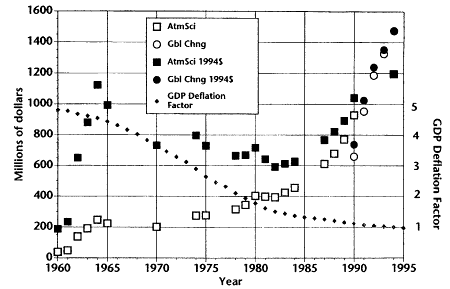
Figure 1.4.1
Federal funding for atmospheric science and global change research in both current
and constant FY 1994 dollars. Estimates for atmospheric science research for FY 1960
-1990 are from summaries prepared by the Subcommittee on Atmospheric Research, and
FY 1994 is a BASC estimate obtained as described in text from data gathered by the
Committee on Environment and Natural Resources. Estimates of global change research
are derived from documents prepared by the U.S. Global Change Research Program as
part of the President's budget. It should be noted that the global change budget includes
research areas other than atmospheric science. The GDP deflation factor used to scale to
the 1994 data was obtained from the Gross Domestic Product (GDP) price deflator (e.g.,
National Science Board, 1996, Appendix 4.1) by shifting to 1994 and then taking the
reciprocal to obtain a multiplicative factor.
Funding for Atmospheric Research
The first comprehensive summary of federal expenditures for atmospheric research was published by ICAS in 1960. Similar summaries were assembled, somewhat sporadically, until the most recent one prepared by SAR in 1990.
The evolution of funding for atmospheric research as portrayed by ICAS-SAR summaries is shown in Figure I.4.1, along with an estimate of the 1994 research budget3 assembled by the Board on Atmospheric Sciences and Climate (BASC) by surveying the agencies. In these data, some of the global change
3 These data are now somewhat out of date, but in the absence of a formal coordinating mechanism for atmospheric research, information on federal expenditures can be assembled only by surveying individual agencies. The last comprehensive compilation was the 1994 Committee on the Environment and Natural Resources research inventory used to prepare some of the analyses presented here.
Page 54
|
TABLE I.4.1 Definition of Functions for BASC's Summary of the CENR |
|
|
Function |
Definition |
|
Data acquisition management |
Acquisition, processing, and management of data from and observing systems or numerical models |
|
Forecasts |
Research related to improving forecasts or applications of meteorological, climatological, and environmental information in public and private sectors |
|
Observing systems |
Development or operation of individual, project-related observing and data systems to acquired atmospheric observations for research purposes |
|
Observing and data system investments |
Development and manufacture of multipurpose observing and data systems for atmospheric research and operations |
|
Process studies |
Theoretical. observational, and laboratory studies of atmospheric or related processes at all scales |
|
Theory and modeling |
Theoretical studies of atmospheric phenomena and development of numerical models and their research applications |
research efforts are included in broader atmospheric research categories; thus, the estimates are not additive. Moreover, whereas atmospheric research funds are for direct research expenditures and concomitant infrastructural support, the total for global change research includes a variety of efforts in other disciplines, such as ecology, ocean sciences, and social science.
An effort to assemble a national research inventory began in November 1993 when President Clinton established the National Science and Technology Council (NSTC) as a replacement for FCCSET and ordered it "to undertake . . . an across-the-board review of federal spending on research and development." In response, the Committee on the Environment and Natural Resources (CENR) asked each agency to provide narrative and budget material describing environmental R&D programs and activities in FY 1994. CENR agencies produced 509 project descriptions, of which some one hundred described atmospheric science research activities. Some 1,000 descriptions, augmented by National Aeronautics and Space Administration (NASA) data on missions for solar and near-Earth space research, were used to prepare the analyses in this section. Although the difficulties of constructing a meaningful budget summary from the disparate sources are recognized, FY 1994 was the last year for which a considerable body of data is available.
To aid understanding of the distribution of funds within atmospheric science, BASC used the CENR project summaries to allot funds to five functions and to each of the five disciplinary areas represented in Part II of this report; funds allocated to related areas (e.g., societal impact, assessment of indoor air quality) were excluded. Definitions of the functions are given in Table I.4.1, and a
Page 55
|
TABLE 1.4.2 Atmospheric Research and Infrastructural Investments, 1994 (million dollars) |
|||||||
|
Category |
Storm Dynamics |
Climate |
Atmospheric Physics |
Atmospheric Chemistry |
Outer Atmosphere |
Total |
|
|
Research Expenditures |
|||||||
|
Data acquisition and management |
5 |
180 |
27 |
23 |
63 |
298 |
|
|
Forecasts and applications |
29 |
45 |
8 |
12 |
0 |
94 |
|
|
Observing systems |
66 |
71 |
54 |
6 |
24 |
221 |
|
|
Process studies |
3 |
45 |
51 |
38 |
16 |
153 |
|
|
Theory and modeling |
16 |
86 |
18 |
31 |
3 |
154 |
|
|
Subtotal |
119 |
427 |
158 |
110 |
106 |
920 |
|
|
Observing and Data Systems Investments |
|||||||
|
NWS AWIPS |
43 |
43 |
|||||
|
NWS ASOS and NEXRAD |
263 |
88 |
351 |
||||
|
NESDIS environmental satellite systems |
249 |
125 |
374 |
||||
|
Defense military satellite program |
26 |
26 |
|||||
|
EOS data and information system |
194 |
194 |
|||||
|
EOS flights |
255 |
255 |
|||||
|
Mission development solar and near-Earth space missions Subtotal |
581 |
662 |
64 |
1,307 |
|||
|
Total Research and Related Activities |
700 |
1,089 |
158 |
110 |
170 |
2,227 |
|
|
SOURCE. Compiled by BASC from CENR research projects inventory for 1994 and NASA data on solar and near-Earth space missions m progress or development in 1994. Allocation of expenditures reported in the CENR project descriptions to categories in this table was done by BASC, in some cases subjectively. |
|||||||
summary of expenditures is presented in Table I.4.2. Many of the expenditures listed for climate are part of the U.S. Global Change Research Program.
The distribution of funding for atmospheric research by agency is shown in Table I.4.3, which was constructed from CENR inventory data and data on total FY 1994 research funding supplied to BASC by the agencies. A summary of agency estimates from the 1990 SAR analysis is shown for comparison. In some cases, base funding included in agency figures was not included in the CENR inventory data; in other cases, infrastructural expenses were not included in the agency estimate.4
4 Note, however, CENR data can be used to provide an independent estimate of total funding for atmospheric research by assuming that only part of the expenditures for data and observing systems should be assigned to research. For example, the CENR total for research projects, added to one-quarter of the total for data and observing systems, gives an estimate of $1,246 million compared to the agency estimate of $1,196 million
Page 56
|
TABLE I.4.3 Agency Expenditures for Research and Related Activities, FY 1990 and 1994 (million dollars) |
|||||
|
Agency Reports |
Compiled from CENR Data |
||||
|
Department or Agency |
FY 1990 (SAR 1990) |
FY 1994 (reported to BASC) |
CENR Research Projects |
Data and Observing Systems |
Agency Total |
|
Commerce |
73 |
254 |
175 |
768 |
943 |
|
National Aeronautics and Space Administration |
509 |
506 |
390 |
513 |
903 |
|
Energy |
45 |
93 |
107 |
0 |
107 |
|
Defense |
122 |
67 |
71 |
26 |
97 |
|
Environmental Protection Agency |
21 |
84 |
84 |
0 |
84 |
|
National Science Foundation |
106 |
135 |
77 |
0 |
77 |
|
Interior |
25 |
15 |
14 |
0 |
14 |
|
Agriculture |
15 |
16 |
1 |
0 |
1 |
|
Transportation |
13 |
26 |
1 |
0 |
1 |
|
Total |
929 |
1,196 |
920 |
1,307 |
2,227 |
|
SOURCE: Compiled by BASC from CENR research projects inventory for 1994 and NASA data on solar and near-Earth space missions in progress or development in 1994. |
|||||
Because of these and other shortcomings in atmospheric sciences budget data, the analyses and summaries presented here involve subjective judgment but still give a rough sense of the magnitude and distribution of federal funding in the atmospheric sciences. Nevertheless, key questions regarding balance, focus, and year-to-year changes in federal funding of atmospheric research cannot be answered because of the lack of substantive budget data and analysis.
Funding for Atmospheric Information Services
The national investment in atmospheric sciences includes federal expenditures for the acquisition and management of atmospheric observations, preparation of forecasts and warnings, and distribution of atmospheric information to a wide variety of users in the private and public sectors. It would be of value to estimate private expenditures to provide and procure atmospheric information, a topic about which little is known.
In sharp contrast to the difficulties in assembling research budget summaries, the federal expenditures for meteorological operations are summarized in detail each year by the Office of the Federal Coordinator for Meteorology (OFCM). The funding history since 1969 is shown in Figure I.4.2, and the distribution of FY 1994 expenditures by agency is given in Table I.4.4.
Page 57
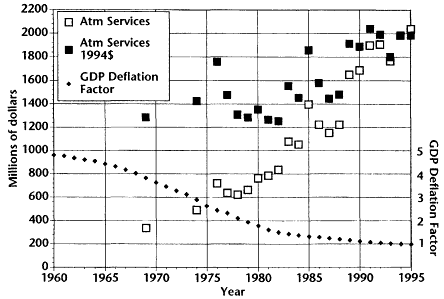
Figure I.4.2
Federal funding for atmospheric information services (often referred to as operational
meteorology) for FY 1969-1995 as summarized by the Office of the Federal Coordinator for
Meteorological Services and Supporting Research, in both current and constant FY 1994
dollars (see legend for Figure I.4.1 for further details).
|
TABLE I.4.4 Federal Expenditures for Meteorological Operations, FY 1994 (million dollars) |
|||
|
Department or Agency |
Budget |
||
|
Agriculture |
12 |
||
|
Commerce (NOAA) |
|||
|
National Weather Service |
7230 |
||
|
National Environmental Satellite, Data, and Information Service |
401 |
1,124 |
|
|
Defense |
506 |
||
|
Interior |
|||
|
Bureau of Land Management |
1 |
||
|
Transportation |
|||
|
FAA |
360 |
||
|
Coast Guard |
7 |
367 |
|
|
National Aeronautics and Space Administration |
8 |
||
|
Nuclear Regulatory Commission |
<1 |
||
|
Total |
2,018 |
||
|
SOURCE: Office of the Federal Coordinator for Meteorology and Supporting Services, with adjustments from data furnished directly by agencies. |
|||
Page 58
It should be understood that the funding for research and related activities (Table I.4.3) and those for meteorological operations (Table I.4.4) are not strictly additive since there are likely to be some overlaps in the reported data.
Summary of Federal Funding
The distribution of federal funding for weather information services is well documented, but funding within key categories of atmospheric research is known only approximately. The question of whether the United States has a balanced and appropriately focused research effort in the atmospheric sciences cannot be answered at present. Obtaining more detailed budgeting information is critical for determining whether important tasks have sufficient support and whether important initiatives are being given appropriate priority.
Leadership and Management Planning
Many government agencies have interest and involvement in atmospheric research and operations because of the intimate relations between atmospheric phenomena and events and many of the nation's activities. Before it was disbanded, SAR coordinated the research efforts of some 10 agencies. OFCM coordinates operational meteorology through a number of committees and activities. An effective coordinating mechanism for advancing and managing the U.S. Global Change Research Program was developed by CEES under FCCSET and has continued under CENR. The U.S. Weather Research Program is similarly organized and managed to focus on improving understanding and prediction of storm-scale phenomena. A significant component of atmospheric chemistry is coordinated through the North American Strategy for Tropospheric Ozone program and the CENR Subcommittee on Air Quality Research. These interagency interests indicate clearly the breadth of the atmospheric sciences and their importance to the nation.
As evident from this report, the advance of atmospheric science requires that appropriate priorities be determined and implemented so that the research enterprise remains vigorous and focused on activities important in the context of broad national goals.
No One Sets the Priorities; No One Fashions the Agenda
Today, there is reason for considerable concern about planning for atmospheric research. No one sets the priorities; no one fashions the agenda. In part, this is a consequence of the attempt to direct federal research efforts toward a number of strategic initiatives managed by the National Science and Technology Council. In this structure, atmospheric science is viewed as a potential contributor to a number of cross-cutting issues such as global change or natural disasters.
Page 59
However, for the efforts of atmospheric sciences to serve national needs effectively, they must be integrated into research approaches that serve a number of initiatives simultaneously. Moreover, this integration must recognize that the scientific advances needed to facilitate progress in addressing strategic issues, whatever their interdisciplinary motivation, will occur within the disciplines themselves.
Thus, BASC believes that a national research environment requires a strong disciplinary planning mechanism. This view is reinforced by the very basic contemporary reality for atmospheric sciences and the nation: opportunities for scientific progress and societal service in the atmospheric sciences are far more plentiful than resources. For this reason, the efforts of the discipline must be guided by an overall vision and reasoned priorities.
Therefore, all partners in the atmospheric enterprise—in government, in universities, and in a variety of commercial undertakings—must join together as an effective team focused on the future. For this to come to pass, there must be clear responsibilities for priorities and progress, for resources and results.


