
2
Current Status of Marine Fisheries
In general, considered on a single-species basis, many marine fisheries are fully exploited or overexploited, while relatively few seem to have the potential for increased exploitation.1 In general, this is true both for the United States and globally, especially in estuarine, nearshore, and continental-shelf fisheries, which produce approximately 75 percent of the world's fish catches (Pauly and Christensen 1995).
The primary source of global information about the condition of fisheries is the Food and Agricultural Organization (FAO) of the United Nations. In the United States the task of carrying out assessments has been primarily the responsibility of the National Marine Fisheries Service (NMFS) of the National Oceanic and Atmospheric Administration, U.S. Department of Commerce. Regional fishery management councils (established under the authority of the Magnuson-Stevens Fishery Conservation and Management Act of 1976) also are involved in the assessment of fish stocks in federal waters. Interstate fishery commissions in the Atlantic, Gulf, and Pacific regions work with states and the NMFS to conduct assessments of migratory fish stocks in state waters. Although assessments and statistics from FAO and NMFS provide only an imperfect characterization of the status of global and U.S. fisheries, the assessments—corroborated by many kinds
|
1 |
Estimates of utilization, according to the National Marine Fisheries Service's terminology (1993, 1996b), are based on the concept of long-term potential yield (LTPY), the maximum long-term (or sustainable) average that can be maintained with conscientious stewardship through regulating total catch. A fishery resource is fully utilized when the current fishing effort is about equal to the amount needed to achieve LTPY. If the effort is greater than that, the resource is considered to be overutilized; if the fishing effort is less, the stock is considered to be underutilized. As noted in Chapter 1, this terminology should be reevaluated. |
of evidence—appear to provide a reasonably accurate description of the overall picture.
Global Overview
Fishing is an important source of food, recreation, community development, wealth, and cultural values in many countries. Although thousands of freshwater and marine fish and shellfish species are used globally, a relatively small number of these species provide the major fraction of the global marine catch. The 10 marine species that provided the greatest catch in 1993 accounted for 35 percent of the commercial marine catch (Figure 2-1, FAO 1996b) and the top 20 species accounted for 46 percent of the global marine catch. Marine fish production is shown in Figure 2-2 and total fish production in Figure 2-3. In addition to the animals mentioned, marine algae (seaweeds) are extensively harvested in many parts of the globe (Abbott and Norris 1985, Akatsuka 1990, Akatsuka 1994, Santelices 1989, Tseng 1984).
Recent estimates indicate that the global first-sale revenues from fishery products are approximately $U.S. 95 billion annually and that fishery products account for about 20 percent of the animal protein consumed by humans (FAO 1995b). Fisheries provide direct and indirect employment to about 200 million people worldwide (Garcia and Newton 1997). Fisheries are especially important in developing countries, which increased their proportion of global catch from about 40 to 65 percent from 1973 to 1993. The net value of fishery products exported from developing countries totaled $16 billion in 1994 (FAO 1997a), greater than the exports of coffee, bananas, rubber, tea, rice, and many other commodities that developing countries have traditionally relied on for foreign exchange (FAO 1997b).
Global marine fish production increased at an average rate of about 3.6 percent per year from 1950 to 1995, from about 18 million to about 91 million metric tons,2 including mariculture production (Figure 2-2, FAO 1997a). In the same period, the world's population increased from 2.5 billion to 5.7 billion people (U.S. Census Bureau 1998), an average annual increase of 1.8 percent. In 1995 total fish production (both freshwater and marine, both through culture and through fishing) was approximately 112 million t (Figure 2-3), of which marine landings accounted for approximately 84 million t. In 1996 the total production reached approximately 116 million t; the increase was due mainly to an increase in freshwater aquaculture production, mainly in China (FAO 1997c). The supply of fish and fish products for human consumption (including freshwater fish and aquaculture products) reached roughly 14 kg per person annually in 1995 (FAO 1997a). By 1995, mariculture accounted for 6.7 million t, 7.4 percent of the total global marine fish yield; freshwater aquaculture provided 14.6 million t (FAO
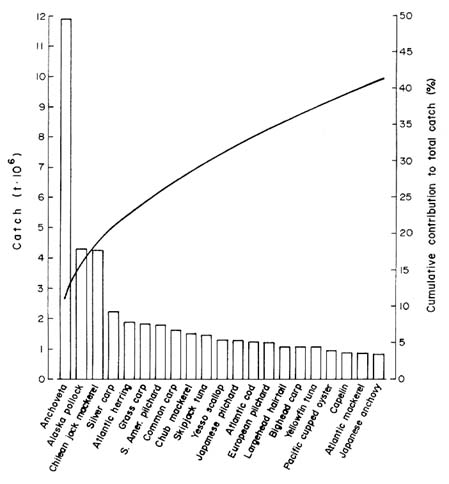
FIGURE 2-1 Total production by principal (mainly marine) species in 1994. Production includes mariculture and aquaculture, but represents catch for most species. Source: Redrawn from FAO (1996b).
1997a). Approximately 31.5 million t (28 percent) of world fish production was used for animal feed—including feed for mariculture—and other products that do not contribute directly to the human food supply in 1995.
In addition to fish that are caught and processed, a substantial number of fish and other organisms are caught and discarded—usually dead—at sea. Discards are a result of bycatch, which results because fishing gear and methods are not selective enough to catch only the target species, and of high grading, the discarding of smaller or less desirable fish in favor of larger or more desirable fish that are caught later. Some bycatch is retained, but the remainder is discarded when
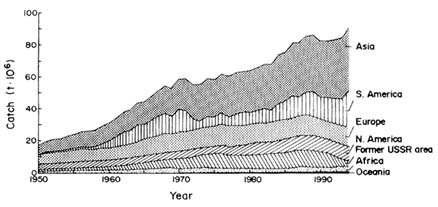
FIGURE 2-2 Total marine fishery production in 1994. Production includes mariculture but represents catch for most species. Source: Redrawn from FAO (1996b).
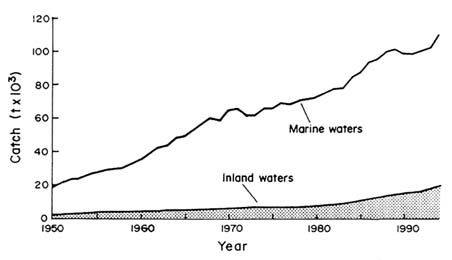
FIGURE 2-3 Total world fishery production, including freshwater and marine, for 1994. Production includes aquaculture but represents catch for most marine species. Source: Redrawn from FAO (1996b).
the species, size, quality, or condition of the fish reduce their value, or when fishery management regulations prohibit their retention. Alverson et al. (1994) estimated that commercial marine fisheries around the world discarded an estimated 27 million t of nontarget animals in the early 1990s, an additional biomass about one-third as large as total landings.
In addition to fish mortality caused by landings and discards, fishing can cause additional unaccounted mortality. Potential causes of unaccounted mortality include illegal or misreported landings; escapement or avoidance mortality that occurs when fish are injured by fishing gear but are not captured; and ghost fishing mortality, caused by lost gear (e.g., traps and gillnets) that continues to catch fish. The magnitude of unaccounted mortality is unknown but may be high for some fisheries. For example, the Scottish Fishermen's Federation estimated illegal or misreported landings, probably of groundfish and crustaceans, to be 100 to 200 percent of the reported catch (ICES 1995). Myers et al. (1997) concluded that discards of young undersized fish were an important reason that the fishing mortality of northern cod off Canada's maritime provinces was consistently underestimated in the 1980s, leading to the overfishing that caused the collapse of the fishery (see discussion of this case at the end of this chapter). Although these examples are not necessarily representative of all fisheries, they show that the total mortality resulting from fishing can easily be underestimated.
The FAO (1994a) and Garcia and Newton (1997) have concluded that the relatively stable catches of the early 1990s indicated that capture fisheries are near, or have reached, their sustainable limit based on existing fishing techniques and market systems. The increase in catch between 1950 and 1994 shown in Figure 2-2 occurred because of steadily increasing demand for fishery products, resulting in increased fishing capacity and effort. Fisheries were developed or expanded on formerly less-exploited or unexploited species and populations. While global assessments indicate that there are still opportunities to expand some fisheries, most are fully exploited or beyond, based on single-species considerations (Garcia and Newton 1997). Some have been so depleted that they are producing much less than their long-term potentials. Global fishing capacity is much greater than needed for sustainable marine fisheries, again based on single-species considerations.
More than 25 years ago, Gulland (1972) estimated that the potential sustainable yield from traditional fishery resource species (excluding Antarctic krill and oceanic mesopelagic fishes) was about 100 million t, with a practical limit (due to imperfect management and multispecies interactions) of about 80 million t, similar to catches that have been achieved in recent years and to recent FAO assessments.
Maximum potential global marine fisheries yield has also been estimated by Schaefer (200 million t, 1965), Ryther (100 million t, 1969), Idyll 400–700 million t, 1978), Houde and Rutherford (more than 300 million t from all marine ecosystems, 1993), and others. Based on those estimates, one might conclude
that we have not yet reached maximum global fisheries yield. However, most of the highest estimates—admittedly upper limits in some cases—were made using unrealistic assumptions about food-web structure (Pauly 1996), effects of bycatch, feedback effects of fishing on other fish populations and marine ecosystems, and the technical and economic feasibility of new fisheries.
Limits to Global Production
Three kinds of information suggest that marine fish catch is near, at, or above its maximum sustainable level: estimates of theoretical limits imposed by available primary production, information on the degree of utilization of fish populations, and information on the catch per ton of fishing vessel.
Food-Web Limitations
The capacity of the ocean to produce fish is limited in part by the amount of marine phytoplankton produced annually. Fishery landings tend to be higher from ecosystems with higher levels of primary production, especially marine areas characterized by fronts, convergence, and upwelling areas. Satellite and in situ measurements of phytoplankton concentrations and in situ measurements of nutrients, water temperature, irradiance, and primary production allow estimates of the primary production of the global ocean, as well as regional estimates. An upper limit to the ocean's potential fisheries yield has been estimated many times by applying knowledge of the amount and location of global primary production, trophic level of the catch, and the transfer efficiency of biomass among trophic levels.
Pauly and Christensen (1995) used global catch data—which they divided according to trophic level—to estimate the flow of carbon up through the trophic levels of global marine ecosystems. They estimated that the transfer efficiency between trophic levels was about 10 percent, and concluded that about one-quarter to one-third of total primary production in coastal and continental shelf waters is needed to support recorded landings plus discards.
Houde and Rutherford (1993) used relationships between catches and primary production (Nixon 1988) and between fish production and primary production (Iverson 1990) to estimate a partitioned global fisheries production for estuaries, coastal zones, and upwelling areas. They estimated a total global fisheries production in those ecosystems of 543 million t, from which 111 million t might be removed as yield. (Note that Houde and Rutherford's estimate of the total potential yield of more than 300 million t was based on an estimated production of more than 1,300 million t in all marine ecosystems. They considered open-ocean production to be technologically difficult to use.) These estimates suggest that landings are near or beyond their sustainable limit, particularly if fish production lost as discards and unaccounted mortality are considered.
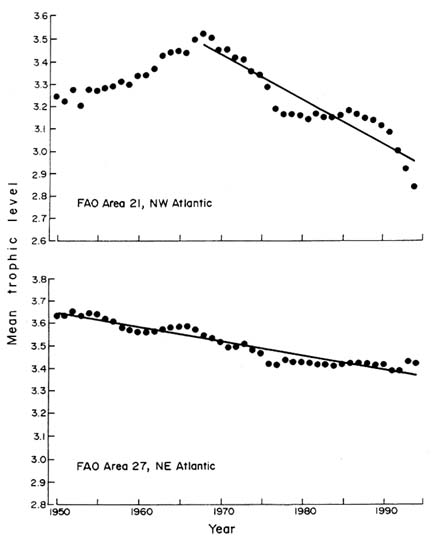
FIGURE 2-4 Trends of mean trophic level of fish landings in the North Atlantic. Source: Redrawn from Pauly et al. (1998).
Another line of evidence suggesting that global marine catch might not increase, even by fishing at progressively lower trophic levels, is provided by analyzing changes in the mean trophic level of marine fishery landings. Figure 2-4 shows the mean trophic level of global marine catches and of catches from FAO areas 21 (northwest Atlantic) and 27 (northeast Atlantic) based on species- or
group-specific trophic levels taken from FAO fishery statistics and FishBase 97 (see www.fishbase.org), and described in detail by Pauly et al. (1998).
Figure 2-4 also shows significant declines in the average trophic level of fish catches from the 1950s for the northeast Atlantic and from the 1970s for the northwest Atlantic. This reflects a decrease in the proportion of long-lived carnivores in the catch relative to shorter-lived smaller pelages and invertebrates. Fishing down the food web, while overfishing higher trophic forms, does not necessarily lead to increased total catches. As fishing takes animals lower in the food web, an increasing portion of the total catch may consist of animals for which there are no current markets or that are so diffuse that the cost of their capture does not warrant the expense (e.g., some large zooplankton species). In addition, the loss of predators (i.e., animals higher in the food web) can lead to an increase in competitors of the target species. The average trophic level of landed species can drop rapidly as catches of top predators or decline as observed in most other FAO areas analyzed in this fashion (Pauly et al. 1998).
Degree of Fish-Stock Utilization
FAO periodically reports the degree of utilization of global fish stocks, classifying fisheries as underexploited,3 moderately exploited, heavily to fully exploited, overexploited, depleted, and recovering. The largest number of fisheries (44 percent) are classified as heavily to fully exploited. Twenty-five percent of stocks have been fished beyond sustainable limits (overexploited, depleted, and recovering). For the United States during the period 1992–1994, the picture was similar despite slight differences in terminology: 12 percent of 275 stock groups were classified as underutilized, 34 percent as fully utilized, 23 percent as overutilized, and 31 percent were of unknown status (NMFS 1996a). Of the 191 stock groups whose status was known, 82 percent were fully utilized or overutilized. A U.S. example of a formerly overexploited and now recovered stock is striped bass (Morone saxatilis): Georges Bank haddock (Melanogrammus aeglefinus) represents a depleted stock.
Globally, some increase in exploitation might be possible for 32 percent of the landed species, but Garcia and Newton (1997) noted that, given past experience, heavily to fully exploited fisheries are likely candidates for future overfishing. This assertion is demonstrated by Alverson et al. (1994), who reported
|
3 |
We have used FAO's terminology here, as we have used NMFS's similar terminology (underutilized) in quoting U.S. figures below. This does not constitute an endorsement of the terms by this committee (see Chapter 1). Clearly, the terms underexploited and underutilized imply a policy goal of full utilization, however that is defined. The terminology reflects a particular policy framework. One of the major arguments in this report is that aspects of the policy framework of our relationship to marine ecosystems need reexamination. The committee does not at present take a position on the desirability of the above terms but recommends that readers keep implied policy frameworks in mind. |
(based on FAO data) that from 1980 to 1990 the number of overexploited fisheries increased by 250 percent, whereas the number of underexploited fisheries decreased by about 75 percent. Depleted species are being replaced in today's catches by species that were less heavily fished in the past.
For example, the Chilean Inca scad (Trachurus murphyi), Japanese pilchard (Sardinops sagax melanosticus), South American pilchard or Chilean sardine (Sardinops sagax sagax), and skipjack tuna (Katsuwonus pelamis) replaced chub mackerel (Scomber japonicus), Atlantic mackerel (Scomber scombrus), Atlantic cutlassfish (Trichiurus lepturus), and saithe (Atlantic pollock, Pollachius virens) in the top-10 species list between 1973 and 1993. In the United States, skates and dogfish have replaced more commercially valuable fish on Georges Bank. This process of depletion of one resource and replacement by another is limited by the number of potentially catchable and usable species; depleted species may not return to previous abundance levels. For example, Atlantic halibut (Hipploglossus hippoglossus) and spring-spawning Icelandic herring (Clupea harengus) have not recovered from overfishing, although they probably would if mortality were reduced (Myers et al. 1997). Many shark populations appear to be declining as well. For instance, Van der Elst (1979) described the impact of South African antishark nets on local populations of oceanic sharks, and the resultant and unanticipated decline in nearshore bony fishes. On a global scale, Manire and Gruber (1990) concluded that sharks were overfished by approximately 30 percent per year in U.S. waters; and cited domestic demand for shark meat; wasteful fisheries practices, especially discarded bycatch of sharks; irrational dread; and an increasing global demand for shark fins as major factors contributing to excess fishing mortality of sharks.
In addition, unexploited fish populations that are long lived and slow growing cannot support high exploitation rates, unlike populations of faster-growing, short-lived species. For example, the five species of the genus Sebastes, including the Pacific Ocean perch itself (S. alutus) and the northern (S. polyspinus), rougheye (S. aleutianus), sharpchin (S. zacentrus), and shortraker (S. borealis) rockfishes off the northwestern and Alaskan coasts of the United States and the coast of British Columbia, are all slow-growing and were severely overfished, although they have now largely recovered (NPFMC 1997, NMFS 1996b). The marbled rockcod (Notothenia rossi) in the Southern Ocean also has been severely overfished (Kock 1992).
Catch Per Ton of Fishing Vessel
Approximately 3.5 million vessels are engaged in fisheries worldwide; about two-thirds are small undocked vessels (FAO 1995b), but the total also includes about 24,000 high-seas fishing vessels of more than 500 gross tons (NMFS 1993). The gross tonnage of the world's fishing fleets (decked vessels only) increased by an average of 2.9 percent annually from 1970 to 1992. This rate of
increase in gross tonnage exceeded the rate of increase in catch (1.8 percent annually) during the same period: the ratio of metric tons of fish caught per ton of fishing vessel decreased from 4.3 in 1970 to 3.0 in 1992. Assuming that additional fishing capacity has at least the same average fishing power per ton as the preexisting fleet—almost certainly true—and that the new vessels are used at least as much as the older ones—probably the case—the decreased ratio of catch to fishing tonnage provides further evidence that fish populations declined on average during this period. The discrepancy between fishing capacity and catch is even greater when one considers the increase in fishing power of vessels as a result of technological improvements. Based on an analysis conducted by Fitzpatrick (1995), the rate of increase in fishing power resulting from technological improvements has averaged 4.4 percent annually since 1965. Garcia and Newton (1997) fit a production model to global catch and gross tonnage data, adjusted for fishing power increases. Their analysis indicates that catch is higher than the maximum sustainable yield of world fisheries and that fishing capacity is too large to be economically efficient.
The decline in the per-ton catch rate of fishing vessels also indicates an economic problem, although lower catches have probably been partially offset by price increases. The economic problems also include the substantial debt service or depreciation of fishing vessels. Government subsidies have been used worldwide to increase employment and food supply. Subsidies have probably stimulated excess growth in the world's fishing fleet and must be a major factor in poor economic performance. They may amount to as much as $27 billion per year, although information about subsidies and how people and organizations react to them is not readily available, as discussed in Chapter 4. These problems, usually referred to as overcapitalization or excess fishing capacity, are discussed in more detail in chapters 4 and 5.
United States Overview
Fishing Sectors
Marine fishing activities in the United States are divided among commercial, recreational,4 subsistence,5 and indigenous sectors. The balance of activity among these sectors depends on the areas and species fished and whether the comparison is made in terms of weight or number of fish landed or dollars injected into the U.S. economy. All sectors are subject to fishery management in the United States through the regional fishery management councils and, in some cases, through
state and international agreements as well. Fisheries are important to the culture and social structure of their practitioners and can have a major economic impact, at least regionally.
Commercial Fisheries
The United States has the largest exclusive economic zone (EEZ) of any nation, covering about 11 million km2.The United States was the fifth-largest fish producer in 1993, following China, Japan, Peru, and Chile (FAO 1995b). The first-sale value of U.S. commercial landings (4.47 million t6) in 1997 was estimated at $3.5 billion (NMFS 1998), with a direct contribution to the gross domestic product (GDP) of $20.2 billion. The United States is also one of the world's largest fish-trading nations, with a deficit of $4.6 billion in 1994 resulting from $12 billion in imports and $7.4 billion in exports (NMFS 1995a).
U.S. commercial landings were relatively stable at about 2 million per year from 1935 until 1977, when the United States extended its jurisdiction over fisheries to 200 miles from the coast and increasingly excluded foreign vessels. At present foreign fishing is not permitted in the U.S. EEZ, although in some cases—for example, menhaden (Brevoortia tyrannus) in the Gulf of Maine—foreign processor vessels receive catches from the U.S. EEZ. Since 1977, landings have more than doubled, to 4.47 million t in 1997 (NMFS 1998). The rapid rise in U.S. catch in the late 1980s was due primarily to the walleye pollock fishery that resulted from displacements of foreign vessels during the 1970s and into the 1980s (Figure 2-5). About half of the U.S. landings are from the fishing grounds off Alaska, primarily walleye pollock (Theragra chalcogramma). Pacific cod (Gadus macrocephalus), and various salmon (Oncorhynchus) species. As is true for most fishing nations, U.S. fishers are dependent on a small number of species, with almost 50 percent of the catch composed of walleye pollock from the Pacific Ocean and menhaden (Brevoortia tyrannus and B. patronus) from the Gulf of Mexico and Atlantic Ocean.
Recreational Fisheries
Recreational fishing also is important in the United States. Although the recreational catch is only about 2 percent as large as commercial landings for all species combined (90,000 t in 1994), there are more than 17 million marine recreational fishers, who in recent years made more than 66 million fishing trips per year, caught about 360 million fish, and spent $25.3 billion per year on
fishing-related activities (NMFS 1995a), comparable to the contribution to the GDP of commercial fisheries. For some fisheries in which both commercial and recreational fishers participate (e.g., summer flounder [Paralichthys dentatus] and bluefish [Pomatomus saltatrix]), the recreational catch is a significant portion or even a majority of the total (Table 2-1).
Recreational and commercial fishers often conflict over management goals and methods for various fisheries. In some cases, recreational fishers are effective at influencing policy, as for example recent restrictions they supported on the use of nets in coastal waters of various states (including a legislative ban on gillnets in Texas in 1988: California's Proposition 132, which banned net fishing starting in 1990: a Florida legislative ban on coastal nets that passed in 1993: and a Louisiana legislative restriction on nets passed in 1994). In other cases, they are not successful. The allocation of available marine fisheries resources between commercial and recreational sectors is a major issue for regional fishery management councils and in the political arena. Some of the disputes and the differences—and occasional agreements—between commercial and recreational fishers are described in almost every issue of National Fisherman and Saltwater Sportsman: for a discussion of net bans, for example, see the August 1996 issue of National Fisherman. The resolution of such disputes and allocation controversies is made more difficult because recreational landings often are underreported or not surveyed. Serious allocation disputes have been limited thus far primarily
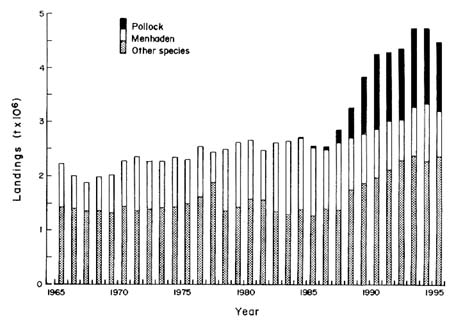
FIGURE 2-5 Total U.S. commercial landings, 1965–1995. Source: Redrawn from NMFS data.
TABLE 2-1 Comparison of U.S. Recreational and Commercial Catches for Selected Species in 1994
|
Fish Species |
Recreational Catch (t x 1,000) |
Commercial Catch (t x 1,000) |
|
Bluefish (Pomatomus saltatrix) |
7.2 |
4.4 |
|
Red snapper (Lutjanus campechanus) |
1.3 |
1.5 |
|
Spotted seatrout (Cynoscion nebulosus) |
5.1 |
1.1 |
|
Summer flounder (Paralichthys dentatus) |
4.2 |
8.9 |
|
Winter flounder (Pleuronectes americanus) |
0.7 |
3.6 |
to the United States and a few other industrialized nations (e.g., New Zealand),although the growth of ecotourism could create commercial-recreational fishery conflicts in industrializing nations.
Indigenous People's Fisheries
Indigenous people's fisheries are a minor part of total catches but are particularly important in cultural and social terms. Indigenous marine fisheries in the United States—primarily in Washington, Oregon, California (NRC 1996b), and Alaska—are subject to treaties between the United States and tribal groups. Tribal fisheries for salmon include commercial, ceremonial, and subsistence uses. The Northwest Indian Fisheries Commission handles treaty rights related to salmon in the Puget Sound area. The Columbia River Inter-Tribal Fisheries Commission represents four tribes in the Columbia River basin of Oregon. Fishing by three tribes in the Klamath River Basin in California is not protected by treaty, but 50 percent of Klamath River chinook salmon are allocated to these tribes by government regulation (NMFS 1996a). The Pacific Fisheries Management Council, as well as its Scientific and Technical Committee and its Salmon Technical Team, have Native American tribal representatives. There is also a Native American allocation for sablefish (Anoplopoma fimbria) off the coast of Washington. For communities in western Alaska, which are largely populated by Alaska natives, Section 305 of the Magnuson Fishery and Conservation Act and Section 111 of
the 1996 amendments provide for a Community Development Quota Program. The program allots varying percentages of the total allowable catch (TAC) of several fisheries to these communities; by 1999 those communities will be allotted 7.5 percent of the TAC of Bering Sea groundfish and crabs. The amendments also allow the establishment of a similar program in the Western Pacific Regional Fishery Management Area (Hawaii and other U.S. Pacific islands).
Subsistence Fisheries
Subsistence fisheries—fisheries conducted for food, material, and fuel but not primarily for commerce or recreation—occur in many parts of the world, most commonly in nonindustrialized and tribal societies. Although the sale of fish for cash is not included in subsistence fishing, trading fish for other food or services is an important part of subsistence economies in many places, and cash from activities in market economies is used to finance subsistence fishing (e.g., NRC 1994a). Subsistence fishers, like others but perhaps to a greater degree, develop a large store of traditional knowledge. Subsistence fishing is recognized in many laws and regulations. It does not usually constitute a major portion of the landings except locally.
Status of U.S. Fisheries
In its most recent assessment of the condition of U.S. fisheries, NMFS (1996a) evaluated 275 stocks caught by fishers in nearshore coastal waters, the EEZ, and the high seas beyond the EEZ for the period 1992–1994. Of the 191 stocks for which information was available, 33 percent were overutilized and 49 percent were fully utilized, leaving only 18 percent underutilized. Forty-six percent were below the level of abundance required to produce the greatest long-term potential yield. The long-term potential yield of the U.S. fisheries within the U.S. EEZ is estimated on a single-species basis to be 8.1 million t per year, which is much greater than the recent yields (NMFS 1996a). Based on the calculations in that estimate, for the United States to achieve its potential increase in long-term potential yield, some (''underutilized") fisheries would need to be fished more heavily, but, more importantly, fishing on overutilized stocks, bycatch, and unaccounted mortality will need to be reduced so that stocks can rebuild. The estimated long-term potential yield and maximum sustainable-yield levels can be used as reference points to help guide the sustainable development and prosecution of fisheries or the rebuilding of marine fish stocks that have been overfished.
Although there is limited information available regarding the overall economic performance of U.S. fisheries, they are undoubtedly suffering from over-capitalization at a national level (with some regional exceptions), as has been reported by FAO for fisheries worldwide. NMFS (1996b) reported that there were about 23,000 commercial fishing vessels in the United States in 1987 (the
latest year for which there is good information), which is more capacity than is required to achieve the long-term potential yield from U.S. fisheries. For example, the capacity off Alaska has been estimated to be two and a half times that necessary to catch the available resources (North Pacific Fishery Management Council [NPFMC] 1992). Major losses in revenue from New England fisheries have resulted from overfishing, driven in large part by excess capacity (Edwards and Murawski 1993).
A Canadian Example: Northern Cod
The case of the northern cod is an example of the effects of overfishing as well as institutional difficulties in applying scientific findings to management. This overfishing occurred despite reasonably conservative target fishing mortalities; the problem was largely due to systematic errors in stock assessments exacerbated by unreported (illegal) discarding of small fish and perhaps unreported catches, and later to a failure of management to respond quickly to corrected assessments.
The fisheries of the Atlantic Canada region have been dominated by groundfish (Munro 1980); the cod fishery was unquestionably of greatest importance. Cod (Gadus morhua) served as the base of the fishing industry in Newfoundland, Nova Scotia, and other provinces in the region (e.g., New Brunswick). The northern cod fishery is an instructive example of overexploitation of a fishery. It has been much discussed, recently by Walters and Maguire (1996) and Hutchings and Myers (1994), who focused on fishery biology, and by Neis (1992), Steele et al. (1992), and Finlayson (1994), who focused on the sociology of science. A combination of lack of data, improper handling of available data, and overconfidence in methods led to overfishing and the collapse of the fishery.
The offshore catch of northern cod expanded from approximately 240,000 t annually in the mid-1950s to a peak of 700,000 t in 1968 (Munro 1980). Total catches of northern cod declined steadily thereafter. By the early 1970s, distress in the northern cod inshore fishery also was evident. The Canadian government planned to rebuild the resource through reduced fishing by the distant water fleets. As the resource rebuilt, the total allowable catch (TAC) for northern cod would gradually be increased (Finlayson 1994). The management strategy adopted was expected to result in sustainable catches averaging 20 percent of the exploitable biomass (Canada 1990) by the late 1980s—roughly 400,000 t annually (Munro 1980). In the years immediately following implementation of this plan, the northern cod resource appeared to be rebuilding as planned, but the actual landings never achieved even 260,000 t per year. The offshore sector of the cod fishery always succeeded in taking its allocation, but the inshore sector landings declined by 35 percent from 1982 to 1986 (Buffet 1989, Finlayson 1994).
In response to these trends, the Canadian Atlantic Fisheries Scientific Advisory
Committee (CAFSAC) undertook in 1988 a review of its stock-assessment methods. CAFSAC concluded that the northern cod stock was in fact substantially smaller than previously believed, a view confirmed by an independent Northern Cod Review Panel (Canada 1990), which estimated that the actual fishing mortality rates had been at least double those projected in the Canadian management strategy (Canada 1990, p. 3). CAFSAC concluded that the northern cod TAC for 1989 should be reduced from the continuing 266,000 t to 125,000 t. The Canadian government, fearful of the economic disruption and dislocation that such a draconian reduction in the TAC would entail, reduced it only to 235,000 t (Buffet 1989).
In mid-1992, after poor catches, a moratorium was established on all directed commercial fishing for northern cod for a period of two years, during which deterioration of the stock continued. The moratorium was extended, remains in place, and is expected to remain in effect for the indefinite future. Recent reports indicate that the northern cod stock is at a historically low level and that there are, as yet, no significant signs of recovery of the stock (Canada 1995).
The causes of the resource management catastrophe are the focus of intense debate in Canada (Neis 1992, Steele et al. 1992, Finlayson 1994, Walters and Maguire 1996), although the proximate cause is clearly overfishing (Hutchings and Myers 1994) supported by erroneous assessments of stock size and fishing mortality (Myers et al. 1997). The reasons for the errors in stock assessments are complex. Overcapitalization in the fishery may have exerted pressure to interpret stock-assessment data in an excessively optimistic manner (Canada 1990), as did an overreliance on the science and culture of quantitative stock assessment (Walters and Maguire 1996, Finlayson 1994). The northern cod stock-assessment procedures appear to have been flawed from 1977 until at least 1985, owing to statistical inadequacies of the biomass model used, overreliance on catch-per-unit-effort data, variability of the data set, and relatively short and unreliable data series (Canada 1990, Walters and Maguire 1996). Ironically, the northern cod is one of the few examples that seems to show a clear and positive relationship between parent stock and recruitment (Hutchings and Myers 1994). Although the intuitive expectation is that the more spawning adults there are in the population, the more recruits there will be, most fish populations do not show such a relationship. For the northern cod, estimates of recruitment were not corrected for changes in spawner biomass, which themselves were overestimated (Hutchings and Myers 1994). Fishing mortalities were underestimated, probably because of unreported discards of young fish—a significant source of mortality—and perhaps unreported or underreported catches of adult fish (Myers et al. 1997).
Recent analyses indicate that the cod populations in the western Atlantic are not the only ones in danger of being overfished. For example, Cook et al. (1997) concluded that there is an urgent need to reduce the exploitation rate on North Sea cod to avoid risk of collapse (they also found a significant relationship between
parent stock and recruitment). Several NMFS assessments of cod in the Gulf of Maine also reached this conclusion, recently confirmed by the National Research Council (NRC 1998b).
Conclusions
Global marine fish catch is at or near its sustainable limit. Many species and some regions are seriously overexploited. Populations of long-lived, slow-growing species are especially vulnerable to collapse as a result of overfishing. The estimates are primarily based on single-species considerations; as described in later chapters, consideration of fishing's effects on biological communities and ecosystems and the need to balance a variety of societal goals reinforces the conclusion that a sustainable general increase in the yield of marine fisheries is probably not possible. Indeed, a moderate level of exploitation may be a better goal for fisheries than full exploitation, because full exploitation tends to lead to overexploitation. Under this strategy relatively few fisheries worldwide (i.e., the relatively few commercial stocks that are lightly fished) are good candidates for increased exploitation. Better management is possible, however, and could greatly improve the situation.


