
Appendix Glossary, Abbreviations, and Acronyms
Å.
See Angstrom.
Accelerator.
A machine that increases the kinetic energy of charged particles such as electrons and protons for collisions with another beam or with a fixed target.
AGASA.
Akeno (Japan) Giant Air Shower Array, a cosmic-ray detector.
AGS.
Alternating Gradient Synchrotron, a 33-GeV proton accelerator at Brookhaven National Laboratory.
Amanda.
Antarctic Muon and Neutrino Detector Array, a high-energy neutrino detector in the ice cap at the South Pole.
AMS.
Alpha Mass Spectrometer experiment, a superconducting-magnet particle detector to be flown on the space station to search for cosmic rays of antimatter and dark matter.
Angstrom.
A unit of distance, 10−10 m, denoted by Å.
Annihilation.
See Antiparticle.
Antimatter.
Matter composed of antiparticles (e.g., antiprotons, antineutrons, antielectrons) instead of particles (e.g., protons, neutrons, electrons).
Antiparticle.
Each particle has a partner, called an antiparticle, with identical properties except that its electric charge and a few other properties are opposite those of the particle. When a particle and its antiparticle meet, they can annihilate each other.
Antiproton.
Antiparticle partner of the proton.
APS.
The American Physical Society.
Astrophysics.
Physics of astronomical phenomena, such as the evolution of stars and the formation of galaxies.
Asymptotic freedom.
Property of the strong force between quarks becoming weaker as quarks get closer together or as the energy of a collision between them increases.
ATLAS.
A Toroidal LHC Apparatus, a detector being built at CERN to study proton-proton interactions at the LHC.
Atom.
Smallest unit of a chemical element, approximately 108 cm in size, consisting of a nucleus surrounded by electrons.
Auger, or Pierre Auger, Project.
A proposed cosmic-ray experiment made up of a large array of photodetectors. (See Fly's Eye.)
AURA.
Association of Universities for Research in Astronomy, Inc.
Axion.
A hypothetical low-mass boson and candidate for a dark matter particle.
B meson.
Meson that contains one b quark and one u, d, or s antiquark.
B factory.
Specialized accelerator facility that produces large numbers of B mesons.
Baryon.
Type of hadron. The baryon family includes protons, neutrons, and other particles whose eventual decay products include the proton. Baryons are composed of combinations of three quarks.
BCS.
Symmetry-breaking theory of superconductivity, for which John Bardeen, Leon Cooper, and John Schrieffer won the Nobel Prize in 1972.
Beam.
Narrow stream of particles produced by an accelerator.
Beauty.
See Bottom.
BEPC.
Circular electron-positron collider with center-of-mass energy up to 6 GeV and high luminosity, located near Beijing, China.
Beta decay.
Decay of a hadron by emission of an electron or positron and a neutrino through the weak interaction.
Bevatron.
Circular accelerator at Lawrence Berkeley National Laboratory, Berkeley, California; previously used to accelerate protons up to 6 GeV. now part of a complex for accelerating nuclei.
Big bang.
Standard Model of the origin of the universe involving an initial phase of high density and temperature followed by a expansion of spacetime and cooling.
BNL.
Brookhaven National Laboratory.
Boson.
Particle with spin of zero or an integer value. Unlike the fermions, more than one boson can occupy the same quantum state.
Bottom.
Fifth type of quark, also called the b quark or beauty quark.
Broken symmetry.
A symmetry principle that is imperfectly respected.
Bubble chamber.
Particle detector in which paths of charged particles are revealed by a trail of bubbles produced by the particles as they traverse a superheated liquid. Hydrogen, deuterium, helium, neon, propane, and freon liquids have been used for this purpose.
Calorimeter.
Particle detector in which the energy carried by a particle or group of particles is measured.
CAMAC.
Computer Automated Measurement and Control, a standardized electronic connection system, invented by nuclear physicists.
CAT.
Computerized axial tomography, a means of imaging internal structures of objects using beams of x rays that probe different parts of the object from different angles.
CDF.
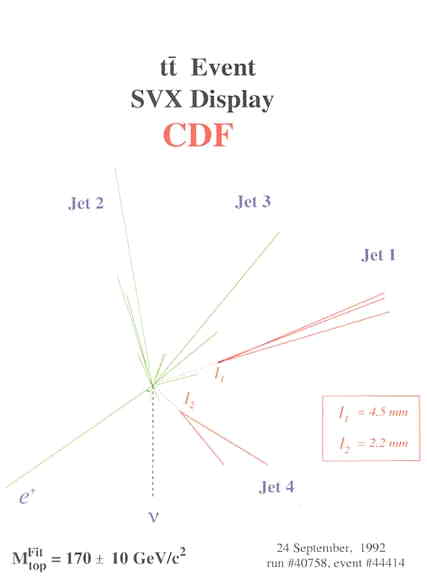
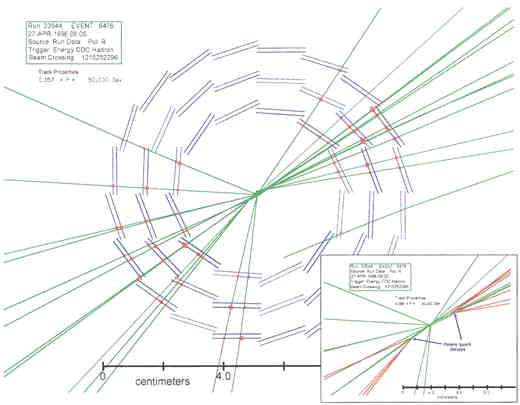
Collider Detector at Fermilab, a detector experiment at the Tevatron.
CEBAF.
Continuous Electron Beam Accelerator Facility, renamed the Thomas Jefferson National Accelerator Facility, located in Virginia.
Center-of-mass energy.
The effective energy in a particle collision.
Cerenkov counter.
Detector of Cerenkov radiation, which is electromagnetic radiation (usually visible light) emitted by a charged particle when it passes through matter at a velocity exceeding that of light in the material.
CERN.
European Laboratory for Particle Physics (originally the European Center for Nuclear Research), located near Geneva, Switzerland.
CESR.
Cornell Electron Storage Ring, an electron-positron collider with a center-of-mass energy of 10 GeV located in the Laboratory of Nuclear Studies at Cornell University.
CGRO.
Compton Gamma-Ray Observatory, a multiple-detector NASA satellite.
Charm.
Fourth type of quark, also called the c quark.
Charmonium.
The family of hadronic particles composed of a charm quark and an anticharm quark.
CHESS.
Cornell High-Energy Synchrotron Source, a national facility for energetic x-ray beams.
Circular accelerator.
Accelerator in which particles move around a circle many times, being accelerated further in each revolution.
CMBR.
Cosmic microwave background radiation from the big bang.
CMP.
Condensed-matter physics, the study of matter in liquid and solid phases.
CMS.
Compact Muon Solenoid, one of two general-purpose detector experiments (see ATLAS) at the LHC.
Collider.
Accelerator in which beams of particles are directed to meet each other head-on to produce collisions.
Colliding-beam accelerator.
See Collider.
Collimate.
To produce a spatially narrow beam of particles or light.
Color.
In high-energy physics, the property of quarks and gluons analogous to electric charge that determines how the strong force acts between a quark and a gluon.
Conservation law.
Physical law stating that the total value of some quantity or property cannot be changed. For example, the conservation of energy states that the total energy of a system cannot change; this implies that the energy of all particles going into a reaction, including the energy associated with their masses, must equal that of all particles escaping from the interaction.
Cooling.
In high-energy physics, a technique for decreasing the kinetic energy of a beam of particles, in the component of motion transverse to the beam direction.
Cosmic rays.
Energetic particles that come from outside Earth's atmosphere.
Cosmology.
A subdiscipline of astrophysics and astronomy having to do with the large-scale behavior of the universe and with its origin and evolution.
CP symmetry.
Operation of changing a particle to an antiparticle (C) and left to right (P).
CP violation.
Experimentally discovered phenomenon, in which CP symmetry does not hold.
Cryogenics.
Science and technology of producing and utilizing very low temperatures.
Cyclotron.
Circular accelerator design, made of two D-shaped magnets.
D meson.
Meson containing a c quark and a u, d, or s antiquark.
DO.
Detector experiment at the Tevatron at Fermilab.
DAPHNE.
Electron-positron collider at Frascati, Italy.
DESY.
Deutsches Elektronen-Synchrotron laboratory in Hamburg, Germany.
Deuterium.
Heavy hydrogen, whose nucleus contains one proton and one neutron.
DOE.
Department of Energy.
DORIS.
Electron-positron collider that used to operate at DESY.
Down.
One of the two lightest quarks, also called d quark. The other light quark is the up or u quark.
DPB.
Division of Physics of Beams of the American Physical Society.
DPF.
Division of Particles and Fields of the American Physical Society.
Drift chamber.
Particle detector in which the passage of charged particles produces tracks of ionized gas. Electrical signals from these tracks are detected and recorded, allowing reconstruction of the particle paths.
Elastic collision.
In high-energy physics, a particle interaction in which interacting particles are not changed into other particles.
Electric dipole moment.
One possible way to distribute the electric charge of a particle that would violate basic symmetries.
Electromagnetic force or interaction.
Long-range force and interaction associated with electric and magnetic properties of particles. This force is intermediate in strength between the weak and strong forces. The carrier of the electromagnetic force is the photon.
Electron.
Elementary particle with a unit negative electrical charge and a mass about 1/1840 that of the proton. Electrons surround an atom's positively charged nucleus and determine the atom's chemical properties. An electron is a lepton.
Electron volt.
Energy of motion acquired by a charged particle accelerated by an electric potential of I V.
Electroweak force or interaction.
Force or interaction that unifies the electromagnetic force and the weak force.
Electroweak symmetry breaking.
Mechanism that gives mass to W and Z particles.
Elementary-particle physics.
Field of physics whose goal is to discover and understand the basic constituents of matter and the forces that act on them.
EPP.
See elementary-particle physics.
eV.
See electron volt.
Family.
See generation.
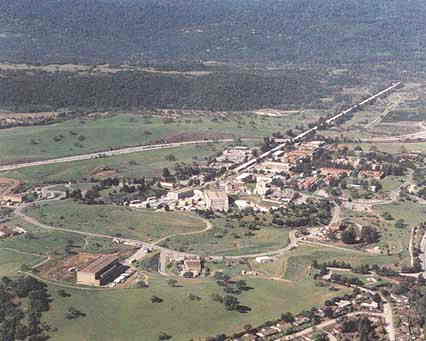
Fermilab.
See FNAL.
Fermion.
Particles having the property that only one can occupy a quantum state (the Pauli exclusion principle). Such particles have half-integer values of spin.
Field theory.
Theory that describes forces as originating from ''fields" that permeate space. For example, electrostatic forces on an electron are due to the presence of electric fields that act on the charge of the electron.
Fixed-target experiment.
Experiment in which a beam of particles is directed onto a nonmoving target. (See Collider.)
Flavor.
Term used in high-energy physics; the uniquely characteristic "flavors" of the six types of quarks are called up, down, strange, charm, bottom, and top.
Fly's Eve.
Giant air-shower detector array, located in Utah, exploring cosmicray events at energies greater than 1017 eV.
FNAL.
Fermi National Accelerator Laboratory in Illinois.
G. Gauss,
unit of magnetic flux density, equal to 10−4 T.
Gamma ray.
Term used for photons with energies higher than the MeV range.
Gauge bosons.
Particles, such as gluons, that have integer spin and carry force and are a manifestation of a symmetry.
Gauge theory.
Theory of particle interactions, modeled on the immensely successful modern theory of electromagnetism, having a special kind of symmetry known as gauge invariance.
Geiger-Müller tube.
Type of particle detector that works by sensing the ionization caused when a charged particle passes through it.
General relativity.
Einstein's theory of gravitation and acceleration, which describes how the presence of matter or energy alters the geometry of space and time.
Generation.
Classification of leptons and quarks into families, according to their internal properties. The first generation consists of the electron and its neutrino and of up and down quarks. The second generation consists of the
muon and its neutrino and of charm and strange quarks. The third generation consists of the tau and its neutrino and of bottom and top quarks.
GeV.
Giga electron volt, a unit of energy equal to 109 eV.
GLAST.
Gamma-ray Large Array Satellite Telescope, a mission under consideration by NASA.
Gluon.
A massless particle that carries the strong force.
Grand unified theory.
Theory that unifies the electroweak force with the strong force into a single gauge theory.
Gran Sasso.
Italian national underground laboratory for particle physics and astrophysics, located in a tunnel near Rome.
Granularity.
Degree of fine spatial resolution in a particle detector (see Chapter 6).
Gravitational force or interaction.
Weakest of the four basic forces and the one responsible for the attraction of objects to Earth and the motion of stars and planets.
Graviton.
As yet undetected massless particle that carries the gravitational force.
Hadron.
Subnuclear particle composed of quarks. The hadron family of particles consists of baryons and mesons. The best known are protons, neutrons, and pions.
HEPAP.
Department of Energy's High-Energy Physics Advisory Panel.
HERA.
Electron-proton circular collider located at DESY in Germany.
Hermeticity.
Degree to which a particle detector surrounds particle interactions.
Higgs boson or particle.
Hypothetical particle that could account for the origin of the masses of elementary particles.
High-energy physics.
Another name for elementary-particle physics. This name arises from the high energies required for experiments in this field.
High-Tc superconductor.
Special class of superconductors that operates at temperatures above the boiling point of liquid nitrogen, about 77 K. Ordinary superconductors operate at 20 K or lower.Hubble constant.
Measure of the expansion rate (and hence, age) of the universe, estimated from observations to be between 45 km/s per megaparsec (a megaparsec is about 3 million light-years) and 90 km/s per megaparsec.
Hypercharge.
Quantum number characterizing a property of quarks and leptons.
IHEP.
Institute for High-Energy Physics, a 76-GeV circular proton accelerator in Protvino, Russia.
IMB.
Irvine Michigan Brookhaven proton-decay experiment.
Intermediate vector boson.
General name for W and Z particles that carry the weak force.
Internal space.
Mathematical space defined by possible values of particular quantum numbers.
Invariance.
Property of a physical system that is unchanged when its coordinate system is altered.
Ionization.
Process of removing electrons from an atom.
Isospin.
Quantum number in an internal space that applies to quarks.
Isotropic.
Condition of having the same property along any direction in space (i.e., rotationally invariant).
J/psi.
Particle made of a c quark (see charm) and an anti-c quark. It is about three times as massive as the proton.
Jet.
Narrow stream of hadrons produced in a high-energy collision.
K meson or kaon.
Second least massive meson, made of one s quark and one u or d antiquark.
Kamiokande.
Kamioka (Japan) Nucleon Decay Experiment, a 3,000-ton water Cerenkov proton decay and neutrino detector experiment (see Super Kamiokande).
KEK.
Japanese High-Energy Accelerator Research Organization's 12-GeV circular proton accelerator at Tsukuba, Japan.
Klystron.
High-frequency oscillator-amplifier that uses an electron beam in a magnetic field to produce microwave radiation.
Kobayashi-Maskawa hypothesis.
(See CP violation.) Hypothesis that if there are more than two generations of quark states and the states mix, then CP violation is allowed.
LAMPF.
800-MeV linear proton accelerator at Los Alamos National Laboratory, used for nuclear and elementary-particle physics.
LEP.
Large Electron-Positron collider, a circular collider at CERN, Switzerland.
LEP II.
LEP upgrade to an energy of 200 GeV.
Lepton.
Member of the family of weakly interacting particles, which includes the electron, muon, tau, and their associated neutrinos. Leptons are acted on by the electroweak and gravitational forces, but not the strong force.
LHC.
Large Hadron Collider, a particle accelerator being constructed at CERN. When completed it will be the highest-energy machine.
Lifetime.
Measure of how long, on average, an unstable particle or nucleus exists before it decays.
Linac.
Abbreviation for linear accelerator.
Linear accelerator.
Type of accelerator in which the beam particles travel in a straight line and gain energy by "surfing" on propagating electromagnetic fields.
Lithography.
In semiconductor manufacturing, using intense beams of particles or radiation to etch circuit patterns on a silicon chip.
LLNL.
Lawrence Livermore National Laboratory.
Luminosity.
Measure of the rate at which particles in a collider come in contact. The higher the luminosity, the greater is the rate of interactions.
MACHOs.
Massive compact halo objects thought to populate the halo of the Milky Way.
MACRO.
Monopole, Astrophysics, and Cosmic-ray Observatory located in the Gran Sasso laboratory.
Magnetic monopole.
Hypothetical particle that would carry a single magnetic pole. All known particles with magnetic properties carry both a north and a south magnetic pole.
Main Injector.
New proton accelerator used for producing antiprotons for the Tevatron as well as for a program of fixed-target physics.
Mark I.
Detector at SPEAR that operated from 1972 to 1976.
Mass.
Intrinsic property of a particle; the energy in a particle at rest is related to its mass by the Einstein equation E = mc2. The weight of an object on Earth is proportional to its mass.
Meissner effect.
Property that a superconductor will expel magnetic lines of force when cooled below its superconducting temperature.
Meson.
Strongly interacting particle that is not a baryon. Mesons are composed of quark-antiquark combinations.
MeV.
Mega electron volt, a unit of energy equal to 106 eV.
MHz.
Megahertz, a frequency of 106 cycles per second.
Mixing.
Tendency for one quantum state to transform into another.
Molecule.
Type of matter made up of two or more atoms.
Monte Carlo.
Statistical method that models processes caused by a series of random events.
MRI.
Magnetic resonance imaging, a technique that uses the resonance of the spin of nuclei when exposed to radio waves to image the internal structure of objects.
Muon.
Particle in the lepton family with a mass about 200 times that of the electron and having other properties similar to those of the electron.
Muon collider.
Accelerator that collides muons with antimuons.
MWPC.
Multiwire proportional chamber, a type of particle detector with many closely spaced wires, providing good spatial resolution.
NASA.
National Aeronautics and Space Administration.
Neutralino.
Neutral particles with a spin of one-half, predicted by supersymmetry as counterparts to the photon, the Z, and the neutral Higgs boson.
Neutrino.
Electrically neutral lepton with very small, possibly zero, mass. There are at least three distinct types of neutrinos, one associated with the electron, one with the muon, and one with the tau. Neutrinos are produced in radioactive decay in stars and copiously in supernovas.
Neutrino oscillations.
Neutrinos of one type may be able to change into those of another type and back again if one or more of the types have mass.
Neutron.
Uncharged baryon with mass slightly greater than that of the proton. The neutron is a strongly interacting particle and a constituent of all atomic nuclei except hydrogen. An isolated neutron decays through the weak interaction to a proton, electron, and antineutrino with a lifetime of about 1,000 s.
NSF.
National Science Foundation.
Nucleon.
Neutron or proton.
Nucleosynthesis.
Process in stars by which heavier elements are generated from lighter ones through nuclear fusion.
Nucleus.
Central core of an atom, made up of neutrons and protons held together by the strong force.
Parity.
Property that may be thought of in the same way as leftor right handedness (see CP symmetry).
Particle.
In high-energy physics, a component of matter on the subatomic scale.
Parton.
Pointlike, internal component of hadrons, now identified as a quark or a gluon.
PEP.
Positron-Electron Project, a circular collider with a maximum energy of 36 GeV, located at SLAC.
PEP-II.
The successor to PEP.
PET.
Positron-emission tomography. A three-dimensional imaging technique that employs characteristic gamma rays from positron annihilation.
PETRA.
Electron-positron circular collider at DESY, Hamburg, Germany.
Phonon.
Quantum of vibrational energy in an atomic lattice.
Photon.
Quantum of electromagnetic energy. A unique massless particle that carries the electromagnetic force.
Pion.
Lightest meson, consisting of a u or d quark and an anti-u or anti-d quark.
Planck scale.
Scale in physics where gravity plays a role equal to other forces, at a distance, time, and energy scale of 10−33 cm, 10−43 s, and 1019 GeV, respectively.
Positron.
Antiparticle of the electron.
Proton.
Baryon with a single positive unit of electric charge and a mass approximately 1,840 times that of the electron, made of two up quarks and one down quark. The proton is the nucleus of the simple hydrogen atom and a constituent of all atomic nuclei.
PS.
Circular proton accelerator with a maximum energy of 28 GeV at CERN, Switzerland.
Quantum chromodynamics (QCD).
Theory that describes the strong force among quarks in a manner analogous to the description of the electromagnetic force by quantum electrodynamics.
Quantum electrodynamics (QED).
Theory that describes the electromagnetic interaction in the framework of quantum mechanics. The particle carrying the electromagnetic force is the photon.
Quantum field theory.
Field theory in which the fields are quantum mechanical variables.
Quantum mechanics.
Mathematical framework for describing the physics at atomic and smaller length scales, where energy exists in discrete quantum units.
Quark-gluon plasma.
High-energy form of nuclear matter, in which the binding forces between quarks in individual protons and neutrons decreases and creates a deconfined state characterized by the free movement of quarks and gluons throughout the nuclear volume.
Quarks.
Family of elementary particles that make up hadrons. Quarks are acted on by strong, electroweak, and gravitational forces. Six are known, referred to as up, down, strange, charm, bottom, and top.
Radiation.
Electromagnetic waves, energy in the form of photons.
Radiography.
Technique of producing an image by using x rays or gamma rays instead of light.
Relativistic.
Systems with particles moving with velocities close to the velocity of light.
RHIC.
Relativistic heavy-ion collider, under construction at Brookhaven National Laboratory in New York.
Scattering.
When two particles collide, they are said to scatter off each other.
Scintillation counter.
Particle detector in which the passage of a charged particle produces a flash of light. This so-called scintillation light, when detected, gives the time at which the particle passed through the counter.
SLAC.
Stanford Linear Accelerator Center in Stanford, California, the electron linear accelerator there having an energy of 50 GeV.
SLC.
Stanford Linear Collider, at SLAC, a linear electron-positron collider with a center-of-mass energy of about 100 GeV.
SNO.
Sudbury Neutrino Detector. A 1,000-ton heavy-water Cerenkov detector under construction in a mine near Sudbury, Ontario, 6,800 feet below ground. SNO is designed to detect neutrinos produced by fusion reactions in the Sun.
Soudan-11.
Detector located in an underground laboratory in a mine about 1/2 mile beneath Soudan, Minnesota. Some physics goals of the experiment are to search for nucleon decay and to study atmospheric neutrino physics. The detector is a 960-ton iron calorimeter surrounded by an active shield of proportional tubes.
SPEAR.
Circular electron-positron collider with center-of-mass energy of about 8 GeV that operated at SLAC in the 1970s and 1980s.
Spin.
Intrinsic angular momentum possessed by a particle. Generally measured in units of the Planck constant h divided by 271.
SPS.
Super Proton Synchrotron, an accelerator at CERN.
SSC.
Superconducting Super Collider.
SSRL.
Stanford (California) Synchrotron Radiation Laboratory.
Standard model.
Theory that summarizes the present picture of the field of elementary-particle physics. It includes three generations of quarks and leptons, the electroweak theory of weak and electromagnetic forces, and the quantum chromodynamic theory of the strong force. It does not include answers to some basic questions such as how to unify electroweak forces with the strong or gravitational forces.
Storage ring.
Ring of magnets used to store circulating particles or act as a collider. Sometimes a synonym for a collider.
Strange.
Third type of quark, also called s quark.
Strange particle.
Particles containing at least one s quark.
String theory.
Class of theories that treats elementary particles as tiny strings in a higher-dimensional space.
Superconducting magnet.
See Superconductivity.
Superconducting Super Collider.
Circular proton-proton collider with a centerof-mass energy of 40 TeV, located in Texas. The collider's construction was terminated by Congress in 1993.
Superconductivity.
Property by which some materials, when cooled to a temperature close to absolute zero, lose all of their electrical resistance and become superconducting. Magnets with superconducting coils can produce large magnetic fields with low power costs.
Superkamiokande.
Joint Japan-U.S. collaboration to construct the world's largest underground neutrino observatory. It is a water Cerenkov detector-a tank of ultrapure water 40 m in diameter and 40 m tall, viewed by thousands of phototubes-located in the Kamioka Mine, about 200 km north of Tokyo.
Superpartner.
SUSY counterpart to an ordinary matter particle.
Supersymmetry.
Theory of elementary particles in which each boson has a fermion counterpart and vice versa.
SUSY.
See Supersymmetry.
Symmetry.
General property of many objects and physical systems whereby the object or system appears unchanged when looked at from different reference frames or coordinate systems. For example, a smooth ball has spherical symmetry because it looks the same from any orientation. Many kinds of symmetry exist.
Synchrotron.
Type of circular particle accelerator in which the frequency of acceleration is synchronized with the particle as it makes successive orbits.
Synchrotron radiation.
Intense light or x rays emitted when electrons move in a circular orbit at relativistic speeds.
Target.
Material struck by a beam of high-energy particles, used in some types of EPP experiments.
Tau.
Elementary particle in the lepton family with a mass 3,500 times that of the electron but with similar properties.
Technicolor.
Theory proposed to explain the masses of particles, which postulates the existence of a new strong force.
Tesla (T).
Unit of magnetic field strength equal to 10,000 gauss. A modern superconducting magnet can generate a field of about 5-10 T.
TeV.
Tera electron volt, a unit of energy equal to 1012 eV.
Tevatron.
Complex of accelerator facilities at Fermilab. The main facility is a circular proton accelerator with superconducting magnets (the first large accelerator to employ such magnets) that can be used as an antiprotonproton collider with a center-of-mass energy of 2 TeV. Currently the highest-energy collider in the world.
Top.
Sixth type of quark, also called t quark. The mass of the top quark is about 175 GeV.
TPC.
Time projection chamber; a particle detector in which the position of the track of ionized gas left by a charged particle is detected by the time it takes for electrons in the gas to move to the ends of the chamber.
TRISTAN.
Circular electron-positron collider, with center-of-mass energy of 60 to 70 GeV, that operated at the KEK laboratory in Japan in the 1980s.
Unified theories.
Theories in which different forces have a common origin. For example, the electric and magnetic forces are unified in the theory of electromagnetism.
UNK.
Accelerator and storage-ring complex, located at Serpukhov, Russia.
Up.
One of the two lightest quarks, also called u quark. Up and down quarks form the first quark generation.
Upsilon.
Meson made up of a b quark and an anti-b quark. It is approximately 10 times as massive as a proton.
VEPP-2M.
Electron-positron collider near Novosibirsk, Russia.
Virtual process or particle.
One that is physically forbidden in classical mechanics but allowed by quantum mechanics.
W boson.
Particle that carries the charged weak force. An intermediate-vector boson with a mass of about 80 GeV.
Weak interaction.
Force responsible for nuclear beta decay. Much weaker than the strong or electromagnetic forces, but stronger than gravity. The weak force has the distinctive feature that it violates parity.
WIMPs.
Weakly interacting massive particles, a class of hypothetical particles thought to be a candidate for dark matter.
4

FIGURE 8.2 (Top) For macromolecular crystallography, x rays are focused onto a small sample to produce the diffraction pattern shown at left. (Bottom) Structural elements of the AIDS virus reverse transcriptase (RT) shown in relation to bound DNA. This type of picture, obtained from crystallography using CHESS, helps in understanding how poly-merases can copy genetic material in living systems. (Proc. Natl. Acad. Sci. USA [1993] 90:6320-6324.)


