
JACOB MARSCHAK
July 23, 1898-July 27, 1977
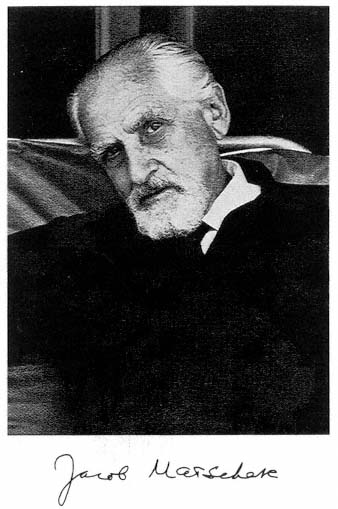
BY KENNETH J. ARROW
BORN IN 1898 IN KIEV, capital of the Ukraine, Jacob Marschak died seventy-nine years later in Los Angeles, California, still in active service as professor of economics and business administration at the University of California at Los Angeles and president-elect of the American Economic Association. These facts only barely suggest the long and varied odyssey of his career and his high—though slowly developed—position in American economics.
Marschak's scholarly career spanned fifty-five years and three very different environments: Germany of the Weimar period, the United Kingdom of the Great Depression, and the United States from World War II on. The world economy and economists' perceptions and theories were altering rapidly, and Marschak experienced, in addition, international variances in academic environment—especially in traditions and modes of economic thought. To all these influences must be added the fact that he was a Russian and a Jew, whose educational and political formation derived from a particular period of Russian history that had little in common with the life of his host countries.
It is not surprising, therefore, that Marschak's focus as an economist showed considerable changes of direction over his long and productive lifetime. His early empirical and prac-
tical interests later yielded to theoretical and methodological themes; his youthful political enthusiasms subsided, and he became increasingly aloof from political affairs and even from specific proposals of economic policy.
For all the changes marking Marschak's thought and work, his extraordinary ability to synthesize enabled him to maintain in his work an underlying continuity of purpose and approach. He looked at the problem in hand from every useful angle, drawing on every good idea and theoretical presupposition, then subjected it to severe criticism regarding utility, clarity of expression, and contribution to the understanding of economic issues. This process allowed him to be remarkably open to new ideas and methods, which he would then transform with his own improvements and clarifications.
Marschak became a leader of research organizations at a relatively young age in Germany, and later—with his increasing recognition—was director of the Oxford Institute of Statistics (1935-1939) and of the Cowles Commission for Research in Economics at The University of Chicago (1943-1948)—a fertile period that greatly influenced the course of economic analysis in several diverse fields. Only after 1948 did he begin to make the contributions to economic analysis that are most distinctively his own. Yet in curious ways, the subject matter of his later studies was consonant with his earlier career. An organizer of economic research, he became a theorist of organization. A student and critic of new developments in economic analysis, he developed the economics of information. A skeptic distrustful of received dogma, he studied the economics of uncertainty.
Another characteristic of Marschak's work was his consistently interdisciplinary approach. Some of his early papers dealt with class structure and the emerging phenomenon of Italian fascism. From 1928 to about 1953, though his titles
stayed more narrowly within the field of economics as it was then understood, the papers themselves not infrequently contained broader notions derived from politics, sociology, and—later—individual psychology. His work on information and organization, for example, led to a series of experimental and theoretical studies on the psychology of decision making, while during his last fifteen years he organized an interdisciplinary behavioral sciences seminar that proved a main source of contact among mathematical modelers with widely divergent interests.
EDUCATION AND EARLY LIFE
Marschak's parents were well-to-do Russian Jews assimilated to the local culture. Their son received some formal Jewish education but was never religious. His family sympathized with the revolution of 1905, but Marschak later remembered the pogrom that followed. He learned German and French from governesses but at age nine was refused admittance to gymnasium because of the very small Jewish quota. He went instead to the First Kiev School of Commerce.
In 1915, after engaging in the very common group discussions about which revolutionary group to join, he became a Marxist and, in the same year, entered the Kiev School of Technology. He joined the Menshevik Internationalist (antiwar) faction, was arrested with others in December 1916, and was released with the fall of the Czar in February 1917. He then joined the Kiev municipal government, but in October that coalition broke into a three-cornered struggle: Bolsheviks, supporters of the Kerensky government, and Ukrainians wanting a separate state. The last group won.
Marschak and his entire family left Kiev to settle in a resort in the Terek region of the northern Caucasus, where political activity was also intense. Bolsheviks there were organizing all Russian political parties against the Moslem
mountaineers—a coalition also intended as a counterweight to the Cossacks, with whom there was an uneasy alliance. In this government Marschak became Secretary of Labor, leading the Menshevik and Socialist Revolutionary movement to withhold recognition of the Bolshevik government in Petrograd until the elected constituent assembly was allowed to meet.
But by June 1918 another three-sided conflict had arisen—this time among Mensheviks, Cossacks, and Bolsheviks (who were by then allied with the mountaineers). Marschak composed manifestos explaining the Menshevik government's aims, acting essentially as a press relations officer. But when the government eventually came under the control of a local dictator, he and his family returned to Ukrainian-run Kiev.
By this time Marschak, like many of his friends and political colleagues, had decided there was no longer a viable political cause in Russia to support. In 1919, after studying statistics briefly at the Kiev Institute of Economics, he decided to study economics at the University of Berlin for six months. This brief period was, according to his later accounts, extremely important in his life, for it was in the lectures of Berlin economist and statistician Ladislaus von Bortkiewicz that he first learned the importance of mathematical and statistical methods in economic analysis. He then moved to the University of Heidelberg, where he received his Ph.D. in 1922.
Economics in Germany at that time was a broad subject. Not only did Marschak study with economist Emil Lederer—a strong advocate of quantitative analysis—but also with philosopher Karl Jaspers and sociologist Alfred Weber.
Because of the good relations between Mensheviks and German Social Democrats, the latter helped Marschak get started in his career. From 1924 to 1926 he was an economics
reporter for the famous newspaper, the Frankfurter Allgemeiner Zeitung, after which he joined the staff of the Forschungsstelle für Wirtschaftspolitik (Research Center for Economic Policy) in Berlin, sponsored by the labor unions and the Social Democratic Party.
His interests and aspirations shifted increasingly toward the academic, and he spent some months in England in 1927 on a Rockefeller Foundation travelling fellowship—the first of several support grants from that source. Back in Germany he joined the staff of the University of Kiel's Institut für Seeverkehr und Weltwirtschaft (Institute for Maritime Shipping and World Economics), headed by Bernhard Harms, an academic entrepreneur with a good eye for quality in those who had had difficulty finding academic posts. In 1930, overcoming the liability of his Russian accent and Jewish origin, he was appointed Privatdozent at the University of Heidelberg.
THE 1920S: THE ECONOMICS OF INDUSTRY
Outside journalism, Marschak's work during the 1920s was largely devoted to studies of industry. At Kiel he directed a large study on export industries for the Reichstag (1929,1). Among the papers with the greatest permanent interest were his first, about the raging debate (started by Ludwig von Mises) on the possibility of a rationally planned socialist society (1923,1). The market system, argued Marschak, could not only be used under socialism, it was likely to work better under socialism than under the monopolistic distortions of capitalism. It is interesting to see here the earliest manifestation of his later interests in organization theory.
Marschak's other major pioneering paper of this period was his detailed, empirical study of the "new middle class"—white-collar workers who, he argued, though economically workers, were sociologically middle class. (1926,3).
Marschak's empirical work led him into studies of de-
mand. He began to participate in the growing econometric movement (not yet so-named) in which formal statistical methods and economic theory were used jointly to interpret empirical economic data. His careful work on the elasticity of demand (1931,1) was—with the contemporary works of Wassily Leontief and Ragnar Frisch—a major contribution to the development of the field.
With financing from the Rockefeller Foundation, he and Walther Lederer also conducted a major empirical study of capital formation. Because of the political upheavals in Germany at that time, however, it was not published until 1936, when it came out in England in the original German (1936,1). He was also one of the young German economists who advocated compensatory public works policy as a response to the Depression (1931,3), years before the publication of Keynes's The General Theory of Employment, Interest, and Money (1936).
Marschak immediately perceived the consequences of the Nazi accession to power in 1933. He had by this time achieved sufficient international reputation to have been invited to write two articles in the Encyclopaedia of the Social Sciences (1933,1,2). Through the good offices of Redvers Opie, he was appointed Chichele Lecturer at All Souls College, Oxford—a position designed for refugees.
English economics was in general far in advance of German at that time, but Marschak brought with him quantitative skills that Oxford lacked. Two years after his arrival, the Oxford Institute of Statistics was created (again with Rockefeller Foundation support) for systematic empirical work, and through Opie and Roy F. Harrod, Marschak was made director. Though treated with great reserve by most of the Oxford economics faculty, the Institute became a world-recognized center for empirical analysis in economics. In 1938, Marschak, Helen Makower, and H. W. Robinson carried out a study of the geographical mobility of labor that
was probably the first true fusion of theoretical reasoning with formal statistical analysis in this area (1938,3). As befits the period, differentials in unemployment rates among cities were found to be a chief determinant of mobility.
THE 1930S: DEMAND AND CAPITAL FORMATION
Marschak's work on demand and on capital formation deepened and developed into more theoretical and methodological studies. The earliest of his papers that are still influential today were two on money and the theory of assets—in the one written with Makower he introduced the portfolio approach to the demand for money as one among a set of assets (1938,1,2). Choosing a new tack from the Cambridge and Fisher approaches, he stressed the relationship of money holdings to wealth rather than income and, above all, derived the demand for different kinds of assets from the uncertainties connected with their holding. Although ideas of this kind had long been informally expressed, this was their first true modeling. Since the expected-utility theory of behavior under uncertainty was then in limbo because it appeared to conflict with the ordinal concept of utility, Marschak had an alternative criterion function—an indifference map in the space of the first two or three moments of the probability distribution of returns.
In 1939 Marschak published a number of methodologically and practically important papers on demand analysis (1939,1,2,6). They studied, in particular, the usefulness of budget studies in developing the consumption function. They also showed how to combine budget and time series studies and aggregate individual demand functions into a national total.
New York (1938-1943)
Marschak spent December 1938 to August 1939 in the United States as a Rockefeller Foundation travelling fellow.
Anticipating the outbreak of World War II, he arranged for his family to be brought over. In 1940 he was appointed professor of economics in the graduate faculty of the New School for Social Research—a faculty created largely to accommodate the flood of German refugee scholars and to make use of their talents. At the same time, through the National Bureau of Economic Research, he organized a seminar in mathematical economics and econometrics that served as a clearinghouse for a flood of new ideas—primarily, though not exclusively, for the growing group of European scholars. After the outbreak of the war, they came not only from Germany, but also from such occupied countries as Norway and the Netherlands.
One of the great motivating forces in quantitative research in this period was Jan Tinbergen's massive 1939 study of business cycles conducted for the League of Nations.1 Like many large-scale studies, its most important scientific effect occurred after it was completed: reflections by participants and critics on ways it could be done better. Ragnar Frisch had perceived while the investigation was under way that statistical inference in the case of simultaneous relations posed new problems not dreamed of in the philosophy of regression analysis. His student, Trygve Haavelmo, who was in the United States during the war, developed the principles of maximum likelihood estimation of simultaneous equations (1943), one of the papers presented at Marschak's seminar.
A small circle of economists in New York immediately recognized the importance of Haavelmo's work. As early as 1942 Marschak wrote a paper on its general philosophy (1942,1). The theoretical statisticians Henry B. Mann and Abraham Wald proved a fundamental consistency property of the es-
timates.2 Tjalling Koopmans, who had earlier worked on Tinbergen's study and found the distribution of the serial correlation coefficient (a closely related statistical problem), was drawn into the field of simultaneous-equations estimation.
THE UNIVERSITY OF CHICAGO AND THE COWLES COMMISSION FOR RESEARCH IN ECONOMICS (1943-1955)
At this moment there occurred an unusual conjunction of opportunities. In 1943 Marschak was appointed director of the Cowles Commission for Research in Economics and professor of economics at The University of Chicago. The Commission, founded and supported by Alfred R. Cowles III, an investment manager who had also been treasurer of the Econometric Society in its early days, had pioneered the use of econometric methods. In particular, its prewar summer conferences at Colorado Springs had attracted the leaders of the leading econometricians. Marschak had attended the 1937 summer conference and in 1943 was offered the directorship.
During Marschak's directorship from 1943 to 1948, the central focus of the Commission's work was to develop economy-wide models for predictive and structural analysis. Two elements were needed: appropriate statistical methods and an economic theory with which to derive equations that fit the data.
The theoretical impetus came from John Maynard Keynes and his American followers. Marschak's receptivity to arguments about purchasing power enabled him to accept Keynesian theory with little of the difficulty experienced by others. By the same token he lacked the dogmatism of many
of the newly converted English and American economists. Several of his 1941 papers (1,2,3), expounded Keynesian policies and theories and related them to earlier European thought—especially that of Knut Wicksell. In an important paper (1942,2), Marschak cleared up many of the confusions regarding identities, equilibrium, and stability—essentials of Keynesian methodology—then current in the literature. At the New School he supervised Franco Modigliani's dissertation, for a long time the most influential exposition of Keynes. But the highly specific discipline of fitting a complete model meant that the Keynesian apparatus had to be defined in far more detail than had been needed for more general expositions and policy statements.
A small, but increasing, band of young economists was finding mathematics and formal thinking useful. Statistical theory, moreover, was just beginning to attract significant numbers of students. Still, neither of these groups was in great demand. The academic market during the war and the immediate postwar period was not strong; mathematical economics was little regarded; and theoretical statistics had yet to find a suitable academic home.
Marschak seized the opportunity to secure a remarkable staff at bargain prices. Though he managed a tenure faculty appointment for Koopmans, he was forced to appoint the rest purely on a research basis. Lawrence Klein developed the model and the data. Haavelmo was there for a few years working on both model development and statistical methodology. The main developments in theoretical statistics were carried out by Koopmans and the theoretical statisticians, Theodore W. Anderson and Herman Rubin. Though sometimes going far afield, Kenneth J. Arrow and Leonid Hurwicz worked on problems in economic theory and statistical inference suggested by the basic modeling effort. Among The University of Chicago graduate students drawn into the
work, mention must be made of Don Patinkin, whose thesis under Marschak's supervision was a milestone in the integration of Keynesian and monetary theory with neoclassical general equilibrium analysis. His subsequent appointment at the Hebrew University of Jerusalem, where he refashioned the Economics Department, stemmed from a recommendation by Marschak to Fritz Naphtali, who had headed the Forschungsstelle für Wirtschaftspolitik during Marschak's stay. Indeed, the Commission in this period was producing scholars as well as scholarship, and it is a close question which was the more valuable.
Marschak did not impose direction; he provided vision and drive. Recognizing the creative energies of his research associates, he saw to it that they flowed in their own most productive channels. He insisted on understanding the essence of the most technical developments and, by requiring explanations, forced the staff to re-evaluate repeatedly the content and significance of their work. His clear, terse introductions to the statistical methodology publications penetrated remarkably deeply into the essentials of the issues (1950,1, 1953,1; see also 1947,2).
With William H. Andrews he carried out one major study of his own: the first application of the simultaneous equations technique to the estimation of production functions (1944,2). Using new statistical approaches, this study resolved the difficulties of interpretation that had been found in the pioneering work of Paul Douglas.
During the same period Marschak reverted once to his old field of industry studies, though in a new context. Through his personal relations with Leo Szilard and the other European scientists at Chicago who had participated in the Manhattan Project, he came to feel that the economist's perspective was important in assessing the future of atomic energy. At the Cowles Commission he initiated a study on the
problem. The bulk of this study was done by others, particularly Sam Schurr and Herbert Simon, but Marschak's judgment, expressed in a summary introduction to the publication of the project (1950,4), was amply confirmed. Straightforward economic analysis showed that the impact of atomic energy could be nothing like the total technological transformation envisaged by many scientists and intellectuals.
The Economics of Information and Team Theory
Turning the directorship of the Cowles Commission over to Koopmans in 1948, Marschak moved very rapidly into pure scholarship and into more abstract and theoretical work than ever before. He was greatly excited by John von Neumann and Oskar Morgenstern's revival of the expected utility theory in its axiomatic form, by Abraham Wald's exploration of the foundations of statistical decision theory, and (at his own Cowles Commission) by Leonard J. Savage and Rubin and Herman Chernoff's axiomatic development of subjective probability theory. To apply these theories he turned most immediately to his old subject, the demand for money and other assets (1949,1).
Then his interests found new focus. Attempts by Marschak, Albert G. Hart, and others to clarify the concept of liquidity had shown how important anticipating new information was to economic behavior and launched Marschak on a series of studies regarding the economics of information. The value, or demand price, of information in any context was governed by the additional benefit that could be obtained by its optimal use, an approach he initiated in 1954 (1954,2) and summarized in 1971 (1971,2). This subject, originally broached by Marschak, has since become a major research area. His most noteworthy immediate influence in
this field was on his student, Roy Radner, and on a colleague at the University of California, Jack Hirshleifer.
Investigating the importance of communication and its limits in the transmission of information led Marschak to a new approach to the study of organization—a simplification of the theory of games he called "the theory of teams."3 A team is an organization in which the members have the same preferences and prior beliefs but have different information and choose different actions. The problem is how to devise optimal decision rules prescribing each member's action as a function of his information. Characteristically for Marschak, his analysis does not so much solve this problem as put it in an entirely different—and much more varied—setting. His work with Radner on this subject was embodied in the book The Economic Theory of Teams (1972,1).4
Stochastic Decision
The third major area of Marschak's research after 1948 was stochastic decision, which, while recognizing that individuals are not thoroughly consistent, also recognizes that the theory of rational behavior has some foundation. Individuals are assumed to make choices randomly about a rational (transitive and connected) pattern, a thesis that was developed both theoretically and experimentally (see 1960,1; and, with G. Becker and M. DeGroot, 1963, 3,4,5). Stochastic decision work so far has had greater impact on psychologists than on economists, though it was recently used as the basis for
Daniel McFadden's work on choice among alternative modes of transportation.5
HONORS AND LATER LIFE
In 1955 Marschak and the Cowles Commission, now renamed the Cowles Foundation for Research in Economics, left Chicago for Yale University. He did not stay long; in 1960 he accepted the post of professor of economics and business administration at the University of California at Los Angeles. Official retirement did not change his activities at all; he remained as active in teaching and research when emeritus as he had been before.
Throughout most of his career in America, Marschak had a reputation as being rather esoteric, and his later broad interests did not change that view. But widespread recognition of his work grew—especially as his former students and junior colleagues became information disseminators. He was elected a fellow of the American Academy of Arts and Sciences in 1962, a distinguished fellow of the American Economic Association in 1967, and a member of the National Academy of Sciences in 1972. He received honorary degrees from the University of Bonn in 1968, from his old University of Heidelberg in 1972, and from Northwestern University in 1977.
In 1976 he was nominated and elected president-elect of the American Economic Association for the year 1977. According to the custom of the association, the president-elect prepares the annual meeting and becomes president the following year. Marschak had completed all arrangements for the December 1977 meeting but died in the summer of that year.
THIS ARTICLE WAS BASED largely on personal communications and reminiscences of Lawrence Klein, Tjalling Koopmans, Karl Lachman, Carl Landauer, Walther Lederer, Adolph Lowe, Helen Makower, Redvers Opie, Don Patinkin, Roy Radner, Hans Speier, and the author. Important material on Marschak's early life is found in an interview with him conducted by Richard A. Pierce, "Notes on Recollections of Kiev and the Northern Caucasus, 1917-1918," on file at the Regional Oral History Office, Bancroft Library, University of California, Berkeley.
SELECTED BIBLIOGRAPHY
1923 Wirtschaftsrechnung und Gemeinwirtschaft. Arch. Sozialwiss. 51: 501-20.
1926 Der neue Mittelstand. Grundriss der Sozialökonomik 9(1): 120-41.
1931 Elastizität der Nachfrage. Tübingen: J. C. B. Mohr.
1933 Consumption (Measurement). Encyclopedia of the social sciences.
Wages (Theory). Encyclopedia of the social sciences.
1938 Money and the theory of assets. Econometrica 6: 311-25.*
With H. Makower. Assets, prices and monetary theory. Economica N. S. 5: 261-88.*
With H. Makower and H. W Robinson. Studies in the mobility of labour. Oxford Econ. Pap. 1: 83-123; 2:70-97; 4:39-62.
1939 Family budgets and the so-called multiplier. Can. J. Econ. 5: 358-62.
On combining market and budget data in demand studies. Econometrica 7: 332-35.
Personal and collective budget functions. Rev. Econ. Stat. 21: 161-70.*
1941 Lack of confidence. Soc. Res. 8: 41-62.*
The task of economic stabilization. Soc. Res. 8: 361-72.
Wicksell's two interest rates. Soc. Res. 8: 469-78.*
1942 Economic interdependence and statistical analysis. In: Studies in mathematical economics and econometrics in memory of Henry Schultz, eds. O. Lange et al., pp. 135-50. Chicago: University of Chicago Press.*
Identity and stability in economics. Econometrica 10: 61-74.*
1944 With W. H. Andrews. Random simultaneous equations and the theory of production. Econometrica 12: 143-205.*
1947 Economic structure, path, policy, and prediction. Am. Econ. Pap. Proc. 37: 81-84.
1949 Role of liquidity under complete and incomplete information. Am. Econ. Rev. 39: 182-95.*
1950 Statistical inference in economics: an introduction. In: Statistical inference in dynamic economic models, ed. T. C. Koopmans, pp. 1-50. New York: Wiley.
Economic aspects of atomic power, eds. Sam Schurr and Jacob Marschak. Princeton: Princeton University Press.
1953 Economic measurements for policy and prediction. In: Studies in econometric method, eds. W. C. Hood and T. C. Koopmans, pp. 1-26. New York: Wiley.*
Équipes et organisations en régime d'incertitude. Économetrie: colloques internationaux du Centre National de la Recherche Scientifique, 40: 201-11. (From a CNRS colloquium held May 12-17, 1952, in Paris)
1954 Towards an economic theory of organization and information. In: Decision processes, eds. R. M. Thrall, R. L. Davis, and C. H. Coombs, pp. 187-220. New York: Wiley.*
1960 Remarks on the economics of information. In: Contributions to scientific research in management, Western Data Processing Center, pp. 79-100. Los Angeles: University of California at Los Angeles.*
1963 With J. G. Becker and M. DeGroot. Stochastic models of choice behavior. Behav. Sci. 8: 41-55.*
With J. G. Becker and M. DeGroot. An experimental study of some stochastic models for wagers. Behav. Sci. 8: 199-202.*
With J. G. Becker and M. DeGroot. Probabilities of choices among very similar objects: An experiment to decide between two models. Behav. Sci. 8: 306-11.*
1971 Economics of information systems. In: Frontiers of quantitative economics, ed. M. Intriligator, pp. 32-107. Amsterdam: North-Holland.*
1972 With R. Radner. Economic theory of teams. New Haven: Yale University Press.
1974 Economic information, decision and prediction, 3 vols. Dordrecht and Boston: Reidel.


