
DONALD HOWARD MENZEL
April 11, 1901-December 14, 1976
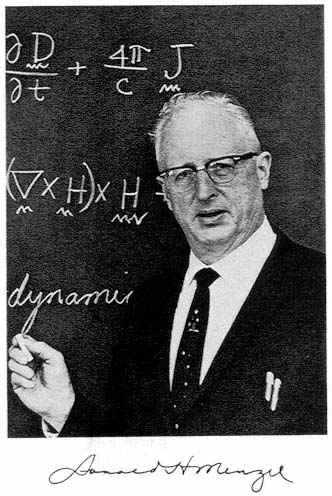
Courtesy, Harvard-Smithsonian Center for Astrophysics
BY LEO GOLDBERG AND LAWRENCE H. ALLER
DONALD H. MENZEL, one of the first practitioners of theoretical astrophysics in the United States, pioneered the application of quantum mechanics to astronomical spectroscopy. He was the first to establish the physical characteristics of the solar chromospheres and he initiated the modern era of investigations of physical processes in gaseous nebulae. Although primarily a theorist, he organized and conducted more than a dozen solar-eclipse expeditions and established two major solar observatories in the western United States. As a naval officer in World War II, he showed how solar observations could be used to anticipate large changes in conditions of long-distance radio wave propagation. He later played a leading role in establishing the Central Radio Propagation Laboratory of the National Bureau of Standards. As director of the Harvard College Observatory from 1952 to 1966, he established one of the first university programs for research and instruction in radioastronomy and space astronomy. He was elected to the National Academy of Sciences in 1948.
EARLY LIFE
The Menzel family was of German origin, his great grandfather, Johann Theodor Menzel, being a member of the
mounted police in Magdeburg. His grandparents emigrated from Germany to America as children, and his father, Charles Theodor, Jr., was born in Brooklyn, New York. When Charles was six, the Menzel family moved to Denver, Colorado. But when Charles was twelve years old his father died, leaving the family in difficult circumstances. Forced to leave school to support the family, the boy found a job with the Denver & Rio Grande Railroad, first as a telegraph operator, then as clerk to a ticket salesman, and finally as the Railroad's passenger agent in Florence, Colorado. In 1900 he married Ina Zint, and Donald was born in Florence a year later, on April 11, 1901.
Four years later Donald's father was transferred to Leadville, Colorado, a famous pioneer mining camp that—at 10,200 feet—was the highest community in the United States. There Donald grew up and received most of his primary and secondary education. In 1910 Donald's father invested his mining savings and proceeds in a partnership in Leadville's largest general store, and the family's financial condition improved markedly.
Young Donald displayed a remarkable ability as a ''quick study.'' By age five he was reading Gulliver's Travels, and even before that his father had taught him to send and receive simple messages in Morse code. Fortunately for the precocious young Menzel, the school superintendent had initiated a program of progressive education that allowed exceptional students to advance at an accelerated pace, and Donald was able to graduate from high school at age sixteen.
As a schoolboy Donald pursued hobbies that helped satisfy his scientific curiosity and provided outlets for the almost limitless energy that was to characterize his entire life. Only five when attracted by the sight of brightly colored ores that had spilled from railway cars near Leadville, he soon owned a rapidly growing collection. He actively traded specimens
and peddled ore samples to tourists on the trains, once giving a choice sample to President William Howard Taft. In ten years his collection grew to at least two tons; it was eventually donated to the University of Denver.
As a teenager, Menzel built a radio transmitter and receiver with a crystal detector, fabricating all the components himself except the earphone. Years later, in the 1930s, he acquired a "ham" (short for Hammerlund) radio transmitter and receiver with the call letters W1JEX.
Menzel's most absorbing hobby was laboratory chemistry, to which a young friend initiated him at age eleven. A great leap forward in his experiments was made possible by the failure of a leading drugstore in town, for it was purchased by Menzel's father and Donald was able to acquire a huge stock of chemicals and other interesting substances. He and his pals performed many experiments with this expanded laboratory, some prompted by ideas gained from the library chemistry books he read so voraciously, others inspired simply by the urge to mix chemicals and see what happened. Although some of this involved the development and manufacture of explosives, good fortune prevailed, and there were no disasters.
COLLEGE DAYS AND A CHANGE OF PLAN
In 1916 Donald's family moved to Denver, where he graduated from high school in 1917 and enrolled in the University. He earned an A.B. in three years at the University of Denver in his beloved chemistry, but a boyhood friend, Edgar Kettering, had aroused his interest in another subject: astronomy. In later years, Donald always credited Kettering, the total solar eclipse of June 8, 1918, and the outburst of Nova Aquilae almost immediately thereafter with awakening his interest in the field.
Further encouragement came from James Whaler, an in-
spiring English professor from whom Donald acquired much of his skill in writing. A Princeton alumnus, Dr. Whaler suggested Donald contact Professor R. S. Dugan, a variable star expert, who sent him instructions for making observations and put him in touch with the American Association of Variable Star Observers. Eagerly taking up a program of observing, young Donald was able to use the 20-inch telescope by the start of his senior year. Classes by day and observation by night did not exhaust his energy; he taught a course of college algebra to forty students, took a surveying course, and in his spare time surveyed fields for farmers and laid out the boundaries of the football field!
After graduating with an A.B. degree, young Menzel decided to continue for an additional year to obtain an M.A. He secured the degree under the guidance of Professor Dugan of Princeton, fulfilling the requirements with astronomy courses and a thesis based on observations of eclipsing stars. Now he was ready to study for the Ph.D., for which he already had several offers of fellowships in chemistry.
It was James Whaler who urged him to apply for an astronomy scholarship at Princeton, though Donald's father—worried, like many fathers of future astronomers, that his son would not make a living in astronomy—urged him to stay in chemistry. Yet the head of the Denver University chemistry department pointed out that, while astronomy jobs were few, astronomers were fewer, and urged Donald to do what he really wanted to do. Fortunately for astronomy, he decided to go to Princeton.
WIDE NEW HORIZONS AT PRINCETON
Menzel continued to observe variable stars for Professor Dugan as a means of support, but he was most enthusiastic about the lectures of Professor Henry Norris Russell. Theoretical astrophysics was new; it had been spawned around
1920 by Saha's derivation of the ionization equation and Eddington's stellar interior modeling that led to his famous relation between mass and luminosity. Russell was the first practitioner of theoretical astrophysics in the United States. Inspired by his example, Donald set out to master as many courses in mathematics and physics as possible. Among his teachers were Oswald Veblen, Luther Eisenhart, Augustus Trowbridge, and K. T. Compton, whom he especially admired.
As his thesis for his Ph.D., Menzel sought to establish a stellar temperature scale by applying the Fowler-Milne theory based on application of the Saha equation to stellar spectra. Harlow Shapley employed him at Harvard as a research assistant during the summers of 1922, 1923, and 1924, but when Menzel arrived at Harvard, he found that a young British lady, Cecilia Payne, had been assigned the same topic. Shapley resolved the conflict in Solomon-like fashion, assigning the hot stars to Miss Payne and the cooler ones to Menzel.
While working as Harlow Shapley's assistant, Donald discovered star clusters on the periphery of the Large Magellanic Cloud. Using their apparent diameters, he and Shapley determined that the Large Cloud was some 100,000 light years distant from us.
At the same time, he analyzed Coblentz and Lampland's published observations and measurements of so-called "water-cell transmissions" of radiation from planets. Menzel found that, contrary to popular belief, at least the upper atmospheres of the planets Jupiter, Saturn, and Uranus were extremely cold. His interest in planets later led to an important deduction concerning the atmosphere of Mars. A planet with a dense atmosphere—such as the Earth—would look blue from a great distance because of the strong colordependence of light-scattering by gas molecules. Conversely,
Mars's red color indicated that the overlying atmosphere was too thin to modify the reflected light by color-dependent molecular scattering. Menzel deduced that the pressure at the surface of the planet was hardly more than one-tenth that of the surface of the Earth.
Upon receipt of his Ph.D. from Princeton in 1924, Donald found that opportunities for an astronomer were few, especially for a new theoretical astrophysicist. He spent the next two years chiefly teaching courses in elementary astronomy, first at the University of Iowa and then at Ohio State University.
In mid-1926 he married Florence Kreager, who had been a student at Ohio State. The pair made an excellent team for the life that lay ahead, and Florence was the ideal hostess. They had two daughters, Suzanne and Elizabeth, and six grandchildren.
AN OPPORTUNITY AT LICK OBSERVATORY
Meanwhile, Henry Norris Russell had convinced authorities at Lick Observatory that they should acquire a staff member conversant with the newer developments in astrophysics. He suggested Menzel, who was offered an appointment. Despite its meaning a cut in salary, Donald accepted the post as a real opportunity to establish himself in research.
He was eager to apply the new developments in atomic physics to the interpretation of astronomical spectra but soon found that the promise of theoretical astrophysics was not at all appreciated by Lick's conservative astronomers. His principal task was to take spectrograms for radial velocity measurements. Fortunately, the director also assigned him the task of analyzing the magnificent collection of solar chromosphere spectra that had been obtained by W. W. Campbell during four different total solar eclipses. This effort was hampered a bit by the fact that Campbell had not calibrated
the photographic plates to establish the relationship between blackness of the image and intensity, a limitation Donald ingeniously managed to overcome.
He soon discovered that what was expected of him was to catalogue wavelengths, identify lines with chemical elements, and give crude intensities; whereas his own aim was to apply the newest atomic theory to the study of atomic processes in the solar chromosphere. Despite periodic scoldings by Director Aitken, who admonished him to leave theory to the "poor, underprivileged British astronomers like Milne and Eddington, who have no decent telescopes," Menzel persevered.
After several years of hard labor, he published his results in a large volume that has become a classic in theoretical astrophysics as one of the earliest examples of quantitative astronomical spectroscopy. He found the temperature of the solar chromosphere to be about 4700°K, but the emission lines of H, He I, and He II revealed large deviations from thermodynamic equilibrium. He also derived the fundamental equations of the curve of growth for emission lines. From observed chromospheric density gradients, he found evidence for a mean molecular weight of about 2 in the lower chromosphere, a result that finally persuaded Russell and others that hydrogen and helium are overwhelmingly the most abundant elements in the sun.
While at Lick, Menzel developed an interest in the physics of gaseous nebulae and directed a thesis by Louis Berman, who made a pioneering spectrophotometric study of planetary nebulae. Donald and J. H. Moore made the first spectroscopic determination of the rate and direction of the rotation of the planet Neptune. He wrote a paper with R. T. Birge in which they pointed out that a discrepancy in the molecular weight of hydrogen could be removed if there existed an isotope of mass 2, a suggestion that led Harold Urey to seek
and find the predicted isotopes. Finally, Donald made many lasting friendships with physicists and chemists at Berkeley.
PREWAR DAYS AT HARVARD OBSERVATORY
In 1932, to the dismay of friends and students in California, Menzel accepted an offer from Harvard University. Harvard was seeking a replacement for H. H. Plaskett, who had gone to Oxford. Lick Observatory, whose director was quite oblivious to the value of Menzel's work, made no effort to retain him. At Harvard, where theoretical activity was encouraged, the next nine years were to be scientifically the most productive of Menzel's career.
He promptly became acquainted with Harvard and Massachusetts Institute of Technology physicists and persuaded them to work with him on problems of astrophysical interest. He and his students studied quantum mechanics intensively and applied it to radiation and atomic structure calculations pertinent to interpretations of spectroscopic data. Menzel and Leo Goldberg, for example, made use of the concept of fractional parentage to invent a new method for calculating the strengths of multiplets. This early program helped to inspire modern laboratory astrophysics, which is being pursued today at the Joint Institute for Laboratory Astrophysics in Boulder, Colorado, and at the Division of Atomic and Molecular Physics at the Harvard-Smithsonian Center for Astrophysics.
Menzel maintained his interest in the solar chromosphere and used spectra from the 1932 Lick Observatory expedition to Fryeburg, Maine, for pioneering investigations of departures in the solar atmosphere from local thermodynamic equilibrium. In the Soviet Union he and MIT's J. C. Boyce carried out a well-planned program of spectroscopic observations of the 1936 solar eclipse—some 800 spectra were obtained during two minutes of totality.
During this epoch Menzel also developed an improved theory of the curve of growth that related the measure-dequivalent widths, or "total intensities," of absorption lines to the corresponding numbers of absorbing atoms. This also laid the groundwork for determining the chemical compositions of solar and stellar atmospheres.
Seeing the dominance of hydrogen in astronomical spectra, Menzel collaborated with C. L. Pekeris in 1935 to improve and extend quantum mechanical calculations of line and continua intensities in the spectrum of hydrogen. In 1937 this study inspired him to initiate, in collaboration with a number of other physicists and astrophysicists, a series of eighteen papers on physical processes in the highly ionized plasmas of gaseous nebulae. Their work on the solar chromosphere and gaseous nebulae was the first realistic investigation of nonequilibrium conditions in celestial plasmas and represented a major advance in the level of sophistication in the analysis of astronomical spectra.
The impact of the nebular series on astronomy has been far-reaching. In the words of D. E. Osterbrock:
"The investigation of the physical processes in gaseous nebulae by Menzel, Goldberg, Aller, Baker, and others before World War II led naturally to the theory of H II regions developed by Strömgren, which in its turn stimulated the observational work on the spiral arms of M31 and other galaxies by Baade, and on the spiral arms of our own galaxy by Morgan. Much of what we know of the galactic structure and dynamics of Population I objects, about abundances of light elements, and of the ultraviolet radiation emitted by hot stars, has been learned from the study of H II regions. Observations of planetary nebulae have led to considerable knowledge of the elemental abundances in highly evolved old objects, the galactic structure and dynamics of Population II objects, and the final stages of evolution of stars with masses of the same order as the Sun's mass."
Although, at that time, high-quality spectrographic equipment had been developed for eclipse work, nothing
more advanced than the objective cameras used in the late nineteenth century by Pickering et al. was available at Harvard for work on stellar and nebular spectra. To complement the theoretical work on gaseous nebulae and stellar atmospheres with suitable observational data, it was necessary to secure high-quality spectra from other observatories, among them Lick.
After the Siberian eclipse expedition, Menzel investigated the possibility of observing the solar corona outside of eclipse in broad daylight. After an unsuccessful effort with a device called the coronavisor, he turned to the coronagraph which had been perfected recently by B. Lyot in France.
The first model with a 10-cm objective lens was built and tested in Cambridge with the collaboration of a graduate student, Walter Orr Roberts. They put the equipment into operation on a high mountain at Climax, Colorado, in 1940. By the time Roberts gave up the leadership of the High Altitude Observatory to become the first director of the National Center for Atmospheric Research in Boulder, HAO had become one of the world's leading centers for solar coronal research.
Within the space of eight years, while the country was in deep financial depression and the government provided no financial support, astronomers under Menzel's guidance did ground-breaking theoretical research in atomic and solar physics and on gaseous nebulae, conducted an ambitious eclipse expedition, founded the first coronagraphic observatory in the western hemisphere, and established a school of theoretical astrophysics.
TEACHER, DIPLOMAT, FRIEND
Those of us who were fortunate enough to study with Don in the 1930s—J. G. Baker, J. W. Evans, W. O. Roberts, and the authors, to mention only a few—remember him with affection and awe. His imagination, powers of concentration, and productivity were outstanding. In addition to his heavy
research program, he taught courses ranging from elementary astronomy to advanced theoretical astrophysics.
His graduate courses, of necessity, contained liberal doses of atomic physics and quantum mechanics, subjects in which graduate students of that era were often ill-prepared. It also must be remembered that in 1934, though theoretical astrophysics—thanks to such luminaries as Eddington, Jeans, Milne, McCrea, Strömgren, Pannekoek, Minnaert, Unsöld, and Rosseland—was well established as a subdiscipline in Europe, in the United States it was still a novelty. Until the late 1930s, Menzel and his former teacher, H. N. Russell, were the only active theoretical astrophysicists in the land. Much of what Menzel taught, consequently, was the product of his own research.
He was relentless in demanding that his students acquire literacy in written English. He detested excessive use of the passive voice and abominated dangling participles. One of his favorite examples was: "Sitting on a park bench and eating bananas, the sun sank slowly in the west."
His influence was also strongly felt in the summer schools of astronomy organized by Harlow Shapley, in which lectures relevant to theoretical astrophysics were offered by such experts as H. N. Russell, A. Pannekoek, B. Edlén, J. C. Slater, O. Struve, P. Merrill, I. S. Bowen, G. H. Shortley, and S. Rosseland.
Menzel was diplomatic and persuasive in his dealings with bureaucrats and administrators, as the following anecdote will show.
In a chimerical hunt for gold, a cruel and irresponsible father dragged his son out of high school after only two years. Yet despite the discouraging environment of a primitive mining camp and the objections of his family, the teenager continued to pursue his studies in astronomy and related sciences.
On reading an article in Publications of the Astronomical So-
ciety of the Pacific by Menzel, the boy wrote him and, by an incredible stroke of luck, managed to meet him at Berkeley, where Menzel was teaching one semester. Menzel gave the would-be astronomer the final examination in Astronomy 1, and he did better than any of the regular students. Menzel promptly recommended that Merton Hill, then director of admissions at UC-Berkeley, admit the young man as a special student. But according to the rules, special students could not be admitted under the age of twenty-one.
Undaunted, Menzel kept hammering on the way the young chap had persevered under miserable conditions and the fact of his having already passed a university course. Why not admit him? Hill relented; the young man was admitted and continued on to have a career in astronomy.
Although he demanded high standards of performance from his students, Don welcomed them as personal friends, and the doors of his home and his office were always open to them without an appointment. In those days he often worked at home until very late, and it was not unusual for students to drop in on him at 10:00 or 11:00 P.M. for a chat on some vexing problems. He was always helpful. This pattern of accessibility greatly enhanced his popularity with students and accelerated the pace of research.
WORLD WAR II AND ITS IMPACT
Pearl Harbor terminated the most scientifically active and rewarding period of Don Menzel's career. After a year of organizational duties and teaching courses in cryptanalysis, Don was offered and accepted a commission as lieutenant commander in the U. S. Navy. He was assigned to the Office of the Chief of Naval Communications as an expert on wave propagation, for which his previous training in solar physics, mathematics, cryptanalysis, and shortwave radio made him uniquely qualified. He soon became an expert on matching
radio frequencies to radio communication conditions, making, for example, significant contributions to the success of the Navy's program for the detection of enemy submarines by radio-direction finding.
In particular Menzel showed how solar observations could be used to anticipate profound changes in radio communication conditions and to dictate appropriate changes in radio frequencies. Foreseeing the need for an agency that could provide similar services after the war, he played a leading part in establishing the Central Radio Propagation Laboratory of the National Bureau of Standards, now located in Boulder, Colorado.
AFTER THE WAR
After the war ended, Don returned to his professorship at Harvard, but his agenda had undergone major revision. He resumed teaching and research, but there was no longer the single-minded devotion to pure scholarship that had distinguished his pre-war career. The availability of federal funds in significant amounts, furthermore, offered unparalleled opportunities for the creation of new astronomical facilities, and Don was uniquely situated to seize the moment.
No branch of astronomy at that time offered better prospects for major support than solar physics, where Don had helped demonstrate to the military the importance of monitoring solar phenomena in order to improve the forecasting of radio propagation conditions. His efforts at the Pentagon resulted not only in a major expansion by the Navy of facilities at Climax but also in the establishment by the Air Force of a new solar observatory at Sacramento Peak, New Mexico. Under the directorship of J. W. Evans, a former student of Menzel's, the Sacramento Peak Observatory became a leading research institution. Later the Air Force supplied funds to build a solar radio-wave observatory at Fort Davis, Texas. For
many years this observatory supplemented the Sacramento Peak Observatory by providing sweep frequency measurements of solar radio bursts.
DIRECTOR OF THE HARVARD COLLEGE OBSERVATORY, LATER YEARS
In 1952, upon the retirement of Harlow Shapley, Don was appointed acting director of Harvard College Observatory and was chosen to be its permanent director two years later.
This was a critical time in the Observatory's history. After more than twenty years of depression and war, it was severely understaffed and underfunded; buildings and equipment were in a state of disrepair and obsolescence. Ancient buildings were torn down and replaced, sometimes in the face of opposition from the old-timers, new faculty positions were created, and new sources of funding sought.
The most far-reaching step was a cooperative arrangement with the Smithsonian Institution, agreed upon in 1955, to transfer the Smithsonian's Astrophysical Observatory to the grounds of Harvard Observatory. Designed to provide Harvard's astronomy effort with a permanent source of financial support, the arrangement evolved into what is now the Center for Astrophysics, whose success stands as a monument to Menzel's wisdom.
He also assisted Bart J. Bok in the acquisition of a sixty-foot radio telescope and participated in efforts that eventually led to the establishment of the National Radio Astronomical Observatory.
During the 1960s Menzel's activity was slowed by a serious circulatory problem, but he continued to work as his strength permitted. In his later years he developed interests in and wrote papers on a wide range of physical and astronomical topics, including radiative transfer, magnetohydrodynamics, and lunar research.
DONALD H. MENZEL-THE MAN
Menzel's versatility and successful pursuit of a vast range of interests were possible only to a person of enormous energy and ability. Among his diversions while he was a student at Princeton was writing contributions for the magazine, Science and Invention, and science fiction articles under a variety of pseudonyms. In addition, he found time to win the chess championship of Princeton and to participate in several Ivy League matches.
He had many hobbies throughout his life, including playing the zither, the piano, the guitar, bridge, and chess; ballroom dancing; necktie collecting; and operating a ham radio. He loved to travel and had a vacation home in Costa Rica. But his best known hobby was doodling sketches of Martians and flying-saucer creatures, the originals of which are now highly prized.
Don's writing skills made him a popular author and editor. He wrote many books on popular science and served as a newspaper correspondent. Among his technical writings was a text on theoretical physics, a book written with Bruce Shore on atomic spectra, and a useful collection of physical formulae.
Astronomers have always had to contend with astrologers and other charlatans, but after World War II the problem became more severe. Menzel's devastating criticism of Velikovsky's Worlds in Collision in Physics Today provided one of the earliest exposés of this pseudoscientific rubbish. His careful analysis of the UFO phenomenon did much to debunk the claims of visitations by extraterrestrial vehicles.
Don Menzel's great personal charm was nowhere better illustrated than in his love of children. He gave talks on astronomy to children from four to eleven years of age at the Harvard Observatory but was at his best in less formal set-
tings. He was Donald Duck to all of them: Donald le Canard in France, Pasto Donald in Latin America, and Donald Utka in the Soviet Union.
Outstanding as were Menzel's research, writing, and administrative accomplishments, they are equalled by his contributions as a teacher. He was an inspiration to his students, who enjoyed all the benefit of his sound physical insights and technical expertise. Many astrophysicists practicing in the United States today do not realize how much of what they learn originated with Menzel, whose tradition carries on through his many and devoted disciples.
SELECTED BIBLIOGRAPHY
1924 A study of line intensities in stellar spectra. Harv. Circular, 258.
1926 The atmosphere of Mars. Astrophys. J. 63: 48-59.
1927 With W. W. Coblentz and C. C. Lampland. Temperatures on Mars, 1926, as derived from the water-cell transmissions. Publ. Astron. Soc. Pac. 39: 97-100.
1931 A study of the solar chromosphere. Publ. Lick Obs. 17: 1-302.1
1932 With R. T. Birge. The relative abundance of the oxygen isotopes, and the basis of the atomic weight system. Phys. Rev. 53: 950(A).
1935 With C. L. Pekeris. Absorption coefficients and hydrogen line intensities. Mon. Not. Roy. Astron. Soc. 96: 77-111.
1936 With L. Goldberg. Multiplet strengths for transitions involving equivalent electrons. Astrophys. J. 84: 1-10.
The theoretical interpretation of equivalent breadths of absorption lines. Astrophys. J. 84: 462-73.
1937 Physical processes in gaseous nebulae. I. Absorption and emission of radiation. Astrophys. J. 85: 330-39.
With J. G. Baker. Physical processes in gaseous nebulae. II. Theory of the Balmer decrement. Astrophys. J. 86: 70-77.
1938 With J. G. Baker and L. Goldberg. Equivalent widths and the temperature of the solar reversing layer. Astrophys. J. 87: 81-101.
With J. G. Baker. Physical processes in gaseous nebulae. III. The Balmer decrement. Astrophys. J. 88: 52-64.
With J. G. Baker and L. H. Aller. Physical processes in gaseous nebulae. IV. The mechanistic and equilibrium treatment of nebular statistics. Astrophys. J. 88: 313-18.
With J. G. Baker and L. H. Aller. Physical processes in gaseous nebulae. V. Electron temperatures. Astrophys. J. 88: 422-28.
1939 With L. H. Aller and J. G. Baker. Physical processes in gaseous nebulae. VII. The transfer of radiation in the Lyman continuum. Astrophys. J. 90: 271-80.
With J. G. Baker and L. H. Aller. Physical processes in gaseous nebulae. VIII. The ultraviolet radiation field and electron temperature of an optically thick nebula. Astrophys. J. 90: 601-10.
1940 With M. H. Hebb. Physical processes in gaseous nebulae. X. Collisional excitation of Nebulium. Astrophys. J. 92: 408-23.
1941 With G. H. Shortley, L. H. Aller, and J. G. Baker. Physical processes in gaseous nebulae. XI. Strengths of forbidden lines in p2, p3, and p4 as a function of coupling. Astrophys. J. 93: 178-93.
With L. H. Aller and M. H. Hebb. Physical processes in gaseous nebulae. XIII. The electron temperatures of some typical planetary nebulae. Astrophys. J. 93: 230-35.
With L. H. Aller. Physical processes in gaseous nebulae. XVI. The abundance of O III. Astrophys. J. 94: 30-36.
With L. H. Aller. Physical processes in gaseous nebulae. XVII. Fluorescence in high-excitation planetaries. Astrophys. J. 94: 436-48.
1945 With L. H. Aller. Physical processes in gaseous nebulae. XVIII. The chemical composition of the planetary nebulae. Astrophys. J. 102: 239-63.
1955 With G. Athay, C. Pecker, and R. Thomas. The thermodynamic state of the outer solar atmosphere. V. A model of the chromosphere from the continuum emission. Astrophys. J. (Supp.) 1: 505-19, no. 12.
1963 With L. Doherty. The evolution of solar prominences, pp. 159-61; Magnetohydrostatic models of the solar corona, pp. 307-15. In The Solar Corona: I.A.U. Symposium XVI in Cloudcroft, New Mexico, August 28-30, 1961, ed. J. W. Evans. New York: Academic Press.
With G. E. Moreton. The sun's magnetic field and the stability of solar markings, pp. 315-31. In The Solar Corona: I.A.U. Symposium XVI in Cloudcroft, New Mexico, August 28-30, 1961, ed. J. W. Evans. New York: Academic Press.
1968 With B. Shore. Principles of atomic structure. New York: J. Wiley & Sons.


