
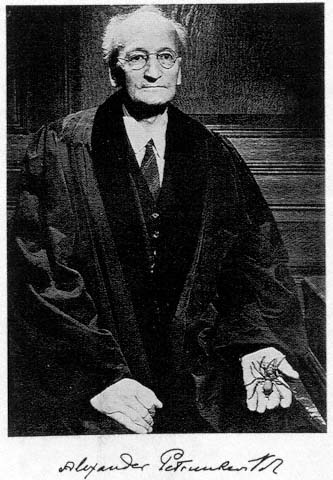
ALEXANDER PETRUNKEVITCH
December 22, 1875-March 9, 1964
BY G. EVELYN HUTCHINSON1
ALEXANDER PETRUNKEVITCH was born on December 22, 1875, in the Ukrainian town of Pliski, near Kiev, the second son of Ivan Illitch Petrunkevitch and his wife, Anna Kandida. Though of aristocratic birth, his father was an important liberal statesman who worked incessantly for a more democratic form of government in Russia. He was a founder of the Kadet, or Constitutional Democratic Party, and was elected to the first Duma. He served as majority Party Leader in this body, for which service he was rewarded once with exile and once with imprisonment.
His son, Alexander Petrunkevitch, seems to have become attached to the study of natural history as a small boy. Like many another eminent zoologist he was first interested in the Coleoptera. He also developed considerable manual skills as a machinist—perhaps in part from his friendship with a member of the English-born Bromley family, who had started a factory in Russia early in that country's industrial development. He retained his machinist's skill throughout his life.
At the University of Moscow, Petrunkevitch's first publi
cation was a note on the development of the heart in a chrysomelid beetle.2 His second, on fat absorption by the crop of the cockroach, was received unfavorably at first and only later recognized as a significant contribution to insect physiology.3
Petrunkevitch was also much attracted to literature and about the same time published—under the pseudonym Alexandr Jan-Ruban—a Russian translation of Byron's Manfred.4 He used the same pseudonym for two later volumes of poetry5 and retained his literary interests throughout his life. Much later he repaid his debt to English letters with an English prose translation of the Lay of the War-ride of Igor, the oldest important monument of Russian literature,6 and—in connection with the centenary of Pushkin's death—prose translations of some of the great Russian poet's poems.
His professors in Moscow seem to have been a varied lot, ranging from the alcoholic to the eminent. Among the latter was the great geochemist, V. I. Vernadsky, with whom Petrunkevitch evidently had quite a close connection. He recounted how the two of them once visited a mine together. A high official of the mining company accompanied the distinguished professor from Moscow University and his young friend in the cage, and a mine worker with an anarchistic turn of mind decided to cut the rope suspending the cage and send at least one mining company official to his doom.
Fortunately, the cage tilted obliquely and stuck in the shaft very close to an adit through which its occupants were rescued unharmed. Later in life, Vernadsky's son, the distinguished Russian historian George Vernadsky, was to become a colleague of Petrunkevitch at Yale and, between them, they were instrumental in introducing to America V. I. Vernadsky's ideas about the biosphere.
THE UNIVERSITY OF FREIBURG (1899-1903)
Before proceeding to an advanced degree Petrunkevitch ran afoul of the authorities in a protest against the way students had been treated in the disturbances in Russia in 1899. Finding he would have to escape from the country if he did not wish to be arrested, he left and made his way to Germany to complete his education. Characteristically, he chose to work under August Weismann at the University of Freiburg because the great German zoologist had been violently attacked by Timariazev, professor of plant physiology at Moscow University. So it was that he first came to study and then to admire Weismann's work.
Although Petrunkevitch came to differ with Weismann on many matters of theoretical interpretation, their admiration and affection for each other were mutual, and their friendship continued until just before Weismann's death when the first World War interrupted their correspondence. Long walks and conversations at a time when Weismann was partially blind evidently played a determining role in developing Petrunkevitch's interest in the philosophy of biology.
In 1900 he took his Ph.D. summa cum laude and stayed on at Freiburg as privat Dozent. Throughout 1902 and 1903 he lectured on cytology and human parasitology. He also had charge of the parasites and spiders in the University collection, the first record of Petrunkevitch as arachnologist.
A certain naïveté and impatience with what seemed fool
ish conventions showed themselves in his German career. A newly appointed privat Dozent, for instance, was expected to pay ceremonial calls at the houses of all 140 members of the faculty. Since this merely involved leaving a card, Petrunkevitch worked out the most efficient route, hired a cab, and set out—only to discover that order of academic precedence, not geographical convenience, should have dictated the way. His mistake caused considerable offense, but despite such misunderstandings he became an effective spokesman for Weismann's students and junior staff, as is evident from his account of an unfortunate situation that developed when the behavior of a lazy, ignorant, and opinionated man began to ruin the reputation of the laboratory.
The Honeybee
Petrunkevitch's most significant scientific work during his Freiburg period was the study he did for his doctoral dissertation, published in 1901, on the cytology and early development of the egg of the honeybee. Although much of the detail recorded in this and in subsequent papers has been superseded by later investigations, Petrunkevitch gave the first statistically adequate cytological demonstration of the truth of Dzierzon's hypothesis that worker and queen bees are developed from fertilized eggs, while drones are developed from unfertilized eggs by parthenogenesis.
Petrunkevitch loved to tell the story of Dickel, an experienced and highly intelligent beekeeper who supplied him with eggs and had his own ideas on bee caste and sex-determination. Doubting what the young investigator could discover by microscopic examination, Dickel sent in the last batch of eggs for investigation with the labels switched. Petrunkevitch discovered the anomalous situation as soon as the eggs were sectioned and went off immediately to confront Dickel. Producing a friend as a witness, the beekeeper smiled sheepishly and admitted that the labels had been switched—
an incident Petrunkevitch recorded briefly in the resulting memoir.
Petrunkevitch's Fixing Fluid
A minor, but nevertheless important, byproduct of this study was the introduction of a modification of Gilson's corrosive sublimate fixing-fluid—a modification that has been widely used as "Petrunkevitch's fluid" in both American and European laboratories. Continental biologists visiting New Haven were sometimes surprised to find themselves in the presence of the almost legendary inventor of this fixative.
It is probable that the mixture was not Petrunkevitch's first attempt in the field; it is certain that he returned again and again to the problems of fixation. Later, in 1943, he obtained remarkable results with a bromophenol-cupric formula, which he believed had finally solved the problem of a "fixing fluid that would leave the tissues soft and at the same time give good nuclear and cytoplasmic fixation."
The fixation process was by no means the only aspect of histological technique that interested him. His work on differential staining at controlled hydrogen ion concentrations did much to interject elementary physical chemistry into histological practice.
While in Weismann's laboratory, Petrunkevitch and George von Guaita completed a morphological study of sound-producing organs in the Orthoptera. This study may well have prepared him for his discovery, over fifty years later, of a biting midge fossilized in amber, the wings of which apparently bore stridulatory organs—a unique occurrence in the Diptera, or two-winged flies.
YALE UNIVERSITY (1910-1964)
In Germany Petrunkevitch met an American, Wanda Hartshorn. They were married in London and came to her home in New Jersey in November 1903. Although he had an
appointment for one term at Harvard, he was compelled to relinquish it on account of his wife's ill health. After that he lived as a private scholar until 1910, maintaining a small laboratory in Short Hills, New Jersey, and, for the summers, in South Harpswell, Maine.
He replaced C. H. Eigenmann for a term and was a visiting professor at the University of Indiana in 1905-1906—in retrospect, a very happy time. In 1906 he returned briefly to Russia, believing that his father's life was in danger as the result of the activities of the Black Hundred, a reactionary group backed by certain members of the Imperial Government. From 1909 until sometime in 1911, he held an honorary curatorship at the American Museum of Natural History.
But in 1910, hearing that A. E. Verrill had retired, he applied for a position at Yale. R. G. Harrison, though embarrassed to suggest a rank so grossly inferior to Petrunkevitch's ability and accomplishments, offered him an instructorship and Petrunkevitch accepted. A year later he was appointed assistant professor, and, in 1917, professor.
During the period between coming to America and his appointment at Yale, Petrunkevitch laid the foundations of his deep knowledge of spiders. His first published paper on the group dealt with the optical properties of the eyes of several species and contained estimates of the possible visual activities of such eyes. This was followed by a number of short works on taxonomy, morphology, and behavior, and in 1911—just after he came to Yale—by a catalog of the spiders of the New World. In 1913 he published ''A Monograph of the Terrestrial Paleozoic Arachnida of North America" (1913) the first of his many significant paleontological works.
POLITICAL ACTIVIST
From 1917 to 1924, Petrunkevitch was much involved with lecturing on Russia and on the political changes taking
place in his homeland. On May 1, 1917, he made an important speech before the Economic Club in New York warning Elihu Root's commission, then about to depart for Russia, that the moderate provisional government the United States supported might easily collapse. Such a collapse would make a separate peace between Russia and Germany probable and free up a great number of German troops to fight on the Western front. On July 4, 1917, he made an address in Center Church, New Haven, on the spirit of freedom.
He was a founder and president of the Federation of Russian Organizations in the United States of America. From 1919 to 1924 he was also president of the Russian Collegiate Institute of New York, set up to assist in the education of Russian refugees. Initially, he taught biology there once a week. In 1921 he made great efforts to ameliorate the position of I. P. Pavlov and seems to have felt that these efforts were not fruitless.
Petrunkevitch was particularly opposed to the United States' recognition of the Bolshevik government in 1924. That same year he became associated with the magazine Current History and contributed several articles on the political and social events in Russia and the Baltic states. This association was terminated, however, by a disagreement with the editor, who apparently felt Petrunkevitch was biased against communists.
RESEARCH PUBLICATIONS
Though all this outside work must inevitably have interfered with his research, he published another paleontological monograph—this time on the Tertiary spiders and harvestmen of North America—in 1922, along with a number of small papers.
In 1925-26 he was a visiting professor at the University of Puerto Rico. Though he had to return as the result of his wife's sudden death in New York, he was able to use the re
suits of his work there to prepare a work of more than 500 pages revising the taxonomy of spiders on that island (1929,2; 1930,1,2).
From this time until the end of his life Petrunkevitch published, quietly but continuously, a series of classic works. His Inquiry into the Natural Classification of Spiders, Based on a Study of Their Internal Anatomy (1933,1) was the first comparative anatomy for any group of arthropods that could be used in classification. In this publication, Petrunkevitch described all but three of the families of spiders, investigating two of the three missing families in subsequent publications. Some later workers have felt that a few of Petrunkevitch's primary divisions, based on the number of pairs of ostia in the heart, indicate grades rather than clades—to use J. S. Huxley's useful terminology. Despite this minor caveat, all subsequent studies of the higher taxa of spiders have been obliged to take his basic findings into account.
Oligocene Amber Spiders
In 1942, having resumed paleontological study, Petrunkevitch produced the first of four basic papers on the spiders of the Oligocene preserved in Baltic amber (1942,1). These investigations continued long after his retirement from Yale in 1943 and became his greatest interest. In 1958 he summarized his findings in a lengthy paper on amber spiders in European collections (1958,1). At the time this paper went to press, Baltic amber spider fauna that had been properly investigated was referable to thirty-three families of which six were extinct; ninety-six genera of which seventy-eight were extinct; and 160 species, all seemingly extinct. It is, therefore, in its familial composition, an essentially modern fauna, though composed of species that have no longer survived.
After he had completed this work, amber spiders turned up in Mexico from deposits of about the same age as in the Baltic countries. Petrunkevitch's second paper on these Mex
ican amber spiders was his last work. Unfinished when he died, it was completed by his friend and fellow worker, Harriet Exline, who, unhappily, herself died while the work was in press (1971,1).
Paleozoic Arachnids
In addition to studying amber spiders, Petrunkevitch devoted a great deal of his extraordinarily productive retirement (about one-quarter of his scientific work was published after he became emeritus) to the Paleozoic arachnids. A prolonged trip to European museums in 1949 greatly furthered this project, which led to several monographs and is summarized in his section on fossil arachnids in Treatise on Invertebrate Paleontology (1955,1). His work led to an extensive critical evaluation of existing knowledge regarding all the higher taxa of the class and to a new, and greatly improved classification.
Surveying the whole evolutionary panorama presented by the Arachnida, he came to feel that all the major lines were established very early by a macroevolutionary process comparable to what his friend Richard Goldschmidt had postulated for his so-called "hopeful monsters." Even the most dyed-in-the-wool proponent of the more conventional view (such as the present writer) must admit that the fossil record of the Arachnida does suggest a macroevolutionary establishment of major lines early in the evolutionary process. However the record is interpreted, it seems reasonable to find the most primitive group—the scorpions—appearing before all others in the Silurian but extremely queer to find the mites, often regarded as one of the most specialized orders, present as early as the Devonian.
PHILOSOPHER
In addition to evolutionary speculations arising directly from his work, Petrunkevitch had deep philosophic interests,
partly from his biological background and partly from his upbringing in a libertarian political tradition. Any form of philosophical determination worried him, and he was continually trying to find a way of reconciling a position that he called "materialistic" with a belief in the freedom of will.
This led him to a position not unlike that of Irving Langmuir in his treatment of an indefinitely large number of small causes producing divergent phenomena. He regarded it as ironical that an early article of his should have been rejected because it was written by a biologist while later the same journal accepted a paper on this subject by Langmuir, an eminent physicist. Actually, of course, the whole intellectual climate had changed.
AWARDS AND HONORS
Petrunkevitch was elected to the National Academy of Sciences in 1954. This event gave him great pleasure but came too late in his life for him to play a significant advisory role.
Among the other societies to which he belonged, the Connecticut Academy of Arts and Scientists, the youngest of the three 18th century learned bodies in the United States, was particularly dear to him. He occupied its presidential chair from 1931 to 1946 and published many of his most important papers in its Transactions. As president, he revitalized the ancient institution and made its meetings—followed by what the Academy home secretary, George F. Eaton, called a resupper—unique intellectual and social occasions of particular value to newly-arrived expatriates, whom he often invited to attend.
Many others will chiefly remember him for "Pete's tea" the weekly gatherings in his laboratory at 4:30 on Mondays at which all graduate students and faculty members were welcome. He continued holding these teas long after his retirement, almost to the end of his life. It is quite likely that many
young experimentalists, attracted first by a break with tea and cookies, later learned to appreciate the tarantulas in Petrunkevitch's vivarium and the beautifully prepared specimens in amber under his binocular microscope. Perhaps these pleasant memories made them friendlier to behavioral, systematic, and evolutionary studies when such matters came under consideration at faculty meetings and on committees for the awarding of grants.
IN PREPARING THIS ACCOUNT I am conscious of the help that I have received from Alexander Petrunkevitch's dear friend and colleague, the late Grace E. Pickford, another invertebrate zoologist with whom he collaborated so beneficially in the later years of his life. I would also like to mention Eugene Kinkaid's general essay, "Arachnologists," in the New Yorker Magazine (Part 1 in April 22, 1950, pp. 38-59, and Part 2 in April 29, pp. 37-55).
SELECTED BIBLIOGRAPHY
1901 Die Parthenogenesis bei der Honigbiene. Naturwiss. Wochenschr. May 26.
1904 Künstliche Parthenogenese. Zool. Jahr., Supplement 7: 1-62.
1911 A synonymic index-catalogue of spiders of North, Central, and South America with all adjacent islands—Greenland, Bermuda, West Indies, Terra del Fuego, Galapagos, etc. Bull. Am. Mus. Nat. Hist. 29.
1913 A monograph of the terrestrial palaeozoic arachnida of North America. Trans. Conn. Acad. Arts Sci. 18: 1-137.
1922 Tertiary spiders and Opilionids of North America. Trans. Conn. Acad. Arts Sci. 25: 211-79.
1923 On families of spiders. Ann. N.Y. Acad. Sci. 29: 145-80.
1925 External reproductive organs of the common grass spider, Agelena naevia Walckenaer. J. Morphol. Physiol. 40: 559-73.
1926 Tarantula versus tarantula-hawk: a study in instinct. J. Exp. Zool. 45: 367-93.
The value of instinct as a taxonomic character in spiders. Biol. Bull. (Woods Hole, Mass.) 50: 427-32.
1928 Systema Aranearum. Trans. Conn. Acad. Arts Sci. 29: 1-270.
1929 The spider fauna of Panama and its Central American affiliation. Am. Nat. 63: 455-69.
The spiders of Porto Rico, part 1. Trans. Conn. Acad. Arts Sci. 30: 1-158.
1930 The spiders of Porto Rico, part 2. Trans. Conn. Acad. Arts Sci. 30: 159-355.
Sex in the eternal triangle of life. Yale Rev. 20: 107-20.
The spiders of Porto Rico, part 3. Trans. Conn. Acad. Arts Sci. 31: 1-191.
1933 An inquiry into the natural classification of spiders, based on a study of their internal anatomy. Trans. Conn. Acad. Arts Sci. 31: 299-389.
1939 With H. Exline. Catalogue of American spiders. I. Classification of the Araneae with key to suborders and families. List of species suborder Mygalomorpha. Trans. Conn. Acad. Arts Sci. 33: 133-338.
1942 A study of amber spiders. Trans. Conn. Acad. Arts Sci. 34: 119-464.
1943 Some curious effects of salts of metals and other chemicals in fixation. Anat. Rec. 86: 387-99.
1945 Palaeozoic Arachnida of Illinois. State of Illinois Scientific Papers 3: 1-72.
1946 Fossil spiders in the collection of the American Museum of Natural History. Am. Mus. Novit. no. 1328, 36 pp.
1949 A study of the structure, classification and relationship of the Palaeozoic Arachnida. Trans. Conn. Acad. Arts Sci. 37: 69-315.
1950 Baltic amber spiders in the Museum of Comparative Zoology. Bull. Mus. Comp. Zool. Harv. Coll. 103: 259-337.
1952 Principles of classification as illustrated by studies of Arachnida. Syst. Zool. 1: 1-19.
1953 Palaeozoic and Mesozoic Arachnida of Europe. Mem. Geol. Soc. Am. no. 53, 128 pp.
1955 Arachnida. In: Treatise on invertebrate paleontology. pt. P: Arthropoda 2. Raymond C. Moore, ed., pp. 46-162. Kansas City: Geol. Soc. Amer. and Univ. Kansas Press.
Trigonotarbus arnoldi, a new species of fossil arachnid from southern France. J. Paleontol. 29: 475-77.
1958 Amber spiders in European collections. Trans. Conn. Acad. Arts Sci. 41: 97-400.
1963 Chiapas amber spiders. In: Studies of fossiliferous amber arthropods of Chiapas, Mexico, pp. 1-40. Berkeley: Univ. Calif. Press Publ. Entomol. 31.
1971 Chiapas amber spiders. II. In: Studies of fossiliferous amber arthropods of Chiapas, Mexico, completed and edited by Harriet Exline, pp. 1-44. Berkeley: Univ. Calif. Press Publ. Entomol. 63.


