
PHILIP JACKSON DARLINGTON, JR.
November 14, 1904-December 16, 1983
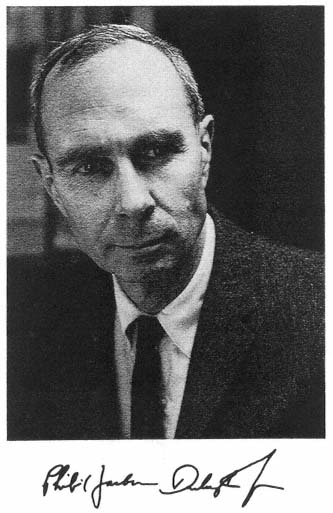
BY EDWARD O. WILSON
AMONG THE MOST ADMIRABLE of scientists are the naturalist explorers who return from arduous journeys to study their specimens, to reflect, and to build new theories of classification and evolution. Linnaeus, back from Lapland and Oland, was the eighteenth century exemplar. In the nineteenth century Darwin, Wallace, and Bates repeated the pattern on a more global scale. In our own time, Philip Jackson Darlington carried on the tradition. A tough explorer, he influenced the style and thinking of current field zoologists. An equally tough and original scientist, he transformed accepted wisdom regarding the way animals evolved and came to be distributed over the land.
EDUCATION AND EARLY LIFE
Like most major naturalists, Darlington grew up one. He was born in Philadelphia, Pennsylvania, on November 14, 1904, and spent most of his childhood in Hartford, Connecticut. With an inventive engineer for a father and a schoolteacher mother, his family environment was conducive to a life of the mind.
Everyone in his family was active in gardening and the study of local natural history, especially flowering plants and birds. Summers were spent at Penobscot Bay in Maine and
in various localities in New Hampshire, where Philip was able to collect and observe animals on a daily basis. Back in Hartford, he rode trolleys and bicycles to nearby natural environments to keep his hobby going. An Exeter physics teacher interested in natural history further influenced him, mentor and student often going out on field trips together. His housemaster once found snakes and turtles in his dresser drawer, and when Darlington graduated in 1922, his class yearbook appropriately designated him ''a lover of the woods and fields.''
As a teenager, Philip wanted to collect specimens for science but could not shoot birds because he was too young to obtain a gun license. He turned to beetles, saying, according to his brother Sidney, "No one cared if I collected bugs," and this became his ruling passion over the remainder of his life. (If beetles seem an odd choice for a future great zoologist, it should be remembered that Darwin's favorite group was also the Coleoptera.)
In 1922 Darlington entered Harvard College and took a wide range of courses in zoology and botany. He could hardly wait to get into the tropics (where the great bulk of insect diversity resides) and so postponed his graduate studies for a year to work for the United Fruit Company near Santa Marta, Colombia. Working extensively in the lowlands and in the surrounding mountains, he climbed up into the highest elevations nearby. Returning to Harvard in 1929, he brought with him a large collection of insects and vertebrates, including a surprising diversity of birds, and published his ornithological notes the following year.
Darlington completed his Ph.D. in 1931 with a thesis on the ground beetles (Carabidae) of New Hampshire. He then began an extraordinary series of field expeditions to Australia and the West Indies, bringing back to Harvard's Museum of Comparative Zoology massive collections of insects, rep-
tiles, and other organisms, many of them new to science. Classifying the new beetles involved exacting techniques, such as counting the hairs on their eye margins and describing minutely the front foot of the male.
In 1940 he was appointed Fall Curator of Coleoptera at the Museum. Two years later he married Elizabeth Koch of Cambridge, who shared his love of natural history and accompanied him on many of his later excursions. (In 1956-57, the two of them and their son, Philip Frederick Darlington, spent eighteen months in the Australian wild living out of a truck.) In 1951 Darlington was appointed Curator of Insects and in 1962 Alexander Agassiz Professor of Zoology as well. He retired in 1971.
DARLINGTON IN THE FIELD
Darlington's collecting ability was legendary, as were his quiet toughness and determination in the field. Frank M. Carpenter, his colleague and friend of sixty years, recalled how, during an early field trip to the Smoky Mountains, Darlington insisted on sleeping under a tree at night and made an apple his breakfast and another his lunch so as not to waste time.
Before I departed on my own first tropical expedition to Cuba and Mexico in 1953, Darlington advised me that a good field biologist must be willing to endure discomfort. "Walk in a straight line across natural habitats," he told me. "It is a mistake to follow lazily along roads and trails, where you might miss some of the native fauna." And so he did himself, whether tracking through the forests of New Hampshire or proceeding directly up to the top of Pico Turquino, Cuba's highest mountain.
In 1933 he was one of the first to climb La Hotte, Haiti's highest and most hazardous mountain. Characteristically, he left his guides behind at 5,000 feet and cut and scrambled
his way up the remaining 3,000 feet through unbroken forest. At the summit, however, he was disappointed to find the remains of a surveyor's camp; approaching from the other side, they had beaten him there by two years. But if not the first human being, he was at least the first biologist to reach the top, and on the slopes of La Hotte he collected many insects and other animals new to science, including a new genus of snakes, later named Darlingtonia in his honor.1
Shortly after Pearl Harbor, Darlington enlisted in the Army Sanitary Corps Malaria Survey as a first lieutenant. He served in the Sixth Army during the New Guinea, Bismarck Archipelago, Central Philippines, and Luzon Campaigns, retiring as a major in 1944. Before leaving New Guinea, he was able to collect great numbers of ground beetles and other insects in several regions of the country, including the Bismarck Range and even the summit of Mt. Wilhelm, the highest mountain in the range.
One Darlington exploit from that era became a standard of zoology lore. Alone in the jungle looking for specimens, he went out on a submerged log to sample water from the middle of a stagnant jungle pool, when a giant crocodile rose from the depths. As he edged back gingerly toward shore, he slipped into the water from the slimy log. The crocodile rushed him, mouth gaping, huge teeth bared. He tried to grasp its jaws, got one grip, then lost it.
"I can't describe the horror of that instant," he told reporters at the time, "but I was scared and I kept thinking: What a hell of a predicament for a naturalist to be in."
The thirty-nine-year-old Darlington was 6-foot 2-inches and 190 pounds; the crocodile several hundred pounds and in its element. It spun him over and over, finally carrying him to the bottom.
"Those few seconds seemed hours," he said. "I kicked, but it was like trying to kick in a sea of molasses. My legs seemed heavy as lead and it was hard to force my muscles to respond." Whether because of a well-placed kick or some other reason, the animal suddenly opened its jaws and Darlington swam free. Despite torn arms, he made for the shore, scrambling frantically up the bank, since crocodiles sometimes pursue prey onto land. Slipping in the mud, he rolled back again into the ooze.
"It was a nightmare. That's the first time I've ever hollered for help," he said. "But there was no one to hear me." Finally reaching the jungle, he became aware of the pain in his arms and his weakness from loss of blood. "That hike to the hospital, which I knew was nearby, was the longest I've ever made." The muscles and ligaments of both arms were torn and the bones of his right arm were crushed, while the crocodile's teeth had pierced both his hands.
With characteristic understatement, Darlington wrote to his wife of "an episode with a crocodile" but supplied no further details.2
He was in a cast for several months, convalescing at Dobadura, Papua, where he perfected a left-handed technique for collecting insects: Have someone tie a vial to the end of a stick. Walk out into the forest, jam the stick into the ground, pull the cork out with the left hand, drop the specimens into the vial, replace the cork. He eventually regained full use of his hands and arms.
If a motion picture had been made of Darlington's life, Gary Cooper would have played him best. His direct, laconic approach to any problem was refreshing to all who knew him.
When Frank Carpenter was asked at Darlington's Harvard memorial service why Philip was so much fun to be with, he cited this quality and told the story—another old standby of zoology lore—of Darlington's debate during the late 1930s with Thomas Barbour, then director of the Museum of Comparative Zoology, regarding the long-distance dispersal of animals.
Barbour was an advocate of land bridges, while Darlington thought that animals might have been transported by winds for considerable distances before being dropped onto islands. Barbour doubted wind dispersal because he felt sure that larger animals, such as frogs, would be killed on striking the ground. To test his theory Darlington dropped several frogs from the fifth floor of the Museum to the grass below, where Barbour and a crowd of spectators were assembled. Carpenter recalls:
"As each frog landed . . . Dr. Barbour shouted to Philip, 'That one's dead!' When they had all been dropped, Philip called down to Dr. Barbour asking how they were, to which he replied, 'They're all dead.' But almost immediately the stunned frogs began to recover, and in a few minutes they began to hop about in all directions. I don't think that Dr. Barbour was convinced, but the discussions on the rear steps were on other subjects after that."3
CARABID BEETLES, MIMICRY, AND FLIGHTLESSNESS
The bulk of Darlington's research was on the systematics, distribution, and ecology of the carabid beetles, for which he was respected as one of the foremost insect taxonomists in the world. He went still further, using this expertise to make several contributions of general importance to biology.
In 1938 he published the results of a pioneering study he
had conducted in Cuba on mimicry in beetles. This zoological classic describes how, when he modified the appearance of distasteful beetles and their mimics, both became acceptable to anole lizards that had previously rejected them. His experiment demonstrated the role of visual cues in mimicry and was the forerunner of many later studies that have brought us to our current firm understanding of the phenomenon.
From his thorough understanding of beetle distribution, Darlington successfully challenged Darwin's theory that flightlessness in island insects is due to winged forms being swept away by the wind. He did this partly by demonstrating that small, low oceanic islands, fully exposed to strong winds, have predominantly fully-winged faunas with very wide geographical ranges, whereas equally remote, high, forested islands tend to have a rich variety of flightless, endemic species. Darlington concluded that evolution proceeds by the arrival of winged carabids on mountainous islands, with subsequent specialization to the mountain habitats entailing reduction of dispersal ability and loss of wings.
THE ORIGIN OF DOMINANT VERTEBRATE GROUPS
Darlington's most important contribution to science was his theory of the Old World tropical origin of dominant vertebrate groups. He first sketched out this formulation—which would influence research in zoogeography for a generation—in The Quarterly Review of Biology of 1948, then presented it in full dress in his 1957 text, Zoogeography: The Geographical Distribution of Animals.
A theory of faunal dominance was first proposed by the American paleontologist William Diller Matthew in 1915. According to Matthew's scheme, new groups of vertebrates—such as the rhinoceros (Rhinocerotidae) and tapirs (Tapiridae)—had originated during the early Tertiary in the central
Eurasian-North American land mass. Hardened by the cold and fickle climate of the north, they became better fitted for competition and survival everywhere and accordingly spread south through the southern land masses and archipelagos, pushing out the previous inhabitants. Rhinos and tapirs, for example, gave way before the great herds of antelopes, bovids, and other artiodactyls that still prevail in both the northern and southern hemispheres.
Darlington realized, however, that Matthew had based his identification of the northern hemisphere as the key faunistic staging area on inadequate, and geographically biased, fossil data. Keeping Matthew's vision of dominance and cyclic replacement, he reconsidered the area of origin. With the aid of extensive new fossil evidence and close examination of the zoogeography of living cold-blooded vertebrates, he shifted the principal source area for dominant groups to the Old World tropics—more precisely, to central and northern Africa, southern Europe and the Middle East (tropical in climate during much of the Tertiary), and southern Asia.
Dominant terrestrial groups originated more frequently within this domain than elsewhere. Their species tended to spread to parts of the world that Darlington now conceived to be peripheral: across the Bering land bridge to North America, and thence to Central and South America; across the Indonesian archipelagos to Australia and the Pacific archipelagos; and straight north into temperate Asia and south into southern Africa.4
Since 1957 the demonstration of plate tectonics has complicated this picture greatly, requiring the superimposition of
continental drift on theories of the distribution of terrestrial animal groups of Mesozoic (or earlier) origin. But the theory of Old World tropic dominance still holds, at least as a working model, for the many other groups of Tertiary origin.
IN CONCLUSION
Philip Darlington was a modest and reserved man with a strong sense of privacy. Though he did not seek fame or position, his contributions were widely recognized and honored. He was a Guggenheim fellow in 1947 and again in 1957, the year he also received the National Academy's Daniel Giraud Eliot Medal in zoology and paleontology. He was a fellow of the American Academy of Arts and Sciences and became a member of the National Academy of Sciences in 1964.
He allowed as little distraction from his family and science as he could manage. As his wife Elizabeth once put it, "Philip led an unfragmented life." The originality and independence of thought evident in all he did set high standards, both for the many who read his works and for the small group of entomologists and biogeographers privileged to work with him. In the tradition of Linnaeus and Darwin, he was a great naturalist.
SELECTED BIBLIOGRAPHY
1927 Auto-hemorrhage in Tropidophis semi-cinctus. Bull. Antivenin Inst. Am. 1: 59.
1930 Notes on the senses of vultures. Auk 47: 251-52.
1931 Notes on the birds of Rio Frio (near Santa Marta), Magdalena, Colombia. Bull. Mus. Comp. Zool. 71: 349-421.
1933 A new tribe of Carabidae (Coleoptera) from western United States. Pan-Pac. Entomol. 9: 110-14.
1934 Four new Bembidiini (Coleoptera: Carabidae) from Costa Rica and Colombia. Occas. Pap. Boston Soc. Nat. Hist. 8: 157-62.
1936 The species of Stenomorphus (Coleoptera: Carabidae), with data on heterogony in S. californicus (Mén.). Pan-Pac. Entomol. 12: 33-44.
Variation and atrophy of flying wings of some carabid beetles. Ann. Entomol. Soc. Am. 29: 136-79.
A list of the West Indian Dryopidae (Coleoptera), with a new genus and eight new species, including one from Colombia. Psyche 43: 65-83.
1938 The origin of the fauna of the Greater Antilles, with discussion of dispersal of animals over water and through the air. Q. Rev. Biol. 13: 274-300.
Experiments on mimicry in Cuba, with suggestions for future study. Trans. R. Entomol. Soc. London 87: 681-96.
1939 West Indian carabidae V: New forms from the Dominican Republic and Puerto Rico. Mem. Soc. Cubana Hist. Nat. 'Felipe Poey' 13: 79-101.
1943 Carabidae of mountains and islands: Data on the evolution of isolated faunas and on atrophy of wings. Ecol. Monogr. 13: 37-61.
1948 The geographical distribution of cold-blooded vertebrates. Q. Rev. Biol. 23: 1-28, 105-23.
1950 Paussid beetles. Trans. Am. Entomol. Soc. 76: 47-142.
1953 West Indian carabidae (IX): More about the Jamaican species. Occas. Pap. Mus. Inst. Jamaica 8: 1-14.
1957 Zoogeography: The geographical distribution of animals. New York: John Wiley & Sons. 675 pp.
1959 The Bembidion and Trechus (Coleoptera, Carabidae) of the Malay Archipelago. Pac. Insects 1: 331-45.
1960 The zoogeography of the southern cold temperate zone. Proc. R. Soc. London 152: 659-68.
1964 Australian carabid beetles XIV: Perigona. Psyche 71: 125-29.
1965 Biogeography of the southern end of the world: Distribution and history of far-southern life and land, with an assessment of continental drift. Cambridge: Harvard Univ. Press. 236 pp.
1969 Coleoptera: Carabidae, including Cicindelinae. Insects Micronesia 15: 1-49.
1971 The carabid beetles of New Guinea, part IV: General considerations; analysis and history of fauna; taxonomic supplement. Bull. Mus. Comp. Zool. 142: 129-337.
1980 Evolution for naturalists: The simple principles and complex reality. New York: John Wiley & Sons. 262 pp.
1983 Evolution: Questions for the modern theory. Proc. Natl. Acad. Sci. USA 80: 1960-63.


