
SELIG HECHT
February 8, 1892-September 18, 1947
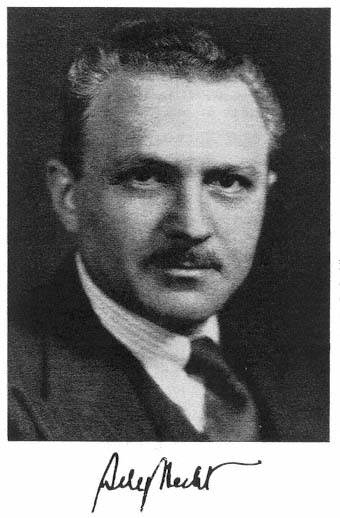
Courtesy, Columbia University, Bulter Library
By GEORGE WALD1
ON SEPMTEMBER 18, 1947, Selig Hecht, professor of biophysics at Columbia University, died suddenly at the age of fifty-five. He was one of the most vivid scientific figures of his time, a pioneer in the development of general physiology in this country and, for more than two decades, the undisputed leader in his chosen field—the physiology of vision.
In Hecht, great scientific capacities combined with equally superb gifts as a teacher, writer, and lecturer. His interests ranged widely, and everywhere they touched, he made striking personal contributions. No less than his works, the world will miss his vigorous personality, his breadth of outlook, and his generosity of spirit.
Hecht instilled something of his own clarity, substance, and force into his special field. He drew together its scattered phenomena, ordered them, and gave them a secure foundation in physics and chemistry. In many areas of vision his laboratory contributed the most complete and accurate data we possess. He provided in addition a context of ideas and rigorous theory upon which workers in vision will rely for many years to come.
Hecht cast his light widely and many found their way by it. In his death, his colleagues recognized the passing of a great scientist. They, and many others, feel as well the loss of a warm friend.
EDUCATION AND EARLY LIFE
Selig Hecht was brought to America as a young child from the village of Glogow, then Austrian Poland. The early part of the century was the period of the great migration to this country from Eastern Europe.2 The family settled in New York's lower East Side, where young Selig went to public and Hebrew schools and was taught Hebrew at home by his father.
The early history of the Hecht family is filled with financial struggles. The eldest of five children, Selig ran errands after school to add to the family's small resources. During high school he found work as a bookkeeper in a woolen business, a position he kept all through college. The ideal of learning under difficulties was deeply embedded in the family's outlook, and Selig's father turned to serious study as soon as he could win some leisure. Over eighty and still vigorous, the elder Hecht read widely, warmly arguing problems in history and philosophy from Schopenhauer to Spinoza.
In 1909 Selig entered the College of the City of New York and began to concentrate in mathematics. He took his first course in zoology only late in his college career but then turned to it as his primary interest. A fellowship allowed him to spend the summer vacation before leaving college with his fellow student, William Crozier, at the Bureau of Fisheries Station in Beaufort, North Carolina. Out of that summer's work came two papers, one written jointly with Crozier on
the relation of weight to length in fishes, and one on the absorption of calcium during molting of the blue crab.
Graduating in February 1913, Selig went to work as a chemist in a fermentation research laboratory. Here he made his first contact with photochemistry, having been asked to study the effect of light on the deterioration of beer. On solving this problem, he was promptly discharged. He determined then and there to renounce industrial work forever.
Back at Beaufort for another summer, Hecht made plans to begin graduate study. To obtain funds for this he took a position as chemist in the Department of Agriculture in Washington. Within a year he had saved enough to enter Harvard for graduate training in zoology.
At Harvard he became one of a group of graduate students who were to play a major role in the development of general physiology in this country—Crozier, Fenn, Redfield, S. C. Brooks, Olmstead, and Minnick. He undertook research for the doctorate under G. H. Parker, studying also with Osterhout, Wheeler, Mark, and Rand. Summers were spent working at the Bermuda Biological Station on the physiology of Ascidia atra, the subject of his doctoral dissertation.
The Ph.D. was granted Hecht in June 1917, and on the following day he married Celia Huebschman, daughter of an immigrant Austrian family, whom he had met while at college in New York. It is difficult to think of either Hecht thereafter without the other. They shared an extraordinary community of interest and enjoyment and dealt with each other on an intellectual level few marriages attain. Wherever they were, Celia made a home warm with hospitality and grace to which Selig could bring his friends and his troubles, sure that both would be received with sympathy and understanding.
Their wedding was brightened by a characteristic incident. Selig had entered a portion of his doctoral thesis for the Bowdoin Prize ''for essays of high literary merit,'' and was
awarded two hundred dollars and a medal. With this puff to their fortunes, the young couple left for a honeymoon at the Oceanographic Institute at La Jolla. Ritter, then director of the Institute, gave Selig a fellowship for the summer, and under these circumstances he performed experiments on the sensitivity to light of the ascidian, Ciona, experiments that launched a lifetime of work on photoreception and vision.
The paper describing this investigation presented for the first time Hecht's view of the photoreceptor process. He sent it to Jacques Loeb for publication in the newly founded Journal of General Physiology, and it appeared in the first volume. From then on Hecht's entire scientific production, with only minor exceptions, was published in the pages of this journal. Though he never played a formal role in its direction, Hecht identified with its purposes and standards and never failed to send it the best of his achievements in their most definitive form.
PHOTORECEPTION STUDIES AND TRAVEL (1917-1926)
In the fall of 1917 Selig took the position of assistant professor of biochemistry in the Medical School of Creighton University, a Jesuit institution in Omaha, where he spent the next four years. But Hecht was made for the metropolis and it for him; he looked upon this as a period of exile made more onerous by lack of time and resources for research. He spent each summer at the Marine Biological Laboratory in Woods Hole, eagerly compensating for the year's frustrations and doing some of his most significant work.
He had by that time worked through the analysis of photoreception (introduced with the Ciona experiments) in detail using another relatively simple system, that of the clam Mya. As his theory became more firmly established, Hecht grew more confident of its generality and essential correctness and turned to the analysis of a human visual function—adaptation to darkness. Seeking direct information on the initial
effects of light on the eye, he performed his classic studies of the bleaching of rhodopsin in solution.
Selig was now wholly caught up in what he believed to be a major scientific advance. He wanted to establish an adequate laboratory and to teach General Physiology—an area of science that inspired him with a mission3—and to develop about himself a group of research students. That no opportunity was made available to do these things was without question a source of deep disappointment.
With Jacques Loeb's sponsorship, Selig was awarded a National Research Council fellowship in biology, which he held for three years. After that, with no post in sight, he was a General Education Board fellow for another two years. Though rich in experience and fruitful in terms of his work, this was a trying period. For all his superb gifts and accomplishments, Hecht had to wait almost a decade after completing his formal training before he received an adequate academic appointment.
During this difficult period the warm friendship and confidence of Jacques Loeb, whom he had come to know at Woods Hole, was a continuing source of encouragement. In the fall of 1922 Loeb wrote to Hecht:
"I feel that in you the coming generation of scientists will have a leader and that I need not yield to my pessimistic mood in regard to the future of science in this country. You yourself may safely ignore the stupidity and even brutality of our times and keep that serenity which is required of a man who wishes to do his best work. The future needs you and belongs to you . . . ." [And, in a characteristically gracious postscript: ] "Please remember me kindly to Mrs. Hecht—she may well be proud of you."
Hecht spent his first year as a National Research Council fellow in Liverpool in the laboratory of the photochemist, E. C. C. Baly. There, with the help of R. E. Williams, he carried through a classic study of the spectral sensitivity of human rod vision.
The remaining two years of this fellowship were spent in the laboratory of L. J. Henderson, both at Harvard Medical School and at Woods Hole. During this period he extended his view of the photoreceptor process to a theoretical analysis of brightness discrimination—a characteristically global view that embraced the data for man and for the clam in one quantitative treatment. Here he pointed out for the first time that the data of human intensity discrimination are dual in origin, breaking on analysis into a low intensity portion (dependent on the rods), and a high intensity segment (governed by the cones).
In the spring of 1924 the Hechts' daughter, Maressa, was born. The family spent the following year in Naples, where Selig, then a General Education Board fellow at the Zoological Station, worked on Ciona and a new lamellibranch, Pholas.
The following year the Hechts lived in Cambridge, England, and Selig entered Barcroft's laboratory. One could hardly do this without being drawn into the lively controversy then raging over the question of whether the oxygen dissociation curve of hemoglobin is S-shaped or hyperbolic. For all his absorption in visual problems, Selig plunged into this work, devising a spectrographic procedure of which Barcroft wrote:
"This technique, so far as the making of all the estimations is concerned, is in many ways a decided advance on any of its predecessors. The improvement was aptly expressed by someone who, looking at one of Hecht['s] and Morgan's curves, said, 'This is the first dissociation curve I have seen where the points really lie on the curve."'4
In that same connection, Hecht told me the following story—a nice example of Barcroft's exuberance. Just as Barcroft was setting out for a meeting of the Physiological Society, Hecht showed him one of his first oxygen dissociation curves of hemoglobin, which looked to be a rectangular hyperbola. Barcroft took it along with him to report on at the meeting. But when he got back to Cambridge, Hecht, who had in the interim done a more detailed job, told him that the curve was S-shaped, after all. Nothing daunted, Barcroft—who had already written an abstract reporting that "the curve is clearly a hyperbola"—crossed out "clearly" and over it wrote "nearly."
The Cambridge interlude was the last of Hecht's Wanderjahre. During these fellowship years, with their opportunities for visiting and travel and at the Physiological Congress in Stockholm in 1926, the Hechts formed many warm friendships abroad, which they maintained and cherished ever afterward and renewed at every opportunity.
In this period Hecht also gained a wide international audience for his work. A general review he wrote for Naturwissenschaften in 1925 led to a published discussion with Lasareff. In part because of associations formed in this earlier period, Hecht continued to publish abroad: again in Naturwissenschaften in 1930, a comprehensive review in the Asher-Spiro Ergebnisse der Physiologie (translated into German by Frau Asher in 1931), a volume in the Actualités Scientifiques in 1938, and invited papers in a number of British journals.
COLUMBIA YEARS (1926-1947)
In the spring of 1926, Selig was offered simultaneously a post at Columbia and a projected chair at a major English university. Much as he had valued his English associations, he decided to return to this country. In September 1926, he became associate professor and, in 1928, professor of bio-
physics at Columbia University—the post he held at the time of his death.
As the only physiologist in Columbia's Department of Zoology, Hecht had a large measure of autonomy within his special sphere to construct a situation after his own design. In the lofty isolation of the thirteenth floor of the new Physics Building, commanding a superb southern view of the city and the Hudson River, he fitted out a compact set of laboratories and workrooms with everything needed for physiological investigation and instruction.
There he began an advanced course in general physiology in which he imparted his highly original ordering of the subject before a small, well-prepared group of students. The students were given individual problems in the laboratory, and most of the initial group remained with him to complete their doctoral research.
Hecht took a quite extraordinary interest in his students, and the layout of the laboratory itself encouraged association. Tea was served every afternoon. There, and at weekly colloquia—indeed on any occasion in which Hecht or one of the students had something he wished to discuss—a group would gather. Under his influence conversation ranged over literature, politics, music, and art as well as science; and at one period students met at the Hechts' home one evening a week to read and discuss, as they appeared, L. J. Henderson's Blood and P. W. Bridgman's Logic of Modern Physics. Mrs. Hecht would join the group later in the evening over sandwiches and beer, and the conversation would broaden its scope.
This communal life of the laboratory articulated and clothed the bare bones of graduate instruction. It fostered in Hecht's students a strong and abiding attachment and sense of loyalty. Long after they left his laboratory, Hecht continued to hold a central place in their thoughts and affections.
Among Hecht's first students was Simon Shlaer, who be-
came Hecht's assistant in his first year at Columbia and continued as his associate for twenty years thereafter. A man infinitely patient with things and impatient with people, Shlaer gave Hecht his entire devotion. He was a master of instrumentation, and though he also had a keen grasp of theory, he devoted himself by choice to the development of new technical devices.
Hecht and Shlaer built a succession of precise instruments for visual measurement, among them an adaptometer and an anomaloscope that have since gone into general use. The entire laboratory came to rely on Shlaer's ingenuity and skill. "I am like a man who has lost his right arm," remarked Hecht on leaving Columbia—and Shlaer—in 1947, "and his right leg."
In his Columbia laboratory, Hecht instituted investigations of human dark adaptation, brightness discrimination, visual acuity, the visual response to flickered light, the mechanism of the visual threshold, and normal and anomalous color vision. His lab also made important contributions regarding the biochemistry of visual pigments, the relation of night blindness to vitamin A deficiency in humans, the spectral sensitivities of man and other animals, and the light reactions of plants—phototropism, photosynthesis, and chlorophyll formation.
As Hecht's Columbia laboratory became one of the most productive centers of physiological investigation and training, he himself exercised an ever-widening influence and activity in contemporary science. Almost a score of his students went on to careers in physical and biological chemistry, physiology, chemical genetics, and ophthalmology.
In 1941, Hecht was awarded the Frederick Ives Medal of the Optical Society of America. He was elected to the National Academy of Sciences in 1944. A director-at-large of the Optical Society of America, he also served on the editorial
boards of the Journal of the Optical Society, the Biological Bulletin, and Documenta Ophthalmologica.
War Work
Throughout the late years of World War II, Hecht devoted his energies and the resources of his laboratory to military problems. He and Shlaer developed a special adaptometer for night-vision testing that was adopted as standard equipment by several Allied military services. Hecht also directed a number of visual projects for the Army and Navy and was consultant and advisor on many others. He was a member of the National Research Council Committee on Visual Problems and of the executive board of the Army-Navy Office of Scientific Research and Development Vision Committee.
His influence, however, extended far beyond the scope of these formal commitments. He visited many military installations to acquaint himself with their problems at first hand, taking researches into the field whenever that seemed likely to bring quicker and more practical results. He had a strong sense of the urgency of the war and no civilian timidity whatever. His plain speech in high places won the esteem and affection of his military associates, who miss him now as deeply as do his academic colleagues.
Hecht had a high sense of the social obligations of science. He thought it imperative that science be explained to the layman in terms that he could understand and use in coming to his own decisions. For this task he himself had a special talent. When, for instance, he thought certain of his colleagues' statements regarding Heisenberg's "Uncertainty Principle" and the problem of human free will were misleading the lay public, he wrote an essay on the subject for Harper's Magazine. Early in the War he wrote another article for Harper's on night vision, which was later distributed in large numbers to the Air Force.
Educating the Public
Hecht greatly enjoyed teaching adults at the New School, where he gave courses in sensory physiology, physics, and atomic energy. His New School lectures on atomic energy grew into the book, Explaining the Atom, a lay approach to atomic theory and its recent developments that the New York Times (in a September 20, 1947, editorial) called "by far the best so far written for the multitude."
This popular book had one curious consequence: Hecht was asked to lecture on atomic energy before the War College. He accepted the invitation, characteristically changing the subject and lecturing instead on the relation of science to technology. In his speech Hecht pointed out the need, now that the war had ended, to foster basic scientific research. He was also deeply involved in the effort to abolish the military uses of atomic energy and to turn it toward constructive ends. An honorary vice-president of the Emergency Committee of Atomic Scientists, he was the only member of this small group who was not a nuclear physicist.
VISION RESEARCH
A man's work merits a biography of its own. It has its own ancestry, birth, and development; its own span of life. Selig Hecht's work was particularly vigorous, and it will long survive him.
All is grist to a mind as original as Hecht's, yet several early influences going back to his graduate years at Harvard made a particular impression on him. He often spoke of them, and they are apparent in his work over a long period. One was the nascent science of photochemistry, coming to fruition in the first decades of the century in the laboratories of Luther and his colleagues Weigert and Plotnikow. Another was Jacques Loeb's treatment of animal phototropism; his generalization of its fundamental mechanisms to include both
animals and plants, and his insistence that phototropic excitation has its source in ordinary physicochemical processes. The third influence—Arrhenius's Quantitative Laws in Biological Chemistry, published in 1915—complemented the others. Hecht spoke of the excitement he and his fellow students at Harvard felt in the face of the promise that, by accurately measuring biological functions and fitting to them the simple equations of chemical kinetics, one could reveal their underlying physicochemical mechanisms.
Photoreception
Hecht launched his own investigations of photoreception with an intensive study of the relatively simple, unorganized systems associated with light reflexes in the ascidian Ciona and the clam Mya. These are highly manipulable organisms susceptible to wide temperature variation; their responses are definite and their reactions slow enough to be measured without elaborate apparatus. Hecht's experiments took full advantage of all these virtues.
His researches produced a picture of the photoreceptor process as a reversible (more properly, pseudo-reversible) system in which a photosensitive pigment is attacked by light and is simultaneously restored by ordinary thermal reactions. In light the concentration of photopigment declines to some constant, steady-state value; in darkness it is restored to a maximum level. Hecht recognized in these processes the chemical sources of light and dark adaptation.
The steady state achieved under constant illumination also has significant properties of its own. The simple animals with which Hecht began his work responded to changes in illumination; in the steady state they behaved as though light no longer stimulated them. Both the light-adapted and dark-adapted condition, therefore, provided a constant background upon which a stimulus could be superimposed—an
absolute threshold upon the dark-adapted state, a differential threshold upon the light-adapted state.
Hecht had already worked out equations describing the steady state. By assuming that the visual threshold, whether absolute or differential, corresponds to a constant increment in the rate of breakdown of photosensitive material, he could also describe departures from the steady state—phenomena encountered in brightness discrimination, responses to flickering light, and the absolute threshold.
With no significant modification, Hecht turned the theoretical apparatus he had devised from studies of invertebrate systems to the examination of human vision. Never ceasing to test the validity of his ideas in the dialectic of organic evolution, he made the most comprehensive contribution to the field since Helmholtz. He explored adaptation to the dark in molluscs (Mya and Pholas), tunicates (Ciona), and primates (man); visual acuity in insects with compound eyes (the bee and fruitfly) and in man; intensity discrimination in Mya, Pholas, Ciona, the fruitfly, and man; and flicker in the clam and in man.
Color Vision
In 1929, at the Thomas Young Centenary celebration at Cornell University, Hecht presented a brilliantly original synthesis of the disorganized quantitative data on human color vision—the first attempt to provide a reasonably comprehensive theory in this field. Starting from the trichromatic theory propounded by Young, Helmholtz, and Maxwell, Hecht posited the existence of three types of cones. He then attempted to define their characteristics and physiological interrelations. The most distinctive outcome of this analysis was Hecht's ingenious conclusion that the sensitivities of all the cones must lie very close together in the spectrum—a theory that, though it differed sharply from all previous formula
tions, seemed highly persuasive until confuted later by direct measurements.
Assuming, more or less arbitrarily, that all three cone types make equal contributions to the brightness of white light, Hecht derived spectral sensitivity functions for each. The last investigation in which he took part, however—a comparison of the brightness function in normal and colorblind subjects—led him to conclude that each type of cone makes a different contribution to brightness, with the ''red'' group contributing the most and the "blue" the least. He had looked forward to exploring this possibility further.
Measuring Light Photons and Rod Stimulation
Hecht was also intensely interested in the relation of light quanta (photons) to vision. Reexamining earlier measurements of the minimum threshold for human rod vision, he and his colleagues confirmed that vision requires only fifty to 150 photons. When all allowances had been made for surface reflections, the absorption of light by ocular tissues, and the absorption by rhodopsin (which alone is an effective stimulant), it emerged that the minimum visual sensation corresponds to the absorption in the rods of, at most, five to fourteen photons. An entirely independent statistical analysis suggested that an absolute threshold involves about five to seven photons. Both procedures, then, confirmed the estimation of the minimum visual stimulus at five to fourteen photons. Since the test field in which these measurements were performed contained about 500 rods, it was difficult to escape the conclusion that one rod is stimulated by a single photon.
Hecht was in the process of determining the consequences of this fundamental discovery at the time of his death. Convinced that one has to deal with small numbers of elementary events at all levels of illumination, he was preparing to modify many of his earlier theories.
In the past, variations in the responses of organisms to physical stimuli were generally ascribed to variations in the reactivity of the organism. Yet in cases such as this, where the stimulus involved so few photons, statistical variations in the delivery of the stimulus became more significant than biological factors in varying the response. This new view also foreshadowed a fundamental revision in the idea of an absolute threshold of vision: the stimulation of a dark-adapted rod by a single photon set an absolute physical limit, for no smaller amount of light exists.
Hecht was deeply interested in the general implications this discovery held for biology. Some question still persists as to whether or not biological systems are subject to the ordinary restrictions of thermodynamics. Careful experiments have generally shown that they are. The process of vision, however, is initiated by so few photons and therefore involves so few photopigment molecules, it falls outside the province of thermodynamic treatment.
Indeed, the absolute threshold of human vision falls potentially inside Heisenberg's "Uncertainty Principle." There is no way to control the path of a single photon or the excitation of a single rod occasioned by a single molecule of rhodopsin. Were we able to see single events, our vision would be "noisy" even in complete darkness. Fortunately, to see even a minimal flash of light requires at least five such events happening simultaneously within a small patch of retina (1942). That "factor five" is what electronics engineers recognize as the proper signal-to-noise ratio needed to make sense out of what is otherwise meaningless chaos.
THEORIST, WRITER, TEACHER
Compared to earlier, more general statements regarding light reception in animals and plants, Hecht's contributions were particularly distinguished for their breadth, definition,
and rigor. He expressed his theories in mathematical form at every turn and devised accurate measurements to test them. Believing it more important that a theory be definite and illuminating than that it attempt to cope with all complexities at once, he emphasized maximum simplicity and concreteness.
Hecht's contributions, furthermore, were presented strikingly and convincingly, and he often wrote several versions of a paper to expose its different facets. Carefully choosing each word, he spiced a vigorous prose style with graphic and telling phrases. He also drew and lettered all his own figures, devoting to them all the care he lavished on his paintings. Worked and reworked, his papers were models of design.
Hecht's scientific lectures were equally persuasive and well designed, and he had the gift of entering into close and earnest communion with large audiences. After he had, through persistent experimentation, testing, and examination, convinced himself of the fruitfulness of an idea, he was able to teach it unforgettably.
At Columbia Hecht set a rigorous standard for the work of his laboratory. He was imbued with the ideal of the "classic experiment," one done so thoroughly and well that it should never have to be repeated.
Hecht also had an unequalled grasp of the literature of his field. He worked constantly at drawing it together, rationalizing it, recalculating, cutting and fitting—attempting to achieve, through this process, an integrated view of the field that would guide him to fruitful experiment.
Before starting experiments in human dark adaptation, visual acuity, intensity discrimination, or color vision, he had already published theoretical approaches to these functions on the basis of existing data. Repeatedly frustrated by incomplete or inadequate information, he was determined that measurements from his own laboratory be precise and exhaustive.
THE PRIVATE MAN
Selig Hecht pursued his relaxations with all the wit and warmth with which he did science. He understood music as do few nonprofessional musicians. He was a painter talented in water colors. He read widely and critically. And to everything he did, he brought unfailing zest and taste.
Wherever he found the creative faculty at work, Hecht worked with it in spirit. He shared the problems of the composer at the symphony, the painter at the exhibition, the author of the book he read. Recognizing this for what it was, practitioners of all the arts dealt with him virtually as a colleague.
He took keen pleasure in all his activities and relationships, in science, painting, teaching, his family, friends, and colleagues. He was the most genial of companions—witty, stimulating, sympathetic. He loved good conversation and fruitful argument. He was a warm friend; in fair weather and foul one could rely upon his understanding and help.
In July, 1947, Hecht flew to England, coming together again with many old friends of earlier years at the Physiological Congress at Oxford. He went on to the Color Vision Conference in Cambridge and spent an absorbing week there in discussion and argument with most of Europe and America's workers in vision. During this period he reviewed the status of his own work, laying plans for the years ahead. One afternoon in Cambridge he walked across the river to the house in which his family had lived—and he had painted in the garden—twenty years before. He then returned to America for the wedding of his daughter. Two weeks later he died, without long illness or apparent suffering. It is good to think that such a life closed, like a sonata movement, recapitulating its main themes.
Selig Hecht conveyed a sense of wide spaces and clear light. The world is smaller and dimmer for his going.
SELECTED BIBLIOGRAPHY
1920 The photochemical nature of the photosensory process. J. Gen. Physiol. 2: 229.
The dark adaptation of the human eye. J. Gen. Physiol. 2: 499.
1921 The relation between the wave length of light and its effect on the photosensory process. J. Gen. Physiol. 3: 375.
The nature of foveal dark adaptation. J. Gen. Physiol. 4: 113.
1922 With Robert E. Williams. The visibility of monochromatic radiation and the absorption spectrum of visual purple . J. Gen. Physiol. 5: 1.
1924 Photochemistry of visual purple. III. The relation between the intensity of light and the rate of bleaching of visual purple. J. Gen. Physiol. 6: 731.
The visual discrimination of intensity and the Weber-Fechner law. J. Gen. Physiol. 7: 235.
1927 The kinetics of dark adaptation. J. Gen. Physiol. 10: 781.
1928 The relation between visual acuity and illumination. J. Gen. Physiol. 11: 255.
On the binocular fusion of colors and its relation to theories of color vision. Proc. Natl. Acad. Sci. USA 14: 237.
1929 With Ernst Wolf. The visual acuity of the honey bee. J. Gen. Physiol. 12: 727.
The nature of the photoreceptor process. In: The foundations of experimental psychology, ed. C. Murchison, p. 216. Worcester, Mass.: Clark University Press.
1930 The development of Thomas Young's theory of color vision. J. Opt. Soc. Am. 20: 231.
1931 Die physikalische Chemie und die Physiologie des Sehaktes. Ergeb. Physiol. 32: 243.
1934 With George Wald. The visual acuity and intensity discrimination of Drosophila. J. Gen. Physiol. 17: 517.
Vision: II. The nature of the photoreceptor process. In: A handbook of general experimental psychology, ed. C. Murchison, p. 704. Worcester, Mass.: Clark University Press.
1935 With Charles Haig and George Wald. The dark adaptation of retinal fields of different size and location. J. Gen. Physiol. 19: 321.
1936 Intensity discrimination and its relation to the adaptation of the eye. J. Physiol. 86: 15.
With Simon Shlaer. Intermittent stimulation by light. V. The relation between intensity and critical frequency for different parts of the spectrum. J. Gen. Physiol. 19: 965.
With Emil L. Smith. Intermittent stimulation by light. VI. Area and the relation between critical frequency and intensity. J. Gen. Physiol. 19: 979.
With Simon Shlaer. The color vision of dichromats. I. Wavelength discrimination, brightness distribution, and color mixture. II. Saturation as the basis for wavelength discrimination and color mixture. J. Gen. Physiol. 20: 57.
1937 Rods, cones, and the chemical basis of vision. Physiol. Rev. 17: 239.
1938 The nature of the visual process. Bull. N.Y. Acad. Med. 14: 21; also in: Harvey Lect. 33:35.
1942 With Simon Shlaer and M. H. Pirenne. Energy, quanta, and vision. J. Gen. Physiol. 25: 819.
1944 Energy and vision. Am. Sci. 32: 159. (Sigma Xi National Lecture)
1947 Explaining the atom. New York: Viking Press.
1948 With Simon Shlaer, Emil L. Smith, Charles Haig, and James C. Peskin. The visual functions of the complete colorblind. J. Gen. Physiol. 31: 459.


