
7
Conclusions and Recommendations
After reviewing the relevant literature and current military policies, the Committee on Body Composition, Nutrition, and Health (BCNH committee) provides the following conclusions and recommendations in response to the questions posed by the military. Recommendations for future research are provided following the responses to the questions.
What body composition standards best serve military women's health and fitness, with respect to minimum lean body mass, maximum body fat, and site specificity of fat deposition? Are the appearance goals of the military in conflict with military readiness?
At the present time, a two-tiered assessment procedure is employed by the military to assess body composition. The first tier consists of a weight-for-height determination using service-specific tables. Personnel deemed overweight are subjected to a second tier of screening consisting of body fat assessment by service-specific circumferential equations that have been validated against the method of underwater weighing. While the Department of Defense (DoD) maximum body fat for women is 36 percent, each service sets its own (lower) standards; thus personnel who are out of compliance in their own service, may be within the standards of another service. Agreement is poor among the body composition assessments provided by each of the equations for the same individuals (that is, assessment of an individual women's percent body fat using
each of the three service-specific equations results in three different values). In addition, validation of the equations has been called into question because the population used diverges significantly in ethnic profile from that of today's military. Personnel who fail the body fat screening within their service are referred to a weight management program, with consequences for their careers.
Fitness is assessed by the military coincident with, but independent of, body composition. Data suggest that a significant percentage of younger personnel cannot pass the fitness tests. These tests assess aerobic capacity and in some cases endurance, but they do not correlate well with performance on tasks requiring strength (characteristic of a high percentage of military operational specialties). Efforts to show a relationship between body composition and fitness among military women have reached the conclusion that women who are judged to be out of standard with respect to body fat perform better on tests of strength than women who are within the body fat standards. Thus, the current body composition assessment procedures may select against retention of those who may be most capable of performing the tasks necessary for military operations while selecting in favor of those who fit an appearance standard.
Recommendations
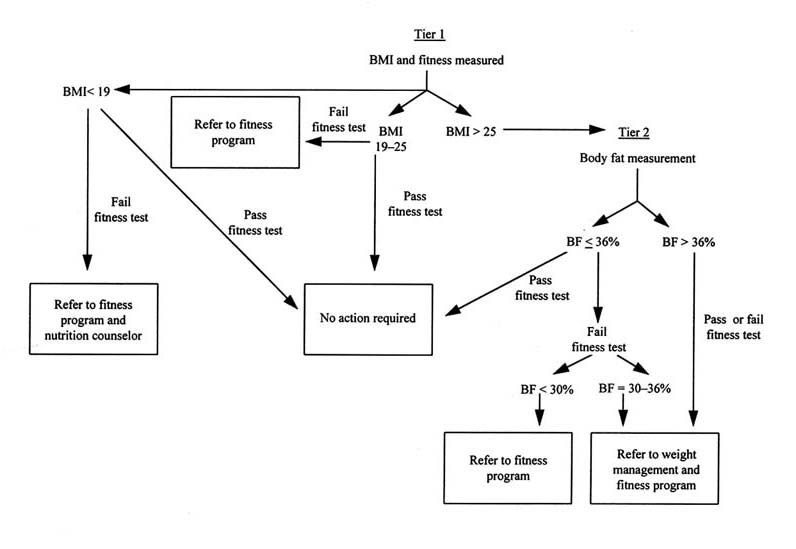
- The BCNH committee recommends the revision of the two-tiered body composition and fitness screen to that presented in Figure 7-1.
The first tier should consist of semiannual assessment of body mass index (BMI, weight in kilograms divided by the square of the height in meters) and fitness (including strength and endurance). The acceptable range of BMIs, based on considerations of health and chronic disease risk, is recommended to be 19 to 25,1 independent of age. Individuals whose BMI falls within the desirable range and who pass the fitness test need no further screening. Individuals with BMIs greater than 25 should be subjected to a second tier of screening, based on body fat assessment. The committee believes that women with BMIs less than 19 can be fit to perform. However, as BMI decreases below 19, women may be at risk for malnutrition and should be considered for medical evaluation.
Individuals whose body fat is assessed at 36 percent or less and who pass the fitness test will be considered within standard. Individuals whose body fat exceeds 30 percent and who fail the fitness test will be referred to weight management and fitness programs. Individuals whose body fat exceeds 36 percent will be referred to a weight management program, regardless of fitness score.
- The BCNH committee also recommends the development of a single, service-wide, circumferential equation for assessment of women's body fat, to be validated against a four-compartment model using a population of active-duty women or a population that is identical in
|
1 |
Table S-3 in the Executive Summary shows the BMIs corresponding to current Army weight limits for women. Table S-4 shows the weight ranges that correspond to the recommended BMI range of 19 to 25. |
- ethnic and age diversity to that of military women. Development and validation of this equation may result in the reconsideration of the recommended BMI cut-offs, in part as a result of establishing the measurement error.
- The BCNH committee recommends increasing emphasis on the importance of general fitness for health and readiness by enforcing uniformly across all services and military occupational specialties (MOSs) regular and monitored participation in a fitness program consisting of a minimum of 3 d/wk of endurance exercise at 60 to 80 percent of maximum capacity for 20 to 60 minutes and 2 d/wk of resistance exercise using all major muscle groups at 85 percent of 1 repetition maximum (ACSM, 1990). Such a program, in addition to promoting fitness, assists in maintenance of weight and fat-free mass (FFM). Periodic fitness and body composition testing, adjusted appropriately for gender, would be conducted to determine both endurance and strength and would be similar across all services. More frequent testing would promote continuous adherence to weight and physical fitness programs and decrease injurious behaviors that result from efforts to pass performance and body composition tests.
- The committee further recommends the development of task-specific, gender-neutral strength and endurance tests and standards for use in the determination of placement in military occupational specialties that require moderate and heavy lifting. Additional fitness programs should be created and enforced to develop and maintain the strength, endurance, and flexibility required by these MOSs.
- The BCNH committee recommends that, in view of the association between FFM (as an indirect indicator of skeletal muscle mass) and strength, the military consider developing an appropriate minimum recommended BMI for accession of women.
- The current appearance standard does not appear to be linked to performance, fitness, nutrition, or health. The BCNH committee recommends that if the military deems appearance standards to be necessary, objective criteria (that do not discriminate on the basis of ethnicity) should be developed and utilized.
Discussion
The substitution of BMI for existing weight/height screening tables is recommended based on mounting evidence of clear associations between BMI, fitness, and health. Body composition estimates for military personnel should supplement BMI-based measures as an additional means of evaluating the health and fitness components of military readiness. Body composition estimates of potential importance to readiness include skeletal muscle, total fat, FFM, and fat distribution. The body composition prediction model should employ an equation based on measured circumferences and other relevant independent variables such as ethnicity. This equation must be service wide and must be validated against measurements performed using multi-compartment models and a population matched to the gender, ethnic, vocational, and age heterogeneity present among women throughout the military.
Fitness testing must include an evaluation of cardiorespiratory endurance, strength, muscular endurance, and flexibility. Suggested guidelines include those prepared by the American College of Sports Medicine (ACSM, 1990). There must be an increase in the emphasis placed on
regular physical activity as a means of increasing fitness, endurance and strength; managing weight; and reducing risk of musculoskeletal injury.
Recommendations for Additional Research
Additional research is needed to refine and standardize anthropometric equations for body fat prediction and to validate them against current four-compartment models. This research must be conducted with a population that is representative of active-duty women with respect to ethnic and age diversity.
In view of the relationship between skeletal muscle/FFM and strength, and recent developments in the ability to assess these parameters, research is recommended to develop an expedient method for the prediction of FFM using anthropometric measurements.
It is also recommended that programs designed to increase strength as well as those seeking to redesign certain tasks be pursued along with the development and validation of task-specific, gender-neutral strength tests for use in determining placement in military occupational specialties requiring moderate and heavy lifting. Task-specific training tests have been developed and validated for comparable jobs in the civilian sector. General and task-specific strength training should be incorporated into basic combat training, advanced training, and ongoing fitness programs to ensure that the maximum strength level requirements of each individual's MOS can be met.
Further research is recommended on the incidence and risk factors for stress fracture and other musculoskeletal injuries in active-duty women.
Should any part of the Military Recommended Dietary Allowances (MRDAs) be further adjusted for women? Should there be any intervention for active-duty women with respect to food provided, dietary supplementation, or education?
In view of current ongoing efforts by the Food and Nutrition Board to revise the Recommended Dietary Allowances upon which the MRDAs (AR 40-25, 1985) are based, the BCNH committee advises that revision of the MRDAs be deferred to a later time, and it has chosen to concentrate on several nutritional issues of importance to active-duty women.
While the MRDAs for calcium, folate, and iron appear to be adequate within normal balanced diet plans, that is, when full rations are consumed (3,600 kcal/d), the average woman cannot consume the equivalent of full rations. Moreover, she may not be able to consume the quantity of energy upon which the MRDAs are based, if she is to balance energy intake with expenditure.
Outcome data for the military weight management programs are currently unavailable. In addition, it is not possible at the present time to determine how individual sites administer their programs. Nevertheless, comparison of the programs as described in the regulations governing these programs with recent recommendations regarding methods for long-term weight loss and management suggest a number of disparities. In addition, evidence from self-report surveys suggests
that a significant percentage of military personnel may engage repeatedly in high-risk behaviors to comply with periodic weight and body composition assessments.
Recommendations
- The BCNH committee reinforces the requirement for adequate energy and nutrient intakes to reflect the needs of the body at a moderate activity level (2,000–2,800 kcal/d). To ensure adequate nutrient intakes, female personnel must be educated on how to meet both energy and nutrient needs whether they are deployed and subsisting on operational rations or in garrison. This education is required to enable women to choose foods of higher nutrient density and to maintain a fitness program that will allow greater energy intake. The committee reinforces the recent efforts of the Army to begin providing complete nutritional labeling of all ration components and to include information to enable identification of nutrient-dense components that would help women meet the MRDAs at their usual energy intake. The committee also supports efforts to create ration supplements that would satisfy requirements that may not be readily met through the usual intake of rations. The committee recommends nutritional labeling of all dining hall menu items and provision of food selection guidelines to women in garrison.
- The BCNH committee recommends that all military women maintain or achieve healthy weight through a continuous exercise and fitness program. If weight loss is a goal, nutrition education and ongoing counseling should be provided for guidance in achieving a healthy, but reduced energy, diet. Emphasis must be placed on prevention of overweight and on long-term weight management through lifestyle changes, rather than on crash dieting to lose weight for a scheduled weigh-in. Adequate energy intake should be encouraged to reduce risks of injury and amenorrhea.
- In view of observed dehydration-induced changes in physiology resulting in performance decrements, and because of evidence that active-duty women in deployment situations may voluntarily restrict fluid intake, adequate intake of fluids must be emphasized (IOM, 1993, 1995). Adoption of the Army fluid doctrine is encouraged by all services.
Discussion
Assessments of nutritional status and dietary intake of active-duty women have been limited to studies of women in basic combat training or on brief field maneuvers. Nevertheless, the results of these studies strongly suggest that because of the nutrient density of operational rations and dining hall menus, active-duty women are at risk for inadequate intake of several nutrients, particularly iron, calcium, and folate, if their energy intake matches expenditure. Education should be aimed at meeting requirements for these nutrients as well as for protein, by helping women to identify and select appropriate foods. Available evidence suggests that the energy needs of the average active-duty woman should reflect a moderate activity level. To ensure adequate energy and nutrient intake, some modifications of operational rations may be needed to increase the nutrient density. Alternatively, use of supplements for iron, calcium, and folate should be considered.
While it appears that military weight management programs thus far have not been required to perform rigorous measurement of outcome, their design suggests a lack of follow-up and inadequate emphasis on techniques for long-term weight management. Such techniques include ongoing education and counseling and programs to support regular physical fitness and other lifestyle changes. Nutrition education must emphasize changing dietary habits by selection of lower fat foods, understanding of portion sizes, and decreasing consumption of alcohol. A basic understanding of obesity prevention, nutrition, and fitness knowledge should be imparted to all military personnel with emphasis on doable measures and skill building, rather than just cognitive knowledge.
Recommendations for Additional Research
Additional research is needed on the effects of environmental stressors on the nutritional status and needs of active-duty women. It is recommended that the military coordinate its research efforts in this area with those of the civilian sector.
What special guidance should be offered with respect to return-to-duty standards and nutrition for women who are pregnant or breastfeeding?
At the present time, active-duty women who become pregnant are exempt from compliance with body composition standards and fitness testing until 6 months postpartum. Restriction on the types of duty that pregnant soldiers may perform differs with branch of service and usual work environment. While it is known that many active-duty women who become pregnant are exposed to a variety of environmental extremes prior to transfer to lighter duty, data are extremely limited regarding nutrient status, physical fitness, and pregnancy outcomes in the active-duty population. In the absence of additional pertinent data, the committee makes the following recommendations.
Recommendations
- The BCNH committee recommends that all women be encouraged to eat an adequate diet during pregnancy and lactation as recommended by the Institute of Medicine (IOM, 1990, 1991). The committee further recommends an intake of 400 µg/d dietary folate during childbearing years, 600 µg/d during pregnancy and 500 µg/d during lactation as recommended by the IOM (1998). A daily supplement of 30 mg of ferrous iron (IOM, 1990) is recommended during the second and third trimesters of pregnancy. During pregnancy and lactation, women should abstain from smoking. Alcohol should be avoided during pregnancy and should only be consumed in moderation during lactation (IOM, 1990).
- The BCNH committee recommends that pregnant women without obstetrical or medical complications engage in moderate levels of physical activity to maintain cardiovascular and muscular fitness throughout the pregnancy and the postpartum period. The American College of Obstetricians and Gynecologists (ACOG, 1994) has published guidelines that should be used to
- advise pregnant active-duty women to modify their physical fitness program. Programs should be individualized and made available to healthy women who can and wish to exercise.
- The BCNH committee recommends the endorsement of the IOM guidelines for gestational weight gain as outlined in Chapter 6 and Table 6-8. Women should be encouraged to gain within the IOM recommendations during pregnancy and to lose weight postpartum through appropriate nutritional counseling and exercise programs. The BCNH committee recommends that the proposed time allowance for compliance to weight and body fat standards postpartum be consistent with IOM recommendations for gestational weight gain. When satisfactory progress is being made towards compliance, an allowance of up to 1 year postpartum should be given for attainment of body weight standards.
- Resumption of exercise postpartum will depend on the type of delivery and the postpartum state of the woman and should be left to the discretion of the woman's obstetrician. Once clearance is given by the woman's physician to resume exercise, a time allowance of 180 days should be sufficient to meet physical fitness standards.
- The Healthy People 2000 (DHHS, 1991) goal for breastfeeding specifies that at least 75 percent of women should breastfeed their babies in the early postnatal period and 50 percent of women should continue to breastfeed until their babies are 5 to 6 months old. As the military has provided no indication as to why they should not strive to comply with this goal, the committee recommends that efforts be made to promote and support breastfeeding among all servicewomen, where appropriate. Promotion of breastfeeding can be incorporated into prenatal classes, family support classes, hospital policies, and training of health care providers.
- The BCNH committee calls attention to the persistent anemia and musculoskeletal and cardiovascular changes that may continue in some women postpartum. These changes may present potential health problems for the mother and compromise her fitness status. Women with low iron stores before pregnancy or excessive blood losses at delivery may require an extended period (5–10 months) to replete/normalize stores. Achievement of normal iron stores prior to and during pregnancy and prevention or correction of anemia may require the use of supplemental iron.
- An increase in the length of exemption from deployment from 4 to 6 months postpartum is recommended to support maternal postpartum recovery, breastfeeding, and enhanced infant health and development.
The BCNH committee acknowledges that childbearing is compatible with a military career. Planning and education on effective birth control and counseling on the importance of timing pregnancy in one's military career should be provided to all servicemembers. The committee also recommends training and education for all supervisory personnel regarding pregnancy policy, as well as a prenatal counseling program for pregnant active-duty women. These policies should be implemented to reduce attrition and enhance military readiness.
Discussion
The IOM recommendations for gestational weight gain have been endorsed by the ACOG and should likewise be endorsed by the DoD. Rather than a single figure, a desirable range is recommended, recognizing the natural variability observed in gestational weight gain among
healthy, pregnant women. Because maternal prepregnancy body size modifies the relation between gestational weight gain and birth weight, separate recommendations are made for underweight, normal-weight, and overweight women. Very young adolescents and African American women should aim for the upper limit of the range, and short women should aim for the lower limit of the range. In adopting the gestational weight gain recommendations, routine monitoring of gestational weight gain and medical/nutritional counseling for inadequate or excessive gestational weight gain should be implemented. There is a lack of representative data on the gestational weight gain of military women. Systematic recording of gestational weight gain and pregnancy outcome among military women would serve to identify and target vulnerable groups or hazardous occupational exposures.
As recommended by the ACOG (1994), in the absence of obstetric and medical complications, pregnant women can engage in moderate levels of physical activity to maintain cardiovascular and muscular fitness throughout the pregnancy and the postpartum period. Although the maternal sense of well-being may be enhanced, no level of exercise has been shown to improve perinatal outcome. Except for findings of lower birthweights among offspring of women who continue to exercise vigorously throughout pregnancy, no data indicate deleterious effects of moderate exercise on the fetus. Intent and participation in exercise should be reviewed with the guidance of the woman's obstetrician. Programs for exercise during pregnancy cannot be mandatory, but they should be made available to healthy gravid women who can and wish to exercise. Programs should be individualized and women allowed to exercise at their own pace. Fit women who exercised prior to pregnancy may respond differently and may exercise at a higher intensity than sedentary women who wish to adopt a moderate exercise program during pregnancy. Nearly all women voluntarily decrease the intensity and duration of exercise as pregnancy progresses.
The prevalence and duration of breastfeeding by military women are virtually unknown. Efforts should be made to promote and support breastfeeding among all servicewomen, where appropriate with regard to the individual. Promotion of breastfeeding can be incorporated into prenatal classes, family support classes, hospital policies, and training of health care providers. Access to consultants on breastfeeding and a private room to express milk once back at the work site would support the continuation of breastfeeding. Exemption from deployment for 6 months postpartum is recommended to support maternal postpartum recovery and breastfeeding. Attainment of military weight standards by 6 months postpartum may be unrealistic for some individuals and restrictive for women who desire to breastfeed, in that drastic weight reduction may compromise milk production.
Recommendations for Additional Research
The use of standard military equations in postpartum women for estimating body fat at return-to-duty testing has not been validated. Therefore, the BCNH committee recommends that validation studies be conducted in these women, controlling for ethnicity, age, and parity.
Recommendations For Future Design And Administration Of Surveys
It is clear that the military services do not collect and archive all of the information needed to clearly define the positive and negative consequences of their body fat and fitness standards for military women. Data as simple as the height and weight of each servicemember are not centrally archived in automated information systems and thus are unavailable to analysts and policymakers. The shortfall is particularly serious regarding information on pregnant women. As a result, it is not possible to assess systematically what military women do to meet weight and fitness standards, how effective their behaviors are, or what the long-term health consequences of the behaviors are. To do this requires a DoD-wide evaluation system.
Relevant Data from Previous Surveys of Military Personnel
Several research projects have been conducted by the services on the health-related behaviors of servicemembers. A list of the most recently administered relevant surveys is provided in Table 7-1.
Relevant Data in Existing DoD Databases
In addition to the wide variety of demographic and personnel data maintained in the Defense Manpower Data Center database, health outcome data are maintained in several medical cost accounting databases. A list of the databases that contain pertinent information is provided in Table 7-2.
Effective Use of Existing Data
A combination of the survey instruments that have been used in the past would be suitable for collecting most of the information needed (including longitudinal data). The personnel and medical databases are capable of producing much of the remaining information needed. However, the committee finds that there are two problems with this method of data collection. First, some of the survey data were collected anonymously (with no identification numbers of any type), precluding any attempt to examine the data longitudinally or merge the databases with existing personnel and medical databases that contain the demographic and health outcome data needed for a comprehensive analysis of the data. Second, the personnel and medical databases were not designed to be linked to each other or to survey databases. Thus, although much potentially worthwhile information has been collected, little meaningful analysis can be performed.
TABLE 7-1 Military Surveys of Health Behaviors
|
Reference |
Name |
Description |
|
Bray et al., 1995 |
Survey of Health-Related Behaviors among Military Personnel (SHRBAMP) |
Triennial survey that sampled all active-duty personnel using a stratified random sampling strategy. Surveys (n = 14,225 of 16,502) were completed anonymously during on-site briefings about the project. Persons unavailable during the site visits were contacted and asked to return their survey by mail (N = 1,968 of 8,749). Questions were designed to determine the prevalence of substance abuse and other health and fitness-related behaviors. Questions on stressful life events were included. Questions were used from large-scale federal surveys of civilian populations to facilitate comparisons. Very little information was collected on nutrition knowledge, eating behavior, history of weight loss/gain, fitness programs, or weight maintenance practices. |
|
Personal communication, Goins, U.S. Army Center for Health Promotion and Preventive Medicine, Aberdeen, Md., 1996 |
Health Risk Appraisal (HRA) |
Annual survey administered to approximately 75,000 active Army personnel during the course of a physical exam or other preventive medicine interview. Social security numbers are recorded, and a longitudinal database is maintained. Questions were designed to determine the prevalence of substance abuse and other health and fitness-related behaviors. Questions on stressful life events were included. Very little information was collected on nutrition knowledge, eating behavior, history of weight loss/gain, fitness programs, or weight maintenance practices. |
|
Hourani, 1995, 1996 |
Perceptions of Wellness and Readiness Assessment (POWR'95) |
Survey administered as a part of a 1995 research project that sampled all active-duty Navy and Marine Corps personnel using a stratified random sampling strategy. Personnel (N = 9,859 of ˜12,000) were contacted in on-site briefings or by mail. Social security numbers were recorded. The survey was a composite survey including items form over a dozen standardized questionnaires. To facilitate comparisons, items were used from the SHRBAMP and the HRA (described above), as well as large scale federal surveys of civilian populations. Questions were designed to determine the prevalence of substance abuse, occupational/environmental exposures, and other health and fitness related behaviors, including nutrition knowledge, eating behavior, and history of weight loss/gain. Questions on health status, reproductive history, stressful life events and personality were also included. |
|
Warber et al., in preparation |
Army Food and Nutrition Survey I (AF&NS-I) |
Information was collected from a convenience sample of 3,065 soldiers at 33 Army installations. Four hundred ninety-four women responded to the survey. The demographic profile of respondents was similar to that of the total Army. Surveys were completed anonymously during an on-site briefing about the project. Questions were designed to assess nutrition knowledge and attitudes, eating behavior, supplement use, history of weight loss/gain, tobacco use, and field feeding behavior. |
TABLE 7-2 Department of Defense Medical Automated Information Systems with Relevant Data
|
Acronym |
Name |
Description |
|
ADS |
Ambulatory Data System |
Captures client-specific encounter, diagnostic, and treatment data for clients visiting outpatient clinics |
|
CDIS |
Civilian Health and Medical Program of the Uniformed Services (CHAMPUS) Detail Information System |
Supports on-line, near real-time access to individual detailed CHAMPUS information |
|
CEIS |
Corporate Executive Information System (800) 865-7023 |
Provides a collection of databases designed to furnish Department of Defense health care managers with executive information for decision support |
|
CHCS |
Composite Health Care System |
Provides a daily record of patient administrative and clinical data for military medical treatment facilities |
|
DMIS |
Defense Medical Information System |
Provides a large repository of patient-level, population, normative, and financial data to support health care analysts and decision makers |
|
MCQA |
Managed Care Query Application |
Provides ad hoc capabilities to medical treatment facilities for CHAMPUS, Biometrics, and patient population data |
|
RCMAS |
Retrospective Case Mix Analysis System |
Provides clinical and management information; detailed patient level data; and workload and utilization data |
|
TCSDB |
Tri-Service CHAMPUS Statistical Database |
Supports ad hoc research, analytical health outcomes studies, and Medical Analysis Support System (MASS) files |
Recommendations For New Methods
The committee recommends that the military survey a representative sample of active-duty personnel individually and review the individuals' personnel and medical records during the course of an interview. This method would enable the investigator to obtain all the data needed in a single effort, ensure quality control of the data, build a database that would preserve the anonymity of the individual, and obviate the need to merge automated information systems with highly sensitive data. However, the need to create a system that will obtain information from several large and representative samples of the entire DoD over the course of several years may make this choice cost prohibitive.
An alternative recommendation is to expand the triennial Survey of Health-Related Behaviors among Military Personnel to include the demographic, medical, nutrition, fitness, and pregnancy data needed. Changing the questionnaire to include the social security number, as was done with the Navy's Perceptions of Wellness and Readiness Assessment survey and the Army's
Health Risk appraisal survey, would permit a longitudinal and potentially integrated database to be developed. The practice of using questions from federal surveys of health and fitness-related behaviors in the general U.S. population should be continued so that comparisons between military and civilian populations can be made.
Additional Data Needed
As recommended by an IOM report (IOM, 1992), longitudinal studies of people admitted to military weight management programs should be conducted to determine the outcome of these programs as recommended changes in program procedures are implemented.
Career, active-duty, military women constitute a unique population of individuals who are required to maintain their weight and body fat and fitness at prescribed levels. Longitudinal studies of health risk factors (cardiovascular, musculoskeletal, diabetes) and outcomes are recommended in these women.
The DoD is encouraged to monitor pregnancy outcome (birth weight, preterm delivery, low birth weight infants, and congenital anomalies) as well as pregnancy wastage (miscarriage) according to service, rank, and MOS to identify potential problems associated with certain military jobs, physical training, or hazardous environments. It is recommended that health surveys be expanded to collect information on the pregnancy history of active-duty women. Suggested questions are those used by Evans and Rosen (1996).
References
ACOG (American College of Obstetricians and Gynecologists). 1994. Exercise during pregnancy and the postpartum period. ACOG Technical Bulletin 189. February. Washington, D.C.: ACOG.
ACSM (American College of Sports Medicine). 1990. ACSM position stand. The recommended quantity and quality of exercise for developing and maintaining cardiorespiratory and muscular fitness in healthy adults. Med. Sci. Sports Exerc. 22:265–274.
AR (Army Regulation) 40-25. 1985. See U.S. Departments of the Army, the Navy, and the Air Force, 1985.
Bray, R.M., L.A. Kroutil, S.C. Wheeless, M.E. Marsden, S.L. Bailey, J.A. Fairbank, and T.C. Harford. 1995. Health behavior and health promotion. Department of Defense Survey of Health-Related Behaviors among Military Personnel. Report No. RTI/6019/06-FR. Research Triangle Park, N.C.: Research Triangle Institute.
DHHS (U.S. Department of Health and Human Services). 1991. Healthy People 2000: National Health Promotion and Disease Prevention Objectives. DHHS (PHS) Publ. No. 91-50212. Public Health Service, U.S. Department of Health and Human Services. Washington, D.C.: U.S. Government Printing Office.
Evans, M.A., and L. Rosen. 1996. Women in the military: Pregnancy, command climate, organizational behavior, and outcomes. Technical Report No. HR 96-001, Part I, Defense Women's Health Research Program. Fort Sam Houston, Tx.: U.S. Army Medical Department Center and School.
Hourani, L.L. 1995. Health status of women in the military. An epidemiological study of active-duty Navy and Marine Corps personnel. Annual Report. San Diego, Calif.: Naval Health Research Center.
Hourani, L.L. 1996. Health and nutrition of women in the Navy. Presentation at the workshop on Assessing Readiness in Military Women: The Relationship to Nutrition. September 9–10, Irvine, Calif.
IOM (Institute of Medicine). 1990. Nutrition during Pregnancy: Part I, Weight Gain; Part II, Nutrient Supplements. Subcommittee on Nutritional Status and Weight Gain during Pregnancy, Subcommittee on Dietary Intake and Nutrient Supplements during Pregnancy, Committee on Nutritional Status during Pregnancy and Lactation, Food and Nutrition Board. Washington, D.C.: National Academy Press.
IOM (Institute of Medicine). 1991. Nutrition during Lactation. Subcommittee on Lactation, Committee on Nutritional Status during Pregnancy and Lactation, Food and Nutrition Board. Washington, D.C.: National Academy Press.
IOM (Institute of Medicine). 1992a. Nutrition during Pregnancy and Lactation: An Implementation Guide. Subcommittee for a Clinical Application Guide, Committee on Nutritional Status during Pregnancy and Lactation, Food and Nutrition Board. Washington, D.C.: National Academy Press.
IOM (Institute of Medicine). 1992b. Body Composition and Physical Performance, Applications for the Military Services , B.M. Marriott and J. Grumstrup-Scott, eds. Committee on Military Nutrition Research, Food and Nutrition Board. Washington, D.C.: National Academy Press.
IOM (Institute of Medicine). 1993. Nutritional Needs in Hot Environments, Applications for Military Personnel in Field Operations, B.M. Marriott, ed. Committee on Military Nutrition Research, Food and Nutrition Board. Washington, D.C.: National Academy Press.
IOM (Institute of Medicine). 1995. Not Eating Enough, Overcoming Underconsumption of Military Operational Rations, B.M. Marriott, ed. Committee on Military Nutrition Research, Food and Nutrition Board. Washington, D.C.: National Academy Press.
IOM (Institute of Medicine). 1998. Dietary Reference Intakes: Folate, Other B Vitamins, and Choline. Standing Committee on the Scientific Evaluation of Dietary Reference Intakes, Food and Nutrition Board. Washington, D.C.: National Academy Press.
U.S. Departments of the Army, the Navy, and the Air Force. 1985. Army Regulation 40-25/Navy Command Medical Instruction 10110.1/Air Force Regulation 160-95. ''Nutritional Allowances, Standards, and Education." May 15. Washington, D.C.
Warber, J.P., S.M. McGraw, M. Kramer, L. Lesher, W. Johnson, and A.D. Cline. In preparation. The Army Food and Nutrition Survey. Technical Report No. T98-XX. Natick, Mass.: U.S. Army Research Institute of Environmental Medicine.


