
1
Introduction to Near-Earth Objects
The recognition that Earth resides in a swarm of small orbiting objects (Figure 1.1) and that the collision of these bodies with our planet poses a finite hazard to humanity has led to a flood of new discoveries and a significant increase in research on the nature and origin of Earth-approaching objects. These discoveries present an opportunity to investigate extraterrestrial bodies while also providing an indirect assessment of the hazard to life on Earth that they pose. Although studies specifically evaluating the risk of asteroid collisions with Earth and the means of diverting them are desirable, they are beyond the charge of this committee.
Appreciation of the fact that some near-Earth objects (NEOs) can collide with Earth has led to increased support by NASA for systematic surveys of potentially hazardous objects.1–3 Currently, about 400 NEOs have been discovered; the rate of discovery is expected to increase in the next few years as additional charge-coupled device (CCD) detection systems are installed at dedicated search telescopes in the United States and abroad. At the expected level of support, thousands of NEOs probably will be discovered in the next decade. A possible cooperative program between NASA and the U.S. Air Force, with the goal of discovering about 90% of NEOs larger than 1 km in diameter (estimated to be about 3000), could increase the rate of discovery by nearly two orders of magnitude.
Approximately 5% of NEOs are the most readily accessible extraterrestrial bodies for exploration by spacecraft. The energy requirements to rendezvous with and land on these bodies are less than those to land on the surface of the Moon. In some cases, the energy requirements to return samples to Earth are very low. The combination of the diversity and accessibility of these bodies presents new opportunities and challenges for space exploration and indicates a need for sufficient ground-based observations of NEOs to identify targets of highest scientific interest.
Understanding the orbital and size distributions and the physical characteristics of NEOs may be useful for devising appropriate strategies for mitigating impact hazards. Furthermore, these tiny worlds are scientifically interesting because they carry records of the origin and evolution of planetesimals such as those that accreted to form the planets. A well-planned program for the study of NEOs can lead to an understanding of the following fundamental questions:
- How many objects are there?
- What are their size distribution and composition?
- How often do they strike Earth?
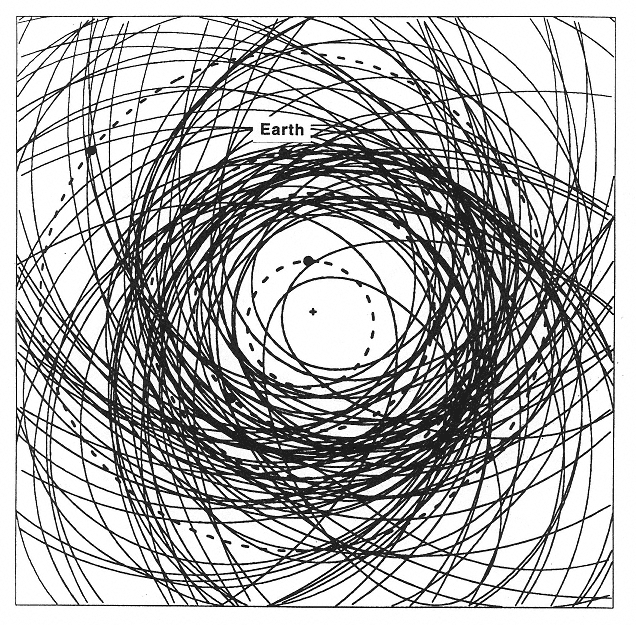
Figure 1.1
Orbits for 100 representative near-Earth objects with estimated diameters of 1 km or larger, representing only about 5% of the total estimated population in this size range. All orbits included have perihelion distances of 1.10 AU or less, and the orbits have been projected into the Earth-Sun (ecliptic) plane. Also shown by dashed lines are orbits for the terrestrial planets Mercury through Mars, with their positions on January 1, 1997, indicated. Vernal equinox is to the right. (Courtesy of R.P. Binzel.)
- What are their thermal and collisional histories, and their relationships to meteorites and other bodies in the solar system?
Scientific Goals for the Study of Near-Earth Objects
The scientific goals of an NEO research program can be stated succinctly: To understand the orbital distribution, physical characteristics, composition, origin, and history of near-Earth objects. These goals are responsive to scientific objectives for the exploration of small bodies in the solar system previously articulated by the Space Studies Board and its committees.4,5
Orbital Distribution
Asteroids in near-Earth space are categorized as Amor, Apollo, or Aten objects, depending on whether their orbits lie outside that of Earth, overlap that of Earth with periods greater than 1 year, or overlap that of Earth with periods less than 1 year, respectively (Box 1.1). Comets are classified as short period or long period, depending on whether their orbital periods are less or greater than 200 years. This report focuses specifically on Amor, Apollo, and Aten objects (collectively referred to as NEOs), some of which may be currently inactive short-period comets. Most NEOs probably originate when collisions in the main asteroid belt eject fragments into resonances with Jupiter and Saturn. They may also derive from the Oort Cloud or the Kuiper Belt. A systematic inventory of NEOs will permit a better understanding of their orbital distribution, as well as the relationships among asteroids, comets, meteorites, and interplanetary dust.
Physical Characteristics
An assessment of the physical characteristics of these objects includes determining their shapes, sizes, albedos, spin characteristics, and masses. Shapes, sizes, and spin characteristics are central to understanding collisional histories; albedos (as functions of wavelength), reflectance spectra, and calculated densities provide information on asteroid and comet compositions and internal structures. Their magnetic and thermal properties relate to composition and thermal history. Studies of surface morphology and materials, including craters, fractures and other structural features, regoliths, and bedrock outcrops, allow the geologic evolution of these objects to be reconstructed.
Chemical and Mineralogical Compositions.
Determining the chemical and mineralogical compositions of NEOs provides critical constraints on their formation and evolution, as previously emphasized by the Space Studies Board.6 Their bulk chemistries relate to condensation and other processes thought to have occurred within the solar nebula, and their mineralogies are functions of temperature, pressure, and geologic history (or orbital history, in the case of comets). Quantification of mineralogy provides a bridge between asteroid spectroscopy and studies of meteorites. Returned samples would also allow determination of their times of formation and fragmentation based on their radiogenic and cosmogenic isotopic compositions, as well as studies of processes resulting from interactions with the space environment (solar wind implantation, space weathering, and so on). The petrology of returned samples would reveal details of accretional, thermal, and regolith-forming processes.
Origins
The origins of NEOs must be inferred from their physical characteristics, compositions, and orbital properties. All of these objects are thought to be relics from the early solar system. Meteorite studies tell us that many bodies retain primordial characteristics and thus provide unique opportunities to constrain presolar and solar nebula events. Others may be geologically processed and differentiated, and the relative importance of subsequent
|
BOX 1.1 Orbital Evolution of NEOs All near-Earth objects (NEOs) are in chaotic, planet-crossing orbits; their orbits evolve as a consequence both of long-range (secular) perturbations, due chiefly to the gravitational attraction of Jupiter and Saturn, and of close-range perturbations due to infrequent close encounters with one or more of the terrestrial planets.* Long-range perturbations drive precession of the long axis of the orbit relative to the line of the nodes and related variations in the eccentricity and inclination of the asteroid's orbit. The orbits of NEOs that overlap Earth orbit can intersect Earth's orbit, typically four times, during a complete cycle of precession of the long axis. Also, many orbits that currently lie outside that of Earth (orbits of the Amors) can become overlapping as a result of secular changes in eccentricity and can intersect Earth's orbit during precession. An example is the orbit of the fairly large Amor asteroid (1580) Betulia, whose orbit can intersect Earth's eight times during one cycle of precession. NEOs whose orbits can intersect Earth's as a result of secular perturbations and thus can collide with Earth, therefore, are called Earth crossing. It should be noted, however, than many Earth crossers cannot collide with Earth because the phase symmetry of their free oscillations causes their perihelia to be outside Earth's orbital plane when their eccentricities are high enough for their perihelia to be inside 1 AU. Occasional close encounters with one or another terrestrial planet lead to long-term chaotic evolution of the orbits of NEOs. Hence, over time, noncrossing Amors can become crossing or evolve into Apollos, Apollos can become Atens, and vice versa. Ultimately, many NEOs can become Jupiter crossing and then generally are ejected from the solar system, or they may evolve through perturbations into small, extremely eccentric orbits and be vaporized during close encounters with the Sun. NEOs are thought to be derived primarily from fragments produced by collisions between asteroids in the main asteroid belt. Studies of the physics of collision and the observed disposition of orbital elements of asteroid families suggest that the changes in velocity imparted to kilometer-size fragments during catastrophic collisions generally do not exceed a few hundred meters per second. These changes are an order of magnitude smaller than those required to inject main-belt asteroid fragments into Earth-approaching orbits. In many cases, however, the small changes in velocity imparted to collisional fragments are sufficient to shift them into a dynamical resonance, such as a mean motion commensurable with the mean motion of Jupiter or a secular resonance. Resonant amplification of the orbital eccentricity of the fragment can then lead to a planet-crossing orbit. Synergistic interplay between resonant perturbations and perturbations due to encounters with Mars probably plays an important role in delivering NEOs to Earth-crossing orbits. _____________ |
processes (e.g., collisional and thermal histories, surface alteration, fluid-rock interactions) can be assessed. However, such modified bodies may have made up a substantial portion of the planetesimals that accreted to form the terrestrial planets,7 thereby providing information related to the early stages of planet growth.
References
1. T. Gehrels, ed., Hazards Due to Comets and Asteroids, University of Arizona Press, Tucson, Ariz., 1994.
2. D. Morrison, ed., The Safeguard Survey: Report of the NASA International Near-Earth-Object Detection Workshop, Jet Propulsion Laboratory, Pasadena, Calif., 1992.
3. Solar System Exploration Division, Office of Space Science, Report of the Near-Earth Objects Survey Working Group, NASA, Washington, D.C., 1995.
4. Space Studies Board, National Research Council, An Integrated Strategy for the Planetary Sciences: 1995–2010, National Academy Press , Washington, D.C., 1994, p. 63.
5. Space Science Board, National Research Council, Strategy for the Exploration of Primitive Solar-System Bodies—Asteroids, Comets, and Meteoroids: 1980–1990, National Academy Press, Washington, D.C., 1980, p. 47.
6. Space Studies Board, National Research Council, The Search for Life's Origins: Progress and Future Directions in Planetary Biology, National Academy Press, Washington, D.C., 1990, p. 47.
7. S.R. Taylor and M.D. Norman, “Accretion of differentiated planetesimals to the Earth,” pp. 29–44 in Origin of the Earth, H.E. Newsom and J.H. Jones, eds., Oxford University Press, New York, 1990.


