
4
U.S. and Japanese MNCs and the Shape of Global Competition
A GLOBAL ECONOMY: WHO'S TURNING TOWARD ASIA?
-
Increasingly, the focus of competition and cooperation for both Japanese and U.S. MNCs is moving to the Asia Pacific region. As a result of rising incomes and continuing rapid growth in the region, it is only natural that both Japan and the United States will focus more closely on business and political developments in Asia. Because of the background of economic rivalry and historical differences in how the two countries view trade and investment policies, as outlined previously, some tension might also be expected. However, it is doubtful that U.S. MNCs can achieve long-term success by “bypassing Japan” or that datsu-o, nyu-ah(“leave the West, join Asia”) will be a viable long-term strategy for Japan.
Through much of the postwar period, both Japanese and U.S. FDI in Asian countries did not figure prominently in the overall competitive context. In the 1970s, as countries in the region moved to policies focused on increasing export-led growth, both Japanese and U.S. MNCs began to invest aggressively.1 It is useful to keep in mind that the Asia Pacific region is highly diverse in terms of income levels, resource endowments, cultures, and political-economic approaches. For the purposes of analysis, it is useful to divide the large non-Japanese Asian economies as follows: (1) newly industrialized economies (NIEs), including Hong Kong, South Korea, Singapore, and Taiwan; (2) Association of South East Asian Nations (ASEAN), excluding Singapore and including Indonesia, Malaysia, Philippines, Brunei, and Thailand; and (3) large emerging economies, primarily China (although India is likely to be increasingly important as well). Table 4-1 , Table 4-2 , and Table 4-3 show recent positions and trends in U.S. and Japanese direct investments in Asia.
Both Japanese and U.S. MNCs have focused natural resource-related investments in Indonesia and finance and distribution investments in Hong Kong. In manufacturing, U.S. electronics companies began making significant investments in Malaysia and Singapore from the late 1970s, with much of the output exported back to the United States. This was largely motivated by the need to reduce costs in response to competition from Japan's ascendant electronics industry. Comparing the Asian strategies of U.S. and Japanese electronics MNCs is useful, because a large portion of each country's manufacturing investments in the region has been made in this industry.
Japanese electronics makers focused early investments in Asia on serving local markets. From the mid 1970s, consumer electronics makers moved production of some mature products, such as black-and-white televisions, to Asia in order to avoid U.S. trade barriers to Japanese exports. This pattern began to change with the yen appreciation occurring in the mid 1980s. In addition to Asian production aimed at export substitution, increasingly undertaken for cost considerations rather than to avoid trade barriers, it appears Japanese electronics MNCs have moved toward more integrated production systems.2 This has taken the form of accelerated
TABLE 4-1 U.S. Multinational Corporations in Asia: 1995 Direct Investment Positions, Sectoral Distribution and Historical Cost, million dollars
|
Total |
Manufacturing |
|
|
NIEs |
||
|
Hong Kong |
13,780 |
1,980 |
|
Korea |
5.322 |
1,548 |
|
Singapore |
12,570 |
5,272 |
|
Taiwan |
4,391 |
2,914 |
|
ASEAN |
||
|
Indonesia |
7,050 |
204 |
|
Malaysia |
3,653 |
2,685 |
|
Philippines |
2,648 |
1,254 |
|
Thailand |
4,596 |
1,768 |
|
China |
1,997 |
899 |
|
India |
836 |
327 |
|
Total Reported |
56,843 |
18,851 |
|
SOURCE: U.S. Department of Commerce, Survey of Current Business, July 1996. |
||
TABLE 4-2 U.S. Majority-owned Nonbank Foreign Affiliates in Asia 1993, million dollars
TABLE 4-3 Japanese Multinational Corporations in Asia; 1993 Direct Investment Flow, million dollars
movement of final production of a range of low- and mid-tech products to Asia; increased reverse exports of final products back to Japan (substituting for domestic production in Japan), with increased exports of key components from Japan; and integrated supply of lower technology components within Asia. Table 4-4 and Table 4-5 show that Japanese electronics subsidiaries have a higher propensity to export back to Japan and a higher propensity to import than do Japanese manufacturing subsidiaries in general.
Further, Japan's electronics FDI appears to be spread throughout the region much more than U.S. electronics investment, which remains concentrated in Malaysia, Hong Kong, Singapore, and to some extent, Taiwan. Overall Japanese investment in China appears to be increasing rapidly. Table 4-6 shows that Japanese electronics manufacturers anticipate considerable growth in Chinese investments and production.
Trade and investment patterns appear to be much different in the transportation equipment industry. Whereas U.S. MNCs have relatively modest Asian investments in this sector, Japanese MNCs have played an important role in building local automobile production in such countries as Malaysia. In contrast to the integrated production networks that Japanese MNCs appear to be building in electronics, transportation equipment subsidiaries have a low propensity to export and a high propensity to import, implying a pattern of local assembly and sale of products with high utilization of Japanese-made components.
Several concerns have been expressed about Japanese FDI in Asia. 3 First, some have asserted that Japanese MNCs will facilitate the formation of an Asian economic bloc whose integrated production will shut out American and other firms, while most of the output will be shipped to the United States. Another factor fueling this concern about a Japan-dominated Asian bloc is the
TABLE 4-4 Composition of Sales Destination for Japanese Manufacturing Affiliates in Asia by Sector 1992, percentage
|
Exports To |
|||||||
|
Local Sales |
Total |
Japan |
North America |
Asia |
Europe |
Other |
|
|
All manufacturing |
66.1 |
33.9 |
15.8 |
3.7 |
11.2 |
2.0 |
1.2 |
|
Textiles |
56.1 |
43.9 |
26.5 |
3.1 |
4.9 |
2.0 |
17.4 |
|
General machinery |
53.0 |
47.0 |
23.6 |
2.1 |
11.3 |
9.8 |
0.1 |
|
Electric machinery |
45.7 |
54.3 |
27.2 |
5.3 |
19.0 |
2.2 |
0.6 |
|
Transportation equipment |
92.6 |
7.4 |
1.7 |
3.9 |
1.0 |
0.5 |
0.3 |
|
Precision instruments |
36.9 |
63.1 |
51.8 |
5.2 |
1.9 |
3.8 |
0.4 |
|
SOURCE: Survey data appearing in MITI, Kaigai Toshi Tokei Soran(Statistics on Overseas Investment), (Tokyo: MITI, 1994). |
|||||||
TABLE 4-5 Distribution of Japanese Subsidiaries in Asia by Percentage of Local Procurement
|
0-20% |
20-40% |
40-60% |
60-80% |
80-100% |
|||
|
All manufacturing |
7.4 |
11.9 |
18.0 |
18.6 |
44.1 |
||
|
Textiles |
4.7 |
7.8 |
21.9 |
12.5 |
53.1 |
||
|
General machinery |
15.4 |
7.7 |
12.8 |
23.1 |
41.0 |
||
|
Electric machinery |
6.7 |
17.6 |
26.5 |
21.2 |
29.1 |
||
|
Transportation equipment |
5.8 |
18.8 |
20.3 |
23.2 |
31.9 |
||
|
Precision instruments |
21.4 |
7.1 |
7.1 |
28.6 |
35.7 |
||
|
SOURCE: Survey data appearing in MITI, Kaigai Toshi Tokei Soran(Statistics on Overseas Investment), (Tokyo: MITI, 1994). |
|||||||
disparity between U.S. and Japanese development assistance to the region—Japan contributes at a much higher level—and whether this aid gives Japanese companies expanded access and influence. A second concern expressed by the Japanese is that Japan-based manufacturing will be “hollowed out” by the increased Asian production of Japanese MNCs.
With regard to the first concern—the formation of a Japan-led bloc—it is important to point out the larger context: an already large and growing proportion of FDI flows in Asia is intraregional. A prominent part of this trend in recent years has been investment by NIEs in China and the ASEAN economies (see Table 4-7 ). Overall trade patterns do not show evidence of a “yen bloc” forming.4 Japan now accounts for a large proportion of the region's output, but it seems unlikely that Japan, or the United States for that matter, will be able to dominate or exert a preponderant economic influence over Asia in the long term, particularly if the growth of China's and other economies in the region continues. There is still a great deal of debate about the role of Japan's development assistance and the economic access that it might facilitate. Official Japanese statistics show that the amount of aid explicitly tied to purchases from Japanese companies has dropped rapidly in recent years, and these statistics indicate that a
TABLE 4-6 Japanese Electronics Multinational Corporations Outlook for Regional Production Trends in 2000, percentage of respondents
|
Region |
Production anticipated to decrease |
Production anticipated to be stable |
Production anticipated to increase |
|
North America |
0.0 |
23.1 |
76.9 |
|
Latin America |
16.7 |
66.7 |
16.7 |
|
Western Europe |
6.7 |
20.0 |
73.4 |
|
Asia |
0.0 |
0.0 |
100.0 |
|
NIEs |
25.9 |
20.8 |
54.2 |
|
ASEAN |
2.9 |
0.0 |
97.1 |
|
China |
0.0 |
0.0 |
100.0 |
|
Japan |
46.2 |
15.4 |
38.5 |
|
NOTE: Percentages total across rows; may not total 100 due to rounding. SOURCE: Compiled from Long-Term Credit Bank Research Institute, Nihon no Elekutoronikusu Meka no Kaigai Seisan no Genjo to Kongo(Status and Prospects for Overseas Production by Japanese ElectronicsMakers), (Tokyo: LTBCR, 1994). |
|||
growing proportion of non-Japanese companies are gaining contracts from Japan's official development assistance (ODA).5 Some analysts, however, assert that there are discrepancies in the official Japanese statistics and that much Japanese aid is effectively, if not officially, tied.6
On a sectoral level, particularly in the critical sectors of electronics and automobiles, reality may be more complicated. 7 As we have seen, both Japanese and U.S. electronics MNCs have developed extensive production networks in Asia. There is some evidence that these networks operate and are evolving differently, but there are many unknowns, and the situation appears to be changing rapidly. The current data and information base is largely inadequate to make fine-grained judgments about the current shape of production and supply networks within the Asia Pacific region and about evolving trends. Even the trade and investment data that are collected are available only after a time lag, and the impacts of the 1993 to 1995 yen appreciation on Japanese electronics MNC strategies will not be known definitively for some time. The extent to which emerging Asian MNCs in the NIEs and elsewhere pose a competitive threat to Japanese and U.S. MNCs, in addition to competition between and among Japanese and U.S. companies, also will impact investment trends and MNC strategies. 8
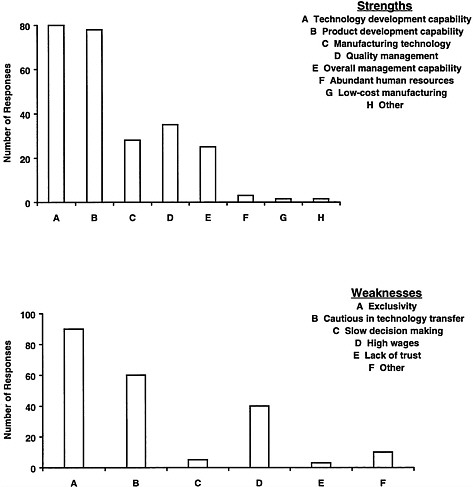
In the automobile industry Japanese companies have already established extensive operations in a number of Asian countries. However, the long-term potential market in China dwarfs the rest of the region, and U.S. and Japanese automakers appear to be on more of an equal footing. The market power of China, in particular, may allow it to play Japanese and U.S. companies against each other in order to maximize technology transfer and regional development benefits of automobile and other FDI. 9 Figure 4-1 show that Korean and Chinese managers name reluctance to transfer technology—along with exclusivity—as a major weak point of Japanese MNCs.
As for the concern that Japanese FDI in Asia will hollow out Japanese manufacturing, analysts paint a mixed picture. Some, for example, note that Japanese manufacturers were able to
TABLE 4-7 Foreign Direct Investment Inflows to Low- and Middle-Income East Asia, By Source, 1986-1992
|
China |
Indonesia |
Malaysia |
Philippines |
Thailand |
Total |
|||||||
|
Source |
Million dollars |
Percent |
Million dollars |
Percent |
Million dollars |
Percent |
Million dollars |
Percent |
Million dollars |
Percent |
Million dollars |
Percent |
|
ASEAN |
238 |
0.8 |
33 |
0.5 |
750 |
5.4 |
18 |
0.5 |
46 |
0.5 |
1,085 |
1.7 |
|
Europe |
1,316 |
4.4 |
1,009 |
16.1 |
2,711 |
19.6 |
378 |
11.7 |
1,108 |
11.0 |
6,522 |
10.3 |
|
Japan |
3,402 |
10.2 |
1,102 |
17.6 |
3,065 |
22.2 |
855 |
26.4 |
3,586 |
35.6 |
11,650 |
18.4 |
|
NIEs |
21,123 |
70.9 |
1,573 |
25.2 |
4,123 |
29.8 |
580 |
17.9 |
3,565 |
35.4 |
30,964 |
49.0 |
|
United States |
2,390 |
8.0 |
428 |
6.8 |
1,499 |
10.8 |
1,193 |
36.9 |
1,373 |
13.6 |
6,884 |
10.9 |
|
Rest of the world |
1,676 |
5.6 |
2,105 |
33.7 |
1,674 |
12.1 |
211 |
6.5 |
393 |
3.9 |
6,058 |
9.6 |
|
All countriesa |
29,785 |
100.0 |
6,250 |
100.0 |
13,822 |
100.0 |
3,235 |
100.0 |
10,071 |
100.0 |
63,163 |
100.0 |
|
NOTE: The totals of arrival inflow data for Indonesia, Malaysia, and the Philippines are derived from International Monetary Fund. Because the investor country breakdowns of arrival inflow data for those countries are unavailable, these data are calculated by multiplying the totals of arrival by the ratios of approval inflows (in the case of the Philippines, central bank registered inflows). The data for China and Thailand are arrival inflows. The data for Tailand are converted into U.S. dollars by using the yearaverage exchange rates. a Percentages may not total precisely 100.0 because of rounding. SOURCES: Japan Institute for Overseas Investment, Foreign Direct Investment in the East Asia Region: Trends and Outlook(Tokyo: Japan Institute for Overseas Investment, 1993) and InternationalMonetary Fund, Balance of Payments Statistics Yearbook (Washington, D.C.: IMF, 1993) as compiled in East Asia's Trade and Investment: Regional and Global Gains from Liberalization(Washington, D.C.: The World Bank, 1994). |
||||||||||||
adjust effectively to the yen appreciation of the mid 1980s. Japanese exports now command higher prices in world markets, indicating that price elasticity of demand for many Japanese exports is low and that Japanese manufacturers will be difficult to displace in the areas of component and equipment manufacture that they now dominate.10 This might also testify to the imputed focus of Japanese MNCs on maintaining tight control over critical technologies. However, many Japanese companies will not be able to raise prices indefinitely. New competition, perhaps from Asian MNCs, will be attracted, as has occurred in semiconductor memories. Also, to the extent that Japan's current account surplus remains high, there will continue to be upward pressure on the yen. Greater Japanese openness to imports now could forestall more severe hollowing and loss of competitiveness in the future.
In short, Asia's importance in U.S. and Japanese MNC strategies will grow in the future. Partly in response to these trends, as well as to increased frustration in both the United States and Japan with aspects of the bilateral relationship, some analysts see both countries turning away from each other and toward Asia. In the United States there appears to be a growing sentiment that Japan's market will remain highly regulated and that business relationships will remain exclusive, blocking entry by U.S. firms despite cost and product advantages. The prescription of some for this “Japan fatigue” is to focus on China and other rapidly growing markets in Asia.11 At the same time, many Japanese leaders express increasing frustration with U.S. trade policies and rhetoric, leading some to advocate a “turn toward Asia”—an Asian-oriented approach for Japan's foreign policy more independent of the United States.12
In general, exclusive regional blocs of whatever variety can only grow and thrive in an environment of significant restrictions on trade and investment. It is likely that Asia will hold greater weight in the U.S.-Japan equation. Although formation of economic blocs is possible, this is not likely to happen as long as trade and investment in Asia and the rest of the world continue to move toward liberalization. That is why the development of regional and global initiatives, such as APEC and the new WTO is so important to the economic futures of Japan, the United States, and all countries of the Asia Pacific region.
With increasing liberalization, growth and economic integration can be sustained. U.S. and Japanese MNCs likely will find more scope for cooperation with each other and with Asian companies, particularly if the Japanese economy becomes more receptive to imports and takes on a greater role as an engine of growth for the region. For example, it might be easier for U.S. companies to break into the supply structures of Japanese MNCs outside of Japan than it is to do so in Japan. Without continued liberalization, a number of unattractive scenarios can be imagined, including a U.S. withdrawal from the region that fans the flames of long-standing regional rivalries. Therefore, although a greater Asian focus is necessary for MNCs and policy makers in both countries, downgrading the bilateral relationship probably is not a viable long-term strategy for either Japan or the United States.
GLOBAL TECHNOLOGY: ACCESSING AND UTILIZING TECHNOLOGICAL CAPABILITIES WORLDWIDE
-
Increasingly, MNCs from Japan, the United States, and other countries are pressed to develop and utilize technological capabilities globally. As national governments seek to ensure that public resources spent to develop greater capabilities for innovation really do enhance security and economic growth, issues related to how domestic and foreign-based MNCs affect the national technology base have come to the front. It is likely that uncertainty and tension
-
regarding these issues will continue: the inputs and outputs of innovative activity and economic growth are difficult to measure, let alone control. For their part, U.S. and Japanese MNCs are taking actions designed to show host governments that they are contributing to the local technology and manufacturing base. There is a need to continue to share perspectives and draw lessons from this growing experience.
A report by the Office of Technology Assessment tracks recent trends in the globalization of innovation spurred by the activities of MNCs.13 One of the main conclusions of the report is that “MNCs develop core technologies at home.”14 The technological capabilities of individual companies will continue to be determined largely by their own innovation strategies and by the complementary assets of their home bases. However, the increasingly integrated, global nature of MNC production will require a similarly global approach to marshaling the technological capabilities necessary to compete. Therefore, the R&D and other innovation-related activities of MNCs away from their home countries will become more visible and important in the future.
At the outset, it should be recognized that on many key points related to these issues, data and trends are subject to various interpretations. A number of groups and individual scholars have studied the trends and the policy implications.15 The U.S. working group had hoped to explore questions of how U.S. and Japanese MNCs view contributions to the technology bases of host countries in greater detail than proved possible. Here, we will attempt to frame some of the major issues and questions, and draw appropriate tentative conclusions, hopefully laying the groundwork for further constructive discussion in a bilateral or multilateral context. The three most important and distinct issues relate to (1) MNC benefits accruing from access to host country technological capabilities and reciprocal access; (2) MNC contributions to technological and manufacturing levels in the host country supplier base; and (3) international strategic alliances and their implications for national technology policies.
MNC Access to Host Country Technological Capabilities
As discussed in Chapter 3 , Japan increasingly focused its FDI in the late 1980s and early 1990s on tapping U.S. technological capabilities—in the form of high-technology acquisitions, establishment of U.S. R&D facilities, and collaboration with U.S. universities. Some in the United States expressed concern over the large scale of this effort and its asymmetrical nature. An analogy is drawn from earlier history—recalling and projecting that Japanese companies would make the same effective use of U.S. technology gained through access to universities and acquisitions that was made of U.S. technology licensed at arms length by U.S. electronics and other MNCs in the 1950s and 1960s, as described in Chapter 3 .
It is first necessary to note that technology access through FDI is asymmetrical in the U.S.-Japan context for many of the same reasons that FDI itself is asymmetrical. High-technology start-ups are rare in Japan, partly because of the structure of capital markets.16 Acquisitions are difficult in Japan because of cross-shareholding, and acquisitions by foreign companies are more difficult for cultural reasons. While there are a number of world class programs and laboratories in Japanese universities, research has been funded at a relatively low level compared to the United States, although the Japanese government recently has indicated a renewed determination to increase research spending.17 For these and other reasons, U.S. MNCs do not find it possible or attractive to engage in technology-acquiring FDI in Japan to nearly the extent that Japanese MNCs have in the United States. This is not to say that U.S. companies have not taken advantage of opportunities to access Japanese technological capabilities: a 1991 study found that about 70 U.S. MNCs maintained R&D facilities in Japan.18Table 4-8 summarizes R&D activities in Japan
by foreign MNCs, Table 4-9 shows aggregate R&D activities by foreign MNCs in the United States, Table 4-10 shows R&D activities abroad by Japanese MNCs, and Table 4-11 shows R&D activities abroad by U.S. companies. As with Japanese R&D investments in the United States, the main motivating factor for U.S. R&D investments in Japan appears to be linking R&D more tightly with local customer needs, which increases sales and drives technology development forward.19
TABLE 4-8 R&D by Foreign Multinational Corporations in Japan by Sector, 1992
TABLE 4-9 R&D by Foreign Multinational Corporations in the United States for Selected High-Technology Industries, 1993
|
R&D Expenditures (billion dollars) |
Percent of Total R&D |
||
|
Industrial chemicals |
2.3 |
45.2 |
|
|
Drugs and medicines |
3.4 |
38.2 |
|
|
Computers and office equipment |
0.8 |
7.2 |
|
|
Audio, video and communications equipment |
1.1 |
33.0 |
|
|
Electronic components |
0.3 |
8.2 |
|
|
Scientific and professional instruments |
0.6 |
7.9 |
|
|
SOURCE: Donald H. Dalton and Manuel G. Serapio, Jr., Globalizing Industrial Research and Development, U.S. Department of Commerce, Office of Technology Policy, Asia-PacificTechnology Program, October 1995. |
|||
TABLE 4-10 R&D Abroad by Japanese Multinational Corporations by Region, 1993
TABLE 4-11 Company-financed Research and Development Performed Outside the United States by U.S. Domestic Companies and Their Foreign Subsidiaries by Industry, 1993, million dollars
|
Chemicals and allied |
2,814 |
||||||
|
Machinery |
342 |
||||||
|
Electrical equipment |
644 |
||||||
|
Professional and scientific instruments |
761 |
||||||
|
Other manufacturing |
1,563 |
||||||
|
Nonmanufacturing |
1,796 |
||||||
|
Total |
7,920 |
||||||
|
SOURCE: National Science Foundation, Science and Engineering Indicators 1996, NSF 96-21 (Arlington, Va.: National Science Foundation, 1996). |
|||||||
The level of concern in the United States with Japanese and other foreign high-technology investments has gone down, partly as a result of the resurgence of U.S. high-technology companies in recent years. The number and scale of Japanese investments also have declined, although a number of Japanese MNCs established new laboratories in the United States and elsewhere in 1995. Fundamental questions raised by these investments and the resulting U.S.Japan asymmetries have not been answered and will likely emerge again in the future: will asymmetrical access to the U.S. technology base give Japanese MNCs an edge in future competition over U.S.-based MNCs? Do Japanese MNCs contribute to the U.S. technology base to an extent that is comparable to the benefits they derive? Are there differences between Japanese and other foreign MNCs in their patterns of technology-acquiring FDI that are significant enough to require policy attention?
Regarding the first question, the impacts of asymmetrical access under current conditions likely will be unclear for some time. In the late 1980s and early 1990s Japanese steel and equipment companies, seeking to diversify, made a large number of Japanese acquisitions of U.S. high-technology start-ups.20 Anecdotal evidence indicates that many of these diversification efforts have not yet yielded results or have been abandoned, but no systematic study has been done. Other acquisitions and investments were made by Japanese electronics companies in areas closer to their core businesses, such as Fujitsu's acquisition of Hal Computer, Matsushita's acquisition of Solborne and Canon's investments in NEXT. Japanese acquirers do not yet appear to have established strong positions in the workstation or personal computer markets as a result of these investments, but, presumably, they made them with a long-term time horizon. Although it is unclear whether the U.S. technology base has benefited from these investments, it is also unclear whether Japanese MNCs will be able to capitalize on the acquired technology in the future.
Investments in R&D facilities raise slightly different issues than do investments in companies. Some analysts have asserted that the correct standard for evaluating the contribution of these investments is whether they are additive—in the sense of representing a significant additional investment in R&D capabilities. In a generic sense, additive investments are seen as more likely to benefit the host country than existing activities that change from domestic to foreign ownership, or small “listening posts” that focus on staying abreast of technological developments in the host country but do not perform significant R&D themselves.21 The 1994 OTA report makes a similar assertion in ranking FDI in terms of benefit to the United States. Most desirable are high-technology investments involving significant manufacturing and R&D activities; somewhat less desirable are manufacturing operations using some U.S. parts and components, with the assembly of foreign components next, and investments in wholesale distribution of foreign products least desirable.22
As seen in Chapter 3 , Japanese MNCs have established many more R&D facilities in the United States than have European MNCs, but they perform less R&D in terms of overall funding levels than the Europeans. This could indicate a lower level of benefit from Japanese-owned R&D facilities. However, the situation is dynamic, and it will be important to follow changes over time. Large-scale Japanese investment in U.S. manufacturing is a fairly recent phenomenon, and experience indicates that R&D investments and spending come somewhat later than manufacturing investments. In addition, there are industry-specific effects that should be taken into account. For example, a large share of European investment in the United States occurs in the chemical and pharmaceutical sectors, where direct market access requires MNCs to establish a significant critical mass of technological capabilities in the host country to meet regulatory requirements. A number of U.S. facilities of Japanese MNCs, such as the NEC Research Institute, do employ a large number of top researchers, and large product development and engineering facilities of the Japanese automakers have come on line relatively recently. Still, a great deal of uncertainty will continue to surround these issues because of gaps in information and because of the undeveloped state of analytical tools. In the meantime, any efforts undertaken to measure the employment of researchers and engineers by MNCs, the overall funding of host country research as a percentage of manufacturing output or sales, and other possible indicators for MNC contributions to host countries could contribute to a greater understanding of these issues.
As is the case with acquisitions, uncertainties exist in calculating the benefits that Japanese MNCs derive from their U.S. R&D investments, particularly those focused on riskier research.23 For many of the investments linked to overall manufacturing and marketing activities in the United States, as most U.S. investments in Japanese R&D appear to be, the benefits are likewise
easier to express in terms of increased market share, lower cycle time, and more rapid incorporation of input from host country customers into overall corporate R&D activities.
The Supplier Base
With MNC strategies accelerating the trend toward integrated global production, traditional mechanisms for procurement and supply are undergoing fundamental changes in manufacturing worldwide. These changes are affecting manufacturers, their suppliers and entire industries and national economies. Manufacturers have a critical interest in access to low-cost, high-quality components and equipment with increasing levels of embedded technology as they struggle to maintain and increase their market shares in an increasingly competitive global market. Suppliers' critical interest is access to the income and the higher technology levels gained through working closely with demanding customers. And, at the national level, there are important policy implications for employment and skill levels, the trade balance, and the overall rate of growth; in many industries suppliers generate more jobs than end-product manufacturers themselves.
Although maintaining and strengthening skills in the supplier base is widely relevant in manufacturing, U.S.-Japan discussion and debate on this issue have focused on the automobile industry because of the rapid growth in U.S. auto production by Japanese MNCs in the 1980s. The impacts of U.S.-Japan MNC interactions on manufacturer-supplier relations are perhaps most significant in this industry, owing to its size and the breadth of components and equipment required.
In contrast to the distribution of benefits from FDI in high-technology acquisitions and from establishing R&D labs, much more is known about aspects of the impacts of FDI on the supplier base. From the extensive research that has been done on the issue, it is possible to extract several essential points. To begin with, particularly in the automobile industry, Japanese companies have advanced the organization and practice of manufacturing and have generated key innovations involving the supplier-manufacturer interface.24 In addition to having suppliers play a key role in just-in-time inventory management and other aspects of Japanese manufacturing practices, Japanese manufacturers have relied more on suppliers to independently design and develop components than U.S. manufacturers traditionally have.
Through Japanese FDI in the United States, as well as through knowlege gained by U.S. companies motivated by competitive pressure, many of these advances have been introduced and are gradually taking hold throughout U.S. manufacturing. This trend is having a significant impact on the U.S. supplier base: those supplier companies that can upgrade their skills and take more responsibility for design and the incorporation of technology are growing rapidly, and many are increasing their global operations. Those companies not able to do business in a new way are being acquired or are withering away.
Although the overall contribution of Japanese MNCs in this area appears to be positive, some have raised questions about the sourcing patterns of Japanese transplants. U.S. sourcing by Japanese transplants has gradually risen, but, in the judgment of the U.S. working group, a more rapid increase would be mutually beneficial. Overall, Japanese MNCs in the United States have a higher propensity to import than other foreign companies.25 This is due partly to industry effects and the relative newness of manufacturing investments. The Japanese transplants and other groups also measure local content differently. Since one cause for the effectiveness of Japanese manufacturing practices is the close, long-term relationship between suppliers and manufacturers, a switchover to local sourcing in manufacturing would be expected to take time. Still, increased local procurement does lead to greater, more widespread benefits for host
countries in both economic terms and in terms of raising supplier skills.26 Increased purchases from U.S. suppliers for U.S. and Japanese production also can benefit Japanese automakers. Many U.S. auto suppliers have made significant strides in efficiency and quality in recent years.
The U.S. working group believes that in the ideal manufacturing infrastructure of the future, global world-class manufacturers would increasingly interface with world-class global suppliers. Corporate nationality would be less and less relevant, and business performance and technological capabilities would determine success. To bring such a situation to fruition and to ensure mutual benefits from growing interdependence, equal access to markets and supply chains will be necessary.
Strategic Alliances
The Japanese working group's report places a heavy emphasis on the value of expanding U.S.-Japan strategic alliances, particularly in R&D. The number and scope of strategic alliances, including U.S.-Japan and other international alliances, have increased dramatically in recent years. These business relationships have attracted a great deal of attention from corporate strategists, analysts, and policy makers.27 As is the case with supplier base issues, the subject of strategic alliances has been extensively studied and debated. The U.S. working group does not have original insights on this experience, but there are several key points emerging that are relevant to the issue of MNCs and the host country technology and innovation base.
Until the 1980s the pattern for U.S.-Japan strategic alliances was straightforward: a trade of U.S. technology for brokered access to the Japanese market, many times in the context of FDI, as outlined in Chapter 3 . Although other NRC studies show that technology still flows primarily from the United States to Japan through alliances, in recent times greater access to the Japanese market and growth in the technological capabilities of Japanese firms appear to have improved the terms of trade for U.S. companies. Even small and medium-size U.S. companies with superior technology and savvy can strike mutually beneficial deals with Japanese partners.28
In the future, business relationships between the two countries likely would be significantly improved if the market-for-technology brokering aspect of U.S.-Japan strategic alliances diminishes further in importance. As is the case for supplier relationships, the key will be greater balance in market access between the two countries.
Even if this occurs, challenges to U.S. and Japanese MNCs will continue to arise because of the different approaches that Japanese and U.S. companies typically have toward strategic alliances.29 For example, it is reported that two-thirds of the joint ventures between Japanese and foreign companies in Japan are bought out by the Japanese partner when they are terminated.30 This is because Japanese companies typically take a longer-term strategic approach to alliances and ventures that focuses on absorbing know-how from the partner. Western companies perhaps are more likely to take a short-term financial results-driven approach.31
In summary, although U.S.-Japan MNC and technological relationships have moved toward greater balance and mutual benefits, long-standing asymmetries and challenges remain.
GLOBAL CORPORATIONS: MANAGEMENT VISION AND EMERGING OPPORTUNITIES
-
Large-scale increases in FDI in Japan by U.S. and foreign MNCs should not be expected in the near term, particularly investments in manufacturing facilities for most industries. However,
-
excellent opportunities exist for foreign companies in a number of fields that enjoy cost or technological advantages to expand their presence and sales in Japan. Investment and presence in Japan will be necessary to tap these opportunities. Although Japanese MNCs have experienced challenges in recent years, many are likely to reassert themselves on the basis of inherent strengths and expanding leverage from their overseas operations.
As pointed out in Chapter 3 , despite the more favorable policy environment for FDI now existing in Japan, a number of significant disincentives remain, particularly those associated with regulatory and informal entry barriers in specific fields and with high costs.32 As will be discussed in Chapter 5 , Japan most likely will not significantly lower these informal barriers to FDI in the near future. However, U.S. firms in such fields as computer software do enjoy technological advantages, and companies in a number of manufacturing industries enjoy a cost advantage over Japanese competitors.
The Long-Term Credit Bank Institute of Research and Consulting (LTCBR) reviewed and reported on the status and prospects of foreign companies in Japan.33 In its report LTCBR distinguishes between several categories of foreign companies. The first category comprises foreign MNCs that manufacture in Japan to supply Japanese customers in such industries as chemicals. These “restructuring MNCs” are facing pressures to reduce costs and excess capacity similar to those faced by their customers and by domestic-owned suppliers. In the future these companies are likely to cut manufacturing in Japan or form joint ventures to reach efficient scale and to cut marketing costs, and they probably follow their customers in expanding production in Asia, perhaps through joint ventures.34
A second category, “well positioned MNCs,” comprises companies that are well positioned to take advantage of future structural changes in the Japanese economy, either by entering new areas where entry barriers are or could be falling (i.e., telecommunications equipment, autos and auto parts, computers, and semiconductors) or by expanding the scope of existing strategies (i.e., pharmaceuticals, food, and other consumer-oriented sectors). A focus for companies in this category will be improving access to distribution channels.
The third category described in the LTCBR report comprises “arriving MNCs.” These companies will be encouraged to enter the Japanese market because of structural changes in the Japanese economy, developing business according to one or more of three major themes. MNCs entering Japan as part of the movement to “build an abundant lifestyle” will provide a wider variety of goods and services at a lower cost than what domestic companies can offer in industries such as clothing, food, telephone sales, cable television, and building materials. The number of these companies and industries should expand further if appreciation of the yen resumes and if the costs of domestic Japanese firms rises above international levels. Another group of companies will find expanded opportunities to participate in the Japanese economy in order to meet the needs of restructuring Japanese companies. Two examples given by the LTCBR report are advanced manufacturing systems and manufacturers of a range of products that can be sold by Japanese retailers as private-label goods or by Japanese manufacturers for which they are nonstrategic products. A final group of “arriving MNCs” will be encouraged to enter Japan in order to lay the foundations for new leading sectors of the Japanese economy, particularly in computers, software, multimedia, and other information sector-related fields.
Strong evidence exists that many U.S. companies are taking advantage of these trends in Japan to establish a foundation for long-term success, although significant barriers to selling in Japan remain. The U.S. Big Three automakers, for example, enjoyed high growth rates in the Japanese market during the 1994-1996 period from their traditional low base, despite continued weakness in the overall Japanese economy, and are investing in improving their distribution
infrastructures. Ford, GM, and other U.S. companies have set up R&D facilities in Japan in recent years aimed at increasing component sales to Japanese automakers. For foreign MNCs seeking to expand their sales in Japan based on importing products manufactured outside Japan, FDI in distribution and service as well as product-focused R&D facilities often will be necessary, even when investment in manufacturing facilities is impractical.
For MNCs entering Japan in leading-edge sectors, such as computer software, the issues are somewhat different. As Table 4-12 shows, software-related MNCs have been very active in Japan. As personal computing and open operating systems diffuse to more Japanese desktops, spurred by lower personal computer prices and software adaptations for Japanese needs, MNCs will find it increasingly possible and desirable to implement networking and other capabilities within the Japanese environment. Rapidly growing U.S. software companies are making direct investments to support these efforts. The keys to long-term success for these and other U.S. companies likely will be maintaining control and sustaining innovation in core technologies, as well as developing effective customer interfaces that allow Japan operations to be integrated fully into global strategies.
For all foreign companies seeking to expand their global market shares, potential investments in Japan will need to be weighed against the opportunity cost of not investing in market expansion efforts elsewhere, in technology development, and in other activities. Major factors in such evaluations will be the speed and extent to which regulatory reforms and other changes in Japan remove or lessen market entry and distribution barriers.
Japanese MNCs have experienced numerous challenges in recent years, owing to the prolonged recession, the aftermath of the bursting of the bubble economy, and difficulties in effectively managing far-flung global operations that they rapidly acquired or established during the 1980s. The 1993 to 1995 yen appreciation increased pressure on Japanese MNCs to expand overseas production networks. It appears that Japanese MNCs are responding to these pressures in a way different from that in which U.S. companies have historically responded to similar trends. Although many Japanese MNCs have embarked on restructuring efforts in domestic operations, they have strived to preserve lifetime employment and other fundamental aspects of the postwar management system. Despite some consolidation in the banking and materials sectors, Japanese manufacturers still have not undertaken many mergers and other forms of consolidation that are common in the United States. Many of these differences are rooted in national differences in corporate governance, finance, and other systems underlying corporate behavior. OTA's report indicates that these differences are deeply rooted and unlikely to change in the short term.35 There is some disagreement over whether Japanese MNCs can maintain their competitive and manufacturing edge in the long term, and resumed yen appreciation constitutes a possible short-term threat to export-oriented companies.36 Still, individual Japanese companies and Japanese manufacturing as a whole retain considerable strengths, and, in many high-technology industries, Japanese MNCs will remain the toughest competitors for U.S. companies for the foreseeable future.
TABLE 4-12 Software-related Foreign MNC Activities in Japan, October 1992-March 1994
|
Software Category |
Marketing Alliances |
Licensing Agreements |
Technology Support Agreements |
Direct Investments |
Total |
||
|
CAD/CAM/CAE |
13 |
3 |
16 |
||||
|
Database-related |
10 |
4 |
14 |
||||
|
Semiconductor design software |
7 |
2 |
9 |
||||
|
Network-related |
7 |
1 |
8 |
||||
|
Operating systems |
2 |
2 |
3 |
7 |
|||
|
CASE tools |
4 |
1 |
1 |
1 |
7 |
||
|
Utilities |
5 |
5 |
|||||
|
Software titles |
5 |
5 |
|||||
|
Application development tools |
4 |
1 |
5 |
||||
|
GUI development tools |
3 |
1 |
4 |
||||
|
CD-ROM software titles |
3 |
1 |
4 |
||||
|
Image management software |
3 |
3 |
|||||
|
Analysis software |
3 |
3 |
|||||
|
Telecommunications |
2 |
2 |
|||||
|
Pen interface |
2 |
2 |
|||||
|
Authoring tools |
1 |
1 |
2 |
||||
|
Integration software |
1 |
1 |
2 |
||||
|
Other |
41 |
2 |
15 |
58 |
|||
|
Total |
111 |
8 |
2 |
35 |
156 |
||
|
SOURCE: Long-Term Credit Bank Institute of Research and Consulting,compiled from M&A Review. |
|||||||
NOTES AND REFERENCES
1 Encarnation, 1992, p. 149.
2 Yoshitomi, Masaru. 1995. “Developing New International Divisions of Labor in East Asia and Building a New U.S.-Pacific Asia Relationship.” Conference paper presented at the American Enterprise Institute, April 5, 1995.
3 Graham, Edward M. and Naoko T. Anzai. 1994. “The Myth of a De Facto Asian Economic Bloc: Japan's Foreign Direct Investment in East Asia” Columbia Journal of World Business24:6.
4 Graham and Anzai, 1994, and Frankel, Jeffrey A. 1993. “Is Japan Creating a Yen Bloc in East Asia and the Pacific?” in Regionalism and Rivalry: Japan and the United States in Pacific Asia , Jeffrey A. Frankel and Miles Kahler, eds., Chicago: The University of Chicago Press, pp. 53-87.
5 Ministry of Foreign Affairs. 1994. Japan's ODA: Annual Report 1993.Tokyo: Association for the Promotion of International Cooperation, p. 86.
6 Ensign, Margee. 1992. Doing Good or Doing Well? Japan's Foreign Aid Program.New York: Columbia University Press.
7 See Bernard, Mitchell and John Ravenhill. 1995. “Beyond Product Cycles and Flying Geese: Regionalization, Hierarchy, and the Industrialization of East Asia.” World Politics47:171-209.
8 Hamilton, David P. and Steve Glain. 1995. "Silicon Duel: Koreans Move to Grab Memory-Chip Market From the Japanese.” The Wall Street Journal, March 14, p. A1.
9 Chen, Kathy. 1995. “China Aims to Steer Foreign Investment By Giving Certain Industries Priority.” The Wall Street Journal, March 30, p. A10.
10 Yoshitomi, 1995.
11 Friedman, Thomas L. 1995. “Japan Fatigue.” The New York Times, January 11, p. A21.
12 Neff, Robert, Michael Shari, Joyce Barnathan, Margaret Dawson, and Edith Updike. 1995. “Japan's New Identity.” Business Week.April 10, pp. 108-114.
13 U.S. Congress, Office of Technology Assessment. 1994. Multinationals and the U.S. Technology Base.Washington, D.C.: U.S. Government Printing Office.
14 U.S. Congress, Office of Technology Assessment, 1994, p. 2.
15 National Academy of Engineering. 1996. Foreign Participation in U.S. Research and Development: Asset or Liability?Washington, D.C.: National Academy Press.
16 Venture capital is not as developed in Japan as it is in the United States. One, but by no means the only, reason is the more stringent requirements for issuing stock to the public: in order to be listed, Japanese companies must show profitability for several years and meet other requirements, making it more difficult for venture investors to develop exit strategies. Recent news reports indicate that Japan 's financial community is moving forward with plans to make it easier for venture companies to enter the over-thecounter market. See Suzuki, Yumiko. 1995. “Easier entry by high-tech firms to OTC market planned. ” The Nikkei Weekly, April 24, p. 19.
17 See Normile, Dennis. 1996. “Five-Year Plan to Boost Spending.” Science, June 28, p. 1868. U.S. semiconductor firms operating in Japan have shown limited but growing interest in research collaboration with Japanese universities. See Christelow, 1995, p. 185.
18 National Science Foundation. 1991. Survey of Direct U.S. Private Capital Investment in Research and Development Facilities in Japan.Washington, D.C.: National Science Foundation.
19 Serapio, Manuel G. 1994. Japan-U.S. Direct R&D Investments in the Electronics Industry. Washington, D.C.: U.S. Department of Commerce, p. iv.
20 See the discussion of Kubota's aquisitions in National Research Council, 1992, pp. 109-112.
21 Graham, Edward M. 1992. “Japanese Control of R&D Activities in the United States: Is This Cause for Concern?” in Japan's Growing Technological Capability: Implications for the U.S. Economy , Thomas Arrison, C. Fred Bergsten, Martha Caldwell Harris and Edward M. Graham, eds. Washington, D.C.: National Academy Press, pp. 189-206.
22 U.S. Congress, Office of Technology Assessment, 1994, p. 36.
23 It is important to remember that U.S. R&D facilities were the focus of a broader thrust by Japanese MNCs, particularly in the electronics, pharmaceuticals, and automobile industries, to expand overseas R&D capabilities in the late 1980s and early 1990s. See LTCBR. 1991. R&D Katsudo no Gurobalizeshon (Globalization of R&D Activities). Tokyo: LTCBR.
24 Womack, James P., Daniel T. Jones and Daniel Roos. 1990. The Machine That Changed the World. New York: Harper.
25 U.S. Congress, Office of Technology Assessment, 1994, pp. 134-150, presents a succinct overview of the data on Japanese MNC sourcing.
26 One example of efforts by Japanese MNCs to contribute to the U.S. supplier base is the Toyota Supplier Support Center. Toyota Supplier Support Center, promotional video, 1994.
27 National Research Council, 1992a. U.S.-Japan Strategic Alliances in the Semiconductor Industry: Technology Transfer, Competition and Public Policy; National Researrch Council. 1992b. U.S.-Japan Technology Linkages in Biotechnology: Challenges for the 1990s; and National Research Council. 1994. High-Stakes Aviation: U.S.-Japan Technology Linkages in Transport Aircraft.Washington, D.C.: National Academy Press.
28 In particular, see the discussion of the Motorola-Toshiba and Fujitsu-Sun alliances in National Research Council, 1992a, pp. 91-101, and the discussion of the Kirin-Amgen alliance in National Research Council, 1992b, pp. 74-81.
29 See the Japanese working group report.
30 Bleeke, Joel and David Ernst. 1995. “Is Your Strategic Alliance Really a Sale?” Harvard Business Review73:105.
31 There are exceptions, however. For example, several of Corning's joint ventures have achieved longterm success. Fuji Xerox is an example of a U.S.-Japan joint venture that has achieved long-term success.
32 For an examination of current barriers in light of historical conditions, see Wakasugi, Ryuhei. 1994. “Why Foreign Firm's Entry Has Been Low in Japan: An Empirical Examination.” Paper for the Conference on “Foreign Investment into Japan: Why So Small and How to Encourage? The Wharton School, University of Pennsylvania, October 1994.
33 LTCBR. 1994. Gaikoku Shihon ga Kaeru Nihon Sangyo(Foreign companies will transform Japanese industry). Tokyo: LTCBR.
34 LTCBR, 1994, p. 5.
35 U.S. Congress, Office of Technology Assessment, 1994, Chapters 7 and 8.
36 An optimistic assessment of Japan's prospects is given by Fingleton, Eamonn. 1995. Blindside: Why Japan is Still on Track to Overtake the U.S. by the Year 2000.New York: Houghton Mifflin.


