
4
Technology Selection for Concept Vehicles
Goal 3 in the PNGV program plan calls for the development of concept vehicles from 1997 to 2000 (PNGV, 1995). A concept vehicle is one that, at the outset, is projected to be capable of meeting most of the critical vehicle attribute parameters set forth in the stated goal. It is a ''proof of concept" vehicle that demonstrates technical feasibility. A concept vehicle may, however, incorporate components and manufacturing techniques that are not suitable for mass production and may cost much more than would be permissible in a commercially viable product. If so, however, a credible plan should have been made for reducing the cost of all critical components so that the projected overall cost meets the ultimate goal. Table 4-1 lists the Goal 3 parameters specified by the PNGV for a vehicle with up to triple the fuel efficiency of the baseline vehicles. Between 2000 and 2004, the program plan calls for the development of production prototype vehicles that, in addition to meeting all of the stated parameters, could be mass produced at a competitive cost.
Making technology selections based only upon meeting Goal 3 as stated may not produce the anticipated societal benefits. First, Goal 3 specifies a target fuel efficiency only for a certain class of vehicles—high-volume, midsize passenger cars. The target is not to reduce overall, nationwide passenger car energy use or emissions. For the societal benefits of increased fuel efficiency to be fully realized, other segments of the passenger car fleet, such as light trucks, must also be affected by the developments under the PNGV program. Second, Goal 3 does not take into account that major technological changes in mass produced cars are very likely to have significant secondary effects on energy use and emissions. The production and operation of passenger cars and light trucks accounts for a sizable portion of the raw materials used by all industries. Radical changes in
TABLE 4-1 Attributes of the PNGV Goal 3 Vehicle
|
Vehicle Attributes |
Parameters |
|
Acceleration |
0 to 60 mph in 12 seconds |
|
Number of passengers |
up to 6 |
|
Operating life |
100,000 miles (minimum) |
|
Range |
380 miles on 1994 combined drive cycle |
|
Emissions |
meet or exceed EPA Tier II requirements |
|
Luggage capacity |
16.8 ft3, 200 lbs |
|
Recyclability |
80 percent |
|
Safety |
meet federal motor vehicle safety standards (FMVSS) |
|
Utility, comfort, ride, handling |
equivalent to current vehicles |
|
Purchase and operating cost |
equivalent to current vehicles when adjusted for economics |
|
Note: Utility refers to the degree to which a given vehicle is useful to an individual car buyer and includes attributes such as passenger space, trunk capacity, seating capacity, and ergonomics. |
|
these raw materials will have secondary effects on emissions from stationary sources, energy usage, and other parameters in a wide variety of industrial operations. To determine the overall societal effects, the direct and indirect effects of these changes on the overall industrial system will have to be analyzed.
METHODOLOGY AND RESULTS OF TECHNOLOGY SELECTION
A large number of technologies must be considered to reach a goal as ambitious as Goal 3. During the first four years of the PNGV program, both the USCAR partners and the government research managers examined hundreds of technologies and ideas that might have contributed to the success of the program. The 2004 deadline for completing production-ready prototypes, together with reasonable limits on available resources, dictated that selections of the most promising technologies be made during 1997. As the PNGV program has matured, however, it has become evident that some promising technologies will not be ready for the construction of a production prototype car in 2004. This suggests that the technology selection process should recognize some technical approaches as near-term candidates, some as longer-term possibilities, and some as not likely to be used in passenger cars in the foreseeable future, although they may be deserving of continued R&D at some level.
The PNGV reached its initial technology selection process milestone on schedule, and the USCAR partners can now continue with the design and construction of concept vehicles. Meeting the PNGV goals required that they adhere to this demanding schedule, and they have accomplished this task. The committee notes and commends their progress. The vehicle criteria in Table 4-2 were the basis for deciding which technologies will be applicable for concept vehicles.
Although the technology selection has been completed, the process PNGV
TABLE 4-2 PNGV Criteria for Year 2000 Concept Vehicle Technology Selection
|
Category |
Criteria |
|
Safety |
must meet FMVSS standards by design |
|
Fuel economy |
up to 80 mpg |
|
Emissions |
capable of meeting Tier II gaseous and applicable ultra-low emission vehicle (ULEV) particulate standards by 2004 |
|
Performance |
within ± 30 percent of Goal 3 targets |
|
Utility |
within ± 30 percent of Goal 3 targets |
|
Cost potential |
within 30 percent of baseline vehicle |
used and the way the criteria were established are not entirely clear to the committee. Given the fact that the fuel economy target is "up to" three times baseline fuel efficiency and the possibility that all of the Goal 3 criteria might not be met simultaneously, several basic selection criteria, either alone or in combination, could have been used to guide the PNGV's decisions. Possible ways to choose technologies are listed below:
-
Select technologies that, with a reasonable stretch, are very likely to approach or meet the 80 mpg goal.
-
Select technologies that are expected to motivate major technological advances.
-
Select technologies that will allow the testing of many individual system components in an overall system.
-
Select technologies that may allow the U.S. industry to leapfrog its international competitors.
-
Select technologies that are likely to result in marketable vehicles.
-
Select technologies that could lead to vehicles with a large aggregate impact on energy consumption, emissions, global warming, or other environmental concerns.
Some technologies might be chosen under all of these selection concepts, but others may be consistent with only some of them. Even if the same technologies would have been chosen at this stage, a statement explaining how the selection criteria were established and used in relation to the requirements of Goal 3 would be helpful for allocating resources among the technologies that require more R&D. As concept cars are proposed, they will inevitably emphasize some selection criteria more than others.
The USCAR partners made extensive use of a simulation model in deciding which technologies to emphasize in the next phases of the program. Based on control algorithms, power train power output, and fuel consumption data, together with vehicle and chassis parameters, this simulation predicts the fuel economy
and acceleration performance of a hypothetical vehicle. The simulation has been validated by tests with conventional power trains and found to be acceptable. The accuracy of predictions for new configurations is limited primarily by how well the characteristics of the new components can be modeled and their behavior forecast. For technology in an early stage of development, such as fuel-cell power plants, subsystem specifications are not detailed enough to provide accurate performance predictions.
For the first-pass technology selection, simulated comparisons of candidate power train technologies did not account for potential mass differences of either the power train or the chassis in response to variations in subsystem mass. Although achieving the vehicle acceleration and fuel economy targets is essential, these measures alone are not sufficient for choosing a power train. Exhaust emissions, fuel storage, and vehicle refueling are also critical. A satisfactory analytic technique for making detailed comparisons of emissions by the power plants currently being considered has not been developed. Therefore, at this stage, comparisons can only be based on engineering judgments.
Vehicle components must be packaged in a way that will accommodate the overall allowable vehicle dimensions and at the same time provide sufficient space for passengers and luggage. This criterion can only be met after component dimensions and mounting requirements have been well established. Packaging studies have been completed for some, but not all, power train configurations.
Projecting the cost of experimental systems is extremely difficult, particularly when completely new components and technologies are involved. For some components, realistic costs cannot be projected because high-volume manufacturing processes have not been developed or even conceived. This is probably the weakest link in the judgment chain for technology selection.
Finally, making trade-off decisions about the technologies that should receive further attention at this stage requires subjective judgments about the likelihood of future breakthroughs and the ultimate marketability of the resulting vehicles. Marketability, in addition to the obvious criteria of overall selling price, performance, durability, reliability, and vehicle appearance, also depends on several less obvious factors, such as insurability, recyclability, and excessive product liability exposure.
Table 4–3 is a list of the most promising technologies selected by the PNGV (see Chapter 2 for more details on individual technologies), grouped by type of technology. Some of these technologies will be used in early concept vehicles for the year 2000; others will continue to be developed for use in post-2000 concept vehicles. No priorities have yet been assigned to these technologies based on the likelihood of their meeting PNGV Goal 3 targets.
A major consideration in PNGV's technology selection for the 2000 concept vehicle was the selection of the energy converter and its related fuel efficiency and exhaust emissions. Through computer simulation, PNGV has computed the expected fuel efficiency of a lightweight, high-efficiency vehicle for various
TABLE 4-3 Most Promising Technologies Selected by the PNGV in 1997
|
Category |
Technical Area and/or Technology |
|
Power trains |
parallel hybrid electric drive |
|
Energy converters |
CIDI engine fuel cells |
|
Energy storage |
nickel metal hydride batteries lithium batteries |
|
Emission controls |
lean NOx catalyst exhaust gas recirculation particulate traps |
|
Fuels |
fuel with less than 50 ppm sulfur Fischer-Tropsch fuel dimethyl ether fuel |
|
Electrical systems and electronics |
induction, reluctance, permanent-magnet motors PEBB, IGBT, MOSFET, MCT semiconductors ultracapacitors |
|
Materials |
aluminum and/or reinforced composite body-in-white |
|
Reducing energy loss |
low rolling resistance tires reduced HVAC requirements and more efficient components |
|
Source: Based on York (1997) and the PNGV Technology Selection Announcement (see Appendix F). Note: PEBB = power electronic building block. HVAC = heating, ventilation and air conditioning. IGBT = insulated gate bipolar transistor. MOSFET = metal oxide semiconductor field effect transistor. MCT = MOS (metal oxide semiconductor) controlled thyristor. Body-in-white constitutes the primary structural frame of the vehicle, not including bolt-on pieces, such as the hood, doors, front fenders, and deck lids. |
|
energy converters and power train combinations (see Figure 4-1) and compared them to conventional power trains. The respective fuel economies ranged from 27 mpg to more than 80 mpg. Uncertainties in the estimates for each power train are represented by the length of the horizontal bars in Figure 4-1.
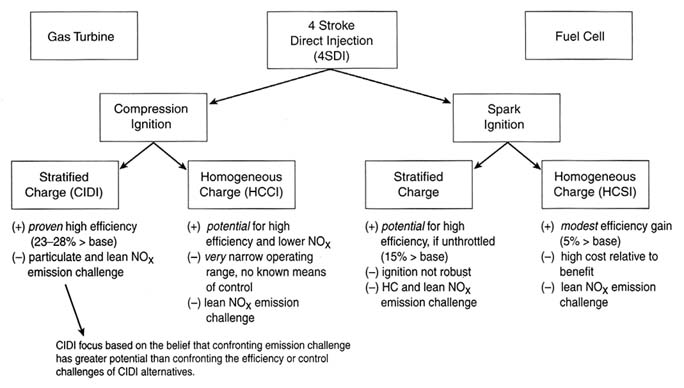
The selection of the concept vehicle energy converter was based on a number of factors, including overall performance, fuel efficiency, emissions, cost, size, weight and state of development. Each company is giving near-term priority to the 4SDI internal combustion engine. Figure 4-2 shows the four types of internal combustion engines that were analyzed. The stratified-charge CIDI engine was ultimately chosen for its potential to achieve a thermal efficiency 23 to 28 percentage points greater than a baseline engine. This was the highest efficiency of all of the 4SDI engines. Nevertheless, the CIDI engine still faces major challenges in meeting the NOx and particulate emissions targets (see Chapter 2). The advanced gas turbine and the Stirling engines were not selected because they either have lower levels of performance, are less mature technologies, or have higher projected production costs.
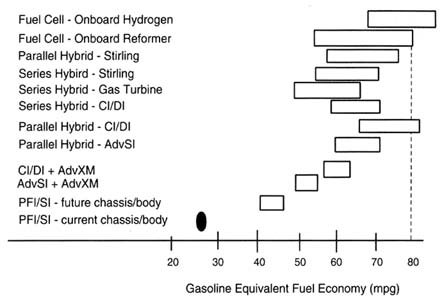
FIGURE 4-1 Relative fuel economy projections for various vehicle/power train configurations. All configurations except the current chassis/body include PNGV-class lightweight body, chassis, and interior (2,000 lbs); advanced aerodynamics; and low rolling resistance tires. The PFI/SI (port fuel injection/spark ignition) conventional vehicle is the baseline. Key:  =current vehicle chassis/body; = future efficient vehicle body/chassis; [light weight (2,000 lbs), sleek aerodynamics and low rolling resistance]. Variance denotes downward uncertainty from unmodeled energy losses and upward uncertainty from improvement as technology matures. CIDI = compression ignition/direct injection; AdvSI = advanced spark ignition. AdvXM = advanced transmission. Source: Provided to the committee by PNGV.
These analyses (Figures 4-1 and 4-2) indicate that an HEV with a CIDI engine is the most appropriate near-term (year 2000) choice, although the fuel-cell energy converter is clearly the longer-term choice, provided the many challenges facing it can be overcome. The committee agrees with the PNGV's technology selections based on the performance potential and state of development of the systems and subsystems.
CONCEPT VEHICLES
The USCAR partners have independently built test vehicles that incorporate some of the advanced technologies and components being considered and have shared the results of their evaluations. In the future, however, each company plans to build its own concept vehicle or vehicles. The overall design and construction
of these vehicles may go well beyond the precompetitive R&D boundaries that define USCAR's cooperative work. Because each manufacturer views the market somewhat differently, each is expected to develop a different type of concept vehicle. They will also have different approaches to mass reduction and will use different power train configurations. All three manufacturers have programs to develop hybrid-electric power trains, and many different configurations and degrees of hybridization are possible. Also, in the next few years, some test-bed cars that incorporate one or another advanced concept will continue to be built and tested, in addition to vehicles that meet all of the PNGV concept vehicle criteria.
In spite of this diversity, many areas of precompetitive research have still not been explored. All of the most promising technologies listed above still require major development before they will be serious candidates for use in mass-produced passenger cars and trucks. Reducing the cost of these technologies is the most common concern.
POST-2000 CONCEPT VEHICLES
Some of the technologies being explored (e.g., fuel-cell power plant, advanced batteries, ultracapacitors, and flywheels) are very promising but are unlikely to be ready for application in full-concept vehicles before 2000. These technologies are expected to be developed under the PNGV cooperative program and incorporated in post-2000 concept vehicles.
HYBRID VEHICLE DEVELOPMENT
All three USCAR partners have DOE-supported HEV programs that started at different times and have somewhat different goals. The vehicles being constructed under these contracts should not be confused with the concept vehicles being built for the PNGV program. They will not necessarily meet the criteria for the PNGV concept vehicles. For example, they were conceived as vehicles that would deliver only twice the baseline fuel economy. Nevertheless, these programs will speed the development of components specifically suited for HEV applications and increase the expertise in systems management issues associated with this complex power train.
RECOMMENDATION
Recommendation. The relationship between the criteria for technology selection and the critical requirements of Goal 3 should be made more explicit to facilitate the proper distribution of resources for an ongoing, well structured research and development program.


