
1
INTRODUCTION
Section 109 of the Clean Air Act requires the administrator of the U.S. Environmental Protection Agency (EPA) to set National Ambient Air Quality Standards (NAAQS) for particulate matter (PM) and five other widespread air pollutants, the so-called "criteria" pollutants (carbon monoxide, ozone, sulfur dioxide, nitrogen dioxide, and lead). The primary NAAQS for each criteria pollutant must be set to protect public health "with an adequate margin of safety" for the general public and potentially susceptible subpopulations. That requires EPA to make both scientific assessments and policy decisions. EPA is further required to review periodically (at least every 5 years) the primary NAAQS for each pollutant and the scientific criteria upon which they are based, and to revise the standards as warranted.
Airborne PM is a generic term applied to a broad class of particles ranging in size from molecular clusters less than 0.001 µm to particles of more than 50 µm in diameter. The particles are composed of chemically diverse materials. They are transported in the air as solid particles or liquid droplets. Outdoor particles originate from varied natural processes and human activities, including forest fires, wind erosion, agricultural practices, fossil-fuel combustion, industrial manufacturing, and the construction and use of buildings and roads. The particles can be emitted directly from the sources or formed in the atmosphere from gaseous precursors, such as sulfur dioxide, nitrogen oxides, and hydrocarbon vapors. The variety of sources of particles and gases and the
transformations of particulate matter in the atmosphere produce airborne particles of different sizes and chemical composition. For example, the particles can contain heavy metals, acids, biological or biogenic material, or other organic and inorganic compounds.
Although particulate matter is regulated as a single pollutant by EPA, it consists of a mixture of materials that are far more complex than regulated gaseous pollutants, such as ozone or carbon monoxide. Particles that can be inhaled into the respiratory tract span a range of aerodynamic diameters from molecular clusters as small as 0.001 µm up to larger particles of 10 µm or more in diameter. The numbers of particles and their chemical composition can vary within specific particle size fractions from location to location and over time, depending on the types of source emissions and atmospheric conditions.
Concern about airborne particulate matter in recent years has been driven largely by epidemiological studies that have reported relatively consistent associations between outdoor particulate-matter levels and adverse health effects. However, assessing the specific health risks resulting from exposures to airborne particulate matter, and distinguishing these effects from those produced by gaseous copollutants, involves substantial scientific uncertainty about the influence of copollutants and weather, about whether some particulate-matter fractions (size or chemical) might be more highly associated with health risks, and about the nature of dose-response relationships between particulate matter and health. Many previous analyses have not considered the simultaneous presence of all of the gaseous criteria air pollutants (sulfur dioxide, nitrogen dioxide, carbon monoxide, and ozone) and potentially important weather factors in estimating the association between particulate matter and health, and the treatment of such factors has not been uniform across previous studies. It will be important to understand how these factors influence estimates of particulate-matter risks to health and to learn whether the relationships are consistent across study areas. There is limited information about the physical, chemical, or biological properties of particles that might cause the observed adverse health effects, and information is also limited on the mechanisms of toxicity and the locations, activities, and intensity of actual human exposures to such particles. To date, researchers have
not obtained a sufficient picture associating specific toxic constituents of airborne particles with health indicators, such as respiratory and cardiovascular ailments, nor have they found definitive toxicological evidence to suggest plausible biological mechanisms to explain the toxic effects attributed to particulate matter in epidemiological studies (Vedal 1997; EPA 1996a) or to determine the extent to which populations at risk are exposed to these constituents.
Without knowing the most toxic particle constituents, the toxicological mechanisms through which they act, or the actual exposures experienced by people, a nationwide control strategy might reduce some kinds of particulate-matter exposures while failing to protect public health adequately, if the types of particulate matter controlled are not the most important in causing adverse health effects. In other words, at the present time, there is uncertainty as to what specific types or components of particulate matter need to be reduced to achieve substantial health-risk reduction cost effectively. It will also be important to obtain greater confidence about the shape of any dose-response relationship between particulate matter concentrations and health outcomes. Linear and nonlinear models both need to be considered, and the role of measurement error on estimated relationships needs to be investigated. These uncertainties are not presented here as a rationale for abandoning current or future efforts to control public exposures to particulate matter, but they do indicate the critical need for better scientific knowledge to guide such efforts.
The first NAAQS for particulate matter was set in 1971; it targeted total suspended particulate (TSP) mass per unit volume of air (Table 1.1), without regard to the chemical composition of the particles. In 1987, EPA revised the standard, changing the indicator from TSP to particles of 10 µm aerodynamic diameter or less, called PM10.1 PM10 was considered to be more important than TSP for protecting public
TABLE 1.1 EPA's Review and Implementation Timetable for Particulate-Matter Standards
|
Past Actions |
|
|
1971 |
EPA issues TSP NAAQS. |
|
1979-1987 |
Review of criteria and standards |
|
1987 |
EPA issues PM10 NAAQS |
|
1994-1997 |
Review of criteria and standards |
|
1997 |
EPA issues PM2.5 and revised PM10 NAAQS |
|
Planned Review and Implementation of PM2.5NAAQS |
|
|
1999 |
EPA will designate areas as "unclassifiable" for PM2.5. |
|
1998-2000 |
PM2.5 monitors to be in place nationwide. |
|
1998-2003 |
PM2.5 monitoring data to be collected nationwide. |
|
2002 |
EPA will complete 5-year scientific review of PM2.5 standards, leading to possible revision. |
|
2002-2005 |
EPA will designate nonattainment areas for PM2.5. |
|
2005-2008 |
States will submit implementation plans for meeting the PM2.5 standard. |
|
2012-2017 |
States will have up to 10 years to meet PM2.5 standards plus two 1-year extensions. |
health because it targets particles more likely to reach the bronchial tree and the gas exchange regions of the lung. (Figure 1.1 shows the distributions of airborne particle diameters as described by various metrics: particle number, particle surface area, and particle volume (or mass). The PM10 standard, like the TSP standard, was based on mass without regard to chemical composition.
The most recent particulate-matter criteria document (EPA 1996a) and the related EPA regulatory options document (EPA 1996b) were completed in 1996. They were reviewed by EPA's Clean Air Act Scientific Advisory Committee (CASAC). CASAC's evaluations (see Chapter 2) of the two documents were summarized in "closure" letters to the EPA administrator (CASAC 1996a, 1996b, 1996c).
In July 1997, the EPA administrator issued new particulate-matter standards that targeted PM2.5 (also called fine particles) for the first time, again without regard to chemical composition (EPA 1997b). Two standards for PM2.5 were promulgated: an annual standard of 15 µg/m3 in air, with attainment based on the 3-year average of annual arithmetic mean PM2.5 concentrations from single or multiple community-oriented monitors, and a 24-hour standard of 65 µg/m3, with attainment based on the 3-year average of the 98th percentile of 24-hour PM2.5 concentrations at each population-oriented monitoring site within an area. The previous 24-hour PM10 standard (150 µg/m3) was revised to be based on the 99th percentile of 24-hour PM10 concentrations at each monitoring site within an area, while the averaging time and form of the annual PM10 standard (50 µg/m3) was retained.
The new PM2.5 standards were developed by EPA largely on the basis of epidemiological studies that found relatively consistent but poorly understood associations between ambient particulate-matter concentrations and various adverse health effects, including premature (excess) mortality, exacerbation of asthma and other respiratory-tract diseases, decreased lung function, and increased hospitalization for cardiopulmonary diseases. EPA has estimated that compliance with the new PM2.5 standards will prevent approximately 15,000 premature deaths per year in the United States (EPA 1997a). The new standards have aroused substantial public debate, due largely to the current lack of knowledge of toxicological mechanisms and actual human exposures
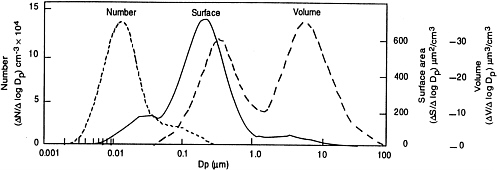
FIGURE 1.1 A hypothetical distribution of airborne particle diameters as described by particle number, particle surface area, and particle volume (or mass). Dp refers to the diameter of a particle. Particles with diameters less than approximately 0.1 µm are referred to as nucleation mode particles. Accumulation mode particles are those particles with diameters between the approximate range of 0.1 and 1.0 µm. Coarse particles have diameters greater than about 1 µm. Source: McClellan and Miller (1997) as adapted from Whitby (1978).
to outdoor PM2.5, as well as uncertainties about the magnitude of estimated potential risk reduction and the potential costs of complying with the new standards. (By law, EPA cannot consider compliance and other costs when setting primary, health-based NAAQS.)
EPA has stated that the new particulate-matter standards will have no actual regulatory impact until well after the next scheduled review of the particulate-matter NAAQS, which is due to occur in July 2002 (see Table 1.1). Many experts believe that substantially more scientific information is needed to assess the standards, and Congress has directed and funded a major program of research. In EPA's Fiscal 1998 appropriations, Congress provided $49.6 million for particulate-matter research, nearly twice the EPA request, and substantial funding over the next several years is generally believed to be needed to reduce current scientific uncertainties. Congress also directed the EPA administrator to arrange for an independent study (the present study) by the National Research Council (NRC) to identify the most important research priorities relevant to setting and reviewing NAAQS for particulate matter, to develop a conceptual plan for particulate-matter research, and to monitor and report over 5 years on research progress toward improved understanding of the relationship between particulate matter and its effects upon public health.
In response to the request from Congress, the Committee on Research Priorities for Airborne Particulate Matter, which prepared this report, was established by the NRC in January 1998. The committee consists of experts, chosen by the NRC, in epidemiology, medicine, pulmonary physiology, toxicology, public health, exposure assessment, atmospheric chemistry and modeling, emission sources, air-monitoring techniques, biostatistics, risk assessment, research management, and regulatory policy. Its members come from universities and other organizations and serve pro bono. In forming the committee, the NRC deliberately sought a balance of candidates with differing views on the major issues. Committee members were asked to serve as individual experts, not as representatives of any organization.
The committee is charged to produce four reports over the 5 years 1998-2002. This is the committee's first report. To date, the committee has held two working meetings at the National Academy of Sciences
in Washington, D.C., on January 20-21 and February 18-19, 1998. Those meetings included public sessions at which the committee heard presentations from representatives of EPA, EPA's CASAC, the National Institute of Environmental Health Sciences (NIEHS), the National Institute for Occupational Safety and Health (NIOSH), the North American Research Strategy for Tropospheric Ozone (NARSTO), Health Effects Institute (HEI), the Lovelace Respiratory Research Institute (LRRI), the American Petroleum Institute (API), the Chemical Industry Institute of Toxicology (CIIT), the Electric Power Research Institute (EPRI), the American Industrial Health Council (AIHC), and the National Resources Defense Council (NRDC). In addition, the committee received valuable documents and other written material from most of the presenters.
In developing its research priorities, the committee has considered particulate matter not in isolation, but in the context of the mixture of air pollutants of which particulate matter is a part. Other air pollutants are also of public-health concern; they might have effects similar to particulate matter or might interact with it to cause adverse health effects. Although the principal focus of this report is on particulate matter, the committee also considered research that can simultaneously and cost-effectively address the health effects of the full mixture of air pollutants.
Faced with the challenge of reconciling research planning and regulatory decision-making schedules, the committee has developed an approach that articulates a long-range research strategy for particulate matter over the next 13 years and also seeks to deliver timely results on important policy-related scientific questions as early as possible. The committee recognizes that the regulatory timetable places difficult demands on the planning and implementation of research. However, by careful prioritization of research activities during the period leading up to 2002, the committee believes that additional scientific information will be forthcoming to enhance the scientific basis for decision-making in the next scheduled review of the particulate-matter NAAQS, subsequent reviews of particulate-matter standards by EPA, and the development of particulate-matter control strategies.
This report offers a general framework for a program of highest-priority research on particulate matter. It presents a conceptual framework
and criteria for determinating research priorities. It describes 10 recommended research topics linked to key scientific policy-relevant uncertainties and integrates the recommended research activities into a 13-year research investment portfolio. The estimated cost and timing of the recommended research activities are also presented in the committee's recommended research portfolio.
During the course of its review, the committee identified several key uncertainties and limitations in existing scientific information. No attempt was made to evaluate the scientific adequacy of existing particulate-matter standards, and none should be inferred. It is important to recognize that legal requirements and policy choices are important factors in setting such standards, and this committee was not constituted or charged to address legal and policy matters.
Given the potential magnitude of public-health consequences associated with exposures to particulate matter and the potential economic costs of implementing the new PM2.5 standards, it is essential that policymakers and the American public have confidence that sufficient, high-quality scientific and technical information is available to reduce the risks effectively and efficiently. Proceeding in the absence of such information could lead policymakers to focus on standards and controls for particulate matter that are not of the highest public-health priority.
Failure to plan, implement, and sustain an integrated program of the highest-priority research activities could have undesirable consequences. If the most biologically important toxic components of particulate matter are not adequately identified, then fixed-site or personal monitors might fail to indicate the most serious particulate-matter risks to public health. Epidemiological and experimental studies that rely upon such information could be impeded, or worse, be misdirected. In addition, sources of emissions of the most toxic portions of particulate matter or their precursors could be misidentified, leading to ineffective air-pollution-control strategies.
The highest-priority research activities recommended in this report are critical to determining actual exposures to human subpopulations at the greatest risk of harm from the most hazardous components of particulate matter. The potential cost of ignorance is by no means
limited to wasting considerable dollars and effort, but, more important, failing to protect people from preventable public-health risks. Such research will be an investment in public health and a means to ensure that resources spent on control technology and regulatory compliance will have a reasonable probability of success. Given the extensive potential consequences of implementing the particulate-matter standards, only both kinds of success are acceptable. The committee is convinced that such success is achievable and that the recommended research can help guide public-health protection and cost-effective regulatory decisions.
It is also important that the scientific community speak with a clear voice in communicating research priorities for airborne particulate matter. Nonscientists in Congress, the Executive Branch, and the American public deserve to have a clear explanation of the state of scientific knowledge and uncertainty regarding particulate matter, what research is needed, and how more research could make a difference in guiding public-health decisions. Scientists have a responsibility to identify opportunities for clarifying the facts underlying important public-policy debates and to demonstrate that science can help resolve important issues that concern the public.
Chapter 2 of this report summarizes previous reviews of particulate-matter research needs and activities by EPA and other organizations. Chapter 3 presents the committee's conceptual framework and decision criteria for developing its research recommendations. The committee's highest-priority research recommendations are presented in Chapter 4. The recommended phasing and estimated costs of these research activities are integrated into a research investment portfolio in Chapter 5. In Chapter 6, the research priorities and strategies recommended by the committee are compared with those previously identified by EPA. Chapter 7 discusses additional aspects of implementing the committee's recommended research strategy.


