
2
PREVIOUS REVIEWS OF PARTICULATE-MATTER RESEARCH NEEDS
Unanswered questions about the relationships between airborne particulate matter and public health have stimulated several organizations, including EPA, to assess and recommend relevant research needs. The approaches taken in these efforts have varied among the groups, as has the basis for assigning priorities. Because the present NRC committee faced a similar challenge, several approaches taken previously by others are summarized in this chapter.
REPORT OF THE PARK CITY WORKSHOP ON PARTICULATE-MATTER RESEARCH STRATEGIES
A workshop sponsored by the U.S. Centers for Disease Control and Prevention was held in Park City, Utah, on April 29-30, 1996, in conjunction with the Second Colloquium on Particulate Air Pollution and Health, held May 1-3, 1996. The main objective of the workshop was to determine research needs related to health effects of the complex mixtures of particles and vapors commonly encountered in air. The starting point for identifying critical gaps and uncertainties was to synthesize the current knowledge of the nature, extent, and causes of health effects associated with general population exposures to such mixtures.
A published summary of the workshop (Lippmann et al. 1996) identified the following areas of research to be most useful with respect to health risk assessment for particulate matter:
-
Study accumulation-mode aerosol with the objective of disentangling the roles of its chemical constituents, as well as their interactive effects, with each other and with coexisting gaseous criteria pollutants.
-
Study the health effects of coarse-mode PM10 and the ultrafine particles in nuclei-mode aerosol.
-
Study sensitive human subpopulations—infants, the elderly, and people with pre-existing cardiopulmonary diseases.
-
Further develop and validate animal models for sensitive human groups. Validated animal models are needed for target (sensitive) human populations to investigate:
-
the roles of specific constituents of particulate-matter mixtures
-
the roles of exposure concentrations and durations of responses
-
the risk factors that predispose individuals to be responsive to particulate-matter exposures
-
physiological, biochemical, molecular, and pathological correlates of mortality, tissue and organ damage, and chronic disease development
-
EPA'S PARTICULATE-MATTER RESEARCH-NEEDS DOCUMENT
As part of each periodic review of NAAQS under the Clean Air Act, EPA prepares a so-called ''criteria" document intended to describe the state of relevant scientific knowledge and important uncertainties in the existing evidence. In a separate document, EPA also identifies research needed to improve the scientific bases for future reviews of the NAAQS. Therefore, in 1996, when EPA prepared the revised criteria
document on particulate matter (EPA 1996a), it also prepared a draft research-needs document, Particulate Matter Research Needs for Human Health Risk Assessment (EPA 1996d). That document was reviewed by several outside groups and revised (EPA 1998) in response to comments obtained from EPA workshops held in 1996 and 1997 and from CASAC (summarized below). EPA's research-needs document does not present a research plan or program. Instead, its primary purpose is to provide guidance to EPA's national research laboratories and other organizations that undertake and support research as they develop and justify particulate-matter research plans and programs.
The particulate-matter-related research needs identified by EPA included research on health effects, toxicology, atmospheric science, monitoring, modeling, and human exposure. The research-needs document does not address research related to implementing particulate-matter air-quality standards, determining compliance, or determining effective control techniques to attain such standards.
The document identifies research needs to improve human-health risk assessment for particulate matter and to reduce uncertainties associated with particulate-matter standards. It emphasizes that the uncertainties associated with establishing standards for particulate matter are more difficult than those associated with standard-setting for other criteria pollutants, all of which target single pollutants. The key uncertainties identified by EPA are listed in Table 2.1. The research needs document recommends highest-priority needs and second-level (high) priority needs. The specific links between uncertainties and research needs generally are not made explicit in the EPA document.
EPA'S PARTICULATE-MATTER RESEARCH-STRATEGY DOCUMENT
Particulate Matter Research Program Strategy (EPA 1996c) described EPA's research strategy for particulate matter in the areas of health effects, exposure, risk assessment, and risk management. The document was intended to guide future particulate-matter research to be performed or funded by EPA's Office of Research and Development
TABLE 2.1 Uncertainties and Highest-Priority Research Needs Identified by EPA for Establishing Standards for Airborne Particulate Mattera
(ORD). The particulate-matter research-strategy document was developed by a multidisciplinary group of EPA staff from several offices within ORD and the Office of Air and Radiation. The document emphasized research that pertains directly to EPA's responsibilities to establish and implement NAAQS. Thus, it did not cover all particulate-matter-related research topics identified in the EPA research-needs document summarized below.
EPA's 1996 research strategy document presented a two-step planning framework for setting research priorities:
-
Assessment of current knowledge
-
Identification of major knowledge gaps and key scientific questions
The EPA document proposed the following criteria for ranking particulate-matter research:
-
Risk-Based Planning. The focus is on research to reduce uncertainties in the assessment of health risks from exposure to airborne particulate matter and to develop or assess technologies for reducing emissions, exposures, and, ultimately, risks.
-
Scientific Excellence. Scientific quality is critical to development and testing of hypotheses, data collection and evaluation, and, ultimately, support of credible regulatory standards.
-
Policy Relevance. Importance is placed on the expected utility of research products for addressing short-term and long-term regulatory issues.
-
Other Sources of Data/Information. Research being conducted by organizations other than EPA is also considered in setting priorities and allocating resources for EPA research. Through venues such as the EPA Particulate Matter Research Needs Workshops (held in 1996 and 1997) and the interagency Committee on Environment and Natural Resources, which coordinates certain federal research activities, EPA seeks to be aware of the research activities of other organizations, such as the Health Effects Institute and the Electric Power Research Institute, as well as federal research organizations.
-
Capabilities and Capacities. This criterion focused on research implementation issues, such as ensuring that EPA has the facilities and expertise to conduct or oversee the needed research. Inhouse expertise is necessary to oversee research, even if it is conducted by outside organizations through grants, cooperative agreements, or contracts. Capabilities of the extramural scientific community are tapped mostly through EPA's Science to Achieve Results (STAR) grants program, which is investigator-initiated, competitive, and peer-reviewed.
-
Sequence of Research. The success of most research, no matter how important, usually depends on the results of previous studies. Research that depends on studies that have not yet begun or are only partially complete received lower immediate priority in the EPA strategy document, regardless of eventual importance.
EPA applied the above criteria to potential research activities and thereby identified an initial list of research priorities. The sequencing of research (i.e., the order in which research should be conducted) was an important consideration in the ranking. Another important consideration was that some research is needed in the near term to support the next review and subsequent implementation of the new particulate-matter NAAQS, while other research is needed in the longer term to support future NAAQS reviews.
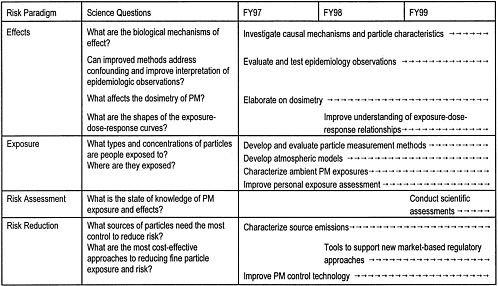
Table 2.2 summarizes and links the key research questions and priorities identified by EPA in 1996 for FY 1997 through FY 1999. EPA stated that its proposed research will be conducted by intramural and extramural investigators, taking into consideration the capabilities and capacities of the investigators to conduct the needed research.
A 1997 progress report (EPA 1997a) on EPA's particulate-matter research strategy reported that various methods and models are being developed in human, animal, and in vitro systems to improve the basis for future evaluations of the particulate-matter NAAQS. EPA's 1997 progress report described research under way in problem characterization, dosimetry, mechanisms of toxicity, and host-susceptibility factors.
An inventory of current federal and nonfederal research activities on particulate matter, recently prepared through a joint effort by the Health Effects Institute and EPA's Office of Research and Development, is summarized in Appendix B.
CASAC'S REVIEWS OF EPA'S PARTICULATE-MATTER RESEARCH-NEEDS AND RESEARCH-STRATEGY DOCUMENTS
CASAC is authorized by the Clean Air Act to review the scientific basis of EPA's NAAQS and to identify information needs associated with these standards. Supplemented by expert consultants (and collectively called the panel) (CASAC 1997), CASAC reviewed a previous draft (EPA 1996d) of Particulate Matter Research Needs for Human Health Risk Assessment at a public meeting in Chapel Hill, N.C., on November 18-19, 1996. The panel made numerous recommendations for improving the draft document.
CASAC's main criticism of EPA's 1996 draft research-needs document was that it failed to place particulate-matter research needs clearly in the context of the present large uncertainties in assessing the health risks from inhaled particulate matter. The panel expressed concern that EPA's 1996 research-needs draft did not reflect the uncertainties adequately and recommended that the nature and magnitude of present uncertainties should be better described.
The panel also noted that EPA's 1996 draft research-needs document conveyed the notion that direct causal links of particulate matter (and especially PM2.5) with health effects, as observed in epidemiological studies, were already established. Although the CASAC panel agreed that the available evidence warranted investigation, and most panel members generally supported implementation of some type of fine particle standard, the panel recommended that the EPA document should clearly state that the causality of adverse health effects due to PM2.5 had not been firmly established yet.
On particulate-matter research priorities, the CASAC panel recommended that "a useful approach would be to begin with a framework consisting of the key steps in health risk assessment and standard setting. The key uncertainties presently limiting analysis at each step could then be listed in summary form, and then summary statements of the information needed to reduce the key uncertainties could be listed. With this structure as a prologue, the most important research and the research approaches likely to be most productive could be described" (CASAC 1997).
The CASAC panel did not develop a detailed description of particulate-matter research needs, but it described the following general research areas to be of highest priority (CASAC 1997):
-
Effects of long-term exposures and relative contributions of short-term peak and cumulative exposures to long-term health outcomes
-
Mechanisms by which particulate matter could contribute to life shortening, daily mortality and morbidity
-
Linkages between particulate-matter data from outdoor monitors and actual personal exposures
-
Particulate-matter classes and physical-chemical characteristics associated with response pathways and potency
-
Extent to which particulate matter causes health effects independent of other pollutants
No second rank of priorities was given by the CASAC panel. Several other research topics were mentioned, but there was no consensus on their priorities.
The panel also recommended the following important concepts:
-
Interdisciplinary collaboration and integration of efforts
-
Research training
-
International cooperation
The CASAC panel also recommended that in determining research needs, EPA would benefit from more consideration of the technical feasibility and time requirements of conducting proposed research. Some of the research suggested in EPA's 1996 draft research-needs document was judged by CASAC as not feasible for technological reasons. The panel recommended that the time required to fill critical information gaps should be estimated, and that the research-needs document would benefit from the placement of research in a time context, with the 2002 review of the particulate-matter NAAQS as one benchmark.


