
3
THE COMMITTEE'S FRAMEWORK AND CRITERIA FOR EVALUATION
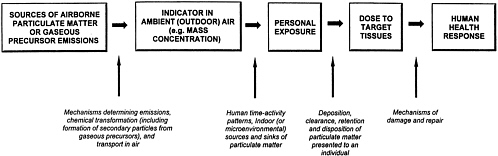
The committee developed a simple, coherent, science-based framework (Figure 3.1) for organizing its evaluation of particulate-matter research. This framework links the sources of emissions of particulate matter or its gaseous precursors with adverse health outcomes in exposed individuals or populations. This source-to-response framework provides a useful overall structure for identifying and organizing the critical scientific information and research topics that must be addressed to reduce uncertainties underlying the establishment and implementation of the NAAQS for particulate matter. The components of this framework are generally well known to EPA and the environmental research community but have not previously been developed in the integrated, iterative manner recommended in this report. At each step in the framework, various scientific uncertainties exist that decisionmakers must consider in making policy choices. Improved scientific information at each step could assist policymakers and the public to understand better the health risks associated with particulate matter and to develop cost-effective strategies to reduce such risks.
Key elements of the committee's framework include the following:
-
Sources—Motor vehicles, fossil-fueled electric power plants, industrial facilities, agricultural practices, consumer products, other human sources, and natural processes, such as forest fires or wind erosion, all
-
release particulate matter (or precursors) that can adversely affect public health. This element of the framework includes factors determining the release rates, locations, chemical composition, particle size, deposition, transport, and transformation of emissions that lead to indoor and occupational atmospheric contamination.
-
Ambient Indicators—Mass or other measures, such as measures of size or composition of particles, per unit volume of ambient air. Data for specific pollutant indicators (e.g., PM2.5 or PM10) are typically collected at fixed outdoor community-monitoring sites to estimate local attainment of NAAQS.
-
Personal Exposure—The concentration of particulate-matter indicators with which an individual comes into contact over a specified period of time. Actual exposure of humans is determined by outdoor-air concentrations, indoor sources, and human time-activity patterns. The relevant point of contact is the breathing zone of the individual. The regulatory objective is to measure the amount or intensity of such exposures that are attributable to outdoor sources.
-
Dose—The amount and chemical species of toxicants that reach and remain in the lung and other sites within the body over a specified period. Dose is influenced by factors such as deposition, retention, deposition, and clearance of particulate matter and specific constitutents from target tissues. The dose delivered to specific tissues may result in injury and altered mechanisms of repair.
-
Response—Changes in specific health parameters attributable to tissue doses of inhaled particulate matter. These biological responses can be expressed in terms of molecular or cellular changes in the target tissue, overall tissue damage, or ultimately, clinical signs of pulmonary, cardiac, or other toxicity.
For particulate matter, current knowledge is incomplete for all steps in this framework (Table 3.1). There is limited evidence on the relationship between ambient concentration measures of particles and
TABLE 3.1 Key Scientific Uncertainties Related to the Source-to-Response Framework
|
Source → Concentration (or other indicator) |
|
• Contribution of various emission sources to ambient and indoor particulate-matter concentrations |
|
• Relative contribution of various sources to the most toxic components of particulate matter |
|
Concentration (indicator) → Exposure |
|
• Relationship between ambient (outdoor) particulate matter and the composition of particles to which individuals are exposed |
|
• Contribution of ambient particulate matter to total personal exposure for: |
|
— Susceptible subpopulations |
|
— General population |
|
• Variation in relationship of ambient particulate-matter concentrations to human exposure by place |
|
• Variation in contribution of ambient particulate matter to total human exposure over time |
|
• Covariance of particulate-matter exposure with exposures to other pollutants |
|
• Relationship between outdoor ambient and personal exposures for particulate matter and copollutants |
|
Exposure → Dose |
|
• Relationship between inhaled concentration and dose of particulate matter and constituents at the tissue level in susceptible subjects |
|
— Asthma |
|
— Chronic Obstructive Pulmonary Disease (COPD) |
|
— Heart Disease |
|
— Age: infants and elderly |
|
— Others |
|
Dose → Response |
|
• Mechanisms linking morbidity and mortality to particulate-matter dose to or via the lungs |
|
— Inflammation |
|
— Host Defenses |
|
— Neural Mechanisms |
other pollutants in outdoor air, and the actual human exposures to those outdoor pollutants after time-activity patterns and indoor sources are taken into account, particularly for individuals within the populations considered most susceptible to air pollution. Doses of particles vary according to physical and chemical aspects of particles as well as physiological factors, such as human activity levels, breathing patterns, lung morphometry, and alterations of lung structure and function. Effects of particulate matter can vary with co-exposure to gaseous pollutants. Through the application of computer models of lung deposition, the relationship between exposure and dose can be estimated (empirical validation of the relationship is lacking at present). EPA currently assumes that the particles deposited in the lung elicit biological responses that result in adverse health effects in the respiratory tract and cardiovascular system. Although there is general understanding of how inhaled pollutants lead to respiratory and cardiovascular injury, that understanding does not extend to the low personal exposures and associated low doses at which effects of particulate matter have been observed in epidemiological studies. Toxicological mechanisms—how particles interact with target cells and subsequently elicit toxic responses—have been postulated, based on observations at higher levels of exposure and on toxicological models, but there is not yet a substantive body of human data on these relationships, and there is general uncertainty about toxicological mechanisms.
Epidemiological evidence, principally time-series studies, has indicated relatively consistent associations between measures of ambient concentrations of particulate matter and adverse health responses, but the evidence provides limited insight into the intervening steps of the committee's framework. The limited dose and mechanistic evidence contributes to uncertainty about the interpretation of epidemiological findings. The committee believes that evidence on toxicological mechanisms could significantly reduce many uncertainties about source-receptor relationships and strengthen the scientific knowledge base for risk assessment and risk-management decisions. Understanding such mechanisms could augment the credibility of the epidemiological evidence and provide a basis for guiding cost-effective control strategies for toxic particles. Another key uncertainty identified by the committee
is the relationship between outdoor particulate-matter concentration measurements and actual personal exposures and doses after indoor exposures, human time-activity patterns, and lung-clearance processes are taken into account. Tools are available for characterizing the relationship between ambient concentration and exposure and for exploring the association of exposure with dose. To date, however, only limited work has addressed those two important contributors to uncertainty.
The committee's highest-priority research recommendations and integrated research investment portfolio to address such uncertainties are presented in Chapter 4 and 5, respectively.
EVALUATION CRITERIA
The criteria chosen by the committee for assigning priorities to particulate-matter research needs are multidimensional, reflecting the complex physical and chemical processes and variety of biological effects associated with particulate-matter exposures, the varied information needs of decisionmakers for establishing and implementing the NAAQS, and the feasibility and timing of research activities.
In considering criteria to be used in establishing priorities for particulate-matter research, the committee was mindful of the need to integrate scientific and policy questions relevant to standard-setting and implementation. Each standard consists of four elements:
-
Indicator(s)—the specific measurement (e.g., mass, chemical form, or size fraction, such as PM2.5 or PM10) of airborne particles that is important to control to protect public health.
-
Concentration—the amount per unit volume of air
-
Averaging time(s)—the period for which measurements are made or averaged (e.g., annual or 24-hour periods)
-
Form—the statistical nature of the standard, used for determining the allowable number of exceedences per averaging time (e.g., 98th percentile).
The main overall categories of criteria chosen by the committee for identifying research priorities are scientific value and the value of research results to meet the information needs of decisionmakers. Research that would not ultimately have a potential effect on the standard-setting or implementation process was given low priority. Research directed at addressing key uncertainties and meeting key information needs within a risk assessment framework was ranked higher.
SCIENTIFIC VALUE
The committee believes that any research activities should be of significant scientific value. Such knowledge should pertain to one or more of the components of the committee's conceptual framework for reducing uncertainty (Figure 3.1), The scientific value of the information generated can be assessed in terms of its overall contribution to scientific knowledge about particulate matter and its health effects. Such knowledge will provide information on cause-and-effect relationships. It would be obtained through investigations that address testable hypotheses in a reproducible manner and provide results that can be generalized, to some degree, beyond the immediate study being performed.
Of particular value are innovative investigations that promise to fill important data gaps. Whereas confirmation of existing results is not always needed, studies designed to strengthen the basis for existing conclusions through new research results or replication of previous results, particularly those lacking a clear interpretation, are important. Studies that increase the ability to generalize upon previous findings are also valuable. Studies that contribute to the development of an integrated understanding of the health effects of particulate matter and gaseous copollutants are of particular value.
The committee also noted that some investigations can have side benefits in addition to knowledge generation per se. Specifically, new types of research might have the added benefit of building new research capacity and skills that might be valuable for addressing future questions about particulate matter and other air pollutants.
DECISIONMAKING VALUE
Research activities should contribute to reducing key uncertainties (Table 3-1) in standard-setting and risk-management decisions concerning particulate matter for the next scheduled review of the NAAQS in 2002 and in subsequent reviews.
Uncertainties exist at all stages of the committee's source-to-response framework (Figure 3.1). There are uncertainties about sources of particulate matter, biologically important particulate-matter constituents and mechanisms, ambient concentrations, levels of actual personal exposure, dose-response relationships, and the extent of short-term and long-term human health risk. Investigations that make a major contribution to particulate-matter risk assessment, through better characterization of particulate-matter risks, reduction in uncertainty about risks, or both, are of particular importance to policymaking.
FEASIBILITY AND TIMING
Research needs to be operationally, technically, and financially feasible. Operational factors include having sufficient research capacity and expertise available to successfully achieve the research objectives. The technical methods needed to conduct the research must also be available. Research objectives should be achievable within reasonable budgets, should make effective use of available financial and human resources, and where appropriate, should be leveraged with other scientific studies.
Particulate-matter-related research activities currently under way within EPA and other research organizations, as well as many of the research recommendations in this report, are largely directed toward the next review of the NAAQS for particulate matter in 2002. It is important that results be achieved in a timely manner. In addition, it is necessary to plan the overall research program in the context of a longer-range strategy and in such a way that the results of early investigations can be used advantageously in the planning and conduct of later research and regulatory reviews.
The committee understands that various decisionmakers will place different values on each type of information. Research results that can be generalized (i.e., extended generally to particulate matter or some fraction thereof or to other pollutants) are of enhanced value. Leveraging (the degree to which the results of a research activity can also increase the feasibility or value of other research results) also is valuable. And finally, the cost of ignorance (the potential health consequences and economic costs of proceeding inappropriately without the specified information) is a critical consideration.
The extent to which new research is needed to confirm previous findings was also considered. Based on the collective judgment of the committee, some research findings no longer need duplication (e.g., the now well-documented statistical association between daily mortality counts and various indicators of outdoor air pollution, including measures of particulate matter). On the other hand, some findings still need independent confirmation to be validated. For example, only a few studies contribute evidence on the long-term effects of particulate-matter exposures on morbidity and mortality. For these questions, the committee supported studies to provide independent confirmation. Furthermore, most currently available methods for toxicity testing for particulate matter can be used only for acute and subacute studies. Techniques are urgently needed for chronic or subchronic toxicity studies. Information is also severely lacking on the degree of actual human contact with PM2.5 in populations at risk.
In establishing priorities for research on particulate matter, as for other areas of environmental research, practical considerations are also important. Feasibility, cost, timing, and the capacity of investigators to conduct the needed research are fundamental. Beyond the prerequisites, research that creates synergism by building on existing or new projects was given greater weight by the committee. For example, research that can be conducted by adding to existing population studies within a reasonable time was more highly rated, but only when it did not deviate from or adversely affect testing of key hypotheses. For specific steps within the framework, investigations that can be integrated with other research are also emphasized by this committee.
Improvements in particulate-matter measurement methods are also
needed to advance understanding of relationships between ambient concentrations of particulate matter and actual exposures of individuals at high risk of adverse health effects. Methods to perform continuous analyses of ambient concentrations or integral analyses over extended intervals would provide better real-time data for exposure assessment, compliance analyses, pollution-episode identification, and remedy selection. The data generated by improved measurement methods would also be useful for systematic studies of exposure misclassification and measurement error. These studies would enhance the analysis of population distributions of exposures and applications in epidemiological studies.
For each research activity recommended in Chapter 4, the committee provides rough but informed collective-judgment estimates of the cost of such research, based on the knowledge and experience of the committee members (see Appendix A).


