





Below is the uncorrected machine-read text of this chapter, intended to provide our own search engines and external engines with highly rich, chapter-representative searchable text of each book. Because it is UNCORRECTED material, please consider the following text as a useful but insufficient proxy for the authoritative book pages.
WELFARE, THE FAMILY, AND REPRODUCTIVE BEHAVIOR RESEARCH PERSPECTIVES Robert A. Moffitt, editor Committee on Population Board on Children, Youth, and Families Commission on Behavioral and Social Sciences and Education National Research Council and Institute of Medicine NATIONAL ACADEMY PRESS Washington, D.C. 1998
NATIONAL ACADEMY PRESS · 2101 Constitution Avenue, N.W. · Washington, D.C. 20418 NOTICE: The project that is the subject of this report was approved by the Governing Board of the National Research Council, whose members are drawn from the councils of the National Academy of Sciences, the National Academy of Engineering, and the Institute of Medicine. The members of the committee responsible for the report were chosen for their special competences and with regard for appropriate balance. This report has been reviewed by a group other than the authors according to procedures approved by a Report Review Committee consisting of members of the National Academy of Sci- ences, the National Academy of Engineering, and the Institute of Medicine. Library of Congress Cataloging-in-Publication Data Welfare, the family, and reproductive behavior: research perspectives / Robert A. Moffitt, editor. p. cm. Includes bibliographical references and index. ISBN 0-309-06125-3 (pbk.) 1. Public welfare Government policy United States. 2. Child welfare Government policy United States. 3. Birth control Government policy United States. 4. Aid to families with dependent children programs United States. I. Moffitt, Robert A. (Robert Allan), 1917 HV91 .W478 1998 361.973 ddc21 98-9099 Additional copies of this report are available from: National Academy Press, 2101 Constitution Avenue, N.W., Washington, D.C. 20418 Call 800-624-6242 or 202-334-3313 (in the Washington Metropolitan Area). This report is also available on line at http://www.nap.edu Printed in the United States of America Copyright 1998 by the National Academy of Sciences. All rights reserved.
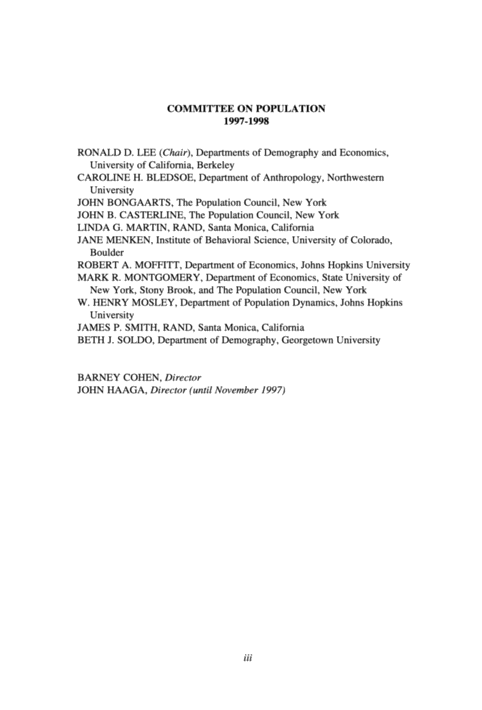
COMMITTEE ON POPULATION 1997-1998 RONALD D. LEE (Chair), Departments of Demography and Economics, University of California, Berkeley CAROLINE H. BLEDSOE, Department of Anthropology, Northwestern University JOHN BONGAARTS, The Population Council, New York JOHN B. CASTERLINE, The Population Council, New York LINDA G. MARTIN, RAND, Santa Monica, California JANE MENKEN, Institute of Behavioral Science, University of Colorado, Boulder ROBERT A. MOFFITT, Department of Economics, Johns Hopkins University MARK R. MONTGOMERY, Department of Economics, State University of New York, Stony Brook, and The Population Council, New York W. HENRY MOSLEY, Department of Population Dynamics, Johns Hopkins University JAMES P. SMITH, RAND, Santa Monica, California BETH J. SOLDO, Department of Demography, Georgetown University BARNEY COHEN, Director JOHN HAAGA, Director (until November 1997) . . .
BOARD ON CHILDREN, YOUTH, AND FAMILIES 1997-1998 JACK P. SHONKOFF (Chair), Helter Graduate School, Brandeis University DAVID V.B. BRITT, Children's Television Workshop, New York LARRY BUMPASS, Department of Sociology, Center for Demography and Ecology, University of Wisconsin FERNANDO A. GUERRA, San Antonio Metropolitan Health District BERNARD GUYER, Department of Maternal and Child Health, Johns Hopkins University ALETHA C. HUSTON, Department of Human Ecology, University of Texas, Austin RENEE R. JENKINS, Department of Pediatrics and Child Health, Howard University Hospital SARA McLANAHAN, Office of Population Research, Princeton University ROBERT MICHAEL, Harris Graduate School of Public Policy Studies, University of Chicago PAUL NEWACHECK, Institute of Health Policy Studies and Department of Pediatrics, University of California, San Francisco MARTHA PHILLIPS, The Concord Coalition, Washington, D.C. JULIUS B. RICHMOND, Department of Social Medicine, Harvard University Medical School TIMOTHY M. SANDOS, TCI Central Inc., Denver DEBORAH STIPEK, Graduate School of Education, University of California, Los Angeles DIANA TAYLOR, Women' s Health Program, Department of Family Health Care Nursing, University of California, San Francisco GAIL WILENSKY, Project Hope, Bethesda, Maryland EVAN CHARNEY, Council, Institute of Medicine (liaison member) RUTH T. GROSS, Board on Health Promotion and Disease Prevention, Institute of Medicine (liaison member) ELEANOR E. MACCOBY, Commission on Behavioral and Social Sciences and Education (liaison member) DEBORAH A. PHILLIPS, Director V
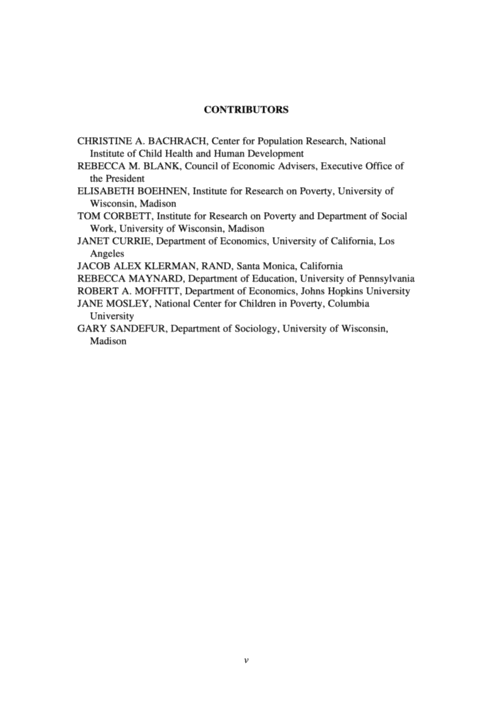
CONTRIBUTORS CHRISTINE A. BACHRACH, Center for Population Research, National Institute of Child Health and Human Development REBECCA M. BLANK, Council of Economic Advisers, Executive Office of the President ELISABETH BOEHNEN, Institute for Research on Poverty, University of Wisconsin, Madison TOM CORBETT, Institute for Research on Poverty and Department of Social Work, University of Wisconsin, Madison JANET CURRIE, Department of Economics, University of California, Los Angeles JACOB ALEX KLERMAN, RAND, Santa Monica, California REBECCA MAYNARD, Department of Education, University of Pennsylvania ROBERT A. MOFFITT, Department of Economics, Johns Hopkins University JANE MOSLEY, National Center for Children in Poverty, Columbia University GARY SANDEFUR, Department of Sociology, University of Wisconsin, Madison v
The National Academy of Sciences is a private, nonprofit, self-perpetuating society of distin- guished scholars engaged in scientific and engineering research, dedicated to the furtherance of science and technology and to their use for the general welfare. Upon the authority of the charter granted to it by the Congress in 1863, the Academy has a mandate that requires it to advise the federal government on scientific and technical matters. Dr. Bruce M. Alberts is president of the National Academy of Sciences. The National Academy of Engineering was established in 1964, under the charter of the Na- tional Academy of Sciences, as a parallel organization of outstanding engineers. It is autonomous in its administration and in the selection of its members, sharing with the National Academy of Sciences the responsibility for advising the federal government. The National Academy of Engineering also sponsors engineering programs aimed at meeting national needs, encourages education and research, and recognizes the superior achievements of engineers. Dr. William A. Wulf is interim president of the National Academy of Engineering. The Institute of Medicine was established in 1970 by the National Academy of Sciences to secure the services of eminent members of appropriate professions in the examination of policy matters pertaining to the health of the public. The Institute acts under the responsibility given to the National Academy of Sciences by its congressional charter to be an adviser to the federal government and, upon its own initiative, to identify issues of medical care, research, and education. Dr. Kenneth I. Shine is president of the Institute of Medicine. The National Research Council was organized by the National Academy of Sciences in 1916 to associate the broad community of science and technology with the Academy's purposes of furthering knowledge and advising the federal government. Functioning in accordance with general policies determined by the Academy, the Council has become the principal operating agency of both the National Academy of Sciences and the National Academy of Engineering in providing services to the government, the public, and the scientific and engineering communities. The Council is administered jointly by both Academies and the Institute of Medicine. Dr. Bruce M. Alberts and Dr. William A. Wulf are chairman and interim vice chairman, respectively, of the National Research Council. This project was supported by the Annie E. Casey Foundation and the Kellogg Fund of the Governing Board of the National Academy of Sciences, the National Academy of Engineering, and the Institute of Medicine. Any opinions, findings, conclusions, or recommendations expressed in this publication are those of the authors and do not necessarily reflect the view of the organizations or agencies that provided support for the project.
Preface Over the last decade, welfare reform has figured prominently in the policy agenda at both the state and the federal levels. One of the most important issues in the policy debate concerns the effect of welfare programs on individual demo- graphic behavior. Some of the possibilities most frequently mentioned are that welfare programs affect labor force participation rates, living arrangements, mi- gration patterns, and reproductive behavior, with perhaps the biggest fear being that welfare programs encourage out-of-wedlock childbearing, particularly among teenagers. Unfortunately, there is great uncertainty regarding the scientific evidence for these and other possible effects of income support programs. The policy debate is filled with unsubstantiated claims, in both directions (that the programs have no behavioral effects or that they have extremely large behavioral effects). Faced with conflicting claims, even well-informed participants in the policy process find it difficult to distinguish whether disagreement is due to differences in data sources, analytic methods, variability in program or nonprogram factors affecting the behaviors in question, or the interpretation of results. In an attempt to clarify some of the issues both for the policy debate and for setting research priorities, the National Research Council organized a Work- shop on The Effects of Welfare on the Family and Reproductive Behavior in May 1996, which brought together experts in demographic and family studies, along with researchers and policy makers familiar with income support pro- grams. The chapters in this volume were first presented at that workshop and cover the lessons from available research and the implications for future research. . . vat
. . . vile PREFACE This report is the product of the efforts of many people. The Committee on Population was very fortunate in being able to enlist the services of committee member Robert Moffitt, whose unflagging efforts in organizing the workshop and editing the resulting papers have contributed enormously to the volume. In addition, Ronald Lee, former chair of the Committee on Population, provided much thoughtful guidance at the formative stages of the project. Most impor- tantly, the committee is deeply grateful to the various authors for all their fine work on these papers. The committee offers appreciative thanks to the Annie E. Casey Foundation and the Kellogg Fund of the Governing Board of the National Academy of Sciences for financial support and to Michael Laracy and William O'Hare at the Casey Foundation for their encouragement and intellectual input. Finally, the committee thanks the staff at the National Research Council. John Haaga, former director of the Committee on Population, led the initial staff work and served as a rapporteur at the workshop. Anne Bridgman, Nancy Maritato, Kristin McCue, Faith Mitchell, and Deborah Phillips provided essential input at various stages of the project. Final production took place under the guidance of Barney Cohen, director of the Committee on Population. Florence Poillon edited the volume. LaTanya Johnson prepared the papers for publication. The committee is grateful to them all. Jane Menken, Chair Committee on Population May 1998
Contents Preface 1 Introduction Robert A. Moffitt The Changing Circumstances of Marriage and Fertility in the United States Christine A. Bachrach Trends in the Welfare System Rebecca M. Blank 4 The Effect of Welfare on Marriage and Fertility Robert A. Moffitt 5 Welfare Reform and Abortion Jacob Alex Klerman Changing Family Formation Behavior Through Welfare Reform Rebecca Maynard, Elisabeth Boehnen, Tom Corbett, and Gary Sandefur, with Jane Mosley 7 The Effect of Welfare on Child Outcomes Janet Currie Mix v 9 33 50 98 134 177
WELFARE, THE FAMILY, AND REPRODUCTIVE BEHAVIOR
