
5
Application to Water Resources
Improve the utility of hydrologic predictions for water resources management up to seasonal and interannual time scales.
BACKGROUND
Management Issues
Proper management of water resources in large river basins, such as the Mississippi River basin, has the potential to benefit from improvements in scientific understanding of hydrologic processes, better modeling schemes (which can produce more accurate forecasts), and enhanced generation of data products, developed by programs such as GCIP. To realize how this will come about, it is important to understand what water resources management means from the perspective of an entire river basin. This includes an understanding of the wide variation in spatial and temporal scales at which the water resources are relevant because, in the final analysis, our ability to predict the availability of water in time and space under both "normal" and "anomalous" conditions will be critical for applications.
Most water resources management problems are either local or regional in nature. The complex hydrologic system of the Mississippi possesses a wide range of attributes, including numerous flood control structures, a network of navigation locks and dams, overlapping hydrologic and water resources management units, extensive groundwater and surface-water interaction and close proximity of the water table to the surface, and a wide range of hydroclimatic conditions along the basin. The average annual temperature varies from 5 to 10°C in the northernmost parts to 20–27°C at the mouth of the river. Similarly, the average annual precipitation varies between 50 and 100 cm in the northern parts
of the basin and 150 and 180 cm in its southern parts. Seasonal variations in temperature and precipitation across the basin are even greater.
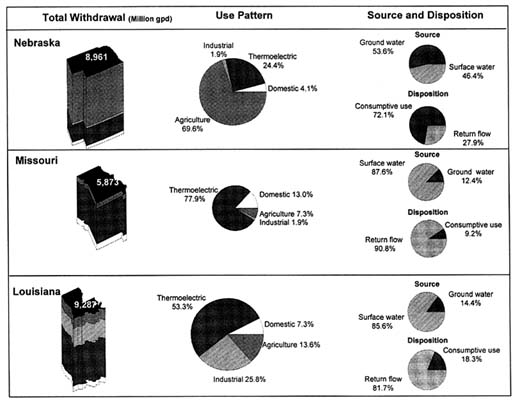
The regional nature of the management issue becomes apparent through a comparison of the water-use patterns, sources, and dispositions for three states on the Mississippi River basin (Figure 5.1). The selected states represent a north-to-south transect of the basin. In Nebraska for the year 1990, nearly 70 percent of the water consumption was for agricultural purposes. More than 53 percent of that amount was obtained from groundwater sources. Of the total water consumed, nearly 28 percent was returned to the river network. In Missouri, nearly 78 percent of the water consumption was for thermoelectric power generation. Almost 88 percent of the total water use came from surface-water sources, and 91 percent of the total was returned to the streams. As we move farther south to Louisiana, which is a more industrialized state, the primary water use (nearly 53 percent) was still for thermoelectric production, whereas 26 percent went for industrial applications. Of the total water use, nearly 86 percent was provided by surface-water sources, and almost 82 percent of the total was returned to the river network. Water quality/quantity resource and management issues for Nebraska (which is primarily an agricultural state) are likely to be different from those for Louisiana, where industrial consumption and instream use of water for cooling towers of power plants are prevalent.
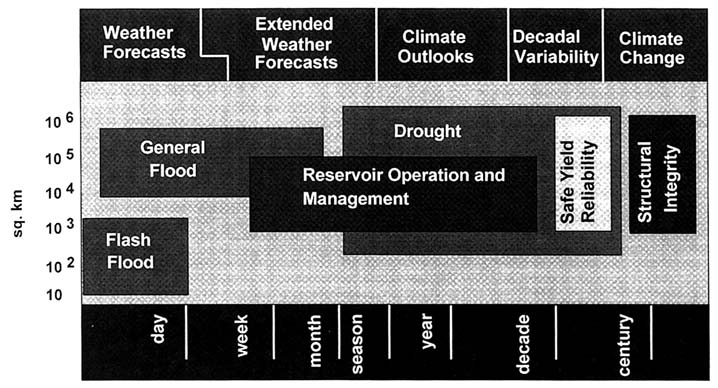
Almost all water management decisions depend on relevant information and reliable predictions at different time scales. For example, short-term to extended weather forecast products generated by mesoscale models will enable farmers to know whether precipitation will provide the water required for the next irrigation cycle or whether alternative sources, such as surface-water diversion or ground-water withdrawal, must be arranged. At the seasonal time scale, reliable climatic predictions may enhance reservoir operation with respect to releases for water supply, power generation, and so forth. Furthermore, the ability to provide advance warning of the occurrence of floods will enable emergency and disaster relief managers to take timely and effective action toward saving lives and mitigating property damage (which can amount to billions of dollars). Prediction of droughts would also have a great impact on water resources management, for both instream and offstream uses. At the decadal time scale, the ability to predict regional tendencies toward warmer or cooler and wetter or drier conditions will be beneficial when establishing policies impacting the planning of water resources supply systems and socioeconomic issues such as migration, industrialization, and urbanization. The range of water resources concerns, depending on their temporal and spatial scales, is depicted in Figure 5.2.
Special mention should be made of the fact that a variety of water quality, wetland, fisheries, and aquatic ecosystem management issues are also affected by climate variability at the various space-time scales mentioned above. For instance, a different combination of land-use patterns on watersheds (i.e., deforestation, agricultural practices, urbanization, etc.) and human activities in rivers
(i.e., construction of dams, levees, etc.) produces different responses to extreme hydroclimatic conditions, which alter the timing, magnitude, and nature of inputs of materials to wetlands and estuaries. An increase in the frequency or magnitude of overland flow (e.g., due to an increase in the severity of storm events) will alter the downstream transfer of sediments, organic matter, and nutrients. Given that aquatic ecosystems are sensitive to these alterations, proper management practices at all space-time scales will be critical to minimize the potential for longterm or irreversible damage.
A variety of both hydrologic-based models (e.g., precipitation-runoff, routing, sediment transport) and water resources management models are necessary to assist in the decision-making process for addressing issues such as urban flood studies, reservoir operation, drought management, erosion, and stream water quality monitoring, among other concerns. Depending on the nature of the data and information available and/or required, both deterministic and statistical models are in use. The deterministic models are commonly used to generate either short-term operational forecasts or future hydrologic scenarios. Management issues that deal with operational problems extending beyond several weeks (months, years, decades, etc.) and/or design scenarios (which are not necessarily time-dependent) have been handled using statistical and stochastic models.
Although GCIP's research program is not geared directly toward the development of water resources management models, GCIP's observational and modeling efforts are expected to enhance the front-end modeling tools, such as those mentioned above used for water resources management process. A particular role of GCIP in this regard could be to improve both the accuracy and the relevance of the hydrologic model-generated predictions that are used as inputs for water management. Hydrologic models that might receive the most benefit in this regard are discussed below.
Hydrologic Models for Water Resources Management
Deterministic Precipitation Runoff Models
The current generation of precipitation runoff models used for water management purposes is lumped rather than distributed, and their structures (e.g., process equations) have been determined by the availability of observations and the current state of knowledge about the processes. Among the most widely used models of this class are the NWS River Forecast Centers' Soil Moisture Accounting models (Hudlow, 1988) and physically based distributed models such as HEC-1 (Feldman and Davis, 1993). These models are applied to a variety of spatial and temporal scales, ranging from small plots to thousands of square miles and from hours or days to weeks, respectively. Better accuracy in the predictions provided by precipitation runoff models will come from two areas of progress: improvements in observed hydrometeorological inputs (principally precipitation)
and improvements in the representations of land surface processes that mediate the storage, release, and redistribution of groundwater. In principle, the simulation of precipitation runoff performed by these models involves two phases: (1) the storm period and (2) the interstorm period. In the storm period, the problem is one of partitioning the precipitation between basin recharge and excess rainfall, which gets converted to direct surface runoff. Once a particular storm event occurs over an area, there may be a few days, weeks, or perhaps months before the next sequence of storms arrives. Thus, the main purpose of modeling interstorm periods would be to keep track of the various states of hydrologic processes. The primary state variables that require monitoring and updating are the soil moisture condition and snowpack (if any) over the catchment.
Accuracy of the precipitation observations required for storm period models is critical. It is well known that precipitation measurements from gauge recordings have a large amount of error associated with them. The errors are compounded further by the fact that data from sparse gauges are processed to obtain areal averages over a given basin. The potential benefits of NEXRAD precipitation estimates for rainfall runoff modeling purposes have been anticipated and discussed extensively in the literature (Crum and Alberty, 1993; Lindsey, 1993; Smith et al., 1996). Because a NEXRAD precipitation data base is one of the primary GCIP contributions, it will be of great benefit to the rainfall runoff modeling community.
Before runoff can take place, an initial amount of precipitation is lost to (1) interception by vegetation canopy and (2) capture by surface depressions. In hydrologic terms, these are known as initial losses. The initial losses, particularly canopy interception, can be rather significant, depending upon surface cover (Dunne and Leopold, 1978). For example, spring wheat can intercept anywhere between 10 and 35 percent of the gross precipitation. It is estimated that deciduous forests can intercept as much as 13 percent and coniferous forests as much as 22 percent of the gross precipitation. Depending on the catchment size, this can represent a very significant amount of precipitation that will not reach the ground surface to either recharge groundwater or to become surface runoff.
Once initial losses are accounted for, the most critical aspect of the storm period is the partitioning of precipitation between the volume resulting in direct runoff and the volume that goes to basin recharge. Essentially, two different types of partitioning mechanisms occur on a given catchment. These mechanisms are (1) infiltration excess (Horton, 1933) and (2) saturation excess (Dunne and Black, 1970). On a basin the size of the Mississippi River at any time, both of these mechanisms can occur. In fact, a substantial portion of the runoff generated in the Mississippi River basin may be due to saturation excess. Most hydrologic runoff generation models currently in use are based on the infiltration excess mechanism. Recently, models based on saturation excess (e.g., TOPMODEL, Beven et al., 1995) have been developed. The challenge for the future will be the development and application of models capable of computing runoff when both processes are
accounted for simultaneously in a distributed fashion. In either case the volume of runoff generated during a given storm event is directly dependent on the initial surface and soil moisture conditions.
The changes in soil moisture over time are controlled by factors such as evapotranspiration, air and soil temperature, soil texture, land cover, topographic features, snowmelt, and accumulation. These factors result in heterogeneous changes in soil moisture, which, if not captured properly and incorporated into these models, can have a profound effect on water balance calculations. For example, an underestimation of the available soil moisture would suggest that there is more storage capacity to hold water than is actually available. The result might be an underestimation of the magnitude of the flood volume. The opposite could also be true, resulting, for example, in the overestimation of the amount of water available in the soil. This may have implications in groundwater recharge, irrigation scheduling, and so forth.
Statistically Based Hydrologic Models
Hydrologists and water resources planners rely on a number of statistically based schemes to deal with structural design and long-term operational requirements of water resources systems. Several popular synthetic streamflow techniques (e.g., Fiering and Jackson, 1971) are used for both design and operation of water resources structures such as dams. Flood frequency analysis methods are used routinely to address floodplain management and zoning (Bedient and Huber, 1988). For example, the insurance industry relies on results obtained from the flood frequency analysis method to develop guidelines for flood-prone regions. Most municipalities, flood control districts, and state and federal departments of transportation rely on the results of flood frequency analysis to size culverts, drainage systems, bridges, and so forth.
The principle behind these statistical approaches is that when the probability distribution of historical streamflow is analyzed and the suitable distribution with the proper parameters has been identified, future scenarios can be generated. In the case of flood frequency analysis, emphasis is placed on the distribution of extreme values (i.e., floods). Inherent in these methods is their ability to help managers deal with future uncertainties based on a probabilistic understanding of the past. The key issue in climate change scenarios is whether we can rely on climate model simulations to produce relevant hydrological statistics for the future (or different climate conditions). Such statistics would answer the question of whether our hydrologic regimes (i.e., precipitation and streamflow) are, indeed, changing in character (Figure 5.3). The issues that would be of greatest concern to water resources planners and managers are (1) whether future streamflows are increasing or decreasing, due to wetter or drier climate in a fashion that fits the scenario shown in Figure 5.3A, or (2) while the mean streamflow remains constant, whether its variability is increasing or decreasing in a fashion that fits the scenario shown in Figure 5.3B.
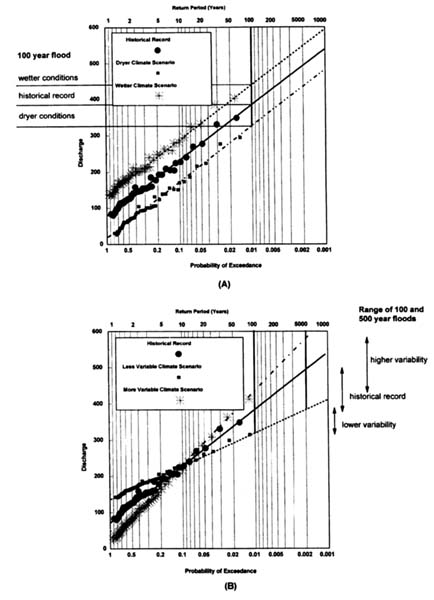
FIGURE 5.3 Conceptual representation of possible impacts of climate change on the maximum flood series. (A) Upward or downward shifts in the mean annual flood without changes in the variability of the series reflect an increase or decrease of the flood magnitude for all return periods. (B) A change in the variability of flood magnitude indicated by the different slopes of the frequency lines, while the mean annual flood remains the same, reflects opposite changes in the magnitudes of high- or low-frequency events.
ACCOMPLISHMENTS
GCIP research activities to date have not made direct contributions to water resources management. However, there is a great potential for useful interactions. Once a proper mechanism for closer cooperation with the water resources community has been established, the benefits of GCIP's budget studies (Chapter 1), model development (Chapter 2), data assimilation (Chapter 3), and collection and management (Chapter 4) will be better realized. The involvement of the Tennessee Valley Authority in the LSA-East detailed design workshop, held in Huntsville, Alabama (November 1996), is a step in the right direction.
RECOMMENDATIONS
It is anticipated that GCIP's observational and modeling efforts will enhance the front-end modeling tools used for water resources management purposes. However, the GCIP research program is not geared directly toward the development of water resources management models. At the present time, clear knowledge is lacking on the part of the water resources management agencies as to the potential benefits of GCIP research. In this regard, fostering an interactive dialogue between GCIP and the water resources management community in the Mississippi River basin is highly recommended. Specific recommendations relevant to these and related issues are discussed below.
Ensure That Hydrologic Data Sets Prepared Under GCIP Will Also Satisfy Modeling Requirements of the Water Resources Management Community
GCIP's comprehensive data base is placing a major emphasis on hydrologically related observations, such as precipitation, streamflow, and so forth. In order to ensure that the water resources community is able to take full advantage of this vast information, it is critical that the quality (accuracy and completeness) and resolution (in space and time) of hydrologic data be compatible with hydrologic modeling requirements. In this regard, the quality of the precipitation data from NEXRAD should be given a very high priority.
Develop Better Characterization and Estimation of Precipitation Partitioning in Rainfall Runoff Models
Although a significant amount of research has been directed toward understanding and modeling infiltration processes, particularly at the point scale, there has not been as much improvement in the partitioning procedure used in precipitation runoff models. Methods range anywhere from the simple Ø-index method—which
assumes a constant rate of infiltration (Singh, 1992)—to some conceptual approaches, such as the one used in the Stanford-type watershed model (Crawford and Linsley, 1966), or saturation-excess mechanics used in TOPMODEL (Beven et al., 1995). Because GCIP's focus is on water and energy balance studies, it follows that the partitioning of precipitation relevant to storm periods and applicable to catchment scales would benefit as well. GCIP should encourage the research community involved in precipitation runoff modeling to take advantage of the data and modeling activities sponsored by GCIP in order to improve the reliability and accuracy of the precipitation runoff models used extensively in operational hydrology and water resources studies.
Develop Strategies to Monitor, Model, and Archive Soil Moisture Data at Appropriate Spatial and Temporal Resolutions
The importance of soil moisture information to update the state of precipitation runoff models used for water resources forecasting purposes has been established in this chapter. At the present time, there seems to be no clear agreement about the definition, type, and resolution requirements (in time and space) of soil moisture among various scientific communities (i.e., climatologists, hydrologists, agricultural meteorologists, etc.). Given the strong land surface modeling orientation of GCIP and, hence, the importance of soil moisture information, GCIP should attempt to clarify these requirements in a manner suitable to the needs of various disciplines. It is through such an effort that the requirements for a space-based soil moisture global monitoring program can be best defined.
Combine GCIP's Physically Driven Studies with Statistical Approaches in Water Resources Management
One approach that should be considered is exploring changes in the probability distribution of extreme hydrologic events by means of climate model simulation. In this regard, climate models with high spatial resolution could be used to generate climate scenarios by varying plausible initial and boundary conditions on a regional basis. The ensemble of results could then be used to explore changes in the statistical properties of regional precipitation patterns, streamflow, runoff, and so forth. Clarifying the role that GCIP might play in furthering understanding of hydrological and meteorological variabilities on seasonal to interannual and decade to century time scales must be given high priority. Would any aspect of this new understanding improve our ability to more accurately predict changes in the parameterization of probability distributions used in statistical methods in hydrology? Similarly, could an understanding of elementary processes provide the capability to capture trends in the hydrologic regimes of a given region (e.g., moving toward wetter or drier climates in the next decade) or
changes in their variability? This creates an opportunity for furthering cooperative research among the GEWEX, Climate Variability and Prediction Program (CLIVAR), and PACS communities.
Foster an Interactive Dialogue with Water Resources Management Agencies in the Mississippi River Basin
GCIP's research priorities and focus are geared toward improving the front-end hydrologic models and data bases used for water resources management purposes. However, to ensure that GCIP's modeling improvements and data products are useful to the water resources management community, it is important that a dialogue be established. Besides numerous local and state agencies, there are several large institutions and federal agencies with direct involvement in water resources decisions in the Mississippi River basin. Among these are the Army Corps of Engineers, the Tennessee Valley Authority, the Federal Emergency Management Agency, the Environmental Protection Agency, and so forth. It is not unusual to discover that some of these agencies are unfamiliar with GCIP and the potential benefits of GCIP research for their purposes. It is highly recommended that the GCIP program develop a strategy for (1) familiarizing the water resources management entities in the Mississippi River basin with the program and (2) seeking their input and advice on GCIP modeling and data activities and how these could be made more useful for their purposes.


