
4
Accomplishments, Impacts, and Legacies
The primary driving forces for the initiation of major research efforts of any type are the importance, scale, and complexity of the scientific question to be addressed. However, greater organization often leads to costly bureaucracy; thus, organized efforts in science tend to be controversial.1 Accomplishments and benefits of such efforts will inevitably be weighed against any impact they may have on the overall collegiality of the scientific community in which they exist. To systematically examine the impact of major oceanographic programs on various aspects of the ocean sciences, specific metrics of performance need to be evaluated. However, such metrics are difficult to develop and implement.
In an effort to identify the most significant accomplishments and impacts of the major oceanographic programs, the committee developed a study approach (Box 4-1) to guide its systematic examination of these programs.
The Role Of Major Oceanographic Programs In Our Understanding Of The Oceans
Developing a basic understanding of ocean processes often requires a synoptic and interdisciplinary approach to hypothesis testing, data collection, and modeling. For example, understanding processes such as (1) flux of matter and energy in marine food webs, (2) the ocean's role in climate change, and (3)
biological, chemical, geological, and physical variability on different spatial scales, requires synoptic collection of many disparate types of data. Similarly, understanding interactive processes or a linked series of processes requires a synoptic, coordinated series of measurements. The collection of these measurements is generally accomplished by vessels coordinated through a series of cruises, often using large and expensive instruments and many people working together on a common set of questions, in a true interdisciplinary (as opposed to multidisciplinary) approach. In other words—major oceanographic programs.
Data as Legacy
The large amount of data collected during the quasi-synoptic observational phases of many of the ongoing major oceanographic programs presents a new array of challenges in data management, data access, data assimilation, and modeling. Access to these data by project scientists is imperative and in many instances forms the core of the collaborative relationship. Access by the broader research community is an important and commonly underestimated benefit of these programs. In fact, an important indirect effect of these programs is a changed attitude in the community toward data ownership and data access. Striking a balance between accessibility and ownership is a significant challenge facing existing and future programs.
Most of the major programs have data management structures for gathering and distributing data in the program and the nonprogram science community. For example, the Tropical Ocean and Global Atmosphere (TOGA) Program and Coupled Ocean-Atmosphere Response Experiment (COARE) made use of the World Wide Web to develop a system that is widely accessed. The World Ocean Circulation Experiment (WOCE) created a data information unit (DIU) that serves as a router for data requests and distribution. As previously discussed, the greatest legacy of the major oceanographic programs may be the data that they have collected, and the continuation of certain data-gathering efforts may prove to greatly enhance that legacy.
Two examples of time-series that were initiated as part of major program science plans include what are commonly referred to as the HOTS and BATS series. The Hawaii Ocean Time Series (HOTS)2 is a component of both WOCE and JGOFS, intended to obtain a long-time series of physical and biochemical observations in the North Pacific subtropical gyre. Since October 1988, HOTS has occupied Station ALOHA approximately every month. The observational strategy is to combine periodic occupations of Station ALOHA with continuous moored measurements. Easy access to the HOTS data is available via the World Wide Web. To date, HOTS has supported research on lowered acoustic profiler
|
2 |
http://hahana.soest.hawaii.edu/hot/hot_jgofs.html; August 13, 1998 |
|
Box 4-1 Study Approach for Task Group 2 Task 2: The committee will evaluate the impact of the major oceanographic programs on the understanding of the ocean, development of research facilities, education, and collegiality in the academic community. Question 2a:Have major oceanographic programs led to a demonstrable and unique increase in our understanding of the ocean? Data used:
Question 2b:Have major oceanographic programs contributed to a demonstrable and unique increase in the development of technology and research facilities? Data used:
|
measurements of currents in support of WOCE objectives (Firing and Gordon, 1990), and on dissolved oxygen sensor technology (Atkinson et al., 1995), to name a few examples.
The Bermuda Atlantic Time-Series Study (BATS)3 is intended to help understand the causes of seasonal and interannual variability in ocean biogeochemistry,
|
3 |
http://www.bbsr.edu/bats/, May 20, 1998 |
Question 2c: What has been the impact of major oceanographic programs on education? Data used:
Question 2d: Have the major oceanographic programs brought new money into the field, offered participation to a broad segment of the community, and had a demonstrable impact on collegiality in the academic community (defined as the quality of working toward a common goal or purpose)? Data used:
|
both at this site and as it may relate to biogeochemistry of the rest of the ocean. In October 1988 BATS commenced sampling the Sargasso Sea in an area 85 km southeast of Bermuda as part of JGOFS. Bermuda is also the site of other continuing and historical oceanic and atmospheric time-series programs. One ongoing time series commenced in 1954 includes biweekly profiles of temperature, salinity, and oxygen—providing data to link the more recent biogeochemistry time-series studies to the decadal variability in this region.
The continuation of the time series (such as HOTS and BATS) may be in doubt as many of the ongoing programs end. If this should be the case, it will jeopardize the legacy of long-time series from these programs and eliminate an important potential link to future programs.
Scientific Accomplishments
Have major oceanographic programs led to a demonstrable increase in our understanding of the oceans? This question is at the center of any discussion of the impact of the major programs. However, as important as this question is, there are few clear-cut metrics in place to derive anything beyond a qualitative answer. As outlined in the study approach, the committee attempted to collect and examine various types of information, including publication impact, demonstrable use of program products or derivative knowledge in the classroom and decision making activities, and a sampling of opinions from the research community.
Program-identified Accomplishments. Most of the major oceanographic programs provide a periodic synopsis of their accomplishments through annual or interim reports. A few of the major accomplishments identified in these reports are included in Box 4-2, to give the reader a sense of the breadth and significance of each program's self-identified accomplishments. In addition, the committee asked each program to identify publications of greatest potential impact (Appendix H). This information was then used to develop a sense of how the accomplishments of each program influence scientific research outside the program.
Impact on Nonprogram Research. Evaluation of publications from IDOE and TOGA suggests that the number of publications reaches a maximum seven years after completion of the major field efforts. Even at this early point, citations of the ongoing major oceanographic programs in publications resulting from nonprogram research, would suggest that the major programs are providing stimulus to traditional core-funded research. To evaluate this aspect of major programs, the citations of nine publications listed in the background questionnaire responses from SSCs were analyzed to evaluate impact on research of nonprogram scientists. The selected publications included four WOCE publications and five JGOFS publications. All were published between 1993 and 1996. For each publication, the total number of citations was determined. Each citation was then assigned to one of two categories depending on whether it was authored by other principal investigators in the same major program or represented a citation of the original work by scientists outside the program.
It is widely recognized that citation indices alone should not be used to determine quality (Hamilton, 1991; Syed, 1996), therefore, the use of the citation index here is intended only to indicate evidence of impact of major program
research on research conducted outside the program. Overall, citation numbers per paper ranged from 5 to 78, averaging 22.9. No effort was made to compare these citation rates with those from core-funded publications. Forty-two percent of the citations of the nine JGOFS and WOCE publications appeared in publications by researchers who were not investigators in the JGOFS or WOCE programs. This seems to be healthy evidence that, even at this early time, scientific findings and techniques of the major programs are finding their way into the larger scientific body of knowledge.
In addition, the citations of articles published in a JGOFS special issue of Deep-Sea Research were compared with citations of JGOFS articles published in the journal Science. Of the Science article citations, 36 percent were in publications authored by non-JGOFS scientists; of the Deep-Sea Research special issue citations, 25 percent were in publications by non-JGOFS scientists. Although this difference is not large, it still suggests a strategy that is already used by some program scientists. To encourage widest dissemination of scientific findings, SSC members should encourage publication of detailed articles in special issues and use more general scientific journals for briefer articles that summarize major findings and call attention to the more detailed articles.
Community Perception of Accomplishments
From the beginning, the committee recognized that attempting a quantitative census of the opinions held by members of the ocean science community was beyond the scope and resources of the study. Consequently, the committee developed a series of questionnaires intended to help ascertain the range of views held. Although this approach is limited, the committee did find it useful as a means to stimulate and focus discussion in several key areas. The responses listed in Appendix J are included to provide a qualitative sense of the range of views held within the community.
It is obvious that members of the community hold differing perceptions of the impact of major oceanographic programs. The views may reflect a lack of firsthand knowledge of the objectives or details of many of the programs. Among the significant responses are those that point out that some programs appear to suffer from lack of adequate integration across disciplines and those that recognize that any program's value must be measured in terms of the significance of the scientific questions it is designed to examine and the data sets it may have collected.
Technology And Research Facilities Development
The technological demands of conducting research at sea have challenged oceanographers since the first days of ocean exploration. Consequently, major oceanographic programs, with their heavy sea time, have stimulated the development
|
Box 4-2 Some Accomplishments of the Major Oceanographic Research Programs (projects recently initiated—such as CLIVAR—are not included) COASTAL OCEAN PROCESSES (CoOP)
|
|
of techniques and hardware that is now used by nonprogram ocean scientists. The impact of major programs must therefore be measured not just in scientific accomplishments or dollars spent, but also in terms of their impact on technology development.
Technology Development
The major oceanographic programs are more frequently than not users or enhancers of existing technology. Although in some instances they have contributed to the development of some important technological advances (Table 4-1) such as: Acoustic Doppler Current Profilers (ADCPs), Lagrangian drifters and floats, Autonomous Lagrangian Circulation Explorer (ALACE), and Improved Meteorological Package (IMET) were used by WOCE and TOGA, as well as moored ADCPs and Lagrangian drifters. WOCE was directly involved in the establishment of the Accelerator Mass Spectrometer facility and passive tracer technology. CoOP has developed in situ plankton pumps, inner shelf mooring techniques, and instruments to measure gas flux. RIDGE and ODP, used multichannel seismic systems, along with seafloor sensing systems. Satellite products are being used by all major oceanographic programs, and the programs provided much of the rationale for their design.
Another contribution of the major programs has been the standardization of sampling techniques. For example, hydrographic standards have been established
TABLE 4.1 Technological Advancements Attributed to Major Oceanographic Programs
|
Program |
Technological Advancement |
|
WOCE |
Profiling ALACE floats |
|
|
Accelerator Mass Spectrometer for radiocarbon measurement |
|
|
Satellite altimetry |
|
|
Successful open-ocean use of passive tracer technology |
|
|
Improved data assembly and availability |
|
JGOFS |
Standardized methods for nutrient chemistry |
|
|
Certified Reference Material Programs (CO2 reference materials, DOC controversy workshop, POC sediment comparison) |
|
|
Dissolved Organic Carbon methodology |
|
RIDGE |
Radioactive dating of young basalts |
|
|
In situ logging temperatures |
|
|
Seafloor geodetic techniques |
|
USSSP |
Scripps wireline reentry system |
|
CoOP |
In situ plankton pumps |
|
|
Inner shelf moorings |
|
|
Instruments to measure gas flux |
|
TOGA |
Atlas moorings |
|
|
Realtime subsurface data |
|
|
Distribution of data via Internet |
|
|
Distribution of graphics via Internet |
|
|
Distribution of predictions via Internet |
by WOCE and have been adopted by others interested in obtaining high accuracy ocean observations. The JGOFS program has resulted in de facto standardization of methods for measuring productivity, nutrients, and dissolved organic carbon content.
Facilities
A legacy of major oceanographic programs has been the technical expertise attained to carry out field observations. High-quality groups and facilities have developed in response to major program needs with the support of the oceanographic community (e.g., accelerator mass spectrometer [AMS], conductivity, temperature, and depth [CTD] groups, mooring groups, and carbon dioxide measurement groups). Many of these facilities are used by the wider oceanographic community that includes users outside of the institution at which they are located.
Presently, it is uncertain whether some of these personnel and equipment will remain in the community as the major oceanographic programs end. These groups and facilities need to be systematically evaluated to decide if they should be given the status of national facilities (e.g., maintained for use by the research community as a whole). One model for supporting such a facility is the AMS, which is supported by a combination of block funding from NSF and a per-sample user cost. Similar to what is done for ships, a thorough review of the other facilities (existing and proposed) and procedures for establishing and maintaining them is necessary to set priorities for support of facilities used by the wider oceanographic community. The NSF/OCE Office of Facilities and Ships should take the lead in providing periodic interagency reviews of facilities and should make these findings available to all agencies and community.
The Research Fleet
The research fleet, which includes many vessels with unique capabilities such as the JOIDES Resolution or Alvin, is a major component of the scientific infrastructure available to the oceanographic community. The fleet's continued development was undoubtedly influenced by the needs of the major programs. UNOLS administers most of the ship time used by the major U.S. oceanographic programs. There was also some use of NOAA vessels. The UNOLS fleet consists of 28 ships ranging from small (<150 feet) to large (> 200 feet). Major programs tend to use the larger platforms since they usually require many scientists to be at sea simultaneously, and often require more specialized facilities that are only available on the larger vessels. For example, in 1994 the major programs used 782 days of UNOLS ship time with 608 of those days on the large vessels (Fig. 4-1). There was no major program use of small research vessels from 1992 to 1996. Major program ship use grew steadily from 12 days in 1988 to more than 280 in 1991 and was approximately 1,000 days in 1996. This represented about 20 percent of the UNOLS annual total ship days. The projection for 1998 and beyond is for major program ship days to drop to less than 500 per year. This decline in use will affect primarily the large ships, which, because they are more costly to operate, will have a major impact on the community.
The most frequent problem major programs have had with ships is scheduling, especially for the HOTS time-series work. There were also problems with the impacts of the scheduling changes on cruise logistics. Changes in cruise ports and vessels caused large shipping and transportation costs that were often borne by the research project. That, in turn, reduced the funds available for science. Initially, the planning of the various field programs involved long-range coordination with the research fleet. Delays in the programs and the consequent slippage in the schedule for the field components of the program created difficulties with ship scheduling. However, SSCs and most of the website respondents
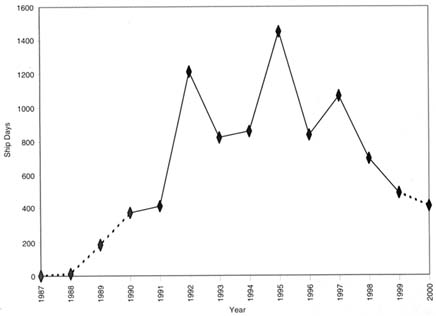
Figure 4-1
Trends in total UNOLS [University-National Oceanographic Laboratory] ship use by major oceanographic programs. Data provided by the program offices for 1987-1990 and 1999-2000 (dashed line) and by the UNOLS Office for 1991-1998 (solid line; Appendix F).
expressed the view that programs were not limited by research vessels, field equipment, and the maintenance of that equipment.
Interestingly, none of the responses to the SSC questionnaire suggest that the composition of the present or future UNOLS fleet is a major oceanographic program legacy. Yet, review of the UNOLS documents indicate that the fleet's evolution has been influenced by the major oceanographic programs (e.g., the newest vessels are the largest in the fleet and are designed for serving the large, interdisciplinary programs that require high endurance platforms). For example, the 1995 Fleet Improvement Plan (UNOLS, 1995) discussed the needs of research vessels by current large oceanographic programs and the need for ships by the major programs over the next decade.
The very long lead times for facilities development (e.g., research ships, remotely operated and autonomous vehicles [ROVs and AUVs], cable systems, and satellites) require that the oceanographic community be developing plans for facilities requirements for 2008 and beyond. Coordination among the various agencies supporting research efforts at all scales must be encouraged so that the
federal effort can be synchronized with the ocean science community's long-range plans. Strategic planning for facilities (including ships and non-ships) should be coordinated across agencies with long-range science plans and with input from the ocean sciences community.
Community Perceptions of Technology Development
Specific examples of technological advancements or facility development can be credited to a number of programs, however, there is no quantitative mechanism to predict whether similar development would have taken place in the absence of major programs. One aspect of impact is the community's assessment of that impact. Accordingly, the committee attempted to query the SSCs of the major programs as well as the broader research community through its series of questionnaires (Appendix D and E). The range of responses included in Appendix J demonstrates that first hand knowledge of the role the major programs play in technology development is generally limited.
Impact On Education
The committee examined three components of the impact of the major oceanographic programs on education: (1) the development of educational facilities, (2) major ocean programs in the classroom, and (3) the impact on graduate education. Although the major programs were developed to conduct scientific research, they have also affected the support and training of future ocean scientists. In addition, the committee recognized that these programs deal with issues of interest to the general public, and therefore provide a potential focal point for educating the public about the ocean and science in general.
Educational Facilities
Whenever the Ocean Drilling Program (ODP) drillship is in port, an effort is made to have public education tours, allowing the drillship to serve as an educational facility as well as a research platform. The ODP sample repositories are always open for tours and a rock core collected by ODP is now on display at the Smithsonian Institution's Museum of Natural History. U.S. Science Support Program (USSSP) supports ODP educational activities, and has attracted many students. Many students first encountered the major programs while searching for information about El Niño using the Internet. The World Wide Web has numerous El Niño-related sites, including some linked to major program sites. Major program data sets and illustrations on the World Wide Web are used by K-12 teachers and in the college classroom. WOCE animations of observations, satellite data, and model output are used in graduate education of oceanographers,
and many graduate students have been involved in the collection, analysis, and interpretation of major program data sets. With the aid of excellent presentation media, findings from many major programs have permeated all levels of education, and have inspired many segments of society.
Major Oceanographic Programs in the Classroom
Some major program scientists have used, with great success, Deep-Sea Research issues as a basis for special topics classes. Many graduate programs have held semester or year-long classes using JGOFS, WOCE, and GLOBEC data. ODP data have been used in Joint Oceanographic Institutions/U.S. Science Advisory Committee (JOI/USSAC) Ocean Drilling Fellowships for doctoral students, Summer Research Programs for undergraduates, and Distinguished Lecture Series. Oceanography students have used Ocean Surface Topography Experiment (TOPEX) data to consider time-dependent ocean circulation.
Satellite data and ocean model output have also been integrated into undergraduate curricula. ODP data have been used to develop Cenozoic glaciation undergraduate course supplements. ODP's Greatest Hits abstract volume and numerous other educational materials can be found at the JOI World Wide Web site. They have also been used extensively to develop the ''Mountains to Monsoons" multimedia educational CD-ROM and teacher's manual—over 2,000 of these CDs have been distributed to educators free of charge.
RIDGE has not pursued special issues in a formal manner; however, videos, computer simulations, and maps put together by RIDGE-funded scientists have been used in a wide variety of educational settings. They are found in textbooks used to teach introductory oceanography to non-science majors.
A group of college-level textbooks, considered by the committee to be useful to the field, was drawn up a priori (Appendix I) and examined for inclusion of information on, or findings derived from, major oceanographic programs. As would be expected, the most widely discussed programs are the older, more mature ones. The nature of the discussions tended to fall into three broad categories.
First, the most common reference to major oceanographic programs occurs in introductory texts that used completed (e.g., International Decade of Ocean Exploration, Deep-Sea Drilling Program) and ongoing programs as examples of how research and technology development have had an impact on the understanding of the ocean. These discussions tended to be included in historical treatments of the science and rarely went beyond an explanation of the program acronym and its most basic goals.
Secondly, upper-level texts or more recent introductory texts with significant discussions of global change tended to have more complete descriptions of the various programs, including synopses of each program's goals and accomplishments. These discussions often described the goals of the programs in terms of
hypotheses to be tested and tended to highlight the organization of major programs as examples of how modern oceanographic research is conducted.
A third significant category of discussion was restricted to the most recent upper-level texts dealing with specific ocean-related environmental problems. These texts tended to discuss the goals and accomplishments of relevant major programs and, more importantly, they provided pre-packaged data and information, collected as part of the program, in an effort to let students develop interpretive skills. Although this type of discussion was limited to the most recent texts (typically dealing with global change and climate) it clearly demonstrates a trend toward an ever-widening use of program data and results in education.
Most current textbooks mentioned at least one major oceanographic program. The others at least include discussions of some important publications attributable to major programs, demonstrating that scientific findings of the major programs are becoming well-integrated into the knowledge base and are a significant component of the educational structure. As K-12 educators move toward greater use of on-line information to integrate experience-based teaching into their curricula, the demand for oceanographic data, much of which is collected through major oceanographic programs, will continue to grow. Efforts to facilitate the integration of program data and information into the classroom should be fostered.
Impact on Graduate Education
In 1997, the Consortium for Oceanographic Research and Education (CORE) surveyed its member institutions in an effort to assess the impact of major ocean research programs on graduate education (Nikolaus and Spinrad, 1998). The survey provided input from 90 respondents out of a field of 450 throughout the U.S. oceanographic community. Although the total number of students supported was not indicated, the report showed that a higher percentage of Ph.D. students were supported by major oceanographic programs than master-level students. Those students who were supported by major programs did not see an advantage to such support, whereas those who were not supported felt that major program support would have given them greater benefits. All in all, the majority of the two sets of graduate students felt that participation in a major oceanographic program did not lead to a better educational experience. However, the number of graduate students supported by a major program who published in refereed literature (91 percent) or presented papers at national meetings (93 percent) was higher than graduate students not supported by a major oceanographic program (72 percent/68 percent; Nikolaus and Spinrad, 1998).
Graduate students funded by major programs have been trained somewhat differently than traditionally educated, core-funded graduate students. They may have been exposed to working in team efforts and have learned the benefits of
working with colleagues. It is difficult to measure or evaluate the ties that graduate students develop with scientists at other major institutions through their affiliations with the major oceanographic program. Such connections may become important for the pursuit of technical or postdoctoral positions after graduation. Graduate students involved in major programs may have learned to ask interdisciplinary questions and to think in terms of modeling and model testing. Some members of the ocean science community are of the opinion that they have received less training in developing their own ideas and generating grant support. In order to understand the real impact participation in major oceanographic programs has had on graduate education, the careers of these students should be tracked and compared to the career tracks of their core-funded peers. This need parallels the need for broader efforts to understand how graduate education shapes the careers of scientists and engineers nationally. As pointed out in the report Reshaping the Graduate Education of Scientists and Engineers (NRC, 1995), there is a general lack of "timely and relevant information [on the education and employment of scientists and engineers] that students, advisors, and policymakers should have." That same NRC report recommended that the National Science Foundation should continue to improve the coverage, timeliness, and clarity of analysis of data on the education and employment of scientists and engineers in order to support better national decision making about human resources in science and technology. The committee echoes this recommendation and suggests that any evaluation of the impact of graduate student participation in major programs be integrated into any ongoing efforts, whether undertaken by NSF or other entities, to understand general trends in the graduate education and employment of U.S. scientists and engineers.
Collegiality In The Oceanographic Academic Community
Large organized scientific activities can have a variety of effects on the community in which they operate. The term "collegiality" is used throughout this report to refer to the willingness of a community to work together in a mutually beneficial way.
The committee queried the oceanographic community to assess the concerns it may have about the impacts of major oceanographic programs (Appendix E). The responses included in Appendix J have been organized into three groups that reflect concerns about the impact of major programs on funding, collaboration, and scientific inquiry.
Overall, the respondents emphasized the need to properly and openly focus scientific efforts. Other respondents find a greater willingness to share data that has resulted from the recent major oceanographic programs. In many instances, some respondents expressed the view that the major oceanographic programs are "clubs" that have adversely affected non-major oceanographic program funding.
The website responses further suggest that collegiality would be enhanced if nonprogram scientists had a greater opportunity to be involved in programs. Efforts to actively recruit nonprogram scientists (i.e., researchers without a history of funding through the major programs) to participate as members of the SSCs of major oceanographic programs and in "mid-life" program reviews should be initiated (if not already under way) or expanded (for programs where efforts are already under way). These committees and reviews ensure that program goals continue to reflect the scientific needs of the program, and that emerging opportunities are made known to the wider research community. The continuing and expanded participation of nonprogram scientists in these functions helps ensure the health and vitality of the program and ocean research in general.
Funding Stresses
During the last decade, an increasing proportion of NSF ocean science funds have been used to support major oceanographic programs. Since 1987, the NSF/OCE budget has increased from $66.5 million to $109.3 million in current dollars. During that same period, funds available to disciplinary (core) research has remained level at approximately $60 million (Fig. 2-4a and b). Thus, all new moneys coming into ocean science in the last decade have been directed in support of major oceanographic programs, and almost half of the ocean science budget now funds research related to the major programs. Whether any of these new funds would have become available in the absence of the major programs cannot be determined. Nevertheless, the global change programs were established by congressional mandate and it is unlikely that the same increases would have been generated in response to requests for an expansion of core research. However, the fact that funding for core programs has failed to keep pace with inflation (Fig. 2-4b) has been interpreted by some individuals within the ocean science community as evidence that, to some degree, major programs have grown at the expense of core research since 1982. Thus, there remains the question of whether this trend toward large programs is entirely healthy. As pointed out by the 1995 NSF/OCE Committee of Visitors, "… if growth continues in this direction [toward large programs], without a concomitant increase in core funding, it could fundamentally change the way we do our science." It is clear, however, that major oceanographic programs have resulted in significant increases in money that otherwise would not have been available for ocean science research in general.
Considering that almost half of the NSF/OCE's budget is being directed at major oceanographic programs, it is surprising that the rate of proposal submission for major programs has been lower than for the core discipline programs. As a result of the higher submission rate to the core discipline programs. competition for core funds is heavier and the proposal success rate is lower (Fig. 4-2a and b).
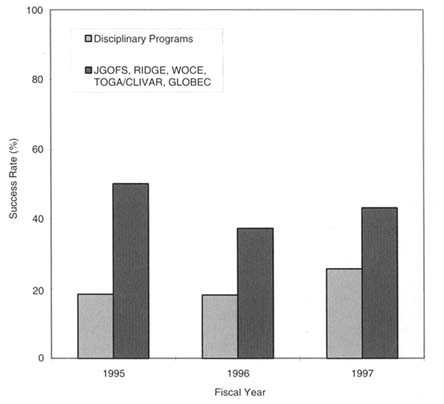
Figure 4-2a
Average proposal success rates for Focus Initiatives (Joint Global Ocean Flux Study [JGOFS]. Ridge Inter-Disciplinary Global Experiments [RIDGE]. World Ocean Circulation Experiment [WOCE]. Tropical Oceans and Global Atmosphere Program [TOGA]/CLImate VARiability and Predictability Programme [CLIVAR]. and GLOBal Ocean ECosystem Dynamics [GLOBEC]) versus the "core" Disciplinary Programs (chemical oceanography, biological oceanography, physical oceanography, and marine geology and geophysics) funded through the Ocean Sciences Division (OCE) of NSF. Data from informal program estimates made by relevant OCE program managers, but do not constitute official NSF data.
In addition, the average size of grants given to major program scientists is larger. Since 1995, the core program success rate has ranged from approximately 15 percent (biological oceanography) to approximately 30 percent (physical oceanography). Major program success rates have ranged from approximately 25 percent (RIDGE) to 65 percent (WOCE). However, these statistics must be considered in the context of how major programs are designed and function.
WOCE and RIDGE, as the two extremes, serve as useful examples of how
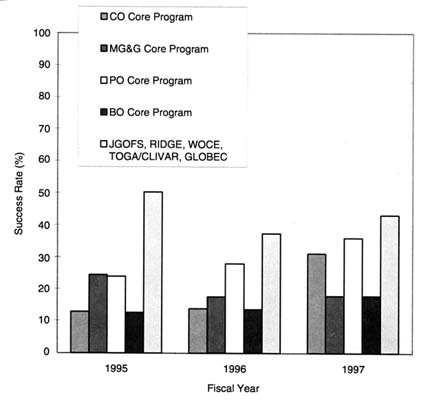
Figure 4-2b
Average proposal success rates for Focus Initiatives (Joint Global Ocean Flux Study [JGOFS], Ridge Inter-Disciplinary Global Experiments [RIDGE], World Ocean Circulation Experiment [WOCE], Tropical Oceans and Global Atmosphere Program [TOGA]/CLImate VARiability and Predictability Programme [CLIVAR], and GLOBal Ocean ECosystem Dynamics [GLOBEC]) versus the "core" Disciplinary Programs (chemical oceanography, biological oceanography, physical oceanography, and marine geology and geophysics) funded through the Ocean Sciences Division (OCE) of NSF. Data from informal program estimates made by relevant OCE program managers, but do not constitute official NSF data.
the spectrum of approaches used by the ongoing programs influences certain metrics such as proposal success rate. WOCE, as its name implies, is a highly structured experiment. The WOCE science plan emphasizes the systematic collection of observations of a range of ocean parameters. These observations form the basis of detailed comparisons and must be both precise and reproducible. A significant fraction of the proposals submitted to NSF/OCE in response to WOCE announcements of opportunity (AOs) requested funds to collect this important data. Proposals to collect repetitive observations often fare poorly in a peer-review
system that places great value on originality. Consequently, the use of AOs to solicit proposals to specifically fund the collection of key observational data improves the likelihood that important observations will be collected even though they are perceived as being routine or uninspired science. In addition, the narrow technical tolerance allowed for by the WOCE science plan, and required for successful completion of the study, greatly limited the number of individuals who could or would apply for funding to conduct observational cruises. The WOCE observation proposal preparation process involved assembling a measurement team to respond to a specific AO. Generally only the group of investigators involved will propose to address a specific task in the AO. This combination of factors, sometimes referred to as proposal pre-selection, results in a low number of proposals. The relative low numbers of individual proposals submitted in response to any given WOCE AO resulted in a relatively high success rate.
Conversely, the RIDGE scientific plan is much broader and any number of well conceived research initiatives designed to increase understanding of the processes operating at mid-ocean ridges can be expected to be received by NSF/OCE in response to a RIDGE AO. Furthermore, unlike WOCE, unsolicited proposals submitted to NSF/OCE as part of the semi-annual proposal cycle are regularly funded as part of RIDGE.4 Thus, it should not be unexpected that the RIDGE success rate is very comparable to the overall success rate for unsolicited proposals submitted to Marine Geology and Geophysics (MG&G).
As these two examples point out, unless consideration is given to how proposals are reviewed with regard to each program's science plan, it is difficult to determine whether the differences in success rate relate to proposal pre-selection, lack of interest in these questions and approaches, lack of information about AOs, or to a perception in the broader community that funds are somehow inaccessible by the nonprogram scientists.
When resources become more limited and grant competition increases, there is bound to be added incentive to examine the role of the major programs. The community generally acknowledges, and is frustrated by, declination of many high-quality proposals, which contribute to community unrest. Although there is some support in Congress to increase federal support of basic research, the probability of large increases would seem remote, and the ocean science community must set priorities.
In times of declining or flat budgets, funding priorities will be an ever more difficult issue. Consequently, the perception of inequities in the funding of
proposals submitted as part of major oceanographic programs versus unsolicited proposals will continue to impact collegiality. NSF/OCE and the major programs themselves should make every effort to correct any widely-held misconceptions. Requests made of NSF/OCE by the last four Committees of Visitors suggest that these thorough and periodic reviews of NSF/OCE, and the issues facing the ocean science community, benefit from timely access to information about resource allocation. Allocation decisions should be based on wide input from the community and the basis for decisions should be set forth clearly to the scientific community. Therefore, NSF/OCE should make a concerted effort to continue to (or begin to) track key metrics regarding the funding for core and major oceanographic programs, including:
- NSF/OCE funding history: total, OSRS, facilities (ships, etc.);
- Total dollars into major programs as compared with core;
- Total dollars into field versus modeling and analysis;
- Annual history of the average size of NSF/OCE grants funded through major programs versus core;
- Number of principal investigators receiving, in a given period of time, more than one major ocean program grant; more than one core grant, and/or receiving a major program and a core grant;
- Annual history of proposal success rate for major programs as compared to core, including number of awards and declinations for each;
- Principal investigator turnover rate (percentage of new principal investigators funded who were not previously funded, divided by total number of principal investigators) for major programs and core;
- Number of ship days for major oceanographic programs versus core projects;
- Number of graduate students supported by major oceanographic programs versus number of graduate students supported by core grants; and
- Number of post doctoral students supported by major oceanographic programs versus by core grants.
In addition, as discussed previously, NSF should seek mechanisms to track the "fate" of these students during their professional careers (perhaps through the Consortium for Oceanographic Research and Education).
By providing the community with timely access to data and information regarding allocation decisions, misperceptions can be avoided and the impact of funding pressures minimized. One such perception is that of a two-tiered system, consisting of scientists who participate in the major oceanographic programs and those who do not. This view reflects, to some degree, the nature of how large research programs tend to evolve. Figure 4-3 depicts involvement in large programs by plotting three components of the population of investigators involved in WOCE. In WOCE, as is probably the case with most large programs initiated
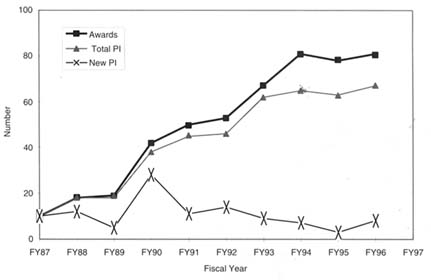
Figure 4-3
Total number of principal investigators, "new" principal investigators, and "alumni" principal investigators, per year, funded through NSF/OCE to participate in the World Ocean Circulation Experiment [WOCE]. Data from informal program estimates made by relevant OCE program managers, but do not constitute official NSF data.
and managed in similar ways, the initial number of principal investigators was small (approximately 10) and then grew rather rapidly as greater funding became available. After the initial expansion, recruitment decreased rapidly.
The decreasing recruitment through time may reflect that during the initial phase of WOCE (Fig. 4-4), researchers were drawn by intellectual curiosity and the promise of funding. As time passed, the number of recruits decreased as a limited number of individuals were interested in participating in an organized and committee driven program. Alternatively, as goals focused, fewer new scientists were able to make the rigorous measurements required by the program. In either case, there needs to be a mechanism for smaller subsets of principal investigators to regroup and repropose. The federal sponsors, and especially NSF/OCE, should make every effort to encourage and support a broad spectrum of interdisciplinary research activities (varying in size from a collaboration of a few scientists to programs perhaps even larger in scope than the present major oceanographic programs). There needs to be a structure in place so that any individual can propose initiatives of any size appropriate to address the science challenge.
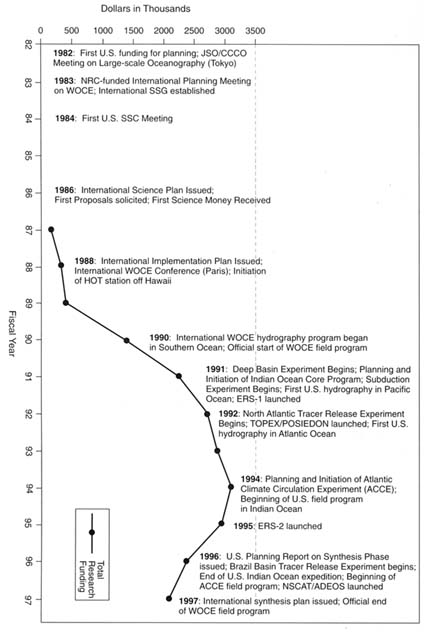
Figure: 4-4
Major events or "milestones" in the World Ocean Circulation Experiment (WOCE) program compared to program research funding (in current dollars from all U.S. sources). Data from the U.S. WOCE Program Office (Appendix F).
International Cooperation
As discussed in Chapter 2, the importance of international cooperation in conducting research on a global scale has been recognized for some time. The NRC report Oceanography in the Next Decade: Building New Partnerships, (NRC, 1992) pointed out that because of the global scale of many environmental problems and the substantial resources (i.e., financial, infrastructure, and human) required, large ocean research programs are often cooperative international efforts. Many of the existing major oceanographic programs discussed in this report are the U.S. components of international programs. These international oceanographic programs are, in turn, part of the World Climate Research Program and the International Geosphere-Biosphere Program (see Box 2-2) and are jointly supported by the World Meteorological Organization (WMO), the International Council of Scientific Unions (ICSU), and the Intergovernmental Oceanographic Commission (IOC) of the United Nations Educational, Scientific, and Cultural Organization (UNESCO).
These international programs provide important opportunities for resource and information sharing and technology transfer. The greater access provided to scientists involved in these programs strengthens wider efforts to understand global and regional ocean and climate and environmental processes. Aside from gaining important scientific and economic benefits from collaborative international research, the United States also derives diplomatic benefits from its participation in international programs.
It is unlikely that the same level of international financial support and cooperation will be achieved without the organizational structure and identity provided by major programs. Scientific steering committees and program offices form the points of contact that are often necessary to facilitate collaborative international research on large-scales. As with interagency cooperation in the United States, these international connections enhance the ocean science community's ability to obtain and share information, leverage resources, and disseminate important discoveries.


