
2
Human Behavior Representation: Military Requirements and Current Models
This chapter examines the military requirements for human behavior representation and reviews current military modeling efforts in light of those requirements. The first section identifies key military modeling requirements in terms of levels of aggregation. These requirements are then illustrated and elaborated by a vignette describing a tank platoon in a hasty defense. This is followed by a discussion of the types of military simulations and their uses. The final section reviews selected military models, focused on providing computer generated forces. The annex to this chapter reviews other current models used by the various services that are briefly referred to in the chapter.
Military/Modeling Requirements
The Under Secretary of Defense for Acquisition and Technology has set as an objective to "develop authoritative representations of individual human behavior" and to "develop authoritative representations of the behavior of groups and organizations" (U.S. Department of Defense, 1995:4-19 to 4-21). Yet presentations made at three workshops held by DMSO, formal briefings to the panel, and informal conversations among panelists, Department of Defense (DoD) representatives, and DoD contractor personnel all suggested to the panel that users of military simulations do not consider the current generation of human behavior representations to be reflective of the scope or realism required for the range of applications of interest to the military. The panel interprets this finding as indicating the need for representation of larger units and organizations, as well as for better agreement between the behavior of modeled forces (individual combatants
and teams) and that of real forces; for less predictability of modeled forces, to prevent trainees from gaming the training simulations; for more variability due not just to randomness, but also to reasoned behavior in a complex environment, and for realistic individual differences among human agents; for more intelligence to reflect the behavior of capable, trained forces; and for more adaptivity to reflect the dynamic nature of the simulated environment and intelligent forces.
Authoritative behavioral representations are needed at different levels of aggregation for different purposes. At various times, representations are needed for the following:
-
Individual combatants, including dismounted infantry
-
Squad, platoon, and/or company
-
Individual combat vehicles
-
Groups of combat vehicles and other combat support and combat service support
-
Aircraft
-
Aircraft formations
-
The output of command and control elements
-
Large units, such as Army battalions, brigades, or divisions; Air Force squadrons and wings; and Navy battle groups
Representations are needed for OPFOR (opposing forces or hostiles), BLUFOR (own forces or friendlies) to represent adjacent units, and GRAYFOR (neutrals or civilians) to represent operations other than war and the interactions among these forces.
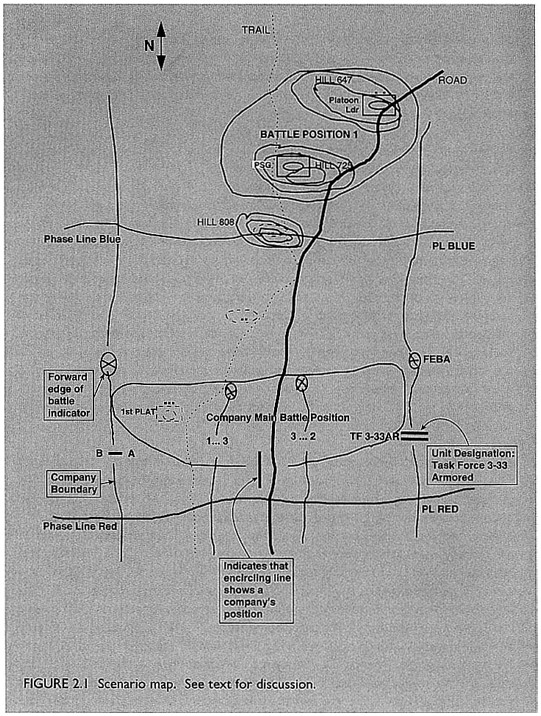
EXAMPLE VIGNETTE: A TANK PLATOON IN THE HASTY DEFENSETo illustrate the scope of military model requirements, the panel prepared a vignette describing the typical activities of an Army platoon leader preparing for and carrying out what is referred to as a "hasty defense"—a basic military operation in which a small unit of 16 soldiers manning four MI tanks is participating as a part of a larger force to defend a tactically important segment of the battlefield. The platoon leader's tasks include planning the defense, making decisions, rehearsing the mission, moving to and occupying the battle positions, and conducting the defense. This vignette is realistic as regards what is required of such an Army unit. Clearly none of the currently known modeling technologies or methods for representing human behavior can even come close to mimicking all the behaviors exhibited in this vignette, nor would they be expected to do so. The vignette is intended to provide an overview for the reader who is unfamiliar with the kinds of military operations that are typically trained. Annotations appearing throughout link various elements of the vignette to the discussion in later chapters of the report. |
|
While the planning actions described do not need to be represented in detail, the results of those actions do—since they lead the platoon leader to decide where to locate his forces and what specific orders to give. Command and control models will require the generation of such a set of orders (see Chapter 10). Similarly, the detailed analysis of specified and implied tasks and the evaluation of courses of action do not typically need to be modeled directly, but the outcomes of these activities—the actual behavior of the individual soldiers responding to the resulting orders—do need to be represented. These observations may help clarify why the panel believes that at some level of detail, the actual behavioral and organizational processes underlying the platoon leader's orders and the soldier's behavior must be addressed if any degree of realism in the observable results is to be achieved. Finally, some of the activities described in the execution phase of the battle are reactive in that the platoon leader and elements of his platoon change their behavior in response to what they see and hear during contact with the enemy. It is this kind of reactive behavior that cannot be modeled unless behavioral and organizational processes are represented at a deeper level than a script to be carried out by each soldier. It is important to note that this vignette touches on only a fraction of the command and control decisions that occur throughout the levels of command as a battle starts to unfold. Enemy identification, fratricide, casualty evacuation, target identification between units, target handoff, the effects of stress and fatigue, the level of destruction desired, and civilian casualties are but a few of the issues that affect combat decisions and the actions of military decision makers. Enemy and Friendly SituationEnemy SituationA small country friendly to the United States is under the threat of attack from its northern neighbor. An enemy armored brigade has deployed along the country's current northern border. The lead battalion of an enemy force has pushed armored scout elements across the border into the country's territory to gain intelligence on its expected defensive strong points. Enemy forces have the capability to attack with one full-strength armored brigade and two motorized infantry brigades at any time. Friendly SituationIn support of the friendly country, a U.S. armor brigade from the 1st U.S. Armor Division has occupied assembly areas south of a proposed line of defense and is preparing to occupy a series of defensive positions to stop a threatened attack by the enemy forces. The 3rd Battalion 33rd Armor has the northernmost defensive strong point in the country. |
Planning the DefenseInitial PlanningThe planning process described below parallels the planning considerations presented in Chapter 8 of this report. After the 1st platoon leader, A Company, 3-33 Armor, receives his unit's mission from the company commander, he begins his planning process with an analysis of the mission and situation. He starts with a basic mission assessment process that looks at mission, enemy, terrain, troops, and time available (METT-T). METT-T is a standardized thought process taught to leaders as a way to facilitate the planning process. [Potentially useful theories and models of planning are discussed in Chapter 8.] Mission A forward defensive position along the expected avenue of enemy attack is defended by A Company. 1st platoon is to engage the enemy lead armor elements from a forward battle position, then withdraw to the main line of defense occupied by A Company (-). 1st platoon is to occupy its forward battle position (BPI) under cover of darkness. Enemy 1st platoon is expected to encounter an enemy force of up to 10 T-80 tanks, possibly reinforced with a mechanized infantry platoon of 30 soldiers. Terrain The ground is wooded, rolling terrain and provides good concealment with folds in the earth. Long-range fields of fire are possible from high ground at the edge of the wood lines. Trafficability is high, forestation does not prevent tank and BMP1 movement off road, and all streams in the area are fordable. [The terrain configuration affects intervisibility between friendly and enemy forces. Realistic models require representation of what each soldier, vehicle commander, and driver can detect and identify as the battlefield is scanned, as discussed in Chapter 7.] Troops 1st platoon is at 100 percent strength with experienced tank commanders, morale is high, troops are rested, and all four MI tanks/systems are functioning. [Fatigue affects the overall level of performance of the troops. See Chapter 9 for a discussion of this and other variables that moderate behavior.] Time 1st platoon has little time after moving to its forward position before the expected attack by the enemy. The platoon has no time for an actual reconnaissance and will do a thorough map reconnaissance of the terrain instead. |
Initial ScheduleThe 1st platoon leader develops an initial schedule that maps out the time he has available. His tentative schedule is to issue a warning order to his tank commanders immediately and issue the platoon operations order after finishing the leader rehearsal with the company commander. At 1900 hours, the platoon leader must be ready for the company commander's rehearsal with a proposed platoon plan. He will let the platoon continue its sleep plan (one-third of the platoon awake on guard, the other two-thirds asleep) until after the commander's rehearsal. He formulates a tentative plan based on his METT-T analysis and his knowledge of the platoon's capabilities. Upon returning to the platoon, he briefs his platoon sergeant, issues a warning order to his tank commanders, and begins to prepare his plan. [See Chapter 8 for a discussion of potential planning models.] Tentative Plan and ScheduleTo complete his tentative plan, the platoon leader conducts a detailed mission analysis. In this analysis, he assesses his mission and the intent of the commander two levels higher. He determines the platoon's purpose and mission, assesses the unit's mission and its execution to identify specified and implied tasks, assesses time constraints and limitations, and makes a tentative time schedule. [Planning models are discussed in Chapter 8.] Estimate of the Situation (Situation Awareness)The use of an estimate of the situation reflects the platoon leader's need to gain situation awareness. Gaining situation awareness includes performing assessments of terrain and weather and the enemy and friendly situations. [The impact of situation awareness is a significant cognitive factor and has a major effect on decision making. Situation awareness is discussed in Chapter 7.] Assessment of Terrain and Weather This assessment includes observation and fields of fire, cover and concealment, obstacles, key terrain, and avenues of approach (OCOKA), as well as weather.
|
Assessment of Enemy Situation The enemy tank elements are expected to attempt to fight through any resistance. They will try to attack with overwhelming |
|
firepower. Other company-sized enemy elements will simultaneously be attacking the other friendly forces. Initially, the platoon can expect an enemy tank platoon of three T-80 tanks, followed by a second and third tank platoon and possibly a mechanized infantry platoon of approximately 30 men in three BMP personnel carriers. [See Chapter 6 for a discussion of relevant modeling efforts.] Assessment of Friendly Situation The task force is defending with two armored companies and one mechanized company. It has priority of fires from the brigade's direct support artillery battalion and can expect up to six attack helicopters in support. The brigade has an attack aviation battalion under its control and will use it to reinforce forward ground units once the location of the main enemy has been determined. The best use of attack helicopters is against enemy armor. The brigade commander wants to use the attack helicopters to engage the enemy as early and as far forward as possible and at long range. Sending a tank platoon forward of the main battle area will provide early warning and give some protection to the helicopters. During the conduct of the defense, helicopters could be forced to leave because of fuel requirements or enemy ground fire. The task force commander wants a platoon from A Company to be pushed forward (north) to support brigade air attack plans and to cover the northern avenues of approach leading into the task force sector. [These are examples of some of the principles and rules that could be used to guide models of planning.] Platoon Leader's Concerns from OCOKA and Enemy/Friendly Assessments The platoon leader is concerned about the friendly attack helicopters. His platoon will initially be forward of the main battle areas. He is fearful that if the enemy attacks during hours of darkness, the attack choppers could become disoriented and mistake his unit for an enemy force. The company commander has already voiced this concern at the battalion operation order (OPORD) and has returned with coordinating instructions for the platoon leader. The platoon leader is going to mark his vehicles with laser-reflecting tape that will allow his unit to be differentiated from the enemy through heat signatures. He is also concerned with the possibility that the helicopters will be pursuing the enemy and will literally run into his force when he is attempting to engage the enemy. He has been given the radio frequency for coordination with the attack helicopters, and a ''no-fire line" has been coordinated through artillery channels forward of BPI. The no-fire line is not easily identified from the air. Finally, the platoon leader is concerned that the enemy may attack in greater strength than expected. If this is true, it may be difficult to maintain needed maneuver flexibility, and his ammunition supply could become a problem. His platoon will have to protect itself while operating forward of the company. Once the enemy starts to close on BPI, the enemy's position will be identified and targeted. The |
|
decision point for when to initiate the unit maneuver to the rear after enemy engagement is critical. The platoon leader is not comfortable with the length of time his elements can and should stay in their initial positions. He decides to limit the rate of ammunition expenditure within the platoon during the initial phase of the enemy engagement. [This element of the vignette illustrates the complexity of battlefield decision making. See Chapter 6 for a discussion of possible modeling frameworks and behavioral decision making phenomena that need to be taken into account.] Development of Courses of ActionNow the platoon leader must develop potential courses of action. He has three basic courses of action in mind that he will discuss with the company commander. Course of Action #1—One Battle Position Occupied in a Diamond Formation The platoon will occupy a BP in a diamond formation, with the guns of the four tanks pointed in all four cardinal directions, covering all potential avenues until the enemy approaches. Based on the direction of the enemy advance, one tank will engage immediately, and two of the tanks will relocate as necessary to engage. The fourth tank will provide rear security and will overwatch the withdrawal of the other tanks after they engage the enemy. The platoon will move from this position after destroying the lead tank platoon and causing the enemy force to deploy, and then maneuver to the company main BP. Course of Action #2—Two Battle Positions Occupied by Sections Covering Two Avenues of Approach The platoon will split into two sections—one with the platoon leader and the other with the platoon sergeant. The platoon leader will occupy the north edge of BPI along the most likely avenue of approach. The platoon sergeant will occupy BPI farther south and southwest of the platoon leader's section to cover a second avenue (the trail) and support the platoon leader's section by fire. Once the enemy is engaged and deploys, the two sections will support each other as they maneuver to the rear to reach the company main BP. Course of Action #3—One Platoon Battle Position on Line The platoon will occupy its position on line, with all four tanks in a platoon BP to protect the most likely avenue of approach. However, once the enemy is engaged, the platoon will displace by sections, covering each other until they all reach a position at the center of the company main BP. [The formulation and evaluation of alternative courses of action are generally considered part of the human decision making process. They are sometimes undertaken formally, but more often are accomplished only informally or within the head of the commander and/or his staff.] |
The Decision Process[The initial decision process during the planning of the defense reflects, in a simple form, the types of considerations and theories presented in Chapter 6 of this report. The challenge in military simulations is to bring the effects of realistic leader planning and execution decisions into complex models in which multiple levels of decision outcomes are embedded.] Analysis of Courses of ActionCourse of Action #1 This course of action is flexible and can accomplish the mission of blocking the initial enemy attack regardless of the direction from which the enemy approaches. It offers the potential for engaging the enemy before reaching BPI regardless of what route the enemy chooses. At the very least it guarantees early warning for the task force elements in the rear. This course of action relies on the notion that the enemy will use any one of three avenues, including the open road and trail, in advancing toward their objectives. This course of action leaves the platoon in one BP for support; however, two of the tanks could require repositioning to bring effective fires on the enemy, depending on the actual direction of enemy approach. The deployment may not allow maximum fires at first contact, but it does support flexibility. Course of Action #2 The enemy is most likely to move on one of the high-speed avenues of approach, with no bounding maneuver until contact is made. This course of action ensures that two tanks can immediately engage any enemy forces that approach on the road (the most likely avenue of approach) and on the trial (the other high-speed approach). It also provides overwatch to the forward tank section. This course of action provides less local security than course of action #1 since the sections are split, and the separate sections are thus more open to dismounted attack. Course of Action #3 This course of action focuses all the platoon's combat power on the road, the most likely high-speed approach. The platoon is susceptible to flank attack in its exposed position; however, all tanks are mutually supporting. Being in one forward position requires a planned movement by the platoon at a critical time to ensure that it is not decisively engaged. It also requires selection of alternate positions for the platoon to cover the trial and potential cross-country approaches. Comparison of Courses of ActionThe platoon leader decides the most important criteria for choosing a |
|
TABLE 2.1 Course of Action (COA) Rating Chart
course of action are (1) engagement of the enemy at long range, (2) survivability of the platoon when engaged, (3) simplicity of executing battle actions, (4) security of the platoon prior to attack, and (5) flexibility of the dispositions. He compares each course of action against these criteria. He adopts a simple rating of 1 for the best course of action for a criterion, 2 for the next best, and 3 for the least desirable, as shown in Table 2.1. Selecting a Course of ActionThe platoon leader decides to go with course of action #2—which has the lowest total score (Table 2.1)—for the commander's rehearsal. He brings to the rehearsal questions regarding coordination with the attack helicopters, his ability to move in and around BPI, and the availability of infantry support. The Final PlanAfter the company commander's rehearsal, the platoon leader consults with his platoon sergeant and tank commanders. He has learned that there is no infantry support available for his mission and that he is confined in his movement until the platoon arrives in the vicinity of the company's battle position. He is informed that the attack helicopters are aware of the no-fire line and will not engage the enemy south of that line. He is still uncomfortable about the attack helicopters operating so close to the platoon. After incorporating the new information from the company commander's rehearsal, he finalizes the plan. He then issues the platoon OPORD to his tank commanders and gunners. Mission RehearsalIn his timeline the platoon leader has roughly 1.5 hours for rehearsal. He plans to rehearse right up to the moment the platoon marshals for movement to the start point. This is not very much time. He sets priorities for the rehearsal: |
||||||||||||||||||||||||||||||||
[The behavior of the unit can be expected to change as a result of this rehearsal. Learning will take place. Representing such changes will require models of the learning process, such as those discussed in Chapter 5 for the individual combatant and in Chapter 10 for the unit.] Movement to and Occupation of BPIThe movement phase begins with the platoon marshaling to move to the start point. Movement to the company release point near the company main BP will take about 2 hours. 1st platoon moves last in the A Company column. In the vicinity of the main company BP, 1st platoon receives a radio message to move forward to BPI. The platoon leader radios his tank commanders to turn left in a column formation, with the platoon leader's tank in the lead. He observes the area to his front with a night vision sight for signs of the enemy as they move. His gunner observes the terrain to the left with a night thermal sight, and the following tank observes to the right. As the terrain opens up, the platoon leader radios his tank commanders to shift to a wedge formation. This maneuver will bring more firepower to the front and still provide some flank security within the platoon. The platoon leader knows the platoon is proficient in the wedge formation, but at night it is more difficult to maintain this formation, and their rate of movement is slower. Possible enemy contact en route is the platoon leader's primary concern with this phase of the operation. His mission requires establishment of a blocking position at BPI, so it will not be enough to encounter enemy resistance and simply break contact. In the reaction drills in his rehearsal, the platoon leader emphasized fighting through any enemy. As the platoon approaches the southern edge of BPI, the platoon leader reports to the company commander, "Crossing phase line blue with negative enemy contact." On the move, he directs his platoon sergeant and his tank section to occupy fighting positions on the high ground oriented to the trial to the north, but positioned with observation to the northeast. The platoon leader now moves astride the road to the northeast, with his wingman covering his left rear. As the platoon leader continues his move to the northeast, his platoon sergeant signals "set in position." As the platoon leader approaches the piece of high ground he has planned to occupy to block the road, he orders his wingman to stop while he makes a reconnaissance of the area. He edges forward to observe for any enemy before breaking the crest of the hill. On foot, he locates the exact positions that give his section cover to the northeast, but long-range |
|
fields of fire over the road. He directs the section into position—"set." The tanks are now in hide positions. They can observe any enemy approach at long range, but they are not exposed. Now comes the battle of nerves. The platoon leader uses the loader from each tank as forward security, observing for dismounted infantry. The gunner mans the night thermal sight, scanning at long range for signs of enemy movement. The platoon leader, tank commanders, and drivers improve their positions by camouflaging their tanks and locating alternate firing positions. The wait continues toward dawn, with situation reports to the company every 30 minutes. Where is the enemy? [Intervisibility, detection, and identification are paramount here, but the parameters of a model that includes these elements for nighttime conditions will be quite different than those for a daytime engagement. The way the platoon leader allocates his attention and time to these tasks and the tasks associated with conducting the defense are covered in Chapter 4, on attention and multitasking.] Conduct of the Defense: The Battle Decision Process[Execution of the battle plan represents another human decision making process. This process differs from the deliberate decision making discussed earlier. It is rushed and filled with rapid cognitive perceptions by the decision maker trying to sense rapidly changing conditions that must be confronted. This process does not always result in logical or sound decisions. This process must also be reflected within military simulations—with the same models as those presented in Chapter 6.] In 1st platoon's battle plan, the intent of the platoon leader at BPI is to attrite the enemy at long range using indirect fires and attack helicopters first and then long-range direct fires. He has instructed his tank commanders to engage enemy tanks first and then enemy personnel carriers. From their hide positions, the tank commanders will pop up into firing positions and then relocate to alternate hide or firing positions. It is now 0535 hours and starting to become light. A radio message is received from the platoon sergeant: "Enemy tanks! Three, no! six T-80s approaching along the trail in column at grid NA 943672" (4.5 kilometers to the sergeant's front)." The platoon leader searches to his front—no signs of the enemy on the road. The enemy is coming directly from the north, not along the road! The platoon leader calls the spot report to company and requests artillery fires and attack helicopters. The platoon leader and his section must relocate. He radios to his platoon sergeant, "Am moving to your location! Will go into overwatch 500 meters to your south VIC Hill 808. Over!" His platoon sergeant answers, "Roger Plan B!" Now everything starts to happen rapidly. In minutes, artillery is pounding the grid. The platoon leader's section is racing to positions on Hill 808. Two gun ships arrive, hovering behind Hill 808, and come up on the platoon's radio frequency. They have the enemy in sight. The platoon leader's section moves into hide positions forward of the crest on Hill 808. One enemy tank is destroyed by artillery. The attack birds pop up, and two Longbow missiles |
|
streak toward the first two enemy tanks. Two enemy tanks are destroyed! The platoon sergeant reports six more T-80s moving through the woods east of the trail. The enemy is now 3,000 meters from the platoon sergeant's tank section. The tank commanders pick their targets, and the section moves forward to fire. Two more enemy tanks are destroyed. The platoon leader orders the platoon sergeant to relocate to the high ground south of Hill 808. The helicopters report to the platoon leader that they have spotted four BMPs and three more tanks west of the trail 3,000 meters from Hill 808, and they see signs of a large force deploying farther to the north. The choppers pop up once more and fire two Longbows and then duck down and race toward the south. The platoon leader reports a total of five enemy tanks destroyed and calls for smoke to cover the movement of the platoon sergeant's section. Soon he will be the front line. He hears the platoon sergeant's section racing past Hill 808. He spots two enemy tanks coming out of a wood line 2,000 meters to his front. He alerts the gunner closest to this position and radios to his wingman. They pull up, fire, and then immediately pull back. The platoon leader orders his wingman to withdraw, calls for the platoon sergeant to cover his move, and radios to company: "Two more enemy tanks destroyed at grid 938626! Enemy forces deploying to my north. Request permission to withdraw to main BP." [The stresses of too much workload and time pressure both tend to degrade performance from ideal levels. In modeling, these stresses might be treated as moderator variables (see Chapter 9) or, where sufficient theory exists, incorporated into models of situation awareness and decision making (see Chapters 7 and 6, respectively).] With permission granted, the platoon leader requests artillery at the enemy locations and requests smoke on the northern slope of Hill 808. In minutes, his section is racing toward the platoon sergeant's overwatching section. He has destroyed the initial forces sighted and has caused the enemy to deploy. The platoon will move by echelon to supplementary positions and potentially experience more engagements before reaching the company main BP. As the platoon moves toward the company main BP, it faces another critical set of events—recognition and passage. With communications and planned signals in place, the platoon's final movement can be covered by the other platoons as they approach the main BP. This could have become a chaotic situation if the platoon and company had not trained for such an operation. When the platoon reaches the main BP, another set of decisions and actions awaits. The platoon leader and platoon sergeant must set the platoon in its positions, check its ammunition and fuel status, check for battle damage, report to company, and be ready for the enemy's next action. This is the end of a small unit leader tactical vignette, but it represents the beginning of the process of describing models and promising research for more accurately depicting human actions and command and control decision outcomes from the tactical, to the operational, to the strategic level within military simulations. |
MILITARY SIMULATIONS: TYPES AND USES
As noted in the introduction, there are at least three major categories of simulation users in the military—those that are training individual combatants or leaders and teams; those that are performing analyses of systems, doctrine, and tactics for purposes of acquisition and advanced development; and those that are addressing questions associated with improving command and control and the interoperability of joint forces. Because training of the force and its leaders is the largest mission of the military in peacetime, it has received the most attention and the highest level of funding. We begin this section with some brief definitions of the types of simulations used in the military services. We then discuss the above three major areas of application. In the final section we examine efforts to create models that can be used to introduce human behavior into military simulations.
Definitions
As noted in Chapter 1, we define a model as a physical, mathematical, or otherwise logical representation of a system, entity, phenomenon, or process and a simulation as a method for implementing a model over time. The widely used military taxonomy for classifying types of simulation includes three categories: live, virtual, and constructive. Depending on the type of simulation, human behavior may be introduced by computational models or by actual human participants. Since humans play a central role in the outcomes of combat engagements, the panel believes that when human roles are involved and human participants are not used, it is important to provide models of human behavior in order to ensure realistic outcomes for training and analysis.
The traditional approach to maintaining readiness and testing new employment concepts has been to conduct field exercises or live maneuver exercises, also referred to as live simulations. Live simulations are least dependent on accurate models of human behavior because in these exercises, real humans operate real equipment. The aspects that are simulated involve weapon firing and how hits of different types of ordnance are measured and recorded. All of the services have large investments in major training centers that are designed to exercise battalion/squadron and larger formations in a realistic combat environment. Exercises conducted at major training centers are often joint exercises that include participation by multiple services.
Limited physical maneuver space and the cost of transporting units and operating major weapon systems constrain the number of units that can participate in live simulations and the duration of such exercises. Additionally, the time between exercises/rotations is too long for units to maintain the required level of combat readiness. In the future, there will be a continuing need to use live simulations. However, the above shortcomings in effectively meeting military
readiness needs with regard to physical space, cost, and time considerations will continue to become more limiting.
Virtual simulations are characterized by real humans operating simulated equipment in simulated environments. These simulations use a full range of multimedia technology and computer software to replicate weapon and system functions in real time with a suitable level of fidelity for interactive training with humans in the loop. The requirement for models of human behavior arises from the need to represent intelligent opponents and collateral forces. In some cases, opposing forces are played by real humans; in other cases, a human controller represents the decision making and tactics of enemy commanders and the execution of battle movements, and engagement behavior is simulated to represent doctrinal maneuvers. Virtual simulations are used for individual combatant, team, and leader training. Networked virtual simulations (sometimes referred to as distributed interactive simulations [DIS]) are used to engage trainees located in physically remote distributed sites in a common combat exercise. In these cases, simulators representing units are linked electronically. Although these simulations hold the promise of creating highly effective training environments, they are pushing the limits of available simulation technology, and simulators that apply this technology are costly.
The Army's close combat tactical trainer (CCTT), discussed in detail later in the chapter, is an example of a virtual simulation. The CCTT program includes company and battalion sets of M1 tank simulators, M2 Bradley fighting vehicle simulators, and AH64 Apache helicopter simulators, and now has semiautomated force representations of infantry soldiers/dismounted units. CCTTs can be networked from multiple remote locations to execute an integrated battle scenario with effective simulation of maneuvers and battle engagements, command and control, and logistics support. They are operated as human-in-the-loop, fully crewed systems.
Finally, constructive simulations involve simulated people operating simulated equipment, usually not in real time. Real people provide inputs that set limiting values on parameters, but they are not involved in determining the outcomes. All human behavior in the event flow comes from models. A few simulation systems have a feature that allows those running the simulation to freeze the action periodically in order to make fine adjustments to the dynamics. Variability in the behavior of systems and humans can be introduced by stochastic processes. The level of human behavior representation in these systems varies widely, but even the best of them assume ideal human behavior according to doctrine that will be carried out literally, and rarely take account of the vagaries of human performance capacities and limitations.
Within the military today, constructive simulations are the largest and most broadly applied type of simulation. Each of the services has developed several simulations of this type, many of which support multiple purposes, including
planning, training, force development, organizational analysis, and resource assessments within the services. Examples of multipurpose constructive simulations include JANUS (Army), naval simulation system (NSS) (Navy), advanced air-to-air system performance evaluation model (Air Force), and joint warfare system (JWARS) (Joint Services). These and other selected models and simulations are briefly described and categorized in the addendum to this chapter.
The linking of constructive and virtual reality simulations into federated networks is the newest and most rapidly expanding application of simulations in the DoD arena. Advances in this area were born of the necessity to reduce costs associated with the development of training and weapon systems. All of the services are seeking means of maintaining the fighting readiness of units and large combat organizations that cannot be deployed or exercised in peacetime to the degree required because of environmental and cost constraints. In addition, in the joint and combined arena, the military services and joint service commanders have a range of requirements that involve the development of command and control doctrine, force readiness, and procedures for joint service task forces and combined international coalition forces that may best be accomplished with the support of simulation.
Training Applications
Individual Combatant, Unit, and Leader Training
As noted above, training is a central concern for the military services. Key objectives of the Army's use of simulations in this arena have been to decrease training time, decrease the cost of training, and increase the realism of training events. The Army uses constructive simulations such as JANUS and Corps Battle Simulation (CBS) to train leaders and other decision makers. In the last decade, with assistance from the Defense Advanced Research Projects Agency (DARPA), the Army has developed virtual system simulators for use in local and distributed computer networks. For example, systems such as simulation network (SIMNET) and its successor, CCTT, were designed to provide training in crew maneuver and fighting skills, as well as to provide unit-level training up to the battalion task force level for organizations equipped with M1 tanks, M2 Bradleys, and AH64 Apache helicopters. Recent training applications have been focused on attempts to integrate constructive simulations with virtual and live simulations.
The Navy has developed an array of simulations to support team/crew, classroom, and shipboard training requirements. Simulation and simulator training requirements are focused on ship systems and fleet operations. Simulations of Navy command and control task force and fleet operations have been developed within all of the unified commands, including European, Atlantic, and Pacific.
These large force constructive simulations, such as NSS, are used primarily for command and staff training. They are constructive two-sided simulations that have red team opposition force players and blue force staff and commander players.
The Air Force Air Combat Command has used airframe-specific flight simulators for decades in transition training and at the squadron and wing levels for sustainment training. The advent of virtual simulations that replicate system-specific performance functions with good fidelity offers the possibility of reduced training costs and increased levels of individual and unit proficiency. These simulations may allow the development of more highly refined coordination procedures and tactics that have not previously been possible in a peacetime environment.
Joint and Combined Training
An area of expanding growth in the number, size, and capability of models and simulations is Joint Chiefs of Staff and major theater command simulations. The Joint Chiefs of Staff Joint Warfighting Center, located at Fort Monroe, Virginia, conducts joint staff training exercises for the unified commands around the world. These exercises operate with a number of joint and service simulations, some of which are described in the annex to this chapter. A consistent direction in the joint training area has been a growing need for DIS to allow the conduct of realistic joint training exercises with increased fidelity and significantly decreased costs. The synthetic theater of war (STOW) is an example of the blending of constructive and virtual simulations for joint and combined training. STOW-Europe was the first operational demonstration of the concept of linked constructive simulations, with Army ground force players at remote sites being linked to the Air Force Air Warrior Center. Incorporation of intelligent forces into STOW is discussed later in the chapter.
Analysis Applications
Research, Development, and Acquisition
The thrust of simulations for research, development, and acquisition is to determine system capabilities and levels of performance that can be expected from new systems. Simulations are applied to address human engineering concerns, the design of systems and their interoperability with other services or multinational forces, and option prioritization and risk assessment decisions, as well as to examine survivability, vulnerability, reliability, and maintainability. All of the military services use simulations in their respective research, development, and acquisition processes; however, they do not have comparable organizations for the development of systems, and, therefore do not have a common set
of processes for the development or application of such simulations. Training and Doctrine Command (TRADOC) is responsible for the development of operational system requirements, training, and doctrine for the U.S. Army. Once a weapon system has been approved for development, it is assigned to a program office headed by a program manager and supported by a staff that coordinates all aspects of the development. The various offices are grouped by type of system (e.g., electronic, combat, combat support, combat service support) and are controlled by program executive officers on the Army staff. They are reinforced by proponent organizations from TRADOC and by material developers from the U.S. Army Materiel Command. The most commonly used simulations in support of Army research, development, and acquisition are of the constructive type.
The Naval Systems Command, organized into air, surface, and subsurface systems, oversees the system requirements process, but actual development is placed in the hands of a system program office. Each such office is organized with all of the resources and organizational structure needed to control and execute program development and acquisition. Programs are organized around the fighting system, such as the Aegis class cruiser or a carrier-based attack aircraft. Typically, the system program offices develop unique simulation capabilities for their system for both analysis and training applications.
The Air Force Systems Command is organized into system program offices similar to those of the Navy and has operational commands, such as the Air Combat Command, that provide doctrine and training requirements. The Air Force acquisition process is built entirely around the weapon system, and the system program office has control of all of the development processes, including simulation and simulator development.
Advanced Concepts and Requirements
Analysis of advanced concepts and requirements is focused on the development and evaluation of doctrine and organizations at a stage that precedes system development. The thrust is on predicting and assessing the impact of force effectiveness outcomes that will result from new technology, changes in force structure mixes, or the integration of joint or combined forces. Users of simulations in this advanced-technology area include DARPA, the U.S. Army Concepts Analysis Agency (CAA), the Center for Naval Analyses (CNA), several Air Force analysis organizations, such as the RAND Corporation, and DoD joint task force study organizations, all of which research new defense threat issues or future service structures/requirements. While such organizations may develop new simulations through civilian contracts, they use or adapt many of the same constructive simulations used in the research, development, and acquisition area.
Development of Doctrine, Techniques, and Procedures
The services use both constructive and virtual simulations to support doctrine development, assess battle tactics for new systems and organizations, and refine techniques for system and unit employment. Creating new or revised doctrine and procedures is a function of the introduction of new technology, new systems, or new missions. Many of the simulations used to analyze advanced development and acquisition issues are also used to examine doctrine and procedures.
Command Decision Making and Interoperability—Joint/Combined Forces
Interoperability of joint and combined forces has been less emphasized than changes in the world situation and U.S. military commitments around the globe would suggest. Joint training has seen an ever-increasing level of activity with the development of joint/combined forces organizations, such as the Joint Warfighting Center and a number of joint models and simulations developed by the unified commands. But these training simulations and the standardization of procedures incorporating potential coalition forces and the differences in respective decision processes have not received the same level of attention as other development areas.
CURRENT MILITARY MODELS OF HUMAN BEHAVIOR AND THEIR LIMITATIONS
This section reviews existing military models that have been developed to represent human elements in computer-generated forces. Table 2.2 lists these models and shows the application areas from the previous section (training, analysis, interoperability) to which each relates. The models with an asterisk are those discussed in this section; the other models listed in the table are those discussed in the annex to this chapter and only referred to briefly in the chapter.
Computer-Generated Forces
Computer-generated forces are computer representations of vehicles and humans for use in simulations. The goal is to develop these representations to the point that they will act automatically and with some realism without human intervention. Computer-generated forces populate both constructive and virtual simulations. They are used in combination with human players as a semiautomated force in the DIS context to represent opposing forces and collateral friendly forces. There are specific programs devoted to creating these entities. The most widely used is modular semiautomated forces (ModSAF), which plays in a number of applications within the services and in joint force models; however, several other models are also used, such as CCTT semiautomated force
TABLE 2.2 Key Military Models and Simulations
|
|
Training |
Analysis |
Interoperability |
|||
|
Model/Simulation |
Individual/ Leader |
Joint and Combined |
Research, Development, Acquisition |
Advanced Concepts |
Doctrine Development |
|
|
ARMY |
||||||
|
CAST-FOREM |
X |
|
X |
X |
|
|
|
CBS |
X |
X |
|
|
X |
|
|
CCTT SAF* |
X |
|
|
|
X |
|
|
CSSTSS |
X |
|
|
X |
X |
|
|
EADSIM |
|
X |
|
X |
|
|
|
Eagle |
|
X |
|
X |
|
X |
|
JANUS |
X |
|
X |
|
X |
|
|
ModSAF* |
X |
X |
|
|
|
|
|
RWA-Soar* |
X |
|
|
|
|
|
|
VIC |
|
|
X |
X |
X |
|
|
WARSIM |
||||||
|
NAVY AND MARINE CORPS |
||||||
|
MCSF* |
X |
|
|
|
|
|
|
MTWS |
X |
|
|
|
|
|
|
NSS |
X |
|
X |
X |
X |
|
|
SUTT* |
X |
|
|
|
X |
|
|
AIR FORCE |
||||||
|
AASPEM |
X |
|
X |
|
X |
|
|
FWA-Soar* |
X |
|
|
|
|
|
|
TAC-BRAWLER |
X |
|
|
|
|
|
|
JOINT SERVICE |
||||||
|
CFOR* |
X |
X |
|
|
|
|
|
JCATS |
X |
X |
|
|
X |
|
|
JCM |
X |
X |
|
|
|
X |
|
JTLS |
X |
X |
|
|
|
|
|
JWARS |
|
X |
|
X |
X |
X |
|
STOW |
X |
X |
|
|
|
|
|
* Indicates those models and simulations used for human behavior representation. |
||||||
(SAF); computer-controlled hostiles, intelligent forces (IFOR); and command forces (CFOR) models. Both IFOR and CFOR models have been developed in the context of the synthetic theater of war (STOW), an advanced-concept technology demonstration jointly sponsored by the U.S. Atlantic Command and DARPA. A key element of STOW is the representation of both fighting forces and their commanders in software.
Modular Semiautomated Forces (ModSAF)
ModSAF is an open architecture for modeling semiautomated forces, developed by the Army's Simulation, Training, and Instrumentation Command (STRICOM). It provides a set of software modules for constructing advanced distributed simulation and computer-generated force applications. Semiautomated forces are virtual simulations of multiple objects that are under the supervisory control of a single operator. According to Downes-Martin (1995), the human behaviors represented in ModSAF include move, shoot, sense, communicate, tactics, and situation awareness. The authoritative sources of these behaviors are subject matter experts and doctrine provided by the Army Training and Doctrine Command (TRADOC). Task-based explicit behaviors are enumerated by a finite-state machine that represents all the behavior and functionality of a process for a limited number of states. The finite-state machine includes a list of states, a list of commands that can be accepted while in each state, a list of actions for each command, and a list of state conditions required for an action to be triggered.
In ModSAF there is no underlying model of human behavior, so that any behavior representation must be coded into the finite-state machine. As a result, it is impractical to use ModSAF to construct general-purpose behavioral or learning models. Typically, ModSAF models are employed to represent individual soldiers or vehicles and their coordination into orderly-moving squads and platoons, but their tactical actions as units are planned and executed by a human controller. Ceranowicz (1994) states that because the human agents in ModSAF are not intelligent enough to respond to commands, it is necessary for the human in command to know everything about the units under his/her control. This would not be the case in a real-world situation. ModSAF supports the building of models of simple behaviors at the company level and below.
The initial ModSAF (developed by the Army) has been adopted by the other services—Navy, Marine Corps, and Air Force. Each of these services now has its own ModSAF source and capability tailored to its own needs. In a recent STOW exercise, four types of ModSAFs were used. The scenarios for this exercise were preset and the role of the human controller minimized.
Close Combat Tactical Trainer Semiautomated Force (CCTT SAF)
CCTT SAF, also under development by STRICOM, is designed to simulate actual combat vehicles, weapon systems, and crew and platoon commander elements. The approach used to model human behavior is rule-based knowledge representation. The source of the knowledge is doctrine provided by natural-language descriptions of tactical behavior incorporated into combat instruction sets developed by subject matter experts. Combat instruction sets contain the following elements: a behavior description, a sequence of actions taken in the behavior, initial conditions, input data, terminating conditions, and situational interrupts. For action selection, blue force behaviors are grouped into categories of move, shoot, observe, or communicate; opposing force actions are listed in order, but not catalogued.
According to Downes-Martin (1995), the CCTT SAF human behavior representations work reasonably well for small-unit tactics, but because there is no underlying model of human behavior, it is difficult to increase the size or scope of the simulated operations. Like ModSAF, the system requires hand coding of rules, and therefore its models can be generalized only to groups of similar size and complexity. It should also be noted that behavior in CCTT SAF is based solely on following doctrine and does not allow for intelligent human responses. According to Kraus et al. (1996), work is under way on using CCTT combat instruction sets as inputs to ModSAF.
Marine Corps Synthetic Forces
Marine Corps Synthetic Forces (MCSF) is a DARPA-supported project conducted by Hughes Research Laboratory. The simulation provides a computer-generated force representation for the Marine Corps that is intended to model individual fire-team members, fire-team leaders, and squad leaders for the purpose of training their respective superiors (Hoff, 1996). MCSF is based on ModSAF. Individual behavior is controlled by unit-level (i.e., higher-echelon) tasks. Units and individuals perform doctrinally correct sequences of actions that can be interrupted in limited ways by reactions to events. In MCSF, units plan assaults and other tasks using fuzzy decision tables. These decision tables encode a subject matter expert's ranking of decision alternatives for a number of key decisions, such as attack or abort, avoid contact, select assault point, and select route.
Ruleset antecedents are essentially features of the tactical situation (e.g., enemy posture is dug in), which are obtained directly by querying the ModSAF module(s) responsible for maintaining the state of the simulation. No attempt is made to model the individual's cognitive functions of information gathering, perception, correlation, or situation assessment.
Computer-Controlled Hostiles for the Small Unit Tactical Trainer 2
The small unit tactical trainer (SUTT) is under development for the Marine Corps by the Naval Air Warfare Center, Training Systems Division (NAWCTSD). It is a virtual world simulator for training Marine rifle squads in military operations in urban terrain (MOUT) clearing (Reece, 1996). The virtual world in the trainer is populated by computer-controlled hostiles (CCHs) developed by the Institute for Simulation and Training at the University of Central Florida. The CCHs behave as smart adversaries and evade and counterattack friendly forces. The key state variables include low-level facts (e.g., soldier position, heading, posture), situation knowledge (e.g., threats, current target), and the current task. Perception is based on simple visual and aural detection and identification of enemy forces. Situation awareness involves both visible and remembered threats.
Most of the activity is reflexive. The model has an action selection component based on hierarchical task decomposition, starting with top-level-tasks, e.g., engage enemy, seek cover, watch threat, look around, and run away. Situation dependent rules propose tasks to perform. Rule priorities allow specification of critical, normal, and default behavior. Tasks may be deliberately proposed with the same priority level, allowing random selection to choose a task according to predefined weights. This mechanism supports variation in behavior that obeys a prior probability distribution (e.g., probability of fight or flight reaction can be set for a CCH). A new task may be selected each time frame as the situation changes. Proposed, but not implemented, architecture extensions would allow the selection of tasks that would serve more than one top-level goal or task simultaneously. Other models under development as part of this program include one for visual detection and another for hearing (Reece and Kelly, 1996).
Intelligent Forces (IFOR) Models
IFOR models have been created using the Soar architecture to model the combat behavior of fixed- and rotary-wing pilots in combat and reconnaissance missions. (Details on the Soar architecture are presented in Chapter 3.) IFORs are very large expert systems—they use encoded knowledge as a basis for action and problem solving. The Soar architecture was originally devised to support the study of human problem solving behavior. It incorporates many of the concepts of artificial intelligence, and its main feature is the use of production rules as the means to link an initial condition (a stimulus) to a particular response. Although Soar is capable of learning, this function has not been exercised.
To meet the objectives of simulating intelligent forces, specific contexts were needed. In the IFOR framework, adaptations for both fixed-wing attack (FWA)-Soar and rotary-wing attack (RWA)-Soar air operations were developed.
FWA-Soar This adaptation of IFOR (formerly known as tactical air [TacAir]-Soar) can simulate a fleet of up to 500 fixed-wing aircraft in a context that includes such elements as enemy aircraft, surface-to-air missiles, and enemy radar installations. It is usable by Army, Navy, Marine, and Air Force units. Its most extensive and intensive use recently was as the primary source of air missions for STOW-97. Soar's participation in this exercise was initially intended to serve as a demonstration of the capabilities of FWA-Soar; however, a training mission was added to the exercise.
FWA-Soar presents an excellent example of the adjustments often required when a software program of major dimensions (5,200 production rules) is taken from the laboratory into an operational environment. Specifically, it was clear early in the exercise that some real-world behavioral complexities had not been captured. Some of these were relatively trivial, such as the real-world behavior of pilots in avoiding known sites of ground-to-air missile defenses. Others were more serious in the sense that they highlighted questions about costs and benefits related to the extent to which functions could or should be automated. For example, the translation of an air tasking order into a detailed mission plan/profile was a new requirement presented by STOW that was not provided for in the original software. During the exercise, human operator intervention was needed via a computer subsystem known as the exercise editor to achieve the translation.
The net effect of the postexercise evaluation of FWA-Soar was to encourage the possible addition of computational capabilities. However, the proposed additions were not tied to modeling of human behavior at the basic level, but were focused on developing a simulation that was capable of executing subtasks omitted from the original program (Laird et al., 1997).
RWA-Soar The development of RWA-Soar includes representations of helicopter company-level anti-armor attacks and multicompany operations in air transport (the movement of foot soldiers) and escort missions. In addition to its uses in the Army, RWA-Soar has been used to model Marine transport and escort missions. At present, RWA-Soar resides in a smaller computer program than that of FWA-Soar. However, effort toward the implementation of RWA-Soar is closely integrated with the work on the Soar version of CFOR (discussed below).
Command Forces (CFOR) Simulations
The CFOR project is part of the STOW program. Its focus has been on providing a framework for the simulation of behavior at the command and control level. The program has three components: (1) an architecture in which simulations of command and control interact with the simulated battlefield, (2) a command language for information exchange between simulated and real commanders (the command and control simulation interface language, or CCSIL),
and (3) a strategy that provides for the integration of command entities developed by different contractors and services. Each of the services has its CFOR requirements definitions and development efforts (Hartzog and Salisbury, 1996).
One example of a development effort for the Army in this domain is Soar/CFOR. At present, this effort encompasses the command functions of a helicopter battalion-to-company operation. RWA-Soar provides the simulation of the individual helicopter pilots in this setting (vehicle dynamics are provided by ModSAF). The entity simulated by Soar/CFOR is the company commander. In exercises, a live human represents the battalion commander, who generates orders that are rendered in computer language by CCSIL. From that point forward in the exercise, all actions are computer formulated. A critique by one of the developers (Gratch, 1996) stipulates that the most difficult features to put into the computer program are responses to unanticipated contingencies. As in FWA-Soar, the main developmental thrust in trying to overcome such a difficulty is to add subtask elements to the computer program so that every contingency can be met at the automated level. Development of an approach that would solve the general problem—such as a truly adaptive model of human problem solving—has not been actively pursued.
Human Behavior in Constructive Wargaming Models
In the domain of constructive wargaming models, human behavior typically is not represented explicitly at all, for either blue or red forces. When human decisions are called for, a doctrinally based decision rule is inserted that reflects what the individual ought to do in the ideal case. Human performance capacities and limitations are ignored. For example, in the NSS, a Monte Carlo simulation, plans are executed based on decision tables developed by subject matter experts. This approach does not provide the fidelity of battle outcomes on a real battlefield, where the number of casualties or weapon system losses depends on real human strengths and frailties and varies significantly from unit to unit based on leadership, stress, consistency of tactical decisions, and effectiveness of training. This lack of human performance representation in models becomes more significant as the size, scope, and duration of wargaming simulations continue to grow. In the future, these limitations will become more noticeable as greater reliance is placed on the outcomes of models/simulations to support training and unit readiness, assessments of system performance, and key development and acquisition decisions.
Thus it is fair to say that, in terms of models in active use, the introduction of human behavior into military simulations is in its infancy. However, because of the wide range of potential uses of these kinds of models, it is badly needed to create more realistic and useful evaluations. It is timely, therefore, to consider ways in which human behavior representation can be expanded. The following chapters review the state of the science in several areas of human behavior and
suggest goals for incorporation into existing models as well as goals for promising research directions.
ANNEX: CURRENT MILITARY MODELS AND SIMULATIONS
This annex presents a brief characterization of some of the current models and simulations used by the various services. This review is not intended to be exhaustive, but rather to provide a selective sampling of these activities. Table 2.2 shows the uses of each model and simulation described below.
Army Models and Simulations
JANUS
JANUS is a constructive model that provides the battle results of set engagements by forces in contact. It is focused on the levels of squad/team/crew to battalion task force, but has been extended with sacrifices in fidelity to the brigade and division levels. Engagement results are based on a series of mathematical computations with stochastic distributions of the probabilities of (1) detection, based on line of sight; (2) hit, based on the ballistic characteristics of the weapon; and (3) kill, based on the lethality of the firer and protection characteristics of the target. The model requires entry of the capabilities and location of every weapon system on the notional battlefield. Organizations are represented by player cells on the blue and red sides. The model can incorporate such elements as normal staff action drills, experimental weapon characteristics, and new tactics and procedures, depending on the setup and particular version of JANUS employed. Within the Army, the principal users of JANUS are combat development and training organizations of the branch schools within TRADOC; the TRADOC Battle Laboratories; and the TRADOC Analysis Command at White Sands Missile Range, New Mexico, and Fort Leavenworth, Kansas.
Combined Arms Task Force Effectiveness Model
The combined arms task force effectiveness model (CASTFOREM) is a large-scale model focused on tactics and employment of forces at the task force and brigade levels. The model uses mathematical calculations and stochastic distributions, along with subroutines to execute some command and control functions. It uses doctrinal tactics and maneuvers and key characteristics of the weapon systems to determine the battle outcome of a scenario against a postulated threat force used by a red team cell employing threat weapons and maneuver characteristics. The model has been expanded to the division level with some loss in fidelity. The key user of CASTFOREM is TRADOC.
Eagle
Eagle is a high-level constructive model that addresses and assesses force-level requirements at the division and corps levels. Essentially a mathematical model, it provides gross requirement determinations based on the execution of a battle scenario involving up to a two-division corps against semiautomated forces in a combined and/or joint air-land battle. It incorporates logistics requirements based on expected rates of consumption.
Vector-in-Command
Vector-in-command is a constructive model that can be run at the battalion task force to division and corps levels, depending on scenario construction. It is used extensively within TRADOC to assess the performance effectiveness of proposed new weapon systems, conduct assessments of new doctrine, and address the potential impacts of organizational or procedural changes. The model is stochastic and operates according to sets of rules programmed for the scenarios planned for the assessment.
Extended Air Defense Simulation
The extended air defense simulation (EADSIM) is a system-level analysis simulation capable of assessing the effectiveness of theater missile defense and air defense systems against a broad range of extended air defense threats. The model incorporates fixed- and rotary-wing aircraft, ballistic missiles, cruise missiles, radar and infrared sensors, satellites, command and control structures, electronic warfare effects, and fire support. It is a time- and event-stepped two-side reactive model that executes a planned scenario. In its basic configuration it does not operate as a human-in-the-loop simulation. Used primarily by the U.S. Army Space and Strategic Defense Command, it can be confederated with other theater- or campaign-level constructive models, as well as some system virtual simulators.
Corps Battle Simulation
Currently, corps battle simulation (CBS) is the primary simulation used by the Army to train staff officers at the Army's Command and General Staff College at Fort Leavenworth, Kansas. It is employed to support a number of higher-level division and corps exercise programs and has been used extensively to support assessment of the Army's advanced warfighting experiments. CBS is a constructive simulation originally designed to be conducted at the division level, and subsequently revised and expanded for use at the corps level. It interfaces with other models and simulations, such as air warfare simulation (AWSIM), tactical simulation model (TACSIM), combat service support training support
simulation (CSSTSS), and Marine air-ground task force tactical warfare system (MTWS). CBS uses human-in-the-loop commanders and staff organizations from brigade-, division-, and corps-level staffs. It executes the battle outcomes of approximately 3 hours of combat based on player inputs that establish unit locations, weapon system status, and intended actions/maneuvers. It computes battle losses and logistics consumption in gross terms down to the company and battalion task force levels, with reports and status given to each command and staff level participating. The simulation requires considerable pre-exercise setup, a significant opposing forces (OPFOR) player cell, and blue forces (BLUFOR) commanders and staff officers for all unit command and staff organizations in the scenario task organization being represented.
Close Combat Tactical Trainer
CCTT is a family of virtual simulations and simulators currently under development by the Army and TRADOC. It is organized into unit formations of battalion task forces equipped with M1 tank devices and M2 Bradley infantry fighting vehicle devices, and supported by AH64 attack helicopter simulators. CCTT is being designed to support brigade-level operations with high task fidelity down to the crew and squad levels.
Combat Service Support Training Support Simulation
The combat service support training support simulation (CSSTSS) is a deterministic logistics requirements and performance model. It is a logistics exercise model and can be used as the logistics driver for operational simulations such as corps battle simulation (CBS). CSSTSS replicates all the automated logistics system functions of the Army's standard Army management information system (STAMIS) systems, with support logistics and personnel operations from the conterminous United States (CONUS) level to the theater, corps, and division levels and below. The level of logistics fidelity is high, but setup time and input operations are extensive.
War Simulation 2000
War Simulation (WARSIM) 2000 is a proposed Army corps- and theater-level simulation that is currently under development as the replacement for CBS, the tactical simulation model (TACSIM), CSSTSS, and the brigade/battalion battle simulation (BBS). It is intended to provide a high-fidelity simulation for operational exercises that will effectively model the new digital command control, Intel, and logistics systems and requirements. As proposed, it will allow interface with a constructive model environment, as well as with virtual simulators/simulations and live simulations.
Navy and Marine Corps Models and Simulations
Naval Simulation System
The naval simulation system (NSS) is an object-oriented, Monte Carlo, multiresolution constructive simulation under development for naval operations—OPNAV N812 and OPNAV N62. It has a planned (future) virtual simulation mode of operation. NSS is being developed for use in simulating naval operations in support of analyses of tactics, decision support applications, and training (Stevens and Parish, 1996). It provides explicit treatment of command structures from the national to the operating unit level, operational plans and tactics, sensors, weapons, and countermeasures. The simulation applies situation awareness based on a commander's perception of the status of friendly, neutral, and hostile forces. Tactics are represented by means of what is termed a decision table, although it might be more properly termed a prioritized production rule system. The simulation normally operates faster than real time. The basic unit is the ''entity," typically a ship or aircraft. Explicit representations are included for the "hardware" component, consisting of the environment, sensors, weapons, and communications channels, and the "software" component, consisting of the command structure, the data fusion process, the tactics, and the operational plans. This latter set of components is the key determinant of unit behavior. The data fusion process serves to generate the tactical picture or the assessed situation. This, in combination with the tactics, generates the unit behavior.
Marine Air-Ground Task Force Tactical Warfare System
The Marine air-ground task force tactical warfare system (MTWS) is a commander and staff air and ground training simulation that simulates the ground combat of a task force and its air and indirect fire support elements. It is used as a staff trainer, but not validated for analysis. MTWS unit behavior is not sophisticated, and the simulation does not model individual behavior. Doctrine is parametric, and communications is not represented. The simulation is controlled by human controllers whose skills are critical to the realism of the play.
Air Force Models and Simulations
Advanced Air-to-Air System Performance Evaluation Model
The advanced air-to-air system performance evaluation model (AASPEM) 4.1 is a comprehensive tool for performing air combat analysis in a realistic few-on-few engagement environment of up to 75 aircraft and missile combinations for six different aircraft and six different missiles at a time. AASPEM can be used to explore tactics, maneuver versus detection, launch ranges, flight testing, and mission planning. It has been used for studies of the effectiveness of new
aircraft, missiles, countermeasure system designs, and concept development. Aircraft and missiles are explicitly flown incorporating Air Force-specified missile guidance laws and missile propulsion characteristics. AASPEM comprises a family of four integrated submodels: (1) the advanced missile flyout model (AMFOM); (2) the aircraft, missile, avionics performance simulation (AMAPS); (3) the interactive tactical air combat simulation (INTACS); and (4) the automated decision logic tactical air combat simulation (ALTACS). The simulation requires a large amount of time to create realistic scenarios.
Tactical Air Combat Simulator
The tactical air combat simulator (TACBRAWLER) simulates air-to-air combat between multiple flights of aircraft in both visual and beyond-visual ranges. The simulation incorporates user determination of mission and tactical doctrine, pilot aggressiveness, pilot perception of the enemy, reaction time, and quality of the decision made. It models the aircraft's aerodynamics, missiles, radars, communications, infrared situation track (IRST), identification friend or foe (IFF), radar warning receiver (RWR), and missile warning devices. It is an event-store simulation operated on Monte Carlo principles. It requires a large amount of time for initialization and does not simulate terrain.
Joint Service Models and Simulations
Joint Conflict Model
The joint conflict model (JCM) is a deterministic model developed by the Pacific Theater Commander for joint staff-level training with joint task force-level structures and scenarios for the Pacific Theater.
Joint Theater Level Simulation
The joint theater level simulation (JTLS) system is an interactive, multisided analytical wargaming system that models a theater-level joint and coalition force air, land, and naval warfare environment. The system consists of six major programs and a number of smaller support programs used to plan, execute, and analyze plans and operations. The simulation uses Lanchester attrition algorithms; detailed logistics modeling; and explicit movement of air, land, and naval forces.
Synthetic Theater of War
Synthetic theater of war (STOW) is a family of constructive and virtual simulations linked together to support joint training and theater contingency exercises. STOW-Europe (STOW-E) was the first operational demonstration of
the concept of linked constructive simulations, with Army ground force players at remote sites being linked to the U.S. Air Force Air Warrior Center. An exercise called STOW-97 was conducted to test new doctrine, tactics, and weapon system concepts. It incorporated Soar-based IFORs to represent fixed-wing air-craft that exhibited human-like behavior. The STOW concept has expanded and evolved to include linking of virtual simulations in both joint service and North Atlantic Treaty Organization scenarios.
Joint Combat Operations
Joint combat operations (JCATS) is being developed by the Conflict Simulation Laboratory at Lawrence Livermore National Laboratory to model joint combat operations, as well as unconventional warfare (e.g., hostage rescue, operations other than war). Coverage is from the individual up to the division level. Currently, no human behavior representation is included, and all tactics and play are specified by the human players. However, efforts are under way to incorporate an optimal route-planning algorithm developed by Lawrence Livermore National Laboratory to support route planning for individual and unit entities. No cognitive architecture has been specified for representing synthetic human players.
Joint Warfare System
The joint warfare system (JWARS) is being developed by the JWARS program office to model joint combat operations (Prosser, 1996a, 1996b). Key command and control, communications, and computers (C4) intelligence, surveillance, and reconnaissance (ISR) modeling requirements include the following tasks:
-
Situation development and assessment
-
Intelligence planning and direction
-
Command and control decision making
It is not clear whether any attempts are being made to represent the way human decision makers accomplish these tasks. For example, situation development and assessment are modeled by a stepwise process of (1) data fusion, (2) situation map generation, and (3) enemy course-of-action assessment through best-fit matching of library templates to the estimated situation map. Although this approach reflects a plausible process for automated situation assessment, whether it provides an appropriate basis for human behavior representation is unclear. Likewise, there is no description of how or whether JWARS models the human planning function for either intelligence planning and collection or operations planning. Additional review is clearly needed, especially in light of the emphasis being placed on JWARS as the keystone tool for joint operations analysis.


