
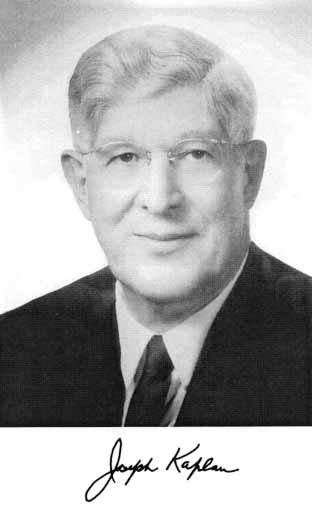
Joseph Kaplan
September 8, 1902-October 3, 1991
By William W. Kellogg and Charles A. Barth
Joseph Kaplan's research was largely concerned with the spectra of diatomic molecules and, more specifically, in afterglows of nitrogen and oxygen and their mixtures. These spectra are important in understanding the photochemistry of the upper atmosphere of the Earth and other planets.
Kaplan will be more widely remembered, however, for his leadership in the geophysics community. He was one of the creators of the new science of aeronomy. For ten years he served as chairman of the U.S. National Committee for the International Geophysical year and for five years he was a member of the Executive Committee of the International Committee of Scientific Unions. He played a leading role in establishing such significant programs as the International Hydrological Decade and the Global Atmospheric Research Program.
In spite of his involvement in such public arenas, he remained a popular and inspiring teacher at the University of California at Los Angeles, not only of many science graduate students, but also of undergraduates. Because of his warmth and charm, he was in constant demand by the public and the media as well as the scientific community, and he always seemed to welcome the opportunity to explain the scientific enterprise to non-scientists.
Early Life and Education
As is common in a scientific career, Joe Kaplan's early life was largely devoted to his studies and the pursuit of his research. In his later years his energies also went into furthering his interests in public education and promoting international scientific programs.
Kaplan was born on September 8, 1902, in Tapolcza, Austria-Hungary. When he was eight years old, his parents and eleven brothers and sisters moved to Baltimore. After graduating from the Baltimore Polytechnic Institute in 1921, he attended Johns Hopkins University, where he earned a bachelor's degree in chemistry in 1924 and a doctorate in physics in 1927. Among his professors at Hopkins were Joseph S. Ames and Francis D. Murnaghan, authors of the classic textbook on theoretical mechanics. He did his thesis work with R. W. Wood, an expert experimental spectroscopist.
On graduating, he became a National Research Council fellow at Princeton University, where he continued his research under Karl T. Compton. From there he accepted an assistant professorship at the University of California at Los Angeles (UCLA) in 1928. He was destined to remain on the faculty of UCLA for the rest of his professional life, becoming an associate professor in 1935 and a professor in 1940. He was appointed chairman of the Department of Physics (1939-44) and director of the Institute of Geophysics (1946-47).
Kaplan took great satisfaction in his many graduate students, including the authors of this memoir. He also took pleasure in teaching an introduction to physics (Physics 10) for undergraduates. Kaplan was an ardent booster of UCLA sports, and it is doubtful whether he ever failed any good athlete who was reasonably attentive in class. In an interview with the Los Angeles Times he is quoted as saying, ''I see no difference in a boy preparing to become a foot-
ball or basketball player or a boy learning to be a violinist, a social worker, or a surgeon." His advice to a defensive halfback was, "Never collide with anyone. Just intercept those passes and run out of bounds. That's elementary physics."
Laboratory Studies
During the years of his graduate studies at Johns Hopkins University (1924-27), Kaplan learned how to produce atoms in laboratory vacuum tubes. Kaplan's advisor, R. W. Wood, was the master of laboratory research on atomic hydrogen. What Kaplan contributed to these experiments was the addition of a large (for the 1920s) evacuated bulb sealed to Wood's atomic hydrogen tube. Kaplan found that the hydrogen atoms entering the large bulb from a Wood's tube remained there for tens of seconds while recombining. Kaplan correctly deduced that the atoms recombined in three-body collisions with the energy of recombination sometimes appearing in the excitation of spectral emissions. This was the beginning of a career of laboratory experiments that simulated atomic and molecular reactions occurring in the upper atmospheres of the planets.
In 1928, as a National Research Council fellow, Kaplan went to work in Karl Compton's Princeton University laboratory, where he began his laboratory studies of active nitrogen. Active nitrogen is produced when a small amount of nitrogen gas is placed in an evacuated tube at low pressure and subjected to a high voltage discharge. When the discharge is turned off, the nitrogen gas continues to glow with the spectral emissions of atomic and molecular nitrogen. This is the phenomenon of the nitrogen afterglow. The source of energy for this afterglow is called active nitrogen. Working with Gunter Cario, Kaplan proposed the idea that both metastable nitrogen atoms and metastable nitrogen molecules were present in active nitrogen.
While experimenting with active nitrogen, Kaplan made a discovery that set the course of his research for the rest of his career. He was able to produce in the laboratory the auroral green line of atomic oxygen. This is the spectroscopic emission that gives the polar aurora its green color. Kaplan made this discovery by adding a small amount of oxygen to the active nitrogen he produced in his laboratory discharge tube. Today we know the aurora is produced by bombardment of the upper atmosphere by energetic electrons from the radiation belts during geomagnetic storms. The emission originates from the upper atmosphere at an altitude of about 100 km, where the maximum density in atomic oxygen occurs. The auroral green line is a forbidden transition and the excited state has a lifetime of a little less than one second. The bombarding auroral electrons ionize and excite the nitrogen molecules and oxygen atoms present at 100 km. Current thinking about the source of excitation of the oxygen green line in the aurora is that the oxygen atom is excited by a collision with a metastable nitrogen molecule. This is the type of process that Kaplan was studying in the 1930s in his laboratory experiments on active nitrogen.
Kaplan then began directing his laboratory research to reproducing the spectrum of the aurora in the laboratory. In 1932 he produced a laboratory afterglow, which he felt did reproduce the auroral conditions and from his experiments concluded "that the auroral display is really an electrical discharge in a nitrogen-oxygen mixture in which metastable molecules abound." The innovation of this particular experiment was that he ran the discharge in the tube for a long period of time, and this conditioned the walls so that collisions with the walls did not deactivate the metastable atoms and molecules produced in the afterglow tube.
Using this experimental apparatus, Kaplan discovered the
Vegard-Kaplan bands of molecular nitrogen. These bands had been observed earlier by Vegard in the spectrum of the aurora. Vegard did some laboratory experiments in which he bombarded solid nitrogen with electrons. The resulting luminescence included bands with approximately the same wavelength as the emission bands in the aurora. This result led Vegard to the speculation that solid nitrogen may be present in the earth's upper atmosphere. What Kaplan accomplished was to produce the bands in gaseous nitrogen, which, of course, is a known constituent of the upper atmosphere. Kaplan's measurements of the wavelength of the Vegard-Kaplan bands in the laboratory were of sufficient accuracy to permit the identification of the upper state of these bands as the A3Σ., a metastable state with a lifetime of about one second. Kaplan's laboratory apparatus truly did reproduce the conditions in the aurora.
Following the identification of the Vegard-Kaplan bands as the A3Σ - X1Σ transition in molecular nitrogen, Kaplan showed that in laboratory afterglows that produced the Vegard-Kaplan bands, the atomic oxygen green line at 5577 Å is also produced when a small amount of oxygen is added. This led Kaplan in 1935 to propose that the auroral green line is produced in the aurora by a collision of an oxygen atom and a metastable nitrogen molecule in the A3Σ state. This idea is the current explanation for excitation of the 5577 Å line in the aurora.
During the same period, Kaplan produced the Goldstein-Kaplan bands in the laboratory and proposed that they were present in the "light of the night sky." That these bands are present in the ultraviolet aurora has been shown by rocket experiments that fly 100 km high into an aurora with an ultraviolet spectrometer.
Kaplan continued his laboratory experiments on the nitrogen afterglow, varying the physical conditions to enhance
the intensity of the Vegard-Kaplan bands. When he increased the pressure of nitrogen in a well-conditioned tube, he found another emission that appears in the aurora. The forbidden transition 2P - 4S in atomic nitrogen at 3467 Å appeared in the laboratory apparatus. Atomic nitrogen in the excited 2P state has a lifetime of about twenty seconds, a long time for a metastable atom in a small laboratory tube. When he repeated these experiments using a spectrograph sensitive to radiation in the visible part of the spectrum, he observed another forbidden line of atomic nitrogen at 5200 Å . The upper state of this transition, the 2D, has a lifetime of twenty-four hours. It would be expected that this excited metastable atom would have many opportunities to be deactivated by collisions with the walls before radiating. It is a demonstration of Kaplan's experimental skill that these excited atoms were not deactivated and that the "tube behaves effectively as if it had no walls." Today, we know that the N(2D) excited atom plays an important role in the production of nitric oxide in the upper atmosphere.
In 1947 Kaplan revamped one of his afterglow tubes and studied the photographic infrared portion of the spectrum. When he added a small amount of oxygen to the afterglow, he discovered the atmospheric bands of molecular oxygen in emission. These are the bands that were first measured in absorption by Fraunhofer in the solar spectrum over 100 years earlier. Kaplan's discovery was the first observation of these bands in emission. Since he was studying the laboratory source to simulate conditions in the upper atmosphere, he recognized that these bands were potential contributors to the light of the night sky. These atmospheric bands were discovered subsequently in the night airglow infrared spectrum. This was the first time that Kaplan discovered an upper atmosphere emission in the laboratory before it was identified in the night sky spectrum. In all of his previous discoveries in the laboratory, the spectral emissions were
identified first in the auroral spectrum, and he subsequently produced them in the laboratory.
In the 1950s Kaplan began thinking about the exploration of the upper atmosphere with rockets. He was particularly interested in the chemical reactions in the upper atmosphere, especially those that led to the production of the airglow. He suggested that the region of the atmosphere where the chemical reactions take place be called the chemosphere in analog to the ionosphere, where reactions between ions occur. As chairman of the U.S. National Committee for the International Geophysical Year, he provided leadership for the U.S. part of this international scientific program to explore space. He was an advocate of the plan to launch satellites to explore the upper atmosphere of the Earth. It was during the IGY that the first satellites were launched by the Soviet Union and the United States.
Service to Geophysics
Kaplan took pleasure in interacting with people, and in the later part of his life a great deal of his energy went into the promotion of some of his favorite scientific enterprises. His outgoing personality and ability to influence people made him a natural leader. He enjoyed taking part in the public arena, as well as in scientific research.
His research, as we have pointed out, led him to studies of the upper atmosphere, which emerged as a very fertile and important branch of geophysics in the 1940s. At that time, as radio developed, knowledge of the ionosphere and effects of solar activity was crucial. The rapidly improving technology of rocketry permitted sounding rockets to directly explore the upper atmosphere for the first time. Of course, eventually, the launching of earth satellites allowed direct, prolonged observation of atmospheric phenomena.
Kaplan established geophysics at UCLA, where he played a leading role in setting up the university's Institute of Geo-
physics in 1944 and served as its director from 1946 to 1947. This institute now has five branches in the California state system.
During the war years, Kaplan and Karl Gustav Rossby of the University of Chicago were instrumental in helping the U.S. Air Force organize a major program to train weather officers at several universities with meteorology curricula. In the postwar era, the field of meteorology in the United States seems to have been well populated by the many graduates of this program.
Kaplan moved easily among the top brass of the Air Force and was a personal friend of Chief of Staff General Hap Arnold and the commander of the Systems Command General Bernard Shriever. In 1943 Kaplan was named chief operations analyst for the Second Air Force and the Air Weather Service, a post he held for two years. Starting in 1948 he became a long-time member of the Air Force Scientific Advisory Board and the Advisory Committee of the Air Force's Office of Aerospace Research.
Despite his continuing involvement in national affairs as consultant to the White House's Office of Science and Technology, the National Science Foundation, and several California agencies, his real love was the world of international scientific organizations. In the early 1950s he became active in the International Union of Geodesy and Geophysics (IUGG) and with Sidney Chapman and Lloyd Berkner introduced the term "aeronomy" to describe the physics of the upper atmosphere, now taken to include studies of planetary atmospheres. After much debate, the IUGG Association of Geomagnetism changed its name to the Association of Geomagnetism and Aeronomy. At the time of this name change, officially adopted at the IUGG annual meeting in Toronto in 1954, Kaplan was elected vice-president; he became president in 1957.
Incidentally, there were some influential meteorologists who strongly resented the implication that upper atmospheric research (aeronomy) was being baptized as a separate science, and their response was to rename the IUGG Association of Meteorology the Association of Meteorology and Atmospheric Physics. We recall Kaplan's quiet amusement in Toronto at all the furor over a name.
Kaplan now moved to the center stage of the continuing evolution of international scientific organizations. In a very real sense, he lived at the right time in the history of science. In 1950 Lloyd Berkner suggested that the period 1957-58 be devoted to the Third International Polar Year, a suggestion later modified to include all of geophysics in the program. Berkner was joined by the distinguished British scientist Sidney Chapman in persuading the International Council of Scientific Unions to officially approve the International Geophysical Year (IGY) Programme.
As plans were being laid for the IGY, Kaplan became chairman of the U.S. National Committee for the IGY, established by the National Academy of Sciences. He retained this post from 1953 to 1963. Among other things, the IGY will be remembered for the launch of Sputnik 1 on October 4, 1957.
The IGY turned out to be an enormous undertaking, both in the United States and abroad, and Kaplan was greatly aided in organizing this program by Hugh Odishaw, executive director of the U.S. IGY Committee. The two men complemented each other in many ways and were an effective team. As Homer Newell recalls, "Kaplan . . . was noted for an inexhaustible supply of pleasant anecdotes. His genial personality was ideally suited to working with the difficult, dark, moody, sometimes abrasive Hugh Odishaw."
There were, of course, many organizational meetings leading up to the IGY, most of which Kaplan attended. At the
meeting of the Committee Speciale de l'Annee Geophysique Internationale in Brussels in July 1955, Kaplan announced (after obtaining White House approval) that the United States would launch an earth satellite as a contribution to the IGY. Kaplan jokingly referred to such a satellite as a "long-playing rocket." As anticipated, this announcement attracted wide public attention.
In 1960, after the IGY ended, he assumed the vice-presidency of the International Union of Geodesy and Geophysics and the presidency in 1963. He was a member of the Executive Committee on Space Research from 1958 to 1967. From 1962 to 1967 he was a member of the Executive Committee of the parent organization of both of the above, the International Committee of Scientific Unions (ICSU). He continued to serve the ICSU from 1967 to 1968 as a member of its Standing Committee of Admissions and Organization.
In spite of all his international involvement, he was able to continue his duties as a UCLA professor and to serve on the Committee for the International Years of the Quiet Sun (1964-67) and the Committee for the International Hydrological Decade (1965-67). He will be remembered in California for his membership on the Advisory Council on Atomic Energy Development and Radiation Protection and also on the California Advisory Commission on Marine and Coastal Resources.
As he approached emeritus status at UCLA he had more time for other community service. He was a long-time member of the Rotary Club and was in demand as a speaker on many subjects. He and his first wife Katherine were invited on several occasions to take part in goodwill missions to developing countries on behalf of the U.S. Department of State. He derived great satisfaction from these kinds of activities.
Of course, he retained his membership in many scientific
and educational organizations. Perhaps he was proudest of his membership in the National Academy of Sciences, to which he was elected in 1957. Other memberships included the Institute of Aeronautical Sciences (fellow), American Geophysical Union (fellow), American Meteorological Society (honorary member), American Physical Society (fellow), National Association of Science Writers (honorary member), and the International Academy of Astronautics (founding member). He was also an honorary member of the Board of Governors of Hebrew University of Jerusalem and a member of the Board of Governors of the Weizman Institute of Science in Rehovot. He was made an honorary chairman of the American Histadrut Cultural Institute.
In the course of his long career Kaplan received many awards and honorary degrees. Among the awards were the John Adams Fleming Award of the American Geophysical Union (1970), the Commemorative Medal for the 50th Anniversary of the American Meteorological Society (1969), the Hodgkins Medal and Prize from the Smithsonian Institution, and the Astronautical Award from the American Rocket Society. He was given the War Department's Decoration for Exceptional Civilian Service (1947) and the Air Force's Exceptional Civilian Service Award (1960 and 1969). He received the degree of doctor of science from Carleton College and the University of Notre Dame and a L.H.D. degree from Yeshiva University, Hebrew Union College, Jewish Institute of Religion, and the University of Judaism.
Kaplan married Katherine E. Feraud on June 24, 1933. She was a psychologist and was active in community service; she often accompanied her husband on his frequent trips abroad. She died in January 1977. On February 26, 1984, Kaplan married Frances I. Baum, who remained with him until his death. Kaplan died in Santa Monica, California, of a heart attack on October 3, 1991. He was eighty-nine.
Selected Bibliography
1928 Theory of the excitation of spectra by atomic hydrogen. Phys. Rev. 31:997-1002.
With G. Cario. Active nitrogen. Nature 121:906-907.
Excitation of the auroral green line in active nitrogen. Nature 121:711.
1929 With G. Cario. Das sichtbare Nachleuchten des aktiven Stickstoffs. Zeit. Phys. 58:769-80.
The existence of metastable molecules in active nitrogen. Phys. Rev. 33:189-94.
The excitation of the aurora green line in active nitrogen. Phys. Rev. 33:154-56.
1932 The auroral spectrum. Phys. Rev. 42:807-11.
1933 A new band system in nitrogen. Phys. Rev. 44:947.
1934 New band system in nitrogen. Phys. Rev. 45:675-77.
New band system in nitrogen—an addition and correction. Phys. Rev. 45:898-99.
New bands in nitrogen. Phys. Rev. 46:534.
1935 Light of the night sky. Phys. Rev. 47:193.
1936 The excitation of the auroral green line by metastable nitrogen molecules. Phys. Rev. 49:67-69.
1938 High-pressure afterglow in nitrogen. Nature 141:645-46.
1939 Forbidden transitions in nitrogen. Nature 143:1066.
1942 A remarkable green line source. Nature 149:273.
1947 Active oxygen. Nature 159:673.
1953 The earth's atmosphere. Am. Sci. 41:49-65.
1956 United States programme for the International Geophysical Year. Nature 178:665-67.
1958 With C. A. Barth. Chemical aeronomy. Proc. Natl. Acad. Sci. U. S. A. 44:105-12.


