
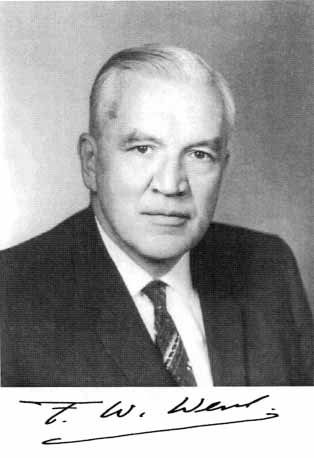
Frits Warmolt Went
May 18, 1903 - May 1, 1990
By Arthur W. Galston and Thomas D. Sharkey
If ever a scientist could be said to have been born into his profession, it was Frits Went. His father, F. A. F. C. Went, was professor of botany and director of the Botanical Garden at the University of Utrecht in the Netherlands. The director and his family lived in a 300-year-old mansion in the middle of the garden, and Frits was born there in 1903. Because the well-known and respected Professor Went presided over a modern, well-equipped laboratory of botany, he attracted a great many visitors from all over the world, many of them famous in their own right. Young Frits benefited not only from acquaintance with such people, but also from the inquisitive intellectual environment of the laboratory; from witnessing the use of rather sophisticated equipment in experiments on plants; and from being exposed to the approaches used by young investigators to attack a broad range of interesting scientific problems. Frits Went relates, "I greatly profited from the thorough knowledge that my father had of botany in general. He knew the entire plant physiological literature, having read every important paper ever published (and remembering its content). He personally subscribed to most botanical journals. He knew and was friendly with most botanists all over the world, and thus I came to know many of them" (1974).
Such an upbringing certainly provides a formula for success, and young Frits did not fail to benefit from it. Although his father did not press him to become a botanist, Frits was almost automatically drawn to this field, and after graduation from the university, he entered into graduate study in his father's department.
One of his father's students, A. H. Blaauw, had discovered that light inhibited the extension growth of cylindrical plant organs, and on this basis, had attributed all of photo-tropic curvature to differential light growth inhibitions on the shaded rather than the illuminated sides of the organ. When Frits began research in his father's laboratory, he chose to repeat the Blaauw experiments, using an auxanometer invented by another graduate student, V. J. Koningsberger, to measure growth. He quickly confirmed Charles Darwin's finding that the tip of the cylindrical grass coleoptile (a hollow sheath surrounding the first embryonic leaf) is much more sensitive to light than are the basal regions of the organ. After also confirming that removal of the coleoptile tip lowered the growth of the subjacent region and that replacement of the tip restored much of the lost growth, he hypothesized, as had others, that the tip was a source of substances promoting the growth of cells lower down the organ. His creative innovation was to collect such growth hormones by simply allowing them to diffuse from the cut surface of the excised tip into gelatin blocks. When applied symmetrically to the subapical tissue, these gelatin blocks promoted elongation of the decapitated coleoptile, and when applied asymmetrically, they caused curvature in a dose-dependent manner. This experiment, which succeeded in the spring of 1926, was the first unequivocal demonstration of the existence of a growth-promoting hormone, named auxin, in plant tissues. Went used this decapitated oat coleoptile technique to demonstrate that phototropism was
linked to and probably caused by a photo-induced movement of auxin from the illuminated to the shaded side of the coleoptile tip without significant destruction of the molecule. His thesis (1928) became an instant classic, and his oat coleoptile technique became the standard procedure for bioassay of auxin.
In the early part of the twentieth century, several European countries, including the Netherlands, had colonies in the underdeveloped world to which young men were sent "to establish their fortunes." Fortified by his new Ph.D. degree and accompanied by his wife Cathrien and ultimately two children, Hans and Anneka, Frits Went served from 1927 to 1933 as plant physiologist at the Royal Botanical Gardens at Buitenzorg (now Bogor) on the island of Java, then part of the Dutch East Indies. He soon discovered that complex equipment did not function well in the oppressive moist heat of Java, and so he moved into simpler applied physiological and ecological work. His experience in the tropics greatly affected his later thinking and research.
In 1933 he moved to the California Institute of Technology to replace another young Dutch plant hormone researcher, Herman E. Dolk, who had died tragically in a traffic accident. At Caltech he quickly became the center of a vigorous group of plant hormone researchers which eventually included Kenneth Thimann, James Bonner, Folke Skoog, and Johannes van Overbeek, among others. Went's work on growth hormones culminated in his publication with Kenneth Thimann of Phytohormones (1938) after which his interests gradually shifted to an examination of the effects of environmental factors on plant growth.
With the aid of a generous donor, Lucy Mason Clark, he constructed at Caltech several controlled-condition greenhouses in which plants could be grown under specified regimes of light, temperature, nutrition, humidity, and air
quality in an insect-free environment. He soon found that the variability of response of his controlled plant populations to experimental procedures was much lower than that encountered in ordinary greenhouses or in the field. This result encouraged him to venture further into the study of plant growth under stringently controlled conditions, and with the aid of another generous donor, Harry Earhart, he was able to build and dedicate in 1949 a building containing a large new complex of air-conditioned rooms for plant growth. This vast Earhart Plant Research Laboratory, along with its supporting engineering and machinery, was dubbed the "phytotron" by Went's Caltech colleagues. It became the prototype for many similar installations all over the world. In the phytotron Went was able to establish climatic conditions for maximizing productivity of many important plant crops; to find that optimal day and night temperatures were vastly different for each plant and among plants; to study circadian rhythms under specified conditions; and to make significant discoveries about air pollution and desert ecology. Research at the phytotron is well summarized in "The Experimental Control of Plant Growth" (1957). It is paradoxical that the Caltech phytotron, which sparked the construction of other phytotrons all over the world, was destroyed a few years later when it became clear that its prodigious operating costs exceeded the institute's ability to support them.
One of the lasting legacies of work in the phytotron was the analysis of the nature of the air pollution (smog) plaguing the Los Angeles basin, and later, many other major urban centers. Because air drawn into the phytotron was passed over activated charcoal filters, it was free of many components of smog, and the plants thus protected frequently grew much better than outside unprotected plants exposed to smog. It had been assumed that sulfur dioxide
was the main toxic component of smog, but Went doubted this, largely because the symptoms of smog damage on plants did not match those produced by SO2. Aided by his friend and biochemist colleague Arie J. Haagen-Smit, Went began a series of investigations that led to the correct designation of smog as a mixture of the reaction products of unsaturated hydrocarbons (mainly from gasoline) and ozone produced photochemically in the atmosphere. These findings had many practical consequences, including the use of sensitive crops as indicators of smog levels and the rigorous and widely copied air pollution control measures in Los Angeles. Went's interest in air pollution also led to examination of the blue hazes that frequently covered forested areas, as in the Blue Ridge and Great Smoky mountains. His investigations led to quantification of the release of terpenes and other volatile materials from plants and studies of their condensation into the submicroscopic aerial particulates that produce the blue haze through the Tyndall effect.
I (A.W.G.) got to know Frits Went well during my years at Caltech-in 1943-44 and from 1947 to 1955. I conducted some experiments at the phytotron; taught with him in a collaborative graduate course in plant physiology; shared his seminars, informal discussions, and desert field trips; and with my wife enjoyed the hospitality of Frits and Cathrien Went at occasional sumptuous Javanese-style rijstaffel dinners at their home. I found him fiercely loyal to his friends and associates, but a vigorous opponent to his antagonists, holding firm convictions and sometimes championing highly unpopular ideas. For example, despite growing evidence that 3-indoleacetic acid is the major native auxin of plants, he continued to believe in the existence of auxin a until his death. In the face of growing skepticism, he never ceased advocating the existence of calines—hypothetical growth
substances supposedly interacting with auxin to produce varied specific effects. Against almost unanimous contrary opinion, he seriously argued that petroleum deposits could have arisen from condensation and deposition of volatile emanations (e.g., terpenes) from land plants. None of these hypotheses enjoys much support today, although the discovery of the cytokinins and other plant hormones can be interpreted in terms of the caline theory.
Went decried the growing reductionism in biology and was especially disturbed by the increasing emphasis on DNA, to the virtual exclusion of other subjects. He remained to the end a naturalist, or at least a broad-spectrum biologist. He always advocated simple experiments; was suspicious of any conclusion that had to be bolstered by statistics; insisted that research should be fun; and believed in changing fields from time to time. Because he wrapped these sometimes-unpopular views in a kind of a continental charm, he usually, but not always, escaped offending his opponents.
Nobody who knew Frits Went during his last years at Caltech could have escaped learning of his enthusiasm for the desert flora of the nearby Mojave and Sonoran deserts. He delighted in studying the wildflowers that burgeoned after a spring rain, and in learning the mechanisms involved in their dormancy, germination, and competition with neighbors.
He was fascinated by the tiny annuals of the desert, which he called belly plants, because one had to lie on one's belly to get close enough to study them. To study this flora, he led many legendary field trips, Spartan in nature except for the inevitable strawberry-rhubarb pies he purchased at a bakery en route to Joshua Tree National Monument. Went became an expert in desert flora, establishing a linkage with Israeli botanists through visits to the Negev Desert and with American botanists through work at the Desert Research Institute in Reno, Nevada. In the end he had be-
come a competent systematist and ecologist as well as an outstanding plant physiologist.
In 1958, after a quarter century at Caltech, Went left Pasadena to become director of the famous Missouri (Shaw's) Botanical Garden. He left behind his cherished phytotron and the desert ecosystem he had come to love. What propelled him outward was a growing disenchantment with the burdens of administering and raising grant support for the phytotron and of coexistence with colleagues who were increasingly committed to reductionist molecular genetic approaches to the problems of biology. In St. Louis, he rose to new challenges.
The Missouri Botanical Garden was an ideal place for Went to indulge his taste for studies of the great diversity of plants. However, the garden's infrastructure had become run-down and it was essential to build new plant growth facilities. Drawing on experience in climate control gained at the Pasadena phytotron, Went oversaw design and construction of the Climatron. This impressive geodesic dome is open inside, but through clever use of air movements, it simulates many different climates simultaneously. One of the unusual attractions is a tunnel under Victoria Pool, named after Victoria regia, a water lily with six-foot-wide leaves. The tunnel is curved so that at some points visitors see only aquatic life while walking through the tunnel.
Went started many new programs at the Missouri Botanical Gardens. However, he was frustrated by slow progress in some of the building projects and by the large institutional inertia he encountered. He was also being drawn more deeply into atmospheric research. He resigned as director in 1963 to spend the next two years teaching and doing research at Washington University in St. Louis.
The air pollution studies begun at Caltech again occupied Went's attention in St. Louis. Smog and air pollution
are obvious in many big cities, but Went measured smog in the remotest parts of the Earth (for example, Pt. Barrow, Alaska, in the 1960s). He was convinced that plants provided the hydrocarbons that formed these particles. Went reminded the world of the experiments of Tyndall, in which the right mix of reduced carbon and catalyst could result in particles formed from carbon compound aggregates. These particles tend to stay small, usually less than one micrometer. Because of their small size, these particles scatter blue light, and Went described this natural blue haze (1960). He believed that many of the ''blue" mountain ranges are named for the blue haze developed from terpenoid emissions from trees; Went cited the Blue Ridge Mountains of the Appalachians and the Blue Mountains in Australia as examples. When viewed from a distance, the mountains appeared blue because of the particles arising from condensation of plant-derived terpenoids scattering the light. Thirty years after Went brought attention to the terpenoids emitted from plants, atmospheric chemists are finding that plant terpenoids have a remarkably large effect on the oxidation potential of the atmosphere.
He also used terpenoid plant emissions to explain the origin of anthracite coal and petroleum (1960) and as an explanation of some of the properties of thunderstorms (1962). Unlike the blue haze theory, his explanations of the origin of anthracite and petroleum from volatile emissions of plants are not widely accepted.
In 1965 Went founded the Laboratory of Desert Biology as part of the Desert Research Institute in Reno, Nevada. Now known as the Biological Sciences Center, this group still conducts desert biology and plant-atmosphere research inspired by Went. Upon his arrival in Reno, Went built two air-conditioned greenhouses for his research. While the Climatron had been a huge undertaking, Went built his last
phytotron in Reno as economically as possible. In Reno the elegance of simplicity allowed his greenhouses to survive to this day, thirty years after their construction, longer than the existence of the more famous Pasadena phytotron.
In 1967 Went spent six weeks aboard the research vessel Alpha Helix. The ship traveled up the Amazon River, but the Brazilian authorities confiscated the gas chromatograph he was intending to use to measure terpenoid emissions from the tropical plants. Unable to do his planned research, Went displayed his breadth of interests and keen ability to observe and explain. He observed masses of fungal hyphae in the soil of the tropical forest and realized that the high rates of fungal metabolism could quickly recycle nutrients to the forest (1968).
It was clear that intensive agriculture, as practiced in temperate ecosystems, would be disastrous in many tropical forests. The fertility of the tropical ecosystems depends on rapid recycling of nutrients by a large fungal community, which is lost under intensive agriculture. Went suggested modifying the tropical forests to that they would produce cash crops without altering the basic ecological relationships that were necessary for high productivity in these environments. Went's seminal work on the root fungi, or mycorrhizae, energized research in this field. Since his initial observations, other scientists have shown that nearly all plants become infected with mycorrhizae and that the same fungus individual can infect more than one tree—even more than one tree species—simultaneously. This work is having a profound influence on forest studies and management.
The maximum growth rate of plants was one of the central questions in plant physiology that fascinated Went. Work on tomato in the Pasadena phytotron was followed up in Reno. Went believed that some factor from decomposing organic matter stimulated plant growth. He grew plants un-
der ideal conditions in his latest phytotron in Reno, placing one group of plants in sand and another in compost taken from his yard. Despite copious fertilizer additions to all of the plants, the plants in compost grew larger. Went suspected that fungi in the soil provided sugar to the plants, but collaborators using stable carbon isotopes as tracers ruled out this possibility. However, given Went's many seminal insights, it may be worth following up these observations to see if compounds besides mineral nutrients are transferred to plants from the mycorrhizae growing on their roots.
Went firmly believed that diffusion processes control the maximum growth rates of plants. He also believed that photosynthesis does not control plant growth; rather, plant growth controls photosynthesis. Given this view, it was easy for Went to accept that some signal from mycorrhizae could substantially alter growth rate. That photosynthesis does not regulate plant growth is not immediately obvious, since nearly all of the mass of a plant comes from photosynthesis. Nevertheless, the plant's use of sugars, which determines the concentration of sugars in leaves, is now known to affect the expression of genes coding for enzymes needed in photosynthesis. Went's ideas on limits to plant growth are not as widely recognized as his work on phytohormones and plant-atmosphere interactions, but some of his insights have been confirmed.
Went's interest in desert plants from his days at Caltech found a new challenge in Reno. He was a charter member of the Northern Nevada Native Plant Society, allowing him to spend many hours observing plants and teaching others the joy of exploring the plant world around them. Despite these broad interests, Went remained primarily a plant physiologist. To him this meant using any and all means to understand plant growth, development, and interactions with
the environment. He saw the domination of physiology by molecular biology as an impoverishment of biology. However, he was quick to invoke genetic explanations when appropriate. Went used the term "jumping genes" to describe remarkable similarity in the taxonomy of plants in Australia and New Zealand. At the time this was heresy, and Went intentionally chose a whimsical name to needle his geneticist colleagues. Now moving genes from one organism to another is nearly routine. Went was so often willing to consider what most scientists dismissed, and this permitted him to pioneer new fields of inquiry, rather than to move into fields opened up by others.
Went considered that experiments requiring statistical analysis to tease out the signal from the noise were inadequately controlled. He urged all plant physiologists to work in highly controlled greenhouses or growth rooms so that experimental effects would be clear without resorting to statistics. He felt that ecology was an important tool for physiologists, and that much of what he did was autecology, or the study of the interaction between a single plant and its environment.
In 1985 Went moved to Oregon to be near his daughter. There he discussed atmospheric science with his former graduate student from St. Louis, R. Rasmussen, who also lives in Oregon. In 1990 Went visited the Desert Research Institute in Reno to consult on plants for a large research greenhouse. He died in his sleep while visiting Little Valley, where he had made measurements of air particles twenty years before.
In the last years of his life, Went was working on the formation of particles in the atmosphere from plant emissions. He was frustrated that the interactions between plant hydrocarbons, cloud condensation nuclei, and thunderstorms were not recognized as important problems. He was impa-
tient with the emphasis on rising CO2 levels in the atmosphere, since increased CO2 would simply lead to increased growth of plants and the climatic "forcing" by CO2 is small relative to other gases in the atmosphere. On his last trip to Reno he took along a manuscript of a book on the formation of smog particles. After his death, his daughter and son published his manuscript, which he called Black Carbon Means Blue Sky. In the book Went described the formation of cloud condensation nuclei and thunderstorms.
Went was struck by the fact that his father seemed to have read every paper ever published on plant physiology and remembered all of them. Performing research at the very frontiers of knowledge—where there are few enough papers that one can read them all and where new discoveries come easily to those brave enough to follow their curiosity—was what Went recommended (1974). He lived by his advice. He leaves behind a legacy of insights that have fueled many fields. Plant hormones, air pollution, desert ecology, plant-atmosphere interactions, mycorrhizae, and the limits of plant growth all fascinated him at one time or another in his career. However, for many people, Went's greatest legacies are his commitment to science as a human endeavor and his willingness to put forward revolutionary ideas about plants and the world around us.
Selected Bibliography
1928 Wuchsstoff und Wachstum. Rec. Trav. Bot. Neerl. 25:1-116.
1932 Eine botanische Polaritätstheorie. Jahrb. Wiss. Bot. 76:528-57.
1934 A test method for rhizocaline, the rootforming substance. Proc. K. Ned. Akad. Wet. 37:445-55.
1935 Auxin, the plant growth hormone. Bot. Rev. 1:162-82.
1938 With K. V. Thimann. Phytohormones. New York: Macmillan.
1939 Growth hormones in higher plants. Annu. Rev. Biochem. 8:522-40.
1943 The regulation of plant growth. Am. Sci. 31:189-210.
Plant growth under controlled conditions. I. The air-conditioned greenhouses at the California Institute of Technology. Am. J. Bot. 30:157-63
1944 Plant growth under controlled conditions. II. Thermoperiodicity in the growth and fruiting of the tomato. Am. J. Bot. 31:135-50.
1957 The Experimental Control of Plant Growth. Waltham, Mass.: Chronica Botanica.
1960 Blue hazes in the atmosphere. Nature 187:641-43.
Organic matter in the atmosphere, and its possible relation to petroleum formation. Proc. Natl. Acad. Sci. U. S. A. 46:212-21.
1962 Thunderstorms as related to organic matter in the atmosphere. Proc. Natl. Acad. Sci. U. S. A. 48:309-16.
1964 With R. A. Rasmussen. Volatile organic material of plant origin in the atmosphere. Proc. Natl. Acad. Sci. U. S. A. 53:220.
The nature of Aitken condensation nuclei in the atmosphere. Proc. Natl. Acad. Sci. U. S. A. 51:1259-67.
1966 On the nature of Aitken condensation nuclei. Tellus 18:549-56.
1967 With D. B. Slemmons and H. N. Mozingo. The organic nature of atmospheric condensation nuclei. Proc. Natl. Acad. Sci. U. S. A. 69:74.
1968 With N. Stark. The biological and mechanical role of soil fungi. Proc. Natl. Acad. Sci. U. S. A. 60:497-504.
With N. Stark. Mycorrhiza. BioScience 18:1035-39.
1971 Parallel evolution. Taxon 197:226.
1972 With J. Wheeler and G. C. Wheeler. Feeding and digestion in some ants. BioScience 22:82-88.
1973 Rhizomorphs in the soil not connected with fungal fruiting bodies. Am. J. Bot. 60:103-10.
Competition among plants. Proc. Natl. Acad. Sci. U. S. A. 585-90.
1974 Reflections and speculations. Annu. Rev. Plant Physiol. 25:1-26.


