
2
Education and Research Training of Life-Science PHDS
In this chapter, we examine the changes that have occurred over the last 3 decades in the number of new life-science PhDs produced and the length of their doctoral and postdoctoral training. We also examine some key factors underlying these trends to establish a basis for understanding the forces that influence the trends in career outcomes presented in chapter 3. Most of the data in this chapter come from two National Research Council surveys: the annual Survey of Earned Degrees, which collects biographic information (including postdoctoral plans) from all persons receiving research doctorates from US universities, and the biennial Survey of Doctorate Recipients, which compiles current employment information from a 5–10% sample of US-educated PhD scientists and engineers. Additional data on graduate-student support and postdoctorals were obtained from the National Science Foundation's Survey of Graduate Students and Post-doctorates in Science and Engineering. (See appendix C for additional detail on sources of data and appendix D for fields of study included in the committee's analysis.)
PHDS Awarded in the Life Sciences
Since the 1960s, the number of PhDs awarded annually in the life sciences has more than tripled. As illustrated in figure 2.1, 7,696 life-science doctorates were awarded by US universities in 1996, compared with 2,095 degrees in 1963. However, the growth pattern during that 33-year period has not been constant. During the first 8 years, primarily as the result of the many new graduate programs that were established1 and programs that were expanded before 1963 (as discussed in chapter 1), the number of PhD awards grew at an average of 11.4% a year. In the next 16 years (1971–1987), there was minimal growth in PhD production (less than 1% a year). Since 1987, the growth in doctoral degrees in the life sciences has resumed—an average of about 4% from 1987 to 1996 (the most recent year for which data are available), for a total increase of 42.5% in that period. (See table E.1, in appendix E, for details and figure 2.1 for a graphic presentation.)
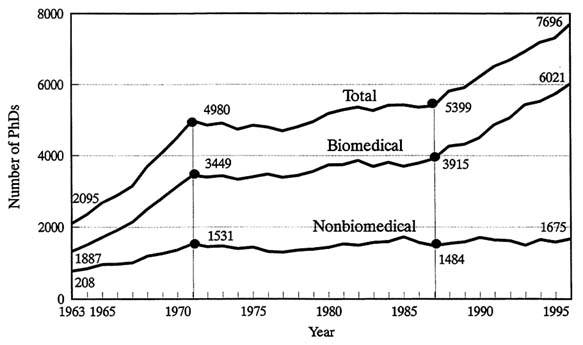
The increases in PhD awards have by no means been uniform across the disciplines of the life sciences. Changes in survey taxonomy do not permit a detailed analysis of the doctoral increase in every life-science discipline, but some of the differences observed from data in tables E.2, E.3, and E.4 are striking. For the most part, the largest increases have occurred in biomedical sciences, such as biochemistry, cellular biology, molecular biology, neurosciences, and pharmacology. The numbers of PhDs awarded in some agricultural and basic biologic sciences (such as plant sciences and ecology) have also grown during the last 3 decades but to a much smaller degree. Overall, almost all the growth in the number of PhDs awarded has been in the biomedical fields (figure 2.2).
Two demographic characteristics of life scientists have changed considerably during the 30-year period under study. First, as can be seen in figure 2.1, the percentage of PhDs awarded to women has grown steadily. In 1963,
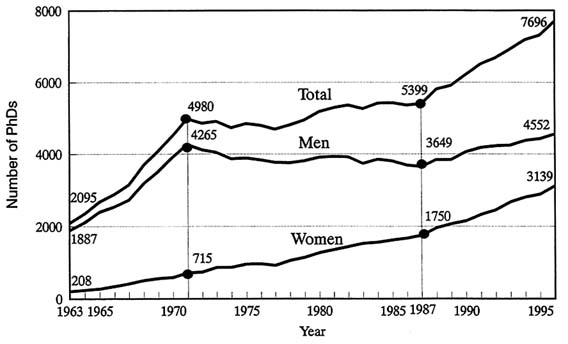
for example, fewer than 10% of life scientists receiving PhDs were women. By 1996, the corresponding fraction was over 40%. In contrast, the number of men receiving life-science PhDs—after rapidly rising in the 1960s—actually declined from 1971 to 1987 and has only modestly increased since then. Although there has been a doubling in the fraction of life-science PhD recipients who are members of minority group over the last 20 years (table E.1), the absolute numbers remain very small—rising from 96 in 1973 to 341 in 1996.
The second notable change is the increase since 1987 in the number of degrees awarded to citizens of other countries. As shown in figure 2.3 and table E.5, the number of foreign citizens (holding permanent-resident status or temporary visas) earning life-science degrees at US universities more than doubled from 1987 to 1996 (from 1,127 to 2,947). The percentage of life-science PhDs who are foreign nationals with temporary visas peaked at 28.2% in 1993 but declined somewhat thereafter. That is almost certainly an artifact attributable to the passage of the Chinese Student Protection Act of 1992, which permitted Chinese nationals temporarily residing in the United States to change to permanent-resident status; many Chinese students who have earned PhDs since 1992 have been counted in the US citizen and permanent-resident category. Figure 2.3 shows that when the number of temporary residents receiving PhDs dipped after 1993, the number of permanent residents increased sharply and that the sum of these two classes of foreign nationals rose at a steady pace from 1989 to 1996.
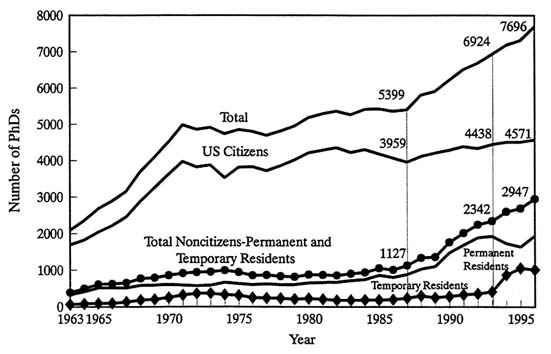
Figure 2.3
Number of US life-science PhDs awarded annually, by citizenship, 1963–1996.
Data from table E.5. 1996 total includes 178 recipients of unknown citizenship.
We do not have accurate data on how many of the foreign students on temporary visas have pursued research careers in the United States, but the percentage appears to be substantial. Figure 2.4 shows that an increasing number and percentage of temporary residents report on receiving their PhDs that they plan to remain in the United States. In recent years, about 60% have said that they plan to remain. Finn and others (1996) estimated that nearly one-third of the temporary residents who earned life-science PhDs in 1987–1988 were working in this country in 1992. The foreign-national PhDs are found in the highest proportions in subdisciplines of the agricultural sciences—such as agronomy, animal breeding, food engineering, and plant pathology—and fields that have more direct application, such as pharmacy.
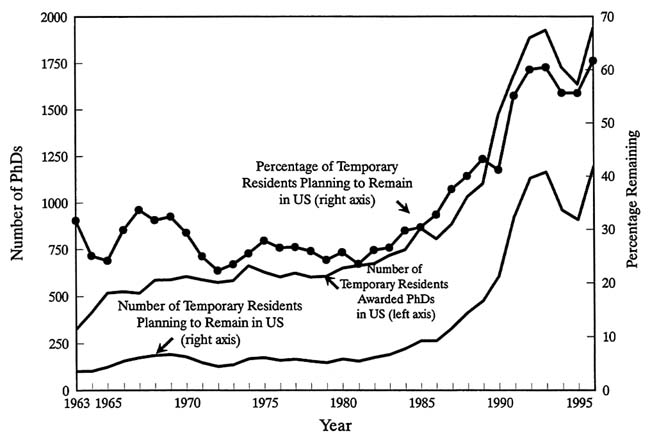
Figure 2.4
Number of US life-science PhDs awarded annually to temporary residents
and number and percentage of temporary residents planning to remain in
the United States, 1963–1996 Data from table E.1.
Although women and foreign nationals account for most of the increase in the number of PhD recipients over the last 10 years, there is a notable difference in the academic standing of the institutions in which they train. Overall, the top 26 life-science PhD-granting programs by reputation2 (NRC 1995) educate 25–32% of the life-science PhDs, a percentage that has remained roughly constant over the last 3 decades. Their programs have historically awarded a disproportionate share of the doctorates received by women. For example, in 1963, when the top programs granted 34% of all PhDs, they awarded 45% of all PhDs going to women. Although the percentage has fallen, it consistently has stayed above the top 26 programs' share of total degrees awarded; women who receive PhDs are consistently more likely to get their degrees from top departments than are men.
In contrast, the large increase in the proportion of degrees awarded to temporary residents occurred primarily at non-top-26 institutions. Only in the very earliest years was it as high as, (or higher than) the proportion of all degrees awarded by the top 26 programs, and during most of the period it was substantially lower.
There has also been a change in the means of financial support of graduate students—an increase in the fraction of graduate students receiving federal and institutional support and a large increase in the fraction supported as research assistants. As shown in figure 2.5 and table 2.1, the fraction of life-science graduate students receiving federal funds rose from 28.3% in 1975 to 28.7% in 1985 and to 34.8% in 1995. Almost all the increase between 1985 and 1995 is attributable to the support of students by research grants; the fraction of students supported by federal training grants or fellowships fell during the same period. The number of students supported by institutional (university) funds increased markedly, almost entirely because of the larger number supported as research assistants. The relatively small fraction of self-supported students dropped sharply between 1975 and 1985.
Table 2.1 is a snapshot in time of the primary means of support. In the course of a graduate student's education, the student might shift from one means of support to another. Data show that about two-thirds of students receive federal support at some time in their training
Time Required to Attain the PHD
The time required to complete the PhD in the life sciences has increased substantially over the last 30 years. As illustrated in figure 2.6, the median time to finish requirements for the doctorate—as measured from graduate enrollment to PhD award (that is, total elapsed time)—has increased from 6.0 years for 1970 graduates to 8.0 years for 1995 graduates. As can be seen from the data presented in table E.4, this median time has varied considerably among disciplines. For example, fields that either involve extensive field work—such as ecology, forestry, conservation, and fish sciences—or require multiyear studies—such as epidemiology and public health—have typically
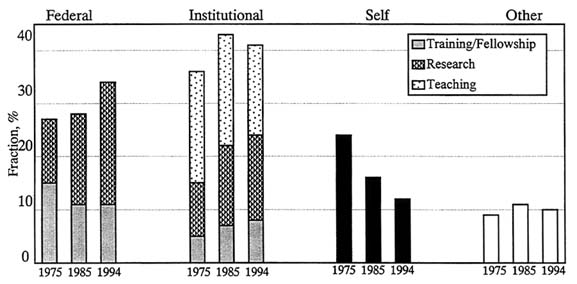
Figure 2.5
Primary source of support of graduate students in life sciences, 1975, 1985, 1994.
Data from table 2.1.
Data not available on function for self supported and other supported.
Table 2.1 Number and Percentage of Graduate Students of Various Kinds and Sources of Support, 1975, 1985, 1995
|
|
|
1975 |
1985 |
1995 |
||||||
|
|
|
No. |
% of Group |
% of Total |
No. |
% of Group |
% of Total |
No. |
% of Group |
% of Total |
|
Federal support |
|
|
|
|
|
|
|
|
|
|
|
|
Research assistant |
4653 |
41.7 |
— |
6928 |
58.6 |
— |
11963 |
66.5 |
— |
|
|
Trainee/fellow |
5994 |
53.7 |
— |
4285 |
36.2 |
— |
5391 |
30.0 |
— |
|
|
Teaching assistant |
118 |
1.1 |
— |
96 |
0.8 |
— |
155 |
0.9 |
— |
|
|
Other |
404 |
3.6 |
— |
512 |
4.3 |
— |
471 |
2.6 |
— |
|
|
Total federal |
11169 |
100.1 |
28.3 |
11821 |
99.9 |
28.7 |
17980 |
100.0 |
34.8 |
|
Institutional support |
|
|
|
|
|
|
|
|
|
|
|
|
Research assistant |
3876 |
25.3 |
— |
5678 |
31.2 |
— |
8489 |
38.2 |
— |
|
|
Trainee/fellow |
2040 |
13.3 |
— |
2891 |
15.9 |
— |
4017 |
18.1 |
— |
|
|
Teaching assistant |
8495 |
55.5 |
— |
8647 |
47.5 |
— |
8589 |
38.6 |
— |
|
|
Other |
901 |
5.9 |
— |
978 |
5.4 |
— |
1136 |
5.1 |
— |
|
|
Total Institutional |
15312 |
100.0 |
38.7 |
18194 |
100.0 |
44.2 |
22231 |
100.0 |
43.0 |
|
Other |
|
|
|
|
|
|
|
|
|
|
|
|
Self-supported |
9359 |
71.8 |
— |
6388 |
57.2 |
— |
6396 |
55.5 |
—
|
|
|
|
1975 |
1985 |
1995 |
||||||
|
|
|
No. |
% of Group |
% of Total |
No. |
% of Group |
% of Total |
No. |
% of Group |
% of Total |
|
|
|
|
|
|
|
|
|
|
|
|
|
|
Private and foreign |
3676 |
28.2 |
— |
4786 |
42.8 |
— |
5124 |
44.5 |
— |
|
|
Total other |
13035 |
100.0 |
33.0 |
11174 |
100.0 |
27.1 |
11520 |
100.0 |
22.3 |
|
GRAND TOTAL |
39516 |
— |
100.0 |
41189 |
— |
100.0 |
51731 |
— |
100.1 |
|
|
Source: NSF 1995. |
||||||||||
had longer doctoral training periods than disciplines that focus on laboratory-based research. Nevertheless, in every life-science discipline, the median time to complete the PhD is longer now than it was 2 decades ago. Since 1992, there has been no increase in median time to degree.
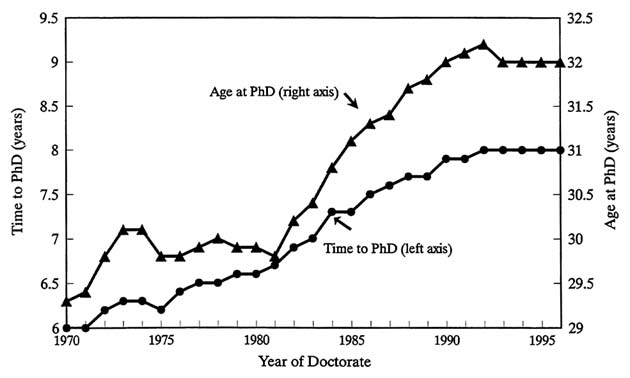
Not unexpectedly, recent PhD recipients are completing their degree requirements at higher ages than their colleagues who graduated in the 1970s and 1980s. The data in figure 2.6 reveal that the median age at PhD has risen from 29.3 years for 1970 graduates to 32.0 years for 1996 graduates. This increase of 2.7 years is substantially greater than the increase of 2.0 years in median time to complete graduate training. The difference might be explained by that fact that students have been enrolling in graduate programs at higher ages—especially in recent years.
It is uncertain why the time to degree has lengthened. No compelling academic reason exists, inasmuch as coursework typically is completed within 2 years and research usually begins at the end of the first year. Some argue that faculty use graduate students as a source of labor to conduct faculty members' research. Others point to possible benefits for the students, such as an opportunity to increase the numbers of publications on which their names appear. Without a cap on the number of years of support, there might be no compelling reason to complete the degree, especially given the perceived unfavorable job market. Students could also be trying to wait out a period of poor employment possibilities by stretching their time in school and building their resumes. It should be noted that there has been no increase in elapsed time to degree or age at degree after 1992.
Postdoctoral Training
For a steadily increasing fraction of life-science PhDs, receipt of the doctoral degree does not signify the completion of research training. As shown in figure 2.7, both the number and the percentage of PhDs planning to take postdoctoral appointments after graduation rose dramatically from 1963 to 1992. From 1993 to 1996, the number of PhDs planning postdoctoral training increased, but the percentage decreased somewhat. In the middle 1960s, fewer than one-fourth of the life-science graduates planned postdoctoral work; by the late 1980s, the fraction had doubled. The trend resulted in an increase in the total number of graduates planning postdoctoral work from 485 in 1963 to 3,940 in 1996. As will be discussed in chapter 3, that phenomenon has had a dramatic effect on the career patterns of young life scientists.
Although the trend has occurred in all life-science disciplines, it should be emphasized that the likelihood of a degree recipient's taking a postdoctoral position has varied greatly from one field to another (see table E.4). In many of the agricultural sciences, for example, fewer than one-fourth of the recent (1986–1996) graduates have planned postdoctoral work; in some biomedical disciplines such as molecular biology and neurosciences, more than three-fourths of the PhD recipients have pursued additional research training.
Figure 2.8 shows the growth in the number of postdoctoral fellows (both US citizens and foreign nationals) in academic institutions, which has increased steadily since 1972. By 1995, the number of academic postdoctoral fellows had reached 15,348 (NSF 1995). In addition to the postdoctoral fellows in academe, there are postdoctoral fellows in government laboratories (about 3,200, including clinical fellows at the National Institutes of Health) and in industry. A 1995 survey by the American Society for Microbiology (Van Ryzin and others 1995) found that 763 PhD microbiologists in industry (11% of the 7,090 PhD microbiologists in industry) were postdoctoral fellows. We estimate the total population of postdoctorals at about 20,000, but the number could well be higher.
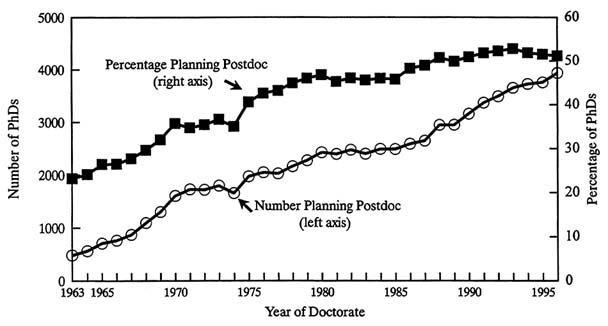
Figure 2.7
Number and percentage of PhDs planning postdoctoral training on graduation, 1963–1996.
Data from table E.1.
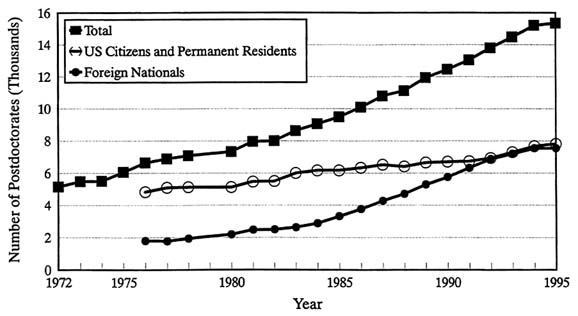
Figure 2.8
Postdoctorates in biologic and agricultural sciences, by citizenship, 1972–1994.
Source: NSF/SRS Selected Data on Graduate Students and Postdoctorates in Science and Engineering, Fall 1993, Selected Data Tables, J. G. Hukenpohler, and NSF/SRS, 1995 Survey of Graduate Students and Postdoctorates in Science and Engineering.
Over the last 20 years, foreign nationals have made an increasing contribution to the size of the postdoctoral pool. In 1975, they held about one-fourth of all academic posts; in 1995, they held half the academic postdoctoral positions. In one important nonacademic environment—the National Institutes of Health intramural postdoctoral program—almost exactly half the postdoctoral workers are foreign citizens (Michael Fordis, National Institutes of Health, 1996 personal communication).
It is important to understand that the data and discussions of chapter 3 and the remainder of this report generally do not include the large number of foreign citizens who, after completing their doctoral education abroad, have come to this country for postdoctoral training. Those scientists and foreign citizens who have obtained their PhDs here but declared their intention to leave the country are not included in the Survey of Doctorate Recipients, so there is no systematic evidence available to chart their career paths. Some data indicate that, at least in one sector, foreign nationals compete well for positions in this country. Association of American Medical Colleges (AAMC) data indicate that in the late 1980s and in the 1990s, close to one-third of new hires of PhDs, MD-PhDs, and MDs whose primary responsibility was research in basic-science departments were foreign nationals (special analysis for this study from AAMC Faculty Roster System by Lisa Sherman, 1997; see table E.9).
Length of Postdoctoral Training
From committee members' experience and from much anecdotal evidence collected by the committee, it appears that many postdoctoral fellows are spending longer times in training in recent years—4 or more years is now not uncommon for young biomedical scientists in some fields. The trends presented in figure 2.9 and table E.9, based on a retrospective reporting by respondents to the 1995 Survey of Doctorate Recipients, confirm the impression. The fraction of young life scientists holding postdoctoral appointments longer than 2 years increased substantially among those graduating in the late 1970s, with more modest growth since then. A similar pattern is observed for the fraction holding postdoctoral appointments for a total of more than 4 years. It is too early to obtain reliable estimates for graduates of the 1990s because some of them have not yet completed their postdoctoral work. Furthermore, figure 3.3 (in chapter 3) shows that a higher fraction of PhDs were in postdoctoral training in 1995 3–4 years and 5–6 years after they received their degrees than in 1973 and that the increase is greatest in the cohorts that received their degrees 3–4 and 5–6 years earlier. It is not possible to establish from these data a meaningful median time spent in postdoctoral work. However, there are clear indications that more young scientists are spending long periods as postdoctoral fellows.
On the basis of data and discussion above, it is evident that over the last 2 decades life-science PhDs have been spending increasing amounts of time preparing for research careers—a consequence mainly of the longer period in graduate training and the larger fraction that take postdoctoral fellowships of long durations. Most students pursuing a biomedical science career, for example, can now expect to spend 6 or more years in graduate school, and many spend another 4 years or more in postdoctoral work.
Field and Other Differences
This chapter frequently notes differences among sectors of the PhD population. The reader is referred to tables E.4 to note important
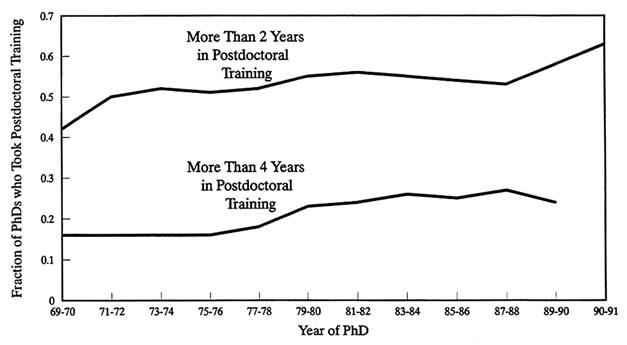
Figure 2.9
Time spent in postdoctoral training by life-science PhDs who took postdoctoral training, 1969–1994, as reported in 1995.
Data from table E.8.
differences, for example, that almost all the increase in the life-science PhD population is in biomedical sciences, whereas there has been little or no increase in the number of nonbiomedical-science PhDs. Table E.10 shows differences by sex, race, citizenship, and top-26 universities compared to non-top-26 institutions.
Summary
- The number of life-science PhDs awarded annually in the United States has increased by 42% since the late 1980s, and the number awarded in 1996 was more than 3 times the number awarded in 1963.
- Foreign nationals with either permanent or temporary visas accounted for 38% of the life-science PhDs in 1996, and the number of temporary-visa holders planning to remain in the United States has risen to about 60% in recent years.
- Almost all the increase in numbers of life-science PhDs awarded has been in biomedical fields; the number in nonbiomedical fields has remained virtually the same since 1970.
- The median elapsed time between entry into graduate school and receipt of the life-science PhD has increased by about 2 years, from 6 to 8 years, but PhDs are obtained more quickly in some fields.
- The federal government financially supports the education and research training of about one-third of all life-science graduate students. The almost 12,000 graduate students supported by federal research grants represent the largest support mechanism among all categories of support—federal, institutional, or self.
- An increasing percentage of life-science PhDs do postdoctoral work, and the length of time spent in postdoctoral training is increasing.
- The number of persons in the postdoctoral pool has been increasing steadily and is now about 20,000.
Those several changes have had a serious effect on the labor market for life scientists. Throughout the roughly 30-year period being considered in this report, the cohort of young scientists entering the workforce has been much larger than the cohort that they replace (those who had completed their training 30 or so years earlier). Although the number of life scientists reaching retirement age has been steadily increasing, so has the number entering the workforce. For example, some 2,700 doctorates were awarded in 1965, compared with 7,696 in 1996. The impact of these trends on career opportunities for young PhDs is examined in detail in the chapter 3.
References
Finn MG, Pennington LA, Anderson KH. 1996. Who stays—who leaves: foreign PhDs eight years after graduation. Presented at 1996 American Association for the Advancement of Science annual meeting.
NRC (National Research Council). 1978. A century of doctorates: data analysis of growth and change. Washington, DC: National Academy Press.
NRC (National Research Council). 1995. Study of research doctorate programs in the United States: Continuity and Change. Washington, DC: National Academy Press.
NSF (National Science Foundation). 1995. Survey of graduate students and postdoctorates in science and engineering. Washington, DC: NSF.
Van Ryzin G, Dietz S, Weiner J, Wright D. 1995. The employment outlook in the microbiological sciences, 1995. http://www.asmusa.org/pasrc/empoutlk.pdf.


