
5
Implications of the Findings
Changing Career Prospects for Life-Science PHDS
The career prospects in 1998 for a graduate student or postdoctoral fellow in the life sciences are very different from those of someone who trained in the 1960s or 1970s. Today's life scientist will commonly have started graduate school at a slightly greater age and will have taken 2 years longer to obtain the PhD degree. This year's PhD recipient is on the average 32 years old. With degree in hand, he or she will probably join an ever-growing pool of postdoctoral fellows now estimated at about 20,000 persons to engage in research while obtaining further professional training. Although postdoctoral positions have much in common with medical internships and legal clerkships as a means to obtain further postgraduate training, they are different in one important respect: they have no fixed length of tenure. It is not unusual for a trainee to spend 5 years or more as a postdoctoral fellow. Consequently, the average life scientist will be 35–40 years old before obtaining his or her first permanent job.
A life scientist's probability of finding employment in either a 4-year undergraduate college or a research university has declined over the last 20 years, as described in chapter 3. In contrast to declining prospects in academe, however, the fraction of graduates who hold positions in industry has increased; it surged during the middle 1980s, but the increase has slowed recently. In spite of the increase, according to the National Research Council surveys, there has been an overall decline in the percentage of life scientists who are using their research training in their "permanent" employment; the fraction of life scientists who had graduated 5–6 years before and who were employed in "permanent" positions in academe, industry, or government decreased from 89% in the 1973 survey to 62% in the 1995 survey1.
Changes in the Research and Training Enterprise
The rapid expansion in federal support of basic biologic research that occurred during the 1960s and early 1970s allowed the joint research and training system to flourish. Scientists who earned their PhDs in that era had bright prospects for employment in research. The training system of that time was built on the tacit premise that there would be continuous growth in the size of the US research enterprise—sufficient to absorb the trainees who were moving through the system. The result was not simply that more life scientists were available to work in laboratories and in the field; the active training enterprise produced a scientific workforce whose age distribution became skewed toward youth. That age bias brought energy and innovation into the profession.
Beginning in the early 1970s, however, the rate of expansion in federal research support and the growth in the number of universities and colleges began to slow down. The slowdown was not accompanied by a corresponding decline in PhD production. Instead, the annual rate of PhD
|
1 |
See Figures 3.12 and 3.13, in chapter 3. The categories included as employed in "permanent" positions are tenured or tenure-track faculty positions in PhD-granting or other academic institutions, positions in industry or government, and other positions including self-employment. The categories included as not employed in "permanent" positions are unemployed and seeking a position, part-time employment, positions outside science and engineering, postdoctoral appointments in any sector, and other academic positions. |
production was fairly constant through the 1970s and 1980s at about 5,500 per year. Two changes in the employment market absorbed the trainees who could no longer find jobs in the traditional employment sectors of academe, the pharmaceutical and agricultural industries, and government. First, the biotechnology industry emerged in time to provide new and exciting employment prospects for many PhD graduates in the life sciences. Second, the system adapted to the continued high rate of training by increasing the support available for postdoctoral fellows.
The resulting expansion of the postdoctoral pool has not, however, created permanent jobs for life scientists; it has produced a holding pattern. In its favor, the increased fraction of PhDs who now take postdoctoral work is probably responsible for the finding that an increased fraction of life-science PhD recipients are involved primarily in research (Table F.1). The result has been an economical and highly effective workforce whose research productivity is excellent and whose salary costs are comparatively low. The intellectual fluidity and scientific productivity of the life sciences rests to a great extent upon this cadre of postdoctoral fellows who, with graduate students, operate within the tradition of laboratories that are funded through highly competitive grants to principal investigators for the pursuit of their scientific ideas.
If the annual rate of PhD production had been constant into the 1990s, the number of scientists in the postdoctoral holding pattern would probably have continued to grow. In reality the rate of PhD production has increased. In 1996, 7,696 life-science PhD degrees were awarded, roughly a 42% increase over the 5,500 characteristic of the 1980s. A substantial fraction of that increase was due to an influx of foreign students, partly as a result of a change in immigration law described in chapter 2. In 1995 about 22.4% of the PhD recipients were foreign nationals. Although it is difficult to know precisely what percentage of those foreign-born graduates will return to their countries of origin, the most recent Survey of Doctoral Recipients indicates that, at least at graduation, the majority state an intention to remain in the United States.
The dramatic increase in the number of life-science PhDs has already had a substantial effect on the size and composition of the postdoctoral pool, and the pool is being enlarged by an influx of foreign-trained PhDs who have come to the United States for further training. The inevitable consequence has been an increase in the competition among postdoctoral fellows for permanent positions in all employment sectors. The full impact of the population increase has not yet been felt in that most of the new postdoctoral fellows have yet to face the permanent-job market. That suggests that young people's difficulty in finding jobs that use their research training will get worse before they get better. Moreover, the committee's analysis in chapter 4 suggests that there is no new source of jobs for life scientists lying just over the immediate horizon—nothing like the opportunities provided by industry during the 1980s. If anything, the expected changes in the financing of higher education, academic health centers, and industry will only widen the gap between the number of life scientists being trained and the number of jobs for them to do.
Is there a Problem? an Analysis from Different Perspectives
Should the recent changes in the career paths of life scientists be a cause of concern? Is the dismay that is being voiced by the current generation of trainees a symptom that the system is no longer optimal, or is it simply the normal discomfort of students reacting to the prospect of healthy competition? Opinions about the value, appropriateness, and stability of the current
professional system vary widely, depending in part on the perspectives of those holding the opinions. A convenient way to describe the situation is to identify groups of "stakeholders" who look at the current professional system from different points of view.
Administrators and Established Researchers
Leaders of industrial or government laboratories, university administrators, teachers in large undergraduate programs where extensive laboratory work is performed, and established life-science researchers who must compete for renewed funding are likely to argue that the current situation has much to offer; their motivation to promote change is weak or absent. Both the time-consuming experiments that are characteristic of much biologic research and the education of large numbers of undergraduates are well suited to the skills and training of graduate students and postdoctoral fellows. The research productivity of an individual laboratory—even of an entire department—can depend on the number of graduate students employed, so future funding and intellectual prestige might depend on attracting as many good students as possible. Occasionally, there are additional incentives to keep numbers of students high, such as the supplements provided by some local legislatures to their state universities in proportion to the size of their graduate programs. All those factors are powerful arguments for leaving the current situation unchanged.
Few branches of the life sciences in the United States have adopted the alternative professional system of hiring permanent laboratory scientists and technicians trained at the bachelor's, master's, or PhD level. From an economic point of view, such permanent employees usually require higher salaries and a greater institutional commitment, such as retirement benefits, than temporary students and fellows. Furthermore, from an intellectual perspective, most life scientists will argue that students and postdoctoral fellows bring fresh approaches and new energy to a laboratory—features that are difficult to duplicate with a more permanent workforce. Thus, a pool of young scientists who rotate through a research laboratory is considered by many to be optimal for creativity and productivity, even though there can be inefficiencies while students are acquiring expertise.
Funding Agencies
Organizations that fund life-science research can also be seen as having a vested interest in maintaining the status quo. Life-science graduate students supported by research grants are regarded by many such agencies as employees, as reflected by their designation on budget sheets and the resistance of some agencies to paying tuition. Most life-science graduate students are good value for the research dollar: they earn annual salaries of only about $16,000 and generally work very hard. Their productivity might be modest early in their doctoral research, but they become effective producers of data later in their training. In this context, it appears that a long graduate-student tenure has features that are desirable to established scientists and funding agencies; this training system increases the likelihood that a student can accomplish substantial work while still being paid at a comparatively low rate.
Funding agencies are likely to view their investment in postdoctoral fellows in much the same light. Even though the initial salaries of this group are higher than those of graduate students, tuition is no longer an issue, and these young scientists are more likely than graduate students to be immediately effective research workers. Thus, the growth of both populations of life scientists carries benefits for institutions that wish to maximize the effect of their research
investment.
Incoming Graduate Students
Prospective graduate students have good reasons for wanting the profession to maintain high enrollments in a large number of graduate programs. The availability of many programs offers students a wide range of choices, and high enrollments increase one's likelihood of being accepted. Stipends for graduate life-science students are below the current average starting salary for a person with a bachelor's degree in biology ($21,558), so short-term financial sacrifices are associated with graduate training, but one can reasonably expect to recover these losses eventually. Finally biology has an exciting intellectual future, and students can be confident that the research apparatus will not run out of work in the foreseeable future.
Senior Graduate Students
Senior graduate students might begin to view the current training system more negatively. The data show that they must expect a protracted graduate career; the longer their training continues, the greater the extent to which their incomes will fall behind the salaries of their college classmates who entered the workforce at graduation. Health-insurance benefits might not be as good as those in the overall workforce—a more pressing issue as a student contemplates starting a family. During the later stages of training, senior graduate students might no longer be learning new skills but rather spending time in increasing their professional accomplishments and contributing to those of their mentors.
Postdoctoral Fellows
Finding a postdoctoral position is normally not difficult because many such jobs are available. The compensation of life-science postdoctoral fellows is, however, only marginally better than that of graduate students, and the quality of the benefits remains low. At the beginning of this career stage, postdoctoral fellows might well be so involved with their new and exciting work that their long-range professional prospects are invisible. Virtually all by their third or fourth year, and some sooner, face the prospect of searching for a more permanent position. Many entered graduate school with the intent of eventually finding a position as a professor in a university or college. Their mentors in both graduate school and postdoctoral training probably encouraged them to pursue this career goal, and some will have implied, either explicitly or implicitly, that any other career outcome would be a sign that they had failed. Yet the likelihood that they will obtain such a position is now lower than it was when they made the decision to begin graduate studies. Although unemployment is very low (still less than 2% in Table F.1) and underemployment is only modest, the number of applicants for good jobs of all kinds—whether in academe, government or industry—is very large. Thus, the prospects for permanent employment that will provide research opportunities and intellectual independence appear dim.
Even the most highly successful postdoctoral fellows, working in one of the 26 institutions of the highest reputation, are now seeing that 3–4 years of postdoctoral training might not be sufficient to secure a good job. The data in Table F.1 show that the fraction of scientists in the cohort 3–4 years after receipt of the PhD who are still engaged in postdoctoral training has been steadily increasing over the last 10 years. Members of that cohort are competing for jobs with members of the cohort who are 5–6 years post receipt of the PhD, who have often published more papers. In response to these realities, many postdoctoral fellows are now undergoing a "crisis of expectation" that comes from a sense that an implicit contract between them and the scientific establishment has been broken. They had agreed
to forgo economic compensation for 10–12 years while they acquired scientific knowledge and expertise; in exchange, they expected a reasonable likelihood of obtaining a satisfying job later. Had they known their realistic prospects at the beginning of the long training period, they might well have made different choices.
Young Investigators
Another important group of stakeholders is the young scientists who have recently become employed in research-oriented institutions. One might imagine that they would view their careers as established and that they would adopt the viewpoint of more-senior scientists. Several differences between young and established scientists, however, suggest otherwise. For one thing, these scientists are likely to be older than were life scientists at a comparable stage of professional development some years ago. The demanding work of establishing a productive laboratory comes at a time when other responsibilities, such as children, might be competing for their time. Decisions about starting a family are important to both male and female students, but females must consider whether they want to have children because they are likely to be in their middle to late 30s, and their biologic clocks will not grant them much more time.
Young life scientists whose jobs are not in an industrial or government laboratory face the primary responsibility of attracting research support so that they can build their research programs and have some likelihood of being retained and promoted. They must compete successfully for money, or their research careers will soon end. Yet success rates in obtaining grants have decreased for young investigators as they have for investigators of all ages. The situation has been ameliorated to some extent by the existence of other sources of research money that are available explicitly for young people, such as grants from the Pew Charitable Trusts, the Searle Foundation, formerly from the Markey Trust, and now from both the Burroughs Welcome Fund, and the American Cancer Society, which is focusing its scientific-grants program on young people. Notwithstanding the additional sources, however, even the most successful young investigators view the task of establishing their research programs as stressful and difficult.
The American People
An additional group of stakeholders is the American people, the citizens whose taxes and gifts have supported all aspects of the scientific enterprise. The American people have a right to expect a system of life-science research that will be productive and efficient and that will generate knowledge that leads to improvements in their environment, their food, and their health.
Through Congress, the electorate has consistently endorsed the importance of life-science research, and such groups as Research! America have found that most Americans are willing even to increase the money invested in biomedical research (Research!America 1997). From an economic point of view, there is much value in the short run associated with a large training enterprise that keeps labor costs low, but this might not be the most cost-effective strategy to meet the research interests of the country in the long run. Taxpayers deserve a professional system that will be strong and effective not just today, but also in the future. The interests of the American people will be best served by keeping firmly in mind the question of what is best for life-science research enterprise, not just best for some current life scientists.
The Crisis of Expectation
The foregoing discussion underscores the reality that one's opinion about the fairness and
effectiveness of the current system for producing life scientists and conducting life-science research can depend very much on how far along the career path one is. Many established scientists view the current professional system as optimal and point out the importance of competition for a healthy scientific climate; these scientists often refer to their own success with analogous competition when they were young. There is certainly some truth in that point of view, but it misses some of the flavor of the current times. The current cohort of established investigators began their careers in a very different climate; regardless of their recollections, they experienced far more favorable conditions—from the length of their training to their prospects of a job and a grant with which to conduct research.
The crisis of expectation among today's young life scientists is palpable. Although there are no extensive data from an objective survey of public opinion, the committee had information from four informal sources. In the fall of 1994, Richard McIntosh, president of the American Society for Cell Biology, wrote a short piece in the society's newsletter (McIntosh 1994) describing his understanding of the problems facing young cell biologists and asking those interested to reply and present their views or experience. More than 50 letters were received; some were written by senior investigators, but most came from graduate students, postdoctoral fellows, and young independent scientists. More recently, the committee held a public hearing in Washington and invited members of the life-science community to present their views at the hearing and electronically through e-mail. The committee was also given access to the results of a survey conducted by the University of California, San Francisco Center for the Health Professions of the Pew Scholars in the Biomedical Sciences. This program, funded by the Pew Charitable Trusts, has supported 20–22 newly independent scientists per year for the last 10 years. Pew scholars are a highly select group of young investigators in all fields of the biomedical sciences. The survey collected retrospective data on the duration of training and opinions of the scholars regarding the health of biology. Finally, the Education Committee of the American Society for Cell Biology, chaired by Professor Frank Solomon of the Massachusetts Institute of Technology, used a Federation of American Societies for Experimental Biology e-mail network to query a broad range of investigators about their views.
Clearly, those informal surveys cannot be regarded as statistically reliable inasmuch as no effort was made to obtain a representative sample of the various populations of life scientists. Nonetheless, they are informative in several ways. First, they encourage the view that many established scientists are concerned about the fate of the young people they are training, many of whom are having great trouble getting jobs or grants. Second, there is a perception that a large gap separates the haves and the have-nots: those who are established in jobs and with grants and those who aspire to such a situation. Third, there is a pervasive sense that in the current climate of increased competition, something precious has been lost; the excitement and promise that have characterized the life sciences for many years are not felt with the same intensity by many young people because they are too concerned about their futures. Fourth, there is a widespread sense of failed expectations. Most of the young people who replied had entered life-science training with the expectation that they would become like their mentors: they would be able to establish a laboratory (in industry, academe, or a government agency) in which they would pursue research based on their own scientific ideas. The reality that now lies before them seems very different. There simply are too few such jobs, in any sector of the profession, to hire all the new life-science aspirants of high quality. The result is a crisis of expectations.
Many thoughtful commentators on the current situation, including the National Academy of Sciences' Committee on Science, Engineering, and Public Policy report (COSEPUP 1995), have argued that there are plentiful alternative careers for people with the intellectual abilities and training implied by a doctorate in the life sciences. Whether or not those positions will become more important as sources of employment for life-science PhDs in the years ahead, there appears to be a substantial resistance to career redirection during the postdoctoral years. At least four factors seem to contribute to this unwillingness to redirect a career:
- Most people who have gone through the labor of getting a life-science PhD, whether or not they go on to training at the postdoctoral level, love the process of science in a powerful and fundamental way. To relinquish the pursuit of a first professional love is a tremendous loss.
- It is satisfying and rewarding to do something that one does well. Most PhD-trained life scientists are highly accomplished in their research, and there is intrinsic satisfaction in doing more of same.
- The expectations with which many people entered scientific training included working in a field that is highly respected within the country, earning a good middle-class wage and doing things that are fundamentally enjoyable. These are attractive features of life-science research; leaving science before one is forced out is therefore very difficult.
- When one has invested so much effort in highly focused training, it seems wasteful and even self-destructive to leave it behind and go on to something else. There are transferable skills—such as problem-solving, the acquisition and analysis of data, and the hierarchic organization of ideas and activities—but many postdoctoral scientists expect that a change of fields will mean either doing something rote or going through yet more training. After more than 10 years of ''training", this is an onerous prospect.
Factors Affecting the Future Vitality of the Life-Science Enterprise
One important aspect of America's current training system for life scientists is beyond dispute: it is inherently expansionist and is not at steady state. The significant contributions of young people to the life-science enterprise have made them so attractive to the senior members of the profession that the rates of training have continued to increase while the number of people still in postdoctoral positions, without any immediate prospect of permanent research positions, is also increasing. The most likely future for a recent life-science PhD is to be a postdoctoral fellow for a very long time.
The present situation in life sciences is not, however, unique. All the sciences expanded rapidly in the late 1950s and the 1960s as a direct response to the threats of the Cold War. The number of academic openings was huge, coming from both expansion in existing universities and the rapid creation of new ones. That growth was highly unusual in the history of science, and it is unlikely to be repeated soon. As the inevitable slowdown occurred, there developed an over-abundance of aspirants relative to the number of permanent positions in the sciences. In physics, the reduction in research funding reduced both available positions and funds to support research and training; as a consequence, enrollments in physics programs declined.
The effect of the slowdown was felt earlier in fields other than the life sciences, in part because the life sciences have experienced a virtual explosion in opportunities and their federal support over the last 10 years has outperformed that of all other sciences. In addition, the life sciences have made efficient and effective use of the postdoctoral position by keeping remuneration of younger colleagues low. As a consequence, the life sciences have been able to support a much
larger number of postdoctoral fellows than any of the other sciences.
The current pressing challenge for the community of life scientists is to acknowledge that the structure of the profession has led to declining prospects for its young and to develop accommodations that maximize the quantity and quality of future scientific productivity. Success in meeting the challenge will depend to a large extent on ensuring the future success of the most talented of young life scientists. In the next section of this chapter, the committee analyzes the effects of the structural changes from the perspective of the scientific enterprise itself.
Number of Aspirants
The current size of the life-science PhD candidate pool is testimony to the remarkable success of the US investment in life-science research over the last 20 years. Many college-age students, both here and abroad, judge the life sciences to have the most exciting future of all the sciences. As a result, the enrollment in undergraduate life science courses is growing: from 1989 to 1993, the number of people earning bachelor's degrees in the life sciences increased by about 30% (NSF 1996). The future vigor of the life sciences will depend on ensuring that the most talented students continue to be attracted to graduate training in the life sciences. Of course, the fascinating problems that remain to be solved will always be a draw, but to provide these able young people a profession that is commensurate with their talents we must meet at least two additional conditions: we must inform them in realistic terms of their chances of achieving their career goals and we must recognize that these times are very different from those when today's established investigator began their careers. Several of the recommendations presented in chapter 6 focus on meeting those conditions effectively.
Balance Between Research Training and Employment Opportunities
The extraordinary research opportunities that are sketched in chapter 4 are only a few of the many in modern life science that offer stimulating challenges for both scientific advance and commercial development. As a reflection of the scientific opportunities, the budget of the National Institutes of Health (NIH) has fared exceptionally well in Congress over the last 10 years, when other discretionary programs of the federal budget have diminished. The FY 1997 budget included a remarkable 7% increase for NIH—unprecedented among agencies funded within the discretionary part of the budget. That vote of confidence on the part of the president and Congress reflects their conviction that the life sciences are important to the future health and economic well-being of the US population.
In the context of the scientific and financial opportunities there appears to be no compelling justification for discouraging the best students from considering graduate training in the life sciences. As long as there are numerous tasks to be done and sufficient funds to support research, the training of new scientists has a high priority for the profession. Moreover, the long time between entry into graduate school and assumption of a permanent position makes it difficult to predict the employment market as little as 10 years hence.
But it would be irresponsible to ignore the signs that our existing PhD production is perhaps too large and that there is an imbalance in the population of life scientists compared to available positions. The signs include the lengthening of time to graduate-degree receipt and the increases in the duration and number of postdoctoral positions. It is argued by some that the lengthening of training reflects the vast amount of new information that must be learned to become a
successful modern biologist, but this argument is difficult to sustain on either intellectual or practical grounds. As knowledge increases, some of what used to be thought essential is set aside, and more of what is still essential is taught at lower levels. High-school students now learn about the structure and function of DNA, whereas 30 years ago this was college material. The committee believes that the lengthening of graduate and postdoctoral training is primarily a response to the growing number of applicants and the intense competition for permanent positions. To be competitive for those positions, young scientists must have extensive records of productivity at each stage of their careers.
The continued increase in graduate admissions over the last 10 years has contributed new strains to an already strained system. One can easily imagine that further increases in graduate enrollments, without a concomitant increase in the size of the job market, will lead to such widespread student disaffection that the long-term result will be a drop in the number of highly qualified PhD candidates in the life sciences. The situation suggests that a balance must be found to maximize the likelihood of a good supply of high-quality, well-trained life scientists for many years to come.
Strategies for Optimizing Graduate and Postdoctoral Training
Maximizing the Return on Funds Invested in Training
The stipend and tuition of US-trained graduate students in the life sciences are supported by a variety of mechanisms, as described in chapter 2, including training grants, fellowships, and teaching and research assistantships. About half the students are employed as research assistants. The different sources of support have relatively little effect on the day-to-day activities of students, the vast majority of whom spend their time conducting research in the laboratories of their mentors. However, there is a real distinction among the funding mechanisms in the level of oversight of training itself. We focus in the following pages on the NIH support of training because NIH is the single largest source of such support. Other federal agencies play important roles and, as can be seen in Table 2.1, institutional support of graduate students and "other" support, including self-support, also account for substantial numbers of students.
The current NIH training-grants program was established by Congress in 1973 when it authorized National Research Service Awards (NRSAs) as a way to ensure that the need for new biomedical and behavioral research scientists was being met. At the same time, Congress asked the National Research Council to make periodic estimates of the national needs for such personnel that congressional committees could use to evaluate the annual NIH budgetary requests for training funds; this action was intended to prevent shortfalls and surpluses in the number of research scientists being trained. For more than 20 years, the Research Council's Committee on National Needs for Biomedical and Behavioral Research Personnel has been making advice available to Congress.
Training grants are awarded to graduate programs on the basis of a stringent process of peer review. The grants fund the stipends and some fraction of tuition for a specific number of students, determined at the time of application review. Some funds are also provided for auxiliary educational activities, such as seminar programs and symposiums. Graduate students are identified for appointment under a training grant by the institution itself, and they are usually supported for 2–3 years of their total graduate career. NIH supports about 7,500 students on training grants at about 197 institutions, or about
14% of the country's life-science graduate students.
NIH training grant are awarded only after a graduate program has been peer-reviewed by a training committee appointed by the NIH. The review process takes into account such factors as students' time to degree, postgraduation careers, and accomplishments. The process also holds programs to a very high standard of minority-group student recruitment and retention and faculty diversity. And applicant institutions must provide a program of formal instruction in the responsible conduct of research.
The review committee visits the training institution and observes the educational program, interviews students, and engages faculty in discussion. That kind of review by an external group brings to training an expert assessment of quality that parallels the scrutiny that research proposals receive. Such careful examination of faculty, students, and graduates stands in marked contrast with the procedure for employing a graduate student as a research assistant under a research grant, in which case the judgment of the supervising investigator and the willingness of the student are the only controls on the quality of training. In the committee's opinion, the guidance achieved through the review process is likely to produce a better-balanced, more-rounded education of students. Most important, perhaps, is that the award of a training grant is based on the quality of training provided and the training record of the program, and not just on the value or significance of ongoing research. Competition among universities for training grants is fierce. In general, the programs that succeed in obtaining training grants are those in the top-rated universities, as ranked by the National Research Council's Survey of Graduate Programs (NRC 1995)
The superiority of outcomes of training grants is difficult to document. One older study of the question (IOM 1984) focused on the biomedical sector of the life sciences. The study compared performance with respect to a series of indicators (for example time to degree, completion of degree, later research-grant awards, and articles written) of three groups of former graduate students: those who had held NIH traineeships, others in the same programs who had not had traineeship support, and all other biomedical graduate students in the same annual cohorts. Holders and nonholders of traineeships in programs that had training grants performed about the same, and both outperformed the students who had completed programs that did not have any training grants. It appears that the benefits of training grants are program wide rather than support-specific. The results of that study, which is now 17 years out of date, would appear to support the committee's judgment that applying for and receiving a training grant have a salutary effect on department faculty, leading them to a concern about how, as an entity, they are providing for the education and training of their students. An update of the study is being sponsored by NIH, but its conclusions were not available at the time of our deliberations.
Those results are equivocal in that training grants are awarded only to programs that are already providing a superior education or have attracted students of superior ability. The alternative explanations cannot be ruled out, and the prominence of highly ranked institutions on the roster of those receiving training grants lends them added plausibility. Nevertheless, members of the committee with personal experience of the review process for training grants believe that the process affects the critical standards that faculty apply to themselves. On this ground alone, namely the beneficial scrutiny of peers who are not immediate colleagues, seems to be the strength of NIH training grants.
Almost 12,000, or two-thirds, of the graduate students supported by federal funds in 1995 were
paid from research grants awarded to faculty (see table 2.1). Unlike the training grants and fellowships awarded to individuals, the quality of graduate training provided through this mechanism is not monitored by any agency outside the individual university. NIH, the major federal sponsor of research and training, does not consider the research funds used for graduate-student salaries on research grants as money invested in training although tuition and a salary can be charged to the grant. Rather, these students are seen as employees hired to conduct research. According to Public Health Service policy, graduate students' tuition remission that is charged to faculty research grants is an allowable cost—payment in lieu of salary or wages to students performing necessary work.
Supporting student training through individual research grants permits a funding agency the least amount of peer review of its graduate training investment. It also promotes an employer-employee relationship between faculty mentor and student that creates a potential for a conflict of interest that might adversely impact effective training. For example, because PhD training does not have a fixed term, the decision as to when a candidate has completed training usually rests with one or a small number of faculty members. This system contains a potential for abuse, particularly in times of job shortage. A conflict can arise between a student's interest in moving on to the next career stage and a professor's interest in retaining a highly productive worker. Or a mentor might discourage a student from taking additional coursework or teaching an additional class to gain more pedagogic experience on the grounds that these activities take time away from the grant-supported activity.
NIH and the National Science Foundation also award graduate-training fellowships directly to individuals, although the number of fellows at any time is tiny compared with the numbers of trainees and research assistants. Fellows usually enjoy more freedom in shaping their graduate education than do trainees and assistants, although they must of course abide by department or program rules. In considering fellowship applications, the overall quality of the institution chosen for training is taken into account, but the major factor in awarding a fellowship is the quality of the applicant. Once such a fellowship has been awarded, there is no followup review to judge the nature or quality of the training that the awards has received. This form of graduate support therefore lacks an important component of peer review that is found in training grants. By relying more on training grants for the support of graduate students, the federal government will be in a better position to gather information about its current investment in graduate education and thus be in a better position to monitor PhD production.
The Problem of Time to Degree
Whether the pressure to lengthen postbaccalaureate training is coming from mentors, who are maximizing the return on their investment in training, or from the students themselves, who are trying to improve their research records, the outcome is that young scientists are spending their most creative and productive years under the direction of more senior investigators. The US scientific enterprise is at risk of losing what many consider to be its most distinctive and successful attribute: that scientists are given their independence at a relatively early age. In contrast with many European countries, where scientists spend many post-PhD years in positions that depend on senior professors, the United States has prided itself on encouraging the energy, independence, and creativity of its talented young practitioners. In the past, it was expected that by the age of 35 US life scientists would have their own laboratories and the resources to carry out newly conceived research plans.
Figure 5.1 and table 5.1 show the number of tenured and tenure-track faculty of various ages at PhD-granting and non-PhD-granting institutions in 1975, 1985, and 1995. The distribution in 1975 was decidedly skewed toward a young faculty complement. By 1994, the distribution was broader and shifted toward higher ages (Figure 5.2). Whereas in 1975, half the faculty were under 39–40 years old, half of the faculty in 1995 were under 47–48.
Although young scientists might be productive in dependent postdoctoral positions, it is important to consider whether they are allowed, under these circumstances, to develop and use their creativity. The lengthening of time that young scientists spend in dependent positions would be deleterious to science only if there were a negative correlation between age and scientific innovation. In mathematics, the aging of the population would be viewed with great dismay, given the common perception that mathematics benefits from young and nimble minds. In the life sciences, there is not the same perception that youth is an advantage. However, using the Nobel prize as a yardstick of originality and impact of scientific work, Stephan and Levin (1993) examined the age at which the critical experiments awarded Nobel prizes in Medicine and Physiology in 1901–1992 were conducted. They found that the median age was 38 years, only slightly older than the median age of 37 in chemistry and 34.5 in physics. Their data showed that the most innovative experiments generally were done by those 30–50 years old; the majority were under 40. The authors concluded that "it is safe to say that regardless of field, the odds of commencing research for which a Nobel prize is awarded decline dramatically after age 40, and very, very few laureates undertake prize-winning work after the age of 55."
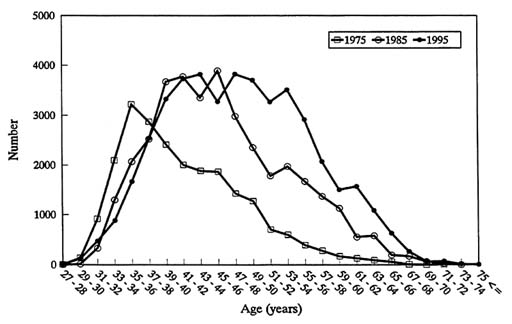
Figure 5.1
Number of US life-science PhDs in tenured positions, by age, 1975, 1985, 1995.
Data from table 5.1.
Table 5.1 Age distribution of US PhD life-science faculty in 1975, 1985, and 1995
|
|
1975 Survey |
1985 Survey |
1995 Survey |
||||||
|
Age, Years |
No. |
% |
Cumulative % |
No. |
% |
Cumulative % |
No. |
% |
Cumulative % |
|
27–28 |
5 |
0.0 |
|
0 |
— |
— |
2 |
0.0 |
0.0 |
|
29–30 |
132 |
0.6 |
0.6 |
13 |
0.0 |
0.0 |
122 |
0.3 |
0.3 |
|
31–32 |
912 |
4.1 |
4.7 |
329 |
0.9 |
1.0 |
471 |
1.1 |
1.3 |
|
33–34 |
2093 |
9.3 |
14.0 |
1295 |
3.6 |
4.6 |
881 |
2.0 |
3.3 |
|
35–36 |
3218 |
14.3 |
28.3 |
2067 |
5.8 |
10.4 |
1664 |
3.8 |
7.1 |
|
37–38 |
2868 |
12.8 |
41.1 |
2523 |
7.1 |
17.4 |
2533 |
5.7 |
12.8 |
|
39–40 |
2410 |
10.7 |
51.8 |
3668 |
10.3 |
27.7 |
3324 |
7.5 |
20.3 |
|
41–42 |
2002 |
8.9 |
60.7 |
3772 |
10.6 |
38.3 |
3726 |
8.4 |
28.7 |
|
43–44 |
1882 |
8.4 |
69.1 |
3353 |
9.4 |
47.7 |
3817 |
8.6 |
37.4 |
|
45–46 |
1865 |
8.3 |
77.4 |
3886 |
10.9 |
58.5 |
3274 |
7.4 |
44.8 |
|
47–48 |
1421 |
6.3 |
83.7 |
2977 |
8.3 |
66.9 |
3821 |
8.6 |
53.4 |
|
49–50 |
1268 |
5.6 |
89.3 |
2353 |
6.6 |
73.5 |
3700 |
8.4 |
61.7 |
|
51–52 |
699 |
3.1 |
92.4 |
1782 |
5.0 |
78.4 |
3267 |
7.4 |
69.1 |
|
53–54 |
595 |
2.6 |
95.1 |
1971 |
5.5 |
84.0 |
3510 |
7.9 |
77.0 |
|
55–56 |
388 |
1.7 |
96.8 |
1668 |
4.7 |
88.6 |
2913 |
6.6 |
83.6 |
|
57–58 |
276 |
1.2 |
98.1 |
1366 |
3.8 |
92.5 |
2069 |
4.7 |
88.3 |
|
59–60 |
164 |
0.7 |
98.8 |
1124 |
3.1 |
95.6 |
1501 |
3.4 |
91.7 |
|
61–62 |
123 |
0.5 |
99.3 |
551 |
1.5 |
97.1 |
1567 |
3.5 |
95.2 |
|
63–64 |
86 |
0.4 |
99.7 |
577 |
1.6 |
98.8 |
1079 |
2.4 |
97.7 |
|
65–66 |
54 |
0.2 |
100.0 |
190 |
0.5 |
99.3 |
626 |
1.4 |
99.1 |
|
67–68 |
6 |
0.0 |
100.0 |
167 |
0.5 |
99.8 |
264 |
0.6 |
99.7 |
|
69–70 |
0 |
0.0 |
100.0 |
61 |
0.2 |
99.9 |
61 |
0.1 |
99.8 |
|
71–72 |
0 |
0.0 |
100.0 |
24 |
0.1 |
100.0 |
67 |
0.2 |
100.0 |
|
73–74 |
0 |
0.0 |
100.0 |
1 |
0.0 |
100.0 |
8 |
0.0 |
100.0 |
|
75+ |
0 |
0.0 |
100.0 |
0 |
0.0 |
100.0 |
4 |
0.0 |
100.0 |
|
|
22,467 |
|
|
35,718 |
|
|
44,271 |
|
|
Those authors attributed the association between important scientific discovery and youthfulness to many factors, including the ability of the young to focus on a problem without the distractions and responsibilities that people accumulate with age. They also identified the ability to approach a problem from a fresh perspective unfettered and unbiased by previous experience and the freedom of having little to lose from being wrong. Today, life scientists are still in dependent positions well into their 30s; often they are working on research projects designed by their mentors rather than on projects that they designed themselves.
It can be argued that the age-related success of Nobel laureates, a highly elite group of scientists, does not reflect the population as a whole. One indication that age does affect the creativity of a broad range of life scientists is the observation that the likelihood of any person's competing successfully for an NIH grant
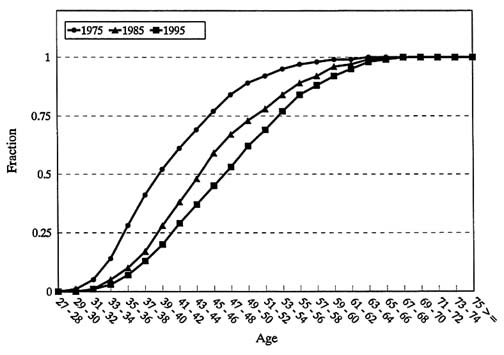
Figure 5.2
Cumulative fraction of US life-science PhDs in tenured positions, by age, 1975, 1985, 1995.
Date from Table 5.1.
decreases after the age of 50. Given that trend, it is reasonable to worry that delaying the independence of young scientists until they are well into their 30s or early 40s, will have long-term deleterious effect on the quality of science produced. Other impediments to the continual replenishment of university and college faculties with young scientists, such as tenure and the disappearance of mandatory retirement because of age, also contribute to the "graying" of the US faculty and have the potential of having a deleterious effect on the quality and quantity of US life science. Still, only somewhat more than 2% of faculty were 65 or older in 1995.
Some data suggest that the lengthening of training is not affecting all segments of the training pool equally. For example, a recent retrospective survey of 192 recipients of the prestigious awards from the Pew Scholars Program in the Biomedical Sciences which identifies promising assistant professors and other research scientists at the beginning of their careers, indicated that their average time to the PhD degree was only 5 years and the duration of their postdoctoral training 3.9 years. The current system has not substantially hampered the rapid progression of these young scientists through training to independent positions, so, at least in this case, it is fulfilling one of its highest priorities: the production of a cadre of truly innovative scientists. But it seems important to do whatever is reasonable to minimize the duration of training while keeping it consistent with the need to prepare young scientists for their careers. It is encouraging that time to degree and age at degree stopped increasing after 1993, but they are still higher than in previous generations
of graduates.
Employment Prospects of Young Life Scientists
The increase in the size of the American postdoctoral population, which has been further increased by the foreign nationals who are training in the United States at both the graduate and postgraduate levels, has led to intense competition for the permanent positions in every sector of the job market, but especially in universities and 4-year colleges. University faculty search committees report hundreds of applications for single positions. Competition among postdoctoral fellows for limited employment opportunities is considered by some to be an ideal way to bring out the best in each person and to select the best people for the jobs. At some critical point, however, competition ceases to bring out the best among aspiring members of the field and becomes a destructive force, breeding conservatism and, at its worst, even dishonesty. When they start new projects, young investigators contribute to an expansion and diversification of the questions being studied in life science. Today, in our experience in the laboratory and on review panels, instead of broadening the fields of inquiry, young investigators are tending to stay within conventional boundaries. If that trend continues, it will ultimately have an adverse effect on the quality of the life sciences.
Our profession must face the fact that current training practices are inexorably leading to increasing problems for the life sciences, not just a crisis of expectation among the young. The issue comes into sharp focus when we take into account the fact that the life-science PhD population problem is going to get worse. The 42% increase in PhD production is a recent phenomenon, and most of the new PhDs have not yet faced the permanent job market, much less begun to compete for grants. Yet the committee's review of future hiring in the life sciences, detailed in chapter 4, provides little likelihood of short-term solutions to the imbalance between PhD production and jobs.
The key to the issue might be in the research and training system now so entrenched. Representative George E. Brown, Jr., the ranking Democrat on the House Committee on Science, has pointed out that with the end of the Cold War, and the slowing of the increase in government investment in research and development, the US science establishment needs to reassess the traditional link between academic research and graduate education (Brown 1997). He argues that the continued linkage means that the number of PhDs produced reflects the availability of academic R&D funding, rather than being related to a set of national goals with respect to the need for science and engineering PhDs. He argues further that we are not analyzing the needs sufficiently and that the result is that production of PhDs can exceed the needs.
This committee's findings support Brown's views on the relationship between research funding and the number of PhDs produced. Life-science research funding has continued to rise in the last 20 years—albeit more slowly than in earlier decades—and PhD output has more than kept pace. Increased research funding means greater demand for workers in laboratories—more graduate students and postdoctoral fellows. But the research-education link also pushes more trained persons into the job market than the available positions in academe, industry, and government can accommodate. This committee's exploration of the nexus between training and the job market has convinced us that the question of national needs is complex and subtle. Although analysis of national needs might not have been sufficient, we note that the problem has defied full solution for 2 decades, because of missing or incomplete evidence, because of the costs of a
fuller analysis, and for other reasons—sometimes government rules and procedures themselves. Regardless of the history, we agree with Brown's argument that a reassessment of the nation's linked training and research policies would be useful.
It is plausible that job prospects of young life scientists will diminish further in the coming years unless unforeseen events intervene. The training system, by virtue of its time between graduate-school admission and obtaining of a first permanent position, is slow to respond to changing conditions. It behooves the profession to act in an intelligent and balanced way so that a future crisis will be avoided. If the difficulties of finding appropriate employment become sufficiently widespread, the discontent of postdoctoral fellows might infect undergraduates, who are considering graduate education in life sciences, and result in a decline in high-quality applications. For the future health of the life-science enterprise, we must encourage and retain our most talented aspirants, the people who will always have many attractive options.
In conclusion, the current life-science training enterprise is producing about 2.5 times the number of PhDs needed to fill the jobs that are currently available in academe and when all forms of research-oriented employment are considered, there are still more trainees than there are positions available—and the number of trainees is going up. The recommendations in chapter 6 are designed to ameliorate the stresses in the current situation and to increase the likelihood that we can keep the American life sciences strong and productive.
References
Brown, GE. American Physical Society News Online. http://www.aps.org/apsnews/aug97.html
COSEPUP (National Academy of Sciences, Committee on Science, Engineering, and Public Policy). 1995. Reshaping the Graduate Education of Scientists and Engineers. Washington, DC: National Academy Press.
IOM (Institute of Medicine). 1984. The Career Achievements of NIH Predoctoral Trainees and Fellows. Washington, DC: National Academy Press.
McIntosh R. 1994. Funding constraints and population growth: the cell biologist's nightmare. Amer Soc Cell Biol News 117(11):1–5.
NRC (National Research Council). 1995. Research Doctorate Programs in the United States. Washington, DC: National Academy Press.
NSF (National Science Foundation). 1996. Science and Engineering Indicators 1996. NSB 96-21. Washington, DC: US Government Printing Office.
Research!America. 1997. Public Disagrees with Clinton Budget Proposal: Medical Research Funding Should Be Dubled. http://www.nicom.com/˜ramerica/newbrief.html.
Stephan PE, Levin SG. 1993. Age and the Nobel Prize Revisited. Scientometrics 28:387–99.


