
| This page in the original is blank. |
A Behavior of Radon and its Decay Product in the Body
A physiologically based pharmacokinetic (PBPK) model was developed to describe the fate of radon within systemic tissues. A schematic diagram of the model is shown in figure A-1. The model is based on the blood-flow model of Leggett and Williams (1995) (see also Williams and Leggett 1989; Leggett and Williams 1991). The blood of the body is partitioned into a number of compartments, representing various blood pools in the body (the compartment Large Veins represents the venous return from the systemic tissues, Right Heart and Left Heart the content of the heart chambers, Alveolar represents the region of gas exchange in the lung, and Large Arteries represent the arterial blood flow to the systemic tissues). The gastrointestinal tract is divided into four segments (St, SI, ULI, and LLI) denote stomach, small intestine, upper large intestine, and lower large intestine, respectively, and Cont and Wall refer to the content and wall of the segments; for example St Cont and St Wall denote the content and wall of the stomach. Ingested radon enters the St Cont compartment while inhaled radon would enter the Alveolar compartment. The walls of the gastrointestinal tract are perfused with arterial blood which, with that from the spleen and pancreas, enters the portal circulation of the liver as shown in figure A-1. Radon dissolved in blood entering the Alveolar compartment exchanges with the alveolar air and is exhaled from the body. Although the kinetics of blood circulation are complex, for the most practical purposes it can be viewed as a system of first-order transfer among the different blood pools.
Model Structure
The model, a system of compartments, depicts the manner in which radon is distributed among the tissues of the body and subsequently removed from the
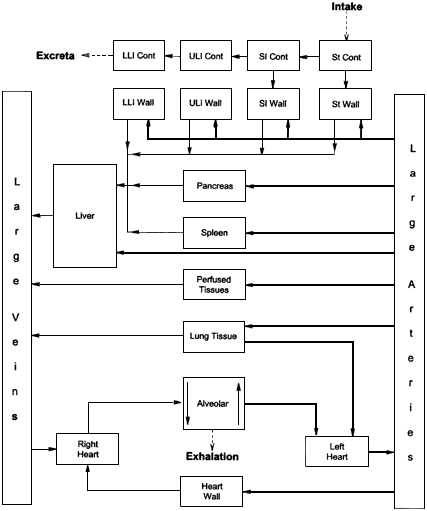
Figure A-1
Schematic diagram of the physiologically based pharmacokinetic (PBPK) model developed to describe the fate of radon within systemic tissues.
body. Radon can enter the body either through inhalation (introduced into the Alveolar compartment) or by ingestion (introduced into the St Cont compartment), only the latter is of interest here. The quantity of radon in organ i, Qi, is given by a differential equation describing the inflow of radon to the organ and its outflow from the organ. The concentration of radon in organ i, Ci, perfused by
blood is assumed to be directly proportional to the radon concentration in the venous blood leaving the organ, CV,i. The constant of proportionality between concentration in the organ and the venous blood is referred to as the tissue-blood partition coefficient λi defined by

The equations describing the kinetics of the gas (radon) in perfused tissues are formulated in the manner described by Kety (1951), that is, the rate of change in the quantity of gas in the ith compartment or organ, Qi, is given by

where VCO denotes the volumetric flow of arterial blood from the heart (the cardiac output), Fi is the fraction of the cardiac output entering the ith organ, CA is the concentration of the gas in the arterial blood, and CV,i is the concentration in the venous blood leaving the organ. Rewriting Eqn. A-2 in terms of the activity of radon AA and Ai in the arterial blood (Large Arteries compartment of figure A.1) and in organ i, respectively, and including radioactive decay as a removal mechanism yields

where VA is the volume of arterial blood, Vi is the volume of the organ, and λR is the decay constant of 222Rn. The volume of an organ is related to its mass Mi as Vi = Mi / ρi. Eqn. A-3 is applicable to organs perfused by arterial blood and represented collectively, in figure A-1, by the Perfused Tissues compartment.
Radon removed from the Perfused Tissues compartment enters the compartment Large Veins compartment. The rate of change of the radon activity in the Large Veins compartment, AV, is given by

where the summation is over all perfused tissues other than the lung, Alung is the activity of radon within the tissues of the lung (compartment Lung Tissue), Flung is the fraction of the cardiac output distributed to lung tissue of which only one-third enters the Large Vein compartment, Vlung, is the volume of lung tissue, and VV is the volume of venous blood. Note that the fraction of the cardiac output flowing from the liver is the sum of the cardiac output to the segments of the gastrointestinal tract, the spleen, pancreas and the liver itself.
Radon enters the Right Heart compartment with the flow of venous blood from the Large Veins compartment and the flow of venous blood from the heart (Heart Wall compartment). The change in the radon activity in the Right Heart compartment, ARH, is given by

where AHT activity of radon present within the tissues of the heart, FHT is the fraction of the cardiac output distributed to heart tissues, VHT is the volume of heart tissues, and VRH is volume of blood within the chambers of the right heart.
Radon may enter into and be removed from the systemic circulation in the gas-exchange regions of the lung. Radon in blood leaving the gas-exchange region of the lung is assumed to be in equilibrium with the alveolar air. The constant of proportionality being the air-blood partition coefficient λair. The change in the radon activity in the alveolar air, AV is given by

where CI is the concentration of radon in inspired air, VV is the volumetric inhalation rate, VV is the alveolar volume, and λair is the air-blood partition coefficient for radon. If the intake is not by inhalation, as in the case of radon in drinking water, then CI, is taken as zero.
Radon enters the Left Heart compartment from the Alveolar and Lung Tissue compartments and departs to Large Arteries compartment. The concentration of radon in the blood flowing from the gas-exchange region of the lung, CP, is in equilibrium with the alveolar air; i.e., CP = λairCV, where Cv is the radon concentration in alveolar air. The change in the radon activity in the Left Heart compartment, ALH, of volume VLH is given by

where λlung is the lung tissue-blood partition coefficient for radon, and the factor 2/3 represents the fractional of the blood flow from the lung that enters the Left Heart compartment.
The gastrointestinal tract model is shown in figure A-1. The equations for the radon activity in the spleen and pancreas follow the equation for perfused organs presented above (equation A.4) and are noted here only because their venous blood enters the liver. Assume that at time zero the activity of radon in the St Cont compartment is A0St, then the changes in the radon activity of the St Cont compartment, AST, is given by

where kSt and kStw are the coefficients for transfer of the gas from the stomach contents to the small intestine contents and to the wall of the stomach, respectively. The value of the coefficient kStw was derived to correspond to that indicated by the diffusion model discussed in Appendix B. That is, the time integrated concentration of radon in the wall of the stomach was taken to be 30% of that in the content of the stomach. The value of kSt, the transfer coefficient from the stomach content to the small intestine contents, for water, was taken to correspond to a half-time of 15 min.
Blood flows through the walls of the segments of the gastrointestinal tract and enters the liver. The change in radon activity within the St Wall compartment, AStW, is given by

where VStW is the volume of the stomach wall.
The equations describing the rate of change in the activity of radon in the contents and walls of the other segments of the gastrointestinal tract have similar form, that is

where j = SI, ULI, and LLL denote the regions of the tract.
Parameter Values
Adult Values
The first-order transfer coefficients describing the movement of radon within the blood are, as indicated above, dependent on the cardiac output VCO, the distribution of the cardiac output Fi, and the tissue-to-blood partition coefficient λi. The reference values for the total blood volume and cardiac output in an adult male are 5.3 L and 6.5 L min-1, respectively (Leggett and Williams 1995). The large arteries and veins in Fig A-1 contain 6 and 18% of the blood volume of the body, respectively. The distribution of the cardiac output (Leggett and Williams 1995) and the tissue-to-blood partition coefficients (Nussbaum 1957) for the
various organs are given in table A-1. The masses and densities of the organs in the adult male are given in table A-2. As an example, table A-1 indicates that 0.3% of the cardiac output is directed to the adrenals which have a radon partition coefficient of 0.7, thus the coefficient transferring radon from the large arteries to the adrenals, the terms  of Eqn. A-4, has a value of

where 0.06 × 5.3 L is the volume of blood in the large arteries. The removal coefficient from the adrenals to the large veins, the term 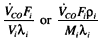 of Eqn. A-4, is
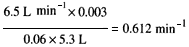
where all numerical values are from tables A-1 and A-2.
Radon is considerably more soluble in adipose tissue than other tissues of the body as reflect in the high adipose-to-blood partition coefficient listed in table A-1. The transfer of radon from the large arteries to adipose tissue, the terms  of Eqn. A-4, has a value of

where is the volume of blood in the large arteries. The removal coefficient from the adipose tissue to the large veins, the term  of Eqn. A-4, is

where all numerical values are from tables A-1 and A-2. The biological removal from adipose tissue corresponds to a half-time, in the absence of additional input, of about 5.4 hours.
Table A-1
Reference Regional Blood Flows (% of Cardiac Output) and Radon Tissue-to-Blood Partition Coefficients in PBPK Model.
|
Compartment |
Flow (%) |
λi |
Compartment |
Flow (%) |
λi |
|
Stomach Wall |
1.0 |
0.7 |
Kidneys |
19.0 |
0.66 |
|
Small Intestine Wall |
10.0 |
0.7 |
Muscle |
17.0 |
0.36 |
|
Upper Large Intestine Wall |
2.0 |
0.7 |
Red Marrow |
3.0 |
8.2 |
|
Lower Large Intestine Wall |
2.0 |
0.7 |
Yellow Marrow |
3.0 |
8.2 |
|
Pancreas |
1.0 |
0.4 |
Trabecular Bone |
0.9 |
0.36 |
|
Spleen |
3.0 |
0.7 |
Cortical Bone |
0.6 |
0.36 |
|
Adrenals |
0.3 |
0.7 |
Adipose Tissue |
5.0 |
11.2 |
|
Brain |
12.0 |
0.7 |
Skin |
5.0 |
0.36 |
|
Heart Wall |
4.0 |
0.5 |
Thyroid |
1.5 |
0.7 |
|
Liver |
6.5 |
0.7 |
Testes |
0.05 |
0.43 |
|
Lung Tissue |
2.5 |
0.7 |
Other |
3.2 |
0.7 |
Table A-2
Mass and Density of Organs in the Adult Male
|
Compartment |
Mass (kg) |
ρi |
Compartment |
Mass (kg) |
ρi |
|
Stomach Wall |
0.15 |
1.05 |
Kidneys |
0.31 |
1.05 |
|
Small Intestine Wall |
0.64 |
1.04 |
Muscle |
28.0 |
1.04 |
|
Upper Large Intestine Wall |
0.21 |
1.04 |
Red Marrow |
1.5 |
1.03 |
|
Lower Large Intestine Wall |
0.16 |
1.04 |
Yellow Marrow |
1.5 |
0.98 |
|
Pancreas |
0.10 |
1.05 |
Trabecular Bone |
1.0 |
1.92 |
|
Spleen |
0.18 |
1.05 |
Cortical Bone |
4.0 |
1.99 |
|
Adrenals |
0.014 |
1.02 |
Adipose Tissue |
12.5 |
0.92 |
|
Brain |
1.4 |
1.03 |
Skin |
2.6 |
1.05 |
|
Heart Wall |
0.33 |
1.03 |
Thyroid |
0.02 |
1.05 |
|
Liver |
1.8 |
1.04 |
Testes |
0.035 |
1.04 |
|
Lung Tissue |
0.47 |
1.05 |
Other |
3.2 |
1.04 |
The response of the model was shown graphically in chapter 4 and compared to experimental observations.
Other Ages
Considerably less information is available regarding cardiac output and blood volumes in the non-adult. Age-dependence in the model was introduced by assuming the blood flow to an organ was proportional to the mass of the organ; the constant of proportionality being derived from the adult values. The age-dependent masses were taken from ICRP Publication 56 (1989). The cardiac output was taken to be 0.6, 1.2, 3.7, 5.0, 6.2, and 6.5 L/min in the newborn, 1-, 5-, 10-, 15 year-old, and adult, respectively (Williams 1993). The volume of blood in the body was taken as 0.27, 0.5, 1.4, 2.4, 4.5, and 5.3 L in the newborn, 1-, 5-, 10-, 15 year-old, and adult, respectively (Williams 1993). In the absence of
information on the fraction of the blood volume associated with the large arteries and veins of the body at various ages the adult fractions were assumed; namely 6% and 18% in the arteries and veins, respectively.
Biokinetics of Short-Lived Radon Decay Products
In its recent reports, the International Commission on Radiological Protection (ICRP) have assessed the component of the dose associated with decay products from within the body following the intake of a radionuclide based on the biokinetic behavior of the specific decay product; so-called independent kinetics. Details regarding this implementation are discussed in Annex C of Publication 71 (ICRP 1995). In the publication are also set forth the description of the biokinetic of lead, bismuth, polonium, and astatine as members of the uranium decay series. These data have been applied in the dosimetric analysis in this report.


