
5
The Nuclear Physics of the Universe
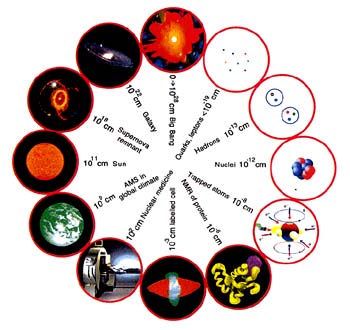
Introduction: Challenges for the Field
The rich tradition of collaboration between nuclear physics and astrophysics dates from the early work of Hans Bethe and Willy Fowler, nuclear physicists who won Nobel Prizes for their efforts to understand the nuclear reactions taking place in stars. Today this intersection remains especially vital, driven on the one hand by the rapid technological advances in astronomical observation, and on the other by the need to understand the underlying nuclear and atomic microphysics that govern most astrophysical objects and phenomena.
The questions nuclear physicists ask about our universe range from the synthesis of the light elements in the first minutes after creation to the violent deaths of massive stars we observe today:
- What is the explanation for the shortfall of neutrinos emitted by our Sun? Is the current discrepancy due to new particle physics, beyond our standard theory of electroweak interactions, or does it represent some misunderstanding of the nuclear reactions that power our Sun? What new technologies can nuclear physicists and others exploit to measure the entire spectrum of solar neutrinos?
- Is the process by which the lightest elements were created in the first few minutes of the Big Bang well understood? Might there exist, in this fossil record of the birth of the universe, evidence of early exotic states of high-temperature hadronic matter?
- What drives the spectacular stellar explosions known as supernovae? The detection of the various neutrino species emitted in such explosions may determine
- whether massive neutrinos play a crucial role in cosmology. What detectors might nuclear physicists construct for this purpose?
- Our Earth and its rich biology depend on the many heavy elements synthesized during stellar evolution and in violent events like supernovae. What are the nuclear processes responsible for nucleosynthesis, and when and where do they take place?
- What exotic forms of nuclear matter exist at the extraordinary densities characteristic of neutron stars? What connections can be established between the observed properties of such stars—their masses, radii, rotation rates, electromagnetic emissions, and so forth—and the behavior of nuclear matter under exotic conditions?
- As the early universe cooled, a hot plasma of unconfined quarks and gluons coalesced into a gas of mesons and nucleons. Can ultrarelativistic heavy-ion collisions provide new insight into the consequences of this phase transition?
- Earth is bathed in a sea of cosmic radiation, much of it emanating from nuclear processes occurring in our galaxy. How can further measurements of nuclear properties—lifetimes, gamma-ray lines, and so forth—help in determining the origin and consequences of this radiation? How can we exploit unstable nuclei as cosmological clocks of past events in our galaxy?
The efforts under way to address these challenges are described below.
The Solar Neutrino Problem
Stars, to sustain themselves against the force of gravity, must maintain the pressure of their gases by constantly producing energy. In our Sun, this energy is generated in a series of nuclear fusion reactions in which four hydrogen atoms are converted into helium. These reactions take place deep in the solar core, where temperatures are sufficiently high to allow nuclear fusion to occur. Although we cannot see into the solar core by conventional means, these reactions do produce one form of radiation, neutrinos, to which the Sun is transparent. Passing through the cooler outer layers of the Sun without scattering, these neutrinos carry, in their flux and energy distribution, a detailed record of the reactions by which they were produced. Thus, they offer a unique opportunity to view the nuclear processes that power stars like our Sun.
But the reason neutrinos can pass so easily through the Sun—their remarkably weak interactions with matter—also means that detecting them on Earth is a formidable experimental challenge. After almost three decades of effort, the tools to answer that challenge may be in hand. In the summer of 1965, a group of nuclear scientists began excavations for the first experiment, deep within the Homestake gold mine in Lead, South Dakota (see Box 5.1). With a detector filled with 610 tons of cleaning fluid, the experimentalists patiently waited for rare reactions of neutrinos that would convert a chlorine atom into argon. Because
|
BOX 5.1 Solar Neutrinos from Homestake to the Sudbury Neutrino Observatory In the summer of 1965, workers deep in the Homestake gold mine, Lead, South Dakota, completed the excavation of a 30 × 60 × 32 ft3 cavity at a depth of 4,850 ft. This was the first step in bringing to life a new detector proposed by Ray Davis, Jr., and his Brookhaven National Laboratory collaborators. The cavity was soon occupied by an enormous tank filled with 610 tons—the contents of 10 railway tankers—of chlorine-bearing cleaning fluid. The purpose of this detector was to make the first attempt to verify that our Sun produces its energy by converting four protons into 4He in a sequence of nuclear reactions called the pp chain (Figure 5.1.1). This prediction was the basis of our understanding of stellar evolution. Three years later Davis, Harmer, and Hoffman announced an upper bound on the solar neutrino flux that was a factor of two and one-half below the theoretical expectation. Davis was consoled by one of the miners, who pointed out that it had been, after all, an unusually cloudy summer. 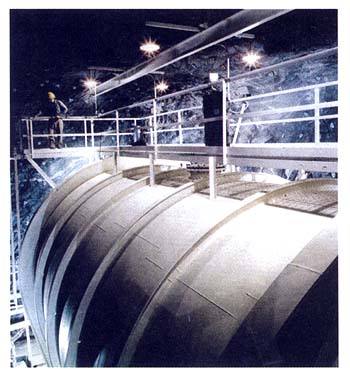 FIGURE 5.1.1 The 37Cl detector located in the Homestake gold mine, Lead, South Dakota. The steel vessel contains 0.6 kilotons of percloroethylene. During use, the cavity is filled with water to provide additional shielding from neutrons and other radioactivity produced in the surrounding rock walls. (Courtesy of Brookhaven National Laboratory.) |
|
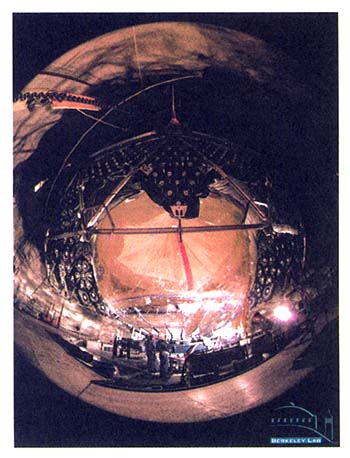
The chlorine detector was literally 20 years before its time. It exploited a marvelous circumstance: solar neutrinos would convert a few atoms of 37Cl into 37Ar which, because argon is a noble gas, could be quantitatively flushed from a large volume of fluid by a helium-gas purge. As the 37Ar then decays back to 37Cl with a half-life of about one month, the number of purged atoms could then, with patience, be counted in miniaturized gas proportional counters capable of detecting these decays. The sensitivity of the technique was astounding: a solar neutrino capture rate producing three 37Ar atoms per week was eventually measured to an accuracy of 10 percent. It would take the community another two decades to develop the technology to mount other experiments capable of verifying the chlorine detector results and of extending its measurements to other portions of the solar neutrino spectrum. Today, with the completion of the Kamioka experiment and the SAGE and GALLEX measurements of the low-energy solar neutrino flux, it is recognized that the solar neutrino problem is a profound issue for all of physics. It has become increasingly difficult to account for the discrepancies by plausible changes in the solar model or in nuclear reaction rates. On the other hand, the results appear consistent with new particle physics, particularly the possibility that the electron neutrino has a mass and oscillates with either the muon or tauon neutrinos. If this is the correct explanation, then massive neutrinos would contribute in cosmology to dark matter and to the clustering of visible matter on large scales. In particle physics, a new Standard Model would have to be formulated, one in which massive neutrinos are accommodated. Today, two major new solar neutrino experiments have begun with the goal of providing an unequivocal resolution to the solar neutrino problem. The first is SuperKamiokande, a massive 50,000-ton water Cerenkov detector located in the Japanese mine Kamioka. The second is the Sudbury Neutrino Observatory (SNO), the first detector having the capability to distinguish electron neutrinos from muon or tauon neutrinos (Figure 5.1.2). Just as in the case of the Homestake detector, it is essential to mount these new experiments deep underground so that the Earth above will serve as a protective shield against cosmic-ray backgrounds. The SNO detector, within the Creighton #9 nickel mine at Sudbury, Ontario, Canada, is more than 2 kilometers beneath the surface. The central region of the detector is an acrylic vessel containing 1 kiloton of heavy water, D2O. Light produced in the detector by neutrino interactions will activate some of the surrounding 9,500 photomultiplier tubes. The detector depth all but eliminates cosmic-ray interactions, but the confusing effects of natural radioactivity remain a serious problem. The experimentalists had to construct SNO with extraordinarily pure materials. For example, there must be fewer than 10 atoms of uranium or thorium for every million billion atoms of water. It is a great nuclear chemistry challenge to even measure trace contaminations at this level. To ensure such purity, SNO was built under the most rigorous clean room standards, a daunting task in an active mine. If a thimbleful of dust were to enter the 10-story-high detector cavity, the experiment could fail. Finally, the inner heavy-water portion of the detector is protected by a 7-kiloton shield of ordinary water, which will absorb neutrons produced by radioactivity in the surrounding rock walls. Why does the inner detector consist of rare heavy water? This has to do with proving that neutrinos oscillate, an effect that can be especially pronounced for solar neutrinos due to the matter effects discussed in the text. One kind of reaction |
argon is a nobel gas, the few atoms produced, roughly one every few days, could be extracted from the Homestake detector and counted by observing their subsequent decay. This experiment, which continues to operate and improve in accuracy, produced the first evidence that the Sun was not producing as many neutrinos as predicted by our theories of stars and nuclear reactions. Because of this intriguing result, an experiment of a different kind, in which neutrino reactions could be measured event by event in a detector containing 4,500 tons of ultrapure water (neutrinos produce detectable light when they scatter off the electrons in water), was mounted in the Kamioka mine in Japan. The Japanese physicists and their American collaborators again found a deficit of neutrinos. Finally, two radiochemical detectors that use gallium, a special material sensitive to the lowest-energy neutrinos produced by the Sun, were constructed in Italy and Russia. U.S. nuclear physicists played important roles in both of these efforts.
The combined results of these measurements are surprising. The flux of the highest-energy neutrinos produced by the Sun, coming from the beta decay of 8B, is about 40 percent of the standard solar model value, while those produced from electron capture on 7Be are reduced even further. While a lower neutrino flux suggests that the Sun's core might be cooler than predicted, such a change is expected to suppress the 8B neutrino flux much more than the 7Be flux, in contradiction to the measurements. In fact, detailed fits to the experimental results show that even with arbitrary changes in the total fluxes of the 7Be, 8B, and very low energy pp neutrinos, one cannot fit the data well (Figure 5.1).
The solar neutrino results become more curious in light of other tests that the best current model of the Sun has passed. In recent years, careful measurements of the Sun's surface have allowed astrophysicists to deduce the frequencies of the Sun's internal vibrations, which depend sensitively on the Sun's composition and temperature profiles. The results of such helioseismology studies are in excellent agreement with solar model predictions. In addition, the consistency of stellar evolution calculations with observations of other solar-like stars has increased our confidence in the solar model.
However, the failure to detect the predicted number of neutrinos might have nothing to do with the solar model and nuclear reactions; instead, it could reflect a lack of understanding of the properties of neutrinos. In particular, if neutrinos have a small mass—a possibility not envisioned in the current Standard Model of particle physics—a natural explanation can be offered for the observations. Electron neutrinos produced by the nuclear reaction in stars can then transform (or oscillate) into neutrinos of a different flavor, thereby escaping detection on Earth. Because solar neutrinos are low in energy and travel a great distance before they are detected on Earth, this effect can arise for masses much smaller (e.g., 10-6 eV) than those detectable by any other means. Furthermore, it was shown in 1985 that as neutrinos make their way from the solar core through the outer layers of the Sun, oscillation effects can be greatly magnified. This phenomenon is known as the MSW or Mikheyev-Smirnov-Wolfenstein mechanism, after the physicists
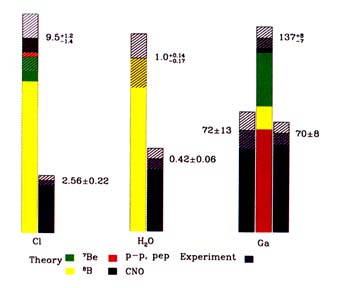
FIGURE 5.1
Comparison of the predicted counting rates of the solar model (taller bars) with the rates measured in the chlorine, Kamioka II/III, and SAGE and GALLEX gallium experiments. The respective uncertainties are indicated by the hashed regions, while the contributions of various neutrino sources to the predicted counting rates are coded by the indicated colors. The counting rates are given in solar neutrino units (SNUs), corresponding to one capture per 1036 target atoms per second. The discrepancies between theory and experiment constitute the solar neutrino problem.
who first described it. The dependence of this enhancement on the energy of the neutrino provides a natural explanation for the experimental results discussed above.
If this conclusion is correct, solar neutrino experiments—begun by nuclear physicists to study the nuclear reactions occurring in the solar core—will have provided the first evidence that the Standard Model of particle physics is incomplete. For this reason, there is great excitement about two new experiments now under way. Within the Kamioka mine, a new, purer, and much larger water Cerenkov detector has recently been completed. It will provide a more precise measurement of the shape of the 8B neutrino spectrum, perhaps revealing distortions characteristic of neutrino oscillations. Named SuperKamiokande, this detector was built by a Japanese-U.S. collaboration (Figure 5.2). A second detector, a Canadian-U.S.-U.K. collaboration, the Sudbury Neutrino Observatory (SNO),
is similar in design, except that the water is "heavy," with the hydrogen replaced by deuterium. This difference will allow the nuclear physicists building the detector to measure solar neutrinos whether or not they have oscillated into a different type (or flavor). If this detector measures more neutrinos than seen in previous experiments, it will prove that neutrinos have oscillated, and thus have a nonzero mass. SNO construction is finished, and the commissioning of the detector is under way. Two other detectors with very low energy thresholds. Borexino and Iodine, are in earlier stages of preparation; when completed, they will provide additional information on the flux and flavor of the 7Be neutrinos.
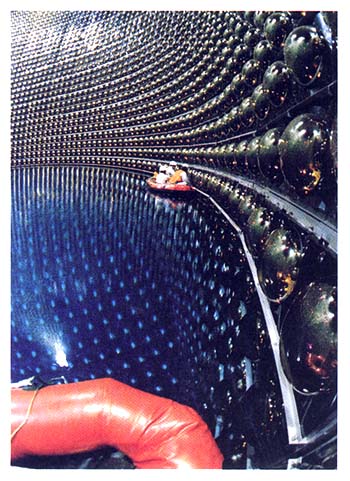
FIGURE 5.2
The 50-kiloton SuperKamiokande detector was filled in the spring of 1996. Here, members of the collaboration, in a small rubber boat, make use of an opportunity to complete a final cleaning of the phototube surfaces. The inner detector is viewed by 11,200 50-cm-diameter tubes. (Courtesy of the Institute for Cosmic-Ray Research, University of Tokyo.)
The resolution of the solar neutrino problem is important not only to nuclear physics, but also to particle physics, astrophysics, and cosmology. In many theories that attempt to generalize our current Standard Model of particle physics, small neutrino masses are related to entirely new physics that is otherwise beyond our grasp: current and planned accelerators fall far short of the energies where this physics can be seen directly. Thus, neutrinos may provide our only means of experimentally testing these new theories. In cosmology, neutrinos are a leading candidate to explain the problem of dark matter: if the universe is filled with a sea of invisible but massive neutrinos created in the Big Bang, this could explain why the visible matter is insufficient to account for the gravitational forces within clusters of galaxies. Neutrino oscillations could also have profound consequences for supernovae, the violent explosions by which massive stars die once they have consumed all of their nuclear fuel.
The Big Bang, The Quark-Gluon Plasma, and The Origin of the Elements
We believe our universe began in an extraordinary explosion known as the Big Bang. In the first instants after this explosion, when the temperature was in excess of about 150 MeV, matter existed in a state unknown to us, a plasma of unconfined quarks and gluons. After the universe expanded and cooled below this critical temperature, hadronic matter coalesced into a more familiar gas of nucleons and mesons. It is quite possible that this transition, if sufficiently violent, could have left a signature in our low-temperature world, perhaps through inhomogeneities in the density or by producing isolated regions carrying unusual quantum numbers, such as nuggets of strange quarks. Such relics might be found in today's universe, or we might be able to discern the effects of this transition in the pattern of light nuclei that coalesced out of the inhomogeneous nucleon gas, as discussed below. One exciting nuclear physics connection to these early times is the possibility that future relativistic heavy-ion experiments will allow us to examine this transition in the laboratory, thereby providing the information we need to model the analogous cosmological epoch.
The primordial nucleon soup is the starting point for all the chemical elements that we see about us. In the first few minutes after the Big Bang, the nucleon gas cooled sufficiently to allow protons and neutrons to combine into deuterium, and for subsequent nuclear reactions on deuterium to produce light elements like helium and lithium. Much later, these light elements begin to coalesce under the action of gravity, forming stars and galaxies. Within these stars synthesis continues as nuclei are fused to produce heavier elements and heat: many of the most plentiful elements, like 12C and 16O, are produced in this way. Additional synthesis occurs through violent stellar explosions known as novae and supernovae.
Novae, supernovae, and the "winds" generated by ordinary stars eject the products of nucleosynthesis into the interstellar medium, where they again form
the raw material for a future generation of stars and planets. Indeed, were it not for this continuing synthesis, we would lack the essential elements that make up our Earth and allow it to sustain life. One of the primary goals of nuclear astrophysics is to understand quantitatively the processes by which this synthesis takes place.
The synthesis of light nuclei in the very early universe is considered one of the cornerstones of modern cosmology. The abundance and distribution of such nuclei provide a detailed fossil record of conditions in the first few minutes of the Big Bang. By precisely measuring the nuclear reactions that contributed to this synthesis, nuclear physicists have allowed this record to be read with great clarity.
Hydrogen and helium stand out among the elements as being by far the most abundant. While some helium is produced in stars like our Sun, one can demonstrate, by studying the abundances of elements in old stars, that most of the observed helium was produced prior to the formation of stars. Likewise, deuterium, 3He, and lithium appear to be at least partially primordial. These observations are quite consistent with light-element reaction rates measured in the laboratory. Likewise, the absence of stable nuclei with mass numbers 5 and 8 creates roadblocks to further synthesis, accounting for the lack of primordial elements above mass 8. However, the successful prediction of primordial abundances, a crucial result supporting the Big Bang theory, requires one to pick the initial abundance of baryons (protons and neutrons) appropriately.
The baryon density thus derived from Big Bang nucleosynthesis exceeds the density of luminous matter (e.g., stars) we see about us. This problem of the missing baryons, as well as the dark matter problem mentioned earlier in connection with massive neutrinos, prompted nuclear physicists and astrophysicists to explore nucleosynthesis in nonstandard cosmologies, such as those where the matter distribution is quite inhomogeneous due to some early, violent phase transition. The nuclear networks can operate quite differently in an inhomogeneous Big Bang, altering the abundances of elements like Li substantially. The conclusion, after considerable work on the theory and measurements of possible new reaction paths, is that primordial abundances remain a stringent constraint, making it difficult to solve the dark matter problem by altering Big Bang cosmology. Yet, because inhomogeneities could play a more modest role in Big Bang nucleosynthesis, the existence of primordial elements other than those made according to the standard Big Bang model remains an important question.
Progress continues to be made in observations of primordial elements. Deuterium abundances deduced from the absorption of light as it passes through clouds of interstellar hydrogen gas have been at the center of recent Big Bang nucleosynthesis controversies. This is a promising technique that makes use of the power of the newest telescopes. As primordial elements can be produced and destroyed in stars, our increasing knowledge of stellar abundances is also helping
us deduce more accurate primordial values from present-day abundance measurements.
In the later synthesis that begins with the formation of the first stars, there is a close coupling between the macroscopic astrophysics issues, models of stars and of galactic chemical evolution, and the nuclear microphysics, the networks of nuclear reactions that govern this evolution. A classic example is the synthesis of 12C from three 4He nuclei, which triggers the ignition of the dense He core of a red giant star. The detailed nuclear structure necessary for this reaction to take place was anticipated because of the astrophysics, then confirmed by nuclear experiments. A reaction of great current interest is the synthesis of 16O from the reaction of 4He with 12C, which determines the relative sizes of the carbon and oxygen shells of massive stars that later explode in supernovae. The sizes of these shells are a crucial factor in predicting the nucleosynthesis that occurs during the explosion. Nuclear physicists are currently trying to measure the rate of this reaction with sufficient accuracy to constrain the astrophysical models.
The expulsion by supernovae of newly synthesized nuclei—both the products of nuclear fusion (common elements like 4He, 12C, 16O, 20 Ne, and others) and the many less-abundant species made by the explosion itself—accounts for much of the chemical diversity of our galaxy. For example, about half of the elements heavier than iron must be synthesized in about a second in the rapid neutron capture process, the r-process, requiring very high neutron densities and temperatures above a billion degrees. The astrophysical site where such explosive conditions might exist has been a matter of continuing speculation for several decades. One suggestion has been the neutron-rich matter ejected from near the surface of the neutron star that forms at the center of a core-collapse supernova.
An important advance of the past 5 years has been the modeling of the network of nuclear reactions that govern r-process synthesis of nuclei in a supernova. One prediction of the theory is that the r-process would have occurred in the earliest stars in much the same way as in today's stars, a result in agreement with observations made with the Hubble Space Telescope (HST). Nuclear calculations have recently provided additional evidence that supernovae are the site of the r-process: neutrinos produced in such supernova explosions can transmute r-process elements into new species. Such neutrino "fingerprints" of a supernova r-process site were recently found.
Nuclear physicists are being helped in their efforts to understand nucleosynthesis by the rapid instrumentation advances in astronomy and astrophysics. For example, the origin of the relatively rare elements Li, Be, and B is an important issue for several reasons, including Big Bang nucleosynthesis. The textbook explanation for these elements is that they form when high-energy cosmic rays break up 12C and 16O in the interstellar medium. This mechanism requires preexisting C and O, so it is secondary and should grow in effectiveness as the amount of these heavier elements in the galaxy increases. But recent HST spectroscopic studies of very metal poor stars appear to establish that B grows linearly with Fe
and other metals, a signature of a primary process not dependent on preexisting metals. This has focused attention on nucleosynthesis by supernova neutrinos, a process suggested by nuclear physicists: energetic neutrinos scatter off nuclei in the outer layers of the exploding star, knocking out nucleons and transmuting the target nuclei into different elements. Thus 11B can be made by neutrinos scattering off carbon, one of the most abundant elements in the mantles of such stars. A competing possibility is similar spallation reactions of cosmic rays with nuclei in the local environments of stars or nebulae. Anticipated HST measurements separating 10B from 11B may decide which of these processes is more important.
The Supernova Mechanism
One of the outstanding theoretical challenges in nuclear astrophysics is to understand the process by which a massive, fully evolved star ejects its mantle while its core collapses to a neutron star or black hole. The collapse of the iron core to several times nuclear-matter density produces a powerful shock wave that travels outward through the mantle of the star. It is believed that this shock wave, aided by the heating of the matter by neutrinos emitted by the newly formed neutron star, is responsible for the ejection of the mantle. This broad-brush picture has emerged from heroic efforts over a decade or more to simulate this process numerically; difficult hydrodynamics, the need to understand the nuclear equation of state at high densities and large neutron number, shock wave propagation, general relativistic effects, and the complexity of the neutrino diffusion make this problem unusually challenging. Despite great progress, the field is still struggling to define a mechanism that is sufficiently robust to account for the observed frequency of supernovae.
An exciting recent advance has been the development of two-dimensional hydrodynamic codes for simulating stellar collapse. This step, made possible by supercomputers, is important because observations of Supernova 1987A (Figure 5.3), the most recent supernova in our galactic neighborhood, provide clear evidence of deep mixing that can only be generated dynamically in multidimensional models. Recent calculations find convective cells forming above the neutrinosphere (the point in the star where neutrinos are no longer "trapped," but can stream out freely, as they do in less dense stars like our Sun). These cells sweep colder matter to smaller radii, where it can be more effectively heated by neutrinos. Hot material is carried to the shock by buoyancy; once there, it can help to push the shock outward. One group of supernova modelers finds that the enhanced neutrino heating produces a successful explosion for most initial conditions. A competing group finds less favorable results. The discrepancy appears to reflect different approximations in the treatment of neutrino diffusion and of the innermost layers of the star, problems that can be resolved if supercomputer resources are increased.
A result that is independent of the details of the explosion is the characteristic
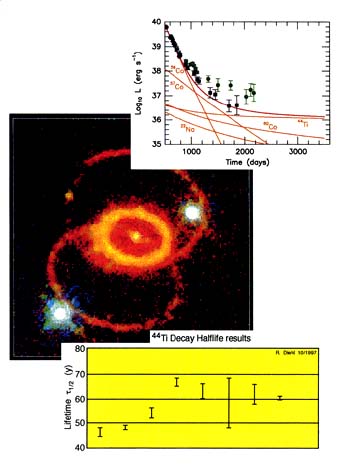
FIGURE 5.3
Hubble Space Telescope picture of Supernova 1987A, which exploded 169,000 years ago in a nearby dwarf galaxy, the Large Magellanic Cloud. The light from this explosion reached Earth in 1987 and was visible to the unaided eye in the southern hemisphere. Three rings appear around the explosion region. While their origin is not precisely understood, they may arise from irradiation of a bubble of gas blown into space by the supernova's progenitor star. The supernova ejecta include many newly synthesized nuclei. The presence of some of these can be deduced from the light produced by the supernova as a function of time, shown at the upper right. The observations are consistent with a gamma-ray power source from the decay of short-lived nuclei such as 56Co, 57Co, and 44Ti. Note that the light curve at late times depends on 44Ti, whose half-life was quite uncertain until recently. Nuclear physicists have made several new and independent measurements, shown in the figure at the bottom, that fix its half-life at about 60 years, so that 44Ti should continue to dominate the SN1987A light curve for the next century. (Courtesy Space Telescope Science Institute.)
hierarchy of neutrino temperatures: the muon and tauon neutrinos are about twice as energetic, on average, as the electron neutrinos. It has been emphasized recently that, if the tauon neutrino has a mass large enough to be important in cosmology, oscillations between electron and tauon neutrinos might be expected in supernova explosions. This would lead to a temperature inversion between electron and tauon neutrinos, producing interesting effects in the explosion mechanism and in the nucleosynthesis from neutrino-heated supernova ejecta, e.g., destroying the conditions necessary for the r-process. More important, by measuring the types and energy distribution of the neutrinos emitted by a galactic supernova, experimentalists should be able to deduce whether the tauon neutrino is the source of the nonbaryonic dark matter: the temperature inversion will cause a dramatic increase in electron neutrino capture rates. Several of the solar neutrino detectors that are being built or designed by the nuclear physics community are motivated in part by this additional goal. Operation of such detectors for extended periods is necessary to provide a reasonable probability of detecting these rare events in our galaxy.
The success or failure of the supernova mechanism in a star of given mass is critically dependent upon the properties of the iron core. The structure of the core depends both on the nuclear reactions governing the evolution of the star prior to collapse and on weak interactions occurring in the early stages of the collapse: electron capture on nuclei produces neutrinos that immediately escape the star, thus lowering the number of electrons and electron neutrinos trapped in the core. The electron capture proceeds by spin-flip transitions to states in the daughter nucleus. One of the important experimental contributions to the supernova problem has been careful measurements of spin-flip strengths in nuclei, using (p,n)
and (n,p) reactions at medium-energy nuclear facilities, as described in the next section.
During a supernova collapse, the matter at the core of the star reaches the extraordinary densities characteristic of the nucleus (a million billion times that of ordinary matter). At this point, as individual nucleons begin to touch, the strong nuclear force halts the collapse. The result is a trampoline-like rebound that sends a shock wave traveling outward through the core (Figure 5.4). The dynamics of this process—compression of the matter to and past nuclear density, rebound, and formation of the shock wave—is governed by the nuclear equation of state, a topic discussed in more detail in the neutron star subsection.
Measuring Stellar Nuclear Reactions in the Laboratory
Careful treatments of the energy dependence of nuclear reaction rates are required to extrapolate higher-energy measurements to characteristically low astrophysical energies. Similarly, many explosive stellar reactions involve exotic isotopes not found naturally on Earth. Here, laboratory nuclear astrophysics is making crucial contributions to our understanding of stellar structure.
In the solar neutrino problem, the primary remaining nuclear uncertainty is the rate for proton capture by 7Be, a reaction that leads to the production of high-energy 8B solar neutrinos. These are the neutrinos that react in the SNO and SuperKamiokande detectors. Two low-energy data sets agree in energy dependence, but disagree in normalization by about 25 percent. Theory confirms that the energy dependence is correct, but it probably is not yet capable of predicting the absolute cross section. Several new experiments to resolve this problem are now being pursued. These include both conventional measurements, in which a 7Be target is bombarded with protons, and new approaches with different systematic uncertainties that will be possible at radioactive beam facilities. For example, one could use a hydrogen target and a 7Be beam, or observe the inverse process, breakup of 8B in the Coulomb field of a heavy nucleus. It appears likely that uncertainties in this rate will soon be reduced substantially.
Nuclear theorists have done much of the work on atomic screening corrections that must be made to derive stellar cross sections from terrestrial measurements. In the solar core, almost all of the electrons in the matter are free, and not confined to orbits around the nuclei as they are in terrestrial atoms. Thus, theorists must extract from laboratory cross sections values that are appropriate for the bare nuclei found in stars.
Neutrino physics is crucial to supernova explosions, controlling the transition from ordinary to neutron star matter and helping to power the explosion itself. Nuclear accelerators producing medium-energy protons have made a major contribution to our understanding of these processes. When a proton scatters off a nucleus, producing an outgoing neutron in the forward direction, it probes
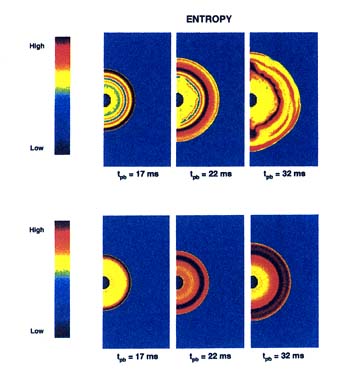
FIGURE 5.4
This series of two-dimensional plots shows the results of a supercomputer study of a supernova explosion in a 15-solar-mass star. The frames correspond to "snap-shots" of the entropy, or degree of disorder, in the material above the neutron star's surface some tens of milliseconds after core bounce (the time when the collapsing star reaches maximum nuclear density). The upper frames show a simulation without neutrino transport, while the lower frames have neutrino transport included. The higher regularity of the lower frames indicates that neutrino transport tends to inhibit the development of convection in such two-dimensional simulations. The calculations were performed by using facilities at several supercomputer centers.
the same spin-flip transitions that govern neutrino-nucleus interactions. (The same measurements can be made for radioactive species of interest by illuminating a hydrogen target at a radioactive ion beam facility.) Thus, such (p,n) and (n,p) reactions can determine the beta decay rates important during stellar collapse, as well as the neutrino-nucleus reaction rates that help to eject the outer layers of the star. This technique has also been important in calibrating solar neutrino
detectors. In fact, it led to the discovery that the original cross section estimates for the chlorine detector were based on a flawed assumption; fortunately, it proved possible to correct the error.
The nuclear reactions that make up the r-process involve exotic, short-lived, neutron-rich isotopes that can exist only in explosive conditions similar to those in a supernova. Many of these isotopes cannot yet be produced on Earth. To understand the unusual properties of the nuclei along the r-process path, nuclear experimentalists are building radioactive ion beam facilities capable of producing very short-lived nuclei, as mentioned in Chapter 3. Such facilities will provide direct information on selected important nuclei on the r-process path, and they will determine systematic trends for neutron-rich nuclei that will lead to more accurate theoretical predictions of the masses, lifetimes, and decay properties of other r-process nuclei.
Radioactive beams will help us understand another kind of explosive event important in novae and x-ray bursters. Novae are believed to occur in systems containing two stars, one a white dwarf that has completed its nuclear burning and the other a normal star, that is still evolving. Material from the evolving star can be accreted onto the white dwarf, where it ignites in explosive reactions that convert hydrogen to heavier elements. The elements observed in the ejecta of novae serve as a diagnostic of the conversion process. Most of the star's energy is believed to come from the conversion of hydrogen into helium through a series of reactions called the CNO cycles, so named because carbon, nitrogen, and oxygen act as catalysts for the reactions. But if sufficiently high temperatures are reached, as in the case of an x-ray burster where the accreting object is a neutron star, the reactions break out of the CNO cycles, producing heavier nuclei by repeated capture of protons or helium nuclei, with intervening radioactive decay (Figure 5.5). This rapid proton capture, or rp, process is characterized by much faster energy release, accompanied by the synthesis of distinctive proton-rich nuclei. These nuclei can serve as sensitive probes of the stellar conditions during novae, provided the nuclear reactions responsible for their creation, including their dependence on stellar temperature and densities, are well determined. At present, the rp process is understood only in broad outline. For example, the conditions for breakout to the rp process are poorly known, as are the effects of various nuclear reaction bottlenecks that limit the flow toward higher masses. Such bottlenecks determine the time scale for the rp process and thus the necessary characteristics of the associated stellar explosion.
This situation should improve greatly with the coming new generation of radioactive ion beams. The rates for particle reactions on 14O and 15O, crucial in determining the temperatures and densities where breakout from the hot CNO cycle to the rp process occurs, can be directly measured with planned radioactive beams (though the beam intensities and detector requirements are challenging). Such facilities will also allow experimentalists to measure the masses and disintegration energies of rp process bottleneck nuclei near the proton drip line, such
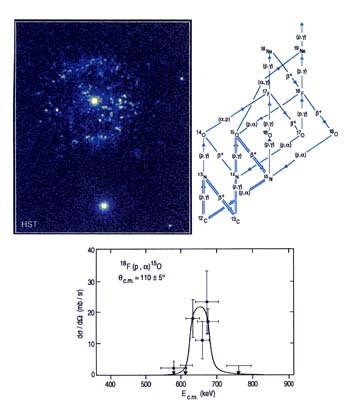
FIGURE 5.5
At the upper right, the nuclear reaction network of the carbon-nitrogen oxygen (CNO) cycles, including possible pathways for breaking out of these cycles into heavier nuclei, is shown. Some of the branching points involve reactions on short-lived nuclei. At the bottom, the results from a recent measurement of one of the relevant pathways, 18F(p. α)15O. is shown. 18F has a half-life of about two hours. Above is a Hubble Space Telescope photograph of the unusual recurrent nova, T Pyxidis, which erupts about every 20 years. Blobs of gas, spread over an area about one light-year in diameter, are the “shrapnel" from previous explosions. The thermonuclear runaways that power typical novae release an energy equivalent to about 1020 tons of TNT, (Courtesy Space Telescope Science Institute.)
as 68Se. Our current poor knowledge of the disintegration energy of this nucleus makes the stellar lifetime of 68Se uncertain by about a factor of 10,000. Such experimental studies have the potential to determine the rate, principal nucleosynthetic products, and endpoint of the rp process (Figure 5.6). This, in turn, would make the rp process an important probe of x-ray bursters and other explosive stellar environments.
Additional nuclear physics tools are becoming increasingly important for probing stars and the interstellar medium, as a result of recent instrumentation advances in satellite-based gamma-ray observations. Gamma-ray lines from excited states in 12C and 16O, detected from the direction of the Orion nebula, indicate that such nebulae could synthesize light elements like lithium, beryllium, and boron by cosmic-ray spallation; gamma-ray lines from 26Al decay have been used to map the galactic distribution of this element, a result that is helping to eliminate some of the proposed sites for Al synthesis. Radioactive nuclei and the gamma-ray lines they produce are a powerful probe of our galaxy because, through their varying lifetimes, one can sample different epochs in time.
Such measurements also provide crucial information about the nature of supernova progenitors and supernova explosions. Much of the light emitted from supernova remnants is associated with decays of isotopes like 44Ti, 56Co, and 60Co. Such isotopes are a powerful diagnostic of the explosion, telling us about conditions within the star, the extent to which convection mixes the exploding star, and so forth. Gamma-ray lines from the 44Ti decay chain were recently observed. To interpret such measurements, one must understand how such elements are synthesized in the explosion, how they decay, and how that synthesis depends on variables such as the mass of the progenitor. This is a rich area for collaboration between nuclear physicists and astrophysicists.
Finally, one of humanity's most exciting endeavors in the twentieth century has been its ventures into space. The cosmic-ray environment of space is more severe than on Earth, and the associated radiation hazards to human health must be evaluated and addressed. Nuclear science is contributing to this effort by studying radiation damage under the controlled conditions of accelerator beams, providing the basic knowledge needed for the interpretation of space-bound measurements.
Neutron Stars
Neutron stars are the extraordinarily dense stellar cores that remain after supernova explosions. They can be studied through their radio, optical, x-ray, and gamma-ray pulsations, as well as through their gravitational effects on companion stars. They typically contain about 1.5 times the mass of the Sun, packed into a sphere only 10 kilometers in radius. The enormous gravitational forces in neutron stars compress electrically neutral matter to densities up to approximately 1015 g/cc. or about five times that of charged nuclear matter in atomic
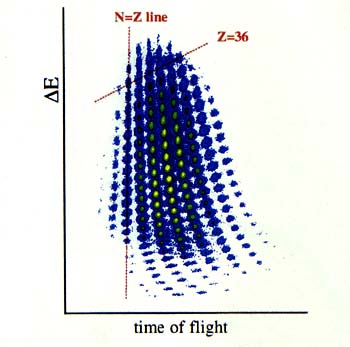
FIGURE 5.6
The rp process can be halted by encountering a nucleus that too easily emits protons, and thus lives only a very short time. Nuclides resulting from the breakup of 78Kr in an in-flight radioactive beams facility are shown in the panel above. They were detected and identified from their velocity and charge. The proton-rich nuclei that participate in the rp process lie to the left of the N = Z line. Their appearance on the plot indicates that they live sufficiently long to be of importance to the rp process.
nuclei. Thus, a teaspoon of neutron-star matter would have the same mass as a cubic kilometer of matter on Earth. There is a maximum mass for neutron stars; compact objects exceeding this maximum value collapse under their own gravity into black holes.
Nuclear theorists have been able to exploit neutron stars as an important laboratory for the study of dense matter. For example, the limiting mass of neutron stars, beyond which black holes are formed, is enhanced by nuclear forces, which resist gravity, from 0.7 times to over twice the mass of the Sun. Thus, nuclear forces are essential for the existence of the commonly observed neutron stars having 1.4 times the solar mass.
Solid metallic iron, with the lowest energy per nucleon of all forms of matter,
constitutes the outer surface of neutron stars. But as one descends below the surface, the matter is squeezed more and more tightly by gravity (Figure 5.7). Initially, this does not affect the nuclear properties of the matter; the compression works on the electron gas surrounding the nuclei. But beyond a density of about 8 × 10⁶ g/cc, the electron energy becomes so great that electrons begin to be captured by protons in the nuclei, transmuting the iron into nuclei that are more neutron-rich. This process continues with further compression until matter reaches a density of about 4 × 10¹¹ g/cm3. Up to this point, the matter has the familiar form of a crystal lattice of nuclei surrounded by a dense electron gas.
Beyond this density, the additional neutrons produced by electron capture do not remain bound to nuclei; like electrons, they form a gas that fills the space between the nuclei. This new form of matter is still a solid, but it may have novel
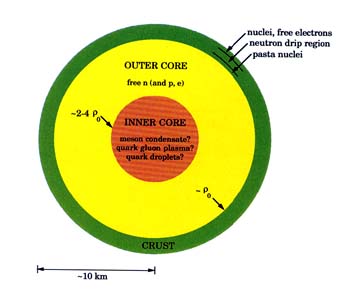
FIGURE 5.7
Schematic cross section of a neutron star, illustrating possible states of the hadronic matter as one progresses from the crust to the inner core, where densities perhaps four times that of ordinary nuclear matter will be encountered. The crust is solid metallic iron, while the outer core is a neutron gas, with a small admixture of protons and electrons. At the extreme densities characterizing the inner core, many exotic forms of nuclear matter—pion or kaon condensates, quark droplets, or a quark-gluon plasma—could exist.
features. For example, when sufficiently compressed, the nuclei of this matter could join to form thin and long spaghetti nuclei, which in turn might merge at even higher densities into thin flat sheets of "lasagne." Finally, at a density of about 1014 g/cc, the nuclei are fully dissolved and matter becomes a nuclear fluid.
The evolution of the matter traced above—from solid iron to fluid—occurs as one descends through the crust of a neutron star, a layer about one kilometer in thickness. The neutron gas in this crust is believed to be superfluid, and the puzzling phenomena of glitches, i.e., sudden speedups observed in the rotational periods of neutron stars, are likely due to the transfer of angular momentum from the superfluid to the remainder of the crust.
The fluid matter at densities of the order of 1014 g/cc contains mostly neutrons, with a small admixture of protons and electrons. Deeper within the neutron star, where gravity compresses the matter to densities approaching 1015 g/cc, more exotic changes can occur. Although accurate predictions are difficult to make, given our uncertain knowledge of nuclear forces in this regime, the possibilities include:
- Some of the most energetic electrons in matter are likely converted to muons, heavy cousins of electrons in the family of charged leptons. It is also possible that the electrons are replaced in part by negatively charged pions or kaons, condensed into quantum states exhibiting interesting collective properties.
- Some of the most energetic neutrons or protons may be converted into heavier baryons, such as lambdas or sigmas, containing strange quarks.
- The neutrons and protons may dissolve into uniform quark matter or quark-matter droplets, the low-temperature form of the quark-gluon plasma discussed in the last chapter.
Two important aspects of this dense fluid are its equation of state and composition. The equation of state determines the relationship between the mass and the radius of a neutron star. Masses of a number of neutron stars are known from their orbital motion about other stars, and indirect means exist for deducing radii from observations. The composition is important to neutron-star cooling: hot, nascent neutron stars, produced in supernova explosions, cool through neutrino emission processes that take place in the matter. Measurements of the surface temperatures of neutron stars may be possible with satellite-based x-ray observatories within the next decade. Such measurements could tell us whether exotic components of nuclear matter—constituents other than neutrons, protons, electrons, and muons—are playing a role in the cooling. Finally, one of the major goals of the Laser Interferometer Gravitational-wave Observatory (LIGO), now under construction, is to measure gravity waves emitted in the coalescence of two neutron stars. The pattern of the waves emitted just prior to merger is also sensitive to the structure of the stars and the equation of state.
Efforts to understand dense nuclear matter and to predict the properties of
neutron stars depend on knowledge of nuclear interactions gained in the laboratory. In the next few years, new progress is expected. Heavy-ion collisions will help us better understand the interactions of mesons in hot, dense nuclear matter, which is crucial to the issue of meson condensation in neutron stars. Future studies of neutron-rich nuclei, near the limit of stability, in radioactive ion beam facilities will allow us to more accurately model nuclear forces in neutron star crusts.
Particle Properties from Nuclear Astrophysics
Some of the nuclear astrophysics issues discussed above have important implications for the properties of elementary particles. The Big Bang limit on the number of light neutrino species and the implications of the solar neutrino puzzle for neutrino mixing are two famous examples. Another important set of particle physics constraints comes from studying how stars cool. Often there exists a delicate balance between some temperature-dependent nuclear reaction rate and the life cycles of stars. For example, red giant core ignition, discussed above in connection with the fusion of three 4He nuclei into 12C, can serve as an extremely sensitive stellar thermometer, because a 1 percent change in core temperature leads to a 30 percent change in the triple 4He reaction rate; this is known from laboratory measurements that constrain the nuclear cross sections. Thus, the ignition of 4He can be appreciably delayed by even modest stellar cooling associated with, for example, anomalous electromagnetic interactions that produce neutrinos. Such a delay has consequences for astronomy, altering the ratio of red giant to horizontal branch stars (the stage of slow stellar evolution following the red giant phase). This chain of reasoning provides our best experimental constraint on magnetic moments of neutrinos, a limit that is a factor of 100 more sensitive than those derived from direct laboratory measurements.
Similarly, one type of neutrino mass can allow neutrinos to scatter into so-called sterile states in which no interactions with matter can occur. Neutrinos could then immediately escape from a supernova. If the cooling is increased too much, a conflict with the measured duration of the SN1987A neutrino pulse arises. Nuclear physics is crucial in deriving such limits, which are extremely sensitive to the maximum temperature achieved after core bounce. Thus, it is essential to understand the uncertainties in the nuclear equation of state when extrapolated to the unusual temperatures and densities encountered in the cores of supernovae.
Similar arguments apply to new particles that might mediate the cooling. One important example is the axion, a particle predicted in theories that explain why the strong interaction respects time-reversal symmetry so exactly. The combination of red giant and supernova cooling arguments limits possible axion masses and couplings to a narrow range, a window where such axions might also be an important contributor to dark matter.
Outlook
Present efforts in nuclear astrophysics may soon lead to the solution of the solar neutrino problem, the successful modeling of the supernova explosion mechanism, an understanding of the nucleosynthesis of heavy elements, and more quantitative constraints on the structure and dynamics of neutron stars. If the solution of the solar neutrino problem involves massive neutrinos, nuclear physics will have demonstrated the need for physics beyond the current Standard Model of particle physics. The supernova mechanism and the origin of the heavy elements are questions with deep connections, as the dynamics of the supernova explosion and the fossil record of that explosion in the synthesized nuclei must be understood within a single model.
In the longer term, it is apparent that an explosion of new instrumentation is revolutionizing the rich intersections between astronomy, astrophysics, and nuclear physics: new technology telescopes, satellite-based detectors for probing the microwave background and for measuring astrophysical sources of gamma rays, more sophisticated solar-neutrino detectors, radioactive-beam facilities for the study of reactions that previously occurred only in stars, high-energy neutrino detectors utilizing the ice caps or the oceans, new observations of neutron stars (including the exciting prospect that the detection of gravitational radiation emitted when neutron stars collide may become possible), and others. Increasingly, the understanding of new data on astrophysical objects depends on our understanding of the underlying nuclear (and atomic) microphysics that drive the evolution and energy production of the stars and the galaxies in which they reside. This inextricable linking of nuclear physics and astrophysics has produced a rich bond between the two fields that seems destined to grow ever stronger.


