
7
The Tools of Nuclear Physics
Introduction
Nuclear physics is a science driven by experiment, so its progress depends critically on advances in instrumentation. New developments in accelerators, detectors and their associated electronics, data acquisition systems, and computers for data analysis have been the bases for rapid developments in the field and provide the technical underpinnings for today's thrusts in nuclear physics.
Given the range of nuclear phenomena, and the corresponding length and energy scales at which we observe them, a large variety of experimental instrumentation is needed and is continuously being developed. This spectrum includes various types of accelerators that provide a broad range of beam species and energies, as well as the particle detectors to register and identify a diverse range of reaction products.
Beams of nucleons and nuclei from low-energy accelerators are used to excite the nucleus as a whole. At the other end of the energy scale, high-energy lepton and hadron beams probe the distance scales relevant for the subnucleonic structures of nucleons and nuclei. Colliding beams of massive, highly relativistic nuclei transiently generate nuclear matter at the highest energy densities and hadron densities, offering the possibility of observing the quark-gluon plasma. In addition, exploring spin degrees of freedom requires polarized beams (and targets), while beams of mesons and strange baryons uniquely probe specific aspects of the strong interaction in nuclear many-body systems.
To the same extent that a diverse assembly of accelerators with widely varying characteristics is needed to cover the range of beam species and energies
needed for nuclear physics, detectors of greatly varying characteristics have been and continue to be developed for a spectrum of experimental observables. These range from the high-resolution detection of optical radiation at eV energies in studies of nuclear hyperfine structures, to sophisticated multidetector arrays needed to disentangle thousands of reaction products in high-energy nuclear collisions, and to scintillation detectors of thousands of tons buried deep underground to register the most elusive particles in nature, the neutrinos coming from the cosmos, the Sun, or from accelerators. Detectors are used in stand-alone mode, as in the underground neutrino experiments; as single detectors and small arrays at low-energy facilities; and in vast assemblies of complex particle detection systems at the facilities with the highest-energy beams.
The continuous advancement of accelerators, detectors, and data acquisition techniques provides a rich milieu for training and innovation over a wide spectrum of technical areas, including electronics, vacuum technology, large-scale data acquisition and computer systems with corresponding software development, novel detector materials and sensors, automated high-level control systems, ion-beam and accelerator technology, and superconductivity.
The experimental work in nuclear physics goes hand in hand with the development of theoretical understanding. The theoretical effort is undertaken by a number of researchers at universities and laboratories. An important part of the infrastructure of the field is the Institute of Nuclear Theory, described in Box 7.1.
Accelerators
Nuclear physics needs primary beams of electrons, protons, and heavy ions over a wide energy range. Each serves a complementary class of experiments. Secondary beams of other particles, such as neutrons, pions, muons, neutrinos, and radioactive ions, can be derived principally from intense proton and heavy-ion beams. Accelerator facilities for nuclear science fall into two major categories: larger facilities that operate for substantial outside-user communities, and smaller facilities that mainly serve local groups of scientists.
Historical Perspective
A variety of accelerators was invented, built, and used in the 1930s to begin the exploration of nuclei. During the 1950s and 1960s, needs from nuclear physics experiments led to major improvements in these technologies and a number of accelerators, cyclotrons, and Van de Graaffs (now considered small) were constructed and used for research at university laboratories. As the requirements for beam energies, intensities, and especially beam species grew, larger dedicated facilities were built at universities and at the national laboratories. It was also during this period that high-energy physics started, and the accelerator developments of nuclear physics formed the basis of the first high-energy facilities—greatly
|
BOX 7.1 The Institute for Nuclear Theory The formulation of our theoretical understanding of nature and frequent, detailed discussions between theorists and experimentalists, are key elements to progress in physics. About a decade ago, with CEBAF and RHIC on the horizon, the Nuclear Science Advisory Committee recommended establishing a center for nuclear theory. As a result, the national Institute for Nuclear Theory (INT) opened its doors in the spring of 1990 at the University of Washington in Seattle. Some of the goals of the INT are as follows:
The INT contributes in important ways to the vitality of nuclear physics. It sponsors three programs each year focused on specific physics questions and draws visiting physicists from the United States and abroad who are expert in the subject area. The INT also sponsors an annual series of schools and smaller workshops (e.g., see Figure 7.1.1), many of the latter organized quickly in response to urgent developments in the field. The INT has enjoyed remarkable success from its inception. The three main programs attract approximately 200 visitors each year for an average stay of about one month. Approximately 60 percent of the visitors are U.S. physicists; the rest come from around the world. The concept behind the programs is that close discussions among groups of experts will both sharpen the physics questions and speed progress on their resolution. This includes issues specifically related to experiment: most programs include significant participation by experimentalists, who describe what can be measured and how theory might be of help in their analyses. Many of the more interdisciplinary programs have drawn equal numbers of participants from several physics subdisciplines. Recent examples of such programs include nucleosynthesis, atomic clusters, Monte Carlo techniques in strongly |
aided by the discovery of strong focusing. In nuclear physics the Los Alamos Meson Physics Facility (LAMPF) was the premier large nuclear physics facility in the United States for many years. At the same time, innovative technological developments and extensions of existing smaller accelerators—superconducting magnet developments, postaccelerators based on superconducting radio-frequency technology, ion sources for highly charged ions, intense polarized

electron and proton beams, storage rings for leptons and hadrons—have provided new and unparalleled capabilities for nuclear physics research. In addition, high-energy physics facilities were used in certain areas of nuclear physics. For example, the Lawrence Berkeley National Laboratory (LBNL) Bevatron was modified to become the Bevalac, the first high-energy heavy-ion accelerator, and nuclear physicists carried out a number of experiments at the Stanford Linear
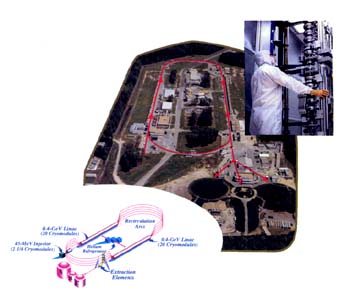
FIGURE 7.1
Schematic and aerial view of CEBAF at the Thomas Jefferson National Accelerator Facility (TJNAF) in Newport News, Virginia. The accelerator is based on superconducting cavities for acceleration. Beams are recirculated and accelerated up to 5 times to provide intense continuous electron beams of 1-5 GeV, polarized and unpolarized, to three target areas simultaneously. The photo insert shows assembly of a superconducting cavity section in the clean room. (Courtesy TJNAF.)
Accelerator Center (SLAC), and continue to be involved in measurements at Fermilab and other high-energy facilities around the world.
Two current key objectives of nuclear physics, understanding the quark structure of nucleons and nuclei and the search for the quark-gluon plasma, have demanded higher energies, beam currents, and duty factors for electrons, and much higher energies for heavy ions. This motivated the construction of two large facilities designed specifically for nuclear physics at these research frontiers: CEBAF at the Thomas Jefferson National Accelerator Facility (TJNAF) in Virginia (shown in Figure 7.1), a high-current, continuous-beam electron accelerator of moderately high energy that has recently become operational; and the
Relativistic Heavy Ion Collider (RHIC), the first high-energy heavy-ion collider, now nearing completion at Brookhaven National Laboratory (BNL).
Accelerator Research and Development
Most of the accelerator facilities in nuclear physics have developed in close association with the science on the one hand and with the more general research and development in accelerator science and technology on the other. Long-term accelerator R&D has led to new technologies and new science in nuclear physics, with significant spin-off into other areas of science.
Superconducting magnet development at Michigan State University has led to compact, powerful cyclotrons for heavy-ion beams; superconducting beam bending and focusing magnets for the highest-energy beams, originally developed for proton accelerators in particle physics, have been extended for use with heavy-ion beams at RHIC.
Superconducting radio-frequency (rf) cavities have been successfully developed over the past two decades for acceleration of low-velocity heavy ions and of high-velocity electrons. Cavities for heavy ions, first developed and implemented at Argonne National Laboratory in the early 1970s and soon after at the State University of New York at Stony Brook and other universities, provide cost-effective and versatile postaccelerators for high-quality ion beams that cover the full mass range from protons to uranium. The successful operating experience with this new technology bolstered its development and application to the higher velocities required in the accelerators for particle physics. In nuclear physics, recent R&D at TJNAF led to the development of reliable, high-gradient, superconducting acceleration cavities with higher-order mode suppression for electrons at the velocity of light. R&D in this area could lead to a further factor of two or so in gradient and will likely open this technology to other applications, such as the use of superconducting rf cavities as accelerator drivers for high-power interaction regions and ultraviolet free-electron lasers and, possibly, in high-energy linear colliders.
The development of high-charge-state electron cyclotron resonance (ECR) ion sources is revolutionizing the acceleration of heavy-ion beams both at cyclotrons and at heavy-ion linacs. Since energy gains increase with ionic charge state, acceleration of highly charged ions makes the most efficient use of accelerator voltages.
The development of polarized beams and targets has made major strides. Developments in atomic-beam techniques at the University of Wisconsin are providing polarized gas targets and polarized ion sources, and long-lived frozen polarized targets have been developed at various facilities. Laser polarized targets have been developed for hydrogen, helium, and lithium ions at various universities and national laboratories. So-called Siberian snakes and spin rotators
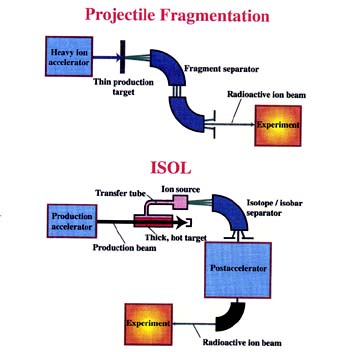
FIGURE 7.2
Schematics of the two principal concepts for the generation of energetic beams of short-lived nuclei (radioactive beams). The top figure illustrates the in-flight projectile fragmentation approach in which an energetic particle (typically several tens of MeV/u to GeV/u) is fragmented in a nuclear reaction in a thin target, and radioactive reaction products are separated in-flight and transported as a secondary beam to the experiment. The ISOL (isotope separator online) approach illustrated at the bottom employs two independent accelerators: a high-power driver accelerator for production of the short-lived nuclei in a thick target that is directly connected to an ion-source and a postaccelerator. Radioactive atoms diffuse out of the hot target into the ion source where they are ionized for acceleration in the postaccelerator. This scheme provides for excellent beam quality since it allows full control over beam energy and time structure.
based on a superconducting helical dipole magnet design are allowing acceleration and complex manipulations of polarized beams.
Electron cooling of ion beams in storage rings has greatly advanced, allowing precision in-beam nuclear physics measurements in storage rings with internal targets. The low emittance of the cooled, stored proton beam at the Indiana University Cyclotron Facility (IUCF) has proved to be an excellent tool to study threshold reactions for nuclear physics on the one hand and nonlinear, single-particle beam dynamics effects of interest to accelerator physicists on the other.
Some of the developments mentioned have occurred at the larger user facilities. But often smaller facilities, in particular those at universities, have provided the environment for generic developments that have important applications to the research programs at large accelerators. This exemplifies the symbiotic relationship between small university accelerators and large national and international facilities in nuclear physics.
Several new projects are in progress or under consideration. First, there is the completion of RHIC, expected for 1999, with ongoing R&D efforts to extend its performance beyond the design parameters: superconducting magnet control, bunched-beam stochastic cooling, and the implementation of polarized proton-beam operation. A viable, bunched-beam, stochastic cooling system could potentially ameliorate the effects of intrabeam scattering in heavy-ion beams and thus significantly improve performance. A recent decision to implement polarized proton operation at RHIC has led to an R&D program to develop the previously mentioned Siberian snakes and spin rotators.
The 1996 NSAC Long Range Plan recommended an upgrade, now under way, of the radioactive-beam capabilities at Michigan State University. Two superconducting cyclotrons are being upgraded to boost the energy and intensity of the primary production beam at this radioactive-beam facility of the in-flight fragmentation type. Radioactive-beam intensities will be increased by factors ranging from 100 to 1,000. Figure 7.2 shows the schematics of the two principal approaches to radioactive-beam facilities—in-flight fragmentation and the two-accelerator ISOL (isotope separator online) concept.
The NSAC Long-Range Plan also recommends development of a next-generation, ISOL-type, radioactive-beam facility based on the two-accelerator (driver/postaccelerator) concept, with its construction to begin once construction of RHIC is substantially completed. The advanced ISOL facility will bring together the fruits of a number of current accelerator developments—suitable radiofrequency quadrupole accelerators, high-power conventional and superconducting linacs or cyclotrons, and the developments of target/ion source systems—that have been carried out in recent years at a variety of nuclear physics facilities.
A list of present accelerators for nuclear physics research in the United States is given in Appendix A with a short summary of their respective performance characteristics.
Instrumentation
Major progress made in target and detector systems in recent years underlies many of the current advances in nuclear science. Polarized targets of light nuclei, produced either by atomic-beam techniques or by novel approaches using laser-induced polarization, have played an important role in fixed-target experiments, as well as in experiments using internal targets in storage rings. Advances in particle detectors range from single detectors at low energies to complex detector arrays for the highest energies and the largest particle multiplicities. Most detectors are used in experiments with beams from accelerators, but stand-alone systems also play an important role and have undergone major developments. It is not possible to give a detailed discussion of all the recent developments within the limited space available in this report. Rather, we will give selected examples from the various areas of nuclear physics research to provide a taste of the novel developments and genuine advances that these targets and detectors represent for the science.
Examples of New Detector Systems
Ion and Atom Traps
At the lowest energies, novel structure information on nuclei has been obtained by trapping nuclei, in particular short-lived, radioactive ones far from stability, in ion or atom traps and by measuring their masses and the properties of their radioactive decays.
Trapping atoms in magneto-optical traps with the help of lasers has made major advances over the last decade (as shown in Figure 7.3). This technique promises unique advances in studying nuclear decays, allowing precision studies of fundamental symmetries under controlled conditions. For example, atomic experiments can measure parity-violating matrix elements with significant precision. The heaviest alkali, francium, promises particularly large sensitivity to parity violations because of its simple structure, with only one electron outside of a spherical core. Francium has no stable isotopes, making it difficult to carry out this important class of measurements. However, several laboratories have recently taken an important step in starting these measurements, by efficiently collecting the small number of francium atoms created in a nuclear reaction and cooling them sufficiently to confine them in a laser trap. To reach the intensities of trapped ions needed for the symmetry studies, major advances are needed in production yield and trapping. The next-generation ISOL facility will provide the required intensities.
The use of ion traps in nuclear physics has proven equally exciting. Penning traps have been effective instruments for high-accuracy mass determinations. With these devices, the mass ratios of a number of stable or long-lived light
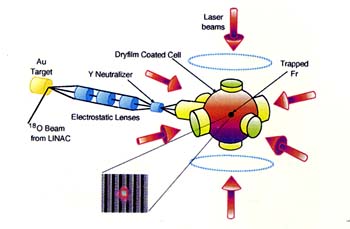
FIGURE 7.3
Schematic layout of a magneto-optical trap, which uses a combination of a weak magnetic field and six intersecting polarized laser beams to capture radioactive atoms generated in a nuclear reaction. These atoms are captured by neutralization and thermalization of a low-energy radioactive ion beam. Once captured in the trap, these atoms can become an ideal source for precision studies of nuclear decays that address aspects of fundamental symmetries and the Standard Model.
particles have been determined to high accuracy, on the order of a part in a hundred million. High-accuracy measurements with radionuclides have been performed for an accurate determination of the binding energies of nuclei.
Exploring the Structure of Exotic Nuclei
Novel high-precision mass measurements have also been made in a storage ring. Signals have been detected from as little as a single circulating ion of a specific isotope.
Advanced detectors for nuclear reactions near the Coulomb barrier allow one to explore the behavior of the nucleus under the extremes of excitation, spin, and neutron-to-proton ratio. High-sensitivity recoil systems allow identification of the rarest reaction products in heavy-ion fusion reactions at zero degrees, which are usually hidden in an overwhelming background from the incident particle beam. This has allowed nuclear physics, for example, to identify the new heavy elements up to 112, and a number of proton emitters, literally dripping protons, at the proton drip line.
New information about high-spin states in nuclei has been obtained with large, highly efficient germanium detector arrays. The Gammasphere array consists
of 100 large Compton-suppressed germanium crystals. Using its high efficiency for high-energy gamma rays, it has been possible to identify, unambiguously, the transitions linking states in the superdeformed and normally deformed potential minima. The combination of such powerful high-resolution detectors with the highly selective recoil systems shown in Figure 7.4, supports studies of nuclear structure out to the limits of nuclear existence. Similarly, new high-resolution magnetic spectrometers allow precision nuclear structure studies in reactions with radioactive beams or polarized light-ion beams. Figure 7.5 shows the recently completed superconducting magnetic spectrograph at Michigan State University for a broad range of studies with radioactive beams.
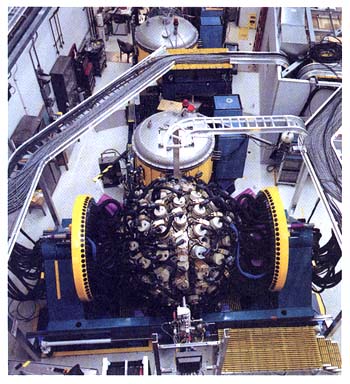
FIGURE 7.4
Gammasphere, the national gamma-ray facility for studies in nuclear structure research, mounted in front of the fragment mass analyzer (FMA) at the ATLAS accelerator at Argonne National Laboratory (ANL). Gammasphere was built at the Lawrence Berkeley National Laboratory in a collaboration of national laboratories and universities and is the premier detector for nuclear structure research with gamma rays. The FMA is an electromagnetic ion-beam filter that allows researchers to select rare nuclear reaction products out of an overwhelming background of beam particles at zero degrees, and then study their decay through coincidence with the cascade of decay gamma rays detected by Gammasphere. (Courtesy ANL.)
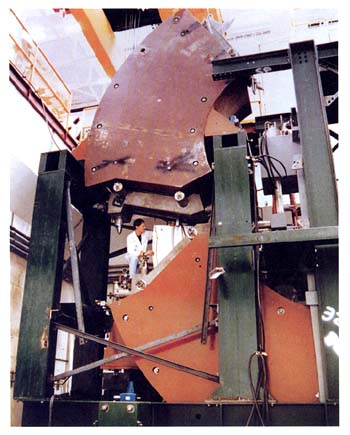
FIGURE 7.5
The superconducting magnetic spectrograph S800 at Michigan State University. The target for the nuclear reactions is at the bottom left of the spectrometer structure. Reaction products from nuclear collisions, induced by beams of short-lived nuclei (radioactive beams) are selected and bent upwards by powerful superconducting magnets onto the focal-plane detector system mounted on the top of the spectrograph. (Courtesy MSU.)
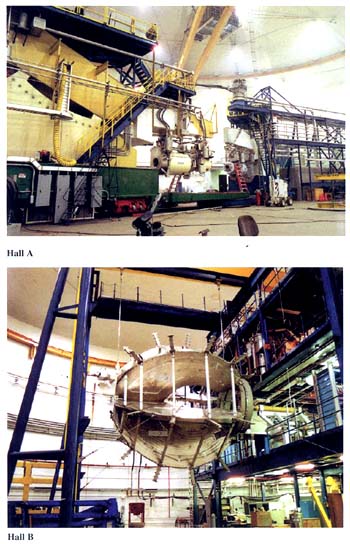
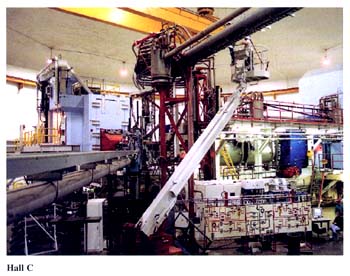
The three experimental halls at CEBAF at the Thomas Jefferson National Accelerator Facility in Newport News, Virginia. Hall A houses two high-resolution magnetic spectrometers based on superconducting magnetic dipoles to bend the reaction products into their focal-plane detector systems. Hall B houses a clam-shell-type, large-acceptance, magnetic spectrometer, again based on superconducting magnets, but with a novel technology that uses iron-free magnet coils. Hall C houses a combination of a high-resolution magnetic spectrometer for electrons and a short-orbit spectrometer to allow detection of short-lived particles before they decay. (Courtesy TJNAF.)
Detectors for the Quark Structure of Matter
The program to elucidate the quark and gluon substructure of nucleons and nuclei requires large, high-quality spectrometers at high energies and momenta. At TJNAF, two of the three experimental areas house pairs of large magnetic spectrometers (shown in Figure 7.6). The spectrometers are equipped with sophisticated focal-plane detection systems with high rate capabilities, to detect, identify, and analyze with excellent resolution electrons as well as hadronic reaction products, i.e., mesons, nucleons, and hyperons. A third hall houses a novel large-acceptance spectrometer, with its magnetic field generated by a six-coil, iron-free, superconducting toroidal magnet and a complex particle detector array. At MIT's Bates accelerator, a novel detector, the Bates Large Acceptance
Spectrometer Toroid (BLAST), is under construction for a full exploitation of spin observables in intermediate-energy nuclear physics. It will be used in experiments in which polarized circulating electrons scatter from polarized internal targets in the Bates storage ring. Out-of-plane measurements, for added understanding of electron scattering from nuclei, are being performed with the new Out-of-Plane Spectrometer (OOPS), shown in Figure 7.7.
The detection of neutral mesons with high resolution and efficiency has been a long-standing technological challenge. Arrays of barium fluoride detectors have been developed for use in heavy-ion-induced reactions, where excellent timing characteristics are necessary to discriminate against the overwhelming neutron background. A detector for high-resolution measurements of pions and beta mesons that detects high-energy decay photons with bismuth germanate (BGO) converters and pure cesium iodide (CsI) calorimeters was developed at Los Alamos and recently moved to the Brookhaven accelerators.
Detectors for the Frontier of High-Energy Density
The attempt to observe phase transitions in bulk nuclear matter by colliding two heavy nuclei at RHIC requires detectors covering the full solid angle, having large dynamic range, and, at the highest energies, able to handle the highest particle densities emerging from any reaction studied in the laboratory. At medium energies, the clean detection and identification of complex nuclear fragments pose severe challenges. The RHIC detectors collectively cover all of the predicted signatures for the quark-gluon plasma (QGP). Two complementary major detector systems, PHENIX and STAR, and two smaller-scale detector systems, PHOBOS and BRAHMS, are under construction.
The STAR detector, shown in Figure 7.8, uses the large, solid-angle tracking and particle identification capability of a cylindrical time-projection chamber, placed in a large solenoidal magnet. The design emphasizes detection of the global features of the hadrons and jets as the signatures for QGP formation. Proposed additions to this detector include a silicon vertex tracker, an electromagnetic calorimeter, a time-of-flight array, and a pair of external time-projection chambers.
The PHENIX detector focuses on the detection of leptons, photons, and hadrons in selected solid angles, with a high-rate capability, to emphasize the electromagnetic signatures of QGP formation. The central part of PHENIX consists of an axial field magnet and two detector arms, each covering one-fourth of the full azimuth. Each arm will be equipped with a drift chamber, pad chambers, ring-imaging Cerenkov counter, time-expansion chamber, time-of-flight, and electromagnetic calorimeters. Silicon detectors close to the beam pipe provide nearly full solid-angle coverage for particle detection. Upgrade items proposed for PHENIX are instrumentation for the forward muon arm, a high-resolution photon detector, and improved tracking and trigger electronics.
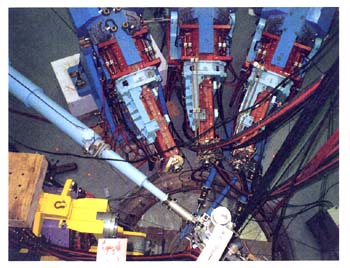
FIGURE 7.7
The Out-of-Plane-Spectrometer (OOPS) at the Bates accelerator is used to study polarization phenomena in nuclei. The four spectrometers allow positioning out of the reaction plane, which is important for the analysis of polarization variables. (Courtesy MIT Bates Linear Accelerator Center.)
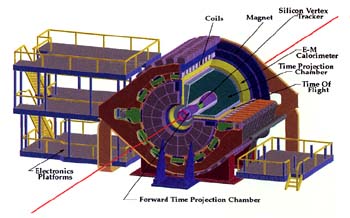
FIGURE 7.8
The STAR detector at the Relativistic Heavy Ion Collider (RHIC) at Brookhaven National Laboratory. This detector comprises an assembly of many different detection systems, including a large central time-projection chamber that allows precise three-dimensional reconstruction of particle trajectories. Appendix Figure A.2 shows an aerial view of the RHIC complex. (Courtesy RHIC.)
PHOBOS is a smaller detector; its double arm spectrometers use small magnets with strong magnetic fields and high-spatial-resolution silicon detector planes. The detector focuses on hadronic signatures for the QGP at low transverse momentum. BRAHMS uses two independent magnetic spectrometer arms for inclusive measurement, with particle identification and the ability to reach very forward angles.
Detection Schemes for Fundamental Symmetries and Underground Laboratories
High-precision spectrometers provide measurements of endpoints for beta-decay spectra that limit the electron-neutrino mass to a few eV. A neutrino oscillation experiment at Los Alamos is providing tantalizing glimpses of a possible oscillation between different neutrino flavors, using a 200-ton liquid scintillator to detect both scintillation and Cerenkov light and identify the different neutrino-interaction processes. Two smaller scintillation detectors to search for oscillations using reactor antineutrinos have been constructed in California and in France.
Underground laboratories are utilized increasingly to solve specific problems in nuclear physics; they have been essential in some important major advances of the field, particularly for measurements requiring very low backgrounds. They are cleaned of contaminants and are well shielded from cosmic rays, thus providing the environment in which searches for incredibly rare events become possible. For example. improved studies of the elusive double-beta decays established important upper limits on the probability for neutrinoless decay. Three new, underground, solar-neutrino detectors (and one extension of a previous detector) are under construction or recently completed; these will generate large amounts of precise data over the next few years that will have a major impact on understanding how the Sun shines and on the nature of neutrinos. Following up on the tradition of having pioneered this field (with the chlorine experiment in the Homestake mine), U.S. nuclear physicists are participating in all these experiments.
The Kamiokande detector, a large tank of water in which the Cerenkov light induced by charged particles is detected with great sensitivity, was built under a mountain west of Tokyo to study proton decay. Proton decay was not observed, but this detector became the first to be able to count individual neutrino events from the Sun. Together with the IMB (Irvine, Michigan, and Brookhaven) detector, Kamiokande also recorded the burst of neutrinos from a supernova explosion in 1987. Recently the international team of nuclear and particle physicists working at the new SuperKamiokande detector announced the discovery of oscillations in neutrinos produced at the edge of outer space from the interaction of cosmic-ray particles with air molecules. The consequences for physics are likely to be revolutionary.
The Sudbury Neutrino Observatory (SNO) is a water-Cerenkov detector like SuperKamiokande; it is sited 2 km underground near Sudbury, Ontario, in an active nickel mine. Unlike SuperKamiokande, SNO contains heavy water. Although SNO will have a broad range of physics and astrophysics capabilities, its primary activity will be the detection of neutrinos from 8B decays in the Sun. With its deuterium nuclei, SNO will be able to distinguish electron neutrinos from the other neutrino varieties.
The Gran Sasso Laboratory, adjacent to the highway tunnel under the Gran Sasso d'Italia, in the Apennines about 100 km east of Rome carries out solar neutrino physics, a search for proton decay, and a range of cosmic-ray experiments. A high-intensity electrostatic accelerator for nuclear astrophysics is a new addition to the Gran Sasso Laboratory. In the United States, in addition to Homestake, a large underground detector at the Sudan mine in Minnesota searches for proton decay and studies energetic neutrinos produced high in the atmosphere. There are new proposals from nuclear and particle physicists to construct even more massive detectors to study energetic neutrinos created in exotic galactic or even extra-galactic processes.
The next generation of solar neutrino detectors include BOREXINO, planned
for the Gran Sasso and indicated in Figure 7.9. The detector is based on liquid scintillation spectroscopy, a standard method for detecting particles in nuclear and high-energy physics, and aims at a precise measurement of the neutrino flux from the 7Be decay in the Sun. But the size of the detector and its requirement for exceptionally low backgrounds are not at all standard. A prototype detector, an order of magnitude smaller, has recently succeeded in the development of the necessary new, high-purity, low-background materials and techniques. A detector under the ice at the South Pole and an underwater detector project in Russia are pioneering new techniques. Because of the low background and unique sensitivity, experimental activities at underground laboratories address diverse and important questions, representing an exciting frontier of nuclear physics, a frontier that will likely grow in the next decade.
These are examples of some of the important instrumentation in use with nuclear physics experiments today. The scope of this report does not allow a comprehensive accounting of all developments under way or in use. Development of new schemes and novel concepts is continuously occurring. These
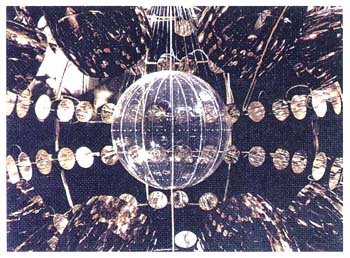
FIGURE 7.9
View of the prototype detector developed for the BOREXINO solar neutrino experiment at the Gran Sasso underground laboratory in Italy. The central 2-meter-diameter nylon sphere holds 4.5 tons of liquid scintillator and is surrounded by 1,000 tons of high-purity water. (Courtesy BOREXINO group.)
developments, as for new accelerator technologies, provide a unique and challenging training ground for the future scientists in nuclear physics and related sciences, but also for the technical workforce of the nation in general (see Box 7.1). Constantly pushing these frontiers, which have no technical peers, has generated and will generate the technical breakthroughs that are essential for progress and world leadership in the sciences, as well as the societal applications that many of these technologies achieve.
Computers in Nuclear Physics
Computers are an essential tool for research in nuclear physics. They are used for high-speed computing and for storage and retrieval of experimental data and other information. The needs of the field far exceed the capabilities of the present state of the art in computers and computational methods. Thus parts of the field are always exploring and pushing the limits of our computational abilities. They promote the development of new computational methods and new special purpose computers. The further applications of these methods have impacts in many other spheres. Some of the computational challenges facing nuclear physicists are described below.
Relativistic Heavy-Ion Data Storage and Retrieval
The detectors under construction at the RHIC facility in Brookhaven will yield vast amounts of information because up to 10,000 particles can be created in a single collision of gold ions. Since millions of collisions must be recorded from the finely divided, highly granular detectors, the total accumulated data volume will be close to one million gigabytes per year. These data sets are ten times larger than from previous experiments in either nuclear or particle physics, and their storage will require large-scale, high-bandwidth disk farms, tape robots with high-speed tape drives, and massive tape vaults. Furthermore, an input-output capacity to record the data as the collisions occur, and throughout of data at the analysis stage, must also be an order of magnitude faster than the present state of the art. All this has to be seamlessly tied together, allowing physicists access to data through simple database queries. A special Computational Grand Challenge project on data access is under way to provide software to do this in collaboration with computing facilities at RHIC, SLAC, and CERN. It will develop more efficient techniques of data mining based on pattern recognition techniques that allow users to locate the particular type of events needed from the large body of stored data. Applications of these techniques beyond the physics community will likely be broad, as was the case with the World Wide Web.
Quantum Monte Carlo Simulations of Nuclei
Detailed predictions of the microscopic and global structures of nuclei, and of nuclear reaction rates are challenging because of the quantal nature of nuclei and the complexities of nuclear forces. Many new developments in computational physics, including some of the key developments in the quantum Monte Carlo methods now used in several branches of the physical sciences, were made to address these problems in nuclear physics.
Quantum Monte Carlo techniques, developed in the past few years, can predict the structures and simple reaction rates of light nuclei having up to 8 nucleons, using present supercomputers operating at about 10 gigaflops, i.e., performing 10 billion operations per second. These predictions are being used for the studies of nuclear forces, nuclear structure, and solar and primordial nucleosynthesis. The next goal is to address structure and reactions of the more complex carbon, nitrogen, and oxygen nuclei, having up to 16 nucleons in an ab initio fashion, starting with the basic interaction between nucleons, with anticipated future computers operating at speeds of several trillion operations per second.
Computer Simulations of Supernovae
Core-collapse supernovae are spectacular stellar explosions that mark the end of a star's life after millions to billions of years of stellar evolution, disrupting it almost entirely. They occupy a special place in astrophysics and cosmic hierarchy for many reasons. They are the most energetic explosions in the cosmos, releasing energy in the form of neutrinos at the staggering rate of 1045 watts! They are also responsible for disseminating and producing most of the heavy nuclei in the universe, without which life as we know it would not be possible.
Current supernova modeling revolves around the idea that the shock wave, which will ultimately disrupt the star and produce the supernova, is partly fueled by neutrino heating of the matter behind it. These neutrinos are created in the core of the hot proto-neutron star left behind by the shock, and the most challenging task is to calculate the neutrino transport taking into account the three-dimensional hydrodynamic motions of the stellar matter. This presents a fundamental scientific problem that can be solved by (and only by) stretching computational resources to the limit.
Lattice Quantum Chromodynamics
For the understanding of the quark-gluon structure of the protons, neutrons, and other hadron building blocks of matter, and that of the phases and behavior of hadronic matter under extreme conditions, quantitative answers are within reach.
The only known way to calculate quark-gluon bound states and dynamics is by numerical evaluation on a discrete space-time lattice of large dimension. This technique was originally developed by particle physicists and is now being applied widely to problems in both particle and nuclear physics. One challenging problem of particular interest in nuclear physics is the behavior of bulk matter at the very high temperatures characteristic of RHIC collisions.
Such lattice-QCD calculations pose an extraordinarily demanding computational physics problem. In recent years these demands have lead to constructing a series of the fastest civilian computers in the world, with theoretical physicists playing a key role. In addition, physicists have pioneered a number of algorithmic developments to obtain great improvements in the accuracy of the calculations. Progress has been impressive, but a great deal more needs to be, and will be, accomplished in the coming decades.
Outlook
Progress in nuclear physics is intimately linked to the continuous development of sophisticated and high performance instrumentation, especially particle accelerators, particle detectors, and data acquisition and computer systems. This development entails a broad range of modern technologies.
The design, construction, and operation of the sophisticated devices used in nuclear research involve students at all stages. This direct participation enables the students to acquire the skills, experience, and vision to develop the next generation of instrumentation for use in nuclear science and applied research, and for industrial applications. Although they are motivated by basic research, accelerators and detector techniques used by nuclear scientists have a broad range of applications outside of nuclear physics, especially in medicine and materials science.
The education of young scientists, engineers and technicians is essential for the technological advancement of this instrumentation, for the progressive evolution of the field, and for meeting society's technological needs.


