
8
Nuclear Physics and Society
Introduction
Society supports fundamental research in the expectation of benefits that support national priorities. These benefits take many forms. Satisfying natural human curiosity about the workings of nature is one, and this is the principal motivation for most researchers. Their search for new knowledge often stimulates advances in the limits of technology. It leads to instrumentation and theoretical concepts that address problems of societal concern, and to advances in other areas of science. The concepts and techniques of nuclear physics have had exceptional impact in this regard.
An equally important aspect is the contribution nuclear physics makes to the education of the technically sophisticated workforce that is essential for the nation's present and future economic well-being. Graduate education in nuclear physics provides broad training, involving experimental and conceptual techniques from a broad range of science and technology. As a result, nuclear physicists contribute in many areas of our society, frequently well beyond their original training in nuclear physics. Nuclear physics laboratories also provide an infrastructure for the hands-on education of younger students, involving undergraduates in research and exposing secondary school teachers and their students to the subatomic world and to scientific research.
The direct applications of nuclear physics have a major overlap with the priorities of the nation: improvements in human health, the environment, the efficiency of industrial processes, energy production, the exploration of space,
and national security. Beyond these direct applications is the general benefit that arises from pressing forward the frontiers of high-technology development.
Some of the most pervasive applications of nuclear physics are in medicine. Medical imaging techniques now widely used, such as positron emission tomography (PET) and nuclear magnetic resonance imaging (MRI), provide information in three dimensions about the structure and biochemical activity of the human interior. Radioactive isotopes produced by accelerators and reactors are routinely used in medical diagnostic procedures, in treatment, and in medical research. Cancer radiation therapy mainly uses electron accelerators and radioactive sources. Treatment with protons, neutrons, and heavier ions is becoming more widespread and shows great promise for improved selectivity and effectiveness.
Many applications to environmental problems take advantage of the exceptional sensitivity of nuclear techniques such as accelerator mass spectroscopy to obtain information not available by other means. One can determine oceanic circulation patterns, the rate of carbon dioxide exchange between the atmosphere and the land and oceans, and the historic climate record. All of these have major implications for an understanding of climatic change. Studies of groundwater resources and their recharge rates, and of the origin of atmospheric pollutants, also provide unique information.
The assortment of industrial applications reflects the great variety of industrial processes. One common theme is the use of nuclear techniques and accelerators to determine the composition and properties of materials, their structural integrity after manufacture, and their wear in use. Another is the development of techniques for the modification of materials through accelerator ion-implantation, as in the doping of microelectronic circuits, or the introduction of defects to increase the current-carrying properties of high-temperature superconductors.
Safety and national security are areas with broad applications of nuclear techniques. Their use in detection of explosives and weapons has occupied increasing attention as a barrier to terrorism. Diagnostic procedures based on nuclear physics techniques will play a major role in noninvasive monitoring of chemical weapons and in controlling the distribution of enriched uranium and plutonium from dismantled nuclear weapons. Such procedures will also be important in the stewardship of the remaining nuclear stockpile. Intense beams from accelerators may in the future serve a joint role in production of the tritium required to maintain the required stockpile of nuclear weapons and in disposal of radioactive wastes.
Nuclear physics continues to have a profound impact on the production of energy: nuclear fission reactors produce about 19 percent of U.S. electricity (17 percent worldwide), and they provide an option for reducing use of finite hydrocarbon fuels and hence the emission of carbon dioxide into the atmosphere.
A few examples—of successes, of programs in early stages of development,
and of some others with a good chance to become important in the future—are given here.
Human Health
Technologies emerging from nuclear research have an important impact on human health and have resulted in a new field, nuclear medicine. In the United States, 1,600 radiation oncology departments operate 2,100 linear accelerators. Nuclear diagnostic medicine generates approximately $10 billion in business annually, radiation therapy using linear electron accelerators about the same, and instrumentation about $3 billion. Over 10 million diagnostic medical procedures and 100 million laboratory tests using radioisotopes are performed annually in the United States. Three areas of particular medical significance are cancer radiation therapy, diagnostic imaging, and trace-isotope analysis.
Radiation Therapy for Cancer
Over a million new patients develop serious forms of cancer every year, and about half of them receive some form of radiation therapy. Traditional radiation treatments use streams of x rays or nuclear gamma rays. These high-energy photons deposit most of their energy where they enter the body. Thus, for a single exposure, healthy tissue unavoidably receives a higher dose than the cancer. The damage to healthy tissue can be ameliorated by irradiating the tumor from many different directions, all intersecting at the site of the tumor. Teams of radiologists, physicists (many with training in nuclear physics), and computer programmers design three-dimensional treatment plans (conformal therapy) that maximize dose-deposition in the tumor while minimizing the exposure of healthy tissue.
Recent developments by nuclear scientists and radiologists that use protons, neutrons, and heavy ions for radiation therapy promise to reduce the problems inherent in treatment with photons. As new accelerators designed explicitly for cancer treatment come into wider usage over the next decade, it is likely that there will be significant improvements in radiation treatment, resulting in more cures and fewer side effects. These advances will use techniques, knowledge, and accelerators that stem from nuclear physics.
Cancer Therapy with Protons
The use of protons for radiation therapy has the advantages that protons deposit more of their energy where they stop, not where they enter the body, and that their depth of penetration can be precisely controlled so that they stop within the tumor. This allows radiologists to increase the radiation dose to the tumor while reducing the dose to healthy tissues.
Over 20,000 patients have been treated with protons, mostly at accelerators originally built for physics research. Now, physicists are designing accelerators optimized for cancer therapy; one has been in operation since 1990 at Loma Linda Hospital near Los Angeles, and many others are in various stages of planning and construction, both in the United States and overseas.
Cancer Therapy with Neutrons and Heavy Ions
Research is continuing with other forms of radiation therapy that use neutrons and heavy ions. Neutrons produce a high linear energy transfer (LET); i.e., the density of broken chemical bonds in the cell is high. High-LET radiation overcomes a cancer cell's resistance to radiation damage more effectively than low-LET photon, electron, or proton radiation. Thus neutrons appear to be more biologically effective in killing cancers than are many other forms of radiation, especially in oxygen-poor cells. After three decades of clinical experience, it appears that some 10 to 15 percent of patients referred to radiotherapy would benefit from neutron therapy for cancers such as salivary gland tumors, some head and neck tumors, advanced tumors of the prostate, and melanomas.
A recent example of an optimized neutron facility is the superconducting neutron-therapy cyclotron designed and constructed by the National Superconducting Cyclotron Laboratory at Michigan State University. This cyclotron is in operation at Detroit's Harper Hospital, where neutron therapy is part of new cancer treatment protocols that have already shown highly promising results for tumors otherwise difficult to treat.
Beams of heavy ions, such as carbon or neon, with energies of 400-800 MeV per nucleon, are nearly ideal dose delivery vehicles for radiation therapy. They produce high LETs, which may offer the advantage of selectively destroying cancer cells (as compared to normal cells), and a sharply defined dose profile. Limited studies with carbon and neon beams were conducted at the Bevalac accelerator at Berkeley, but the studies were insufficient to establish a clear clinical advantage over proton therapy. Following pioneering U.S. studies, clinical research to assess the effectiveness of heavy ion radiation therapy using new accelerators and/or new techniques is now being pursued in Japan and at the GSI laboratory in Germany, but not in the United States.
Diagnostic Imaging
Diagnostic imaging technology started a century ago when Roentgen, the discoverer of x rays, immediately applied the penetrating power of these high-energy photons to make images of the interior of the human body, thereby revolutionizing diagnostic medicine. New imaging techniques have continued to have revolutionary impacts by providing improved, more sophisticated ways to see inside the body without surgery. Fundamental discoveries in physics have
given us x rays, computerized axial tomography (CAT), nuclear magnetic resonance imaging (MRI), single photon emission computerized tomography (SPECT), and positron emission tomography (PET). Some of these—CAT scans, MRI, and, increasingly, SPECT—are now standard diagnostic tools of comparable importance with basic x rays, and the needed instruments are provided by commercial manufacturers. The practitioners of advanced PET techniques are often nuclear physicists, who continue to develop more powerful instruments and techniques, and work with physicians to apply the techniques in the medical environment.
SPECT and PET Imaging
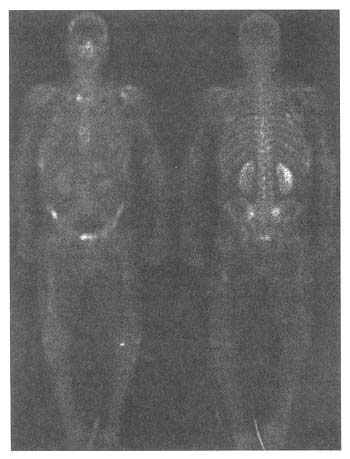
The SPECT imaging technique uses drugs containing small amounts of short-lived radioactive isotopes, mainly single photon emitters. The emitted photons are viewed by large detector arrays, which are moved around the patient to obtain a complete picture of the drug's concentration in the body. If the drug accumulates only in particular sites, such as cancer metastases, the images show the location of these metastases (Figure 8.1).
In contrast, the PET imaging technique uses drugs containing small amounts of short-lived radioactive isotopes that emit positrons. When a positron encounters an electron in the patient's body, the two particles annihilate and emit a pair of photons, which move in opposite directions and strike radiation detectors arranged in a circle around the patient. The line connecting the two detectors that were struck passes through the point where the annihilation took place; by using information from all detectors, one can pinpoint the location of the nuclear decay. Since the annihilation takes place near the drug molecule that contained the positron-emitting nuclide, PET devices can image metabolic activity within the human brain for neurological and psychiatric evaluations, or the whole body for detecting cancer, or the metabolism in the heart and other organs. One can study the body in near-equilibrium by administering the positron-emitting nuclides slowly with time, or study the body's dynamic response by administering the positron-emitting nuclides over a short time interval and then observing their spread through the body with time. Physicists are currently developing ultra-fast PETs that could one day be used for online dose verification in cancer radiation therapy, allowing much more accurate dose administration than is now possible.
Nuclear Magnetic Resonance Imaging
An important activity that helped unlock the mystery of nuclear structure was systematic study of nuclear magnetism. In its simplest manifestation, the nucleus behaves like a tiny bar magnet. Developing precision methods for measuring the strength of the nuclear dipole magnet was an early goal of nuclear physics. This basic research challenge was met with elegant experimental techniques
that have had enormous impact on diverse areas of science and technology. Even in the earliest experiments, it was found that measurements of nuclear magnetism were affected by the environment. It was necessary for the nuclear experimentalists to understand the environmental effects in order to extract the nuclear information that they desired. The modern technique of magnetic resonance imaging developed from this area of basic nuclear physics research. MRI is used to detect these environmental influences and to obtain images of the body's interior from them, providing a remarkable medical diagnostic tool.
New opportunities are being provided by nuclei that have their magnetism (spins) oriented in a particular direction. As discussed in Chapters 2 and 3 of this report, polarized protons and nuclei provide greatly improved sensitivity in studying the structure of matter. Motivated by such research opportunities, nuclear physicists, working with atomic physicists, have recently developed highly polarized nuclear targets using finely tuned lasers that generate polarized light of precise wavelengths. They have then used these targets at a variety of accelerator facilities in the United States and abroad (e.g., MIT-Bates, IUCF, SLAC, DESY in Hamburg, and shortly, TJNAF) to probe the structure of nucleons and nuclei. Some of these nuclei, the gases 3He and 129Xe, have the magnetic properties needed for MRI and the atomic structure needed to retain their polarization for hours at a time. They can be introduced into lungs, allowing MRI studies of lung function. In recent experiments, a group of atomic and nuclear physicists and medical researchers used this technique with 3He and 129Xe to obtain MRI images of human lungs (Figure 8.2). Because of the strong signal provided by the polarized nuclei in the gas atoms, the MRI scans are short and can be synchronized
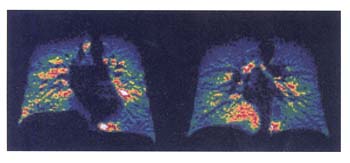
FIGURE 8.2
Nuclear magnetic resonance (MRI) images of a human lung, made possible by inhaling polarized 3He gas. Because roughly 10 percent of the magnetic moments of the gas are lined up in one direction, a high sensitivity is achieved. This makes it possible to view the largely empty space of the lung. (Image courtesy of Duke University and Magnetic Imaging Technologies, Inc.)
with breathing. MRI with polarized nuclei provides the only imaging method now available for examining lung function. 129Xe provides another capability; it dissolves well into blood and may allow the study of biochemical detail throughout the body.
Trace-Isotope Analysis
Radioactive nuclear isotopes produced by accelerators or nuclear reactors are used in many areas of biological and biomedical research. These isotopes have chemical properties essentially identical to their stable counterparts, but they decay and emit characteristic radiation that is readily detected. By inserting such radioisotopes as 14C and tritium, it is possible to turn molecules into tiny transmitters without perturbing their natural biochemical properties. The signals from these transmitters (their unique radioactive decays) provide information on how molecules move through the body, what types of cells contain receptors, and what kinds of compounds bind to these receptors. Radioisotopes help researchers to develop diagnostic procedures and to help create new pharmaceutical treatments for diseases, including cancer, AIDS, and Alzheimer's disease. They are also used directly to treat disease. Radioactive tracers are indispensable tools for the new forensic technique of DNA fingerprinting, as well as for the Human Genome Project, which seeks to unravel the human genetic code.
Accelerator Mass Spectrometry
Accelerator mass spectrometry (AMS) was developed by nuclear scientists building on the experimental technology of nuclear physics. It is used in a number of areas of research, medical research among them. The technique uses nuclear physics accelerators to make possible new uses of isotopes in the health sciences, for applications where the common techniques are inadequate. In AMS, atoms from a minute sample are ionized and accelerated to a sufficiently high energy that one can detect and identify individual atoms, using nuclear techniques. One thereby measures the concentration of a given tracer without having to wait for its decay. When the time available for observation in the laboratory is much shorter than the half-life of the isotope, AMS has a much higher sensitivity for long-lived isotopes than does decay counting. Only very small quantities of tracer material are required, greatly reducing exposure to radioactivity.
This technique has had many applications in other fields of science, for example in geology, oceanography, archeology, and climate studies. Although most AMS work uses dedicated low-energy accelerators, advanced facilities used for basic nuclear research often extend the technical edge in terms of sensitivity and mass range. For example, an isotope of krypton (81Kr) produced by cosmic rays has a lifetime of 210,000 years and will be useful for groundwater dating. It was necessary to use a large heavy-ion accelerator at MSU to produce Kr at a
sufficiently high energy so it could be identified at its natural level of about 5 atoms in 1013 atoms of stable krypton.
In biological applications of AMS, 14C can be used as a tracer with one million times the sensitivity of conventional scintillation counting. With this advantage, one can determine the uptake of hazardous chemicals through the skin or measure the damage to DNA by carcinogens or mutagens at actual exposure levels; environmental hazards or safety risks of pharmaceuticals can be evaluated without requiring (unreliable) extrapolations from unrealistically high doses. For example, the amount of benzene from a single cigarette has been traced in vivo to the exact proteins in the bone marrow of a mouse that this toxin affects. One can also use rare, but naturally occurring, isotopes to assess disease states. For example, the long-term progression of bone loss from osteoporosis can be studied at very low radiation exposure to the human subject by detecting minute amounts of the long-lived rare isotope 41Ca. And it is now possible to optimize the dose of a drug for an individual patient by measuring the fraction of an isotopic tag in excreted metabolites.
Environmental Applications
Accelerator mass spectrometry is also an important tool for environmental measurements. Measurements that would otherwise be difficult or impossible are made routine by its great sensitivity. One important example is the use of long-lived radioactive nuclei to obtain information about past and present climate.
Cosmic rays—mainly high-energy protons—from elsewhere in the galaxy continually bombard Earth's atmosphere and surface, producing long-lived radioactive nuclei. These cosmogenic nuclei can be used to provide information that cannot be obtained by other means. The best-known application involves the isotope of carbon with mass 14. Because carbon in organic objects is not replenished from the atmosphere once the animal or plant dies, the 14C present decays with a 5,700 year half-life, and the amount remaining provides a measure of the object's age. Other cosmogenic nuclei can be used in a similar manner to determine how long material that contains them has been shielded from cosmic rays and from the atmosphere. The concentration of the long-lived isotope 81Kr in an aquifer of the Great Artesian Basin in Australia will be measured and used to determine how long its water has remained uncontaminated with younger groundwater. its sensitivity allows the use of extremely small samples. A previous attempt to detect 10Be and 26Al in ice required 100 tons of ice—with AMS, 1 kilogram is sufficient.
Some of the most important applications of cosmogenic nuclei are studies of large-scale environmental phenomena. The amount of 10Be in ice cores has been measured by AMS and is found to be correlated with solar activity. This correlation
may make it possible to extend studies of solar activity backward 10,000 years in time, compared to the 400-year record currently available. A determination of whether solar variation could be partly responsible for climate variation may then be possible.
Other extensive measurements are devoted to understanding the nature of oceanic circulation. The pattern of these ocean currents is shown in Figure 8.3. Because they transport large amounts of water and heat, changes in the circulation pattern can have a major influence on climate. For example, if northward-flowing currents in the Atlantic were suddenly to cease, the temperature in northern Europe would decrease by 5 to 10 °C. An accurate description of these currents is of great interest, because of a concern that the driving force of increasing greenhouse gases could initiate such a change, causing sudden stepwise changes in climate or a shift to a climate regime less stable than the present.

FIGURE 8.3
Global currents carry large amounts of heat. Cold, salty water (dark shading) initially formed in the North Atlantic sinks into the depths of the ocean and flows south. The warm water (light shading) that flows northward to replace it is responsible for the present warm climate of northern Europe. It seems possible that these currents may stop, leading to rapid climatic changes. (From “Chaotic Climate." by W.S. Broecker. Scientific American. Nov. 1995. page 62. Copyright © 1995 by Scientific American. Inc. All rights reserved. Reprinted by permission.)
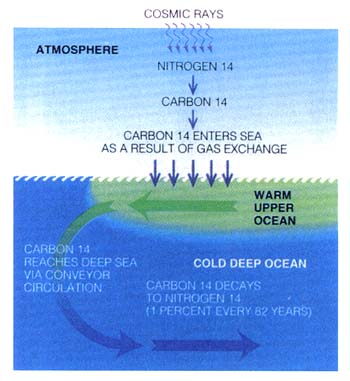
FIGURE 8.4
As cold, salty water sinks to great depths, it carries radioactive 14C out of the atmosphere and into the abyss, where it slowly decays. Radiocarbon dating is used to measure the state of the oceanic current system. (Courtesy Barry Ross.)
Measured concentrations of oxygen isotopes in Greenland ice cores show that large changes were common near the end of the last ice age. Dating of organic glacial remains in New Zealand using 14C indicates that these large changes were global in nature.
As shown in Figure 8.4, 14C enters the ocean and is carried into the abyss by descending currents. Precise measurements of 14C yield the mixing times for deep water and information on the stability of the oceanic circulation pattern.
A different application is to measure the concentrations of long-lived isotopes produced by human activities and deduce the exposure to more dangerous short-lived isotopes of the same element long after they have decayed. This technique made it possible to reconstruct deposition patterns and thyroid doses from radioactive 131I a decade after the Chernobyl accident. Although 131I deposition in the thyroid had been measured for more than 100,000 people soon after
the accident, its half-life is so short (8 days) that it was impossible to repeat or extend these measurements. Since the half-life of 129 I is 16 million years, it can still be detected by AMS, and together with the known ratio of 129I and 131I emitted by the reactor, used to predict thyroid exposure to 131I. So far, AMS is the only way to do this with the necessary accuracy.
Impact on Industry
Techniques derived from experimental nuclear physics and its accelerators and detection devices are today pervasive in technical and industrial applications. They are used for diagnostic and testing purposes, for material modifications, and directly for production processes. In addition, nuclear physics research provides vital input data for applications and engineering designs.
Nuclear Analysis and Testing
Certain techniques of nuclear physics—accelerators for producing a wide variety of particle beams, and methods for detecting and characterizing a broad range of nuclear products—are the basis for many applications. Some of these are discussed elsewhere in this chapter. Here, we concentrate on a small sample of important applications in industry.
Testing with Particle Beams
When a particle scatters backward from another particle, its energy depends on the mass of the target particle. A technique known as Rutherford back scattering, routinely used in industry, takes advantage of this property to determine the elemental composition of a material as well as the depth distribution of various elements in the bulk material. Rutherford's scattering technique was a monumental scientific accomplishment. The scattering experiment was invented to answer a simple but important basic research question: How is electric charge distributed within the atom? In answering the puzzle, Rutherford discovered the atomic nucleus and pointed out the power of a scattering technique that has led to important technological advances in many areas of science and technology. Recently, Rutherford scattering techniques have enabled important practical advances in the semiconductor industry where they are used to characterize the minute but important impurities in semiconducting materials. Materials also emit x-rays and gamma rays that are characteristic of the material when bombarded by low-energy protons. The x-rays (proton-induced x-ray emission or PIXE technique) or gamma rays (proton-induced gamma-ray emission or PIGE technique) are used to detect the presence of specific elements with high sensitivity and spatial resolution. These techniques have an enormous range of applications:
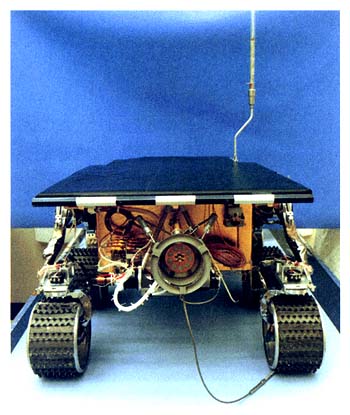
FIGURE 8.5
The alpha-proton-x-ray spectrometer points toward us at the lower center in this picture of the Mars Rover. It consists of an alpha-particle source and detectors to observe the back-scattered alpha particles (Rutherford back scattering) as well as the protons and gamma rays produced by alpha bombardment. Together, this information allows one to determine the composition of rocks on Mars. (Sojourner™. Mars Rover™, and spacecraft design and images copyright © 1996-97, California Institute of Technology. All rights reserved. Further reproduction prohibited. Reprinted by permission.)
recently an alpha-proton-x-ray analyzer installed in the Mars roving vehicle Sojourner analyzed the composition of martian rocks (Figure 8.5).
Testing with Neutron Beams
Following capture of a neutron, nuclei emit gamma rays that are characteristic of the nucleus. It is possible to produce copious beams of neutrons by using
low-energy nuclear reactions, such as the deuteron plus triton reaction, bombard an unknown sample with the neutrons, and detect the presence of specific materials tagged by their characteristic gamma rays. The known dependence of total interaction probabilities on material provides another possible tag. Airport safety devices may use these techniques to check for the presence of nitrogen in otherwise undetectable plastic explosives. Neutron techniques have been especially refined for oil-well logging and are widely used for this purpose. The neutron generators must be compact, and the instruments must be able to withstand pressures as high as 2,000 times atmospheric pressure and temperatures up to 175 °C.
Materials Modification
Beams of high-energy particles and gamma rays have many applications in industry. For example, gamma rays are used for the sterilization of foodstuffs and to cure epoxies. Implantation of beams of heavy ions developed for nuclear physics research is routinely used in the production process for semiconductor devices. As these devices become smaller, they become susceptible to faults caused by the electrical charges produced by background ionizing radiation; accelerator beams are widely used to study sensitivity to these single event effects.
A recent application is the use of proton, neutron, and heavy-ion beams for the improvement of high-temperature superconductors. These superconductors, with transition temperatures as high as 130 K (-143 °C) at ambient pressure, lose all electrical resistance and become superconducting if cooled by liquid nitrogen. For most applications, such superconductors must be able to carry high currents with zero dissipation. In high-Tc superconductors, magnetic fields produced by such currents penetrate into the material and establish tiny magnetic flux tubes that are surrounded by circulating supercurrents. In the presence of an electric current, these flux tubes move, producing thermal losses, unless pinned to a defect in the material. Neutrons or heavy-ion bombardment can produce such pinning defects and thus greatly enhance the current-carrying capability of the high-Tc material. Heavy-ion beams with energies between 5 and 100 MeV per nucleon produce the strongest pinning centers, enhancing the current-carrying capability by several orders of magnitude. Experiments on flux pinning are performed today at many nuclear research centers.
U.S. Nuclear Data Program
As should be clear from the above discussion, nuclear phenomena and techniques have a broad range of applications. Another by-product of nuclear research is a variety of nuclear data. such as nuclear-level schemes and moments and nuclear interaction probabilities, that play a major role in applications. For example, the design of nuclear reactors requires a knowledge of the details of the
interaction of neutrons with reactor fuels and materials, and of the decay properties of many of the radioactive nuclei that are formed. To provide this information, the DOE operates a Nuclear Data Program that, in the context of an international collaboration, is charged to collect, evaluate, and tabulate data useful for applications and for fundamental research.
Energy
Large amounts of energy can be released by splitting or fissioning heavy nuclei, such as uranium, or by fusing light nuclei, such as the isotopes of hydrogen. For example, a very large fission power plant producing a billion watts of electrical power will consume only a ton of uranium in a year. In the 1960s and 1970s, a large number of nuclear fission reactors were constructed to take advantage of this energy source; at present about 110 U.S. reactors are in operation. In 1996, nuclear energy provided about 19 percent of the nation's electric power production. That share has grown continuously, without construction of new plants, because the reliability of nuclear reactors has improved to 76 percent in 1996. Several states obtained more than 50 percent of their electric power from fission in 1996. Internationally, France obtains the highest fraction of its electricity, 77 percent, from nuclear reactors (Figure 8.6).
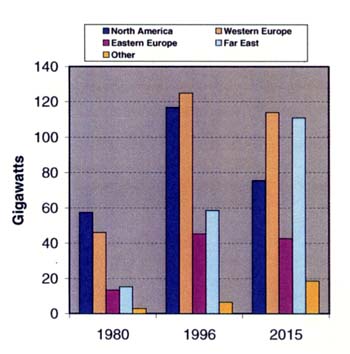
FIGURE 8.6
World nuclear capacity by region in 1980, 1996, and 2015. For a constant capacity, power output has increased in recent years because of increased operating efficiency. The expected decrease in capacity in the future is due to retirement of older reactors.
Since the 1970s, new construction of power reactors in the United States has come to a standstill. Concerns about operational safety and waste disposal have overshadowed the inherent advantages of nuclear power. These issues must be resolved before nuclear power can again be seriously considered on a large scale. Fission and fusion processes produce energy without producing greenhouse gases and components of acidic rain, such as sulfur—matters that are also of concern to society. Ultimately, this is an issue for public policy, and in the meantime it is important for the nation to preserve its options.
Several major new developments, described below, are concerned with improving reactor safety and the handling of waste; some of these will be tested during the next decade. Many of these developments draw on technologies and expertise that were developed as part of basic nuclear research programs.
Burning of Long-Lived Waste and Accelerator-Driven Reactors
One option for handling nuclear waste is to transmute the long-lived radioactive wastes from light-water reactors (the main reactor type) into shorter-lived isotopes that can be dealt with more easily. It has been proposed that intense high-energy proton beams could be used for this purpose; such transmutation machines have been studied at Los Alamos National Laboratory, at Brookhaven National Laboratory, and in Europe.
In one proposed process, proton beams would strike a high-power target and produce copious streams of energetic neutrons that would transmute the bulk of the radioactive waste material into short-lived nuclei. The goal is to reduce waste lifetimes to less than 100 years. Estimates indicate that with a further storage period of only 30 years, these products would have a level of radioactivity less than that of the original unused uranium fuel. The accelerator-waste combination would be operated at a subcritical level—it could not by itself sustain a chain reaction—so that no reactor-core meltdown accident could occur. In another proposed scheme, the PHENIX Project, uranium and most of the plutonium would be separated prior to proton irradiation and used again for reactor fuel. The most important long-lived components of the remaining waste are isotopes of neptunium, americium, curium, and iodine, some with half-lives of 10,000 years or more. According to one estimate, a machine operating at 3,600 million watts of thermal power could process these waste isotopes for 75 light-water reactors.
It has been suggested that this concept might be carried one step farther, and a particle beam might be used to produce additional neutrons directly in a nuclear-reactor-like core. Versions of this concept have been studied at Los Alamos and by a European group. The core would be sub-critical, and the accelerator beams would provide sufficient additional neutrons to run the reactor. Because the neutrons would have high energy, an abundant and less enriched element, such as natural thorium, could serve as the fuel. Such a sub-critical configuration is
inherently safe, and the long-lived waste is transmuted to short-lived nuclei in the process. A 1996 design study concluded that a 1-GeV, 0.03 ampere beam requiring 60 million watts of input power would produce 675 million watts of electric power, amplifying the input power by about a factor of 10. The thorium fuel would not require enrichment, but it would need to be recharged every 5 years.
Inertial Confinement Fusion Reactors
Nuclear fusion provides an alternative approach to producing clean and abundant power. In this process light nuclei such as deuterium and tritium fuse into helium, a process by which the Sun and other stars produce their energy. The fuel supply for fusion, the deuterium in the oceans, is extremely large, and fusion produces no long-lived radioactivity.
Since the 1950s, most studies have used magnetic fields to confine the plasma of interacting nuclei. Another technology, inertial confinement fusion, was proposed more recently: capsules of frozen deuterium and tritium (D-T) would be spherically compressed to several thousand times their normal density by powerful beams of lasers, or of light or heavy ions. Much has been learned about capsule fabrication and compression using powerful laser beams, and the National Ignition Facility, authorized for construction at Lawrence Livermore National Laboratory, has the goal of using lasers to heat D-T capsules to ignition. In the longer run, intense heavy-ion beams may offer a more practical solution.
Nuclear laboratories have much experience with the production and use of heavy-ion beams; their expertise would be important in the development of such powerful heavy-ion machines.
National Security
Nuclear science plays a critical role in national security. It is a matter of national policy that the maintenance of an effective nuclear stockpile continues to be important with the end of nuclear testing. Related to this issue are concerns regarding the proliferation of nuclear weapons and the acquisition of such weapons by terrorist groups.
Stockpile Stewardship
With the end of the Cold War and cessation of nuclear weapons testing, there is a new emphasis on stewardship of the existing nuclear stockpile that is science based rather than test based. It involves intensive computer simulations to replace underground explosions; these simulations rely heavily upon detailed understanding of the relevant nuclear physics processes and parameters.
The simulations must model the explosion of the warhead and also follow the explosion products to determine where and how the energy of the explosion is
deposited. As a result, many reaction probabilities—for charged particles, x rays, gamma rays, and neutrons—as well as the nature of the beta-decay products of fission fragments, are needed to fully simulate the performance of a nuclear weapon. Many of these reaction probabilities and decay properties are known from measurements, but others must be calculated from an understanding of how nuclei behave. This requires a deep understanding of nuclear structure and reactions.
Stockpile stewardship also has an important experimental component. Radiographic techniques that can image warheads without opening them and that can measure the dynamics of nonnuclear explosions will play an important role. Proton radiography is a sharp departure from the flash x-ray technology that has been the predominant radiographic tool in the past. It draws on the skills and techniques of nuclear physicists. The protons are created by an accelerator, transmitted using magnetic lenses, pass through the object under study, and are detected, all using techniques developed for studies in basic nuclear physics. Among the advantages high-energy protons bring to radiography are their penetrating power, well matched to the imaging of dense objects, and their sensitivity to both material density and composition. One can obtain multiple snapshots of dynamical processes such as chemical explosions, including stereoscopic views.
An accelerator at Los Alamos National Laboratory, built for research in nuclear physics (LAMPF), is carrying out a series of experiments to test this concept. A proton radiographic image of the shock front formed in a chemical explosion is shown in Figure 8.7.
This test demonstrates some of the basic concepts of proton radiography. A new experiment now under evaluation at Brookhaven National Laboratory will extend static measurements to higher energy, as required for radiography of thick objects. Eventually a proton accelerator in the 50 GeV range will be required.
Still another issue related to maintenance of the nuclear stockpile is the production of tritium, a heavy form of hydrogen. Tritium is an essential ingredient of thermonuclear weapons, but it decays with a half-life of 12 years and must be continuously replenished. One possibility for production of tritium is to use an accelerator to provide a 100-megawatt proton beam and drive a spallation source. Such a facility could provide the required time-averaged neutron flux. The safety, flexibility, cost, and logistics may prove more attractive than the alternative of constructing a large nuclear reactor. The LAMPF accelerator is currently being used to validate this concept.
Nonproliferation of Nuclear Weapons
The large accumulated quantity of nuclear material and secondary waste products poses a significant challenge. Such materials are used as fuel in nuclear reactors, but some can also be used in nuclear weapons. The Treaty on Non-Proliferation of Nuclear Weapons specifies that every "non-nuclear weapon state"
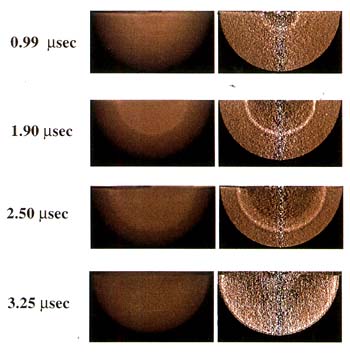
FIGURE 8.7
Proton radiograph of a chemical explosion, taken at the Los Alamos Neutron Science Center (LANSCE). In the sequence of exposures, at 0.99, 1.90, 2.50, and 3.5 microseconds, from top to bottom, one can see two different views of the progress of the shock wave formed in the explosion. (Courtesy Los Alamos Neutron Science Center.)
agrees to allow nondestructive analysis of their nuclear materials to prevent diversion from peaceful uses to weapons production. In those states with nuclear weapons, the material must be monitored and accounted for.
Techniques developed for nuclear physics research form the backbone of safeguards technologies. Gamma-ray detectors are used to assay the amount and isotopic composition of uranium or plutonium in a sample of material. Neutrons from fission are detected and independently determine the content of Pu in a sample. New techniques to enhance sensitivity include tomographic gamma scanning, analogous to medical imaging, and use of neutron sources composed of
the element californium to measure the attenuation of the neutron flux by light elements in the object being assayed.
Education of the Nation's Technical Workforce
Education of the next generation of technically sophisticated citizens and the training of scientists who can contribute to society have high priority in the nuclear physics community. The unique assets of the research enterprise, particularly in nuclear physics, provide a superb infrastructure to address this priority.
Graduate Education in Nuclear Physics
Education of graduate students in nuclear physics is essential for the continuing health of the field, and for maintaining a technically sophisticated workforce with expertise in the many aspects of advanced technology and instrumentation that training in nuclear physics entails. Nuclear physics has a long tradition of producing broadly educated and flexible scientists. Their skills are readily applied to a wide range of the nation's technological problems, in business, industry, government, and medicine.
Students in nuclear experiment and theory have the opportunity to face and solve complex problems at the frontiers of knowledge. Their graduate training involves state-of-the-art instrumentation and knowledge from different fields, many outside of nuclear physics. As an experimentalist, a student commonly designs, builds, and tests hardware using advanced materials, vacuum technology, control technology, and complex electronics and semiconductor devices, and becomes expert at the electronic and computer technology in data acquisition and analysis. Both theoretical and experimental projects often involve the design and implementation of complex computer programs and some of the most advanced computer hardware. In many cases, students have responsibility for all aspects of their projects and thus acquire a broad range of skills in addition to the ability to attack a particular problem in depth. Students often interact with scientists from different institutions and different countries that may contribute detectors or other components to an experiment; they learn teamwork and management and communication skills in addition to acquiring new technical knowledge and expertise.
The field of nuclear physics continues to attract high-quality young people. At present, DOE and NSF are supporting about 650 graduate students in nuclear physics with perhaps one-third that number supported by other funds. This influx of talent advances the intellectual and technical forefront, and it makes nuclear physics an important source of technical manpower.
As an example, the rather complete records of three university-based nuclear physics accelerator laboratories show the career paths of nuclear physics Ph.D.s
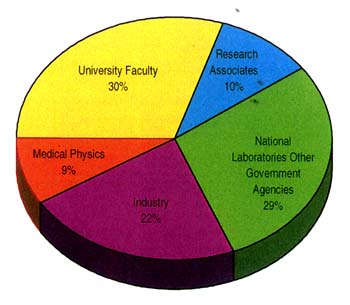
FIGURE 8.8
Employment of Ph.D. graduates in nuclear physics, from the long-term records of three DOE and NSF university laboratories: Indiana University Cyclotron Facility (IUCF), Michigan State University's National Superconducting Cyclotron Laboratory (MSU/NSCL), and the Triangle Universities Nuclear Laboratory (TUNL). They are probably similar to those of the field as a whole.
more quantitatively. These records, summarized in Figure 8.8, are probably typical of the field as a whole. The field of medical physics has long been a special and important application of nuclear physics and is displayed separately for this reason; most of these positions are in industry.
All the categories of permanent positions shown in Figure 8.8 include career opportunities whose scope is much broader than that of nuclear physics. This variety is not a recent phenomenon but has been characteristic of graduates in nuclear science for decades.
The nature of career prospects for young scientists is of considerable interest both within the scientific community and beyond. The decrease in funding for basic research and for the support of long-term research in industry has eroded a major sector of the traditional base of job opportunities for Ph.D. physicists in all fields. Statistics from studies by the American Institute of Physics indicate that the employment situation for physicists is now improving and that there has been a decrease in the number of first-year graduate students that will lead to a significant decrease in Ph.D. production. It appears that the entering generation of graduate students will have much-improved job opportunities. In the particular
case of nuclear physics, the production of Ph.D.s has been stable, and it appears that their employment opportunities have been relatively constant over at least the past decade.
Graduate Student and Faculty Demographics
A number of surveys of people active in basic research in nuclear science have been carried out over the past 20 years, some based on questionnaires sent to essentially all funded researchers, and others on statistics provided by the funding agencies. Taken at face value these surveys indicate that the number of nuclear scientists may have increased since 1980—the largest increase is 18 percent in DOE-supported graduate students. But, because of their different methodologies, one cannot be certain that the different surveys are measuring the same quantities, and indeed, some of the results seem inconsistent.
A significant overall phenomenon is the drop in the number of senior physics majors and beginning graduate students in all fields of physics. There were 26 percent fewer first-year graduate students in 1996 than in the recent peak year, 1992. This will inevitably lead to a drop in the number of physics Ph.D.s. Such a drop clearly is a concern that transcends disciplinary boundaries; it is likely to result in increasing reliance on Ph.D.s from other countries.
Undergraduate Education
An undergraduate degree in physics provides an excellent preparation for many different career paths. Many universities have programs that prepare physics majors for the changing demands of the workplace. These include programs focusing on preparation for secondary education, business, and laboratory instrumentation, as well as interdisciplinary programs in chemistry, biology, and medicine and in environmental and public policy. One indication of the success of these programs in the past is shown in the results of a survey,1 which showed that the median annual earnings (at mid-career) of holders of a physics bachelor's degree ranked among the highest-paying specialties and were 16 percent higher than the median for all fields.
The nuclear physics community has long provided undergraduates with experiences in active research laboratories, but in recent years this effort has had a sharper focus. Both NSF and DOE support such programs. Many students work with nuclear physicists through the NSF Research Experiences for Undergraduates (REU) program (see Figure 7.1.1). The DOE Science and Engineering
Research Semester and the Undergraduate Student Research Participation program involve students in nuclear physics projects. With the American Chemical Society, the DOE has developed an intensive summer school program that exposes students to research in nuclear power, waste disposal, nuclear nonproliferation, radiation safety, and nuclear medicine. Nuclear physics faculty members at undergraduate institutions often involve their students in nuclear research, especially at the user facilities, with NSF Research at Undergraduate Institutions (RUI) program support; about 9 percent of NSF-supported faculty are funded through the RUI program.
While these specific NSF and DOE programs provide opportunities for students who would otherwise not be able to participate in research, many more undergraduates are involved in nuclear physics research, directly supported by research grants. At a large number of universities, nuclear physics faculty involve undergraduates in their research projects, often as part of the research team, through senior theses and part-time or summer jobs. The synergism between research and teaching provides an early exposure to forefront research and state-of-the-art technology.
Earlier Education, Outreach, and Scientific Literacy
Given the rapid pace of technological advances, the future of the country and its economic welfare depend increasingly on the level of the technical and scientific sophistication of the population. The 1996 NSAC Long-Range Plan described the results of a survey on the involvement of nuclear physicists in undergraduate education, outreach, and scientific literacy. It is evident from the responses to the survey that many nuclear physicists are committing increasing amounts of their time and energy to these issues.
K-8 Education in Elementary and Middle Schools
Young children are fascinated by natural phenomena. Reinforcement of this fascination early in the educational process is a goal of many nuclear physicists. The broad variety of approaches includes programs for hands-on experience that have reached thousands of students; visiting minority professorships at research universities charged to interact with inner-city schools; and the Becoming Enthusiastic about Math and Science (BEAMS) program at TJNAF. The BEAMS program is a partnership with the local schools and the Commonwealth of Virginia; entire classes are brought to the facility for a full week of immersion in the scientific environment. To date, about 30,000 students have benefited from BEAMS and other programs at TJNAF.
Contact with Teachers and Students in High Schools
Students often perceive science and mathematics as formidable and as unpopular with their peers. This situation can be improved only if one addresses both the perception of science by young people and the quality of their science education. Nuclear physics laboratories and universities organize many programs for high school students and their teachers. Some of these efforts have been supported by federal funds or by the local institution, but many rely on the voluntary work of individual scientists. Examples include Saturday classes for in-service teachers; multiweek summer programs for students, sometimes involving teachers as well; lectures and demonstrations in schools, coupled with development of instructional material; and extension of computer facilities to high schools, so that students and teachers can access the Internet and the many innovative activities available there.
Activities Addressing Underrepresentation of Women and Minorities
It is unfortunate that large segments of our society are underrepresented in science and technology. The nuclear physics community has endeavored to encourage women and minority students to pursue careers in physics through individual volunteer efforts and specific programs supported by DOE and NSF. Many universities, colleges, and national laboratories bring female and minority students in middle schools for one day or longer visits to participate in hands-on science (especially physics) and to meet practicing scientists. Nuclear scientists have been active in such programs as the American Physical Society's Women in Physics project.
National and university laboratories have also committed resources to recruit students from historically black colleges and universities (HBCUs) and hispanic-serving institutions (HSIs) to participate in the laboratories' summer science research programs. These programs sometimes include support for HBCU faculty participation. For example, TJNAF's efforts have contributed to a significant growth in faculty hirings in HBCUs and HSIs. As a result, Hampton University has developed a new Ph.D. program and graduated about 20 undergraduates, all African American, one-third of whom has done research in nuclear physics. Mentoring programs for promising minority undergraduates have been instituted by national laboratories and universities.
It appears that the programs described above have had positive effects on an overall societal problem, but the issues remain.
Outlook
The past direct contributions of nuclear physicists to problems facing the nation are substantial. This is surprising, given the direction of research in
nuclear physics, which involves the most fundamental aspects of nature and is not directly focused on societal issues. If one examines the contributions outlined above, three threads running through them can explain this result. First, the techniques of nuclear physics are relevant to many of our national problems. Second, the broad training and team experience of many students in nuclear physics provide the background that allows them to confidently and fruitfully apply nuclear techniques in many settings. And third, the varied properties of nuclei, and their radiations, lend themselves to the remarkably broad range of specific applications discussed in this chapter.
It is appropriate to ask whether these contributions are likely to continue. The impact of basic research is hard to predict, but it can lead to profound and revolutionary developments, the case of nuclear fission being an outstanding example. Many of the items discussed above seem likely to have still greater importance in the future, and new applications will certainly arise from new technical developments in nuclear physics. One can anticipate continued growth in the role of nuclear physics in generating applications that contribute to society.


