
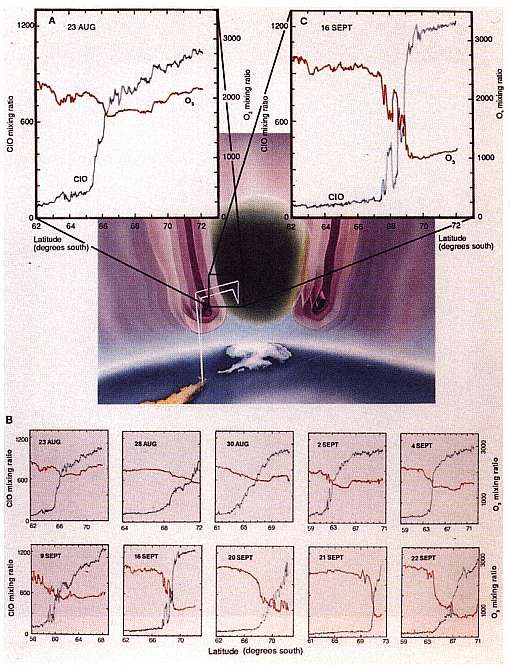
Plate 2.1 Rendering of the containment provided by the circumpolar jet that isolates the region of highly enhanced C1O (shown in green) over the antarctic continent. Evolution of the anticorrelation between C1O and O2 across the vortex transition is traced from (A) the initial condition observed on August 23, 1987, on the southbound leg of the flight, (B) the summary of the sequence over the 10-flight series, and (C) the imprint on O3 resulting from 3 weeks of exposure to elevated levels of C1O. Data panels do not include the dive segment of the trajectory; C1O mixing ratios are in parts per trillion by volume, and O3 mixing ratios are in parts per billion by volume. SOURCE: J.G. Anderson, D.W. Toohey, and W.H. Brune, "Free Radicals Within the Antarctic Vortex: The Role of CFCs in Antarctic Ozone Loss," Science 251:39-46, 1991.
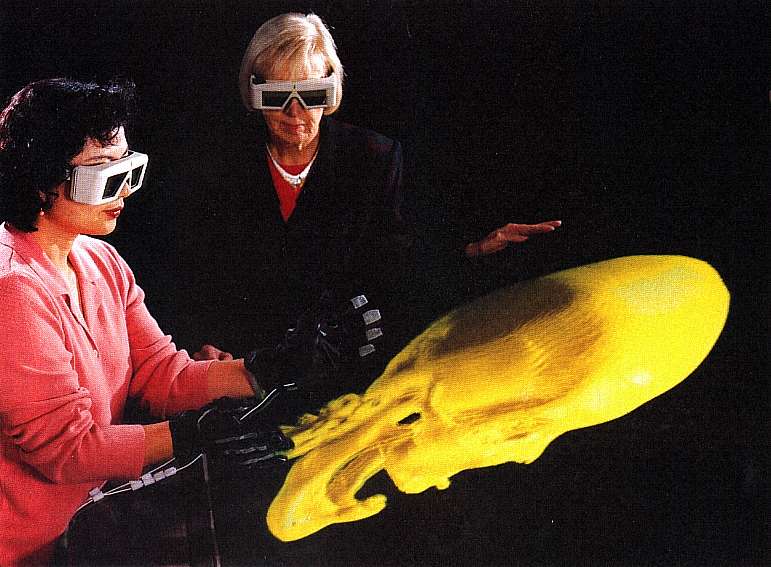
Plate 2.3 Muriel Ross (center) and Rei Cheng (left) use an immersive virtual environment workbench and special "Crystal Eyes" glasses to study a three-dimensional image of a skull. The skull was reconstructed from a computer tomography scan using special software developed in the NASA Ames Biocomputation Center. Interaction with images can be achieved using a pencil-like pointer (stylus) or special gloves as shown here. SOURCE: Courtesy of M.D. Ross, NASA Ames Research Center.


