
3
Federal Support for Research Infrastructure
Research infrastructure consists of many elements. Primary among them are research funding, human resources, and physical facilities for conducting research. Historically, the U.S. government has been a partner with industry and universities in creating the infrastructure for many critical new industries, ranging from agriculture to aircraft to biotechnology.1 Computing is no exception. Government, industry, and universities have all contributed to the research infrastructure that underlies the innovative capacity of the nation's computing industry. Funding for the research infrastructure in computing comes largely from industry and government sources, with small contributions from universities and nonprofit organizations. Private industry invests in research, develops human resources, and builds physical infrastructure for research and development (R&D) primarily to serve commercial purposes. Public support for research infrastructure is, in contrast, intended to create a pool of resources that can be drawn upon by a variety of users in the private and public sectors. For example, substantial public investment is made in universities that train students, conduct research, and build research laboratories.
This chapter explores the federal government's contributions to the research infrastructure, examining the government's support for research, human resources, and research equipment. Although computing technology draws on research in a number of academic disciplines—from computer science, electrical engineering, mathematics, materials science and engineering, and cognitive science and psychology—this chapter ex-
amines federal contributions in the areas of computer science and electrical engineering, which are the most directly relevant. Computer science includes work on the theory of computing; design, development, and application of computer capabilities to data storage and manipulation; information science and systems; programming languages; and systems analysis. Research in electrical engineering includes work in communications, semiconductor technology, and electronic circuits, which is relevant to computing, as well as work in electric power, which is not.2 Data on research funding is categorized according to the National Science Foundation's definitions of basic research, applied research, and development uses. Although the distinctions among these categories are increasingly difficult to make in the computing industry, they reflect the manner in which federal statistics are currently collected (see Chapter 1).3
Federal Research Funding4
Levels of Federal Support
Since the end of World War II, the federal government has been a strong supporter of computing research. Between 1976 and 1995 (the earliest and latest years for which consistent data are available), federal funding for research in computer science increased by a factor of five, from $180 million to $960 million in constant 1995 dollars (Figure 3.1). Growth has occurred in both basic and applied research, with basic research jumping from $65 million to $265 million and applied research rising from $116 million to almost $700 million over the 19-year period. Roughly 35 to 45 percent of total federal research funding for computer science has gone to universities, with industry and government laboratories garnering the remaining 55 to 65 percent; about 70 percent of the basic research funding went to universities during this period.5
In contrast to computer science, federal funding for research in electrical engineering remained essentially flat between 1972 and 1995. From a peak of $1.1 billion (in constant 1995 dollars) in 1972, the real dollar level of federal funding for research in electrical engineering dropped below $800 million in 1976 and, after exceeding the $1 billion mark again in 1987 and 1989, dipped back below $800 million in 1995. Despite the overall decline, obligations for basic research in electrical engineering grew during this time frame, from about $130 million in the 1970s and early 1980s to about $200 million after 1985 (Figure 3.2). As a result, the share of total research funding in electrical engineering going to basic research increased from 12 to 25 percent, and the share of total research funding going to universities rose from 10 to 23 percent.
Federal expenditures on computing research represent just a portion
of the federal budget for scientific and technological research. Combined federal obligations for computer science and electrical engineering research climbed from just under $1 billion to $1.7 billion between 1976 and 1995, growing from 5 percent to almost 7 percent of the federal research budget. Several other fields, such as biology and physics, have historically maintained higher levels of federal investment than computer science and electrical engineering, although growth in physics research funding slowed after the mid-1980s (Figure 3.3).
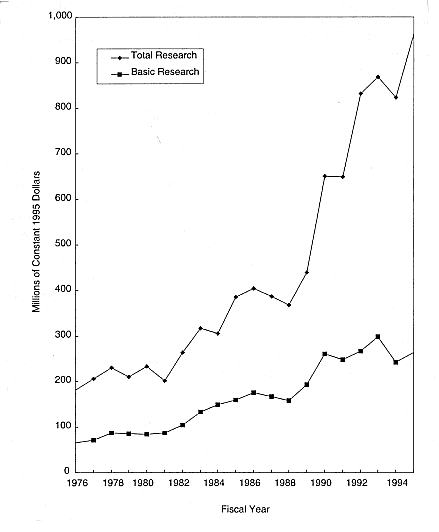
Figure 3.1
Federal funding for research in computer science, 1976-1995.
Source: NSF (1998b), Tables 25 and 35.
Sources of Federal Support
Federal funding for research in computer science and electrical engineering has come through several federal agencies whose roles and levels of support have shifted over time. Because of the emphasis it placed on computing as a means of enhancing U.S. military capabilities during the Cold War, the U.S. Department of Defense (DOD) has long been the largest funder of computing and communications research. Early funding
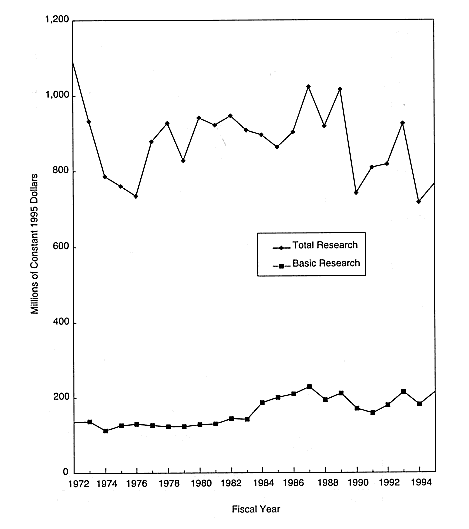
Figure 3.2
Federal funding for research in electrical engineering, 1971-1995.
Source: NSF (1998b), Tables 25 and 35.
came from the Army and Office of Naval Research, but within 2 years of establishing its Information Processing Techniques Office in 1962, the Defense Advanced Research Projects Agency (DARPA) became the dominant source of funding, providing more support for computer science research than all other federal agencies combined. Between 1976 and 1995, DOD provided some 60 percent of total federal research funding in computer science and over 75 percent of total research funding in electrical engineering (Figures 3.4, 3.5).
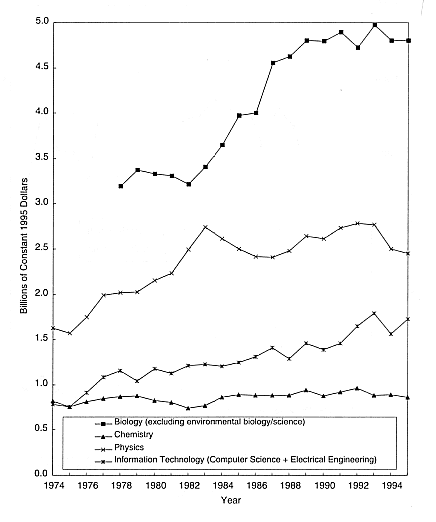
Figure 3.3
Federal funding for scientific research, 1974-1995.
Source: NSF (1998b), Tables 25 and 35.
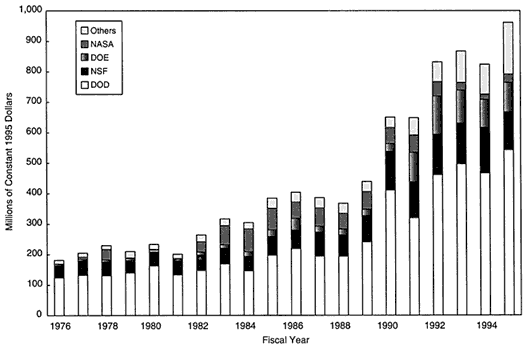
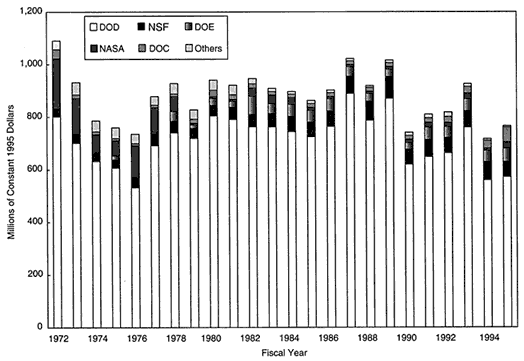
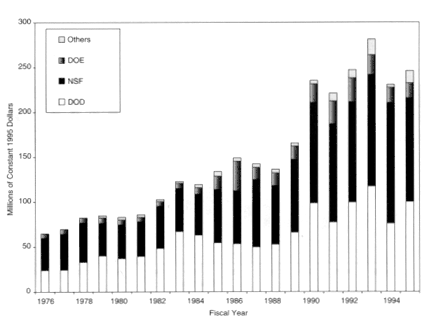
Figure 3.6
Federal funding for basic research in computer science by agency, 1976-1995.
Source: NSF (1998c), Table 2.
By the 1970s, the National Science Foundation (NSF) emerged as the second largest supporter of research in computing and communications, providing 20 percent of all federal support for computer science research and 5 percent of federal support for electrical engineering research between 1976 and 1994. In contrast to DOD, NSF has concentrated its efforts on funding basic and university research in computer science, for which its research expenditures have generally equaled or exceeded those of DOD (Figure 3.6).6 With the exception of a 4-year period between 1983 and 1987, NSF has provided between 40 and 45 percent of all basic research funding in computer science, and it has consistently provided about 40 percent of university research funding in computer science. In electrical engineering, NSF contributed just under 30 percent of the funding for basic research and 30 to 40 percent of the funding for university research, but it lagged behind DOD by a wide margin (Figure 3.7).
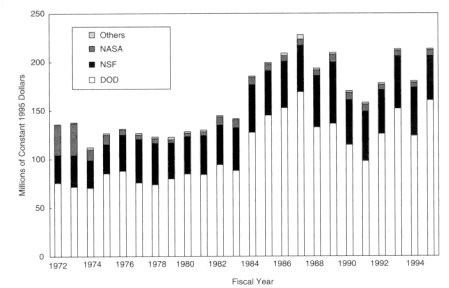
Figure 3.7
Federal funding for basic research in electrical engineering by agency, 1972-1995.
Source: NSF (1998c), Table 2.
Comparisons to Industrial Research Funding
Federal funding has supported a substantial fraction of all research conducted in computing. In 1950, government funding for research and development dominated the computer world: it exceeded all industrial R&D spending on computing by a factor of three. As late as 1963, government still funded 35 percent of IBM's R&D in computing, 50 percent at Burroughs, and 40 percent at Control Data. But even by the 1960s the distribution was uneven, and several commercial suppliers, notably Honeywell and RCA, financed most of their R&D internally. Thus, the overall percentage of computer R&D supported by government declined dramatically from the late 1960s, both because of an absolute decline in government support and because of the rapid growth of the industry. In the mid-1970s, federal support represented only about 25 percent of computer R&D, and then shrank to a postwar low of 15 percent in 1979. With new programs and the Reagan administration's defense buildup, the level was restored to about 20 percent by 1983 (Flamm, 1987, p. 102).
These numbers alone, however, can be deceiving. Very little R&D performed in industry is research; most, in fact, counts as development. Even applied research accounts for only about 10 to 15 percent of indus-
trial R&D in computing. Flamm estimates that the ratio of development to research in the computer industry was about seven to one in the early 1980s, and within the research category it was about seven to one of applied to basic (that is, basic research in industry is only about 2 percent of total R&D). Thus, when one excludes development from consideration, government support represented about 40 percent of all computer research, and half of that was basic research (Flamm, 1987, pp. 104-105).
Direct comparisons between federal and industrial research funding are hard to make because of differences in the way data are collected from federal and industry sources.7 Nevertheless, a rough estimate of the federal share can be made by comparing federal funding for research in computer science to company funding for research in the office, computing, and accounting machinery industry.8 This comparison shows that federal funding constituted roughly one-third of total computer-related research funding in the late 1970s (Figure 3.8). The federal share dipped
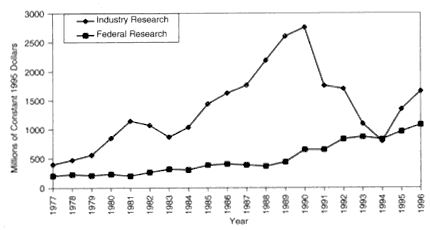
Figure 3.8
Federal and industrial funding for computing research, 1977-1996. Industry research, as shown, consists of company-funded research in computing and office equipment industry; it does not include company-funded research in other computing-related industries such as communications equipment, semiconductors, or computing and communications services. Government-funded research, as shown, consists of total federal funding for research in computer science. Industrial research data for 1978, 1980, 1982, 1985-1987, and 1989 were estimated from data on industry research and development expenditures and from the ratio of research to research and development in expenditures in years for which actual data were available.
Source: Federal research funding from NSF (1998b), Table 25; industry research funding compiled from the 1979-1998 editions of the annual National Science Foundation report Research and Development in Industry.
to 15 percent in the early 1980s as industrial research funding expanded and federal funding stagnated, but by 1992 federal funding again constituted one-third of the total, owing to rapid growth in federal funding and restructuring and cutbacks in industry support.9 Not included in this estimate are research expenditures financed by universities and nonprofit organizations, which tend to be much smaller than the amounts provided by federal agencies or industry.
Government also directed significant research funding to industry—even as the computer industry grew during the late 1970s. While the share of the computer industry's total R&D funds coming from government sources declined dramatically between 1975 and 1979, the share of the industry's research funding coming from the federal government remained high, declining only from 47 percent to 37 percent (Table 3.1). Flamm estimates that federal funding accounted for 40 percent of total computer industry research funding through the mid-1980s (Flamm, 1987, p. 104, Table 4-5). In the communications equipment industry, the federal role has been even larger and more pervasive.10 In 1965, federal funds accounted for 66 percent of the industry's total R&D funding, a figure that declined to 40 percent by 1990. As a percentage of total industry research, federal funds declined steadily from 49 percent in 1965 to 19 percent in 1980, but then rebounded to account for half of all industry research funding in 1990 (Table 3.2). In contrast, federal funding has played a declining role in industrial R&D in the electronic components industry.11 The percentage of industry R&D funding provided by government de-
TABLE 3.1 Funding for Industrial R&D and Research in Office and Computing Equipment, 1975-1979
TABLE 3.2 Funding for Industrial R&D and Research in Communications Equipment, 1965-1990
|
|
R&D |
|
Research |
|
|
|
Funding (in millions of dollars) |
Percent Federal |
Funding (in millions of dollars) |
Percent Federal |
|
1,912 |
66 |
425 |
49 |
|
|
2,578 |
54 |
522 |
41 |
|
|
1975b |
2,385 |
44 |
569 |
27 |
|
1979c |
3,635 |
44 |
787 |
19 |
|
1985 |
9,397 |
45 |
1,674 |
30 |
|
1990 |
5,928 |
40 |
1,321 |
51 |
|
NOTE: Funding levels indicate total support for R&D and research conducted by industry; expenditures for research conducted by universities are excluded. a Includes funding for electronic components, which had $330 million in R&D funding in 1972. bIncludes funding from the communications services industry. c Data for 1979 are shown because complete are not available for 1980. SOURCE: Data compiled from the National Science Foundation's biennial reports, Research and Development in Industry, issued between 1979 and 1992. |
||||
clined from 38 percent in 1972 to 11 percent in 1990 as total R&D funding grew from $330 million to $4 billion.
These figures suggest that federal funding continued to play an important role in the expanding computing industry. It created economic opportunities for industry to exploit and, as such, expanded the private investments made to seize these opportunities. As new ideas emerged from federally funded research, companies capitalized on them. Indeed, firms in computing-related industries tend to spend a greater percentage of their sales revenues on R&D than do firms in most other industries (Figure 3.9). Roughly 10 to 20 percent of corporate R&D funds is spent on research as opposed to development.12 Such expenditures tend to derive from, and result in, the fast pace of innovation characteristic of the field.
Human Resources
Human resources are essential to innovation, especially in knowledge-intensive fields like computing and communications. Attracting and educating students to new areas of research opportunity (especially, but by no means exclusively, at the graduate level) is a vital task—both in maintaining progress at the research frontier and in transferring new knowledge to industry by providing trained scientific and engineering
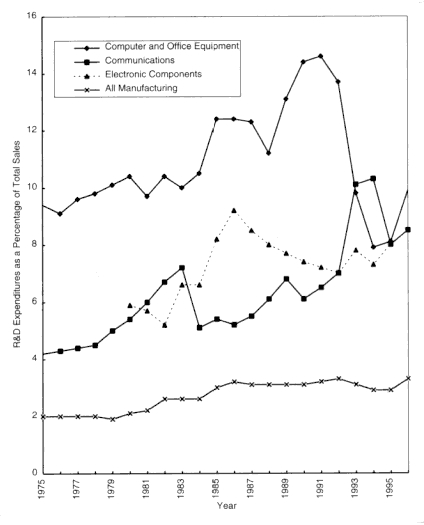
Figure 3.9
R&D intensity in computer-related industries, 1975-1996. Data for computing and office equipment between 1992 and 1996 reflect the reclassification of firms considered to be part of the industry. Source: NSF (1998a), Table A-18
personnel. In the United States, graduate education is tightly connected with university research, and university research budgets are an important driving force for graduate enrollment. The federal government has played an important role by supporting university research in computing and communications, which has directly and indirectly supported the
education of graduate students and the creation of university departments in computer science.
Since 1965, the number of college and university departments in computer science and computer engineering has grown rapidly. The Taulbee surveys of U.S. and Canadian computer science and computer engineering departments show a steady growth in Ph.D.-granting departments, increasing linearly from 6 in 1965 to 56 in 1975 and to 148 in 1995 (Andrews, 1997).13 Along with the expansion of academic computer science departments has been growth in enrollments at all levels, from undergraduate through doctorate. Between 1966 and 1986, the number of bachelor's degrees awarded in computer science skyrocketed from 89 to 42,000, surpassing the number of bachelor's degrees awarded in mathematics and electrical engineering (the largest engineering subdiscipline) in 1981 and in physics in 1982 (Figure 3.10). Electrical engineering also experienced significant growth, expanding at an average annual rate of 4 percent, from 11,000 to 27,000 during this period, while the total number of bachelor's degrees awarded in all academic fields rose at a 1 percent annual rate. Between 1987 and 1995, the number of bachelor's degrees awarded in both these fields declined precipitously, reflecting changing student preferences and shifts in the job market, as well as attempts by some universities to relieve the burden on electrical engineering and computer science departments by shifting students to other academic departments.14 By 1995, the number of bachelor's degrees awarded in computer science and electrical engineering had declined to 25,000 and 18,000, respectively, although the decline showed evidence of leveling off.
Graduate student production also blossomed after 1965. In computer science, the number of master's degrees awarded climbed steadily at a rate of 14.5 percent a year between 1966 and 1995 (Figure 3.11). In electrical engineering, the number of master's degrees remained relatively constant at 4,000 per year from 1966 to 1980, and then began growing at a 6 percent annual rate. Such growth occurred despite the fact that the number of master's degrees awarded in all fields of science and engineering began to decline after 1977 and did not return to the 1977 level until 1990. At the Ph.D. level, the number of degrees awarded by U.S. universities in computer science grew from 19 in 1966 to over 900 in 1995, despite leveling off between 1976 and 1982 (Figure 3.12).15 By comparison, the number of Ph.D.s awarded in electrical engineering and mathematics declined during the 1970s, although both fields began growing again in the 1980s and 1990s. Nevertheless, computer science has continued to lag behind both electrical engineering and mathematics in the total number of Ph.D.s awarded each year—despite leading in the number of bachelor and master degrees awarded. The percentage of Ph.D. recipients choosing a first job in industry (as opposed to academia) grew steadily between 1975 and
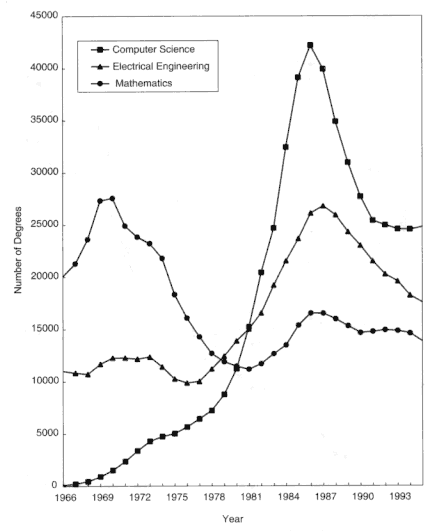
Figure 3.10
Bachelor's degrees awarded by field, 1966-1995.
Source: NSF (1997b), Tables 30, 45, and 46.
1995, reflecting strong industrial demand for skilled computer scientists, and causing concern among universities about their ability to train the next generation of computer scientists (Table 3.3).
Foreign students have also played a large role in the growth of U.S. Ph.D. programs. The Taulbee surveys show that the percentage of Ph.D. recipients in computer science who are nonresident aliens increased from
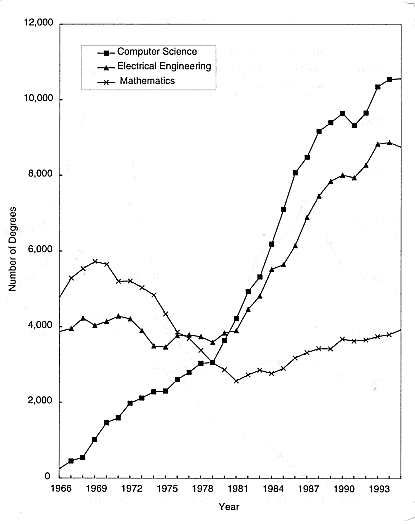
Figure 3.11
Master's degrees awarded by field, 1966-1995.
Source: NSF (1997b), Tables 30, 45, and 46.
20 percent in the early 1970s to 40 percent in the 1980s and 1990s. In computer engineering the percentage reached as high as 64 percent. The United States has attracted a large number of foreign nationals, most of whom were first trained abroad before they entered graduate education in this country. These scientists and engineers have formed an important part of the nation's workforce in computing. It is reasonable to expect
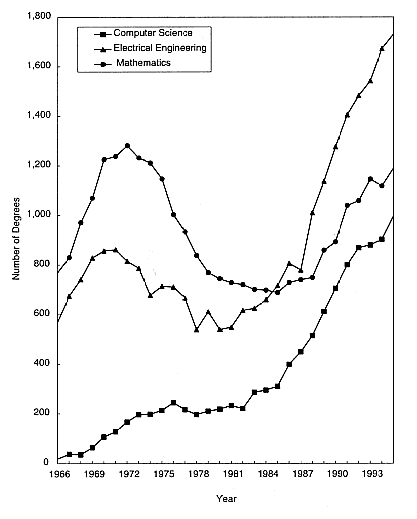
Figure 3.12
Doctoral degrees awarded by field, 1966-1995.
Source: NSF (1997b), Tables 30, 45, and 46.
that fewer foreign students will decide to remain in the United States in the future as opportunities for employment in their home countries increase. By 1997, U.S. industry was already seeing shortages of qualified information technology personnel to fill job market vacancies, raising questions about the need for policies to expand the proportion of the labor force entrants who possess computing and related skills.16
TABLE 3.3 Employment, by Sector, for New Ph.D. Recipients in Computer Science and Engineering, 1970-1995
The federal government has directly and indirectly supported the creation of human resources in computing and communications. As early as the 1960s, federal agencies conducted or sponsored studies that identified human resource issues as matters of national concern.17 Federal agencies have provided a number of fellowships for graduate students in computer science, and NSF has worked to develop curricula for university programs.18 But the most important contribution has come indirectly through federal support of university research. Between 1976 and 1994, federal obligations for university research in computer science expanded from roughly $65 million to $360 million (Figure 3.13), and federal obligations for university research in electrical engineering more than doubled in real terms from $74 million to $161 million (Figure 3.14). Most of this funding has come from two sources, DARPA and NSF. Altogether, federal funding accounted for 70 percent of university research funding for computer science and between 65 and 75 percent of university research funding for electrical engineering from the mid 1970s through 1995 (Figure 3.15). The balance has come from a combination of industry, private foundations, state governments, and universities' own resources.
Federal funds play a significant role in supporting graduate students in electrical engineering and computer science. Data from the National Science Foundation indicate that between 1985 and 1996, the percentage
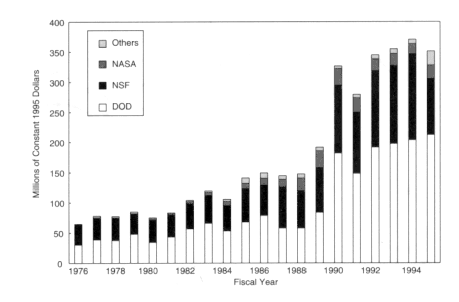
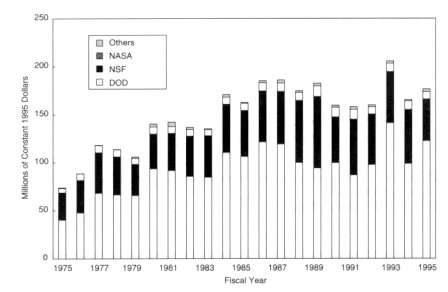
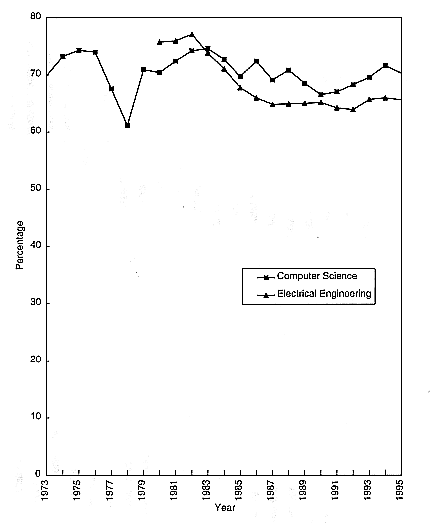
Figure 3.15
Portion of university research funding provided by the federal government, 1973-1995.
Source: NSF (1998d), Table 2.
of graduate students in U.S. computer science and electrical engineering departments supported by federal funds (i.e., research assistantships, teaching assistantships, and fellowships) grew from 14 percent to 20 percent.19 Over 75 percent of this support came in the form of research assistanships; over half of all research assistants in U.S. graduate programs between 1985 and 1996 received federal support.20 In the nation's
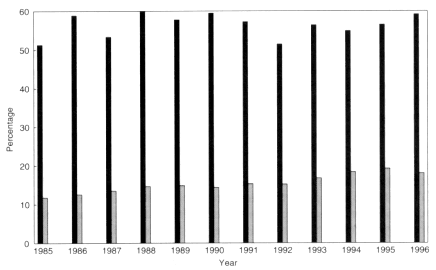
Figure 3.16
Computer science and electrical engineering graduate students supported by the federal government, 1985-1996.
Source: Compiled from data in the National Science Foundation's online database of sources of support for science and engineering graduate students. The database is available via WebCASPAR at <http://caspar.qrc.com>.
top computer science departments, federal funding plays an even greater role (Figure 3.16). Between 1985 and 1995, approximately 56 percent of the graduate students in computer science and electrical engineering departments at the Massachusetts Institute of Technology (MIT), Carnegie Mellon University, and the University of California at Berkeley received federal funding, with research assistantships alone supporting 46 percent of them. At Stanford University, 27 percent of graduate students in electrical engineering and computer science received support from the federal government in 1997;21 it is estimated that 50 to 60 percent of Stanford Ph.D. students in these departments receive federal funds.22
Computer Facilities
Researchers need equipment and facilities with which to conduct their work. Acquiring and maintaining such equipment is especially challenging in computing and communications research because of the rapid growth of the field since the 1950s, the concomitant rise in the number of graduate students and faculty conducting research, and the rapid rate at which computing equipment becomes obsolete.23 In industry, support
for research infrastructure is provided internally: corporate funds are used to build new facilities and to equip them with computers, networking equipment, and other research equipment, as needed. University infrastructure, on the other hand, relies on a mix of support from federal and state governments, university funds, and donations of equipment from industry. Since the 1960s, the federal government has been the dominant source of support for computing and communications research equipment.
Providing and supporting research infrastructure are expensive tasks. In 1988, for example, U.S. universities spent $187 million on equipment for academic computer centers and supercomputer centers, and an additional $334 million for maintenance, repair, and operations (Table 3.4). Computer science departments spent another $77 million on equipment purchases for research purposes and related maintenance, repair, and operational costs. Such expenditures are increasing faster than inflation as universities attempt to maintain state-of-the-art research centers and meet the demands of a growing pool of researchers. Between 1981 and 1995, expenditures for computer science research equipment alone (not including maintenance and operations) tripled in real terms from $25 million to $75 million. In electrical engineering, research equipment expenditures doubled during this same period to $68 million.
The federal government's support for financing the purchase of computing equipment by universities has taken a variety of forms, ranging from funding for general computing resources for universities, to financing of research-grant-related equipment in computer science departments, to establishing large supercomputer centers. While the first two of these missions required scientific or engineering computers of modest capabilities, the third required specialized computers to address large, complex
TABLE 3.4 University Expenditures for Computing Equipment, Maintenance, and Operations (in millions of dollars), 1988
|
Expenditure |
Computer Science Departments |
Computer Centers |
|
Equipment |
45 |
187 |
|
Maintenance and repair |
17 |
84 |
|
Service contracts |
12 |
58 |
|
Other (e.g., salaries, tools) |
5 |
19 |
|
Operations |
15 |
250 |
|
Technician salaries |
12 |
156 |
|
Other (e.g., supplies) |
3 |
94 |
|
TOTAL |
77 |
521 |
|
SOURCE: NSF (1991), Tables 1 and 8. |
||
problems of interest to DOD, other federal agencies (e.g., U.S. Meteorological Service), and academic research communities. All three required development of a networking infrastructure capable of linking researchers with resources that were geographically separated.
University Computing Centers
Among the first federal efforts to provide computing resources for universities was NSF's Institutional Computing Services program, established in 1956 to provide universities with computers for general educational use. Annual obligations expanded rapidly, and, between 1958 and 1970, NSF provided $66 million for such centers (Table 3.5). Other agencies also supported computing facilities on campuses during the 1960s. In fact, virtually all government-funded computer research included significant monies for equipment; one study estimated that in 1963 federal agencies were supplying about half the support for campus computing in the country. NSF support for computing facilities differed from that provided by other federal agencies because it was spread among a large number of universities and because it was not provided for use in any particular project sponsored by the government; rather, it supported general educational and scientific applications of computing. For example, NSF supported Philip Morse at MIT in his early work on time-sharing—a technology intended to improve the efficiency of facilities that NSF was already supporting at academic centers, by making them available to more users. DARPA support, in contrast, was aimed at a limited number
TABLE 3.5 National Science Foundation Obligations for Institutional Computing Services (in thousands of dollars)
|
Year |
Funding |
|
1958 |
200 |
|
1960 |
1,672 |
|
1962 |
2,975 |
|
1964 |
4,517 |
|
1966 |
8,899 |
|
1968 |
10,604 |
|
1970 |
6,563 |
|
TOTAL |
65,913 |
|
SOURCE: Data for 1960-1967 compiled from the National Science Foundation's annual Budget Request to Congress; data for 1968-1970 compiled from the National Science Foundation's annual reports, Grants and Awards. |
|
of select computer science departments (such as those at MIT, Carnegie Mellon University, and Stanford University) and was intended for use on DARPA projects, such as Project MAC and the ARPANET.
Departmental Computing
Other initiatives were targeted more specifically to computer science departments. Between 1981 and 1995, the federal government funded roughly 65 percent of the purchases of research equipment in computer science departments—providing 83 percent of such funding in 1985 (Figure 3.17). In electrical engineering, the share of equipment funds coming from the federal government declined from its 75 percent level in 1982, but remained at 60 percent in 1995 (Figure 3.18). Many government agencies provided funds for equipment in research contracts with universities, but NSF established two programs specifically designed to provide infrastructure for computer science departments: the Computer Research Equipment (CRE) program and the much larger Coordinated Experimental Research (CER) program.
The CRE program, initiated in the 1970s, provided basic computer support for computer science departments. Annual expenditures on the CRE between 1977 and 1985 grew to $1.4 million (Table 3.6). With the
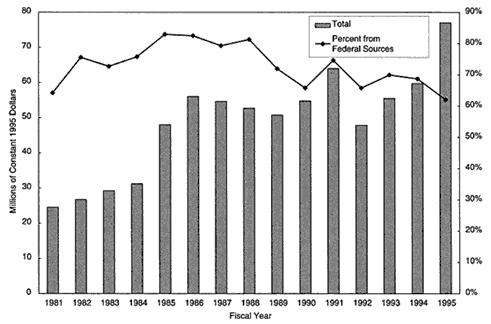
Figure 3.17
Expenditures for research equipment in computer science, 1981-1995.
Source: Compiled from data in the National Science Foundation's online database of current fund research equipment expenditures for computer science between fiscal years 1981 and 1995. The database is available via WebCASPAR at <http://caspar.qrc.com>.
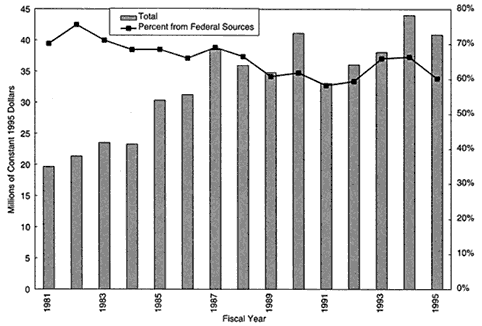
Figure 3.18
Expenditures for research equipment in electrical engineering, 1981-1995.
Source: Compiled from data in the National Science Foundation's online database of current fund research equipment expenditures for electrical engineering between fiscal years 1981 and 1995. The database is available via WebCASPAR at <http://caspar.qrc.com>.
formation of the Computing and Information Science and Engineering (CISE) Directorate in 1986, CRE became the CISE Research Instrumentation Program. Program funding grew from $2 million to $3.8 million between 1987 and 1996.
The CER, started in 1981, was a response to growing concerns that computer science departments were not producing enough Ph.D.s in part because they lacked funds to pursue large-scale experimental computer research (NSF, 1981a). The majority of CER funds was allocated to the Experimental Computer Research Program, which provided ''support of special purpose equipment needed by more than one computer research project and difficult to justify on a single project'' (NSF, 1981b). This program also paid for recruitment and retention of quality faculty and technicians for the new computer science centers.24 Another portion of the CER, the CSNET program (described in more detail below), although constituting less than 10 percent of the CER budget, made major strides in networking by linking computer science departments together to expedite research through a more open forum for ideas. The CER was renamed the CISE Institutional Infrastructure Program in 1986, and funding grew from $14 million to $23 million.
TABLE 3.6 National Science Foundation Expenditures on the Coordinated Experimental Research and Computing Research Equipment Programs (in millions of dollars), 1977-1985
|
Year |
CRE |
CER |
Experimental Computer Researcha |
Total Budget of Computer Sciences Section (1977-1983) and Division of Computer Research (1984-1985) |
|
1977 |
1.65 |
|
|
15.79 |
|
1978 |
1.55 |
|
|
16.63 |
|
1979 |
1.66 |
|
|
16.77 |
|
1980 |
1.97 |
|
|
18.17 |
|
1981 |
1.02 |
5.69 |
3.77 |
22.12 |
|
1982 |
1.21 |
8.55 |
7.10 |
25.59 |
|
1983 |
1.20 |
11.19 |
9.52 |
33.88 |
|
1984 |
1.39 |
13.50 |
12.74 |
33.79 |
|
1985 |
1.46 |
14.99 |
14.76 |
38.59 |
|
TOTAL |
13.11 |
53.92 |
47.89 |
221.33 |
|
a Experimental Computer Research was the predominant source of infrastructure support within the Coordinated Experimental Research Program. It does not include support for faculty or CSNET. SOURCE: Data for 1977-1993 compiled from the annual Summary of Awards for the National Science Foundation’s Mathematical Sciences Section. Data for 1984-1985 compiled from the annual Summary of Awards of the National Science Foundation’s Division of Computer Sciences. |
||||
High-Performance Computing
The government has been the largest supporter of access to high-performance computers for researchers, especially those in universities. Through the mid-1980s, government funding of the IBM 701, UNIVAC LARC (Livermore Automatic Research Computer), Stretch, and later both the CDC and the Cray series of computers created large systems that were used for a variety of applications by researchers. In 1985, NSF launched a program of supercomputer centers to provide access to high-performance machines and to encourage development of useful technology and applications. Annual expenditures increased from $29 million to $71 million in 1996. This funding originally created five centers nationwide that provide researchers in many disciplines with access to supercomputer time.25 The centers were intended to allow for advanced computationally complex research that cannot be carried out on regular computers. Over time, the centers became the early proving grounds of a long-developing new
architecture for high-performance computing—parallel computing. The centers also play an important educational role for some computer science departments teaching parallel computing (CSTB, 1992, p. 225), and they became the spur for additional supercomputer centers, paid for by state and private sources, to be established in other universities. Some computer scientists contend, however, that the supercomputers offered little value to researchers in computer science and that their primary use was by scientists in other disciplines. There has been a long-standing tension in the computer programs about support for computer research and provision of computer facilities to support research in other scientific and engineering disciplines.
Nevertheless, numerous innovations emanated from these centers. They catalyzed work leading to modeling and visualization tools, motivated development of the browser technology for the World Wide Web, and introduced industry to large-scale scientific and engineering calculation on an impressive scale. Both university and government laboratory computer centers were in the forefront of availing themselves of new communications technology to link users and providers and to make more efficient use of computer power on a national level. Many of the centers were used by researchers in the oil, automotive, and pharmaceutical industries whose companies had joined the centers as industrial partners so that they might explore the benefits of supercomputers in their research, development, and manufacturing efforts. As such, the supercomputer sites brought together academic and industry researchers to work on problems of mutual benefit and filled a much-needed gap for computing resources. In doing so, the centers generated scientific and technical benefits as well as economic ones.
Network Infrastructure
Federal agencies have long supported development and deployment of networking infrastructure to assist the research communities in computing and communications. As early as 1973, NSF initiated a program called Networking for Science, which provided between $600,000 and $750,000 per year to create computer networks for university researchers. More significant support for network infrastructure followed upon the development of packet-switched networking technologies by DARPA in the late 1960s and 1970s. This technology formed the basis of the ARPANET, which connected researchers at universities supported by DARPA research funding (see Chapter 7).
Use of the ARPANET expanded to the computer science research community and other scientific research communities starting in the 1970s. After management of the ARPANET was transferred to the De-
fense Communications Agency (now the Defense Information Systems Agency) in 1975, a number of federally supported, discipline-specific networks were established. These included (1) MFEnet, funded by the Department of Energy (DOE) to give academic physicists working on nuclear fusion access to supercomputers at Lawrence Livermore National Laboratory; (2) HEPnet, also funded by DOE to support research in high-energy physics; and (3) Space Physics Analysis Network, funded by the National Aeronautics and Space Administration (NASA). In the early 1980s, NSF established the CSNET to link computer science researchers at different universities who were not attached to the ARPANET. CSNET combined access to ARPANET, TELENET (a commercial packet-switched system run by a subsidiary of Bolt, Beranek, and Newman), and PhoneNet (an e-mail-only system for other academic departments). By 1985, CSNET had links to over 170 university, industrial, and government research organizations. In 1987, it merged with BITNET, another network serving users from academic institutions. CSNET operations were continued under the Corporation for Research and Education Networking until the fall of 1991 (CSTB, 1994, p. 238). The success of the CSNET convinced researchers of the value of a national computer network and therefore provided the impetus for NSF's more notable networking project, the NSFNET (Hafner and Lyon, 1996, pp. 241-245).
In 1986, NSF launched NSFNET, the backbone of a network that connected hundreds of colleges and universities in the United States with high-speed links and was used by departments of all varieties, including computer science and engineering. NSFNET linked NSF's five supercomputing centers and, in coordination with the connections programs of the late 1980s, provided seed funding to allow regional networks (such as the New York State Education and Research Network, or NYSERNet) and universities to interconnect. The connections program provided 2 years of financial support, after which participants were expected to assume financial responsibility. Under the federal government's National Research and Education Network program, different federal agencies, including NSF, NASA, DOE, DARPA, and the National Library of Medicine, launched or expanded separate, interconnected networking efforts that served specific communities. NSF's funding for NSFNET grew from $6.5 million in 1987 to $25 million in 1992, during which time the capacity of the backbone was upgraded several times. With the commercialization of the Internet in 1993, NSF's responsibility for managing the network declined, but it continued to fund development and deployment of high-speed network infrastructure, including the very high speed backbone networking system and the Next-Generation Internet. Expenditures on such network infrastructure reached $42 million in 1996.
Effects of Federal Investments in Research Infrastructure
The effects of federal investments in research infrastructure have been felt throughout the computing industry. Many concepts that were developed by industry and designed into products received their initial impetus from government-sponsored research and large-scale government development programs. Examples include core memories, computer time-sharing, the mouse, packet switching, computer graphics and virtual reality, speech recognition software, and relational databases. Chapter 4 and Chapters 6 through 10 of this report trace the influences of federal research funding upon the development of the particular technologies described above.
A more general sense of the broader linkages between federally funded research and innovation in computing can be derived from patent statistics. Although not an entirely satisfactory measure of innovation, patents can provide a rough measure of invention and, through the references cited within them, they can help in tracing the intellectual inputs to inventions.26 Recent studies by CHI Research, Inc., suggest a significant—and growing—linkage between publicly funded research and patents (and by extension, innovation). Between 1985 and 1994, the number of scientific or technical papers cited in individual patents rose from 0.4 to 1.4 in the United States.27 Of these papers, almost 75 percent were written by public-sector researchers in the United States or abroad (the public sector includes government laboratories, universities, and federally funded research and development centers). For the specific industries analyzed, reliance on public science was highest in drugs and medicines (79 percent of referenced papers) and lowest in electrical components (49 percent of referenced papers). Data for IBM indicate that only 21 percent of the papers referenced in its patents in 1993-1994 were written by IBM employees; 25 percent referenced papers by researchers at U.S. universities (Narin et al., 1997).
Similar figures hold for the computer industry. Between 1993 and 1994, 1,619 patents were issued in the United States containing references to papers published in computing-related journals, such as IEEE Transactions on Computers, the IBM Journal of Research and Development, Communications of the ACM, and Computer. Despite the fact that 75 percent of these patents were issued to U.S. companies, the majority of the papers cited by these patents were written by university or government researchers (Table 3.7). Moreover, of the papers for which funding information is available, 51 percent acknowledged funding from the federal government, whereas 37 percent acknowledged industry funding. NSF support was acknowledged in 22 percent of the papers, DARPA support in 6 percent.28 These
TABLE 3.7 Authorship and Source of Financial Support for Computer-related Papers Cited in U.S. Patents Granted in 1993-1994
|
Number of Acknowledgments per Source of Funding |
||||||||||
|
Sector of Author(s) |
Number of Papers Cited |
Industry |
University |
Government |
Nonprofit |
Foreign |
Unknown |
Total |
NSFa |
DARPAa |
|
Industry |
345 |
344 |
0 |
31 |
2 |
6 |
7 |
390 |
2 |
2 |
|
University |
397 |
113 |
36 |
610 |
11 |
9 |
97 |
876 |
262 |
81 |
|
Industry and university |
82 |
68 |
0 |
82 |
6 |
0 |
2 |
158 |
45 |
4 |
|
Government and university |
7 |
4 |
0 |
9 |
0 |
0 |
4 |
17 |
2 |
1 |
|
TOTAL |
831 |
529 |
36 |
732 |
19 |
15 |
110 |
1,441 |
311 |
88 |
|
Percent |
|
37 |
3 |
51 |
1 |
1 |
8 |
100 |
22 |
6 |
|
a As a subset of the number acknowledging funding by the federal government. SOURCE: Based on patent citation, authorship, and funding data provided by Francis Narin and Anthony Breitzman, CHI Research, Inc., Haddon Heights, N.J. |
||||||||||
data are limited in that they reflect patenting behavior only during a recent 2-year period. Nevertheless, they suggest that federally sponsored research—especially that conducted at universities—continues to contribute to innovation in computing even as the computer industry has grown.
Conclusion
As this chapter demonstrates, the federal government has played an important role in helping to create the research infrastructure needed to support the nation's computing industry. The federal government became the primary source of funding for university research in computer science and electrical engineering and for research equipment in these disciplines. It also became the primary supporter of graduate students studying—and conducting research—in these fields. Such support complemented industry's efforts to build the much larger industrial infrastructure needed for successful innovation in computing and industry's contributions to public infrastructure (through equipment grants, tuition reimbursement, and sponsored research). Together, these investments created a publicly available pool of resources for others to draw upon. As subsequent chapters of this report describe in more detail, people with ideas and training made possible by public investments in research infrastructure helped staff the information revolution, disseminate its ideas, and chart its course. As part of the larger innovation process, they helped the nation to establish a dominant position in the international market for computing technology and to enjoy resulting social and economic benefits.
Notes
|
|
|


