
Research, Technology Development, and Commercialization
David McNelis
Research Triangle Institute
Introduction
U.S. research institutions and research universities receive support through grants from and contracts with the federal government. Just a short time ago, because of federal budgeting issues, many of these institutions, particularly the independent "for profit" and "nonprofit" entities and to a lesser extent the research universities, experienced a significant funding crisis. The crisis paled by comparison to that in which Russian institutions find themselves, but it provided sufficient incentive for U.S. research institutions to develop innovative strategies for obtaining long-term program funding.
The crisis was precipitated by an impasse in Congress over how to achieve a balanced budget. This impasse triggered the withholding of funding for much of the federal extramural research program. In general, no new research contracts were initiated for several months. In addition, certain agencies stopped work on programs that already had been approved and funded. Nearly every authoritative source indicated that government sponsorship of applied research would decline dramatically during the next several years, possibly a decade, and that support for fundamental research also would decline, although less precipitously. Many organizations with significant nonfederal sponsorship or with federal programs for which funding had not been withdrawn were able to shift their investigators into funded work. In many cases, however, staff members were furloughed and, in some cases, terminated. Many businesses failed after months of government inactivity.
The research funding crisis in the United States differs from that in Russia in two respects. First, the U.S. crisis was short-lived, whereas the current Russian crisis continues. Second, even during the U.S. crisis, the institutions and individuals conducting research, although fewer in number, were expected to be fully supported with state of the art equipment, facilities, and resources. There is no such expectation in Russia today.
This paper addresses several positive changes resulting from the U.S. crisis, including some changes that made some independent R&D organizations even stronger and more competitive. The experiences and reactions of one organization, the Research Triangle Institute (RTI), are offered as a case study. It also incorporates observations made during the committee's visit to Moscow and St. Petersburg in November 1997. Although the paper extends beyond technology commercialization, it treats many of the issues that research organizations must address in this effort.
RTI is one of perhaps ten large-scale, basic and applied research, nonprofit organizations in the United Sates. A much larger group of smaller organizations generally follow the same policies and practices for business development and organizational management. Many of these policies and practices are dictated, at least in part, by the sponsors of research programs. Others have been developed over time in the interest of good business.
RTI was founded nearly 40 years ago by the three major universities in the local area—North Carolina State University, Duke University, and the University of North Carolina at Chapel Hill. It was created by those academic institutions and visionaries in the State of North Carolina to provide research opportunities for graduates and thereby retain the graduates as an intellectual resource for the region. Shortly after its creation, RTI became financially and administratively independent of the universities. In accordance with its charter, however, about one-half the members of its Board of Governors are associated with the universities.
RTI has approximately 1,500 investigators and staff members involved in basic and applied research and engineering. Most of the staff is located in Research Triangle Park, North Carolina; some researchers are located at RTI offices or facilities in Washington, D.C.; Hampton, Virginia; Cocoa Beach, Florida; and a number of small project offices in locations around the world.
RTI is organized as a not-for-profit corporation under a section of the U.S. Tax Code (501.C.3) that encompasses entities operating exclusively for religious, charitable, scientific, or educational purposes. As such, it is exempt from federal income taxes, with the exception of taxes on unrelated business income. Such income is earned when a university or a nonprofit research institution realizes gross income from any regularly conducted business that is not substantially related to the purposes cited above. It may be determined that questionable activities are not subject to unrelated business income tax; even if they are taxable activities, the revenue may be offset by associated expenses. State income taxes, intangible taxes, real property taxes, and sales taxes are governed by the state; and in North Carolina, these not-for-profit organizations are exempt from all such taxes. No part of the net earnings of a not-for-profit institution can be used to influence legislation or to participate in a political campaign on behalf of any candidate for public office.
R&D Management
The projected decline in funding by the federal government for research institutions caused the more proactive of these institutions to reassess their missions, strategic objectives, and management policies and practices. As an organization, RTI recast its mission statement to reflect this new market economy and examined four central management issues: strategic planning, cost/pricing, program development/marketing, and competitive intelligence. It retained, however, a business environment in which technical innovation could flourish and in which new ideas could be generated to attract investment.
Strategic Planning
RTI benefits from a strong reputation and facilities. However, the projected decline in federal funding forced RTI to create a new vision and redefine its strategic objectives as well as re-evaluate its markets in light of its capabilities and resources. Market shares were reviewed by government (department by department), commercial, state, and other sectors; by program; and by expertise. The federal budget was scrutinized for funding of new programs and program areas and for those marked for funding reductions. Market opportunities in the state and private sectors also were identified and assessed. Finally, market share projections were forecast on the basis of the best available information and estimates.
Costing/Pricing
RTI's costs, like any organization's costs, can be adjusted by modifying the components that comprise them. For example, RTI can reduce the number of administrative personnel supporting the organization or alter the mix of staff working on a project. Pricing, however, is the amount that a sponsor is willing to pay for a service regardless of cost. When working for the federal government, RTI must use cost-based pricing, meaning that it cannot charge more than its cost. When working for industry, however, RTI can use market-based pricing, meaning that market conditions control the price paid for such services. For example, RTI could, because of risk, include a contingency factor in its pricing for commercial work.
To be price-competitive, research organizations usually attempt to categorize their costs and rates. For example, they would price equipment-or facility-intensive projects differently than office-based tasks, wherein little or no special equipment is required. In this way, they can compete with others who may specialize in only one of these categories.
Program Development/Marketing
For a long time RTI depended extensively on personal contacts between RTI principal investigators and federal agency project officers to secure contracts. A review of program sponsorship indicated a lack of sufficient market diversity within the federal sector and a grossly under-represented commercial market share. To be more competitive, RTI recognized the need to be more proactive at all organizational levels in its marketing activities. Therefore, it used some overhead resources to hire senior marketing personnel and established sector marketing teams.
RTI's marketing strategy had to take into account the distinct differences between working for the federal government and working for the commercial sector. Commercial work typically presents a more difficult marketing challenge. Unlike the government procurements, which are publicly advertised, industry procurements often are only advertised via word of mouth, by personal contacts, or through industry representatives. In addition, industry requires work to be done quickly and, because of its concerns with intellectual property issues, confidentially.
Competitive Intelligence System
Every research and technology organization uses some system to obtain and analyze information about competitors. Competitive intelligence systems range from intuitive reasoning to sophisticated computer-based programs that incorporate searchable text and data files. The development of well-conceived competitive intelligence systems can serve organizations well. In addition, much like the creation of WWW home pages, developing such systems can be a marketable service.
Intellectual Property and Commercialization
Unlike most nonprofit research institutions, which typically receive 70 to 85 percent of their funding from the federal government, RTI is 100 percent self-supporting and currently operates with an annual research budget of about $150 million. It is an example of a not-for-profit entity that must make a ''profit" to survive.
Figure 1 illustrates government and industry investment in the development of technology by nonprofit organizations and universities. Government funding, the white area in Figure 1, supports basic research, applied research, and development through a variety of agencies and programs. Although typically not directly involved in the commercialization of any technologies resulting from these programs, the government during the past few year has developed new programs for partnering with industry to move demonstrated technologies
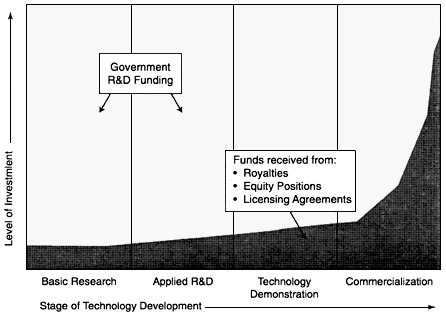
Figure 1
Government and Industry Share of R&D Funding at Different Stages of Technology Development
toward commercialization. Industry investment, the dark area of Figure 1, primarily supports the latter stages of the technology development cycle. As Figure 1 illustrates, government funding for technology development peaks at the research stage, whereas private sector spending is greatest at the commercialization stage.
Most research and academic institutions in the United States have become increasingly aware of the potential rewards associated with commercializing their intellectual property. Over the past few years, the majority of these institutions have developed an infrastructure to support technology commercialization, and some have sought external resources this activity. Institutions also created this infrastructure because they realized many investigators were either too close to their projects or too focused on the technical outcome of their research to recognize the commercial potential of their results. Institutions also have begun to educate their investigators about patent issues as well as to facilitate the administrative processes associated with disclosure and patent searches and with negotiation of licenses, equity positions, and royalties.
For some research institutions, income from the commercialization of intellectual property is a principal source of funding for the stimulation of new research efforts and for the continuation of work on projects through the "Valley
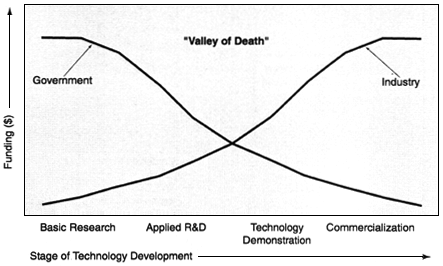
Figure 2
Valley of Death
of Death"—the stage of development at which technologies can die for lack of support. This is the period, as Figure 2 illustrates, when governmental sponsorship drops off and industry sponsorship has yet to be established. Patent royalties, equity positions in spin-off companies, and technology licensing agreements can fill the gap between these funding sources.
Unlike universities, which traditionally concentrated their research activities on basic or fundamental research, independent research institutions generally have focused on applied R&D. One of RTI's units has the mission of assessing and marketing technologies developed by government and commercial laboratories. The unit analyzes the size and stability of a technology's potential market, the presence and strength of competitive technologies, and any laws or regulations that could affect the technology or its use. Leveraging its expertise and technical network, RTI also identifies sources of new technology that could be imported into an industry to improve cost savings, market share, or manufacturing processes. For industrial clients, RTI facilitates the licensing of corporate technology, identifies potential partners, negotiates with possible licensees, and otherwise assists in establishing R&D collaborations.
For government laboratories, RTI provides a range of services, including identifying promising technologies and assessing their commercial potential, promoting technology to industry, developing cooperative research and development agreements between the federal laboratories and third-party organizations, performing market assessments, and providing business development assistance. For example, RTI coordinates a wide variety of licensing opportunities for NASA centers at the Langley, Kennedy, Ames, and
Goddard locations—from transferring the methodology for converting nitrogen oxides waste to fertilizer to seeking partners for commercializing the Smart Surgical Probe, a system that evolved from telemedicine research on astronauts. An RTI-government partnership also commercialized a hand-held imager developed by NASA's John C. Stennis Space Center. The device is capable of imaging the invisible flames of alcohol and hydrogen fires during the daytime, as well as penetrating moderate smoke, fog, and mist. (NASA uses huge volumes of liquid hydrogen in flight certification, testing, and launches and, due to the risk of hydrogen fires, needed a low-cost device that could not just detect a fire but could indicate its precise location and extent.) After assessing the commercial potential of the device, RTI held an industry briefing to introduce fire fighting and safety companies to the technology and to invite them to submit commercialization plans. NASA selected one company to receive the exclusive patent license rights to the Stennis fire imaging technology. The device has now been established as the first affordable commercial product for imaging invisible (ashless) fires and hot embers.
Lessons Learned
RTI's positive and decisive actions have allowed it to prosper across essentially every organizational element of the institution despite the sharp decline in new programs and funding availability from the federal government. The steps outlined above could improve the competitive posture of any organization. Russian research institutions therefore should give serious consideration to the interrelated issues of strategic planning, management and staff training, and marketing in addition to the issues surrounding taxation and intellectual property rights. Also the opportunities for sharing government facilities and equipment seems important. The Russian government has huge investments in research instruments, infrastructure, and facilities which could be shared with independent research institutions and the private sector. Although barriers exist in the United States, government agencies do share capital investments in expensive equipment and facilities with universities and nonprofit research institutions. They also make excess and surplus property available to the private sector at a fair market price.
Strategic Planning
All too often, strategic planning is conducted only periodically, and then it is essentially ignored until the next planning cycle. To be effective, strategic planning must be continuous, involve all staff levels, and address all aspects of the business, including administration, competitiveness, resources, capabilities, and market development.
Management Training
Independent research organizations must not focus only on income and percent of products sold, but also on management and training. RTI has earned large returns on its extensive investments in managers in writing business plans, strategic planning, and the development of marketing plans. Every organization should carefully assess their training needs and the potential return on investment associated with well designed training programs.
Marketing
Over the last few years, the commercial use of the Internet and the World Wide Web has increased dramatically. Home pages, creatively constructed and strategically linked, can serve to inexpensively advertise and market products and services. The Web also can provide a wealth of information on markets and competitors. Of course, a competitor for one program or market could well be a partner for the next. And other new uses are emerging. For example, in early 1998 a university announced over the Internet a service for businesses impacted by reductions in the U.S. Department of Defense's budget. The university's Entrepreneurship Center offered to help these companies identify new business opportunities, diversify existing business bases, and facilitate the transition of products and services from defense customers into civilian government, commercial, and foreign markets.
Closing Remarks
As an environmental scientist, I must close with a caveat. We are living in an industrial age. Since the industrial revolution, we have been encouraged to be entrepreneurs—to use our planet's resources to provide for our needs. Even today, governmental policies in most countries tend to favor exploitation. Compliance merely means to be as bad as the law allows. Sustainability, however, requires that we also allow for the needs of our progeny. The exploitation and alteration of our planet earth in an in credibly short amount of time is well documented and understood. Over the long haul, the economy is a wholly owned subsidiary of the environment, we must make the effort to care for our planet and its life forms in order for it to provide for us. The hope, therefore, is that each of us is mindful environmental sustainability in our technology development and commercialization endeavors. Otherwise, economic sustainability cannot occur.


