
Page 9
1
Introduction
Background
Current U.S. defense strategy1 calls for continuing to shape the strategic environment to advance national interests, maintaining the capability to respond to the full spectrum of anticipated current threats, and preparing for the threats of tomorrow. Implementation depends on the fundamentals of military power: quality people, ready forces, and superior organization, doctrine, and technology. The challenge is to construct an effective defense establishment with limited financial resources in accordance with Department of Defense guidance.2,3 The U.S. Navy is meeting this challenge in part through the use of better business practices and the application of advanced technologies within its shore establishment. Pressures to do so come from competition between the need to maintain force readiness for the present and the need to modernize systems and technology for the fleet of tomorrow.
For the U.S. Navy, the shore establishment includes the fixed activities of the Navy first- and second-echelon commands with their subordinate units
1The White House. 1997. A National Security Strategy for a New Century, U.S. Government Printing Office, Washington, D.C., May. Available online at < http://www.whitehouse.gov/wh/ eop.nsc/strategy>.
2Cohen, William S., Secretary of Defense. 1997. Report of the Quadrennial Defense Review, Office of the Secretary of Defense, Washington, D.C., May. Available online at <HtmlResAnchor http://www.defenselink.mil/pubs/qdr/>.
3Cohen, William S., Secretary of Defense. 1997. Defense Reform Initiative Report, Office of the Secretary of Defense, Washington, D.C., November. Available online at <http://www.defenselink.mil/ pubs/dodreform/>.
Page 10
located throughout the world. Naval installations are major components of the shore establishment and are complex enterprises. Some are comparable to cities, which perform many different functions while supporting numerous tenant organizations and often include child care and commissary facilities, family housing, hospitals, and so on.
The Office of the Chief of Naval Operations (CNO) Shore Installation Management Division (OPNAV-N46) is the CNO's lead office for Navy shore installation programs.4 Its primary responsibilities include installation operations; base operating support; quality-of-life mission support; infrastructure vision, strategic planning, plans, and policy; housing; and the Navy's Smart Base project. The Deputy Chief of Naval Operations for Logistics (N4) is leading a campaign to reduce the cost of the infrastructure through an improvement in efficiency and the consolidation of activities encompassing naval installations.5 This campaign includes initiatives such as regionalization (the consolidation of base operating support functions in regions where individual installations and facilities formerly operated more independently) and Smart Base (a collection of experiments and tests designed to reduce costs and improve the delivery of support services at naval shore installations). Although some of these initiatives are projected to result in significant savings, the committee estimates that these initiatives will most likely yield annual savings of no more than about $500 million. This shortfall is due primarily to the fact that the managers of these naval installations (i.e., base commanders and regional commanders) control only a small fraction of all the resources located within their installations. For example, in the San Diego region, with about 56,000 military and civilian Navy employees and an annual personnel cost of about $2.5 billion, the regional base commander has control of less than $500 million of Navy costs per year. The vast majority of annual costs at naval installations are controlled by other major commands that may or may not be tenants of the specific installation. These “claimants” are the Navy organizations that are responsible for expending the portions of the Navy budget apportioned to them. Examples of claimants are the Pacific Fleet (PACFLT), the Naval Sea Systems Command (NAVSEA), and the Commander, Navy Education and Training (CNET).
Partitioning of the responsibility for financial resource management is the reason that initiatives limited to base commanders, and to the supporting functions under their control, are estimated to result, at best, in limited ($500 million) annual infrastructure cost reductions. The relatively small potential cost reduc-
4Deputy Chief of Naval Operations, Logistics (N4) and the Office of the Deputy Chief of Staff for Installations and Logistics. 1997. Navy and Marine Corps Annual Logistics Review, Washington, D.C.,p.9.
5Hancock, VADM W.J., USN, Deputy Chief of Naval Operations for Logistics (N4). 1997. 21st Century Shore Support Infrastructure: Navy Infrastructure Vision and Strategic Plan, Washington, D.C., June 24.
Page 11
tions from shore installation management initiatives compared to the overall size of the Navy infrastructure ($26.7 billion in FY 1999) motivated the committee to broaden its perspective on the problem at hand.
With respect to the U.S. Navy, where all forces float6 or fly, the shore establishment in the broadest sense is synonymous with infrastructure, which—according to the Joint Chiefs of Staff—includes “all activities that provide support or control of forces from fixed bases of operations.”7 In accordance with this broader perspective of the Navy shore establishment, the committee assesses below the size of the basic problem driving the Navy's desire to reduce infrastructure costs and reexamines the potential base from which infrastructure cost reductions could be obtained. This latter examination places the committee's review of N4 related activities in perspective. It also includes a discussion of recent trends in infrastructure costs and the resources associated with individual infrastructure functions.
The Navy's Problem: Meeting its Recapitalization and Modernization Goal Through Infrastructure Reductions
Since the end of the Cold War, the Department of the Navy, along with the other Services, has been faced with addressing new national security challenges with smaller budgets. As the Department of the Navy reduced its overall force structure, it cut modernization funding by a larger percentage than other categories. Infrastructure costs have been cut, but there is general agreement among Navy leadership that infrastructure can and should be reduced more, compared to the fleet that it supports. In this sense, further infrastructure cost reductions are a potential source of recapitalization funding to sustain the desired fleet capability.
From FY 1991 to FY 1999 the Department of the Navy budget has been reduced by approximately $40 billion (or about 33 percent), and current projections indicate that it will continue to decline at a rate of about 1.4 percent per year.8 Figure 1.1 illustrates the trends in funding for U.S. Navy programs since FY 1991. Most notably, force modernization was reduced by approximately $16 billion (about 42 percent) through FY 1999. This 42 percent reduction in modernization compared to a 33 percent department-wide reduction in total funding amounts to about a $3.5 billion excess reduction in the U.S. Navy's moderniza-
6The term “float” includes submarines.
7Graves, T.J., D. Drake, P. Forsyth, and J.L. Wilson. 1995. A Reference Manual for Defense Mission Categories, Infrastructure Categories, and Program Elements, Paper P-3133, Institute for Defense Analyses, Alexandria, Va., June.
8 All data, findings, and figures shown in this chapter are a result of the committee's use of FY 1999–2003: President's Budget Future Years Defense Programs. See Appendix B for further details.
Page 12
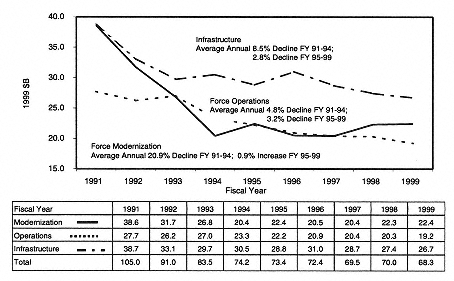
Figure 1.1
Funding for U.S. Navy programs, 1991–1999.
tion accounts. To return the Navy modernization budget to its former (FY 1991) share of the total Department of the Navy budget would require an estimated additional $3.5 billion per year (above the FY 1999 figure of $22.4 billion). It is the committee's judgment that establishing a reinvestment goal of $3.5 billion to $5.0 billion is a reasonable target. Recent analysis of defense modernization needs for ship construction through 2001 cited a range of approximately $4.0 billion to $5.0 billion per year (more than is currently projected) for modernization.9 Clearly, if the Department of the Navy is to achieve its future recapitalization and modernization objectives, a reduction in infrastructure and associated costs will be necessary. If the $3.5 billion to $5.0 billion annual shortfall for Navy modernization is to be recovered entirely from the Navy infrastructure, a 13 to 19 percent reduction in infrastructure costs would be needed. Reductions of this magnitude will demand significant change in the overall management of the infrastructure within the Department of the Navy. As defined by the Office of the Secretary of Defense (OSD), infrastructure comprises the following functional categories: acquisition, central logistics, central personnel, communications, force management, installations, medical functions, quality of life, science
9Lopez, VADM Thomas J., USN, Deputy Chief of Naval Operations, Resources Warefare Requirements and Assessments (N8). 1995. “The State of the Navy,” briefing to the Naval Studies Board, September 13.
Page 13
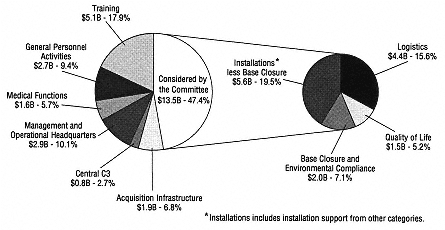
Figure 1.2
Navy infrastructure initially considered by the committee. Data
shown are average
values from FY 1995 to FY 1999.
and technology, and training.10 Because the N4 is one of the more proactive staff elements sponsoring programs specifically with the aim of infrastructure cost reduction, the committee focused its attention on those functional categories most closely associated with the N4, namely, installations (less base closure), central logistics, quality of life (which is largely family housing), and base closure and environmental compliance. Figure 1.2 illustrates those infrastructure categories initially considered by the committee.
Trends in infrastructure categories initially reviewed by the committee are illustrated in Figure 1.3. Base closure and environmental compliance grew significantly from FY 1991 to FY 1995 and then declined substantially from FY 1996 through FY 1999. The Navy does not have much influence on funding for these programs. Conversely, installations (excluding base closure) make up almost 20 percent of the infrastructure and are the subject of the Navy's regionalization initiative. As indicated above, the committee estimates that this concept could eventually yield savings on the order of 10 percent, or $500 million per year, but realization of these savings will demand the full participation of all commands and strong support from the CNO. To yield such significant savings, reengineering of the services provided by the installations is a necessary next step. Logistics comprises mainly central supply, transportation, and maintenance activities. Each of these areas has initiatives aimed at streamlining services,
10Office of the Secretary of Defense, Program Analysis and Evaluation. 1996. Defense Infrastructure Overview Briefing, November 1.
Page 14
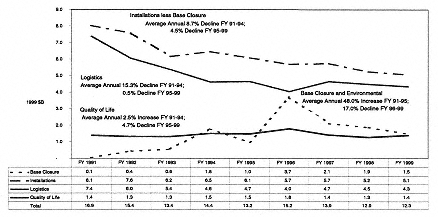
Figure 1.3
Trends in funding for areas of infrastructure considered by the
committee.
but much more is needed. For example, in the area of maintenance, regional maintenance coordinators for the most part have only the power of personal persuasion to make changes and achieve savings. Family housing makes up about two-thirds of the funding for the functional category “quality of life.” Public-private ventures can have a large impact on the cost of meeting this requirement and should be pursued as a matter of priority.
The recent actual and projected total Navy infrastructure decline of about $750 million per year (shown in Figure 1.1) is primarily a result of money being arbitrarily taken out of the budget, particularly in base operating support, rather than the result of the integrated introduction of new innovations to reduce the cost of infrastructure. In fact, budget pressures have been the driving impetus in forcing innovation and overcoming resistance to change. Although a forcing function is desirable, it is also necessary to have an overall, integrated strategic plan, which appears to be lacking, that includes metrics that measure the output of the infrastructure. Without such a plan and metrics, it will not be possible to determine where additional savings can be obtained with acceptable risk or where potential budget reductions would create unacceptable risks and reductions in fleet capabilities and readiness.
The $750 million in annual infrastructure reductions projected over the past few years by the U.S. Navy is a long way from the $3.5 billion to $5.0 billion annual goal. Meeting such a goal will necessitate addressing all functional categories of the infrastructure, which in turn requires a strategy for managing the overall infrastructure.
Although training and general personnel activities were not initially reviewed by the committee, these functional categories do account for about one-fourth of
Page 15
the total cost of Navy infrastructure. They also influence every other category of the infrastructure and are worthy of a separate review and/or study.
The committee was briefed on U.S. Navy training activities after making a specific request to obtain information on training-related initiatives designed to reduce infrastructure costs, but it failed to find any cost reduction initiatives comparable to those being developed and supported in the installation management area. Personnel management is another area that was not considered in detail; however, it is apparent that sea-shore rotation objectives have come into conflict with U.S. Navy objectives to reduce the number of support personnel ashore and thereby reduce infrastructure costs (see Chapter 3).
Organization of this Report
A review and assessment of selected U.S. Navy initiatives to reduce infrastructure costs are presented in Chapter 2. As indicated above, the review focuses on the initiatives being supported within the OPNAV-N4 establishment for two reasons: (1) the leadership within the functional portions of the OPNAV staff for reducing infrastructure costs lies in OPNAV-N4, and (2) the committee's attempts to obtain information on significant infrastructure cost reduction initiatives in other functional categories did not bear fruit.
Chapter 3 points to the need for an overall strategy for managing the Navy's infrastructure. As paraphrased from the words of General Andrew Goodpaster, a strategy contains three elements: (1) What is to be achieved? (2) How is it to be achieved? and (3) With what will it be achieved? In this case the “what” is to reduce the Navy infrastructure in order to recapitalize and modernize the Navy. The “how” is by reengineering the business practices of the infrastructure and applying technology to the infrastructure to enhance efficiency. The “with what” is, in particular, what the committee found lacking as it reviewed individual initiatives. Specifically, the integrating threads—a comprehensive strategy—to tie disparate, and sometimes overlapping, initiatives and activities together were lacking.
Chapters 3 and 4 indicate that two objectives are key to the Navy's success in meeting its recapitalization and modernization goal: (1) assessing and specifying the key enablers that the Navy should use to implement its chosen strategy (i.e., specifying the third, “with what,” portion of a coherent strategy) and (2) defining top leadership's role and potential actions needed to achieve a major change of the magnitude required.
Chapter 3 covers a strategy for implementing three key enablers that are essential for achieving the resource shifts necessary to support the Department of the Navy's recapitalization goals. Chapter 4 provides the mechanism for introducing the strategy and enablers to the Department of the Navy. Supplemental information is provided in the appendixes.


