
Page 274
7
Changes in the R&D Landscape
Science has been a powerful agent of change throughout history. Science expressed through technology has redefined warfare, enabled economic growth, and extended the lifetimes and enhanced the well-being of billions of people. Over the past half-century, condensed-matter and materials physics has profoundly affected our lives, ushering in the information age and contributing to advances in communications, computing, medicine, transportation, energy, and defense. These advances have transformed the economy and dramatically altered our worldview. They have also changed the environment (the R&D landscape) in which science is performed.
From the Cold War to the Global Economy
Condensed-matter and materials physics is a young field. Although components of the field existed earlier, its modem development was enabled by the new discoveries in the 1930s of quantum mechanics and the wave nature of the electron. Its emergence as a discipline was heralded by the invention of the transistor in 1947. In the brief 50 years since then, an impressive understanding has been achieved of the structure and properties of materials on the atomic scale. Accompanying this understanding have been extraordinary technological developments, including the integrated circuit, optical fibers, solid-state lasers, and hightemperature superconductivity.
Powerful forces have driven the development of condensed-matter and materials physics. In the beginning, the desire was to replace inconvenient and bulky vacuum tubes with solid-state devices. Then came World War II with radar and
Page 275
defense technology. The arms race, Sputnik, the energy crisis, and the information revolution stimulated continued growth in the field over the subsequent decades. For most of this period, there was sustained growth in the federal investment in science, including condensed-matter and materials physics. This federal role in fundamental research, originally articulated by Vannevar Bush at the end of World War II in Science: The Endless Frontier,1 was substantially justified on the basis of national defense.
In the late 1980s, the end of the Cold War, the emergence of the global economy, and the growing federal deficit combined to shake the foundations of the national R&D enterprise. In the absence of a major military threat, investments in the defense establishment were reduced, including support for R&D. Overall federal R&D investments, which peaked at $80 billion (in 1997 dollars) in 1987, declined 20 percent in the following decade (see Figure 7.1) as priorities shifted away from defense, and the desire to reduce the deficit applied increased pressure to the discretionary part of the federal budget. Federally supported basic research, performed mostly at universities, fared much better, increasing by 30 percent between 1985 and 1995 (see Table 7.1). This increase was dominated by increased investment in the life sciences; only modest gains were recorded for physics. At the same time, competition in the global economy (which itself was enabled by communications advances rooted largely in condensed-matter and materials physics) forced industry to sharpen the focus of its R&D investments. Industrial R&D turned away from long-term physical sciences and toward projects with more immediate economic return, reducing fundamental research investments that have been essential to the development of new technologies.
A Decade of Change
The transition to the global economy represents a significant opportunity for condensed-matter and materials physics. Competitiveness in a fast-moving economy is critically dependent on advances in materials for a broad range of applications from information technology to transportation to health care. Condensed-matter and materials physics has responded effectively over the past decade, supporting continued innovation in electronic and optical materials, while developing new thrusts in complex fluids, macromolecular systems, and biological systems (collectively known as "soft materials"), and nonequilibrium processes. At the same time, science has become increasingly international, and U.S. leadership in many areas of science and technology, including condensedmatter and materials physics, is being challenged. Continued progress in condensed-matter and materials physics is critical to sustained economic competi-
1 Vannevar Bush, Science the Endless Frontier: A Report to the President, U.S. Government Printing Office, Washington, D.C. (1945), reprinted by the National Science Foundation, Washington, D.C. (1960).
Page 276
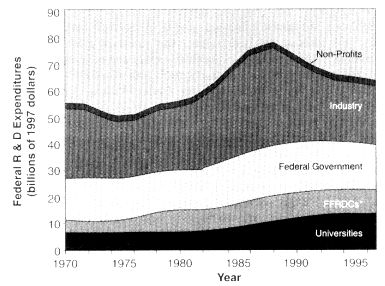
Figure 7.1
Federal investments for R&D by performer, 1970-1997.
| TABLE 7.1 Trends in Federal Investments in Basic Research by Discipline | ||||||
| Expenditures (billions of 1995 dollars) | ||||||
| Research Area | 1985 | 1990 | 1995 | % Change (1985-1995) | ||
| Life Sciences | 5.20 | 5.98 | 6.94 | 33.5 | ||
| Physical Sciences | 2.50 | 3.08 | 2.91 | 16.4 | ||
| (Physics) | (1.32) | (1.71) | (1.50) | (13.6) | ||
| Environmental Sciences | 0.96 | 1.46 | 1.54 | 60.4 | ||
| Mathematical & Computer Sciences | 0.36 | 0.47 | 0.58 | 61.1 | ||
| Social Sciences | 0.19 | 0.17 | 0.21 | 10.5 | ||
| Engineering | 1.22 | 1.27 | 1.29 | 5.7 | ||
| (Materials) | (0.30) | (0.30) | (0.28) | (-6.7) | ||
| Other | 0.14 | 0.35 | 0.53 | 78.6 | ||
| Total Basic Research | 10.57 | 12.78 | 14.00 | 32.5 | ||
| SOURCE: National Science Board, Science and Engineering Indicators—1996 (Table 4-22), National Science Foundation, Washington, D.C. | ||||||
Page 277
tiveness in a broad array of current and emerging technologies. Successfully navigating the changes in the R&D landscape while strengthening condensedmatter and materials physics is a strategic imperative for the field and for the nation.
Within the major industrial laboratories, investments in fundamental physical sciences have been reduced, and much of the remaining effort has been focused on nearer-term projects. The situation has been exacerbated by the increasing tendency to conduct manufacturing offshore to reduce costs. This change is particularly alarming because the special environment of these laboratories sparked many of the important discoveries that led to the major technological advances of the twentieth century (see Box 7.1). This environment—which balanced enlightened management with opportunities for independent inquiry, assembled a critical mass of researchers from a diversity of disciplines, and encouraged "unfettered" research within a framework of strategic intent—was unprecedented in its scientific and technological impact. It was also dependent on monopoly or pseudomonopoly positions, since the profits associated with many of the scientific advances accrued to other companies. There was a high probability that scientific results would fall outside the commercial interests of the parent company, and in many cases the technological value of the new discoveries was not apparent for many years, allowing the information to diffuse throughout the community. This system was inefficient for the parent company, and unsustainable in the current world of global competition and corporate raiding, but very productive for the economy overall. Recreating this environment within the present R&D system represents a major challenge and opportunity.
Within the universities, there has been a steady decline during the past decade in the number of new students entering the physical sciences (see Table 7.2). In fact, undergraduate enrollment in physics (including condensed-matter and materials physics) is at its lowest level in 30 years. This appears to be a response to an apparent oversupply of new Ph.D. physicists in the early 1990s, in combination with a slow job market for physical scientists in fundamental research during this period. The only scientific discipline to increase undergraduate enrollments during the period was biology, which is consistent with the increasing federal investment in biomedical research. The declining numbers of physical science undergraduates raise serious questions about the availability of future human capital in the technologies that drive large sectors of the economy. For example, shortages in many areas of software research and semiconductor processing are already apparent. Physicists, who often possess skills that are attractive to hightechnology industry, provide some of this human capital by pursuing careers in industry. In addition, the economy relies heavily on foreign students who remain in the United States to work after completing their Ph.D. Currently half of the graduate students at U.S. universities in the physical sciences are foreign nationals. There is evidence that many of these students are choosing to return to their homelands as global opportunities in science and technology improve. Unless
Page 278
| BOX 7.1 The Legacy of the Industrial Laboratories |
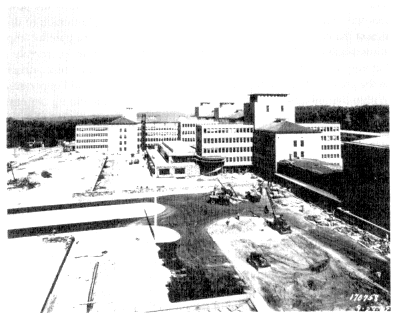
| For condensed-matter and materials physics related to applications, the twenieth century has been the century of the large industrial laboratory. A handful of corporate research laboratories—Bell Laboratories (see Figure 7.1.1), IBM Research, DuPont, and others—have dominated the scene with developments such as the transistor, the solid-state laser, optical fiber, synthetic polymers, hightemperature superconductivity, scanning-tunneling microscopy, and electron diffraction. These organizations operated at the frontier of science in a strategic context, developing broad new understanding to advance both science and technology and making profound contributions with impacts far beyond their corporate borders. |
| The corporate research laboratories emerged to exploit the promise of the physical sciences for the development of revolutionary new technologies and products. Condensed-matter and materials physics, invigorated by the new quantum mechanics, was on the verge of an intellectual explosion. Many corporations recognized the importance of being part of that explosion. Some became leaders by |
|
|
| Figure 7.1.1 |
(Box continued on next page)
Page 279
(Box continued from previous page)
| committing to fundamental research in condensed-matter and materials physics as a path to new technologies. |
| A number of forces combined to promote the rise of the corporate laboratories. First, the time was right. The development of quantum mechanics, advances in the understanding of electrons in solids, and new tools such as x-ray diffraction, electron microscopy, and neutron scattering provided fertile ground for research. At the same time, it was apparent that advances in condensed-matter and materials physics were key to the new materials and devices that would drive modern technology. In many cases the military was willing to pay initial development costs, and the success of the Manhattan Project generated optimism about the power of physics and corporate-scale research. Finally, many of these laboratories enjoyed monopoly or pseudomonopoly positions because of regulatory policy or market dominance. As a result, these institutions took on many of the characteristics of ''national laboratories.'' |
| The corporate research model was very successful in developing new science and technology. Corporations brought together scientists from different disciplines, provided freedom within the context of strategic intent, and had the resources and vertical integration to support large-scale, long-term R&D. Technical management, drawn from the research ranks, was empowered to make financial decisions and to move quickly without formal peer review. The resulting research environment was extremely productive—but the economic benefits did not always accrue to the parent corporation. The unpredictability of research results and applications, the diffusion of knowledge, and the ability to bring new technologies to market were all factors in spreading the economic impact of corporate research. This widespread impact was good for the economy (AT&T maintained an open license for the transistor) and for the development of condensed-matter and materials physics. |
| As we enter the twenty-first century, condensed-matter and materials physics has become much too large to be dominated by a few corporate research laboratories. Furthermore, corporate research has become more focused, and the extent of corporate participation in long-term condensed-matter and materials physics research in the future cannot be predicted. In addition, many industries are emphasizing software and systems research over hardware, and there is a trend toward more research being done in small companies. As a result, the special research environment that led to many of the fundamental condensed-matter and materials physics discoveries of the twentieth century no longer exists. Today, this special environment can best be emulated by government laboratories and universities working together with industry to create distributed, multidisciplinary networks in condensed-matter and materials physics. Within these networks, industry must continue to play a significant role in fundamental research in order to provide the vision needed to connect the research to technological applications. |
| Computers, new synchrotrons and neutron sources, and other instrumentation advances place us on the verge of another revolution in condensed-matter and materials physics. Cooperation among universities, government laboratories, and industry is essential to maintaining U.S. leadership in this revolution. This will require mechanisms, including intellectual property provisions, that encourage this cooperation. |
Page 280
| TABLE 7.2 Bachelor's Degrees Awarded in Selected Disciplines in the United States, 1985-1995 | ||||||
| Number of Bachelor's Degrees | ||||||
| Field | 1985 | 1990 | 1995 | Change (1985-1995) | 1997 | Change (1985-1997) |
| Biological Sciences | 39,405 | 38,040 | 56,890 | (+44%) | ||
| Physics* | 5,013 | 4,950 | 4,263 | (-15%) | 3,826 | (-24%) |
| Chemistry | 10,701 | 8,289 | 10,016 | (-6%) | ||
| Mathematics | 15,389 | 14,674 | 13,851 | (-10%) | ||
| Engineering | 77,572 | 64,725 | 63,371 | (-18%) | ||
| Geosciences | 7,001 | 2,256 | 3,820 | (-45%) | ||
| Computer Sciences | 39,121 | 27,695 | 24,769 | (-37%) | ||
| Materials/Metallurgy Engineering | 1,276 | 1,166 | 1,046 | (-18%) | ||
| All Bachelor's | 990,877 | 1,062,151 | 1,174,436 | (+19%) | ||
| *American Institute of Physics (AIP), Enrollments and Degrees Report, AIP, New York (April 1997). SOURCE: National Science Foundation (NSF), Science and Engineering Degrees: 1966-1995, NSF 97-335, NSF, Washington, D.C. (1996). | ||||||
there is an increase in the attractiveness of the physical sciences to U.S. undergraduate and graduate students, the nation risks a future with insufficient human resources to maintain leadership in science and technology. Intervention at the secondary school level is an essential component of any effort to stimulate interest in physical science careers.
Federal investments in condensed-matter and materials physics have increased slightly in the past decade (see Figure 7.2), despite the general downturn in federal support for R&D. However, these increases have been more than offset by the operating costs of major new research facilities that have come online during this period, notably synchrotrons at the laboratories of the U.S. Department of Energy (DOE). These facilities, which include neutron sources and microcharacterization centers as well as synchrotrons, serve more than 5,000 users per year, more than half of whom come from disciplines other than condensed-matter and materials physics (see Figures 7.3 and 7.4). Setting aside this stewardship responsibility for national facilities, federal investments in condensed-matter and materials physics research have actually declined more than 10 percent since 1985. Although budget statistics are not available, head counts in physical research departments at major industrial laboratories in physics-related industries have declined by a factor of two during the same period, reducing further the nation's research effort in condensed-matter and materials physics.
Page 281
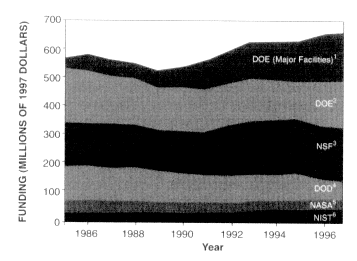
Figure 7.2
Trends in federal investment in condensed-matter and
materials physics, 1985-1997.
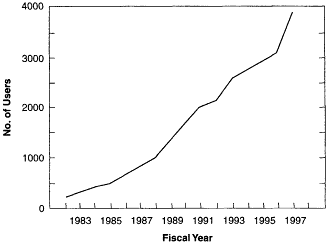
Figure 7.3
Growth in the number of users at Department of Energy
synchrotron facilities, 1982-1997.
Page 282
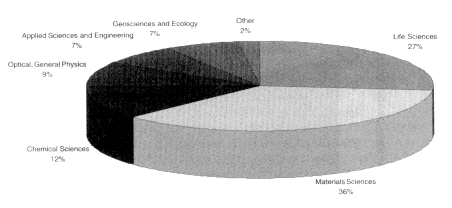
Figure 7.4
Use of national synchrotron facilities by scientific discipline
shows that more than half of the 4000 users in 1997 worked
in fields other than condensed-matter and materials physics.
Condensed-Matter and Materials Physics Today
The evolution in the practice of condensed-matter and materials physics in response to these external forces and to developments within the field itself has been dramatic. Partnerships across disciplines and among performers have proven to be essential to continued progress in the field. Powerful new research facilities have provided individual investigators with unprecedented access to the world of atoms and electrons in materials. These facilities, developed and supported by the condensed-matter and materials physics community, now provide unique research capabilities to thousands of researchers from a wide range of scientific disciplines. Finally, many of the institutions that practice condensed-matter and materials physics have undergone fundamental change in response to changing priorities and economic realities.
Condensed-matter and materials physics is inherently interdisciplinary, with advances increasingly occurring at interfaces with chemistry, materials science, atomic and molecular physics, engineering, biology, and other disciplines (see Box 7.2). Major professional societies, including the Materials Research Society and the Divisions of Materials Physics and High Polymer Physics of the American Physical Society, have positioned themselves to foster and serve this interdisciplinary materials community. Interdisciplinary research represents a significant challenge to the disciplinary boundaries inherent in university departments, funding agencies, and the peer-review process. Bridging these barriers is an important priority for the future of condensed-matter and materials physics. In particular, mechanisms must be found to ensure that compelling interdisciplinary
Page 283
| BOX 7.2 Meeting the Interdisciplinary Challenge |
| Condensed-matter and materials physics is inherently interdisciplinary. Linkages to chemistry, materials science, atomic and molecular physics, and engineering have been essential to progress in the field. New linkages to biology are critical to the future. Forefront research transcends boundaries within condensed-matter and materials physics as well and often depends on an integration of theory and experiment with the synthesis of special research samples and a variety of advanced characterization techniques. Advances in condensed-matter and materials physics cluster at the interfaces between established disciplines, interfaces that face institutional, funding, and disciplinary barriers. |
| Traditional scientific disciplines maintain and nurture the foundations of knowledge. This is important to the scientific enterprise, but it also presents the potential for barriers to interdisciplinary research as scientific disciplines evolve, developing language and culture not readily understood by the practitioners of other disciplines. For example, biology is at a point where the atomic view of physicists is having enormous impact, but physicists and biologists have difficulty communicating. This structural defect in the disciplinary organizational scheme must be addressed through education and budgetary incentives. |
| Institutions also present barriers to interdisciplinary research. University departments are structured around scientific disciplines. As a result, new faculty who wish to pursue research at the boundaries between disciplines can have difficulty finding a home (and earning tenure). Furthermore, the individual-investigator mode does not foster multidisciplinary teaming. The emergence of the multidisciplinary Materials Research Science and Engineering Centers, Science and Technology Centers, and Engineering Research Centers, sponsored by the National Science Foundation, is a response to this issue. |
| Finally, the funding process can present barriers to interdisciplinary research. Projects that fall outside traditional disciplines can easily be overlooked by a peerreview community structured around those disciplines. The peer-review process must include explicit capabilities for handling interdisciplinary proposals. |
| Universities can meet the interdisciplinary challenge through joint appointments for faculty, by encouraging multidisciplinary centers, and by recognizing the value of interdisciplinary research in tenure decisions. Government laboratories, which have an easier time putting together multidisciplinary teams, should be encouraged to involve universities in those teams. Funding agencies have the most leverage, as seen in the success of agency-sponsored multidisciplinary centers. Proposals that assemble diverse teams, including physicists and biologists for example, to tackle high-profile multidisciplinary problems should be encouraged. Institutions that ignore the interdisciplinary challenge risk abandoning the scientific frontier. |
research proposals are not lost in the competition with other proposals that more neatly fit the boundaries of established disciplines.
Partnerships across disciplines and among universities, government laboratories, and industry are becoming increasingly important in bringing together the resources and diverse skills needed to continue advancing knowledge in condensed-
Page 284
matter and materials physics. For many leading-edge research projects, it is neither practical nor cost-effective to assemble the required capital and intellectual resources at a single location. Teams form and dissolve as research directions change, and the diversity of institutions and performers ensures that a wide range of projects and approaches can be accommodated. This is a fundamental strength of the U.S. R&D system. Modem communications, an outgrowth of condensed-matter and materials physics, is essential to these partnerships.
Another significant change in the practice of condensed-matter and materials physics has been the emergence of major national research facilities. These facilities, which include synchrotrons, neutron sources, and microcharacterization centers, have had an extraordinary impact on the ability of researchers to investigate ever-smaller, lower cross-section, more dilute, and more complex systems. Accordingly, there has been a spectacular increase in the use of these facilities. These powerful tools transcend condensed-matter and materials physics to serve large user communities from other disciplines, including biology, which now consumes more than 25 percent of the beam time at national synchrotron facilities. As a result, condensed-matter and materials physics is having a significant impact on many fields with which it had little connection just a decade ago.
Institutional change is never comfortable, and it is a continuing challenge to U.S. space science. Research organizations are being expected to improve organizational effectiveness and resource utilization, create new partnerships, and serve customers better. Customers, ranging from corporate manufacturing arms to sponsors to facility users, are increasingly involved and demanding. All sectors of condensed-matter and materials physics underwent profound change in recent years. Industrial laboratories were downsized and redirected. Government laboratories straggled with substantial reductions in resources, increased regulation, and mission and operational reform. Research universities came under increasing pressure to reduce overhead, cut costs, and become more responsive to the public and to industry. All of these changes have potentially positive outcomes, and condensed-matter and materials physics is particularly well positioned to contribute effectively in this new environment. However, great care will be required to navigate these changes while preserving the research infrastructure of the nation for the long term.
Measuring Performance and Economic Impacts
The Government Performance and Results Act (GPRA), passed in 1993, provides a timetable for agencies to develop strategic plans and criteria for measuring their performance against established goals. These plans and performance measures, which were intended to be in place by 1997, will form the basis for evaluating the effectiveness of agency programs and developing budgets. This represents a major challenge for fundamental science, in which the important
Page 285
impacts tend to be unpredictable, dilute across the spectrum of research activities, and frequently are separated by decades from the initial research results.
GPRA establishes a framework in which agencies provide inputs in order to produce outputs, which have intended outcomes for society and the economy. Inputs might be person-years and equipment-years of effort, for example, while outputs are the direct results of an agency's inputs, and outcomes are the broader impacts that result. For research, these concepts are summarized in Table 7.3. Within condensed-matter and materials physics, the discovery of high-temperature superconductivity represents an output, while the commercialization of superconducting technology would be an outcome. Agencies are required to develop performance criteria for both outputs and outcomes. This requirement is a substantial challenge for agencies involved in fundamental research, for which the outputs
| TABLE 7.3 Inputs, Outputs, and Outcomes of R&D | |||
| Performance Indicators | |||
| Category | Concepts | Proxies | Correlates |
| Inputs | Person-years | Expenditures | |
| Equipment-years | |||
| Outputs | Ideas, discoveries | Papers, prizes | |
| Inventions | Patents, invention-disclosures | ||
| Human capital | Degrees awarded | ||
| Technology transfer | CRADAs, licenses | Cost-shared dollars | |
| Outcomes or Impacts | Broad advance of human knowledge | Papers, citations, expert evaluations | |
| New products | Patents, citations | Licenses, license royalties, product announcements, new product sales | |
| Productivity improvements | Measured productivity growth | ||
| Income growth | Benefit/cost ratio or rate of return | New firms, induced investment | |
| Excitement about science | Science News articles | ||
| Health, environment, etc. | New drug applications | Emissions levels | |
| Cooperation and knowledge flow | CRADAs | ||
| SOURCE: Adam B. Jaffee, "Measurement issues" in L.M. Branscomb and J. Keller, eds., Investing in Innovation, MIT Press, Cambridge, Mass. (1997). | |||
Page 286
(ideas and discoveries) are difficult to measure, and the outcomes (the advance of knowledge or the introduction of new products), are difficult to quantify or relate to specific programs. Consequently, proxy indicators related to the desired outputs or outcomes are developed for research activities. These proxies might include papers, prizes, and patents to take the place of ideas and discoveries in measuring research outputs, and citations and productivity growth to take the place of ad-
| TABLE 7.4 Economic Growth Rates Attributable to R&D Investments | |
| Author(s) and Year of Study | Rate of Returna (Percent) |
| Firm-level Studies | |
| Link (1983) | 3 |
| Bernstein-Nadiri (1989b) | 7 |
| Schankerman-Nadiri (1986) | 13 |
| Lichtenberg-Siegel (1991) | 13 |
| Bernstein-Nadiri (1989a) | 15 |
| Clark-Griliches (1984) | 19 |
| Griliches-Malresse (1983) | 19 |
| Jaffe (1986) | 25 |
| Griliches (1980) | 27 |
| Mansfield (1980) | 28 |
| Griliches-Malresse (1984) | 30 |
| Griliches-Malresse (1986) | 33 |
| Griliches (1986) | 36 |
| Schankerman (1981) | 49 |
| Minasian (1969) | 54 |
| Industry-level Studies | |
| Terleckyj (1980) | NSb |
| Griliches-Lichtenberg (1984a) | 4 |
| Patel-Soete (1988)c | 6 |
| Mohnen-Nadiri-Prucha (1986) | 11 |
| Terleckyj (1974) | 15 |
| Wolff-Nadiri (1987) | 15 |
| Sveikauskas (1981) | 16 |
| Bernstein-Nadiri (1988) | 19 |
| Link (1978) | 19 |
| Griliches (1980) | 21 |
| Bernstein-Nadiri (1991) | 22 |
| Scherer (1982, 1984) | 36 |
| a For studies for which Nadiri (1993) reports a range of possible returns, the midpoint of that range is provided in this table. | |
| b Not significantly different from zero in a statistical sense. This result, however, may be a reflection of limitations in the quantity of data used in the study. | |
| c Economy-level study (all industries grouped together). | |
| SOURCE: M.I. Nadiri, "Innovations and Technological Spillovers," Working Paper No. 4423, National Bureau of Economic Research, Cambridge, Mass. (1993). | |
Page 287
vances in knowledge or the introduction of new products in measuring outcomes. Although inherently imperfect, the use of multiple proxy indicators in combination with peer review probably represents the most likely (and most reasonable) performance measurement approach for fundamental research under GPRA.
This discussion of performance measures raises a key issue: the rate of economic return on R&D investments. Specific data are not available for condensed-matter and materials physics, although powerful evidence abounds, such as the economic impact of the transistor, magnetic materials, fiber optics, and the solid-state laser. Numerous studies of economic return have been performed for the broader R&D enterprise. These studies, many of which are listed in Table 7.4, indicate average rates of return of 15 to 20 percent per year. This is an extraordinary indication of the value of research. Unfortunately, these data do not provide information on the impact of adjustments (either up or down) in the level of R&D investment and are therefore not useful in determining absolute funding levels.


