
Executive Summary
Operational Maneuver From the Sea (OMFTS) provides the Marine Corps vision for conducting 21st-century naval expeditionary operations.1 This vision, which seeks to exploit the sea as maneuver space, involves projecting naval expeditionary forces and power directly from the sea onto operational objectives well inland, obviating the traditional need to first seize and secure a beachhead and build up a support base ashore before pushing out to accomplish inland operational objectives.
Naval expeditionary logistics, which is about moving naval forces and sustaining their operations in a broad array of environments, figures prominently in the new vision. The role of maritime prepositioning will be expanded from the current at-sea warehousing of Marine Corps equipment to include at-sea arrival and assembly of forces, thereby eliminating the need for airfields and ports in the immediate area of operations. To reduce logistics demand and the logistics "footprint" ashore, many of the functions traditionally accomplished in secure rear areas on land, such as command and control, aviation support, and logistics, are to be based at sea. The sea base itself, probably a collection of amphibious assault ships, prepositioning ships, and various auxiliary support ships, is to remain over the horizon, where logistics and other supporting functions can be performed under the security umbrella of the fleet. Rather than off-loading large quantities of supplies and equipment ashore, logistics operations will deliver
tailored support packages from the sea base or from small detachments ashore to widely dispersed, highly mobile combat forces operating up to 200 miles inland.
Today's Framework in Perspective
The OMFTS vision has stimulated innovative thinking, shaped ideas, focused debate, and led to the publication of a series of implementing concepts.2 Collectively, this evolving conceptual framework of visions and new ideas represents the important first step in a strategic planning process that will define future U.S. naval forces.
Shaping the logistics capabilities of the Navy and Marine Corps to meet the needs of the evolving OMFTS conceptual framework will be an enormously complex undertaking. It will entail examining how well and at what costs various combinations of force structure, equipment, and operating concepts—both combat and logistics—might meet future naval expeditionary needs. In such a process, warfighting and logistics capability are inseparable. For while warfighting needs set logistics requirements, the logistics capabilities available will in the end limit warfighting potential and the courses of action available to field commanders.
Today, the Navy and Marine Corps, in such documents as "Operational Maneuver From the Sea" and its supporting papers, are formulating the concepts that will lead to future naval force capabilities.3,4 Figure ES.1 depicts the process. The path from the present to the future is an iterative process of postulating desired operational capability, determining the logistics capability needed to support those operations, and adjusting both in a search for a balance among warfighting needs, logistics requirements, implementation costs, and risks. At each cycle of the process, senior Navy and Marine Corps leaders, selecting among packages of realistic, coherent options, will make the key decisions that step progressively closer to the reality of future forces and set in motion the next iteration of the process.
Logistics Implications of OMFTS—Key Features to be Resolved
Some of the broad logistics implications of OMFTS are clear from the current set of implementing concepts (see Box ES.1). For example, by maneuvering from assault ships over the horizon at sea directly to objectives well inland,
|
2 |
See Box ES.1, Marine Corps Implementing Concepts for OMFTS. |
|
3 |
Department of the Navy. 1992. ". . . From the Sea," U.S. Government Printing Office, Washington, D.C., September. |
|
4 |
Department of the Navy. 1994. "Forward. . . From the Sea, Continuing the Preparation of the Naval Services for the 21st Century," U.S. Government Printing Office, Washington, D.C., September 19. |
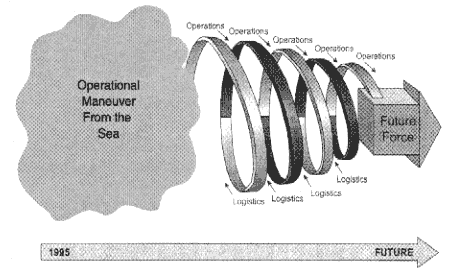
FIGURE ES.1
Operational Maneuver From the Sea, from concept to reality: an iterative process.
|
BOX ES.1 Marine Corps Implementing Concepts for OMFTS "Maritime Prepositioning Force 2010 and Beyond," February 1997* "A Concept for Future Military Operations on Urbanized Terrain," October 1997* "A Concept for Ship-to-Objective Maneuver," November 1997* "Casualty Care Concept for Marine Corps Operational Maneuver From the Sea (Working Draft)," January 1998** "MAGTF Sustained Operations Ashore," October 1998* "A Concept for Advanced Expeditionary Fire Support—The System After Next," April 1998* "Sea Based Logistics: A 21st Century Warfighting Concept," May 1998* |
ground task forces may leave unsecured the land supply routes that normally are essential to logistics operations. That will shift the emphasis from ground transport to air transport. The basing of many supporting functions at sea will dramatically reduce the demand for logistics support ashore but will require that many of the logistics functions usually performed on land be performed at sea,
long distance—over both water and land—from the forces being supported. Logistics communications will have to reach well beyond the radio-line-of-sight distances that now predominate, and new logistics information systems will have to be developed to provide the real-time data and decision support capabilities that logistics commanders will need to plan and control fast-paced, complex logistics operations. At-sea arrival and assembly of maritime prepositioning forces will eliminate the need for ports and airfields in the vicinity of operations but will generate requirements for at-sea arrival and assembly facilities and some means to transport the Marines to those facilities.
The specific logistics implications of OMFTS are much more difficult to discern. For, at its current stage of development, OMFTS is open to a wide range of interpretations, both within the naval services and beyond. Resolving the various interpretations of six key features, in particular, is essential to defining future OMFTS logistics needs:
- Composition of combat and logistics forces ashore,
- Role of naval fire support vis-à-vis ground artillery,
- Availability of overseas ports and airfields,
- Sea base standoff distances and duration,
- Operating distances ashore, and
- Transition to shore-based logistics.
Composition of Combat and Logistics Forces Ashore
Logistics needs derive from combat capability, which, in turn, derives from the forces and concepts employed to attain that capability. Although OMFTS outlines the broad concepts, at this stage it stops short of sizing or characterizing the forces, either combat or logistics forces, that could be ashore.
Some insight can be obtained from examining today's forces. For example, Table ES.1 shows the implications of sea basing, that is, supporting only a land-
TABLE ES.1 Marine Expeditionary Force (Forward) Daily Resupply Requirements
|
|
Marines Ashore |
Tons Needed |
|
Full MEF (FWD) |
17,800 |
2,235 |
|
MEF (FWD) with aviation at sea |
10,460 |
848 |
|
MEF (FWD) with aviation and command at sea |
9,660 |
785 |
|
Landing force only |
6,800 |
490 |
|
SOURCE: McAllister, Keith R. 1998. MPF 2010 Ship-to-Shore Movement and Sea based Logistics Support, Volume I: Report and Volume II: Appendices, Center for Naval Analyses, Alexandria, Va., |
||
TABLE ES.2 Task Force Building Blocks' Daily Resupply Requirements (Short Tons)
|
|
Water |
Fuel |
Ammunition |
Other |
Total |
|
Headquarters Battalion |
4 |
9 |
<1 |
2 |
15 |
|
Infantry Battalion |
27 |
2 |
1 |
5 |
38 |
|
Artillery Battalion |
23 |
54 |
20 |
6 |
103 |
|
Advanced Amphibious Assault Vehicle Battalion |
15 |
26 |
2 |
3 |
46 |
|
Engineering Battalion |
6 |
16 |
3 |
1 |
26 |
|
Light Armored Reconnaissance Company |
4 |
3 |
1 |
1 |
9 |
|
Tank Battalion |
23 |
38 |
2 |
5 |
68 |
ing force ashore instead of a full marine expeditionary force (forward) MEF (FWD): the daily resupply requirements drop from over 2,000 tons per day to under 500 tons per day. The landing force ashore, however, is today's force, not tomorrow's, and it is still a relatively heavy, mechanized force with substantial resupply requirements. Table ES.2 shows approximate daily resupply requirements of the major ground-combat units from which today's commanders create task forces. It illustrates the large difference in support requirements between an infantry battalion and some of the heavier elements of the force, in particular, the tank battalion and the artillery battalion. (The artillery battalion's large fuel requirement is for trucks carrying ammunition.)
Clearly, "lightening" the ground-combat forces could have a dramatic effect on logistics requirements, and some interpretations of OMFTS assume that the concept applies to a future force much lighter than today's. Others are reluctant to speculate on possible changes to Marine Corps forces. For example, war games and analytical work conducted thus far to support assessments of OMFTS logistics have tended to project today's forces operating under what are thought to be the new OMFTS concepts, thereby resulting in a combination of "old think/new think" that confuses both the interpretation of OMFTS and the assessment of logistics needs.
Role of Naval Fire Support Vis-à-Vis Ground Artillery
The Navy is making large investments in the development of long-range naval guns, land-attack missiles, and precision guided munitions. The purpose is to provide the fleet with a substantial capability to support ground operations, and some interpretations of OMFTS postulate a decreasing role for ground artillery. The OMFTS "Concept for Advanced Expeditionary Fire Support," however, states that Marine Corps ground forces will retain organic fire support capa-
bility, and the Marine Corps is developing a new lightweight howitzer. Thus, how the new, sea based fire support capabilities will affect ground artillery force structure (i.e., number of guns ashore) and artillery ammunition requirements is unknown. This issue has significant implications for logistics, because artillery is such a large consumer of fuel and munitions (as shown in Table ES.2).
Availability of Overseas Ports and Airfields
Today, the United States uses overseas ports and airfields routinely for deploying and sustaining naval forces. Many military leaders are concerned about the growing reluctance of foreign nations to allow U.S. forces to use their territory for military operations and believe that the future availability of overseas facilities is uncertain. If large Marine Corps air-ground task forces are to be deployed and sustained without the benefit of overseas facilities, some substitute for those facilities, such as a mobile offshore base, may be needed for assembly of maritime prepositioning forces and for transshipment of sustainment supplies from container ships and cargo aircraft. Thus, decisions about whether or not to rely on overseas facilities could have a major impact on the design and cost of the future naval expeditionary logistics system.
Sea-Base Standoff Distances and Duration
OMFTS implies over-the-horizon operations, 25 to 50 miles at sea, both to make use of the sea as maneuver space and to maintain safe distances from shore-based threats. It is unclear, however, whether OMFTS operations are to be launched only from over the horizon or whether the over-the-horizon distances are to be maintained indefinitely, that is, throughout landing, sustainment, and reconstitution of the force. If one assumes that the ships can close to a port or to over-the-shore distances (within 6 miles) early in an operation, current logistics over-the-shore capabilities—such as the offshore petroleum distribution system, slow landing craft, and lighterage (floating causeway sections)—should be adequate. If one assumes that support ships must stay over the horizon indefinitely, these current systems will be of little use. Although the landing craft (air cushion) (LCAC) has the high speed necessary to provide ship-to-shore transport from over-the-horizon distances, it has insufficient capacity and durability to land and sustain a large force; the naval services would need a new high-speed landing craft.
Operating Distances Ashore
The terms of reference for this study call out a need to support ground forces up to 200 miles inland. This need, in the context of the ship-to-objective maneuver concept portrayed by OMFTS, implies a dominant role for resupply by air,
TABLE ES.3 Percent of Resupply Requirements Met by Air Deliveries
|
Portion of Force Supported |
250 Miles |
125 Miles |
55 Miles |
|
Full MEF (FWD) |
15 |
34 |
55 |
|
MEF (FWD) less ACE |
40 |
89 |
100 |
|
MEF (FWD) less ACE and CE |
43 |
96 |
100 |
|
Landing force only |
69 |
100 |
100 |
|
NOTE: See Appendix C for data and computations. MEF (FWD), Marine expeditionary force (forward); ACE, air combat element; CE, combat element. SOURCE: Adapted from Table C.1, McAllister, Keith R. 1998. MPF 2010 Ship-to-Shore Movement and Sea-based Logistics Support, Volume I: Report and Volume II: Appendices, Center for Naval Analyses, Alexandria, Va., March, and Tables C.2 and C.3 by David Kassing, committee member. |
|||
for to assume that road networks and rear areas will be secure enough for routine truck convoys is unrealistic.5
Deciding the alternatives and limits of resupplying ground elements by air is an important element in defining OMFTS and future expeditionary warfare capabilities and limitations. For example, Table ES.3 shows that if the OMFTS force ashore approaches today's in its need for fuel, ammunition, and other supplies, the rotary-wing and tilt-rotor aircraft planned for the future (CH-53Es and V-22s) will be insufficient, and additional air transport will be required. (These calculations do not consider the possibility of adverse weather or threat conditions.) The potential distances and payload requirements suggest that short takeoff and landing (STOL) aircraft, not vertical takeoff and landing aircraft (such as helicopters), would be more appropriate for this purpose.
It is important to note, also, that OMFTS likely will require much greater allocation of available air assets to logistics missions than has been the case in the past. Not only will logistics, including medical support, be an integral part of maneuver operations, but the support concept for a task force will also need to be fully integrated with aviation support planning and air mission tasking.
Transition to Shore-based Logistics
Sea-based logistics is one of the foundation concepts of OMFTS: By keeping much (though not necessarily all) of the supplies and support activities at sea, naval expeditionary forces could both reduce the vulnerability of logistics
operations to enemy attack and allow greater maneuverability of forces ashore. OMFTS, however, does not rule out a transition to shore-based support. Such a transition implies retaining many of today's land-oriented combat service support capabilities with today's large logistics footprint ashore. This raises a fundamental question: Are OMFTS capabilities in addition to, or in lieu of, today's capabilities? The answer has a profound effect on the future combat service support structure of both the Marine Corps and the Navy.
Interpreting OMFTS
The ranges of interpretation for the six key issues presented above are summarized in Table ES.4. By selecting either the first option on every issue or the second option on every issue, two completely different OMFTS logistics requirements can be generated.
For example, the set of first options yields a light force, with no organic artillery, using overseas facilities to deploy, resupply, and reconstitute, closing to over-the-shore distances early in the operation, supporting large forces only 50 miles inland, and making a transition to shore-based support. That type of force and operation probably could be supported more easily than today's operations. At the other extreme, the set of second options yields a relatively heavy force, much like today's, with organic artillery, unable to use overseas facilities, operating 200 miles inland, supported from over the horizon, but retaining the option to transition to shore-based support. For that type of force and operation, major new investments probably would be needed to provide needed logistics support: a mobile offshore base (MOB); large STOL aircraft-capable logistics ships; ship-capable STOL transport aircraft; and high-speed landing craft.
The sets of options listed in Table ES.4, however, lend themselves to 64 different combinations, not counting the numerous possibilities if neither extreme is selected for each issue. Despite listening to numerous Navy and Marine Corps briefings, studying the published documents about OMFTS and its implementing concepts (see Box ES.1), and discussing the matter at length, members of this committee have no common interpretation of OMFTS. Nor did the
TABLE ES.4 Interpreting OMFTS
|
Issue |
Range of Options |
|
Forces |
Light or heavy? |
|
Naval fire support |
Replace or augment? |
|
Overseas facilities |
Available or unavailable? |
|
Stand-off distances |
Over-the-shore or over-the-horizon? |
|
Distances ashore |
50 miles or 200 miles? |
committee discern a common interpretation among the Navy and Marine Corps personnel who were supporting this study effort. This wide variation in possible interpretation of OMFTS poses two risks—greatly underestimating the true logistics needs of OMFTS or making large investments to acquire or retain unnecessary capability.
Major Recommendations
Because logistics will be so central to implementing OMFTS, the time has come for the Navy and Marine Corps to define the desired end state and planning horizon in sufficient detail to enable reasoned and consistent assessments of logistics requirements and capabilities. In reference to Figure ES.1, they must start down the path to defining future capabilities. An integrated Navy and Marine Corps OMFTS concept of operations, supplemented by a common baseline of planning imperatives and assumptions, is essential to determining the limits of currently programmed capabilities and the relative costs and merits of the new capabilities required to implement OMFTS. Such specificity is essential also to understanding logistics needs and developing a supporting logistics concept of operations.
RECOMMENDATION: The Navy and Marine Corps, using an iterative, strategic planning process, should create an OMFTS concept of operations that integrates tactical and logistical considerations. Key factors to be addressed in defining such a concept should include (1) required combat capability, in terms of the tactical and logistics forces ashore; (2) use of naval fire support; (3) capabilities of the sea basing ships, aircraft, and surface craft; (4) ranges of sea base standoff distances and duration; (5) operating distances ashore; and (6) use of overseas facilities as staging bases and resupply points.
A sound operating concept cannot be formulated independently of the logistics concept supporting it. Contemporary combat service support concepts, forces, capabilities, and processes are designed for shore-based logistics operations. The new OMFTS warfighting concepts and the emphasis placed on sea basing to reduce the logistics footprint ashore are likely to require a materially different logistics concept of operations and supporting set of forces, capabilities, and processes. A defined logistics concept is needed both to guide assessment of organizational, procedural, and equipment needs and to influence, through the iterative process, design of the overall OMFTS concept of operations and operational imperatives. Both the Navy and Marine Corps must participate in creating this logistics concept, and it should be a complete, integrated concept, spanning the full set of combat service support functions, reaching from the Marine at the outer edge of the battlespace, back to the Continental United States (CONUS) sustaining base.
Key factors to be considered in developing the logistics concept should
include operational requirements for the ships, aircraft, and surface craft needed for sea based logistics, for the combat service support units ashore, and for the material-handling and throughout capabilities needed at each node in the system to efficiently transfer material from one transport mode to another. In creating this concept, the Navy and Marine Corps should critically assess the impact of precision guided munitions, naval guns, and ship-launched missiles on requirements for artillery and artillery ammunition; emphasize the use of aircraft, both fixed and rotary wing, rather than truck transport; and seek to create an anticipatory, end-to-end distribution-based logistics system that minimizes material handling and the need for requisitions.
RECOMMENDATION: The Navy and Marine Corps should create an end-to-end, OMFTS logistics concept that supports the concept of operations at each stage in the iterative process of defining future forces and their capabilities.
Designing the support concept or concepts that best fit the needs of future logistics operations is not a trivial task. The number of variables is large, consistency in assumptions and methodology is key to interpreting results, and the costs of experimenting much with large units (e.g., a MEF (FWD) or larger unit) is prohibitive. This type of analysis is best done with modeling and simulation, rather than ad hoc studies.
RECOMMENDATION: The Marine Corps should invest in modeling and simulating OMFTS logistics operations to assess logistics needs, capabilities, and alternative support concepts.
Another large change in the concept of support prompted by OMFTS involves the need for combat casualty care. The current military health service support strategy, which was designed to meet Cold War needs, focuses on providing definitive medical care in-theater in order to maximize the return of personnel to duty. This strategy results in a large medical infrastructure ashore—field hospitals, extensive care capabilities, and lengthy patient holding times. The emerging new strategy, now in its early stages of development, focuses on providing only essential care in-theater, with the injured being evacuated rapidly via enhanced aeromedical evacuation capabilities to definitive care facilities in CONUS and elsewhere throughout the world.
The approach outlined in "Casualty Care Concept for Marine Corps Operational Maneuver From the Sea"6 (draft) is consistent with the emerging new strategy. It emphasizes the need to minimize medical forces ashore and suggests three primary nodes of theater medical activity: one with the combat units, the
second on board amphibious assault or sea based vessels, and a third at the aeromedical port of debarkation for movement to definitive care facilities. In this model, casualties would receive only essential, lifesaving care on the battlefield and would then be evacuated rapidly to a sea based care facility where they would receive the minimum additional care needed to stabilize them far evacuation out of the theater.
The potential implications of this concept and model are profound. They include the need to redirect medical training, research and development, infrastructure and equipment investments, and management to the critical features of the new system: Marines who are trained to stop bleeding and aid breathing of a wounded "buddy," corpsmen who are trained and equipped to provide simple but effective lifesaving trauma care on the battlefield; forward surgical teams who are trained and equipped to practice combat trauma care in small, austere, deployable medical facilities; and means of aeromedical evacuation that provide essential en route patient monitoring and care.
RECOMMENDATION: The Navy and Marine Corps should reengineer the casualty care system to match the warfighting concepts of OMFTS, giving highest priority to improving first-responder care, developing a forward surgical unit, handling and caring for patients contaminated by biological, chemical, or radiological agents, and evacuating patients to at-sea care facilities and onward to points of strategic aeromedical evacuation.
Other Recommendations
Other recommendations are offered throughout the report. They are best understood in the context of the discussions accompanying them but are listed here for the reader's convenience.
- The Navy and Marine Corps should reassess the composition of prepositioned equipment sets as they consider future naval maritime prepositioning needs.
- Before deciding future maritime prepositioning ship requirements, the Navy and Marine Corps should explore the feasibility of using rapidly deployed amphibious warfare ships to facilitate landing maritime prepositioning forces.
- In long-term planning for future amphibious shipping, the Navy should consider the feasibility of a common ship design for assault, prepositioning, and sea basing missions.
- If a goal is to deploy and sustain forces without dependence on overseas facilities, the Navy and Marine Corps should continue research and development of the mobile offshore base as an option for future naval capability.
- The Navy should investigate the design and development of a high-speed, high-capacity landing craft to complement the landing craft (air cushion) (LCAC).
- The Marine Corps should assess the roles of main battle tanks and artillery in future force structure, giving particular attention to the impact of precision guided munitions and naval guns and missiles on artillery ammunition requirements.
- The Marine Corps should examine the capabilities and limitations of various options for delivering by means of air transport the sustaining support required by large ground forces over various operating distances from the sea base. The Marine Corps should adjust the evolution of OMFTS concepts, maneuver force design, and aircraft and shipbuilding programs to ensure that operational and logistics capabilities are appropriately sized and balanced.
- The Navy and Marine Corps should determine the technical feasibility, costs, and operational value of a ship-capable, fixed-wing STOL transport air-craft and a complementary, fixed-wing-capable logistics ship that could substantially increase the naval forces' capability to support large ground units long distances from a sea base.
- The Marine Corps should start developing the logistics and medical information systems, displays, and automated decision aids it will need to manage fast-paced, complex support operations in tomorrow's warfighting environment.
- The Navy and Marine Corps should work together to craft a common approach to the resupply of all naval forces at sea.


