
2
Logistical Implications of Operational Maneuver From the Sea
Supporting Current Amphibious Operations
In amphibious assaults today, a Marine air-ground task force (MAGTF) would secure a beachhead and establish a support base on land as quickly as possible, and then push out from that base to other objectives. The assault, conducted largely from amphibious ships close to shore (usually within about 6 miles1), would be supported by minimal supplies accompanying the assault waves. Within minutes, shore party teams and helicopter support teams would move ashore to organize and establish beach and landing zone support areas. Forward arming and refueling points would provide essential replenishment to aviation units. What starts as on-call waves of support packages would yield quickly to scheduled waves of support equipment and supplies and soon become a general off-loading of amphibious ships onto the beach.
For a large MAGTF, the material carried on the amphibious ships and off-loaded to the beach would provide minimal sustainment. Within days, cause-ways, barges, and lighters would be discharging additional units, equipment, and supplies (the follow-on echelon) from cargo ships and tankers. When fully developed, the combat service support area might spread over a 30 to 40 square mile area; hold thousands of tons of ammunition, thousands of containers of supplies, and millions of gallons of petroleum and water; and house such support services as equipment maintenance and medical care.
If an area is secure from hostile operations, and an airport is available near either a seaport or a coastline suitable for logistics over-the-shore operations,
today's maritime prepositioning forces (MPFs) can be employed. The Navy maintains three maritime prepositioning squadrons, 13 ships total (3 additional ships are being procured). Each squadron holds the unit equipment and 30 days' sustaining supplies for one Marine expeditionary force (forward) (MEF [FWD]) (see Table 3.1). The squadrons, stationed in the Mediterranean Sea and at Guam and Diego Garcia, can deploy, unload, integrate equipment to Marines who have been flown into the theater of operations, and stand up a combat-ready MAGTF in about 15 days. Once the maritime prepositioned force is landed, it is supported the same as any other MAGTF.
Supporting Operational Maneuver From The Sea
The evolving concept of OMFTS depicts a very different type of amphibious operation, with very different logistics requirements. Instead of amphibious warfare ships moving close to shore to disembark the assault echelon, the assault would be launched from over the horizon, 25 to 50 miles at sea. Instead of the first objectives being to establish a beachhead (a logistics base) and secure it from enemy direct and indirect fire, the first objective might be to attack enemy critical positions up to 200 miles inland. Instead of the units ashore being supported by a general off-loading of supplies onto the beach, units would be logistically supported to the extent possible from ships at sea. Instead of the MPFs being dependent on secure airfields and ports in the immediate vicinity of the objectives, Marines would integrate with their equipment at sea and move directly from the prepositioning ships to their areas of operation ashore.
Most importantly, instead of a full task force moving ashore, it is envisioned that many of the supporting functions would be based at sea, for example, command and control, administration, fire-support coordination, and logistics. Conducting much of the activity of these functions at sea not only would change how they are accomplished, but also would reduce substantially the size and support requirements of the force ashore.
For the logistician, OMFTS would entail doing largely at sea many of the tasks that traditionally have been done from a large, shore base. For example, the receipt, storage, breakout, and repackaging for distribution of bulk shipments of rations, fuel, munitions, and spare parts are normally done by logistics units ashore. These operations typically entail the use of large container-handling equipment, involve several hundred containers, and require significant real estate in order to gain access to, sort, and process the materials for distribution to ground-combat elements via truck convoys. The situation is similar for maintenance operations, medical care, and other logistics services. Under OMFTS, those functions would be done largely in the continental United States (CONUS) at sites remote from the theater of operations or at sea, likely dispersed among at least a half dozen or more ships that compose the sea base for the operation (e.g.,
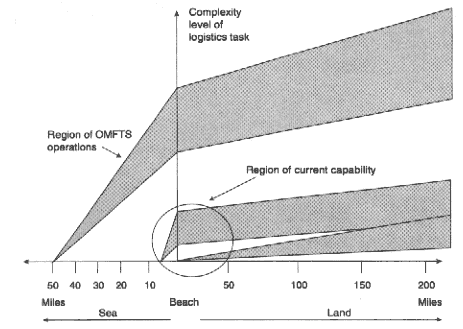
FIGURE 2.1
Impact of range on logistics complexity.
amphibious warfare ships, maritime prepositioning ships, and various auxiliary support ships).
Additionally, the expanded depth and breadth of the battlefield and the rapid pace of maneuver operations portrayed by OMFTS would require that logistics operations be conducted over very long distances, probably without the assurance of secure rear areas ashore and land lines of communication. Figure 2.1 depicts conceptually the challenge facing logisticians.
Whereas current logistics operations, once established ashore, encompass an area of operations nominally 50 miles deep by 50 miles wide, future operations will start with the movement of equipment and supplies from 25 to 50 miles at sea to units as far as 200 miles inland and 200 miles apart—a four-fold increase in the ranges over which forces must be logistically supported. Whereas today's concept of military operations includes clearing and securing rear areas from which forces can be safely operated and logistically supported, OMFTS envisions combat units moving directly from ships to operational objectives, avoiding built-up shore defenses and minefields but also leaving unsecured the areas in between, the areas in which logistics activities normally take place.
Thus, the general logistical implications of OMFTS are discernible: smaller but more mobile forces ashore are to be supported over longer distances from a
logistics base that is at sea. The specific implications, however, are not as clear, for they depend on key features of OMFTS that are not yet fully defined by the implementing concepts. It is to these features of OMFTS and their logistics implications that the committee turned its attention.
Key Undefined Features of OMFTS
Although some would argue that logistics is more an art than a science, it is fundamentally based on quantification: How much? How far? How fast? For how long? Yet at this stage in their development, OMFTS and its implementing concepts lack the information needed to define and size logistics operations. The ambiguity leaves the concepts open to a broad range of interpretation. For example, at one extreme, the concepts may be viewed as modest extensions of current practices aimed at merely exploiting the capabilities of planned new systems, such as the V-22 aircraft and the advanced amphibious assault vehicle (AAAV). At the other extreme, they may be viewed as ambitious blueprints for radical changes in the role of naval expeditionary forces—the way they operate, the way they are equipped, the way they are organized, and the way they are supported. The ultimate goal, which may be somewhere in between, is not yet clear. In the following paragraphs the key unresolved aspects of OMFTS that have major logistical implications are highlighted.
Maneuver Forces Ashore
The major question left unanswered is the required combat capability, especially in terms of the size and composition of the maneuver forces ashore. The central issues are to what extent tomorrow's force will provide for both light infantry and mechanized task forces, as today's does, whether tanks and howitzers will be part of that force mix, and how large a task force (battalion, regiment, division, or corps) will employ the OMFTS concepts. As will be discussed in subsequent chapters, how those issues are resolved will have substantial impact on the capabilities needed for prepositioning, deploying, landing, and sustaining the force.
Overseas Facilities
The assumption one is willing to make about the availability of overseas facilities also greatly influences logistics needs. The Marine Corps already has stated, in its concept of Maritime Prepositioning Force 2010 and Beyond (MPF 2010+), the goal of being able to deploy MPFs without the use of airfields or ports in the immediate vicinity of an objective. The OMFTS concepts are silent, however, about the use of other overseas facilities that could aid deployment and sustainment efforts by serving as staging bases or resupply points. Although the
Navy today depends on overseas supply points for replenishing ships at sea, military leaders are concerned about the growing hesitancy of foreign governments to allow U.S. forces access to their territories. A capability to deploy and sustain large naval expeditionary forces without the use of overseas facilities would be a large and likely an expensive step from today's deployment and sustainment practices.
Naval Fire Support
The Navy is developing long-range naval guns and missiles that will be capable of supporting ground forces widely dispersed ashore. Figure 2.2 shows that planned naval guns are expected to have maximum ranges up to about 100 nautical miles, the land-attack standard missile up to 150 nautical miles, and the Tomahawk and close air support over 200 nautical miles. The OMFTS concept for advanced expeditionary fire support, however, does not call for abandoning current artillery. In fact, the concept is explicit in stating that ground forces will have their own organic fire support, and the Marines Corps is developing a new lightweight howitzer.2 Since artillery is the ground force's highest consumer of ammunition and the trucks that move the ammunition are large consumers of fuel and maintenance services, a decision to include or exclude artillery from future force structure has a large impact on logistics requirements. (That decision, of course, would not be independent of others shaping the combat capability.)
Sea-Base Standoff Distances and Duration
A key tenet of OMFTS is that amphibious operations are to be conducted and supported logistically from over the horizon at sea, not only providing an element of surprise to a landing, but also permitting ships space for maneuver and self-defense. The Marines Corps, in acquiring the LCAC, V-22 tilt-rotor aircraft, and the AAAV, has been acquiring capabilities that permit such over-the-horizon operations. OMFTS, however, does not specify the ship-to-shore distances for landings and sustainment, does not make clear whether naval forces must have the capability to maintain the standoff indefinitely, and does not clarify the roles of amphibious and maritime prepositioning ships. The standoff distances and duration are important because transit time is a key input to logistics system throughout capability—a major determinant of closure times and sustainment capacity. If logistics planners can assume that ships, at some point
|
2 |
The lightweight howitzer will be transportable to about 100 nautical miles by the MV-22 and 200 nautical miles by the CH-53E, unescorted. Escorted, the range is limited to that of the escort, typically an AH-1 attack helicopter, which has a combat radius of about 150 nautical miles. See Appendix B for additional discussion. |
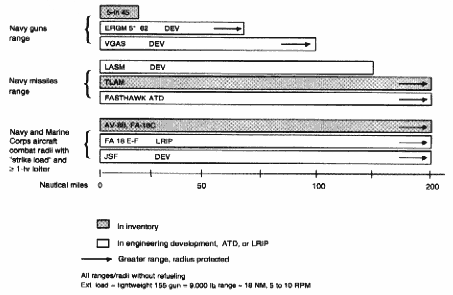
FIGURE 2.2
Ranges and aircraft combat radii relevant to naval fire support for Marines. More detail is given in Appendix B. ERGM, extended-range guided missile; VGAS, vertical gun (advanced) system; LASM, land-attack standard missile; TLAM, Tomahawk land attack missile; JSF, joint strike fighter; ATD, advanced technology demonstration; LRIP, low rate initial production.
in an operation, can use ports or logistics over-the-shore capabilities to land forces, sustain supplies, or reconstitute forces, the logistics task is much simpler than if ships must remain over the horizon.
Operating Distances Ashore
The terms of reference for this study specify landing and sustaining "... dispersed units from the shoreline to 200 miles inland...." With the V-22, the Marines Corps is acquiring a capability to land and sustain forces at that distance or longer. In fact, the operating radii of the V-22 and CH-53 that commonly are used for planning purposes such as those shown in Figure 2.2 do not represent the full reach of the aircraft when possibilities for aerial refueling or return-route refueling are considered.3 How large and what type of force the Marines want to
land and sustain 200 miles inland are not clear, however, and it makes a big difference to the logistics capabilities that naval forces will need to support OMFTS. For example, if only small teams are deployed at very long distances inland, and major units (battalion sized or larger) remain within the 50-mile doctrinal range of today's operations, today's logistics structure and practices might meet much of OMFTS logistics needs. If, however, large mechanized units are to operate 200 miles inland, substantial changes to logistics capability will be needed to support them and to permit rapid force reconstitution.
Transition to Shore-based Logistics
A key feature of OMFTS is that many support functions, such as aviation, command and control, medical services, and logistics, are to be based at sea, presumably aboard amphibious warfare ships, maritime prepositioning ships, and various auxiliary support ships. This will reduce dramatically not only the number of personnel and the amount of equipment that must be landed to support an operation, but also the logistics requirements generated by the forces ashore. Reduced requirements will translate, in turn, into a smaller or reorganized combat service support structure. At least that should be the logical result if the Marine Corps were to tailor its logistics organizations and procedures to a sea based concept of support. If, instead, the Marine Corps must retain its ability to establish a shore-based logistics operation, the combat service support structure needed to maintain such rear area activities as hospitals, fuel dumps, container yards, and maintenance points must be retained. This is a fundamental issue of OMFTS: Is sea basing to be an additional capability of naval expeditionary forces or is it to be a replacement for today's shore-basing capabilities? The answer has implications for the composition of maritime prepositioning assets, the size and organization of the force service support groups, the need for logistics over-the-shore capabilities, and the relationship between the Marine Corps and the Army in providing joint theater logistics capabilities.
OMFTS Concept of Operations Needed
Without definition of these key features of OMFTS—size, locations, and composition of the forces ashore; support-ship standoff distances and support durations; and the degree of dependence on and the location of intermediate bases—the temptation when trying to assess future logistics requirements and options for naval expeditionary forces is to make assumptions that facilitate the analysis, essentially interpreting OMFTS. The risk in such interpretation is that the conclusions then rest on assumptions that may not represent the future capabilities that naval expeditionary forces need to fulfill their role in a national security strategy. In the following chapters, the temptation is resisted to make facilitating assumptions when their impact on logistics requirements seems sub-
stantial. Instead, the committee tries to explore how choices among options are affected by these undefined key features of OMFTS.
In the context of defining the future capabilities and logistics requirements of naval expeditionary forces, however, these issues cannot be left unresolved. Because logistics could be such a major challenge in implementing OMFTS, the time has come for the Navy and Marine Corps to define the desired end states and planning horizons in sufficient detail to enable reasoned and consistent assessment of logistics requirements and capabilities. A defined OMFTS operational concept is needed, a concept that integrates tactical, logistical, and operational considerations. Such a concept should include definite statements regarding the following features: (1) required combat capability, including the size and composition of the tactical and logistical forces ashore; (2) use of naval fire support in relation to organic artillery ashore; (3) characteristics of the sea basing ships, aircraft, and surface craft; (4) sea base standoff distances and duration; (5) operating distances ashore; and (6) use of overseas facilities, staging bases, and resupply points. This concept of operations and common baseline would provide the basis for studies, analyses, war games, and exercises to determine the limits of currently programmed capabilities and the relative costs and values of new investments in meeting future goals. Without such specificity, different interpretations of OMFTS concepts risk underestimating the logistics implications of OMFTS or rationalizing investments that may not be essential.
RECOMMENDATION: The Navy and Marine Corps, using an iterative, strategic planning process, should create an OMFTS concept of operations that integrates tactical and logistical considerations. Key factors to be addressed in defining such a concept should include (1) required combat capability, in terms of the tactical and logistics forces ashore; (2) use of naval fire support; (3) capabilities of the sea basing ships, aircraft, and surface craft; (4) ranges of sea base standoff distances and duration; (5) operating distances ashore; and (6) use of overseas facilities as staging bases and resupply points.


