
4
Force Sustainment
The OMFTS Logistics Challenges
Traditional approaches to logistics will not meet future military requirements. Not only will large logistics bases ashore be unacceptably vulnerable to enemy attack, but their size and immobility will also make them incompatible with the rapidly paced, highly mobile warfighting concepts being developed. Moreover, having large stocks of materials in-theater has proven to be no assurance that the combat forces will get the supplies they need, when they need them. During Operation Desert Shield/Desert Storm, the inability to know what was in those stocks, to locate quickly the items needed, to track the status of requests, or to track shipments into or within the theater frustrated commanders and logisticians alike.
The Navy and Marine Corps are striving to revamp their logistics operations to correct current shortcomings and to meet future requirements. The goal is to replace slow, cumbersome logistics processes that are predicated on large volumes of materials that might be needed, with responsive, or, when possible, anticipatory processes that deliver only what is needed, when and where it is needed. The strategy is to use accurate, timely information and rapid transportation to create for the military the kind of efficient, effective logistics systems that leading commercial firms have developed under the labels of "supply chain management" and "just-in-time" logistics.
The Marine Corps, in particular, under its Precision Logistics program, is streamlining logistics management and business practices, gaining visibility and control of assets, and modernizing computer systems—all desirable actions to improve logistics irrespective of future operating concept. OMFTS, however,
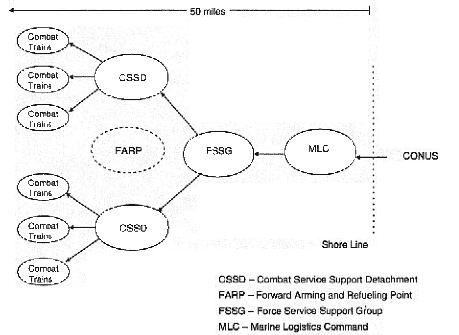
FIGURE 4.1
Principal nodes in today's logistics system.
will make these improvements essential. In addition, OMFTS will impose new demands on the logistics system, and it is to these new demands that the committee addresses its attention.
Figure 4.1 depicts a typical logistics structure for supporting today's Marine Corps operations. Combat units have, in their own combat trains, a capability to meet immediate needs for fuel, ammunition, and other supplies. That capability for most units is modest, consisting of several cargo trucks and trailers and a 1,200-gallon fuel tanker that are usually in a battalion's headquarters and services company. For some units, however, the capability is substantial: for example, in an artillery battalion it includes forklifts and trucks for hauling ammunition; in a tank battalion it includes mobile assault bridging and several fuel tankers.
The combat service support detachment (CSSD) is an ad hoc, mission-tailored organization created from the supply, maintenance, engineering, transport, and medical battalions of a force service support group. It provides the forward logistics support to deployed units. The flexibility inherent in the CSSD concept allows many variations in organizational makeup and employment: large or small, ground- or air-deployed, mobile or stationary.
A forward arming and refueling point, another ad hoc activity, provides limited replenishment of operating supplies, usually for helicopters, well forward in the area of operations. It permits the helicopters to operate for extended periods without returning to a base.
The force service support group (FSSG) is the major logistics organization in a Marine expeditionary force. In addition to being the parent of the elements composing the combat service support detachments, the FSSG is the base for most in-theater logistics activity. When the distances from ports to combat units are long (e.g., over 50 miles), a Marine Logistics Command (MLC) may be added, as depicted in Figure 4.1. An MLC conducts port activities, receives and stores incoming materiel, and provides long-haul land transport to the FSSG.
As with most aspects of its operations, the Marines Corps is adept at tailoring logistics support to the mission at hand, and the basic techniques employed provide a great deal of flexibility. OMFTS, however, suggests that even if the basic techniques may endure, significant changes in emphasis and organization may be needed to support future operations. Figure 4.2 depicts the principal nodes, as seen by the committee, in the OMFTS logistics system. The major differences are a reduction of the logistics presence, or "footprint," ashore; the
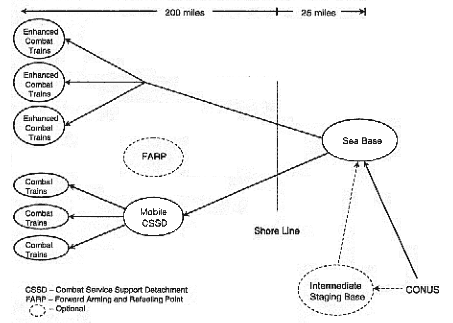
FIGURE 4.2
Principal nodes in OMFTS logistics system.
potential for very long distances between the combat units and their base of logistics support; and the introduction of a sea base. The implications of these differences are difficult to separate, for all aspects of a logistics system are interrelated. Nonetheless, for convenience in discussion, they are addressed in the following three sections.
Reducing the Logistics Footprint
The major determinants of the logistics footprint ashore are the support requirements of the forces ashore and the support concept.
Reducing Forces Ashore
Basing major support functions at sea (or performing them in CONUS or other locations remote from the theater of operations), as envisioned by OMFTS, would be the first and most dramatic step to reducing support requirements ashore. For example, Table 4.1 illustrates how the number of Marines ashore and tons of supplies required per day ashore would change as various elements of a full, prepositioned MEF (FWD) are sea based. Sea basing the air-combat element clearly buys the most reduction in requirements. Putting only the landing force ashore reduces requirements by almost 80 percent.
The landing force in Figure 4.2 is composed primarily of the prepositioned, ground-combat units of an MEF (FWD), with some minimal command and combat service support. Table 4.2 breaks out the landing force's resupply requirements by unit. A quick glance at the bottom row, "Percent," reveals what every Marine Corps logistician knows well: water and fuel are the largest resupply requirements. Water requirements are usually a function of the number of personnel being supported but can vary widely, depending on such factors as the climate, availability of local supplies, and need to decontaminate equipment.
TABLE 4.1 Marine Expeditionary Force (Forward) Daily Resupply Requirements
|
|
Marines Ashore |
Tons Needed |
|
Full MEF (FWD) |
17,800 |
2,235 |
|
MEF (FWD) with aviation at sea |
10,460 |
848 |
|
MEF (FWD) with aviation and command at sea |
9,660 |
785 |
|
Landing force only |
6,800 |
490 |
|
SOURCE: McAllister, Keith R. 1998. MPF 2010 Ship-to-Shore Movement and Sea based Logistics Support, Volume I: Report and Volume II: Appendices, Center for Naval Analyses, Alexandria, Va., March. |
||
TABLE 4.2 Landing Force Daily Resupply Requirements
The largest consumers of fuel among combat forces are the artillery battalion (primarily trucks hauling ammunition), and the AAAV and the tank battalion, together accounting for over half of the landing force's fuel requirements. Although technology may eventually produce more-fuel-efficient power plants for this heavy equipment, the only near-term route to reducing requirements lies in lightening the force. In particular, the Marine Corps should examine carefully the roles of tanks and artillery in future force structure. Logistics requirements of forces ashore would be cut dramatically if the Marine Corps eliminated both, or, in the case of artillery, determined that precision guided rounds and new naval guns and missiles could substitute for artillery enough to reduce conventional artillery ammunition requirements substantially.
RECOMMENDATION: The Marine Corps should assess the roles of main battle tanks and artillery in future force structure, giving particular attention to the impact of precision guided munitions and naval guns and missiles on artillery ammunition requirements.
|
Fuel Requirement (Short Tons) |
Ammunition Requirement (Short Tons) |
Other Cargo* (Short Tons) |
Total |
Percent |
|
15.90 |
0.53 |
1.42 |
28.84 |
5.9 |
|
152.23 |
32.07 |
22.21 |
377.90 |
77.1 |
|
8.96 |
0.20 |
0.62 |
14.54 |
3.0 |
|
6.53 |
3.76 |
11.67 |
112.05 |
22.9 |
|
54.13 |
20.19 |
3.26 |
102.71 |
21.0 |
|
25.86 |
2.28 |
2.03 |
45.86 |
9.4 |
|
16.25 |
2.50 |
0.87 |
26.36 |
5.4 |
|
2.59 |
1.44 |
0.54 |
8.72 |
1.8 |
|
37.91 |
1.71 |
3.22 |
67.66 |
13.8 |
|
56.87 |
0.88 |
2.91 |
83.15 |
17.0 |
|
0.71 |
0.10 |
0.35 |
3.84 |
0.8 |
|
10.67 |
0.23 |
1.40 |
23.13 |
4.7 |
|
45.50 |
0.55 |
1.16 |
56.19 |
11.5 |
|
225.01 |
33.48 |
26.54 |
489.89 |
100.0 |
|
45.90 |
6.80 |
5.40 |
|
100.0 |
|
SOURCE: Adapted from McAllister, Keith R. 1998. MPF 2010 Ship-to-Shore Movement and Sea based Logistics Support, Volume I: Report and Volume II: Appendices, Center for Naval Analyses, Alexandria, Va., March. |
||||
Designing the Support Concept
In Table 4.1, the second largest reduction, signified by the differences between the last two rows (from 9,660 personnel to 6,800 and from 785 short tons to 490) is attributable to leaving most of the combat service support element at sea. The extent to which that is feasible depends in large measure on the support concept.
The new warfighting concepts and the emphasis placed on minimizing the logistics footprint ashore suggest that the OMFTS theater logistics system should be based to the extent possible on two primary nodes—the sea base and the combat forces ashore. Several variations on this theme are possible. Although all are used from time to time by the Marines Corps today, they should become more prevalent under OMFTS.
- Direct unit delivery. Direct air delivery from the ships in the sea base to combat units ashore significantly reduces the need for disembarking considerable numbers of combat service support personnel and equipment. This concept inherently requires intensive use of air assets such as the V-22 and CH-53E, but
- other means such as air drop, parafoil, and unmanned air vehicles could also prove to be indispensable, particularly for resupply of small, light infantry units.
-
Enhanced combat trains. Combat units typically can sustain themselves for a few days without support from a combat service support detachment. Giving a combat unit the capability to sustain itself longer, by either enlarging its organic logistics capabilities or by assigning combat service support elements in a direct support role, could eliminate the need for a separate combat service support detachment. An enhanced combat train could provide a greater safety margin, for example, by having enough trucks and trailers to carry about 5 to 10 days of supplies for the unit instead of just 2 to 3 days. It could also be resupplied directly from the sea base and move with the combat element.
Although enhanced combat trains could provide a greater margin for safety, they could result in a larger logistics footprint than is deemed advisable in a combat unit. Their projected pros and cons would have to be balanced against those associated with employing traditional techniques and the use of mobile but separate combat service support detachments located in close proximity to the supported unit(s).
-
Forward arming and refueling points (FARPs). The primary needs of a combat unit on the move are fuel and ammunition. A highly mobile, arming and refueling capability that could rendezvous with a combat unit, refuel and rearm it, provide other quick services, and then leave would potentially be invaluable because it could enable the fighting forces of the future to have smaller combat trains and to resume operations with minimal delay.
If designed for rapid insertion, setup, breakdown, and removal, FARPs could provide essential support services and enough fuel, ammunition, and other supplies to sustain operations for a short period of time, say 2 to 3 days. The temporary positioning of such detachments by either watercraft or air for a few hours at most would reduce their vulnerability to enemy attack. The tactical bulk fuel delivery systems that can be inserted in the CH-53E are designed specifically for such missions.
- Mobile combat service support detachment. Under a sea based logistics concept, combat service support detachments are likely to be the major logistics footprint ashore. To support the highly mobile, widely dispersed operations and long ranges envisioned by OMFTS, they frequently will have to be mobile. That is, they will deploy rapidly, set up service units in their areas for one to several days, be quickly dismantled, and be moved to new locations. Their modes of deployment, distribution to supported units, and resupply will be tailored to the mission and circumstances. For example, a mobile combat service support detachment might move inland via road as part of a maneuvering task force, and then be resupplied by rotary-wing aircraft from the sea base. Or such a detachment might be established near the shore, where it could be deployed and resupplied by surface craft, or at an airfield, possibly an expeditionary airfield, where it could be deployed and resupplied by intratheater airlift. Distribution of sup-
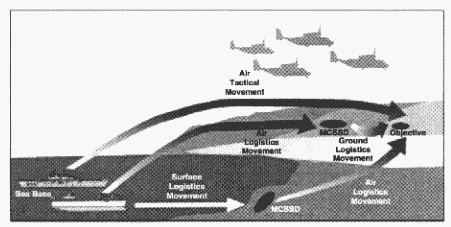
FIGURE 4.3
Mobile combat service support detachments (MCSSDs).
- plies and services from the mobile combat service support detachment to supported units might be by either air or truck, depending on distances and terrain. In all cases, the need will be to minimize the vulnerability of the detachments by keeping them small, dispersed, well camouflaged, and secure from enemy attack, but, at the same time, providing sufficient hedge against the risks created by relying on an at-sea logistics base many miles away. An example of possible uses of such mobile combat service support detachments is depicted in Figure 4.3. The example shows two mobile detachments. One is near the shore, where it can be deployed and resupplied by surface craft. The other is well inland, where it is deployed and resupplied by air.
Packaging and Containerization
An important issue in deciding future support concepts is the role of containers. The general principal in streamlining logistics operations is to minimize the handling of material. The ideal is to package at the origin for end use and deliver directly to users without any repackaging.
To facilitate such origin-to-destination movements of material, industry has developed a highly efficient, worldwide transport system for moving cargo in standard containers. The standard unit of measure is 20-foot equivalent unit (TEU), meaning an 8 ft x 8 ft x 20 ft container, but the industry trend is to 40-ft containers. The system is intermodal, permitting the containers to be moved, without reconfiguration, via truck, railcar, and ship. The advantages of using standardized containers are many: security of contents, protection from the elements, efficiency in handling, and efficiency in movement.
Both the Marine Corps and the Army are developing capabilities to make
greater use of containers in supporting their forces. The Marine Corps maritime prepositioning force, except for rolling stock, is largely containerized, and Marines have the capability to off-load and move the containers either at ports or over the shore. The motivation for using containers has been, in part, to gain the same efficiencies in handling and moving cargo that industry has enjoyed; in addition, the break-bulk ships traditionally used to transport most military material overseas have largely disappeared from commercial service, and container ships are dominating commercial trade.
The dilemma the Marine Corps will face in supporting OMFTS is that while extensive use of containers is essential to efficient support of heavy forces, their use requires a substantial footprint ashore (capabilities for moving them ashore, handling and transporting them, and breaking out their contents for delivery to using units). Moreover, fully loaded 20-ft containers are too heavy to be moved by the V-22 and can be moved only short distances by the CH-53 (40-ft containers are difficult for the Marine Corps to transport and handle by any means). Thus, OMFTS operations probably will dictate that containers be used no further forward than the sea base and that material be repackaged, if necessary, for end use by logistics personnel on board ships. However, if the Marine Corps intends to maintain capabilities to make a transition from sea based logistics to conventional land-based logistics, and then reverse the process for force reconstitution, container-handling and transport assets must remain in the force.
Designing the support concept or concepts that best fit the needs of future logistics operations is not a trivial task. It involves assessing not just logistics requirements and capabilities, but also the costs and risks of each alternative. Since the number of variables is large and the cost of experimenting much with real units the size of an MEF (FWD) would be prohibitive, this type of analysis is best done by modeling and simulation. The committee believes that the potential logistics implications of OMFTS justify the use of such analytic tools.
RECOMMENDATION: The Marine Corps should invest in modeling and simulating OMFTS logistics operations to assess logistics needs, capabilities, and alternative support concepts.
Providing Support Over Extended Distances
If battles of the future are fought as the conceptual designers of OMFTS envision, highly mobile combat units will be widely dispersed, possibly well inland, focusing only on key objectives with high military value; they will not be clearing and securing the areas through which or over which they move en route to their objectives. In some relatively benign situations, establishing traditional land lines of communication, i.e., moving sustaining supplies, equipment, and services by truck convoy, still will be possible. However, having the capability to sustain and reconstitute the combat forces over very long distances without dependence on secure road networks and rear areas seems fundamental to the
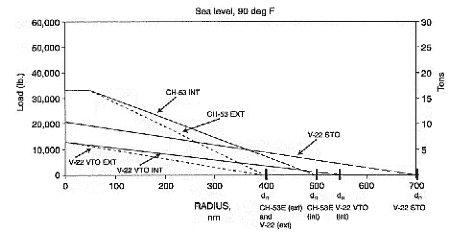
FIGURE 4.4
Performance of some existing transport aircraft. Fuel usage rate is constant, regardless of speed, load, or flying conditions. NOTE: External loads are notional. Ranges vary for different external loads.
OMFTS operating concepts. That means a much greater reliance on air transport than has been the practice for Marine Corps ground-force logistics.
With procurement of the V-22 and extension of the life of the CH-53E, the Marine Corp is gaining the capability to move substantial quantities of material by air. Figure 4.4 shows the approximate relationships between payload and range for the aircraft, with either internal or external loads.1 As can be seen from Figure 4.4, both the V-22 and CH-53E aircraft extend the reach of a landing force far beyond the shore, and, with aerial refueling, both can reach even further with internal loads than shown here. The maximum payloads, however, decrease with distance, especially for external loads. If the effect of distance on flying time is combined with its effect on maximum load, its effect on productivity (the tons of material that can be transported in a day) is dramatic. This decline in aircraft delivery productivity as a function of distance is depicted in Figure 4.5. For example, an aircraft could deliver 10 times as much at 10 percent of the aircraft's maximum no-load radius as it could at 50 percent of the radius. The issues are whether those two aircraft can meet the needs of the types and sizes of forces envisioned over the distances envisioned and, if not, what alternatives the Marine Corps should explore.
The CNA study, in an analytic excursion, sought to gauge the outer limits of the V-22 and CH-53E in supporting the ground-combat element of today's pre-
|
1 |
See Appendix D for derivation of payload-distance and productivity relationships. |
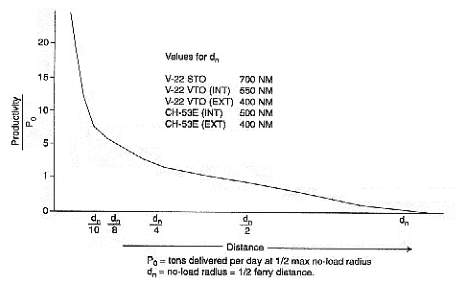
FIGURE 4.5
Aircraft transport productivity as a function of distance.
positioned MEF (FWD), a force of about 7,000 Marines ashore. The finding was 175 nautical miles from the sea base, assuming the numbers of V-22s and CH-53Es normally associated with that size MAGTF and no other missions for the aircraft.2
The committee's own rough assessment, drawing largely on CNA's data, is depicted in Table 4.3. It, too, shows that a large, heavy force will be difficult to support entirely by air over long distances even when the force's entire complement of V-22s and CH-53Es is devoted to logistics missions. In fact, because the committee's analyses assumed ideal conditions—fair weather, calm seas, no enemy interdiction of air routes, a continuous 10 hours of operations per day, 100 percent aircraft availability, and direct routing—the break point is probably well under 125 miles.3 Similar limitations are expected to affect force reconstitution. Reducing the ground-combat element's fuel and ammunition requirements would be one approach to bringing air transport needs and capabilities into better balance. Long-term research and development should be focused on that goal. But, for the foreseeable future, reductions in fuel and ammunition
TABLE 4.3 Percent of Resupply Requirements Met by Air Deliveries (7,000-Marine Landing Force Using All Planned V-22 and CH-53 Aircraft)
|
Portion of Force Supported |
250 Miles |
125 Miles |
55 Miles |
|
Full MEF (FWD) |
15 percent |
34 percent |
55 percent |
|
MEF (FWD) less ACE |
40 percent |
89 percent |
100 percent |
|
MEF (FWD) less ACE and CE |
43 percent |
96 percent |
100 percent |
|
Landing force only |
69 percent |
100 percent |
100 percent |
|
NOTE: See Appendix C for data and computations. MEF (FWD), Marine expeditionary unit (forward); ACE, air combat element; CE, combat element. SOURCE: Adapted from Appendix C, Table C.1, McAllister, Keith R. 1998. MPF 2010 Ship-to-Shore Movement and Sea based Logistics Support, Volume I: Report and Volume II: Appendices, Center for Naval Analyses, Alexandria, Va., March, and Tables C.2 and C.3 by David Kassing, committee member. |
|||
requirements, as already suggested, probably require changes in the structure of the combat force.
If the OMFTS concept is to be implemented with large, mechanized task forces operating long distances inland, additional air transport capabilities will be needed. Several alternatives are possible: more V-22s and CH-53s; reliance on intratheater airlift; development of a new-design, ship-capable, fixed-wing STOL transport; or development of a new-design, longer-range, heavy-lift helicopter.
- More V-22s and CH-53Es. More means either buying additional aircraft or committing a larger proportion of planned purchases to sustainment needs. In either case, sufficient ships for basing the aircraft would need to be factored into the equation.
- Intratheater airlift. C-17 and C-130 aircraft provide the joint intratheater airlift capabilities available to naval forces. The Marines should be prepared by organizational structure and training to fully exploit these capabilities. The issue here, however, is the extent to which naval expeditionary warfare doctrine and capabilities should depend on joint capabilities. Furthermore, if support of large forces well inland requires use of intratheater airlift, then an airfield or suitable terrain for rapid creation of a suitable airstrip must be an early planning objective in operational planning, and lack of such an airfield or suitable terrain will constrain the type of operations that can be supported.
- Heavy-lift helicopter. Although the CH-53 can lift heavy loads, its capability drops off quickly with distance. A new, heavy-lift helicopter—perhaps a crane-type design—could provide the heavy-lift capability at longer ranges, say 15 to 20 tons at an operating radius of 250 miles.
- STOL transport. If the Navy and Marine Corps determine that a ship-to-shore aircraft capability is required to support large forces well inland, they should consider developing a new-design, ship-capable, fixed-wing STOL aircraft for that purpose. Such a decision carries with it complementary decisions and costs associated with having an at-sea basing capability for the aircraft (aircraft carrier, amphibious assault ship, mobile offshore base, or a sea based logistics ship) and a capability to rapidly create suitable airstrips ashore. The Army also has an interest in such an aircraft and should be offered the opportunity to collaborate on the design.
Deciding the alternatives to be examined and the limits to sustaining ground-combat elements by air transport means is critically important to refining the OMFTS conceptual framework. Gaining insight into the size and type of forces that can be supported over long distances and the conditions under which they can be supported with an acceptable level of risk must receive priority effort. Appendix D shows a committee member's approach to quantifying the logistics productivity of aircraft in terms of an aircraft's design features, assumed performance, and distance. Using such an analytical aid could help in making initial assessments.
It is important to note also that OMFTS will likely require a much greater allocation of available air assets for logistics missions than has been the case in the past. Not only will logistics be an integral part of maneuver operations, but the support concept for a task force, including command and control, will also need to be fully integrated with aviation support planning and air mission tasking.
RECOMMENDATION: The Marine Corps should examine the capabilities and limitations of various options for delivering by means of air transport the sustaining support required by large ground forces over various operating distances from the sea base. The Marine Corps should adjust the evolution of OMFTS concepts, maneuver force design, and aircraft and shipbuilding programs to ensure that operational and logistics capabilities are appropriately sized and balanced.
RECOMMENDATION: The Navy and Marine Corps should determine the technical feasibility, costs, and operational value of a ship-capable, fixed-wing STOL transport aircraft and a complementary, fixed-wing-capable logistics ship that could substantially increase the naval forces' capability to support large ground units long distances from a sea base.
Supporting Forces From a Sea Base
Sea basing requires doing at sea, often under severe weather and sea-state conditions, many of the functions traditionally performed at logistics bases on shore (or transferring the function out of theater). This has implications for
organizational design, shipboard distribution operations, integration of sustainment efforts, and strategic resupply.
Organizational Design
While the Marine Corps is adept at tailoring organizations to meet mission needs, the standard organizational structures are designed for operations ashore. Simply adapting those organizations to operations at sea may not be the optimal solution. For example, while standard organizations might adapt well to operations aboard a mobile offshore base, which houses all activities in a central location, spreading those same activities among a number of ships of different types may call for different specialization and division of labor.
In addition, under new Department of Defense policy, many of the product support responsibilities for military equipment are to be performed by contractors. To facilitate effective support of their products, these contractors may need to establish forward operations at an intermediate support base near the theater or, possibly, on ships composing the sea base. This is a matter the Navy and Marine Corps should think through carefully, for using civilians in this matter would have cost, legal, and labor union implications. Nonetheless, civilians may be able to do on ships many of the logistics functions normally done by rear-area military personnel. For example, the warehousing functions of receiving, breaking out, and repackaging supplies for distribution to forces ashore, as well as much of the equipment maintenance, could be done by civilians. Since civil mariners of the Military Sealift Command are likely to be operating many of the ships of the sea base, having other civilians on board performing support functions for the Marines would not be discordant.
Shipboard Distribution Operations
Sustaining OMFTS operations from a sea base will require the ability to rapidly locate, select, package, and deliver supplies to units ashore. These are the traditional functions of a distribution center—pick, pack, and ship—but performed in an at-sea shipboard environment.
Selective off-loading will involve unpacking cargo from containers (with single or mixed loads), repackaging it, and moving the newly packaged cargo from below decks to elevators to the staging area on the flight deck for air transport. Industry-based automated warehousing is done daily on land, but doing it in the confined spaces aboard a ship that has continuous, random motion due to the seaway while cargo is being extracted from containers is a major challenge. Severe weather and rough seas could slow or halt operations. Creating a capability to conduct efficient, effective shipboard distribution operations will require an integrated effort between industries involved in warehousing,
shipbuilding, ship dynamics, crane and deck machinery stabilization, and information systems.
Integrating the Sustainment Effort
One of the central defining features of the new OMFTS conceptual framework is the requirement to deliver tailored loads from the sea base to highly mobile, widely dispersed comat elements in the battlespace. Achieving the OMFTS goal will require the skillful integration of a multitude of diverse activities. Moreover, the scope and complexity of the sustainability integration task under OMFTS is likely to increase exponentially with increases in both (1) the size and dispersion of the forces ashore and (2) the separation distances between them and the sea base.
Today's sustainment operations include a large beach-support area and several layers of stocks ashore, and they rely predominantly on truck convoys. Under the OMFTS framework, once a unit's needs ashore are identified or projected, crews afloat must assemble, possibly from several different ships, a tailored load for delivery to the unit. To facilitate responsiveness and promote better use of available delivery means, pickup times, delivery routes, and mission completion times will have to be preplanned and integrated into the overall operation, particularly along the delivery route to the unit and its immediate area of operations. Reconstitution of forces will pose similar challenges. Moreover, if the threat ashore warrants, V-22 and CH-53 logistics flights may have to be accompanied by suitably armed escorts, further complicating the overall integration effort.
The Marine Corps has given little attention to the information systems needed to control and integrate combat service support activities in the sea based OMFTS environment. Today's bootstrap efforts in operating units to create logistics command-and-control systems are well motivated and creative but have limited resources, use today's communications and computer capabilities, and are focused on today's modes of operation.
RECOMMENDATION: The Marine Corps should start developing the logistics information systems, displays, and automated decision aids it will need to manage fast-paced, complex support operations in tomorrow's warfighting environment.
Resupplying Ships of the Sea Base
If definite sustainment from a sea base is to be attained, resupply of the sea base will be necessary. Unless the sea base includes a mobile offshore base, which by its design is capable of handling strategic airlift and sealift craft, all options have their limitations. The following discussion assumes that the sea
base is composed of ships, e.g., amphibious warfare ships, maritime prepositioning ships, and various auxiliary support ships.
Consider, first, resupply of small, high-priority items, such as spare parts. The movement of such items from CONUS overseas usually will be by strategic airlift. So, how best to link the sea base to arrival airfields is an important issue. A carrier battle group makes that link with its carrier on-board delivery aircraft or, over short distances, helicopters. Some limited resupply of the sea base could be done using the carrier on-board delivery capabilities of the carrier battle group, but probably not much resupply would be possible because the capabilities of those aircraft are consumed supporting the carrier's needs. Most likely, the Marines would use their own CH-53Es and V-22—another mission for those two overworked assets. At long distances, aerial refueling would be needed.
Resupply of fuel, although the toughest problem for forces ashore, is probably the easiest of the tasks at sea. Ships of the sea base would be resupplied with fuel for both their own use and for use by the Marines the same ways ships normally are resupplied: either in port or by underway replenishment.
Replenishing the sea base with dry cargo (ammunition, equipment, and supplies) will be the most difficult task. In the future, most dry cargo will be moved to the theater of operations by container ships. Transferring the containers or their contents to ships of the sea base is a critical link in the sea basing concept. Several options exist:
- Transfer of containers at an intermediate staging base. The simplest approach would be to transfer containers at a port that has container-handling capabilities. However, the ship to be resupplied would have to leave its station, temporarily quitting its mission as part of the sea base, and proceed to the port for the cargo. At best, the process would take several days, probably longer.
- Direct transfer of containers at anchorage. Containers could be transferred directly from a container ship to a sea base ship using either the cranes of the sea base ship or an auxiliary cranes ship. Today, such transfers would have to take place in calm waters, at sea state 2 or less. Research on crane technology is seeking to develop stabilized cranes that could make such transfers at sea state 3 or possibly higher.4 In either case, of course, the specific containers to be transferred would have to be readily accessible on the container ship, on the deck, or on the first or second layer, but not in the holds.
- Container shuttle. If a shuttle ship, designed to handle and transport containers, had a well or other feature for interfacing with landing craft, containers could be loaded on the shuttle ship at an intermediate staging base, shuttled
- to the sea base, and then transferred to ships of the sea base using surface craft, such as the LCAC or other landing craft. Such a ship could be stationed initially as part of the MPF and then could serve as a shuttle as other ships of the sea base need replenishment.
- Conventional underway replenishment. The Navy for years has used underway replenishment techniques to sustain its ships at sea. Shuttle ships move pallets of cargo from overseas supply points to the ships and transfer the pallets by both vertical replenishment, using helicopters, and alongside replenishment. The ships of the sea base could be resupplied with Marine Corps material using the same techniques. Containers would first be moved to an intermediate staging base, off-loaded, and emptied of their pallet loads, and the pallets would then be shuttled to the sea base.
- Underway transfer of containers. This option is not feasible with today's equipment. However, preliminary calculations done by engineers at the Port Hueneme Division, Naval Surface Warfare Center, California, indicate that transferring 20-ft containers by alongside underway replenishment techniques is not out of the question.5 Greater high-line tensions and hauling-winch differentials would be needed, but, from an engineering standpoint, it could be done. (Theoretically, even 40-ft containers could be transferred, but that is an even greater step from today's capabilities. Of course, container-handling capabilities would have to be resident in both the shuttle and receiving ships. Force reconstitution, again, will have similar requirements.
Like other logistics problems related to OMFTS, deciding how best to resupply the sea base (other than a mobile offshore base) is not a straightforward matter. Much depends on the makeup of the sea base, but also on whether overseas ports are available and on how Navy logistics assets are used. Clearly, this is not an issue for the Marine Corps alone.
RECOMMENDATION: The Navy and Marine Corps should work together to craft a common approach to the resupply of all naval forces at sea.
Total Logistics Concept
In summary, some of the important issues that must be addressed in redesigning the logistics system to sustain forces ashore are reducing prepositioning, deployment, and resupply requirements through redesign of the forces ashore; shifting the support concept to two primary nodes (unit and sea base); shifting the emphasis from truck transport to air transport; building the information capabilities to effectively integrate sustainment operations; resupplying the sea base;
and reconstituting the force. These issues, however, must not be approached or resolved piecemeal. They must be addressed in the context of a systems concept of combat service support for future expeditionary operations.
Such a concept, which does not yet exist, is needed both to guide assessment of organizational, procedural, and equipment needs and to influence, in an interactive, integrated, strategic planning process, the design of the operating concept. Both the Navy and the Marine Corps must participate in creating this support concept, and it should span the full set of combat service support functions, reaching from the Marine at the outer edge of the battlespace back to the CONUS sustaining base.
RECOMMENDATION: The Navy and Marine Corps should create an end-to-end OMFTS logistics concept that supports the concept of operations at each stage in the iterative process of defining future forces and their capabilities.


