NOTICE: The project that is the subject of this report was approved by the Governing Board of the National Research Council, whose members are drawn from the councils of the National Academy of Sciences, the National Academy of Engineering, and the Institute of Medicine. The members of the committee responsible for the report were chosen for their special competence and with regard for appropriate balance.
This report was prepared by the Committee on Knowledge Assessment. Support for the project and for this report came from the Knowledge Economy Partnership of Prince Edward Island, Canada. The report has been reviewed by a group other than the authors according to procedures approved by a Report Review Committee consisting of members of the National Academy of Sciences, the National Academy of Engineering, and the Institute of Medicine. Any opinions, findings, conclusions, or recommendations expressed in this publication are those of the author(s) and do not necessarily reflect the view of the organizations or agencies that provided support for the project.
A limited number of copies of this report are available from:
Office of International Affairs
National Research Council
2101 Constitution Avenue, NW
Washington, DC 20418
Additional copies are available for sale from:
National Academy Press
2101 Constitution Avenue, NW Lockbox 285 Washington, DC 20055 1-800-624-6242 (202) 334-3313 (in the Washington metropolitan area) www.nap.edu
ISBN 0-309-06435-X
Copyright 1999 by the National Academy of Sciences. All rights reserved.
Printed in the United States of America.
COMMITTEE ON KNOWLEDGE ASSESSMENT
EDWARD E. DAVID, JR., Chairman,
The Advisory Group
CHRISTOPHER ANDREW,
University of Florida
JENNIFER S. BOND,
National Science Foundation
HARVEY BROOKS,
Harvard University (retired)
GEORGE BUGLIARELLO
Polytechnic University
DAVID GODFREY,
Manufacturing Resources Inc.
GEOFFREY OLDHAM,
Sussex University (retired)
LAURENCE SEIFERT,
AT&T Wireless Communications
JOSE WARMAN, CETEI,
Mexico
CHARLES E. VELA,
Illinois Institute of Technology Research Institute
DIANE WETHERINGTON,
The Cobalt Group
Staff
MICHAEL GREENE, Project Director
Special Advisors
DAVID BODDE
University of Missouri
JAMIE CHAPMAN,
OEM Development Corporation
CHRISTOPHER DEEPHOUSE,
CyberCash Inc.
JOHN R. DOBRINSKY,
Agricultural Research Service, USDA
MICHAEL McD. DOW,
Chevy Chase, Maryland
ANDREW KRUSE,
Southwest Wind Power
DAVID MEEKER,
Ohio State University
DOUGLAS PEREDNIA,
National Association of Telemedicine Providers
RAY PARISER,
Marine Polymer Technologies Inc.
PHYLLIS REUTHER,
Carnegie Mellon University
PAMELA WHITTEN,
University of Kansas Medical Center
EXECUTIVE BOARD OFFICE OF INTERNATIONAL AFFAIRS
F. SHERWOOD ROWLAND, Foreign Secretary,
National Academy of Sciences
HAROLD K. FORSEN, Foreign Secretary,
National Academy of Engineering
DAVID CHALLONER, Foreign Secretary,
Institute of Medicine
JOHN BORIGHT, Executive Director,
Office of International Affairs
Note from the Chairman
This report represents the first experience with National Knowledge Assessment, a method developed in 1996 by a committee of the National Research Council at the request of the World Bank. It is intended to explore a country's potential for adopting and using technology to find a niche in the global marketplace. It was designed for developing countries, and has as its model the small number of countries in Asia and Latin America that, until recently, have lifted themselves from the ranks of the have-nots by employing knowledge and creating knowledge-based enterprises. The problems that many of them have encountered in past months in no way diminishes the role that knowledge will continue to play in the world economy.
The method itself, called knowledge assessment after a remark of World Bank vice president Jean-François Rischard, is an unusual one, both for the Bank and the NRC. Instead of gathering facts by the concentrated efforts of economists and other scholars and drawing conclusions from them in well-appointed conference rooms, the effort is taken into the field, and the inputs come from the country's stakeholders, the businessmen and women, scientists, engineers, and producers who know very well what their problems are and where their systems fall short. The knowledge assessment provides a forum for them, a role-playing exercise that allows them to find solutions for themselves through strategic questioning by a handful of foreign experts in business and technology.
It was recognized by the committee at the outset that such an unusual procedure as this one required a pilot project trial before the National Research Council and its authors would comfortably stand behind it as a useful tool for development planning. For this reason the NRC publication is called Prospectus for Na-
tional Knowledge Assessment, the word prospectus conveying our lack of certainty and commitment. We set about to find a country willing to collaborate with us in the first trial, but before we succeeded, technology itself intervened. A consultant to the Institute of Island Studies in Prince Edward Island found an account of the method on the World-wide Web and set in motion the train of events that led to the present report.
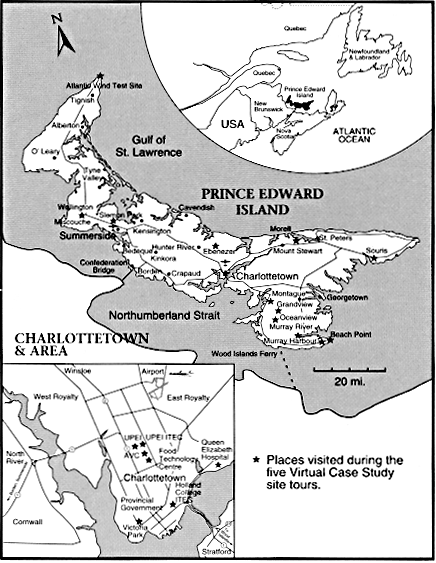
Prince Edward Island was not our original idea of a test site. For one thing it is not a developing country, nor for that matter even a country. It is the smallest province of Canada, our quite highly developed neighbor. But some of its problems are exactly the sort that the knowledge assessment method was designed to explore—stagnant primary sectors, brain drain, and economy dependent on transfers from away. Further, it promised a highly exacting and demanding test. The participants in the working meetings would be as sophisticated and qualified as any we were expecting to encounter in the Third World. The process was taken extremely seriously; the costs were borne by a consortium of government, private sector, and university, all of whom had practical, but not coinciding, interest in the findings and recommendations. And lastly, there was no international development bank waiting in the wings to shower everyone with projects to correct the weaknesses identified. If PEI takes action to implement some of our recommendations, it will be with their own money, and that, we are sure, will evoke the most demanding critical and well-considered judgments.
We offer our thanks to the Institute of Island Studies of the University of Prince Edward Island, to the Provincial Government, and to all those who worked with our teams to produce this report. Our NRC volunteer experts have enjoyed the experience, and we believe that the PEI participants have also found it productive. Further evidence is the apparent emergence of embryonic enterprises as a direct result of some of the activities. We have learned a great deal about our method, and I feel that knowledge assessment is now in a position to be applied in other appropriate venues with diverse development status and needs. We have also learned much about Prince Edward Island, and the collaboration has been a pleasure.
Acknowledgment
The Committee is grateful to the many individuals who made substantive and productive contributions to this project. Particular thanks are due to the colleagues at the Institute of Island Studies whose commitment to this project was firm and infectious. Special praise is due to the leadership and historical perspective contributed by Harry Baglole, the logistical genius of Nancy Murphy, and editing skills of Ed MacDonald. Special mention must be reserved for Wendy MacDonald, whose research contributions and perceptive advice on key issues were invaluable to the knowledge assessment team. We would also like to thank Verna Bruce for her initial interest and support for the notion of doing a knowledge assessment in Prince Edward Island, and Gary Stairs for finding us on the World-wide Web and setting the whole enterprise in motion. Finally, the committee would like to thank all the participants in the focus groups and the virtual case studies for playing their roles in a most convincing manner and providing most of the knowledge that went into this report.
The National Academy of Sciences is a private, nonprofit, self-perpetuating society of distinguished scholars engaged in scientific and engineering research, dedicated to the furtherance of science and technology and to their use for the general welfare. Upon the authority of the charter granted to it by the Congress and signed by Abraham Lincoln in 1863, the Academy has a mandate that requires it to advise the federal government on scientific and technical matters. Dr. Bruce M. Alberts is president of the National Academy of Sciences.
The National Academy of Engineering was established in 1964, under the charter of the National Academy of Sciences, as a parallel organization of outstanding engineers. It is autonomous in its administration and in the selection of its members, sharing with the National Academy of Sciences the responsibility for advising the federal government. The National Academy of Engineering also sponsors engineering programs aimed at meeting national needs, encourages education and research, and recognizes the superior achievements of engineers. Dr. William A. Wulf is president of the National Academy of Engineering.
The Institute of Medicine was established in 1970 by the National Academy of Sciences to secure the services of eminent members of appropriate professions in the examination of policy matters pertaining to the health of the public. The Institute acts under the responsibility given to the National Academy of Sciences by its congressional charter to be an adviser to the federal government and, upon its own initiative, to identify issues of medical care, research, and education. Dr. Kenneth I. Shine is president of the Institute of Medicine.
The National Research Council was organized by the National Academy of Sciences in 1916 to associate the broad community of science and technology with the Academy's purposes of furthering knowledge and advising the federal government. Functioning in accordance with general policies determined by the Academy, the Council has become the principal operating agency of both the National Academy of Sciences and the National Academy of Engineering in providing services to the government, the public, and the scientific and engineering communities. The Council is administered jointly by both Academies and the Institute of Medicine. Dr. Bruce M. Alberts and Dr. William A. Wulf are chairman and vice chairman, respectively, of the National Research Council.
The Office of International Affairs (OIA) is concerned with the development of international and national policies to promote more effective application of science and technology to economic and social problems facing both industrialized and developing countries. OIA participates in international cooperative activities, engages in joint studies and projects with counterpart organizations, manages scientific exchange programs, and represents the Academy complex at many national and international meetings directed toward facilitating international cooperation in science and engineering. Dr. F. Sherwood Rowland, Dr. Harold Forsen, and Dr. David Challoner are the foreign secretaries of the National Academy of Sciences, National Academy of Engineering, and Institute of Medicine, respectively.
| This page in the original is blank. |