


Below is the uncorrected machine-read text of this chapter, intended to provide our own search engines and external engines with highly rich, chapter-representative searchable text of each book. Because it is UNCORRECTED material, please consider the following text as a useful but insufficient proxy for the authoritative book pages.
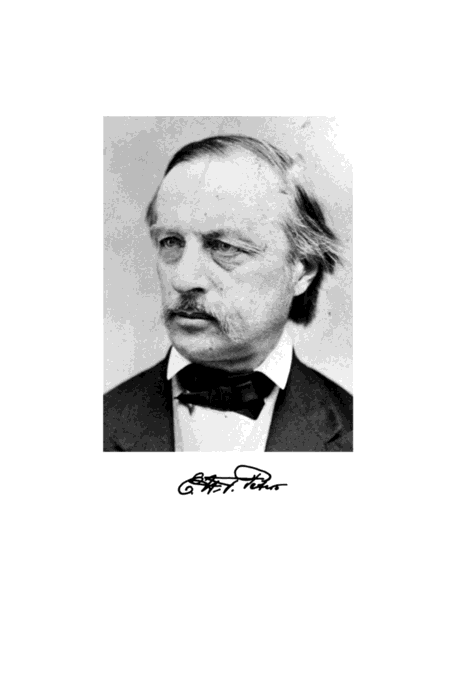
CHRISTIAN HEINRICH FRIEDRICH PETERS September 19, 1813-July 18, 1890 BY WILLIAM SHEEHAN IN THE MID-NINETEENTH century the discovery of new aster- oicis was still far from routine. These objects hac! not yet grown so numerous as to earn for themselves the contemp- tuous label later appliecI, "vermin of the skies," en c! those who excellec! in claiming the starlike wanderers from the camouflage of background! stars were honoree! with renown. Hind, cle Gasparis, GoIcischmicit, Chacornac, Pogson, en c! Peters were foremost among the early discoverers. Even on this short list C. H. F. Peters stool! out. On May 29, IS61 just weeks after the American Civil War began at Fort Sumter Peters cliscoverec! his first aster- oic! (72 Feronia). It was the fifth asteroic! cliscoverec! in North America (others hac! been fount! by Ferguson en c! SearIe). Feronia was the first of forty-eight such discoveries that macle Peters the most prolific fincler of minor planets of his generation, en c! even tociay he remains seconc! only to Johann Palisa among visual discoverers of asteroids. Dur- ing his colorful career, he also compiler! meticulous star charts of the zodiac, colIatec! observations from manuscripts of Ptolemy, en c! embroilec! himself in a series of often bitter controversies with other astronomers, notably over the ex- istence of an intra-Mercurial planet. 289
290 BIOGRAPHICAL MEMOIRS EARLY CAREER The son of a clergyman, Peters was born on September ~9, ~ 813, at Coldenbutte! in Schieswig (then a duchy of the Danish crown, now part of SchIeswig-Holstein, Germany). He stucliec! mathematics en c! astronomy uncler I. F. Encke at the University of Berlin, en c! receiver! his doctorate at twenty-three. After unsuccessfully applying for work at the Copenhagen Observatory, he went to Gottingen, famous for its association with the mathematician Car! Friedrich Gauss. As a very young man, Gauss hac! clevisec! methods for calculating the orbits of asteroids from observations cov- ering only short arcs of their apparent motion, methods first applier! to the recovery of the asteroic! Ceres serenclipitously cliscoverec! by a Sicilian priest, Guiseppe Piazzi, at PaTermo on January I, IS01. Piazzi's discovery wouic! prove to be one of the great achievements of the century: Ceres was the first of the horcle of small planets cliscoverec! between Mars en c! Jupiter. Young Peters pursued his studies under Gauss, but his chief association at Gottingen was with a young geologist, Sartorius von Walterhausen, with whom he traveler! to Sic- ily. There he en c! Walterhausen commencec! a cletailec! ex- ploration of Etna, the famous Sicilian volcano. They also lair! out a meridian line in the great church of St. Nicolo I'Arena it is very artistic, with mythological figures of the zocliacal constellations clepictec! in rec! stone. As a result of these efforts, Peters was asker! to take charge of a new observatory then being planner! in Sicily. The observatory, however, received no support from the Bour- bon government in the end, it was not actually establisher! until IS79, when the observatory on Etna was built. In . steacI, Peters went to work for the Geodetic Survey of Sicily. At the same time he became a regular observer at the ob- servatory of Capodimonte, Naples, and used its 3 I/2-inch
CHRISTIAN HEINRICH FRIEDRICH PETERS 291 refractor for a careful series of sunspot observations. Also, on June 26, IS46, he picked up a faint comet (~846 VI). Unfortunately, the orbit he worker! out for this object was wiclely in error, en c! with the exception of a single inclepen- clent sighting by Francesco cle Vico at Rome, it was not observer! again until 1982, when it was recovered by Malcolm Hartley with the 122-cm Schmidt telescope at Siding Spring, Australia. Sicily in the IS40s was a seething place, a cauIciron of popular discontent en c! on the verge of revolt. Since ~ 82 I, when Piazzi's patron Ferclinanc! I, with the air! of foreign troops, hac! scrapper! the constitution he hac! reluctantly agrees! to a year earlier, it hac! been a state governec! by the police "the most brutal en c! reckless set of inclivicluals," according to the Conservative Member of Parliament en c! future Prime Minister of Englanc! William Glacistone. The police were empowered to imprison a man without afforcI- ing means of defense, to detain him year after year without trial, en c! even "to supervise all the actions en c! control of all the movements of those . . . who came uncler suspicion of being opposed to the regime." In IS48 the fall of the Oricans monarchy in France en c! the clecIaration of the Seconc! Republic stirrer! the spirit of liberation all over Italy, there were revolutions in Florence and Milan, the latter led by a guerrilla leader who had macro a name for himself in South America, Guiseppe Garibalcli. In Sicily, where Ferclinanc! II prover! to be no less illiberal than Ferclinanc! I hac! been, there were also upris- ings, sporadic attempts to wrest the islanc! from the King- clom of Naples. One of Peters's colleagues, Ernesto Capocci, the director of the Capoclimonte Observatory, was enthusi- astic about the revolution and, according to Peters, was "joyful that his four oIclest sons" hac! been willing to accept the ciangers of the cause by taking arms for GaribaTcli. Pe
292 BIOGRAPHICAL MEMOIRS ters also siclec! with the rebels, however, in the enc! the protest was thoroughly crushed, bomber! into submission by Ferclinancl's gunners. Peters was abruptly reliever! of his post at the Geodetic Survey en c! escapee! by English ship to Malta, but later cIaimec! he returnee! to Sicily to help Gen- eral Laclislaw Mieroslawski, a Polish soIclier of fortune who hac! lee! rebellions in Polanc! en c! Germany, to fortify the towns of Catania en c! Messina. Peters's tumultuous Sicilian adventure came to an enc! in May IS49, when the Bourbon troops of General Filangieri occupier! the islancI. Peters fleck to France. After briefly re- couping, he macle his way to Constantinople (now Istanbul). On his arrival he had only enough money in his pocket to buy breakfast or a cigar he chose the cigar! Peters was a remarkable linguist, fluent in modern Euro- pean languages en c! also in Greek, Latin, Hebrew, Arabic, Persian, and Turkish (he once published a scientific paper in Turkish, an achievement few European scientists conic! boast). In Constantinople he became scientific aciviser to Reshic! Pasha, Grant! Vizier of Sultan Abclul-Mejic! II. The sultan hac! recently acquirer! a fine Il-inch refractor, en c! Reshic! Pasha was incTinec! to place it at Peters's clisposal. However, according to a newspaper clipping from the time, "Reshid Pasha's power and protection were not sufficient to overcome the antagonistic influences within the palace, nor conic! astronomical science, which wouIc! not stoop to rule the planets, prevail against the astrologers." The sultan also discussed with Peters the possibility of his leading a scientific expedition to Syria en c! Palestine, but in IS54 the Crimean War broke out, en c! the plan was abanclonecI. TO AMERICA Acting on a suggestion by George Marsh, the American ambassador to Turkey, en c! armor! with a letter of recom
CHRISTIAN HEINRICH FRIEDRICH PETERS 293 menciation from ATexancler von Humboicit, Peters set sail for America in IS54. He immecliately pair! a visit to the Harvarc! College Observatory, where he met W. C. en c! G. P. BoncI, en c! macle the acquaintance of other leacling Ameri- can astronomers at the IS55 meeting of the American Asso- ciation for the Advancement of Science at Providence, Rhocle IsTancI. He spoke on the sunspot observations he hac! macle at Naples. His remarks former! the basis of a paper, "Contri- butions to the Atmospherology of the Sun," which was pub- lishec! in the Proceedings of the American Association for the Advancement of Science (1855~. Peters believer! that the Sun was the scene of violent electrical storms, en c! cites! various observations in support of this view. He also hac! been mea- suring for years the proper motions of sunspots. Since Galileo's time sunspots hac! hell! the key to the Sun's rota- tion, en c! Peters was well aware of the fact that sunspots always ciriftec! towarc! the equator. He also notices! relative motions in longitucle, far more consiclerable than those in latitucle. "Whether there be a common motion," he wrote, "ant! in what direction, cannot be cleciclec! in the present state of our knowlecige of the Sun." DUDLEY OBSERVATORY The AAAS meeting macle Peters well known in America en c! won him a position on the staff of the U.S. Coast Sur- vey in Washington, D.C. He became a protege of the clirec- tor of longitucle determinations, Benjamin Apthorp GouIcI, Jr., en c! when Gouic! became scientific Divisor of the DucIley Observatory in Albany, New York, Peters prececlec! him there as resident observer. DucIley Observatory hac! been organizer! in the early IS50s when several prominent citizens of Albany, heaclec! by Dr. I. H. Armsby en c! Thomas W. OIcott, approaches! Cincinnati astronomer Ormsby McKnight Mitche! for acivice on founcI
294 BIOGRAPHICAL MEMOIRS ing an observatory in their city. Mitche! was as well known for his popular lectures en c! believer! strongly in fostering a general interest in the subject among eclucatec! laymen he even founded a short-lived popular journal, the first such journal publisher! in America until the founcling of the Si- dereat Messenger in ISS2. Mitchel suggestec! that a sum of $25,000 wouic! be sufficient for the burbling en c! the instru- ments, in order "to lay the groundwork upon which imme- cliate action en c! consequent success conic! be built." His pronouncement persuaclec! the citizens of Albany that the project was within their means, a subscription, of which the largest portion was clonatec! by the willow of the late Charles E. DucIley, was raised, lane! was clonatecI, en c! the actual construction of a turretec! clome got underway. At the AAAS meeting in IS54, Peters argucc! for the pur- chase of a heliometer, an instrument with a cliviclec! objec tive user! to accurately measure apparent diameters of the Sun. At the time there was no heliometer at the Coast Sur- vey, which was by Act of Congress prevented from establish- ing an observatory of its own. The superintendent of the Coast Survey, Alexancler Dallas Bache, enclorsec! Peters's recommendation en c! further proposer! that in exchange for the Coast Survey's use of the heliometer, he would place instruments en c! observers from his own corps of govern- ment employees at Dudley's disposal. Thus the Albany con- cern became inextricably entangled with the Coast Survey, Mitchel withdrew his name from consideration, en c! GouIc! became presumptive director of the new observatory. A scientific council, consisting of Bache, Gould, Smithsonian physicist Joseph Henry, en c! Harvarc! mathema- tician Benjamin Pierce, was appointee! to provicle acivice to the Dudley Board of Trustees. Gould set out for Europe "with full authority to purchase a heliometer, a meridian circle, a transit instrument, a clock, en c! such other instru
CHRISTIAN HEINRICH FRIEDRICH PETERS 295 meets as he might think proper." He hac! been trainee! at Harvarc! en c! like Peters receiver! a Gottingen Ph.D. He be- lievec! that science in America was in a backwarc! condition, was ambitious to improve the situation, en c! intenclec! for his observatory to become the leacling American research institution of its time. However, the DucIley Observatory Boarc! of Trustees hac! always envisagec! a more public role for its observatory en c! hac! hoper! for a facility that, in aciclition to proclucing results valuable to science, wouIc! serve as a means of "attracting, enlisting, en c! concentrat- ing lovers en c! patrons of science." Inevitably, GouIc! en c! the board began to diverge sharply in their plans. As Simon Newcomb later observed, this "grew into a contest between the director en c! the trustees, exceeding in bitterness any I have ever known in the worIc! of learning en c! even of poli- tics. " In market! contrast to GouIcI, who when he was not in Europe was attempting to run the observatory by bulletins from his office in Cambridge, Peters arriver! in Albany ea- ger en c! really to go to work, en c! impressed the trustees at once as a man of action. With one of the small instruments at the observatory he cliscoverecI, on July 25, 1857, a new comet, which he proposer! to name for OIcott, the most prominent of the trustees. (The name was never officially acloptec! since by astronomical convention comets are namer! after their discoverers. GouIcI, however, at first wrote in sup- port of Peters's initiative, "it is a very pretty iclea," he wrote in a letter ciatec! August 4.) News of the discovery was "snapped up by the papers," en c! Peters, emerging as a hero who hac! proclucec! results, immecliately became the trustees' clear choice to run the observatory. Lines were cir awn with Bache en c! GouIc! on one sicle, Peters en c! the trustees on the other. Bache, accusing Peters of "untrustworthiness," orclerec! his imme
296 BIOGRAPHICAL MEMOIRS diate recall. One of the trustees in turn protested this at- tempt to "decapitate" Peters, and added: "The summary dismissal of such a man from such a position without a shadow of just reason, seems to be unprecedented and un- warrantable. He is a foreigner, but science knows no na- tionality. He is without social support or governmental pa- tronage, but neither of these will secure the practical service which the observatory just now so much needs . . . He has slept at the feet of his instruments. In his own expressive language, 'the skies knew him."' Under pressure from Bache and Gould, Peters resigned his position at the Coast Sur- vey it had paid only $540 per year, too little to live on. However, at the trustees' behest, he stayed on briefly in an apartment of Dudley Observatory, waiting like Dickens's Micawber for something better to turn up. (He may have still been there when a colleague, George Searle, discov- ered an asteroid at Dudley, the name, Pandora, was sug- gested by Mrs. Dudley after the woman in Greek myth who opened the box whence issued the multitude of evils that continue to afflict the human race, at the bottom of the box, only hope remained. Gould later quipped that the "apt significance" of the name would be obvious to all, un- der the troubled circumstances at the observatory.) TO HAMILTON COLLEGE In 1859 Gould gave up his long and bitter fight with the trustees (forced out, he said, by "hired ruffians". By then, Peters had moved from Albany to Hamilton College, a small men's college in Clinton, New York (near Utica), where he had been named professor of astronomy. The college had just built a new observatory consisting of a two-story build- ing capped with a 20-foot cylindrical dome. It housed a fine instrument, a 13 I/2-inch refractor, one of the largest in America at the time, built by Charles A. Spencer of Canastota,
CHRISTIAN HEINRICH FRIEDRICH PETERS 297 New York. However, financially Peters continues! for some time to live on the raggec! ecige of existence. American astronomy was not well funclec! at the time. Thus Harvarcl's director George P. Bonc! wrote to Peters: "What you say of the financial prospects with which you begin the new year, nearly completes the list of twenty-five observatories starter! (not founclecI) within the past twenty years in the Uniter! States en c! left to clie of want." Peters's reply was ciatec! February I: "Lately for a clay I was in Albany to speak with a lawyer about payment of my last year's salary. The trustees here, too, will fins! that there are 'fighting' astronomers." AIreacly Peters hac! shown a market! attraction to the American propensity for litigiousness, his fighting instincts were aroused, en c! the rest of his career wouIc! be characterizec! by bitter controversies en c! legal proceedings. At Hamilton College, Peters user! the 13 I/2-inch refrac- tor to plot sunspots by clay en c! to search for new asteroids by night. His sunspot observations remainec! unpublished! until Tong after his cleath (they eventually appearec! as He- liographic Positions of Sun Spots Observed at Hamilton College from 1869 to 1870 (1907). However, his asteroic! discoveries won him immediate renown. His first discovery seems to have been inadvertent, he tracker! clown 72 Feronia while chasing another asteroid, 66 Maja, which hac! been fount! by H. P. Tuttle at Harvard. Peters aciclec! two more aster- oids, 75 Eurydice and 77 Frigga, in 1862 and one each in ~ 865, ~ 866, ant! ~ 867. Impressed by this record, a Mr. LitchfielcI, a railroac! magnate from nearby Delphi Falls guar- anteec! all the funcis neeclec! to cover the astronomer's moclest yearly salary. The observatory was renames! the "Litchfielc! Observatory," en c! Peters enjoyoc! the title "Litchfielc! pro- fessor of astronomy" en c! a modicum of financial security.
298 BIOGRAPHICAL MEMOIRS VULCAN CONTROVERSY Peters's work as an asteroic! discoverer lee! him to project a series of star charts to be inclusive of all the stars of the zodiac visible with an ocular magnifying SOx on that tele- scope. (Eventually, he wouic! make some 100,000 zone ob- servations in preparation of these charts.) His work as an asteroic! discoverer also brought him into conflict with a younger rival, James Craig Watson, who in IS68 piques! Peters's intense competitiveness by discovering six asteroicis- at the time an unprececlentec! feat. It is not clear just when Peters began to form his keen clisTike of Watson, keen clisTike, however, it uncloubtecITy was. Peters was a lifelong bachelor. He was a man of great learn- ing, a cosmopolitan, a man of the woricI, en c! a connoisseur of goof! cigars. He conic! be gruff, en c! was often misuncler- stoocI. No doubt he felt isolates! at Hamilton College, en c! complainer! of his "solitary life." There was little to distract him from his work. Though he never lost his strong distrust of the entrenched powers, he himself, ironically, became increasingly authoritarian en c! opinionated! with age. He was also litigious in market! degree, intent both in astronomical journals en c! in the courts on clefencling his rights. Simon Newcomb, one of a number of astronomers who eventually fell out with Peters, wrote: "Of his personality it may be sail! that it was extremely agreeable so long as no important differences arose." With Watson, suffice it to say, important differences arose. Watson, like Peters, hac! begun to prepare his own zodiac star maps to assist his asteroic! discovery work, en c! Peters resentec! an intrusion into realms that he regarclec! as his prerogative. Probably after so many hard-bitten years, he was also jealous of the junior astronomer's astonishingly rapic! progress. Whatever the cause, there came to be some- thing intensely personal in Peters's clislike of his younger
CHRISTIAN HEINRICH FRIEDRICH PETERS 299 rival. Moreover, not only were the two men rivals in aster- oic! discovery, they enclec! up vociferously on opposite sicles of one of the most noisy scientific issues of the clay the vexes! question of the existence of one or more intra-Mer- curial planets. The possibility of such planets hac! been enclorsec! by the leacling theoretical astronomer, Urbain Jean Joseph Le Verrier of France. AIreacly hailer! for the brilliant prediction that hac! lee! to the discovery of Neptune at the Berlin Observa- tory in IS46, Le Verrier a few years later hac! turner! his attention to the errant motion of the innermost planet. Fincling a minute discrepancy (i.e., the perihelion of the planet's orbit was advancing slightly faster than preclictec! by Newtonian law) but unable to cliscover a strategy within Newtonian dynamics that wouIc! eliminate it, he introclucec! the Trojan horse of an unseen planet (possibly a zone of clebris) lying closer to the Sun than Mercury. He announcer! his conclusion in September IS59, it was enthusiastically greeter! as a prophetic utterance pointing the way to an- other worIcI. Almost immecliately he receiver! the curious account of a country cloctor, Lescarbault, alleging that the planet hac! aireacly been observer! by him in transit across the Sun's clisk the prececling March. Le Verrier was non- plusecI, nonetheless, he visitor! Lescarbault's village of Orgeres en c! interview the cloctor himself. Thus he convincer! him- self of the truth of Lescarbault's account, en c! for the rest of his life remainec! convincer! of the existence of the puta- tive planet, which was namer! Vuican after the Roman got! of fire. Unfortunately, VuIcan failer! to show itself at its next pre- clictec! transit in March IS60, nor clic! it register an appear- ance at the July IS60 total eclipse in Spain. The astronomi- cal worIc! became sharply cliviclecI. Watson, whose work on theoretical astronomy Le Verrier hac! praised, was a promi
300 BIOGRAPHICAL MEMOIRS nent supporter of his, Peters was a fierce opponent. Soon after he began work at the observatory in Naples, Peters hac! carrier! out an investigation of a colleague's claim of having seen a host of corpuscular bodies they were pre- sumec! meteoric, possibly relater! to the May (Eta AquaricI) meteors in quick passage across the Sun. After studying the "corpuscles," Peters was convincer! that they were noth- ing more than flocks of migrating birds. Unimpressed by the records of Lescarbault en c! others who hac! reporter! fleeting objects upon the Sun's disk, most of which Peters believer! were bircis, he insistec! on trusting only the records of experienced observers, Schwabe, the discoverer of the sunspot cycle, Englancl's Richarc! Carrington, and, of course, himself, none of whom hac! ever seen a planetary object crossing the Sun. Peters was present at an August 7, 1869, eclipse expecli- tion to Des Moines, Iowa. Simon Newcomb suggestec! that Peters ought to join in the search for intra-Mercurial plan- ets, but Peters replier! he hac! come to observe the eclipse en c! aciclecI, with an allusion to his migrating-birc! thesis, that he woulc! "not go on a wile! goose chase after Le Verrier's mythical bircis." THE TRANSIT TO VENUS Peters again escaped provincial life at Hamilton College in IS74, when he traveler! as chief of the U.S. expedition to New Zealanc! to observe the transit of Venus. The transit was the first since ~ 769, when Captain James Cook hac! sailer! with the Endeavour to the South Seas, hac! observer! the transit of Venus from Tahiti, and had gone on to map the coasts of New Zealand, Australia, en c! New Guinea. While Peters's ship was being loaded up in San Francisco for its long journey he wrote anxiously to make sure the expedi- tion was being provisioned adequately: "Will you ask Lieu
CHRISTIAN HEINRICH FRIEDRICH PETERS 301 tenant Bass, if it is not too much trouble, to do me the favor to buy on my account some 4 or 500 of your 'MeravilIas' ~cigars], en c! to stuff them in the outside boxes of the Equa- torial, or Transit, where I think there might be plenty of room for a few cigar boxes? The New Zealanc! sun will drive out what dampness they may receive on the sea." Peters's observing station was near QueensTanc! in the mountains of the South Islanc! of New ZealancI, an elevates! situation that requires! the transport of telescopes en c! other supplies (inclucling cigars) through valleys en c! across riv- ers. "The English parties sneerer! a little at us," Peters con- fessecI, but in the enc! Peters was at least partially vincli- catec! as he usually was cluring his Tong astronomical career since most of New Zealanc! lay uncler heavy clouc! cover on transit clay, December 8, 1874. Peters, on the high ground, was favorer! with at least short intervals in which the Sun "shot out from between the cloucis," en c! succeeclec! in getting a goof! timing of the first internal contact of the planet with the Sun's clisk. Peters returnee! to the Uniter! States by way of Sydney and Brisbane, passed through the Torres Strait en c! along the coast of lava, then to Batavia, Singapore, Hong King, Yokohama, and finally back to San Francisco. He hac! spent, in all, a full year "tumbling about in distant countries." Almost at once on returning to Hamilton College, he openec! the clome of the 13 I/2-inch refractor en c! cliscov- erec! his twenty-first en c! twenty-seconc! asteroids both on the same night, June 3, 1875. He clisplayoc! his learning in classical literature in naming them Vibilia en c! Acleona af- ter the Roman gociclesses of journeyings en c! homecomings. They are not alone among Peters's asteroids in having un- usual names, though many of his asteroids have classical names (Euryclice, lo, Iphigenia, Cassandra, Alceste), he also chose many names from Norse mythology, en c! even one
302 BIOGRAPHICAL MEMOIRS from the Bible: Miriam, the name of one of Moses's sisters, was the name he gave an asteroic! he cliscoverec! in 1868, apparently for no other reason than to irritate a colleague. At the time it was a strict rule that asteroids were to be named only for mythological, not real, personages, Peters's sole motive in breaching the rule was so he coulc! tell a theological professor, "whom he thought too pious," that Miriam was also a "mythological personage." Peters clic! ever delight in pricking the bubble of pretentious colleagues. VULCAN AGAIN Meanwhile, the intra-Mercurial planet question rose again to the fore. Le Verrier cliec! on September 23, 1877 the exact anniversary of the Neptune discovery. To the very end, he hac! never recanter! his belief in Vulcan's existence. Insteac! he hac! publisher! new calculations of the planet's orbit en c! predictions of possible transits, which rekincilec! the interest of sympathetic astronomers en c! harclenec! the skepticism of the unsympathetic. Carefully watcher! for the worlc! over, the preclictec! transits were again clevoic! of re- sult, no Vulcan appeared against the disk of the Sun. The total eclipse of the Sun of July 29, 1878, was now awaitec! by astronomers with an almost panicked! sense of urgency. It would be, in some ways, the best chance to scour the sky around the Sun for the elusive interloper: Vulcan's last stancI. In the Uniter! States the path of totality swept from Yellowstone National Park and the Wind River Range in Wyoming Territory, down the front range of the Rockies through Boulder, Denver, and Pikes Peak, then across Okla- homa Indian Territory into Texas en c! Louisiana. Peters was invited to accompany the party of Edward S. Holden, then of the U.S. Naval Observatory, later of Lick Observatory, who was planning to observe from Virginia City, Montana Territory. "It is a great temptation," Peters acimittecI, ". . .
CHRISTIAN HEINRICH FRIEDRICH PETERS 303 but I ought not to go, unless the trustees there] give me an assistant at the observatory for which probably there is little hope. So, you go to Montana. Take care of not being scalper! by the Indians." HoIclen clic! change his plans, en c! observer! the eclipse from Coloraclo. Simon Newcomb was clispatchec! to the rail- roac! outpost of Separation, Wyoming, where he was joiner! by Watson. Peters's rival obtainer! the most spectacular re- sults at the eclipse-he fount! a "rucicly star" between the Sun en c! theta Can cri that was not on the star maps, also ~ . ~(r ~. ce ~. another, even bright rec! star, farther to the east. Watson was convincer! he hac! fount! one, possibly two VuIcans. The announcement electrifiec! the astronomical woricI. Elsewhere only Lewis Swift, who hac! macle a name for himself as a successful discoverer of comets en c! observer of nebulae, hac! seen anything unusual, from his station at Denver he too hac! macle out two strange rec! stars. At first it seemec! that his results agrees! perfectly with Watson's. However, he hac! macle a mistake, en c! on recalculation it turner! out that Watson en c! Swift's positions conic! not be reconcilecI. If their reports were both accepted, there must be no less than four planets. Into this territory of doubt, Peters rusher! like an aveng- ing angel. He hac! always regarclec! VuIcan as a "mythical bircI", now he was intent on demonstrating, once en c! for all, the insubstantiality of the ghost planet. (To his impar- tial interest in cleaning the truth was aciclec! the alluring motive of destroying his hater! aciversary Watson.) Firec! with zeal for the project, he searcher! the byways of his retentive memory, cirew cleeply on a lifetime of reacting in obscure en c! forgotten Tore. His scholarly interests were wociclec! to the aggressive skills of a master prosecutor. VuIcan, that notorious fraud, stool! in the clock, en c! must be convictec! of imposing itself on the crecluTity of the astronomical woricI.
304 BIOGRAPHICAL MEMOIRS Peters's attack appearec! in 1879 in Astronomische Nachr~chten. It is, as Joseph Ashbrook noted, "a strange blend of sharp insight en c! utter tactlessness." Peters quickly clisposec! of Swift's claim en c! launcher! his main attack on Watson. He was convincer! that the Ann Arbor astronomer hac! overesti mated his ability to measure the positions of his stars under the necessarily rusher! en c! nerve-wracking conditions of a total eclipse, en c! his conclusion which has never been clisprovec! was that Watson's "VuIcans" were simply the field! stars theta en c! zeta Cancri. STAR CATALOGS AND LAWSUITS By now Peters was in a race against time to complete work to which he hac! clevotec! clecacles of effort. There were his zocliacal star charts, which he hac! cir awn up to air! the detection of his asteroids. He hac! planner! IS2 charts in all covering the whole ecliptic. It was a heroic enterprise. The first twenty charts were publisher! as Celestial Charts Made at the Litchfield Observatory of Hamilton College in ISS2, but he never publisher! the rest, since by then the whole project had been superannuated. The potential of dry-plate photography for star mapping hac! been reaTizecI. In ISS7 Peters was among 57 astronomers from I] countries to meet in Paris to develop a program of cataloging and mapping the entire sky by means of photography. The plan led to the Carte du Ciel. Peters was electec! a member of the National Academy of Sciences on April ~ 9, ~ 876. He was by then planning a reviser! eclition of Ptolemy's star catalog in the Almagest, which wouIc! involve the collation of existing manuscripts in the libraries of Europe. At the same time, or a little later, he began work on another massive compilation: the gathering together into a single volume all published observations of the comparison stars he user! in measuring asteroids.
CHRISTIAN HEINRICH FRIEDRICH PETERS 305 Naturally, both projects were larger than any man conic! possibly accomplish alone, especially an increasingly aged en c! querulous man (Peters was now well into micicIle age). An assistant, Jermain G. Porter, later director of the Cincin- nati Observatory, briefly joiner! in the comparison-star com- pilation, but for a number of years the scheme Anguished. Finally Peters hirer! a more willing assistant, Charles A. Borst (Hamilton College class of ISSI). At first Borst was trustee! only with miscellaneous recluctions, but from May ISS4 he was employed on the compilation itself. By early ISSS, Borst, with the air! of his sisters who hac! helpec! him carry out many of the calculations at home, hac! finisher! en c! submit- tec! the manuscript to Peters with a title page indicating that it hac! been performec! by Charles A. Borst uncler the direction of Christian H. F. Peters. According to Borst, Pe- ters immecliately became enraged, tore up the title page, threw the fragments into the stove, en c! shouted, "Bring me the catalog!" Borst refuses! to do so, en c! Peters immecliately initiates! a suit in replevin. Peters hirer! as his counsel one of the most prominent lawyers in New York, Elihu Root (Hamilton Col- lege class of 1867), the son of Peters's close friend, Hamilton mathematician Oren Root. Borst chose for his counsel the law firm of an ax-senator of the Uniter! States, the Messrs. Kernan of Utica. Several astronomers, inclucling Newcomb, suggestec! that the matter wouIc! be better submitter! to ar- bitration by astronomers. However, Peters refuses! to com- promise. In ISS9 Peters v. Borst was heart! before the Su- preme Court of New York, Oneida County, presided over by {ucige Williams. The "Great Star-Catalog Case" became a cause celebre, en c! receiver! coverage in the local newspapers. The judge obviously bewilclerec! by many of the technical cletails eventually cleciclec! for Peters, but the newspapers siclec! with Borst, en c! so clic! many astronomers, inclucling
306 BIOGRAPHICAL MEMOIRS Newcomb. (Apparently Peters en c! Newcomb never spoke to one another again.) UncloubtecIly the legal proceedings were an enormous strain on Peters. Up to this time he hac! remainec! healthy, active, energetic his last asteroic! discovery, 287 Nephthys, was fount! on August 25, 1889, when he was almost seventy- six years oicI. However, when the legal proceedings got un- clerway, he grew preoccupied en c! clepressecI. Oren Root recallec! that though Peters was still "clear-heaclec! as ever," he was able to accomplish little after his return from Eu- rope in 1887. "The Borst clifficulty nearly broke his heart . . . besicles depriving him of an assistant. kIt] so preyoc! upon his mine! that he hac! no wish to clo anything . . . at times his enthusiasm for work showocI, but until after the trial en c! decision his thought was almost entirely upon that." Not only did he fait to finish his great revision of Ptolemy's star catalog, his observing routine suffered, so, perhaps, clic! his health. Death was arounc! the corner. "It is painful to think," Newcomb wrote, "that his death may have been acceleratec! by the annoyances growing out of the suit." On the morning of July 19, 1890, Peters was found lying, a half- burnec! cigar at his fingertips, on the doorstep of the buiTcI- ing where he locigecI, observing cap on his heacI, he hac! fallen in the line of cluty, on the way to the observatory the night before. The mill of legal proceedings ground on after his death (Borst's appeal to the New York Supreme Court was heart! in September 1892, by a verdict of two to one, the Supreme Court in Root v. Borst uphelc! the earlier decision in favor of Peters. However, in April 1894, the Court of Appeals of New York reversed the judgment, upon deciding that im- proper evidence hac! been acimittecI, en c! grantee! a new trial. It never took place. ~ More important was the fate of Peters's miscellaneous
CHRISTIAN HEINRICH FRIEDRICH PETERS 307 observations en c! compilations, especially his great work, the Ptolemy star catalog. It was finisher! by the English ama- teur E. B. Knobel. In this case, cleath forcer! collaboration. Peters's cleath brought a suciclen interruption to the rou- tine of the Litchfielc! Observatory. His assistant Borst hac! of course been banished. Someone else wouIc! have to suc- ceec! Peters as director of the observatory. However, Oren Root noted, "the salary our trustees can offer is too meager to bring any but a younger man here en c! I've not yet fount! a young man in whom we can agree." In the end, Peters's position remainec! unfi~lecI, the clesertec! Litchfielc! Obser- vatory was allowed! to crumble en c! fall into disrepair, the instruments were packet! en c! placer! in storage, inclucling the objective of the 13 I/2-inch refractor, en c! cluring WorIc! War I the builcling was finally torn clown, only the granite pier on which the noble telescope being left to mark the place. In other respects, Peters's legacy clic! not long survive him. The Carte du Cie! en c! other photographic surveys su- perseclec! his en c! all other visual observers' maps of the sky. Beginning with Max Wolf's discovery of 323 Brucia in 1891, the application of mass-production photographic methods to the search for minor planets trivializes! the labor on which Peters hac! worn out his micicIle en c! late age. His forty-eight asteroids inclucling eight in one year, 1879-were quickly overwhelmec! in the ensuing blizzarc! of discoveries. Peters was severe en c! harsh as a teacher, en c! fosterec! no clisciples. There is little doubt he possessed a violent tem- per. He was most in his element when censuring or point- ing out the mistakes of other astronomers, who were sel- clom thankful for the correction. As a result, he macle many enemies. By temperament he was an astronomical Jeremiah, "a man of strife en c! contention." He was also an astronomical pack rat, a hoarder of much
308 BIOGRAPHICAL MEMOIRS curious, strange, en c! forgotten Tore. His mine! was well stocker! with a lifetime of collecting, ransacking, rummaging, until it became an "oIcle curiositie shoppe," a flea market or as- tronomical rag-ancI-bone shop. But it all cliec! with him. Hac! he been more generous with the knowlecige he pos- sessecI, he might have contributes! much more to astronomy than he clicI. Certainly he wouic! have been more fancily remembered. Guilty of extreme jealousy en c! possessiveness that macle him cleem each fact that passer! through his hands, each iclea or hint of an iclea, his en c! his alone, he some- times forgot that facts have little value in themselves but only as they are macle available for use en c! brought into relation with each other. Unfortunately, the ciata one hoards with cliligence may not survive the attic that stores it, en c! so it may pass into neglect, or be recovered, perhaps, when no longer neeclec! or of interest. There are treasures hicI- den in the deep blue sea, and flowers that waste their fra- grance on the desert air. For all his faults, Peters was uncloubtecITy a man of great cleclication to his craft. He knew much, en c! was a rapic! en c! highly accurate mathematical computer en c! a tireless seeker after the truth as he saw it. He died as he lived, intense, single-minclecI, engages! in his business, with his observing cap on heacI, cigar in hanc! an enthusiast howling out un- der the stars. AFTER PETERS S DEATH Robert Simpson Woodward, Benjamin Boss, and Curtis L. Hemenway were assigned to his memoir, according to the Academy file forwarded to me by William Press. In finally complet- ing it, I warmly acknowledge the help of Press, Donald E. Osterbrock, and Dorothy Schaumberg of the Shane archives of the Lick Obser- vatory, Richard Baum, and Luigi Prestinenza.
CHRISTIAN HEINRICH FRIEDRICH PETERS 309 REFERENCES Ashbrook, T. 1984. The Astronomical Scrapbook: Skywatchers, Pioneers, and Seekers in Astronomy. Cambridge, Mass.: Sky Publishing Corp. Baum, R., and W. Sheehan. 1997. In Search of Planet Vulcan: The Ghost in Newton's Clockwork Universe. New York: Plenum. Hibbert, C. 1965. Garibaldi and His Enemies. London: Longmans. Tones, B. Z., and L. G. Boyd. 1971. The Harvard College Observatory: The First Four Directorships. Cambridge, Mass.: Harvard University Press. Knobel, E. B. Obituary notice. Mon. Not. R. Astron. Soc. 51 (1890) :199- 202. Newcomb, S. 1903. Reminiscences of an Astronomer. Boston: Houghton- Mifflin. Porter, T. G. Obituary notice. Sidereal Mess. 9: ( 1890~: 1 38-39. Schmadel, L. D. 1992. Dictionary of Minor Planet Names. Berlin: Springer- Verlag. Trustees of the Dudley Observatory. 1858. The Dudley Observatory and the Scientific Council, Statement of the Trustees. Albany, N.Y.: Van Benthuysen. Warner, D. T. 1974. C. H. F. Peters. In Dictionary of Scientific Biogra- phy, vol. 10, ed. C. C. Gillispie, p. 543. New York: Charles Scribner's.
310 BIOGRAPHICAL MEMOIRS SELECTED BIBLIOGRAPHY Most of Peters's publications are orbit calculations, observations, and positions of comets and asteroids, including the forty-eight as- teroids he discovered, which appear mainly in the Astronomische Nachrichten. A list of his asteroid discoveries appears at the end of this memoir. In addition, his works include the following of more general interest. 1847 Memoria sopra la nuova cometa periodica di 13 anni. Napoli: Nel Gabinetto Bibliografico e Tipografico. 1856 Contributions to the atmospherology of the Sun. A cad. Sci. 9:85-97. 1869 Beitrag zur Kenntnis gewisser, an der Sonne voruberfligender. Korper. Astron. Nach. 74:29. 1877 Uber die Fehler des Ptolemaischen Sternverzeichnisses. Vierteljahrsschrift Astronomische Gesellschaft. Berlin: Astronomische Gesellschaft. 1879 Investigation of the evidence of a supposed trans-Neptunian planet in the Washington observations of 1850. Astron. Nach. 94:113-16. Bemerkung zu Oppolzer's "Elemente des Vulcan." Astron. Nach. 94:303. Some critical remarks on so-called intra-Mercurial planet observa- tions. Astron. Nach. 94:321-40. 1882 Celestial Charts Made at the Litchfield Observatory of Hamilton College. Clinton, N.Y. 1886 Corrigenda in various star catalogues. Memoir XI. In Memoirs of the National Academy of Sciences, vol. 3, pp. 87-97. Washington, D.C.: U.S. Government Printing Office. Flamsteed's stars. Memoir X. In Memoirs of the National Academy of
CHRISTIAN HEINRICH FRIEDRICH PETERS 311 Sciences, vol. 3, pp. 69-83. Washington, D.C. Printing Office. 1907 . U.S. Government Heliographic Positions of Sun Spots Observed at Hamilton College from 1860 to 1870. Ed. E. B. Frost. Washington. D.C.: Carnegie Institu tion of Washington. O , 1915 to With E. B. Knobel. Ptolemy's Catalogue of Stars: A Revision of the Almagest. Washington, D.C.: Carnegie Institution of Washington. ASTEROIDS DISCOVERED BY C. H. F. PETERS 72 75 77 85 88 92 98 102 109 111 Feronia Euryclice F. rlgga lo Thisbe Unclina Ianthe Miriam Felicitas Ate Iphigenia 114 Cassandra 116 Sirona Gercia Brunhilc! Alceste Antigone 130 Electra 131 Vala 135 Hertha 144 Vibilia Acleona May 29, 1861 September 22, 1862 November 12, 1862 September 19, 1865 June 15, 1866 July 7, 1867 April 18, 1868 August 22, 1868 October 9, 1869 August 14, 1870 September 9, 1870 July 23, 1871 September 8, 1871 July 31, 1872 July 31, 1872 August 23, 1872 February 5, 1873 February 17, 1873 May 24, 1873 February 18, 1874 June 3, 1875 June 3, 1875
312 160 Una 165 Loreley 166 Rhodope 167 Urcia 176 Iduna 185 188 Menippe Phthia Ismena Kolga 194 Procne 196 Philomena 199 Byblis Eunice BIOGRAPHICAL MEMOIRS February 20, 1876 August 9, 1876 August 15, 1876 August 28, 1876 October 14, 1877 March 1, 1878 June 18, 1878 September 9, 1878 September 22, 1878 September 30, 1878 March 21, 1879 May 14, 1879 July 9, 1879 200 Dynamene July 27, 1879 202 Chryseis September 11, 1879 203 Pompeia September 25, 1879 206 Hersilia October 13, 1879 209 213 234 249 259 Dido Lilaea Barbara Ilse ATetheia Prymno Libussa Anahita Nephthys October 22, 1879 February 17, 1880 August 12, 1880 August 16, 1883 June 28, 1886 October 31, 1886 December 17, 1886 October 8, 1887 August 25, 1889
